
金三银四

Search documents
沪铜日报:震荡偏强-20260227
Guan Tong Qi Huo· 2026-02-27 11:12
Report Summary 1. Industry Investment Rating - The investment rating for the copper industry is "Oscillating with a Bullish Bias" [1] 2. Core Viewpoint - The Shanghai copper market opened lower and closed higher today with a late - session rally. In the short - term, it is expected to be bullish. Future attention should be paid to geopolitical conflicts and downstream's acceptance of high prices. Although the "Golden March and Silver April" is approaching, the current high inventory is suppressing the market price [1] 3. Summary by Directory 3.1 Market Analysis - **Market Trend**: The Shanghai copper market opened lower and closed higher, with a late - session rally. The futures market showed an upward trend throughout the day, while the spot market had a cold trading sentiment [1][4] - **Supply**: During the holiday, the upstream smelting load was relatively normal, and future copper supply will remain high and stable. In January, the output was 1.57 million tons more than expected. It is estimated that the output of electrolytic copper in China in February will decrease by 3.58 million tons month - on - month, a decrease of 3.04%, but an increase of 8.06% year - on - year [1] - **Demand**: As of December 2025, the apparent consumption of copper was 1.3188 million tons, a month - on - month increase of 4.00%. Downstream factories have not fully resumed production, and the overall trading activity in the market is low. Due to the suspension of downstream demand during the holiday and normal upstream production, the social inventory of copper has increased significantly [1] - **Inventory**: SHFE copper inventory is 290,600 tons, an increase of 1,375 tons from the previous period. As of February 26, the Shanghai bonded area copper inventory is 88,600 tons, an increase of 0.11 million tons from the previous period. LME copper inventory is 253,600 tons, an increase of 3,950 tons from the previous period. COMEX copper inventory is 601,000 short tons, a decrease of 528 short tons from the previous period [13] 3.2 Futures and Spot Market Conditions - **Futures**: The Shanghai copper futures opened high and moved higher, showing a strong intraday performance [4] - **Spot**: The spot premium in East China is - 250 yuan/ton, and in South China is - 130 yuan/ton. On February 26, 2026, the LME official price was 13,286 US dollars/ton, and the spot premium was - 71 US dollars/ton [4] 3.3 Supply - Side Information - As of the latest data on February 24, the spot rough smelting fee (TC) is - 50.97 US dollars/dry ton, and the spot refining fee (RC) is - 5.02 US cents/pound [9]
软商品:20260227中万期货品种策略日报-20260227
Shen Yin Wan Guo Qi Huo· 2026-02-27 02:13
Report Investment Rating - No investment rating information is provided in the report. Core Viewpoints - The global sugar market remains in an overall surplus pattern. The sugar production in the Northern Hemisphere is in an increasing cycle, which drags down the sugar price. However, considering the current low level of raw sugar prices and the lower - than - expected increase in production in major producing countries, the sugar price is expected to maintain a short - term oscillating trend. In China, the sugar supply is seasonally increasing during the peak crushing period of southern sugar mills, and the import of sugar exceeds market expectations, suppressing the market. Therefore, Zhengzhou sugar is expected to oscillate in the short term [4]. - Zhengzhou cotton's main contract has declined slightly but remains at a high level. During the holiday, the price of US cotton rose due to a significant increase in export sales, which boosted the confidence of the Zhengzhou cotton market. Although the domestic factories have a good resumption of work and sufficient inventory, the high price difference between domestic and foreign cotton exerts pressure on Zhengzhou cotton. Supported by orders in the traditional peak season, it is expected to run strongly in the short term [4]. Summary by Related Catalogs Sugar Futures Market - **Price and Volume**: For Zhengzhou sugar futures, the prices of contracts 2609, 2605, and 2603 increased by 0.65%, 0.71%, and 0.13% respectively compared to the previous two days. The prices of 11 - number sugar contracts 2603 and 2607 decreased by 1.30% and 0.07% respectively, while the price of 2605 remained unchanged. The trading volume and open interest of each contract also changed to varying degrees [2]. - **Price Difference and Basis**: The price differences and basis of sugar futures contracts and spot prices have changed. For example, the price difference between SR2605 and SR2509 increased from 4 to 34, and the basis of sugar in Liuzhou and Kunming also changed [2]. - **Inventory and Position**: The total of sugar warehouse receipts and effective forecasts increased from 15178 to 15949. The non - commercial long and short positions of ICE 11 - number sugar changed, and the long - to - short ratio decreased from 0.42 to 0.40 [2]. Sugar Industry Information - **Indian Sugar Policy**: On February 25, the Indian Food Ministry announced that the domestic sugar sales quota for March 2026 was 2.25 million tons, 50,000 tons less than the same period last year. Market experts believe that after the announcement of the quota, the domestic sugar price is expected to remain bullish [3]. - **Indian Sugar Production Forecast**: The Indian Sugar and Bio - energy Manufacturers Association (ISMA) released the third forecast of sugar production for the 2025/26 crushing season on February 25. The total sugar production (before ethanol diversion) is expected to be 32.409 million tons, the ethanol diversion is expected to be 3.1 million tons, and the net sugar production (after ethanol diversion) is expected to be 29.292 million tons, a year - on - year increase of 12% [3]. Cotton Industry Information - **Factory Resumption and Inventory**: As of the 26th, downstream factories and traders have mostly resumed work, and logistics has basically recovered. The operating rate of Xinjiang yarn mills has reached about 80% - 90%, and that of yarn mills in Shandong, Henan, Hubei and other inland areas has basically recovered to 70% - 80%. The cotton inventory of yarn mills is temporarily sufficient, mostly maintained at about 35 - 40 days. After the sharp rise in futures prices, yarn mills are highly cautious and have a low desire to stock up [3]. - **Market Transaction Situation**: Driven by the sharp rise in cotton prices, yarn mills have continuously raised the yarn price after the festival, with an overall increase of 300 - 800 yuan/ton, and some manufacturers have even suspended quoting. However, the market acceptance is weak, new transactions are rare, and traders and weavers are waiting for the market to stabilize. The resumption rate of the weaving link is lower than that of the yarn link, and downstream orders have not been fully issued. Manufacturers expect that there may be a large number of orders in early March [3].
中辉农产品观点-20260227
Zhong Hui Qi Huo· 2026-02-27 02:01
1. Report Industry Investment Ratings The report does not explicitly provide an overall industry investment rating. However, it gives individual ratings for each commodity: - **Bullish**: Cotton (★★), indicating a relatively strong bullish view [1]. - **Bearish**: None explicitly marked as strongly bearish. - **Neutral or Mixed**: Bean meal (★), Rapeseed meal (★), Palm oil (★), Soybean oil (★), Rapeseed oil (★), Red dates (★), and Live pigs (★★) with various degrees of neutral or mixed expectations [1]. 2. Core Views of the Report - **Bean Meal**: Expected to be bullish and volatile. The US biofuel production outlook is clear, and the US EPA is expected to finalize new biofuel blending mandates by the end of March. The US not raising tariffs on Chinese goods eases market concerns, leading to a rise in overnight US soybeans. Domestic bean meal opened slightly higher and closed up. Future attention should be paid to the yield and quality of South American soybeans [1][3]. - **Rapeseed Meal**: Expected to be short - term volatile. Spot available supply is tight, and imported rapeseed meal is mostly quoted for the March - May far - month. The lack of immediate - delivery spot supply leads to light market trading. Low inventory restricts the downside space. With the Canadian rapeseed anti - dumping final ruling on March 9 yet to be announced, rapeseed meal is expected to follow the trend of bean meal. Yesterday, the spot price of rapeseed meal fell significantly, dragging down the futures price [1][6]. - **Palm Oil**: Expected to be in a range - bound consolidation. Malaysian palm oil export data this month is weak, and due to high domestic palm oil purchases in February, the price closed down and remained weak. However, the optimistic expectation of US bio - diesel and domestic far - month procurement demand may limit the downside space. Attention should be paid to the subsequent export and production data of the Malaysian market [1][8]. - **Soybean Oil**: Expected to be in a range - bound consolidation. The US EPA will submit a new biofuel blending volume authorization proposal to the White House on Wednesday, and the rule is expected to be finalized by the end of March. US soybean oil prices rose. Domestic soybean oil showed resistance compared to other oils. Attention should be paid to the final content of the US bio - diesel policy [1]. - **Rapeseed Oil**: Expected to be in a range - bound oscillation. Currently in the traditional consumption off - season, downstream procurement willingness is low, and demand support is limited. The basis of rapeseed oil is expected to remain weakly volatile. Future attention should be paid to the basis performance, the rhythm of rapeseed arrivals, and changes in China - Canada trade policies [1]. - **Cotton**: Expected to be bullish and volatile. The USDA predicts a decrease in global cotton production in 2026/27, along with an oil price rebound and record - high US cotton export sales, leading to a significant rebound in US cotton prices. Although Trump's tariffs briefly suppressed US cotton, the market's assessment of the negative impact is lower than before. In the domestic market, the USDA also gives a preliminary production reduction expectation for the new year. After the holiday, driven by the rebound of foreign cotton and the "Golden March and Silver April" consumption expectation, the price exceeded expectations. In the short term, there is a need to be vigilant about a certain correction risk, and the support of the gap should be noted. The long - term bullish view is maintained [1][12]. - **Red Dates**: Expected to be under pressure. The overall market trading sentiment is cautious, and trading volume is weak. After the Spring Festival, the supply - demand pattern has become looser. In the short term, the futures price is expected to be suppressed by high inventory. Considering the low valuation, attention should be paid to the support at the previous low. In the medium term, depending on the inventory reduction situation from March to April, attention should be paid to whether there are opportunities for phased repair [1][14]. - **Live Pigs**: Expected to be weakly volatile. The supply - demand of the live pig market has returned to normal, and the spot market is expected to continue the weak pattern. On the supply side, due to the slow reduction of breeding sows, the pig supply base remains high. After the Spring Festival, the market enters the traditional consumption off - season, and the slaughter end is expected to face significant price pressure. Near - month contracts may still enter the delivery month at a discount, and the futures price is expected to remain under pressure. Medium - and long - term contracts are restricted by the slow reduction of breeding sows, and the industry has not experienced continuous deep losses recently, so there is still a lack of upward momentum. However, considering the actual reduction in supply, if the far - month contracts are significantly pulled down by the spot price, phased long positions can be considered [1][17]. 3. Summaries According to Related Catalogs Bean Meal - **Price Data**: The futures price of the main contract closed at 2834 yuan/ton, up 3 yuan or 0.11% from the previous day. The national average spot price was 3190.57 yuan/ton, down 2 yuan or - 0.06%. The soybean crushing profit decreased, and the basis of different contracts also changed [2]. - **Industry News**: Crop experts lowered the forecast of Brazil's 2025/26 soybean production by 1 million tons to 178 million tons due to excessive rainfall in central Brazil and drought in Rio Grande do Sul. The US EPA will submit a new biofuel blending volume authorization proposal, and the market is concerned about whether it will increase the target consumption of biodiesel and renewable diesel [3]. Rapeseed Meal - **Price Data**: The futures price of the main contract closed at 2296 yuan/ton, down 16 yuan or - 0.69% from the previous day. The national average spot price was 2570.53 yuan/ton, down 37.36 yuan or - 1.43%. The rapeseed crushing profit decreased, and the basis and spreads of different contracts also changed [4]. - **Industry News**: As of February 25, the total rapeseed meal inventory in major regions decreased by 0.34 tons to 39.39 tons. Spot available supply is tight, and the market trading is light [6]. Palm Oil - **Price Data**: The futures price of the main contract closed at 8714 yuan/ton, down 134 yuan or - 1.51% from the previous day. The national average price was 8740 yuan/ton, down 120 yuan or - 1.35%. The import cost increased, and the warehouse receipt decreased [7]. - **Industry News**: From February 1 - 25, 2026, the production of Malaysian palm oil decreased, and the export volume also decreased. The domestic palm oil market is affected by high imports in February [8]. Cotton - **Price Data**: The futures prices of different contracts showed different trends. The US cotton main - continuous contract rose 0.61 cents or 0.93% to 66.17 cents/pound. The national commercial cotton inventory decreased, and the spinning profit increased [9]. - **Industry News**: The USDA predicts a 3.9 - million - bale decrease in global cotton production in 2026/27. In the US, the net export signing volume of upland cotton in the 2025/26 season reached a new high. In China, the USDA expects a production reduction in the 2026/27 season, and the post - holiday demand is expected to increase [10][11]. Red Dates - **Price Data**: The futures prices of different contracts showed different trends. The physical inventory of 36 sample enterprises remained unchanged at 11852 tons [13]. - **Industry News**: The downstream market has started trading, and the spot price is stable. After the Spring Festival, the market is in the recovery stage, and the supply - demand pattern is loose. The demand is in the off - season, and the price is expected to be stable with a weak trend [14]. Live Pigs - **Price Data**: The futures prices of different contracts showed different trends. The national average pig slaughter price remained unchanged at 10770 yuan/ton. The inventory and slaughter volume of sample enterprises decreased, and the breeding profit further weakened [15]. - **Industry News**: On February 26, 2026, the daily slaughter volume of key pig - raising enterprises increased. The number of piglets born in January increased, and the inventory of breeding sows decreased slightly. After the Spring Festival, the market enters the consumption off - season, and the slaughter end is expected to face price pressure [16].
黑色建材日报-20260227
Wu Kuang Qi Huo· 2026-02-27 00:52
1. Report Industry Investment Rating No information provided in the report. 2. Core Viewpoints of the Report - The black - series is currently in a bottom - game stage with a mix of long and short factors. In the short term, it is likely to maintain a range - bound and weakly - centered operation, and no trending market has formed yet. Attention should be paid to the actual recovery strength of sheet demand, policy trends during the Two Sessions, and possible marginal adjustments to the "dual - carbon" policy after the Spring Festival [2]. - For iron ore, after the end of the weather influence, overseas supply has recovered. With high inventory suppressing price increases and structural issues to be resolved, while iron - water production on the demand side has recovered well. It is expected that the price will oscillate weakly and steadily. Attention should be paid to the start of domestic terminal demand and policy guidance during the important March meeting [5]. - For manganese silicon and ferrosilicon, in the long - term, the view that the commodity bulls will continue is maintained. In the short term, the market may enter a period of oscillation and volatility reduction. Future market - leading factors include the direction of the black sector, cost - push from manganese ore in the manganese - silicon segment, and supply contraction in the ferrosilicon segment [9][10]. - For coking coal and coke, in the long - term, the view that the commodity bulls will continue is maintained. In the short term, the market may enter a period of oscillation and volatility reduction. Coking coal prices are not strongly catalyzed in the short term, and there is a risk of a phased price correction in March - May. However, it is expected to have a relatively smooth upward market from June - October [16]. - For industrial silicon, the supply side is contracting, and the demand side is weakening. If the northwest large - scale plants resume production as planned in March, the price is expected to remain weak. Attention should be paid to the external impact of coal - coke trends [19]. - For polysilicon, supply continues to decrease, and there is a marginal improvement in supply - demand, with a slight expected reduction in high inventory. The spot price center has moved down, and the futures market is expected to oscillate weakly. Attention should be paid to subsequent demand feedback and spot prices [21]. - For glass, the real - estate policy has led to a slight improvement in the real - estate and building - materials sectors, but the rebound is limited. The spot market is mainly driven by rigid demand, and the market is expected to continue to oscillate in the short term [24]. - For soda ash, the supply side maintains a high - level operation, the demand side is weak, and the market is expected to continue a weakly - stable oscillation in the short term [26]. 3. Summary by Relevant Catalogs Steel Products 3.1.1. Market Information - The closing price of the rebar main contract was 3063 yuan/ton, a decrease of 13 yuan/ton (- 0.42%) from the previous trading day. The registered warehouse receipts were 19,597 tons, with no change from the previous day. The main - contract position was 1.9524 million lots, a decrease of 36,289 lots. In the spot market, the aggregated price of rebar in Tianjin was 3130 yuan/ton, and in Shanghai was 3210 yuan/ton, both with no change [1]. - The closing price of the hot - rolled coil main contract was 3218 yuan/ton, a decrease of 18 yuan/ton (- 0.55%) from the previous trading day. The registered warehouse receipts were 350,770 tons, an increase of 1765 tons. The main - contract position was 1.4928 million lots, a decrease of 8403 lots. In the spot market, the aggregated price of hot - rolled coils in Lecong and Shanghai was 3250 yuan/ton, both with no change [1]. 3.1.2. Strategy Viewpoints - The overall sentiment in the commodity market declined yesterday, and the prices of finished steel products had a phased technical rebound after the previous decline. The "Shanghai Seven - Point Plan" for the real - estate market is expected to boost the real - estate market. Rebar shows a pattern of weak supply and demand, and hot - rolled coils have a relatively high inventory. In general, the black - series is in a bottom - game stage, and in the short term, it is likely to maintain a range - bound and weakly - centered operation [2]. Iron Ore 3.2.1. Market Information - The main contract of iron ore (I2605) closed at 748.50 yuan/ton, with a change of - 0.53% (- 4.00), and the position increased by 12,089 lots to 540,600 lots. The weighted position was 935,700 lots. The spot price of PB powder at Qingdao Port was 750 yuan/wet ton, with a basis of 47.22 yuan/ton and a basis rate of 5.93%. Some steel enterprises in North China have received a notice of temporary independent emission reduction during the important national meeting in 2026, from March 4th to March 11th [4]. 3.2.2. Strategy Viewpoints - On the supply side, after the elimination of weather disturbances during the Spring Festival, overseas ore shipments have returned to the same - period high. The shipments from Australia have significantly recovered, and those from Brazil have slightly increased. The shipments from non - mainstream countries have rebounded month - on - month. The near - end arrivals have continued to decline. On the demand side, the daily average pig - iron production has increased to 233,280 tons (from February 12th to February 25th). Some blast furnaces were scheduled to resume production before the Spring Festival, and most of the blast - furnace overhauls started in late February. The profitability of steel mills has slightly increased. During the important meeting, pig - iron production is expected to be briefly affected. In terms of inventory, port inventory has returned to the accumulation stage, and the inventory of steel mills has significantly decreased during the holiday, with the imported - ore inventory of steel mills falling to a low level. It is expected that the price will oscillate weakly and steadily [5]. Manganese Silicon and Ferrosilicon 3.3.1. Market Information - On February 26th, affected by market rumors, the price of manganese silicon increased significantly, driving a certain increase in ferrosilicon. The main contract of manganese silicon (SM605) closed up 2.89% at 5918 yuan/ton. The spot price of 6517 manganese silicon in Tianjin was 5700 yuan/ton, converted to the futures price of 5890 yuan/ton, a increase of 50 yuan/ton from the previous day, and at a discount of 28 yuan/ton to the futures. The main contract of ferrosilicon (SF605) closed up 0.95% at 5538 yuan/ton. The spot price of 72 ferrosilicon in Tianjin was 5750 yuan/ton, an increase of 50 yuan/ton from the previous day, and at a premium of 212 yuan/ton to the futures [8]. 3.3.2. Strategy Viewpoints - In the long - term, the view that the commodity bulls will continue is maintained. In the short term, the market may enter a period of oscillation and volatility reduction. The supply - demand pattern of manganese silicon is still not ideal, but most of these factors have been factored into the price. The supply - demand structure of ferrosilicon is basically balanced, with marginal improvement. Future market - leading factors include the direction of the black sector, cost - push from manganese ore in the manganese - silicon segment, and supply contraction in the ferrosilicon segment. Attention should be paid to possible sudden situations in the manganese - ore segment and the progress of the "dual - carbon" policy [9][10]. Coking Coal and Coke 3.4.1. Market Information - On February 26th, the main contract of coking coal (JM2605) closed down 3.20% at 1090.0 yuan/ton. In the spot market, the price of low - sulfur main - coking coal in Shanxi was 1533.6 yuan/ton, a decrease of 11.8 yuan/ton; the price of medium - sulfur main - coking coal in Shanxi was 1270 yuan/ton, with no change; the price of Mongolian 5 clean coal in Wubulangjinquan Industrial Park was 1197 yuan/ton, a decrease of 30 yuan/ton. The main contract of coke (J2605) closed down 1.79% at 1644.0 yuan/ton. In the spot market, the price of quasi - first - grade wet - quenched coke at Rizhao Port was 1480 yuan/ton, an increase of 10 yuan/ton; the price of quasi - first - grade dry - quenched coke in Lvliang was 1550 yuan/ton, with no change [12]. 3.4.2. Strategy Viewpoints - Last week, the prices of coking coal and coke weakened. On the one hand, as the Spring Festival approached, the downstream terminal replenishment ended, leading to a decline in demand and restricting prices. On the other hand, the market lacked confidence in the downstream steel - product terminal demand after the Spring Festival, and some long - position funds "fled" due to the need for pre - holiday position - closing and risk - avoidance. In the long - term, the view that the commodity bulls will continue is maintained. In the short term, the market may enter a period of oscillation and volatility reduction. The uncertainty in the US - Iran situation during the Spring Festival has led to a rebound in energy prices, which may have a positive impact on coal prices. In the short term, the upward catalysis for coking - coal prices is not strong, and there is a risk of a phased price correction from March to May. However, coking coal is expected to have a relatively smooth upward market from June to October [14][15][16]. Industrial Silicon and Polysilicon 3.5.1. Market Information - **Industrial Silicon**: The main contract of industrial silicon (SI2605) closed at 8335 yuan/ton, a decrease of 1.13% (- 95). The weighted - contract position increased by 14,625 lots to 441,671 lots. In the spot market, the price of non - oxygen - blown 553 in East China was 9150 yuan/ton, a decrease of 50 yuan/ton; the price of 421 was 9650 yuan/ton, with no change. The basis of the main contract was 815 yuan/ton for 553 and 515 yuan/ton for 421 [18]. - **Polysilicon**: The main contract of polysilicon (PS2605) closed at 46315 yuan/ton, a decrease of 2.76% (- 1315). The weighted - contract position increased by 1480 lots to 65,703 lots. In the spot market, the average price of N - type granular silicon was 50 yuan/kg, with no change; the average price of N - type dense material was 51 yuan/kg, a decrease of 0.75 yuan/kg; the average price of N - type re -投料 was 52 yuan/kg, a decrease of 1 yuan/kg. The basis of the main contract was 5685 yuan/ton [20]. 3.5.2. Strategy Viewpoints - **Industrial Silicon**: The price of industrial silicon oscillated downward yesterday. On the supply side, in February, a large - scale plant in the northwest shut down half of its production, and all production enterprises in Sichuan shut down. The industry's operating rate declined, and the supply side continued to contract. On the demand side, the production schedule of polysilicon declined in February, and a leading enterprise has been shut down since January and remained so in February. The operating rates of organic silicon and silicon - aluminum alloy were weakly stable, and the overall demand for industrial silicon weakened. If the northwest large - scale plants resume production as planned in March, the price is expected to remain weak. Attention should be paid to the external impact of coal - coke trends [19]. - **Polysilicon**: In terms of supply - demand, a leading enterprise maintained a full - scale shutdown in February, and the supply continued to decrease. The production schedule of silicon wafers is expected to remain stable, and there is a marginal improvement in supply - demand, with a slight expected reduction in high inventory in the silicon - material segment. The prices of battery cells and components have increased due to pre - holiday policies and cost - push, but the silicon - wafer segment is still in a state of low prices and high inventory. The spot price center of polysilicon has moved down after the Spring Festival, and the trading is light. In terms of policy expectations, anti - involution is expected to support the price, and the full cost serves as a price - support reference. The futures position and liquidity of polysilicon have fallen to a relatively low level since listing, and the futures market is expected to oscillate weakly. Attention should be paid to subsequent demand feedback and spot prices [21]. Glass and Soda Ash 3.6.1. Market Information - **Glass**: On Thursday at 15:00, the main contract of glass closed at 1058 yuan/ton, a decrease of 0.56% (- 6). The price of large - size glass in North China was 1050 yuan, an increase of 10 yuan from the previous day; the price in Central China was 1110 yuan, with no change. On February 26th, the weekly inventory of float - glass sample enterprises was 76.008 million cases, an increase of 20.656 million cases (+ 37.32%). In terms of positions, the top 20 long - position holders increased their long positions by 11,202 lots, and the top 20 short - position holders increased their short positions by 38,948 lots [23]. - **Soda Ash**: On Thursday at 15:00, the main contract of soda ash closed at 1191 yuan/ton, with no change. The price of heavy - soda ash in Shahe was 1151 yuan, with no change. On February 26th, the weekly inventory of soda - ash sample enterprises was 1.8944 million tons, an increase of 306,400 tons (+ 37.32%), including 895,900 tons of heavy - soda ash, an increase of 139,500 tons, and 998,500 tons of light - soda ash, an increase of 166,900 tons. In terms of positions, the top 20 long - position holders decreased their long positions by 13,133 lots, and the top 20 short - position holders decreased their short positions by 4607 lots [25]. 3.6.2. Strategy Viewpoints - **Glass**: The real - estate policy in Shanghai on the 25th has led to a slight improvement in the real - estate and building - materials sectors, but the rebound is limited. The spot - market transactions are mainly driven by rigid demand, and enterprises' willingness to purchase is generally low. On the supply side, although some production lines have entered cold - repair, the industry's production capacity is expected to decline slightly, but it has not effectively supported the spot price. It is expected that the float - glass market will continue to oscillate in the short term, with the main - contract reference range of 1025 - 1100 yuan/ton [24]. - **Soda Ash**: On the supply side, Fengcheng Salt Chemical has started operation, and the industry's overall operating load remains high. The demand side is weak, new orders are scarce, and manufacturers mainly execute pending orders and have a strong willingness to stabilize prices and sell goods. In general, the trading atmosphere in the soda - ash market is light, and the price lacks upward drive. It is expected that the market will continue a weakly - stable oscillation in the short term, with the main - contract reference range of 1140 - 1200 yuan/ton [26].
沪铜日报:震荡偏强-20260226
Guan Tong Qi Huo· 2026-02-26 11:34
发布日期:2026 年 2 月 26 日 【行情分析】 沪铜今日高开高走,日内偏强。今日美伊谈判,后续进程影响宏观面情绪,若地缘 局势升级,避险情绪或利好铜价,基本面来看,假期间上游冶炼负荷相对正常,后续铜 供应以高位稳定为主,SMM 数据显示,1 月产量较预期多 1.57 万吨,预计 2 月回归正 常。2 月 SMM 中国电解铜预计产量环比减少 3.58 万吨,降幅为 3.04%,同比上升 8.06%。需求方面,截至 2025 年 12 月,铜表观消费量为 131.88 万吨,环比上月增长 4.00%。下游工厂尚未开启完全的复产复工,整体市场交投活跃度低,同时由于假期期间 下游需求端暂停,上游产量正常,故铜社会库存量大幅累积增加。临近金三银四预期, 但目前来看,现货市场交投情绪冷清,库存高位压制盘面价格,宏观情绪支撑有色及贵 金属反弹,旺季启动后,下游高价接受度提升,铜价或企稳偏强。 【冠通期货研究报告】 沪铜日报:震荡偏强 资料来源:同花顺期货通(日线图表) 投资有风险,入市需谨慎。 本公司具备期货交易咨询业务资格,请务必阅读最后一页免责声明。 1 【期现行情】 期货方面:沪铜高开高走,日内偏强。 现货方 ...
化工ETF(159870)收涨近1%,有望进入金三银四传统旺季
Xin Lang Cai Jing· 2026-02-26 07:43
Group 1 - Chemical ETF rose by 0.21%, outperforming the Shanghai Composite Index by 0.22 percentage points [1] - Zimbabwe imposed a ban on all mineral exports, affecting lithium supply; the country produced approximately 20.8 thousand tons of LCE in 2026, accounting for about 10% of global supply, with a monthly impact of approximately 1.7 thousand tons [1] - The U.S. government included elemental phosphorus and glyphosate in the list of critical defense materials, which may benefit China's phosphate fertilizer and phosphate salt trade [1] - Titanium dioxide prices increased by 500 yuan/ton starting February 25, with other companies likely to follow suit [1] - The chemical fiber sector is entering a traditional peak season, with inventory reduction during the Spring Festival and price increases for polyester products [1] Group 2 - The "14th Five-Year Plan" aims to promote carbon peak and restrict high-energy-consuming products, indicating a clearer turning point for the chemical industry [2] - Real estate policies are stabilizing in first-tier cities, suggesting a gradual recovery in the industry, with a focus on investment opportunities in the chemical real estate chain [2] - The CSI sub-industry chemical theme index (000813) rose by 0.34%, with significant gains in stocks such as Salt Lake Co. (+7.76%) and Blue Sky Technology (+6.41%) [2] - The CSI sub-industry chemical theme index reflects the overall performance of listed companies in related sub-industries [2] Group 3 - As of January 30, 2026, the top ten weighted stocks in the CSI sub-industry chemical theme index accounted for 44.82% of the total index [3]


“金三银四”需求旺季,分散染料需求释放,石化ETF(159731)持续获益
Mei Ri Jing Ji Xin Wen· 2026-02-26 07:43
Group 1 - The core viewpoint of the news highlights the strong performance of the Petrochemical ETF (159731), which has risen by 1.22% as of February 26, with significant inflows totaling 1.153 billion yuan over the past 20 trading days [1] - The average price of disperse dyes has increased to 25,000 yuan per ton, reflecting a week-on-week rise of 19.05%, a month-on-month increase of 38.89%, and a year-on-year growth of 47.06% [1] - The dye market is expected to see continued price increases due to supply shortages of core intermediates and the traditional production peak season following the Spring Festival, with a focus on whether downstream demand can sustain the price transmission from upstream [1] Group 2 - The Petrochemical ETF (159731) and its linked funds closely track the CSI Petrochemical Industry Index, with the basic chemical industry accounting for 60.02% and the oil and petrochemical industry for 32.43%, allowing for profit recovery from downstream chemical products [2] - The long-term narrative for the industry is improving due to optimization of industry structure and adjustments in supply and demand [2]
“马”力全开!A股开门红!“涨价”主线回归,化工ETF、有色ETF涨超3%!创业板人工智能ETF最高上探2.84%
Xin Lang Cai Jing· 2026-02-24 11:46
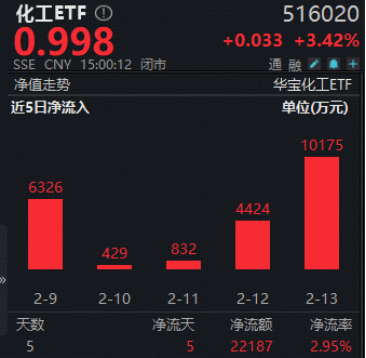
Market Overview - The first trading day of the Year of the Horse (February 24) saw A-shares open positively, with the ChiNext index rising by up to 2% and the Shanghai Composite Index closing up 0.87% [1][14] - Over 4,000 stocks in the market rose, with more than 100 stocks hitting the daily limit [1][14] - The total trading volume in the Shanghai, Shenzhen, and Beijing markets reached 2.2 trillion yuan, an increase of 219.3 billion yuan from the previous trading day [1][14] Sector Performance - The chemical sector continued to rise, with active performances in phosphate chemicals and fertilizers, leading to several stocks, including Hebang Biotechnology, hitting the daily limit [1][14] - The Chemical ETF (516020) surged by 3.42%, attracting 222 million yuan in the previous five trading days [1][14] Precious Metals and Commodities - Following the Spring Festival, the domestic market entered a peak working season, with the "golden March and silver April" period expected to see increased industrial production and infrastructure projects [3][16] - Precious metals prices surged due to rising risk aversion stemming from U.S. tariff policy disputes and geopolitical tensions, with the Precious Metals ETF (159876) rising by 3.18% and attracting a net subscription of 6 million units [3][16] - The outlook for gold demand is optimistic, with expectations of surpassing 5,000 tons globally by 2025, driven by strong investment flows and central bank purchases [7][19] Military and Aerospace Sector - The military sector showed strong performance, with the Military ETF (512810) rising by 1.16% and experiencing a premium at closing [9][21] - The domestic aviation sector is expected to accelerate, with the C919 aircraft averaging nearly 50 flights per day during the Spring Festival, a 52.6% increase year-on-year [11][24] - Geopolitical tensions, particularly between the U.S. and Iran, are expected to heighten the urgency of national defense construction in China [11][24] Investment Strategies - Analysts suggest maintaining a focus on cyclical price increases and the expansion of AI trends as the main market themes [4][17] - The investment strategy emphasizes a dual focus on technology and resource products, with technology centered on AI, new energy, and innovative pharmaceuticals, while resource products focus on precious metals and basic chemicals [4][17]


“金三银四”可期 购房者催着上海房产中介返岗
Xin Lang Cai Jing· 2026-02-23 11:26
Group 1 - The Shanghai second-hand housing market is showing increased activity ahead of the traditional peak season, with transaction volumes exceeding 22,000 units for three consecutive months since November last year, and January's volume reaching a five-year high [1] - Real estate agents report a significant increase in client inquiries and property viewings during the Spring Festival, with one agent noting a doubling of new clients compared to the previous year [1] - The inventory of second-hand homes in Shanghai has been declining for nine consecutive months, with a year-on-year reduction of approximately 20%, leading to heightened urgency among buyers [1] Group 2 - The demand for second-hand homes is not limited to the city center, as real estate agencies in the outer ring are also experiencing a surge in new clients and increased purchasing intent [2] - Public data indicates that the average daily transactions of second-hand homes in Shanghai approached 600 units in the two weeks prior to the Spring Festival, suggesting a rapid recovery in transactions as the holiday period ends [2]
焦煤焦炭周度报告-20260213
Zhong Hang Qi Huo· 2026-02-13 07:28
1. Report Industry Investment Rating - Not provided in the content 2. Core Views of the Report - This week, the double - coking futures maintained a weak and volatile trend. The coking coal supply contracted significantly during the week before the Spring Festival, and the upstream coking coal inventory continued to decline. The inventory of coking coal in independent coking enterprises continued to be replenished, and the raw material end of steel mills was slightly replenished. The fundamentals of coking coal were stable, the spot market was quiet, and the external macro - sentiment significantly affected the futures. After the festival, attention should be paid to the "Two Sessions expectations" and the demand strength in the "Golden March and Silver April", with support at the lower price level and the upward momentum yet to accumulate [6][32]. - Recently, the coke production capacity utilization rates of independent coking enterprises and steel mills remained stable. The molten iron output increased slightly, supporting the coke consumption. After the new round of coke price increase, the profit per ton of coke in independent coking enterprises improved, while the profit of steel enterprises was under pressure. Overall, the inventory pressure of independent coking enterprises was not high, the supply - demand was stable, and the coke futures followed the cost end of coking coal [6][35]. 3. Summary by Directory 3.1 Report Summary - The double - coking futures maintained a weak and volatile trend this week. The coking coal supply contracted significantly during the week before the Spring Festival, and the upstream coking coal inventory continued to decline. The inventory of coking coal in independent coking enterprises continued to be replenished, and the raw material end of steel mills was slightly replenished. The fundamentals of coking coal were stable, the spot market was quiet, and the external macro - sentiment significantly affected the futures. After the festival, attention should be paid to the "Two Sessions expectations" and the demand strength in the "Golden March and Silver April", with support at the lower price level and the upward momentum yet to accumulate. The coke production capacity utilization rates of independent coking enterprises and steel mills remained stable, the molten iron output increased slightly, supporting the coke consumption. After the new round of coke price increase, the profit per ton of coke in independent coking enterprises improved, while the profit of steel enterprises was under pressure. The inventory pressure of independent coking enterprises was not high, the supply - demand was stable, and the coke futures followed the cost end of coking coal [6]. 3.2 Multi - and Short - Focus | Multi - factors | Short - factors | | --- | --- | | The inventory structure of coking coal has improved | The winter storage of steel products was poor, limiting the raw material replenishment space of steel mills | | The domestic macro - policy is positive | As the Spring Festival approaches, the downstream replenishment rhythm gradually slows down | | The molten iron output is stable, supporting the demand for furnace materials | The financial market fluctuations intensify, and the sentiment is changeable | [10] 3.3 Data Analysis - **Coking coal supply**: As of the week of February 13, the operating rate of 523 sample mines was 81.39%, a week - on - week decrease of 5.28%, and the daily average output was 74.26 tons, a decrease of 1.19 tons. The operating rate of 314 sample coal washing plants was 32.28%, a week - on - week decrease of 3.26%, and the daily average output was 24.34 tons, a decrease of 1.97 tons. As of the weekly statistics on February 7, the Mongolian coal customs clearance volume at Ganqimaodu Port was 92.9745 tons, slightly shrinking from the previous period. The coking coal supply contracted significantly during the week before the Spring Festival [12]. - **Coking coal inventory**: As of the week of February 13, the clean coal inventory of 523 sample mines was 261.24 tons, a decrease of 3.41 tons; the clean coal inventory of 314 sample coal washing plants was 309.01 tons, a decrease of 25.45 tons; the coking coal inventory at ports was 258.41 tons, a decrease of 14.35 tons. With the contraction of the supply end and the end of downstream replenishment, the upstream coking coal inventory continued to decline [14]. - **Coking coal inventory of independent coking enterprises**: As of February 13, the coking coal inventory of all - sample independent coking enterprises was 1329.99 tons, an increase of 27.6 tons. The current inventory availability days of coking enterprises were 15.68 days, an increase of 0.17 days compared with the previous period. The coke inventory of independent coking enterprises was 82.8 tons, a cumulative increase of 0.06 tons. The coke inventory pressure of independent coking enterprises was not high, and the coking coal raw material had been replenished for many weeks, but the replenishment intensity weakened as the Spring Festival approached [17]. - **Raw material inventory of steel mills**: As of February 13, the coking coal inventory of 247 steel enterprises was 838.25 tons, an increase of 14.05 tons. The inventory availability days were 13.34 days, an increase of 0.22 days compared with the previous period. The coke inventory was 671.91 tons, an increase of 5.53 tons compared with the previous period, and the availability days were 12.7 days, a decrease of 0.06 days compared with the previous period. The raw material end of steel mills was slightly replenished [21]. - **Coke production capacity utilization rate**: As of February 13, the production capacity utilization rate of all - sample independent coking enterprises was 72.94%, a week - on - week increase of 0.74%, and the daily average output of metallurgical coke was 63.79 tons, an increase of 0.65 tons compared with the previous period; the production capacity utilization rate of 247 steel enterprises was 86.33%, the same as the previous period, and the daily average output of coke was 47.23 tons, a decrease of 0.01 tons compared with the previous period. Recently, the coke production capacity utilization rates of independent coking enterprises and steel mills remained stable [23]. - **Coke consumption**: According to the statistics of Steel Union, as of the week of February 13, China's coke consumption was 103.72 tons, an increase of 0.86 tons. From the data of 247 steel enterprises, the daily average output of molten iron was 230.49 tons, an increase of 1.91 tons. The molten iron output increased slightly, supporting the coke consumption [25]. - **Coke profit**: As of February 13, the average loss per ton of coke in independent coking enterprises was 8 yuan/ton, a decrease of 2 yuan/ton compared with the previous period. The profitability rate of 247 steel enterprises was 38.53%, a decrease of 0.86% compared with the previous period. After the new round of coke price increase, the profit per ton of coke in independent coking enterprises improved, while the profit of steel enterprises was under pressure [27]. - **Double - coking futures - spot basis structure**: The double - coking futures fluctuated [29]. 3.4后市研判 - **Coking coal**: During the week before the Spring Festival, the coking coal supply contracted significantly, and the upstream coking coal inventory continued to decline. The inventory of coking coal in independent coking enterprises continued to be replenished, and the raw material end of steel mills was slightly replenished. The fundamentals of coking coal were stable, the spot market was quiet, and the external macro - sentiment significantly affected the futures. The trading volume of the futures decreased continuously during the week before the Spring Festival, and the pre - festival funds were cautious with reduced participation. After the festival, attention should be paid to the "Two Sessions expectations" and the demand strength in the "Golden March and Silver April", with support at the lower price level and the upward momentum yet to accumulate [32]. - **Coke**: Recently, the coke production capacity utilization rates of independent coking enterprises and steel mills remained stable. The molten iron output increased slightly, supporting the coke consumption. After the new round of coke price increase, the profit per ton of coke in independent coking enterprises improved, while the profit of steel enterprises was under pressure. The inventory pressure of independent coking enterprises was not high, the supply - demand was stable, and the coke futures followed the cost end of coking coal [35].