
AI投资热潮

Search documents
金银周报-20251123
Guo Tai Jun An Qi Huo· 2025-11-23 10:40
1. Report Industry Investment Rating No relevant content provided. 2. Core Viewpoints of the Report - Gold is expected to experience high - level fluctuations, while silver's decline is catalyzed by its risk - asset attributes. The short - term "bottom - fishing" value of gold and silver exists, but it still awaits drivers and catalysts. Gold's current adjustment is considered a monthly - scale jump, and silver is expected to reach a new high this year based on domestic and foreign spot contradictions [3]. 3. Summary by Related Catalogs 3.1 Transaction Aspect (Price, Spread, Inventory, Funds, and Positions) - **Overseas Spot - Futures Price Spread** - For gold, the spread between London spot and COMEX gold主力 fell to $1.479 per ounce, and the spread between COMEX gold continuous and COMEX gold主力 was $22.4 per ounce [9]. - For silver, the spread between London spot and COMEX silver主力 rose to $0.329 per ounce, and the spread between COMEX silver continuous and COMEX silver主力 was $0.285 per ounce [12]. - **Domestic Spot - Futures Price Spread** - The domestic gold spot - futures price spread was - 4.26 yuan per gram, at the lower end of the historical range [16]. - The domestic silver spot - futures price spread was 17 yuan per gram, at the upper end of the historical range [19]. - **Inter - month Price Spread** - The gold inter - month price spread was 7.14 yuan per gram, at the upper end of the historical range [23]. - The silver inter - month price spread was 63 yuan per gram, at the lower end of the historical range [27]. - **Cost of Long - Short Spread Arbitrage in Near - and Far - month Contracts** - For gold, the cost of buying TD and short - selling Shanghai gold futures in near - and far - month contracts was calculated, with a total cost of 27.93 yuan per gram for buying TD and short - selling Shanghai gold futures in one case, and - 7.43 yuan per gram in another case [30][31]. - For silver, the cost of buying TD and short - selling Shanghai silver futures in near - and far - month contracts was calculated, with a total cost of 24.97 yuan per kilogram for one case and 167.53 yuan per kilogram for another case [32][33]. - **Delivery Direction of Deferred Fees for Gold and Silver Spot at Shanghai Gold Exchange** - This week, the gold deferred fee was mainly paid from longs to shorts, indicating strong delivery power, while the silver deferred fee was mainly paid from shorts to longs, indicating strong receiving power [34]. - **Inventory and Position - to - Inventory Ratio** - COMEX gold inventory decreased by 19 tons, and the registered warrant ratio rose to 52.5% [36]. - COMEX silver inventory decreased by 465 tons to 14,329 tons, and the registered warrant ratio rose to 32.8% [38]. - The gold futures inventory remained unchanged, the silver futures inventory decreased by 57 tons to 519 tons, and the Shanghai Gold Exchange's silver inventory decreased by 90 tons to 774 tons [41]. - **CFTC Non - commercial Positions in Gold and Silver** - This week, the non - commercial net - long position in COMEX gold decreased slightly, and the non - commercial net - long position in silver decreased slightly [43]. - **ETF Positions** - The inventory of the gold SPDR ETF decreased by 8.36 tons [49]. - The inventory of the silver SLV ETF increased by 39.5 tons [51]. - **Gold - to - Silver Ratio** - This week, the gold - to - silver ratio rose from 78.4 last week to 83 [54]. - **COMEX Gold Delivery Volume and Gold and Silver Lease Rates** - This week, the 3 - month gold lease rate was - 0.13%, and the 3 - month silver lease rate was 5.6% [57]. 3.2 Core Drivers of Gold - **Gold and Real Interest Rates** - This week, the correlation between gold and real interest rates returned, and the 10 - year TIPS continued to decline [62]. - **Inflation and Retail Sales Performance** - No specific summary content was provided in the text, but relevant data trends were presented in the figures [67]. - **Non - farm Employment Performance** - No specific summary content was provided in the text, but relevant data trends were presented in the figures [70]. - **Industrial Manufacturing Cycle and Financial Conditions** - No specific content was provided in the text. - **Economic Surprise Index and Inflation Surprise Index** - No specific content was provided in the text. - **Probability of Fed Rate Cuts** - No specific content was provided in the text.
英伟达财报及展望双双“炸裂”,有望破除“AI泡沫论”?聚焦恒生科技等中国AI核心资产
Mei Ri Jing Ji Xin Wen· 2025-11-20 02:13
11月20日早盘,港股三大指数涨跌不一,恒生科技指数高开低走。盘面上,科网股涨多跌少,芯片股走 强,创新药概念股多数上涨,中资券商股普涨。主流ETF方面,A股同赛道规模最大的恒生科技指数 ETF(513180)跟随指数震荡下行,持仓股中,快手、百度集团、联想集团、美的集团、中芯国际等领 涨,金山软件、小鹏汽车、哔哩哔哩、小米集团等领跌。 (文章来源:每日经济新闻) 近期"AI泡沫论"热度居高不下,港股的科技板块受到一定影响而有所回调。值得一提的是,当地时间周 三,英伟达发布了强劲的Q3财报数据以及Q4营收展望,或有助于平息市场对"AI泡沫论"的忧虑。具体 来看,英伟达公布Q3财季业绩,芯片销量增长速度再次超过华尔街预期,同时公司给出强劲的当季营 收预测,这让投资者相信AI投资热潮有望持续下去。Q3财报显示,公司三季度营收为570亿美元,同比 增长62%,其中,数据中心营收为512亿美元,高于预期的490亿美元,此外,其对四季度的营收展望为 约650亿美元,远高于分析师预期。财报发布后,英伟达盘后股价上涨逾5%。此外英伟达CEO黄仁勋还 表示"AI没有泡沫"。 公开信息显示,截至11月19日,恒生科技指数ETF ...

今晚,有件大事发生!
摩尔投研精选· 2025-11-19 10:31
Market Overview - The global stock markets are showing divergence, with A-shares experiencing a V-shaped reversal, while US stocks recorded a "four consecutive declines" [1] - Despite the major indices in A-shares closing with little change, there is significant internal market divergence, with the Shanghai Composite 50 Index rising by 0.58%, while nearly 4,600 stocks declined, indicating a shift of funds towards blue-chip stocks [1] Stock Performance - Several previously hot stocks, such as Sanmu Group and Hainan Haiyao, experienced significant drops, even hitting the daily limit down, reflecting a notable cooling of short-term speculative sentiment [2] Sector Focus: Aquaculture - Aquaculture stocks surged, with Zhongshui Fishery hitting four consecutive trading limits, and other stocks like Guolian Aquatic Products and Zhangzidao also reaching their daily limits [3] - A report from Changjiang Securities predicts a significant recovery in China's aquaculture industry by 2025, with major aquatic product prices rebounding to historical highs. For instance, the price of grass carp reached 14 yuan per kilogram, up 25% from the beginning of the year [4] Industry Insights - The price recovery is seen as a result of the industry undergoing a necessary adjustment after two years of stockpiling from 2023 to 2024. The development of marine ranching is highlighted as a key driver for sustainable marine fishery development [5] - Coastal provinces in China are establishing national-level marine ranch demonstration zones, focusing on diversified models such as "fishery +", "ecology +", and "new energy +", achieving breakthroughs in various fields [5] Technology Sector: Nvidia Earnings - Nvidia's upcoming earnings report is viewed as a critical event that could influence the trajectory of AI technology stocks. The market expects revenues between $55.2 billion and $56 billion, with a growth rate exceeding 56% [6][7] - If Nvidia's earnings exceed expectations, it could reverse the current "de-risking" sentiment, potentially stabilizing leading AI stocks in the US and impacting Hong Kong tech stocks [8] Broader Market Implications - The A-share technology market is closely tied to global AI industry trends and US tech stock performance. Key signals to watch include the Federal Reserve's potential interest rate cuts in December and the third-quarter earnings of overseas tech stocks, which could significantly affect A-share tech stocks and global risk assets [9]



经济日报:投资者对美股人工智能泡沫担忧升温
Sou Hu Cai Jing· 2025-11-19 00:28
Core Viewpoint - The article discusses the increasing volatility of AI concept stocks in the US market, highlighting concerns about an "AI bubble" as major firms like Nvidia see soaring valuations while others, including SoftBank and Citadel, reduce their stakes in these stocks [2][3][4]. Group 1: Valuation Concerns - AI concept stocks are perceived to have inflated valuations that may not be sustainable, with Nvidia's stock price increasing approximately 11 times since the launch of ChatGPT in November 2022, while the S&P 500 index rose about 70% during the same period [2][3]. - Nvidia's market capitalization recently surpassed $5 trillion, exceeding Germany's annual GDP, raising questions about the sustainability of such valuations [2]. - Oracle's stock surged 41% after announcing a $300 billion order from OpenAI, yet its latest financial report revealed an AI cloud service gross margin of only 14%, indicating potential profitability issues [2]. Group 2: Infrastructure Investment - Major tech companies, including OpenAI, Microsoft, Google, Meta, and Amazon, are engaged in a significant "AI arms race," with projected capital expenditures on AI infrastructure reaching $1.4 trillion from 2025 to 2027 [3]. - In 2023 alone, investments in the AI sector amounted to $500 billion, but returns have yet to materialize, suggesting a risk of sunk costs if technology becomes outdated [3]. Group 3: Financing Risks - The current financing model among AI giants involves mutual investments and high-value contracts, which may inflate revenue figures artificially, creating a risk of collapse if any part of the chain falters [3][4]. - The shift from light-asset to heavy-asset models among tech companies is leading to increased debt reliance, with $157 billion raised in the US bond market by tech firms as of September 2023, a 70% year-on-year increase [5]. Group 4: Profitability Challenges - There is a significant mismatch between the costs associated with AI and the value generated, with nearly 80% of companies deploying AI failing to achieve net profit increases [4]. - OpenAI reported $4.3 billion in revenue in the first half of 2023 but incurred a net loss of $13.5 billion, highlighting the profitability challenges in the sector [5]. Group 5: Market Sentiment and Future Outlook - Some industry leaders, including Bill Gates and IMF President Kristalina Georgieva, warn that the current AI investment frenzy resembles the late 1990s internet bubble, suggesting potential for significant losses [5][6]. - Supporters of AI argue for its vast demand and potential, with Nvidia's CEO asserting that current AI technology is actively utilized, and capital expenditures among major cloud providers are expected to rise to $632 billion by 2027 [6]. - The article emphasizes the need to differentiate between short-term market fluctuations and the long-term innovative potential of AI, suggesting that while market corrections may occur, the fundamental advancements in productivity driven by AI remain promising [7][8].

耶伦警告:美国面临沦为“香蕉共和国”的危险
Di Yi Cai Jing· 2025-11-17 11:33
Group 1: Economic Risks and AI Investment - The current AI investment boom is masking significant risks in the U.S. economy [1][4] - Oxford Economics predicts that the investment growth rate in information processing equipment and software will reach 20%-40% by mid-2025, marking the fastest growth since the late 1990s [4] - If the tech sector underperforms, the U.S. economy could become vulnerable, as tech investments are expected to contribute all growth in fixed investment by mid-2025, while other sectors may decline [4] Group 2: Federal Reserve Independence - There is a crisis regarding the independence of the Federal Reserve, with concerns that political pressures could undermine its credibility in controlling inflation [2][3] - The Trump administration's attempts to influence the Federal Reserve's policies, including threats to dismiss board members, pose a risk to its independence [2][3] - Yellen warns that if the Trump administration successfully removes a Federal Reserve board member, it could set a precedent that jeopardizes the institution's autonomy [3] Group 3: Impact on Talent and Innovation - The ongoing conflict between U.S. universities and the Trump administration is leading to a loss of scientists and researchers, which could hinder technological advancement [4] - The U.S. economy's growth heavily relies on its leadership in new technologies and the ability to create new enterprises [4]
【环球财经】美国政府“停摆”致经济数据缺失 美联储12月降息预期下降
Sou Hu Cai Jing· 2025-11-14 12:46
Core Viewpoint - The prolonged U.S. government shutdown has disrupted key economic data collection, leading to uncertainty in the Federal Reserve's decision-making regarding interest rate cuts, with market expectations for a December rate cut decreasing significantly [2][3]. Economic Data Impact - The government shutdown has resulted in the potential permanent unavailability of critical economic indicators such as the unemployment rate and inflation data for October [3]. - Analysts predict that the upcoming official employment and consumption data will likely be weaker than market expectations, as various employment-related indicators have shown a downward trend [5]. Federal Reserve Divergence - There is significant internal disagreement within the Federal Reserve regarding the future of interest rate cuts, with some officials expressing caution about further cuts in December [3][4]. - San Francisco Fed President Mary Daly stated that it is too early to conclude whether a rate cut will occur in December, emphasizing the current policy appears "relatively neutral" [3]. - Cleveland Fed President Beth Hammack raised concerns that continued rate cuts could undermine the Fed's credibility in controlling inflation [3]. Market Reactions - The uncertainty surrounding the Fed's policy path and the potential for a K-shaped economic recovery has led to a significant decline in U.S. stock markets, with the Dow Jones dropping nearly 800 points and the Nasdaq falling over 2% [6]. - The ongoing AI investment trend is also a topic of debate, with concerns that fluctuations in the AI sector could lead to broader economic instability [6]. Long-term Economic Outlook - The Congressional Budget Office estimates that the government shutdown could reduce U.S. economic growth by 1 to 2 percentage points in the fourth quarter [5]. - The K-shaped recovery indicates a growing divide in consumer purchasing power, particularly affecting low-income consumers if the job market continues to weaken [5].

花旗预判到了AI泡沫恐慌! Q3猛砍科技巨头仓位 大举做空纳指与英伟达(NVDA.US) 押注AI ASIC崛起
Zhi Tong Cai Jing· 2025-11-14 09:35
Core Viewpoint - Citigroup has significantly reduced its positions in major AI-related tech stocks, reflecting concerns over an "AI bubble" and the sustainability of the AI investment trend, while simultaneously increasing positions in certain ASIC leaders like Broadcom [1][2]. Holdings Summary - Citigroup's total holdings value reached approximately $224 billion in Q3, up 10% from the previous quarter, with 826 new stocks added and 3,028 stocks reduced [1]. - The top ten holdings accounted for 19.48% of Citigroup's total U.S. stock market value, indicating a high concentration in these positions [1]. Major Stock Adjustments - Significant reductions were made in holdings of Nvidia, Microsoft, Apple, and Amazon, with Nvidia being the largest holding but reduced by 28.22% to approximately 33.39 million shares valued at $6.2 billion [2][3]. - Citigroup increased its position in the Russell 2000 ETF put options, reflecting a bearish outlook on small-cap stocks [3]. Specific Stock Positions - The second-largest holding was in Russell 2000 ETF put options, with approximately 23.99 million shares valued at $5.8 billion, an increase of 12.26% [3]. - Microsoft was the third-largest holding, with about 9.56 million shares valued at $5 billion, down 19.55% from the previous quarter [3]. - Tesla put options ranked fourth, with about 10.43 million shares valued at $4.6 billion, showing a slight increase of 6.84% [3]. Additional Insights - Citigroup's strategy included a significant reduction in positions in Apple and Amazon by 33% and 30% respectively, while increasing its stake in Broadcom, which is seen as a competitor to Nvidia in the AI GPU market [4]. - The firm also increased its holdings in Nasdaq 100 ETF put options by 81%, indicating preparation for potential declines in AI-related stocks [4][5]. - The top five sell-offs included Nvidia, Meta, Amazon, Microsoft, and Apple, further emphasizing Citigroup's cautious stance on the AI investment trend [5].




每日机构分析:11月10日
Xin Hua Cai Jing· 2025-11-10 12:00
Group 1 - Citibank indicates that Japan's ultra-long bond yields are expected to fluctuate between 3% and 3.2%, supported by a reduction in issuance scale and weakened economic conditions, which dampen rate hike expectations [1] - Mizuho Securities notes that the anticipated end of the U.S. government shutdown may exacerbate yen depreciation, with potential for verbal intervention from Japan if the USD/JPY approaches 160 [2] - Deutsche Bank highlights that the end of the U.S. government shutdown may not provide immediate clarity on economic data, leaving the dollar's outlook uncertain [3] Group 2 - S Cube Capital's CIO mentions that the temporary funding bill passed by the Senate only delays issues until January 2026, and while it may help restore economic data releases, the focus should remain on the real economy [1] - LBBW analysts predict that U.S. long-term Treasury yields may face greater supply pressure starting next summer due to potential increases in issuance of coupon and floating rate notes [2] - Goldman Sachs compares the current AI investment trend to the internet construction phase of 1997-1998, suggesting that AI is still in its early expansion stage and expects a 5-10% rise in U.S. stocks by year-end [2]
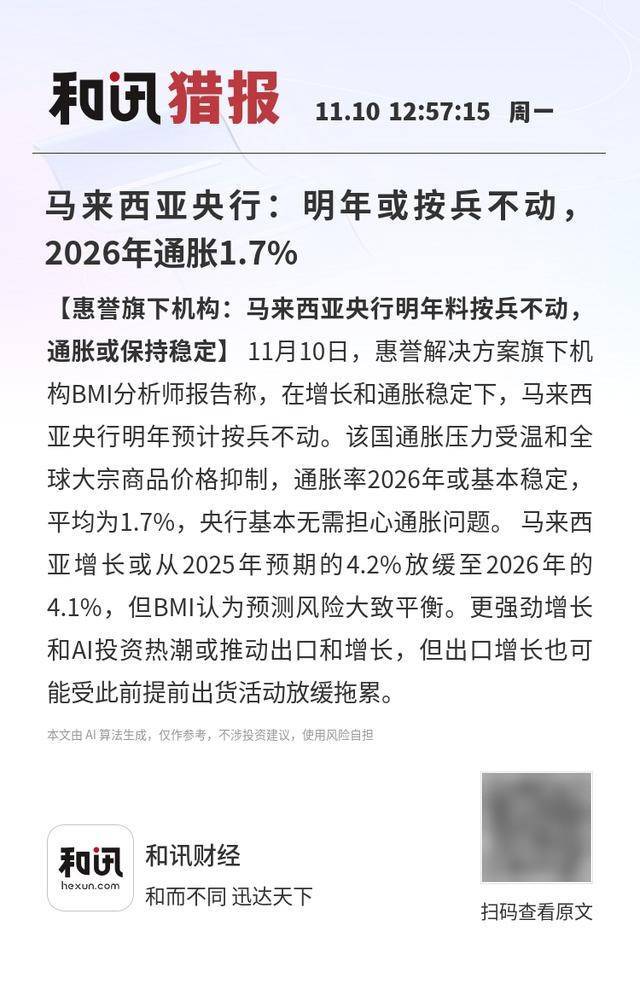
马来西亚央行:明年或按兵不动,2026年通胀1.7%
Sou Hu Cai Jing· 2025-11-10 06:45
Core Insights - Fitch Solutions' BMI analysts predict that the Bank of Malaysia is likely to remain on hold next year due to stable growth and inflation [1][2] - Inflation pressure in Malaysia is expected to be moderated by soft global commodity prices, with an average inflation rate of 1.7% projected for 2026 [1][2] - Malaysia's growth is anticipated to slow from a forecasted 4.2% in 2025 to 4.1% in 2026, with BMI assessing the risks to this forecast as broadly balanced [1][2] Economic Outlook - The Bank of Malaysia is expected to maintain its current monetary policy stance in 2024 [1][2] - The inflation rate is projected to stabilize at an average of 1.7% by 2026, indicating minimal concerns for the central bank regarding inflation [1][2] - Economic growth may be supported by stronger performance in exports and investments in AI, although previous shipping activities may dampen export growth [1][2]
第八届进博会参展企业再创新高,央行连续12个月增持黄金丨一周热点回顾
Di Yi Cai Jing· 2025-11-08 02:50
Group 1: Trade and Export - In the first ten months of the year, China's total goods trade value increased by 3.6% year-on-year, with a slight decrease of 0.4 percentage points compared to the previous nine months [1] - In October, exports decreased by 0.8% in RMB terms and 1.1% in USD terms, marking the first negative growth since February this year, slightly below market expectations [1] - Exports to the US saw a significant decline of 25.2%, which pulled down the overall export growth by 3.8 percentage points [1] - Despite the decline, new export drivers such as "new three samples" products and green products like railway electric locomotives and wind power generators maintained double-digit growth [1] Group 2: Monetary Policy and Debt Management - The People's Bank of China resumed government bond trading in October, injecting 20 billion yuan into the banking system, marking the end of a suspension since January [2][3] - The scale of bond purchases in October was relatively low compared to previous months, indicating a cautious approach by the central bank to avoid rapid declines in interest rates [3] - The establishment of a Debt Management Department by the Ministry of Finance aims to enhance the management and monitoring of government debt, aligning with high-quality development goals [6] Group 3: Economic Events and Trends - The eighth China International Import Expo (CIIE) opened with over 4,000 participating companies, including 290 Fortune 500 firms, showcasing a strong international interest in the Chinese market [4][5] - China's central bank has increased its gold reserves for 12 consecutive months, reaching approximately 2,304.457 tons, reflecting a strategic move to diversify foreign reserves amid global uncertainties [8][9] - The ongoing US government shutdown has reached a record 36 days, with potential economic losses estimated at $11 billion if it continues, impacting key economic data releases [10][11]