能源转型

Search documents
有色牛市难结束,有色金属ETF基金(516650)今年规模增幅108.7%
Sou Hu Cai Jing· 2026-01-19 06:08
Core Viewpoint - The prices of gold, copper, and aluminum are rising, indicating a strong performance in the precious and industrial metals sector, with expectations of a super cycle similar to 2006-2007 driven by AI and industrial metal demand [1] Group 1: Market Performance - As of January 19, gold ETF Huaxia (518850) increased by 1.4%, and the industrial metals ETF (516650) rose by 0.94% [1] - The copper price has reached a historical high, although the London copper market may not see significant upward movement [1] Group 2: Supply and Demand Dynamics - Global major mines are experiencing frequent accidents, leading to an expected reduction of 200,000 tons in supply by Q4 2025, translating to a quarterly decrease of approximately 3%-4% in copper production [1] - The macroeconomic environment, including potential interest rate cuts by the Federal Reserve, is expected to support copper prices, with a forecasted continued depreciation of the US dollar [1] Group 3: Investment Opportunities - Copper is identified as a key metal for energy transition, holding strategic value under the "14th Five-Year Plan" policy guidance [1] - The strong supply-demand fundamentals, along with ongoing macro policy support in China, are likely to stimulate sectors such as electric infrastructure, new energy vehicles, and home appliance consumption [1] Group 4: ETF Fund Performance - The industrial metals ETF (516650) tracks the CSI segmented industrial metals theme index, with a combined gold, copper, and aluminum content of 61.29%, the highest in the market [2] - The fund has seen significant capital inflow, with its latest scale reaching 13.77 billion, an increase of over 71.7 billion from the end of 2025, representing a year-to-date growth rate of over 108.7%, leading the sector [2]
有色金属日度策略-20260119
Fang Zheng Zhong Qi Qi Huo· 2026-01-19 06:01
1. Report Industry Investment Rating No relevant content provided. 2. Core View of the Report The non - ferrous metals sector is generally strong but shows differentiation and rotation. Stronger varieties are undergoing adjustments, while weaker ones are making up for losses. The sector is supported by factors such as a loose monetary environment, AI technological development, increased attention to the critical mineral supply chain, resource nationalism in resource - rich countries, and geopolitical uncertainties. However, with the easing of the Iran situation and the US suspension of new tariffs on key minerals, leading varieties are experiencing some adjustments [11]. 3. Summary According to the Table of Contents 3.1 First Part: Non - ferrous Metals Operating Logic and Investment Suggestions - **Macro Logic**: The non - ferrous metals sector remains strong under the influence of multiple factors. But due to the easing of the Iran situation and the US suspension of new tariffs on key minerals, the sector shows rotation. China's foreign trade is accelerating its recovery, and the new energy vehicle and automobile export markets are expected to grow in 2026. Overseas data shows mixed economic signals in the US, with the market's expectation of a Fed rate cut in April rising [11]. - **Investment Suggestions for Each Metal** - **Copper**: Consider gradually buying on dips. The short - term upper pressure range is 108,000 - 110,000 yuan/ton, and the lower support range is 98,000 - 99,000 yuan/ton. Optionally, buy out - of - the - money long - term call options [3]. - **Zinc**: Hold long positions. The upper pressure is around 25,500 - 25,600 yuan/ton, and the short - term lower support is around 24,300 - 24,400 yuan/ton. Consider selling call options for hedging when the price surges [4]. - **Aluminum and Its Industrial Chain**: Temporarily stay on the sidelines for aluminum. For alumina, consider shorting at high prices. For recycled aluminum alloy, adopt a bullish approach. Use out - of - the - money put options for protection [5]. - **Tin**: Temporarily stay on the sidelines or adopt a bullish approach before the capital enthusiasm fades. Pay attention to the mining end and macro - factors. The upper pressure range is 440,000 - 450,000 yuan/ton, and the lower support range is 330,000 - 350,000 yuan/ton. Consider buying out - of - the - money put options for protection [6][7]. - **Lead**: The price is expected to remain volatile. Consider selling both call and put options. The short - term lower support is around 17,000 - 17,200 yuan/ton, and the upper pressure is around 17,600 - 17,800 yuan/ton [7]. - **Nickel and Stainless Steel**: For nickel, trade in the short - term with light positions. Use covered call options to protect long positions. For stainless steel, adopt a bullish approach on dips. The lower support for nickel is around 137,000 - 138,000 yuan/ton, and the upper pressure is around 150,000 - 155,000 yuan/ton. The lower support for stainless steel is around 13,900 - 14,000 yuan/ton, and the upper pressure is around 14,500 - 14,600 yuan/ton [8]. 3.2 Second Part: Non - ferrous Metals Market Review - Copper closed at 102,810 yuan/ton, down 1.26%; zinc at 25,090 yuan/ton, up 2.51%; aluminum at 24,375 yuan/ton, down 0.89%; alumina at 2,789 yuan/ton, down 0.39%; tin at 433,000 yuan/ton, up 4.80%; lead at 17,550 yuan/ton, up 0.95%; nickel at 146,750 yuan/ton, up 4.12%; stainless steel at 14,415 yuan/ton, up 3.52%; and cast aluminum alloy at 23,155 yuan/ton, down 0.96% [19]. 3.3 Third Part: Non - ferrous Metals Position Analysis - The report provides the latest position analysis of the non - ferrous metals sector, including the net long - short strength comparison, net long - short position base values, changes in net long and net short positions, and influencing factors for various varieties such as Shanghai Silver, Shanghai Tin, Platinum, etc. [22]. 3.4 Fourth Part: Non - ferrous Metals Spot Market - The report presents the spot prices and price changes of various non - ferrous metals, including copper, zinc, aluminum, alumina, nickel, stainless steel, tin, lead, and cast aluminum alloy [23]. 3.5 Fifth Part: Non - ferrous Metals Industry Chain - This part contains various charts related to the industry chain of each non - ferrous metal, such as inventory changes, processing fees, and price comparisons for copper, zinc, aluminum, tin, lead, nickel, and stainless steel [25][26][30]. 3.6 Sixth Part: Non - ferrous Metals Arbitrage - The report includes charts related to non - ferrous metals arbitrage, such as the Shanghai - London ratio changes, basis spreads, and price differences between different contracts for copper, zinc, aluminum, alumina, tin, lead, nickel, and stainless steel [51][53][55]. 3.7 Seventh Part: Non - ferrous Metals Options - It provides charts about non - ferrous metals options, including historical volatility, weighted implied volatility, trading volume, and open interest changes for copper, zinc, and aluminum [67][69][70].
国家统计局发布2025 年 12 月规上工业能源生产数据
Guo Jia Tong Ji Ju· 2026-01-19 04:27
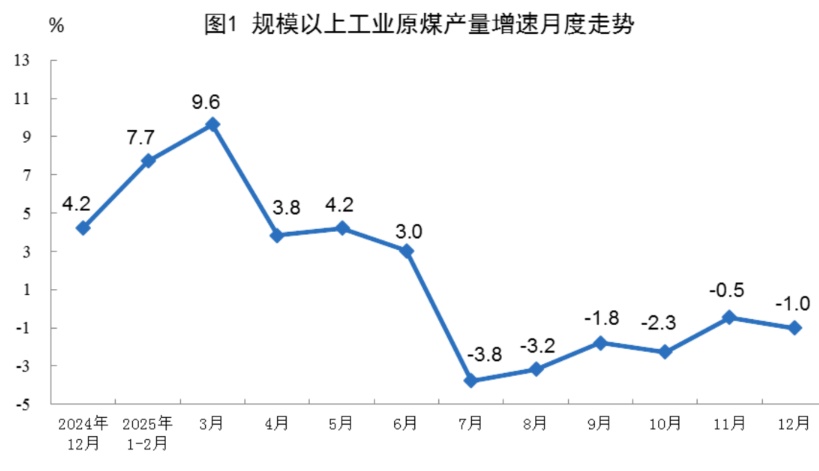
Group 1: Energy Production Overview - In December 2025, the production of raw coal and crude oil in large-scale industries remained stable with a slight decline, while natural gas production increased by 5.1% year-on-year. The overall energy production was stable, supporting the energy transition [1][7] - The raw coal production in December was 440 million tons, a year-on-year decrease of 1.0%, with an average daily production of 14.1 million tons. For the entire year, the raw coal production reached 4.83 billion tons, an increase of 1.2% year-on-year [1][3] - Crude oil production in December was 17.8 million tons, a year-on-year decrease of 0.6%, with an average daily production of 574,000 tons. The total crude oil production for the year was 216.05 million tons, an increase of 1.5% year-on-year [3][4] - Natural gas production in December was 23 billion cubic meters, a year-on-year increase of 5.1%, with an average daily production of 740 million cubic meters. The total natural gas production for the year was 261.9 billion cubic meters, an increase of 6.2% year-on-year [7] Group 2: Electricity Production Situation - Electricity production in large-scale industries maintained growth in December, with a total generation of 858.6 billion kilowatt-hours, a year-on-year increase of 0.1%, and an average daily generation of 27.7 billion kilowatt-hours. The total electricity production for the year was 9,715.9 billion kilowatt-hours, an increase of 2.2% year-on-year [9] - The decline in thermal power generation narrowed in December, with a year-on-year decrease of 3.2%, which is a 1.0 percentage point improvement compared to November. Hydropower generation increased by 4.1%, but the growth rate slowed by 13.0 percentage points compared to November [9] - Nuclear power generation grew by 3.1%, with a slowdown of 1.6 percentage points from November, while wind power generation increased by 8.9%, also experiencing a slowdown of 13.1 percentage points. Solar power generation saw an 18.2% increase, with a 5.2 percentage point slowdown compared to November [9]

K型经济与大宗商品价格
2026-01-19 02:29
Summary of Key Points from Conference Call Industry Overview - The global economy is experiencing a K-shaped recovery, with rapid capital expansion in technology and renewable energy sectors, while traditional sectors and small to medium enterprises face challenges. This has led to a divergence in prices between non-ferrous metals and traditional energy [1][2] - The overall environment for a comprehensive rise in industrial product prices in 2026 is not favorable, with continued price differentiation between non-ferrous metals and black energy products due to geopolitical risks and low capacity utilization [1][3] Core Insights and Arguments - **Global Demand**: Total global demand remains stable without significant turning points. Despite the Federal Reserve's interest rate cuts and other economic measures, the elasticity of demand is limited, and long-term interest rates remain high, indicating weak real growth [2][4] - **Price Performance**: The poor price performance in 2025 was primarily due to low capacity utilization rates across major economies, which are still 3-4 percentage points below 2012 peaks. This suggests that even with strong demand, supply can be increased by improving capacity utilization, preventing widespread inflation [5] - **Market Divergence**: The current market shows a pronounced K-shaped divergence, with emerging sectors like chips and renewable energy seeing rapid capital expansion, while traditional sectors struggle. Non-ferrous metals are at historical highs, while traditional energy and black metals are at relative lows [6][7] - **Impact of Energy Transition**: The energy transition has led to significant changes in the global commodity market, with traditional energy markets potentially shifting from scarcity to surplus. The decline in energy prices has resulted in substantial capital outflows, some of which have flowed into precious metals like gold [9][10] Additional Important Insights - **Future Trends**: The K-shaped divergence is expected to continue into 2026, with strong demand for non-ferrous metals driven by technology, while black metals face low capacity utilization. The potential for oil to become a surplus commodity could further influence market dynamics [11] - **Gold Market Dynamics**: Gold has performed well due to multiple factors, including central bank purchases, retail demand, and geopolitical risks. However, the market size has expanded significantly, making further large price increases more challenging [12][14] - **Geopolitical Risks**: Rising geopolitical risks have profound implications for global financial markets, increasing demand for safe-haven assets and benefiting defense and high-end equipment sectors [15][16] - **Long-term Liquidity Pressure**: In 2026, long-term liquidity pressure, particularly related to the Japanese yen, may lead to increased volatility in financial markets as interest rates rise and market conditions change [17]
电解铝:商品情绪转弱,铝市场中期仍看好
Yin He Qi Huo· 2026-01-19 02:02
电解铝 :商品情绪转弱 铝市场中期仍看好 研究员:陈婧 期货从业证号:F03107034 投资咨询从业证号:Z0018401 铝策略展望 ◼ 衍生品:暂时观望。 GALAXY FUTURES 1 227/82/4 228/210/172 181/181/181 87/87/87 文 字 色 基 础 色 辅 助 色 137/137/137 246/206/207 68/84/105 210/10/16 221/221/221 208/218/234 ◼ 宏观:美联储降息预期、地缘政治风险叠加去美元化预期推动资金青睐实物资产有色金属,去年四季度以来资金持续流入推动铝价随板块 上涨,同时关注伊朗地区地缘政治风险。但近日市场风险偏好有所变化,前期强势上涨品种的市场氛围降温带动沪铝资金流出。商品市场 情绪转弱,引发多品种回调。 ◼ 产业供应:供给端刚性预期明显,安哥拉新项目如期投产,越南电解铝项目投产预期从二季度推迟至7月初;欧洲部分产能寻求复产但仍 处于前期规划阶段、所处国家寻求欧盟补贴以应对高昂的电力成本。负基差较大带动短期铸锭增加、铝棒加工费短期转负,后续持续关注 铝水就地转化率。 ◼ 产业需求:表观需求短期有所 ...
光大证券:重视各国战略金属收储带来投资机会 全面看好战略金属价值重估
智通财经网· 2026-01-19 01:52
Core Viewpoint - The report from Everbright Securities highlights the increasing importance of strategic metals (copper, aluminum, cobalt, nickel, tin, antimony, tungsten, rare earths) due to supply disruptions and the limitations in production capacity in China and abroad [1][2]. Group 1: Strategic Metal Storage Initiatives - Australia announced a strategic reserve plan for critical minerals worth AUD 1.2 billion, with AUD 185 million allocated for necessary mineral reserves, prioritizing antimony, gallium, and rare earths [2] - The European Commission approved a resource revival action plan to raise EUR 3 billion for supply chain strategies, establishing a platform to support critical material reserves [2] - The U.S. Defense Logistics Agency (DLA) plans to procure USD 500 million in cobalt, USD 245 million in antimony, USD 100 million in tantalum, and USD 45 million in scandium [2] Group 2: Investment Opportunities in Strategic Metals - The focus on strategic metal storage in the U.S. and Australia presents significant investment opportunities, particularly in metals with concentrated supply chains and security risks, such as cobalt from the Democratic Republic of Congo and lithium from South America [3] - The rapid development of AI and energy transition is expected to drive demand for copper, aluminum, and tin, although supply constraints exist for these metals [4] - Military-related metals like tungsten, antimony, and rare earths are facing tightening supply, with production declines attributed to lower resource grades and regulatory controls [5] Group 3: Supply Concentration and Constraints - Copper, lithium, cobalt, and nickel supply is highly concentrated in South America, the Democratic Republic of Congo, and Indonesia, with Chile and Peru accounting for 35% of global copper production and the Democratic Republic of Congo producing 76% of global cobalt [4] - The rapid growth of AI is expected to significantly increase demand for copper, aluminum, and tin, but supply for these metals is constrained [4] - Tungsten, antimony, and rare earths are critical for military applications, but their production has decreased due to resource management practices and regulatory measures [5] Group 4: Investment Recommendations - For copper, recommended companies include Zijin Mining, Luoyang Molybdenum, and Western Mining [5] - For aluminum, Yunnan Aluminum is recommended, with China Aluminum as a focus [5] - For cobalt and nickel, Huayou Cobalt is recommended, with attention to Liqin Resources and Shengtun Mining [5] - For tungsten, focus on China Tungsten High-tech [5] - For tin, Xiyang Tin Industry is recommended, with interest in Xingye Silver Tin [5] - For antimony, Huaxi Nonferrous is highlighted, and for rare earths, Northern Rare Earth is recommended with a focus on China Rare Earth [5]



万和财富早班车-20260119
Vanho Securities· 2026-01-19 01:43
Core Insights - The report emphasizes the importance of identifying investment opportunities and risks in the current market landscape, particularly focusing on sectors poised for growth such as AI, energy transition, and semiconductor industries [1]. Domestic Financial Market - The Shanghai Composite Index closed at 4101.91, down by 0.26%, while the Shenzhen Component Index closed at 14281.08, down by 0.18%. The ChiNext Index also saw a decline of 0.20%, closing at 3361.02 [2]. Macro News Summary - The State Council is reviewing measures to boost consumer spending and is focusing on new growth points in service consumption [4]. - The China Securities Regulatory Commission has initiated an investigation into Rongbai Technology for misleading statements regarding a major contract [4]. Industry Dynamics - The energy storage industry is entering a new growth phase driven by AI infrastructure, energy transition, and grid congestion, with related stocks such as Kelon Electronics and Jinrong Tianyu highlighted [5]. - Elon Musk has announced plans to produce 10,000 Starship rockets annually, indicating significant long-term growth potential in the commercial space sector, with stocks like Guoji Jinggong and Aerospace Morning Light being relevant [5]. - TSMC's financial report has led to a surge in US semiconductor stocks, suggesting a new growth opportunity for the semiconductor supply chain, with companies like Jingce Electronics and Zhongwei Company being mentioned [5]. Company Focus - Time Space Technology (605178) is strategically enhancing its semiconductor storage capabilities by leveraging the Shenzhen industrial ecosystem [6]. - Yanjing Co., Ltd. (300658) plans to acquire 98.54% of Yongqiang Technology, marking its entry into the integrated circuit interconnect materials sector [6]. - Jing Shan Light Machinery (000821) is addressing historical issues and has initiated a comprehensive internal control system upgrade [6]. - Starry Sky Technology (002439) has signed a framework agreement with Hong Kong Broadband to provide network security products and solutions [6]. Market Review and Outlook - On January 16, the market opened high but closed lower, with a total trading volume of 3.03 trillion, an increase of 120.8 billion from the previous trading day. Over 2900 stocks declined [7]. - The semiconductor supply chain showed strong performance, with stocks like Changdian Technology hitting a five-year high. Storage chip concepts also saw significant gains, with companies like Baiwei Storage reaching historical highs [7]. - The report maintains a positive outlook on AI investments and the recovery of global manufacturing, particularly in industrial commodities such as copper, aluminum, tin, lithium, crude oil, and oil transportation [7].
河南两大能源国企完成重组,新集团总资产达5900亿元
Zhong Guo Xin Wen Wang· 2026-01-19 00:49
Group 1 - The core viewpoint of the news is the establishment of China Pingmei Shenma Holding Group Co., Ltd., formed by the merger of two major energy state-owned enterprises in Henan, with total assets reaching 590 billion RMB [1] - The new group has five listed companies under its umbrella, with leading production capacities in key products such as coking coal, nylon 66 salt, and engineering plastics, alongside significant coal and rock salt reserves [1] - The merger aims to achieve synergistic effects through complementary advantages, enhancing the coal and chemical industries while also expanding into clean energy sectors like wind, solar, and hydrogen [1] Group 2 - Henan's strategy of "merging similar entities" and "integrating industrial chains" optimizes state-owned asset layout, reinforcing regional energy security and creating a resilient growth engine to adapt to future industrial changes and market fluctuations [2] - This restructuring is part of a broader trend in Henan to consolidate state-owned resources, including previous mergers aimed at enhancing international cooperation and improving logistics and transportation management [1][2]
洛阳钼业量价齐升2025年预盈超200亿 负债率近四年连降上市后分红215.6亿
Chang Jiang Shang Bao· 2026-01-18 23:52
Core Viewpoint - Luoyang Molybdenum's annual profit is expected to exceed 20 billion yuan for the first time, with a projected net profit attributable to shareholders ranging from 20 billion to 20.8 billion yuan, representing a year-on-year increase of 47.8% to 53.71% [2][3] Financial Performance - The company anticipates a significant increase in net profit for 2025, with a projected growth of 64.68 million to 72.68 million yuan compared to the previous year, marking a 47.8% to 53.71% increase [3] - The net profit excluding non-recurring gains is expected to be between 20.4 billion and 21.2 billion yuan, reflecting a year-on-year growth of 55.5% to 61.6% [3] - For Q4 2025, the net profit is estimated to be between 5.72 billion and 6.52 billion yuan, with a year-on-year growth of 8.76% to 23.98% [3] Revenue Trends - From 2019 to 2024, Luoyang Molybdenum's revenue has shown consistent growth, with figures of 68.68 billion, 113 billion, 173.9 billion, 173 billion, 186.3 billion, and 213 billion yuan respectively [4] - The net profit attributable to shareholders has also increased steadily over the years, reaching 13.53 billion yuan in 2024, with projections for 2025 indicating a sixth consecutive year of growth [4] Product Performance - The company reported a production volume of 543,400 tons of copper in the first three quarters of 2025, a year-on-year increase of 14.14%, with sales volume reaching 520,300 tons, up 10.56% [5] - Other products such as cobalt, molybdenum, tungsten, niobium, and phosphate also showed positive trends in gross margins, with significant year-on-year increases [5] Strategic Expansion - Luoyang Molybdenum has been actively expanding its resource portfolio, including the acquisition of a 100% stake in the Cangrejos gold mine in Ecuador for approximately 580 million Canadian dollars, expected to produce 11.5 tons of gold annually starting in 2028 [6] - The company also announced a deal to acquire 100% interests in several gold mines in Canada for 1.015 billion USD, projected to increase annual gold production by 8 tons [7] Financial Health - As of Q3 2025, Luoyang Molybdenum's cash reserves reached 32.47 billion yuan, with a significant increase of 2.04 billion yuan since the beginning of the year, providing a strong liquidity position [7] - The company's debt-to-asset ratio has been steadily declining, from 64.89% in 2021 to 48.57% by Q3 2025, indicating improved financial stability [7] Shareholder Returns - Luoyang Molybdenum has consistently rewarded its shareholders, with a total cash dividend payout of 21.56 billion yuan since its listing in 2012, maintaining a dividend payout ratio of 40.32% [8]

中国发布2025电力数据,超美国2倍,轮到特朗普担忧,找13州商议
Sou Hu Cai Jing· 2026-01-18 14:25
Core Insights - China's electricity consumption has surpassed that of the US, EU, Russia, India, and Japan combined, marking a significant shift in global power dynamics [1][3] - In 2025, China's total electricity consumption reached 10.4 trillion kilowatt-hours, a 5% increase year-on-year, making it the first country to exceed the 10 trillion kilowatt-hours mark [3][4] - The growth in electricity demand is primarily driven by digital industries, with electricity consumption in sectors like internet data services and AI computing increasing by over 30% [6][21] Group 1: Electricity Consumption and Growth - China's electricity consumption reached 10.4 trillion kilowatt-hours, which is 2.5 times that of the US and 35% more than the combined total of the US and EU [3][4] - The electricity demand from new energy vehicle manufacturing and lithium battery production has increased by over 20% [6] - The contribution of the service sector and residential electricity consumption to overall growth is 50%, indicating a shift towards consumption and services [6][18] Group 2: Energy Structure and Technology - Non-fossil energy sources now account for over 60% of China's total installed power generation capacity, with significant advancements in ultra-high voltage transmission technology [8][15] - China's ultra-high voltage technology allows for efficient long-distance electricity transmission, addressing energy distribution challenges [15][21] - The global narrative around China's energy development has shifted, recognizing its ability to transition to cleaner energy while supporting economic growth [15][21] Group 3: Comparison with the US Energy Sector - The US faces rising electricity prices and supply challenges, with wholesale electricity prices in some regions increasing by 267% over five years [10][12] - The US electricity sector is fragmented, leading to difficulties in coordinating responses to systemic challenges [13][20] - The US government is attempting to implement long-term power purchase agreements to ensure sufficient investment in new generation capacity [13][20] Group 4: Implications for Manufacturing and AI - Stable and affordable electricity supply is crucial for AI companies, with electricity costs potentially accounting for over half of AI operational expenses [16][20] - China's stable electricity supply provides a significant cost advantage for emerging manufacturing sectors, attracting global production [20][21] - The contrasting approaches to energy infrastructure between China and the US highlight different philosophies in addressing energy challenges [21][22]