稀土出口管制

Search documents
广晟有色(600259):低估、高成长的华南稀土龙头
SINOLINK SECURITIES· 2025-06-11 07:20
Investment Rating - The report gives a "Buy" rating for the company, with a target price of 66.93 RMB based on a projected PE of 86x for 2025 [4]. Core Viewpoints - The company is a leading player in the rare earth industry in South China, with diversified operations in copper, tungsten, and other metals. The recovery in rare earth prices in Q1 2025 indicates a turning point for profitability [2][3]. - The implementation of export controls in April 2025 is expected to enhance price elasticity in the rare earth market, with domestic prices recovering to pre-export control levels [2][34]. - The company has significant internal mining resources that could double production, with a strong focus on smelting and magnetic materials [3][18]. Summary by Sections Company Overview - The company is a key platform for rare earth resource integration in Guangdong, with a focus on a diversified non-ferrous metal industry chain [10][14]. - It is controlled by the Guangdong Rare Earth Industry Group, with the actual controller being the China Rare Earth Group [19][20]. Rare Earth Industry - The rare earth industry is experiencing price recovery due to export controls, with domestic prices expected to rise significantly [2][34]. - The implementation of the "Rare Earth Management Regulations" in October 2024 will impose stricter controls on imported ores and secondary utilization, enhancing domestic pricing power [44][47]. Rare Earth Business - The company owns several rare earth mines and is expected to increase production from over 2,000 tons to over 5,000 tons with the addition of the ZuoKeng mine [3][18]. - The smelting segment is expected to see a recovery in sales and production in 2024, while the magnetic materials segment is progressing steadily [3][18]. External Assets and Investment Returns - The company has substantial external assets, indicating potential for significant asset injections [3][18]. - The copper and tungsten segments are well-positioned to contribute substantial investment returns, with the Dabaoshan copper mine expected to generate nearly 160 million RMB in investment income in 2024 [3][18]. Financial Projections - Revenue projections for 2025-2027 are 13.62 billion, 14.66 billion, and 15.80 billion RMB, with corresponding net profits of 262 million, 384 million, and 484 million RMB [4][8]. - The company is expected to achieve significant earnings per share growth, with EPS projected at 0.78, 1.14, and 1.44 RMB for 2025-2027 [4][8].

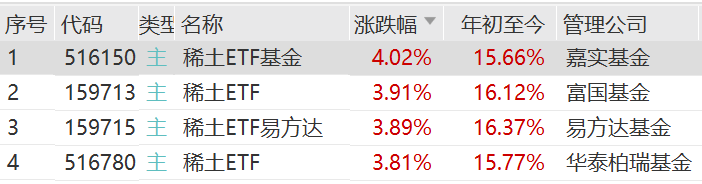
稀土股持续走强,稀土ETF基金、稀土ETF、稀土ETF易方达年内涨超15%
Ge Long Hui A P P· 2025-06-11 04:53
Group 1 - A-shares and Hong Kong stocks are experiencing a collective rise, with rare earth permanent magnets leading the gains [1] - China Rare Earth (0769.HK) has surged over 12%, marking a cumulative increase of 109% over three consecutive days [1] - The rare earth ETF funds have seen significant growth, with the top-performing fund rising 4.02%, leading the market [1][2] Group 2 - The rare earth ETF fund has a current scale of 2.136 billion, ranking first among similar funds [2][3] - The price of rare earth materials is expected to rise due to export control measures and increased demand from overseas companies [3][4] - China holds a dominant position in the global rare earth market, with 40% of global reserves and 70% of global production [4] Group 3 - The export volume of rare earth permanent magnets has significantly decreased, reaching a historical low, which is expected to lead to increased demand in the coming quarters [5] - The tightening of export quotas may lead to a reduction in smelting and separation capacity, benefiting downstream demand in the short to medium term [5]

行业ETF风向标丨涨价预期刺激大涨,稀土ETF基金半日涨幅超4%
Mei Ri Jing Ji Xin Wen· 2025-06-11 04:43
Group 1 - The core viewpoint of the news is that the rare earth sector is experiencing a significant rise in stock prices due to expectations of gradual easing of export controls, leading to a collective surge in the rare earth sector [1][3] - The rare earth ETFs have shown strong performance, with four ETFs rising approximately 4% in half a day, particularly the Rare Earth ETF Fund (516150) which had a half-day increase of 4.02% [1][2] - The investment logic suggests that the supply-demand dynamics for rare earths are likely to continue improving due to export controls, with domestic rare earth magnetic material companies expected to benefit from both performance and valuation increases [3] Group 2 - The Rare Earth ETF Fund (516150) has a scale of 1.871 billion units and a half-day trading volume of 132 million yuan, tracking the CSI Rare Earth Industry Index [3] - The CSI Rare Earth Industry Index includes companies involved in rare earth mining, processing, trading, and applications, reflecting a high concentration of companies deeply involved in the rare earth supply chain [3][4] - Major weight stocks in the CSI Rare Earth Industry Index include North Rare Earth (14.69%), China Rare Earth (6.37%), and others, indicating a strong representation of companies in the rare earth sector [4]


稀土的力量
投资界· 2025-06-11 03:06
Core Viewpoint - The article discusses the strategic importance of rare earth elements in the context of US-China trade relations, highlighting China's dominant position in the rare earth supply chain and the implications for global technology industries [4][13][22]. Group 1: US-China Trade Relations - Following a conversation between the US and Chinese leaders, President Trump announced that China agreed to resume rare earth exports to the US [4]. - The ongoing trade tensions have led to a focus on rare earths and technology, with both countries leveraging their respective strengths: the US in chips and China in rare earths [5][8]. - China's cautious approach to export controls contrasts with the US's aggressive sanctions, indicating a strategic shift in response to US actions [5][24]. Group 2: Importance of Rare Earths - Rare earth elements are crucial for various high-tech applications, including automotive, semiconductors, and military technologies [7][20]. - The supply of rare earths is currently tight, leading to significant price increases; for instance, the price of dysprosium oxide in Europe rose by 167.8% since early April [15]. - Major automotive manufacturers are facing production challenges due to rare earth shortages, with some factories temporarily shutting down [18][16]. Group 3: China's Dominance in Rare Earths - China controls over 60% of global rare earth production and 92% of processing, giving it a near-monopoly in the sector [13][14]. - The US heavily relies on China for rare earth imports, with over 90% of its rare earth compounds and metals coming from China as of 2023 [22]. - Historical context shows that China's dominance in rare earths is a result of decades of strategic investment and policy decisions [24][25]. Group 4: US Efforts to Diversify Supply - The US is exploring alternative sources for rare earths, including partnerships with countries like Australia and Ukraine, and projects like the Round Top project in Texas [39][38]. - Despite these efforts, the US faces significant challenges in establishing a self-sufficient rare earth supply chain, with estimates suggesting it could take at least 10 years and $10-15 billion to develop [44][42]. - The historical challenges faced by US rare earth production, particularly the closure of the Mountain Pass mine, highlight the difficulties in competing with China's established supply chain [35][45].

稀土:出口管制催化,供需或加速错配
2025-06-10 15:26
Summary of Key Points from the Conference Call Industry Overview - The conference call discusses the rare earth industry, particularly focusing on the impact of China's export controls on various rare metals including germanium, gallium, indium, dysprosium, terbium, praseodymium, and neodymium [1][3][5]. Core Insights and Arguments - China's export controls have led to a significant price increase for rare metals, with prices rising by at least 50% within six months due to supply-demand mismatches [1][4]. - The price surge is attributed to the inversion of import raw material prices compared to domestic pricing, prompting domestic prices to follow international trends [5]. - China dominates the global rare earth supply chain, holding over 90% market share in smelting, separation, and alloy powder segments, which directly affects international supply-demand dynamics [1][6]. - The demand for rare earth elements is critical in modern industries, especially in defense and new energy vehicles, with China producing nearly 90% of global magnetic materials [1][8]. Market Dynamics - Following the export controls, overseas markets have seen a rapid increase in prices, particularly for gallium and terbium, which have doubled in price [2][6]. - The export control policy has stimulated overseas manufacturers to replenish their inventories, leading to increased demand despite low prices and low inventory levels [9][12]. - The current supply-demand balance in the rare earth market is tight, with expectations of reduced domestic quotas and ongoing supply disruptions from Myanmar [12][15]. Financial Implications - The export controls have led to a recovery in rare earth prices, helping companies recover from previous asset impairment losses [16]. - Investors are advised to focus on leading companies with substantial rare earth resources, as their profitability is closely linked to the prices of rare earth elements [13][17]. Risks and Challenges - The rare earth sector faces risks from potential oversupply from overseas sources and weaker-than-expected demand from downstream sectors such as new energy vehicles and home appliances [18][19]. Additional Important Points - The export control measures have historically led to increased prices and stock performance in the rare earth sector, as seen during previous trade tensions [10][11]. - The ongoing demand for rare earth elements in strategic applications, such as military technology and electric vehicles, underscores their irreplaceable role in modern industry [7][8].
美媒竟“委屈”上了:车企被影响还能抱怨几声,国防巨头只能沉默承压
Guan Cha Zhe Wang· 2025-06-10 15:10
Core Points - China has recently implemented export controls on certain rare earth items with dual-use military and civilian attributes, affecting foreign automotive companies and raising concerns about the impact on the defense industry [1][5] - The export restrictions are seen as a response to the U.S. government's unilateral tariff measures and technology blockades against China, leading to increased tensions between the two countries [1][5] - Analysts indicate that Western defense giants are also feeling pressure from these export controls, with stock prices of European defense companies declining [1][5] Group 1: Impact on Industries - The automotive and robotics sectors have experienced significant impacts due to the rare earth export controls, with specific mention of the importance of samarium in the manufacturing of F-35 fighter jets [2][4] - The defense industry is facing a potential shortage of rare earth elements, which are critical for various defense technologies, including sonar systems and radar [4][5] - Concerns have been raised that if the price of praseodymium-neodymium oxide remains below $60 per kilogram by 2030, nearly half of the non-Chinese rare earth supply could become economically unviable [5] Group 2: Responses and Future Outlook - China has stated that it will continue to review export applications for rare earth items in accordance with international practices, emphasizing the need to maintain national security and fulfill international non-proliferation obligations [6][7] - The Chinese government is open to establishing a green channel for compliant applications to expedite approvals, reflecting a willingness to accommodate reasonable demands from other countries [7] - The ongoing geopolitical tensions have led to a series of countermeasures from China against U.S. arms sales to Taiwan, indicating a broader strategy of using export controls as a tool in international relations [7]
印度:在努力了,已联系中国
Guan Cha Zhe Wang· 2025-06-10 15:06
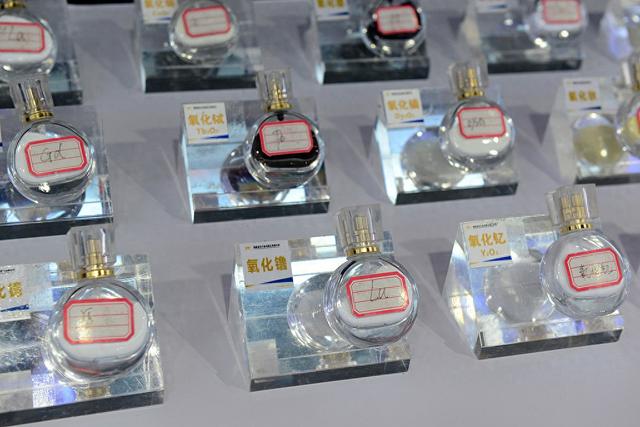
► 文 观察者网 王一 面对中国的稀土管控,一向非常有民族自信的印度低下了头。印度《经济时报》6月10日报道称,印度 商务和工业部长皮尤什·戈亚尔透露,在接到国内公司关于稀土储备即将耗尽的反馈后,他们正在与中 国进行谈判,以确保稀土供应。 "存在担忧,"戈亚尔称,"我们的大使馆正在与他们(中国)对话……商务和工业部也在努力。" 戈亚尔承认,中国停止向印度出口稀土永磁体显然会有影响,"尤其是我们的汽车行业"和一些其他行 业。他称,一些公司已提交了稀土出口许可申请,"我们希望理智会占据上风,他们能获得稀土的出口 许可"。 这位时常发表涉华消极言论的印度官员也没有忘记借此朝中国"泼脏水"。脑回路清奇的他对美国挑起全 球贸易战、滥用出口管制的行径选择性地视而不见,反而暗戳戳地指责中国,拿中国的对美反制措施说 事,污蔑中国不值得信赖。 戈亚尔渲染称,这件事情"对所有过度依赖特定地区的人来说是一个警钟","提醒大家在供应链中需要 值得信赖的合作伙伴"。 稀土储量世界排 名前七的国家的储量(左)和产量(右)图 印度商务和工业 部长皮尤什·戈亚尔 视频截图 他的说法完全站不住脚。《经济时报》在4日的报道中就指出,已有9家印度 ...

中方同意出口稀土?特朗普态度180度转变:欢迎中国留学生来美国
Sou Hu Cai Jing· 2025-06-10 12:17
Group 1 - China has approved a certain quantity of rare earth product export applications, indicating a shift in policy after previously imposing export restrictions [1][3] - The export restrictions on seven categories of medium and heavy rare earth elements have significant implications for various industries, including automotive, semiconductors, and military hardware [1][3] - The slow progress in issuing export licenses has led to a sharp decline in global rare earth supply, affecting multiple sectors [1][3] Group 2 - The Chinese government emphasizes that the export control of rare earths is a common international practice aimed at safeguarding national security and interests [3][4] - The recent approval of some export applications is seen as a strategic move to balance pressure from the U.S. while maintaining China's dominant position in the rare earth market [3][4] - The U.S. military could face significant production challenges if China were to completely cut off rare earth exports, highlighting the strategic importance of these materials [3][4] Group 3 - Trump's recent welcoming of Chinese students to the U.S. marks a significant shift from previous policies that were more restrictive, reflecting a potential change in U.S.-China relations [6][7] - The U.S. economy may benefit from the presence of Chinese students, who contribute to consumption and talent in various fields, despite concerns over technology transfer [6][7] - The fluctuating U.S. policy on Chinese students indicates a complex interplay between competition and cooperation in the context of U.S.-China economic relations [6][7] Group 4 - The long-term outlook suggests that both countries will continue to experience a mix of cooperation and competition across economic, technological, and educational domains [9] - China is encouraged to enhance resource management and improve domestic education quality to attract talent, while also maintaining a strategic stance in trade negotiations [9] - The evolving U.S.-China relationship will have significant implications for the global political and economic landscape, necessitating ongoing dialogue and cooperation [9]
特朗普彻底破防,中方迅速反击,直接掐断美国“命脉”,不简单
Sou Hu Cai Jing· 2025-06-10 10:15
Group 1: U.S.-China Trade Relations - The U.S. has escalated actions against China, including imposing high tariffs on a wide range of Chinese goods, aiming to disrupt China's economic development [3] - In the technology sector, the U.S. continues to implement chip export controls and collaborates with allies to restrict high-end chip technology exports to China, attempting to hinder China's semiconductor industry [3] - The U.S. has also revoked numerous student visas for Chinese students, significantly disrupting educational exchanges between the two countries [3] Group 2: China's Countermeasures - In response to U.S. actions, China has imposed corresponding tariffs on U.S. imports, targeting key U.S. export sectors such as agriculture and energy [3] - China has placed several U.S. entities on an unreliable entity list, prohibiting them from engaging in import and export activities related to China and from making new investments in China [3] Group 3: Rare Earth Industry Dynamics - China holds a dominant position in the global rare earth industry, possessing a significant share of global reserves and advanced extraction and processing technologies [6] - The U.S. faces challenges in its rare earth sector, with high extraction costs and a lack of skilled engineers, making it heavily reliant on Chinese imports for rare earth materials [6] - China's export controls on rare earths have severely impacted U.S. high-tech manufacturing and military modernization efforts, causing production slowdowns and shortages of critical components [6] Group 4: Diplomatic Engagement - The U.S. attempts to discredit China in the international arena, attributing its difficulties to China's countermeasures, while China defends its actions as legitimate and seeks international support [8] - China advocates for dialogue and cooperation to resolve differences, emphasizing the need for equality, respect, and mutual benefit in negotiations [8] - Despite challenges, there remains an openness to dialogue and cooperation between the U.S. and China, which is essential for the stability and prosperity of the global economy [8]
一字涨停!50万手封单排队等买进!国内算力产业最大合并案落锤!4000亿“国产算力航母”启航!这个板块是中美会议关键议题!
雪球· 2025-06-10 08:39
Market Overview - The three major A-share indices collectively retreated today, with the Shanghai Composite Index down 0.44% to 3384.82 points, the Shenzhen Component Index down 0.86% to 10162.18 points, and the ChiNext Index down 1.17% to 2037.27 points [1] - The total trading volume in the Shanghai and Shenzhen markets reached 1.42 trillion, an increase of 129 billion compared to the previous trading day [2] Company News - Zhongke Shuguang resumed trading with a limit-up, closing at 68.09, a 10% increase, with a total market value of 99.63 billion [4][5] - The merger between Haiguang Information and Zhongke Shuguang, with a transaction value of 1159.67 billion, is significant as it marks the first "child swallowing mother" merger in A-shares and is one of the largest mergers in the domestic AI chip sector [6][7] - Following the merger, Haiguang Information's total market value is expected to exceed 400 billion, potentially making it the highest-valued domestic AI chip and server company in A-shares [7] Industry Trends - The rare earth permanent magnet sector showed strong performance, with stocks like Zhongke Magnetic Industry hitting the limit-up, while other companies in the sector also saw gains [9][10] - The Ministry of Commerce has indicated that it will approve export license applications for rare earths that meet regulations, which could lead to price increases in the domestic market [11][12] - Silver prices surged approximately 9% last week, reaching over $36, driven by multiple factors including a rebound in base metal prices and increased retail demand in China [13][14]