
货币政策

Search documents
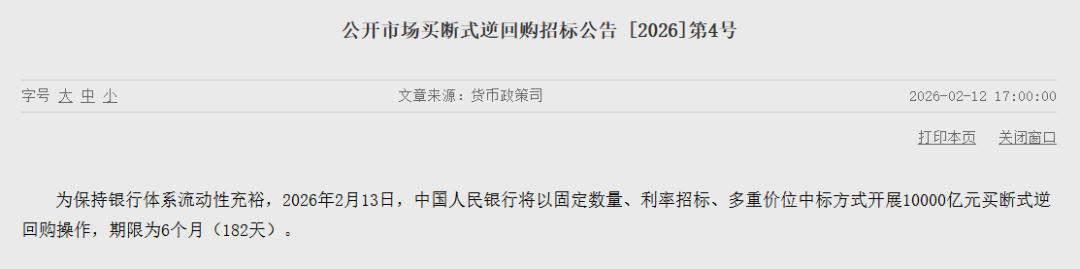
央行10000亿买断式逆回购来了,延续流动性宽松
2 1 Shi Ji Jing Ji Bao Dao· 2026-02-12 14:17
Core Viewpoint - The People's Bank of China (PBOC) is implementing a 10 trillion yuan buyout reverse repurchase operation to maintain ample liquidity in the banking system, with a six-month term starting February 13, 2024 [1][2]. Group 1: Reverse Repo Operations - The PBOC will conduct a buyout reverse repo operation of 10 trillion yuan, marking the sixth consecutive month of increased six-month buyout reverse repos, with an additional 500 billion yuan this month, which is 200 billion yuan more than the previous month [2]. - In January, the PBOC had already conducted an 800 billion yuan three-month buyout reverse repo, resulting in a total net injection of 600 billion yuan for that month, which was 300 billion yuan more than the previous month [2]. Group 2: Economic Support and Policy Stance - The primary reason for these operations is to ensure funding for major projects in key sectors and to support the ongoing economic recovery, with new local government debt limits for 2026 already issued [2][3]. - The PBOC's actions are aimed at stabilizing the liquidity environment ahead of the Spring Festival, facilitating government bond issuance, and supporting financial institutions' credit provision, reflecting a continued supportive monetary policy stance [3]. Group 3: Future Expectations - Looking ahead, the expectation is for further liquidity support through MLF and government bond trading tools in February, with 300 billion yuan of MLF maturing, which may also see equal or slightly increased renewals [3]. - The increased net injection from the buyout reverse repo in February suggests a reduced likelihood of a reserve requirement ratio (RRR) cut in the near term, as the monetary policy is currently in an observation phase following a structural policy package introduced on January 15 [3].
10000亿元!央行最新预告
Zhong Guo Zheng Quan Bao· 2026-02-12 14:17
Core Viewpoint - The People's Bank of China (PBOC) is conducting a 1 trillion yuan reverse repurchase operation to maintain liquidity in the banking system, indicating a proactive approach to ensure financial market stability and support credit growth during a period of increased liquidity demand [1][3][4]. Group 1: Reverse Repo Operations - On February 13, the PBOC will conduct a 1 trillion yuan reverse repurchase operation with a term of 6 months, marking an increase of 500 billion yuan compared to the previous month [1][3]. - This operation represents the sixth consecutive month of increased reverse repurchase operations, with the scale of increase being 200 billion yuan compared to last month [3][4]. - The total net injection from reverse repurchase operations in February is 600 billion yuan, which is an increase of 300 billion yuan from the previous month [4]. Group 2: Market Implications - February is typically a month with concentrated bank credit issuance, and the PBOC's actions are aimed at addressing the increased liquidity demand due to factors such as cash withdrawals before the Spring Festival [4]. - Analysts suggest that the PBOC's reverse repurchase operations are intended to stabilize the funding environment ahead of the Spring Festival, supporting government bond issuance and financial institutions' credit activities [4][5]. - There is an expectation of further liquidity support through medium-term lending facilities (MLF) as 300 billion yuan of MLF is set to mature in February, with potential for equal or slightly increased renewal [4].

国泰海通|银行:从流动性总量视角看待“存款搬家”
国泰海通证券研究· 2026-02-12 14:02
Core Viewpoint - The central theme of the articles emphasizes the continuation of a moderately accommodative monetary policy by the central bank, aiming to support economic growth and optimize credit structures while addressing personal credit issues through specific policies [1][2]. Group 1: Monetary Policy and Credit - The central bank plans to maintain a moderately accommodative monetary policy, integrating both incremental and stock policies to enhance effectiveness [1]. - New loan interest rates have decreased, with the weighted average interest rate for new loans in December at 3.15%, down 10 basis points from September [1]. - The growth rates for various loan categories, including technology loans (11.5%), green loans (20.2%), and digital economy loans (14.1%), have outpaced the overall loan growth rate [1]. Group 2: Asset Management Products and Deposits - The rapid growth of asset management products has influenced the structure of bank deposits, with a notable decline in the growth rate of resident deposits [1]. - By the end of 2025, the total assets of asset management products reached 120 trillion yuan, reflecting a year-on-year growth of 13.1% [8]. - Over 80% of asset management products are allocated to fixed-income assets, indicating that funds, even when shifted to asset management products, ultimately flow back into the banking system [8]. Group 3: Policy Measures and Support for Credit - In January 2026, the central bank and the Ministry of Finance announced a package of policy measures aimed at boosting domestic demand, including support for small and medium-sized enterprises and consumer spending [2]. - A one-time credit repair policy was introduced to help individuals improve their credit status by removing records of overdue debts under specific conditions [2]. - Investment recommendations for the banking sector in 2026 focus on identifying targets with potential for growth, banks with convertible bond expectations, and continuing dividend strategies [2].

1万亿明日落地!买断式逆回购密集加量,短期降准可能性下降
Di Yi Cai Jing· 2026-02-12 10:36
Core Viewpoint - The People's Bank of China (PBOC) is implementing significant liquidity injections through reverse repos to maintain a stable financial environment ahead of the Spring Festival, indicating a supportive monetary policy stance for economic recovery [1][3][4]. Group 1: Liquidity Operations - In February, the PBOC announced a 10 trillion yuan reverse repo operation scheduled for February 13, with a six-month term, to ensure ample liquidity in the banking system [1]. - The total mid-term liquidity maturing in February amounts to 15 trillion yuan, including 7 trillion yuan in three-month reverse repos, 5 trillion yuan in six-month reverse repos, and 3 trillion yuan in Medium-term Lending Facility (MLF) [1][2]. - The PBOC has already conducted an 8 trillion yuan three-month reverse repo operation on February 4, resulting in a net liquidity injection of 1 trillion yuan, leading to a total net injection of 6 trillion yuan for the month [2]. Group 2: Economic Context and Implications - Analysts suggest that the PBOC's actions are aimed at supporting key projects and maintaining economic momentum, especially with the early issuance of local government bonds and increased loan disbursements expected in the first quarter [3]. - The increase in reverse repo operations reflects a response to heightened liquidity demand due to seasonal factors like the Spring Festival and increased cash withdrawals [3][4]. - The PBOC's strategy indicates a continuation of a supportive monetary policy, with expectations of further liquidity support through MLF and government bond transactions in February [4]. Group 3: Policy Outlook - The recent increase in reverse repo net injections suggests a reduced likelihood of immediate interest rate cuts, as the PBOC is currently in an observation phase following a series of structural policy measures [5]. - Analysts believe that the substantial liquidity injections lessen the urgency for a comprehensive reserve requirement ratio (RRR) cut, although it remains a potential tool in the PBOC's policy arsenal [6].
瑞达期货锰硅硅铁产业日报-20260212
Rui Da Qi Huo· 2026-02-12 09:53
Group 1: Investment Rating - No investment rating information is provided in the report. Group 2: Core Viewpoints - Manganese silicon supply and demand both decrease, operating at a low level with continuous inventory accumulation. The spot price in Inner Mongolia is 5650 yuan/ton, unchanged from the previous period. The manganese ore market is relatively strong, and the main production areas are operating at a loss. The main manganese silicon futures contract closed down 0.45% to 5800 yuan/ton, trading below the 20 - and 60 - day moving averages. It is expected to fluctuate weakly in the short term, with attention on the 5766 support level [2]. - Ferrosilicon supply increases while demand decreases, fluctuating at a low level with a neutral inventory. The spot price in Ningxia is 5350 yuan/ton, unchanged from the previous period. The cost of semi - coking coal remains stable, and the main production areas are operating at a loss. The main ferrosilicon futures contract closed down 1.47% to 5500 yuan/ton, trading below the 20 - and 60 - day moving averages. The supply - demand pattern is becoming more relaxed, and the futures price is under downward pressure. With the Spring Festival approaching and insufficient demand support, rising electricity prices in some areas may provide some support, limiting the downside. It is expected to fluctuate at a low level, with attention on the 5480 support level [2]. Group 3: Summary by Directory Futures Market - SM main contract closing price (daily, yuan/ton): 5800, down 24 yuan; SF main contract closing price (daily, yuan/ton): 5500, down 76 yuan [2]. - SM futures contract open interest (daily, lots): 562,439, down 3181 lots; SF futures contract open interest (daily, lots): 366,676, up 21,723 lots [2]. - Net position of the top 20 in manganese silicon (daily, lots): - 26,604, up 759 lots; net position of the top 20 in ferrosilicon (daily, lots): - 11,364, up 6459 lots [2]. - SM 5 - 3 contract spread (daily, yuan/ton): 38, unchanged; SF 4 - 3 contract spread (daily, yuan/ton): - 22, down 8 yuan [2]. - SM warehouse receipts (daily, sheets): 46,543, up 6843 sheets; SF warehouse receipts (daily, sheets): 8163, down 21 sheets [2]. Spot Market - Inner Mongolia manganese silicon FeMn68Si18 (daily, yuan/ton): 5650, unchanged; Inner Mongolia ferrosilicon FeSi75 - B (daily, yuan/ton): 5410, down 10 yuan [2]. - Guizhou manganese silicon FeMn68Si18 (daily, yuan/ton): 5700, unchanged; Qinghai ferrosilicon FeSi75 - B (daily, yuan/ton): 5280, unchanged [2]. - Yunnan manganese silicon FeMn68Si18 (daily, yuan/ton): 5730, unchanged; Ningxia ferrosilicon FeSi75 - B (daily, yuan/ton): 5350, unchanged [2]. - Manganese silicon index average (weekly, yuan/ton): 5665, up 19 yuan; SF main contract basis (daily, yuan/ton): - 150, up 76 yuan [2]. - SM main contract basis (daily, yuan/ton): - 150, up 24 yuan; average price of South African high - iron manganese ore in Tianjin Port (daily, yuan/ton - degree): 31.55, unchanged; silica (98%, Northwest, daily, yuan/ton): 210, unchanged [2]. Upstream Situation - Average price of South African semi - carbonate manganese ore in Tianjin Port (daily, yuan/ton - degree): 36.35, unchanged; semi - coking coal (medium material, Shenmu, daily, yuan/ton): 770, unchanged [2]. - Inner Mongolia Wuhai secondary metallurgical coke (daily, yuan/ton): 1160, unchanged [2]. - Manganese ore port inventory (weekly, 10,000 tons): 420.3, down 15.4 [2]. Industry Situation - Manganese silicon enterprise operating rate (weekly, %): 35.77, down 0.44%; ferrosilicon enterprise operating rate (weekly, %): 29.31, up 0.19% [2]. - Manganese silicon supply (weekly, tons): 190,995, down 1400 tons; ferrosilicon supply (weekly, tons): 99,200, up 700 tons [2]. - Manganese silicon manufacturer inventory (bi - monthly, tons): 377,800, up 3500 tons; ferrosilicon manufacturer inventory (bi - monthly, tons): 66,860, down 1040 tons [2]. - National steel mill inventory of manganese silicon (monthly, days): 17.48, up 1.96 days; national steel mill inventory of ferrosilicon (monthly, days): 17.52, up 2.11 days [2]. - Demand for manganese silicon from five major steel types (weekly, tons): 116,059, down 1161 tons; demand for ferrosilicon from five major steel types (weekly, tons): 18,497.7, down 260.7 tons [2]. Downstream Situation - Blast furnace operating rate of 247 steel mills (weekly, %): 79.53, up 0.53%; blast furnace capacity utilization rate of 247 steel mills (weekly, %): 85.69, up 0.22% [2]. - Crude steel production (monthly, 10,000 tons): 6817.74, down 169.36 [2]. Industry News - The central bank released the China Monetary Policy Implementation Report for the fourth quarter of 2025, stating that it will continue to implement a moderately loose monetary policy, aiming to promote stable economic growth and a reasonable rebound in prices [2]. - According to the China Association of Automobile Manufacturers, in January, China's automobile production and sales were 2.45 million and 2.346 million units respectively, with a year - on - year increase of 0.01% in production and a decrease of 3.2% in sales [2].
「UNForex行情分析」黄金区间震荡格局延续,CPI 前情绪谨慎但机会或随突破而来
Sou Hu Cai Jing· 2026-02-12 09:52
UNForex 2月12日讯(分析师 Stephen)从今日盘面运行来看,现货黄金在亚洲与欧美盘交接时段维持 在约 5000–5100 美元区间内震荡波动。价格在接近上沿压力时屡次受阻,并出现回落;在临近下沿支撑 时则获得承接,盘中形成明显的区间拉锯走势。与近期行情相比,当前盘面未出现单边冲破,节奏显著 放缓,短线方向性不强。 基于当前价格节奏与技术结构,以及宏观事件驱动的预期,行情可能存在以下几种展开方式: 这些展开路径并不互相排斥,关键在于 CPI 公布后的连续性突破是否成立。 从技术走势的角度看,黄金在上行过程中遇到的压制较为明确。5000–5100 美元曾多次充当短线阻力区 域,是多头突破意愿被观察的关键点位。价格虽有反弹冲高动作,但每次上探至该区域时均遭遇明显抛 压,未能形成有效站稳。 若价格能在上方稳定站上阻力区并突破,后市则可能打开更高空间;反之,未突破将继续受限于区间内 震荡。 价格在亚太盘及欧盘阶段多次回落至约 5000 美元附近承接,并在该位置获得明显支撑。即使在短线回 撤过程中,价格也未出现持续下破或单边下跌趋势,这说明下方支撑区域暂时仍然有效。 若该支撑能持续守住,则当前区间震荡结构仍 ...
瑞达期货铝类产业日报-20260212
Rui Da Qi Huo· 2026-02-12 09:24
1. Report Industry Investment Rating - Not provided in the content 2. Core Viewpoints of the Report - For alumina, the fundamentals are in a stage of sufficient supply and stable demand. It is recommended to conduct light - position short - term long trades at low prices, paying attention to controlling the rhythm and trading risks [2] - For electrolytic aluminum, the fundamentals are in a situation of stable supply and improved demand, with seasonal accumulation of industrial inventory. Option market sentiment is bullish, and it is also recommended to conduct light - position short - term long trades at low prices, paying attention to controlling the rhythm and trading risks [2] - For cast aluminum alloy, the fundamentals are in a stage of slightly reduced supply and slightly improved demand, with high industrial inventory. It is recommended to conduct light - position short - term long trades at low prices, paying attention to controlling the rhythm and trading risks [2] 3. Summary by Relevant Catalogs 3.1 Futures Market - **Prices**: The closing price of the Shanghai Aluminum main contract was 23,610 yuan/ton, down 50 yuan; the closing price of the alumina futures main contract was 2,808 yuan/ton, down 34 yuan; the LME aluminum three - month quotation was 3,117 US dollars/ton, up 12 US dollars; the closing price of the cast aluminum alloy main contract was 22,260 yuan/ton, up 55 yuan [2] - **Spreads**: The spread between the main and second - consecutive contracts of Shanghai Aluminum was - 160 yuan/ton, down 15 yuan; that of alumina was - 138 yuan/ton, down 5 yuan; that of cast aluminum alloy was - 1,035 yuan/ton, down 975 yuan [2] - **Positions**: The position of the Shanghai Aluminum main contract was 159,738 lots, down 14,665 lots; that of the alumina main contract was 296,788 lots, down 15,357 lots; that of the cast aluminum alloy main contract was 12,761 lots, down 1,588 lots [2] - **Inventories**: LME aluminum cancelled warrants were 44,325 tons, unchanged; LME aluminum inventory was 485,750 tons, down 1,225 tons; Shanghai Aluminum inventory on the SHFE was 245,140 tons, up 28,369 tons; cast aluminum alloy inventory on the SHFE was 74,425 tons, up 357 tons; Shanghai Aluminum warehouse receipts on the SHFE were 200,654 tons, up 33,088 tons [2] - **Other indicators**: The net position of the top 20 in Shanghai Aluminum was - 50,300 lots, down 725 lots; the Shanghai - London ratio was 7.57, down 0.05; the registered warehouse receipts of cast aluminum alloy on the SHFE were 66,638 tons, down 210 tons [2] 3.2 Spot Market - **Prices**: The average price of Shanghai Non - ferrous A00 aluminum was 23,650 yuan/ton, up 90 yuan; the average price of ADC12 aluminum alloy ingots nationwide was 23,350 yuan/ton, up 90 yuan; the spot price of alumina in Shanghai Non - ferrous was 2,555 yuan/ton, unchanged; the price of Yangtze River Non - ferrous Market AOO aluminum was 23,240 yuan/ton, up 140 yuan [2] - **Basis**: The basis of cast aluminum alloy was 1,390 yuan/ton, down 55 yuan; the basis of electrolytic aluminum was - 260 yuan/ton, up 140 yuan; the basis of alumina was - 253 yuan/ton, up 34 yuan [2] - **Premiums and discounts**: The Shanghai Material Trading aluminum premium/discount was - 160 yuan/ton, up 30 yuan; the LME aluminum premium/discount was - 31.88 US dollars/ton, up 2.46 US dollars [2] 3.3 Upstream Situation - **Production and utilization rate**: Alumina production was 801.08 million tons, down 12.72 million tons; the national alumina start - up rate was 82.49%, down 1%; the total alumina capacity utilization rate was 84%, down 1% [2] - **Demand and balance**: The demand for alumina (electrolytic aluminum part) was 731.29 million tons, up 25.33 million tons; the alumina supply - demand balance was 28.90 million tons, up 2.32 million tons [2] - **Prices and trade**: The average price of crushed raw aluminum in Foshan metal waste was 18,100 yuan/ton, unchanged; that in Shandong metal waste was 17,700 yuan/ton, unchanged; China's import of aluminum waste and scrap was 194,102.07 tons, up 31,482.14 tons; China's export of aluminum waste and scrap was 70.80 tons, down 0.73 tons; alumina exports were 21 million tons, up 4 million tons; alumina imports were 22.78 million tons, down 0.46 million tons [2] - **Other indicators**: The WBMS aluminum supply - demand balance was 20.49 million tons, up 31.36 million tons; the electrolytic aluminum social inventory was 82.32 million tons, up 2.71 million tons [2] 3.4 Industry Situation - **Production and trade**: Primary aluminum imports were 189,196.58 tons, up 43,086.86 tons; primary aluminum exports were 37,575.30 tons, down 15,472.39 tons; aluminum product production was 613.56 million tons, up 20.46 million tons; exports of unforged aluminum and aluminum products were 54 million tons, down 3 million tons; exports of aluminum alloy were 2.55 million tons, down 0.51 million tons [2] - **Capacity and start - up rate**: The total electrolytic aluminum capacity was 4,540.20 million tons, up 4 million tons; the electrolytic aluminum start - up rate was 98.79%, up 0.48% [2] - **Other indicators**: The production of recycled aluminum alloy ingots was 66.49 million tons, up 1.91 million tons; the total built - in capacity of recycled aluminum alloy ingots was 126 million tons, unchanged; the aluminum alloy production was 182.50 million tons, unchanged [2] 3.5 Downstream and Application - **Automobile production**: Automobile production was 341.15 million vehicles, down 10.75 million vehicles [2] - **Real estate index**: The National Housing Climate Index was 91.45, down 0.44 [2] 3.6 Option Situation - **Volatility**: The 20 - day historical volatility of Shanghai Aluminum was 38.37%, down 0.09%; the 40 - day historical volatility of Shanghai Aluminum was 31.22%, down 0.01%; the implied volatility of the Shanghai Aluminum main contract at - the - money was 15.25%, down 0.0068 [2] - **Ratio**: The call - put ratio of Shanghai Aluminum options was 1.98, up 0.0708 [2] 3.7 Industry News - **Economic data**: In January, China's CPI rose 0.2% month - on - month and 0.2% year - on - year, and the core CPI rose 0.8% year - on - year; PPI rose 0.4% month - on - month, rising for 4 consecutive months, and the year - on - year decline narrowed by 0.5 percentage points [2] - **US employment**: In January, the US seasonally - adjusted non - farm payrolls increased by 130,000, far exceeding the market expectation of 70,000; the unemployment rate was 4.3%, the lowest since August 2025; the hourly wage increased 0.4% month - on - month, exceeding expectations [2] - **Trade issue**: A French institution proposed a 30% overall tariff on China to the EU. China may initiate anti - dumping and counter - subsidy investigations on EU, especially French, wines and anti - discrimination investigations on France and the EU. If the EU unilaterally imposes tariffs on China, China will take "reciprocal tariffs" on relevant EU products [2] - **Automobile industry**: In January, China's automobile production and sales were 2.45 million and 2.346 million respectively, with a year - on - year increase of 0.01% and a decrease of 3.2% respectively. New energy vehicle production and sales were 1.041 million and 0.945 million respectively, with a year - on - year increase of 2.5% and 0.1% respectively. New energy vehicle exports were 302,000, doubling year - on - year [2] - **Monetary policy**: The People's Bank of China will continue to implement a moderately loose monetary policy, use various policy tools such as reserve requirement ratio cuts and interest rate cuts, and conduct regular treasury bond trading operations [2]

沪铜产业日报-20260212
Rui Da Qi Huo· 2026-02-12 09:23
Group 1: Report Industry Investment Rating - Not provided Group 2: Report's Core View - The Shanghai copper futures market shows that the main contract opened high and then declined, with decreasing positions. The spot is at a discount, and the basis has strengthened. The copper market fundamentals are in a stage of slightly converging supply and boosted pre - holiday stocking demand. In the options market, the sentiment is bullish, and the implied volatility has slightly increased. The report suggests light - position short - term long trading at low prices, while controlling the rhythm and trading risks [2] Group 3: Summary by Relevant Catalogs Futures Market - The closing price of the Shanghai copper futures main contract is 102,330 yuan/ton, up 150 yuan; the LME 3 - month copper price is 13,245 dollars/ton, up 78.5 dollars. The main contract's inter - month spread is - 350 yuan/ton, down 70 yuan; the main contract's open interest of Shanghai copper is 147,631 lots, down 10,919 lots. The top 20 futures positions of Shanghai copper are - 65,220 lots, down 4,448 lots. The LME copper inventory is 192,100 tons, up 3,000 tons; the SHFE cathode copper inventory is 248,911 tons, up 15,907 tons; the LME copper cancelled warrants are 22,450 tons, up 2,975 tons; the SHFE cathode copper warrants are 187,179 tons, down 2,856 tons; the COMEX copper inventory is 592,536 short tons, up 1,077 short tons [2] Spot Market - The SMM 1 copper spot price is 102,040 yuan/ton, up 725 yuan; the Yangtze River Non - ferrous Metals Market 1 copper spot price is 102,110 yuan/ton, up 775 yuan. The Shanghai electrolytic copper CIF (bill of lading) price is 38 dollars/ton, unchanged; the Yangshan copper average premium is 33 dollars/ton, unchanged. The CU main contract basis is - 290 yuan/ton, up 575 yuan; the LME copper cash - 3 months spread is - 76.01 dollars/ton, up 0.09 dollars [2] Upstream Situation - The monthly import volume of copper ores and concentrates is 2.7043 million tons, up 178,000 tons. The copper smelter's TC is - 52.37 dollars/thousand tons, down 2.53 dollars. The copper concentrate price in Jiangxi is 92,390 yuan/metal ton, up 750 yuan; in Yunnan, it is 93,090 yuan/metal ton, up 750 yuan. The southern processing fee for blister copper is 2,300 yuan/ton, up 100 yuan; the northern processing fee is 1,800 yuan/ton, up 600 yuan [2] Industry Situation - The monthly output of refined copper is 1.326 million tons, up 90,000 tons. The monthly import volume of unwrought copper and copper products is 440,000 tons, up 10,000 tons. The weekly social copper inventory is 418,200 tons, up 4,300 tons. The price of scrap copper (1 bright copper wire) in Shanghai is 67,790 yuan/ton, down 500 yuan; the price of 2 copper (94 - 96%) in Shanghai is 81,850 yuan/ton, down 450 yuan. The ex - factory price of 98% sulfuric acid of Jiangxi Copper is 1,030 yuan/ton, unchanged [2] Downstream and Application - The monthly output of copper products is 2.2291 million tons, up 3,100 tons. The cumulative grid infrastructure investment completion amount is 63.9502 billion yuan, up 7.9113 billion yuan. The cumulative real estate development investment completion amount is 827.8814 billion yuan, up 41.9724 billion yuan. The monthly output of integrated circuits is 4,807,345,000 pieces, up 415,345,000 pieces [2] Option Situation - The 20 - day historical volatility of Shanghai copper is 43.85%, down 0.21 percentage points; the 40 - day historical volatility is 36.17%, down 0.05 percentage points. The current - month at - the - money IV implied volatility is 23.33%, up 0.0015 percentage points; the at - the - money option call - put ratio is 1.4, down 0.0389 [2] Industry News - In January, China's CPI rose 0.2% month - on - month and 0.2% year - on - year, with core CPI up 0.8% year - on - year; PPI rose 0.4% month - on - month for four consecutive months, with a year - on - year decline of 1.4%, narrowing by 0.5 percentage points. The US added 130,000 non - farm payrolls in January, far exceeding expectations. The unemployment rate was 4.3%, the lowest since August 2025. A French institution proposed about 30% tariffs on China, and China may take counter - measures. In January, China's auto production and sales were 2.45 million and 2.346 million respectively, with new energy vehicle production and sales at 1.041 million and 0.945 million, and exports of new energy vehicles up 100%. The central bank will continue a moderately loose monetary policy [2]
债市 进一步走强动力不足
Qi Huo Ri Bao· 2026-02-12 09:16
Group 1 - The bond market has shown a pattern of "narrow yield fluctuations, long-end leading gains, and synchronized strength in futures and spot markets" since February, supported by a reasonably ample liquidity environment and weak financing demand during the production off-season [1] - The central bank's recent actions, including a net injection of 100 billion yuan through a three-month reverse repurchase agreement and the resumption of 14-day reverse repos, have stabilized liquidity in the interbank market, providing support for the bond market [1] - The issuance of government bonds has surged in early February, while the equity market has stabilized, limiting the downward space for yields and making it difficult for the bond market to achieve a trend breakthrough [1] Group 2 - The central bank's monetary policy report indicates that the effects of the moderately accommodative monetary policy implemented in 2025 are gradually becoming evident, with significant impacts on stabilizing economic growth and financial market operations [2] - The report emphasizes the continuation of a supportive monetary policy stance, with a focus on expanding domestic demand and optimizing supply, while indicating a low probability of short-term reserve requirement ratio (RRR) cuts or interest rate reductions [2] - The central bank is expected to maintain a "protective" policy tone, avoiding abrupt changes, which will help the bond market maintain a strong oscillating pattern and prevent large fluctuations [3] Group 3 - Consumer prices (CPI) rose by 0.2% year-on-year in January, with core CPI (excluding food and energy) increasing by 0.8% year-on-year, indicating a moderate rise in service and industrial consumer goods prices [4] - The Producer Price Index (PPI) decreased by 1.4% year-on-year in January, but the decline has narrowed compared to the previous month, with a month-on-month increase of 0.4%, suggesting a bottoming out and recovery in industrial product prices [4] Group 4 - The bond market has entered a recovery phase due to multiple factors, but the recent drop in the 10-year government bond yield below 1.8% and the cooling of short-term interest rate cut expectations indicate insufficient driving forces for further declines, leading to a lack of momentum for a trend breakthrough [5]
短端利率上行
Qi Huo Ri Bao· 2026-02-12 09:15
Group 1 - The core viewpoint of the articles indicates that the short-term interest rates in the money market have shown a pattern of short-term increases and long-term decreases, driven by strong demand for funds ahead of the Spring Festival and expectations of continued accommodative monetary policy from the central bank until 2026 [1][2] - As of February 11, the Shanghai Interbank Offered Rate (Shibor) for overnight, 1-week, 2-week, and 1-month periods were reported at 1.366%, 1.523%, 1.6%, and 1.5511% respectively, reflecting increases of 4.8, 5, 1.7, and 0.11 basis points compared to February 4 [1] - The central bank has increased its reverse repurchase operations to counteract the strong demand for funds before the holiday, conducting 9029 billion yuan in reverse repos in the first three working days of the week, including 5029 billion yuan for 7-day and 4000 billion yuan for 14-day reverse repos [1] Group 2 - Post-holiday, the domestic money market interest rates are expected to be weak in the short term but stable in the long term, as the demand for funds is anticipated to decrease significantly despite a large amount of reverse repos maturing [2] - The central bank's recent commitment to continue implementing a moderately accommodative policy is likely to lead to a re-pricing of interest rates in the market, with expectations that medium- to long-term rates will stabilize after adjustments [2]