
扩大内需

Search documents
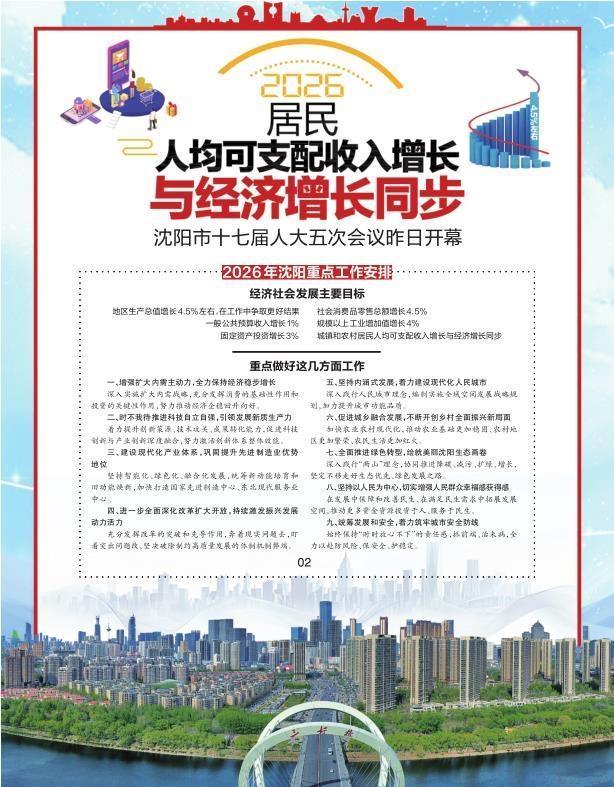
2026居民人均可支配收入增长与经济增长同步
Xin Lang Cai Jing· 2026-01-14 23:48
2026年沈阳重点工作安排 经济社会发展主要目标 地区生产总值增长4.5%左右,在工作中争取更好结果 一般公共预算收入增长1% 固定资产投资增长3% 社会消费品零售总额增长4.5% 规模以上工业增加值增长4% 城镇和农村居民人均可支配收入增长与经济增长同步 重点做好这几方面工作 一、增强扩大内需主动力,全力保持经济稳步增长 着力提升创新策源、技术攻关、成果转化能力,促进科技创新与产业创新深度融合,努力激活创新体系 整体效能。 三、建设现代化产业体系,巩固提升先进制造业优势地位 坚持智能化、绿色化、融合化发展,统筹新动能培育和旧动能焕新,加快打造国家先进制造中心、东北 现代服务业中心。 四、进一步全面深化改革扩大开放,持续激发振兴发展动力活力 充分发挥改革的突破和先导作用,奔着现实问题去,盯着突出问题改,坚决破除制约高质量发展的体制 机制弊端。 五、坚持内涵式发展,着力建设现代化人民城市 深入践行人民城市理念,编制实施全域空间发展战略规划,加力提升城市功能品质。 六、促进城乡融合发展,不断开创乡村全面振兴新局面 加快农业农村现代化,推动农业基础更加稳固、农村地区更加繁荣、农民生活更加红火。 深入实施扩大内需战略 ...

推动服务业供需良性循环
Jing Ji Ri Bao· 2026-01-14 23:05
Core Viewpoint - The development of the service industry is crucial for upgrading consumption structure and optimizing industrial structure, with a focus on enhancing domestic demand and building a strong domestic market [1] Group 1: Transition of Consumption Structure to Service Consumption - The shift from goods consumption to service consumption is emphasized, aiming to meet diverse and personalized needs through the expansion of quality service supply [1][6] - The upgrade in service consumption can drive effective investment and expand employment capacity, creating a virtuous cycle of supply and demand [2][3] Group 2: Optimization of Supply System - The upgrade in service consumption drives the continuous optimization of the supply system, with a focus on quality, personalization, and emotional satisfaction [2] - In the life service sector, the demand for elderly care is leading to the adoption of smart wearable devices and health data management systems, enhancing service quality [2] Group 3: Economic Growth and Employment Creation - Strong growth in service consumption can effectively drive investment in related industries and create diverse employment opportunities, forming a cycle of "industry growth - income increase - consumption expansion" [3] - The expansion of health service consumption not only boosts core sectors like health management but also stimulates investment in related industries such as medical device manufacturing [3] Group 4: Integration of Service Industry with Other Sectors - The service industry is a key driver for efficiency improvement and technological innovation, particularly through the integration with manufacturing, agriculture, and digital industries [5] - The deep integration of "manufacturing + service" transforms companies into comprehensive solution providers, significantly expanding industrial value [5] Group 5: Systematic Layout for Expanding Domestic Demand - To expand domestic demand, a systematic layout should focus on basic livelihood, quality upgrades, scene innovation, and environmental improvement [6][7] - The emphasis is on enhancing service supply in education, healthcare, and childcare to stimulate potential demand and improve service accessibility [6] Group 6: Goals for Service Industry Development - The goals for expanding domestic demand include optimizing supply and deepening integration, with a focus on upgrading productive service industries and enhancing the quality of life services [7] - The integration of digital technology with the service industry is crucial for fostering new business models and consumption scenarios [7]
拓宽农民增收致富空间
Jing Ji Ri Bao· 2026-01-14 22:10
Core Viewpoint - The article emphasizes the importance of increasing farmers' income as a key measure for achieving common prosperity, expanding domestic demand, ensuring food security, and promoting sustainable agricultural development. It highlights the need for multi-faceted efforts to address the intertwined challenges faced by farmers in increasing their income [1]. Group 1: Challenges in Increasing Farmers' Income - Farmers face difficulties due to small-scale production, low efficiency, and limited sharing of value-added benefits in the agricultural supply chain [1]. - There are invisible barriers to the flow of resources between urban and rural areas, and the potential of land, labor, and capital has not been fully realized [1]. - Low educational levels among some farmers hinder their ability to adapt to new market trends and business models [1]. Group 2: Strategies for Increasing Operating Income - Development of modern agriculture is essential, focusing on integrated improvements in land, seeds, machinery, and methods to reduce costs and enhance yield and quality [2]. - Policies supporting price stability, subsidies, and insurance are crucial to safeguard farmers' basic income [2]. - Extending the agricultural value chain through deep processing of agricultural products and fostering regional brands can help farmers transition from selling raw grains to selling products and brands [2]. Group 3: Enhancing Wage Income - Wage income constitutes a significant portion of farmers' earnings, but issues like unstable employment and insufficient skills remain prevalent [3]. - Strengthening vocational training tailored to market demands can equip farmers with necessary skills for better job opportunities [3]. - Creating local job opportunities through the development of county-level industries and improving the business environment can encourage farmers to work closer to home [3]. Group 4: Activating Property Income - Property income, though currently a small share, holds significant potential for farmers [4]. - Reforming land tenure systems and promoting cooperative models can transform resources into assets, allowing farmers to gain stable returns [4]. - Utilizing idle rural properties for tourism and creative industries can generate additional income streams for farmers [4].
发放消费券、拓展春秋游——多措并举扩大职工文体消费
Jing Ji Ri Bao· 2026-01-14 22:09
Core Viewpoint - The initiative to enhance cultural and sports consumption among workers aims to transform the potential demand of 402 million workers into actual purchasing power, thereby expanding domestic demand and invigorating the cultural and sports consumption market [1][2]. Group 1: Policy and Objectives - The document outlines eight key tasks to address the cultural and sports needs of workers, aiming to establish a comprehensive and distinctive worker cultural and sports activity system by 2030 [2][3]. - The initiative aligns with the broader trend of shifting consumer structure from product-centric to a balanced focus on both goods and services, as well as from survival-oriented to development and enjoyment-oriented consumption [2][3]. Group 2: Implementation Measures - Various targeted measures have been proposed to break the stereotype of traditional union activities, making cultural and sports events more integrated into daily life and catering to diverse group needs [3][4]. - The initiative includes increasing the proportion of union funds allocated to cultural and sports activities, issuing consumption vouchers, and promoting collective bargaining for paid annual leave to ensure workers' rights [4]. Group 3: Expected Outcomes - The measures are expected to stimulate immediate consumption among workers and their families, fostering a habitual consumption pattern that leads to a virtuous cycle of cultural and sports consumption [3][4]. - The initiative is anticipated to enhance the overall consumption capacity of workers, creating more employment and income opportunities, and providing a stable and lasting internal driving force for economic growth [3].
【高端访谈】专访经济学家、华夏新供给经济学研究院创始院长贾康:政府有效投资是提振消费的重要动力之一
Sou Hu Cai Jing· 2026-01-14 12:46
Core Viewpoint - The article emphasizes the implementation of a more proactive fiscal policy in 2026, aimed at stimulating domestic demand and supporting high-quality economic development as part of the "14th Five-Year Plan" [1][3]. Fiscal Policy Expansion - The term "more proactive" indicates an increase in the expansionary fiscal policy, with a focus on maintaining a high deficit rate, which was over 4% last year, and matching borrowing scales to cover the deficit [4][10]. - The coordination between fiscal and monetary policies is crucial, with fiscal policy playing a significant role in structural adjustments while monetary policy focuses on total demand management [4][10]. Key Areas for Fiscal Investment - Fiscal policy will prioritize areas such as industrial upgrading, technological self-reliance, and social welfare to enhance high-quality development [5][6]. - Specific measures include tax incentives, special funds, and support for critical sectors like semiconductors and aerospace to address "bottleneck" issues [5][6]. Enhancing Domestic Demand - The government aims to better coordinate supply-side structural reforms with domestic demand expansion, focusing on boosting consumption and improving investment efficiency [7][8]. - Effective investment is essential for job creation, particularly in the private sector, which has seen a decline in investment activity [8][9]. Social Security and Consumer Confidence - Strengthening the social security system is vital to alleviate public concerns regarding healthcare, education, and housing, thereby encouraging consumer spending [9]. - Specific measures to stimulate consumption include subsidies for replacing old products and local governments issuing consumption vouchers [9]. Coordination of Fiscal and Monetary Policies - The article discusses the importance of aligning fiscal and monetary policies, particularly during economic downturns, where fiscal policy is more effective in driving growth [10][11]. - The current approach involves a "double easing" strategy, combining proactive fiscal measures with moderately loose monetary policies to enhance liquidity and support economic recovery [11]. Innovation and Productivity - Developing new quality productivity is essential for high-quality growth, requiring a focus on institutional innovation alongside technological advancements [12][13]. - Fiscal support is necessary for original innovation, particularly in the early stages of research and development, to mitigate risks and encourage private sector participation [14][15].
外贸展现强大韧性!2025年中国出口同比增长5.5%
Xin Lang Cai Jing· 2026-01-14 04:38
Core Viewpoint - China's export growth in December 2025 reached 6.6% year-on-year, while imports grew by 5.7%, indicating a positive trend despite external trade tensions [1][5]. Group 1: Export Performance - In 2025, China's total export growth was 5.5%, slightly down from 5.9% in the previous year, while imports remained flat compared to a 1.1% increase in 2024 [2][6]. - The strong export performance is attributed to three main factors: 1. A significant decline of nearly 20% in exports to the U.S. was offset by increased exports to the EU and Belt and Road Initiative countries [2][6]. 2. Upgrades in domestic manufacturing and a surge in global AI investments boosted exports of chips and automobiles, counterbalancing declines in traditional labor-intensive goods [2][6]. 3. Fluctuations in U.S. tariffs led to a "rush to export and import" phenomenon, with U.S. imports rising by 7.4% year-on-year from January to September 2025, supporting global trade growth [2][6]. Group 2: Future Export Outlook - For 2026, a potential decline in export growth is anticipated, with estimates around 1.0%, particularly due to high tariffs on U.S. goods [3][7]. - The U.S. trade representative indicated that a 25% decrease in U.S.-China trade is a step in the right direction, suggesting continued challenges in the U.S. market [3][7]. - Despite trade tensions, resilience in exports is expected due to new demands from emerging markets, global AI investments, and China's strong position in midstream and upstream sectors [3][7]. Group 3: Import Dynamics - Import momentum is likely to be affected by the slowdown in exports, but domestic policies aimed at boosting consumption and investment are expected to support demand for consumer goods and bulk commodities [3][7]. - The Central Economic Work Conference emphasized the importance of expanding domestic demand as a key focus for economic policy in 2026 [4][8]. Group 4: Investment Strategies - The Central Financial Office highlighted the need to stabilize investment, which has been declining, by leveraging government investments and optimizing project implementations [4][8]. - The focus for 2026 will be on real estate, infrastructure, and private investments to enhance overall investment contributions to the economy [4][8].
供需协同发力 财政政策打出扩内需“组合拳”
Zhong Guo Jing Ying Bao· 2026-01-14 04:30
Core Viewpoint - Expanding domestic demand is a crucial strategy for China's economic development, with fiscal policy playing a key role in stimulating consumption and investment to drive high-quality economic growth [1][2]. Group 1: Fiscal Policy and Economic Strategy - The 2025 Central Economic Work Conference emphasizes "demand-led growth and building a strong domestic market" as a key task for the start of the 14th Five-Year Plan [1]. - Fiscal policy aims to boost consumption and expand effective investment through coordinated efforts on both supply and demand sides [1][3]. - The goal of fiscal policy is to ensure that residents "can consume, dare to consume, and are willing to consume," supported by institutional guarantees [1][2]. Group 2: Income and Consumption Support - The focus is on optimizing income distribution with goals to "raise the low, expand the middle, and adjust the high," implementing plans to increase income for urban and rural residents [1]. - Minimum wage standards are set to increase in several regions, with Jiangsu and Zhejiang provinces reaching a maximum of 2,660 yuan/month, which will also raise related benefits [1]. - Measures include enhancing tax and transfer payment systems to reduce income disparity and ensure residents have disposable income [1]. Group 3: Investment and Supply-Side Policies - Fiscal funds are directed towards inclusive sectors such as childcare, elderly care, and healthcare, which alleviates consumer concerns and encourages spending [2]. - A new round of consumption subsidies for replacing old products will be implemented, covering key areas like automobiles and home appliances, with subsidies for electric vehicles reaching up to 20,000 yuan [2]. - Policies focus on expanding investment and optimizing supply, leveraging fiscal funds to stimulate market activity and support private investment projects [2][3]. Group 4: Infrastructure and Long-term Investment - The 2026 fiscal policy will expand general budget expenditures and optimize government bond tools, focusing on new infrastructure and urban renewal [3]. - Coordinated fiscal policies are expected to release supply and demand effects, enhancing the willingness and ability of private capital to invest [3]. - Maintaining economic growth within a reasonable range is crucial for stabilizing expectations and boosting confidence, which is essential for unleashing consumption and investment potential [3].
我国连续17年成为全球第二大进口市场,海关总署:进口增长空间仍广阔
Xin Lang Cai Jing· 2026-01-14 03:40
Group 1 - The core viewpoint of the news is that China is expected to reach an import value of 18.48 trillion yuan by 2025, marking a historical high and maintaining its position as the world's second-largest import market for 17 consecutive years [1][3]. - In 2022, despite a decline in international prices of major commodities, China's overall import growth was still achieved, with a 1.4 percentage point reduction in growth rate due to a 10% drop in prices of crude oil and iron ore [1][3]. - From June 2022, China's imports have shown a continuous year-on-year growth for seven months, with December's growth rate accelerating to 4.4% [1][3]. Group 2 - The Central Economic Work Conference emphasized the importance of domestic demand and identified expanding domestic demand as a top priority for China's economic work in the coming year [2][4]. - The Central Financial Office highlighted the need to address shortcomings in technology innovation, industrial upgrading, infrastructure, and improving people's livelihoods, and to effectively utilize government investment to drive growth [2][4]. - This year, the government plans to hold over a hundred import promotion activities under the theme "Shared Big Market, Export to China," aiming to further expand imports and support the import of quality consumer goods and key equipment [5].
升级服务业 让消费持续“转起来” 上海聚焦6大领域 推出服务业提质增效和消费提振扩容联动发展28条
Jie Fang Ri Bao· 2026-01-14 01:58
Core Viewpoint - Shanghai is implementing new measures to boost consumption and enhance the service industry, focusing on six key sectors with 28 specific initiatives aimed at stimulating economic growth and service sector transformation [1][2]. Group 1: Service Industry Focus - The measures emphasize service industry reform rather than traditional consumption promotion methods like vouchers and shopping festivals [2]. - From 2021 to 2024, the service sector's contribution to Shanghai's GDP is projected to increase from 75.5% to 78.2%, indicating a growing importance of service consumption [2]. - The service consumption sector is characterized by high repurchase rates and significant potential, prompting Shanghai to shift its consumption focus towards this area [2]. Group 2: Supply-Side Reforms - Starting in 2024, expanding domestic demand is identified as a primary economic task, with Shanghai allocating 1 billion yuan for "Le Shanghai" service consumption vouchers, significantly boosting retail sales [3]. - In the first 11 months of 2025, Shanghai's retail sales grew by 5%, surpassing the national average, demonstrating the effectiveness of consumption vouchers [3]. - The "Pyramid at the Top: Ancient Egyptian Civilization Exhibition" at the Shanghai Museum attracted 2.77 million visitors and generated 760 million yuan in ticket and cultural revenue, significantly boosting overall city consumption [3]. Group 3: Key Sectors and Initiatives - The measures target six major service sectors: finance, platform consumption, transportation, cultural and entertainment services, life services, and brand standards, which together account for about 60% of Shanghai's service industry value [4]. - Specific initiatives include developing innovative financial products, enhancing competition among platform enterprises, and improving transportation services to facilitate consumer access [4]. Group 4: Consumer Demand and Experience - The measures aim to address consumer pain points by enhancing service visibility and improving transportation efficiency, thereby facilitating better consumer experiences [6]. - Initiatives include encouraging platforms to promote quality services and optimizing transportation networks to reduce travel difficulties for consumers [6]. Group 5: Supportive Measures and Talent Development - The measures also include supportive actions for market reforms, such as allowing part of the net income from cultural and sports events to be used for personnel incentives [7]. - There is a focus on attracting talent in the service and consumption sectors, with support for international teams and various talent plans [7]. Group 6: Systematic Approach and Future Plans - Overall, the measures represent a systematic beginning, with plans for specific policies and funding to support quality supply and consumption cycles [8].
2026年首批625亿元资金已下达 新一轮“国补”落地多地积极部署
Zhong Guo Chan Ye Jing Ji Xin Xi Wang· 2026-01-14 01:08
Core Viewpoint - The 2026 national subsidy program aims to stimulate domestic consumption through a series of financial incentives for consumers purchasing new products, particularly in the electronics and automotive sectors, with a total of 62.5 billion yuan allocated for the first batch of subsidies [1][8]. Subsidy Details - Consumers purchasing eligible digital products such as smartphones, tablets, smartwatches, and smart glasses priced under 6,000 yuan will receive a subsidy of 15% of the product price, capped at 500 yuan per item [2]. - For major home appliances like refrigerators, washing machines, and air conditioners, a similar subsidy of 15% applies, with a maximum of 1,500 yuan per item [2]. - In the automotive sector, scrapping eligible old vehicles for new energy cars will yield a subsidy of 12% of the new car price, up to 20,000 yuan, while scrapping fuel vehicles for smaller fuel cars will provide a 10% subsidy, capped at 15,000 yuan [2]. Regional Implementation - All 21 cities in Guangdong Province launched the 2026 subsidy program on January 1, with the first transactions occurring in Guangzhou, indicating strong local engagement [3]. - Other provinces, such as Yunnan and Zhejiang, have also initiated their own automotive subsidy programs, leading to increased consumer interest and foot traffic in dealerships [3][4]. Process Optimization - Various regions have streamlined the subsidy application process, allowing consumers to apply for automotive subsidies through national systems or mobile apps, while home appliance subsidies are facilitated through major e-commerce platforms [4]. - Cities like Beijing and Shanghai have adopted innovative methods for subsidy distribution, enhancing consumer participation and interest [4]. Market Impact - The expanded subsidy program is expected to create new opportunities in the digital and smart product markets, with significant sales increases observed in smart glasses and AI-enabled home appliances during the New Year holiday [5][7]. - The policy is designed to support small and medium enterprises by lowering investment thresholds for equipment upgrades, thereby enhancing public service and commercial facilities [5]. Economic Outlook - The 2026 subsidy program is viewed as a critical measure for boosting domestic demand and stabilizing economic growth, with long-term benefits anticipated in industrial structure optimization and consumer ecosystem enhancement [8].