
供给侧改革2.0

Search documents
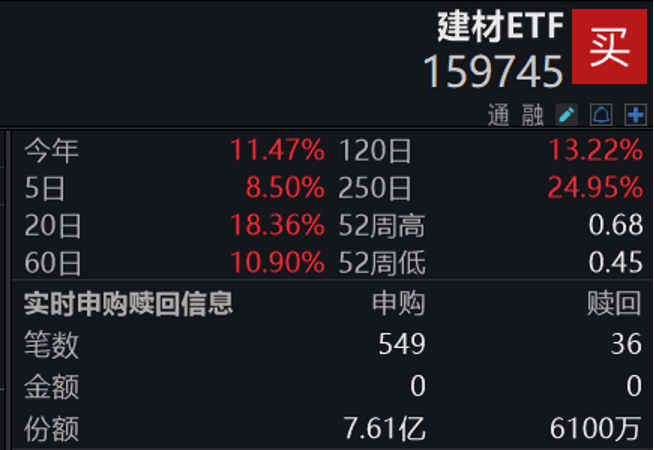
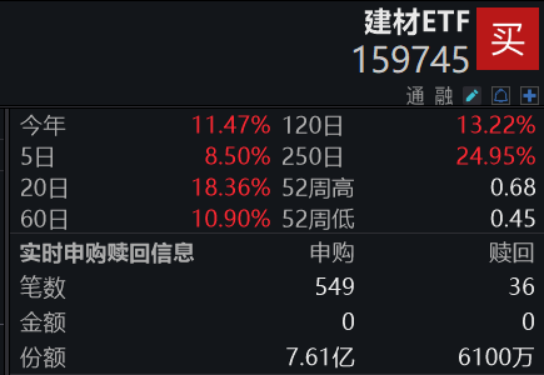
全市场规模最大建材ETF(159745)昨日净流入超5亿份!建材ETF(159745)涨超2%,雅江万亿工程催化建材板块!
Sou Hu Cai Jing· 2025-07-22 02:26
Group 1 - The core viewpoint of the news highlights a significant inflow of over 500 million units into the building materials ETF (159745), driven by optimistic market sentiment regarding demand recovery due to the commencement of the Yarlung Tsangpo River downstream hydropower project [1] - The Yarlung Tsangpo River downstream hydropower project, which began construction on July 19, will involve the establishment of five tiered power stations over a ten-year period, with a total investment of approximately 1.2 trillion yuan [1] - The project is expected to stimulate demand for essential building materials such as steel, cement, non-ferrous metals, and waterproof materials, acting as a stabilizer against short-term demand fluctuations [1] Group 2 - The Ministry of Industry and Information Technology announced that a growth stabilization plan for ten key industries, including steel, non-ferrous metals, petrochemicals, and building materials, is set to be released, indicating a move towards supply-side reform 2.0 [1] - The building materials ETF (159745) is the largest in the market, closely tracking the CSI All Share Construction Materials Index, and is positioned to benefit from the recovery in consumption and the real estate market [2] - As of July 21, 2025, the building materials ETF has a scale of 1.111 billion yuan, ranking first among three similar products, indicating strong market interest and potential for growth in the building materials sector [2]
杨德龙:低利率环境有利于权益投资
Xin Lang Ji Jin· 2025-07-22 02:01
Group 1: Monetary Policy and Economic Impact - The People's Bank of China (PBOC) maintained the Loan Prime Rate (LPR) at 3.05% for one year and 3.5% for five years, aligning with market expectations due to the current low interest rate environment [1] - The low interest rate policy aims to stimulate economic growth and stabilize the real estate and stock markets, with adjustments made to mortgage rates to support the housing market [1] - There is limited potential for significant increases in housing prices, as expectations have fundamentally changed, and the low interest rate policy primarily seeks to prevent a sharp decline in property values [1] Group 2: Industrial Growth and Economic Recovery - The Ministry of Industry and Information Technology (MIIT) proposed a new round of growth stabilization plans for key industries such as steel, non-ferrous metals, petrochemicals, and building materials, indicating more policies will be implemented in the second half of the year [3] - China's GDP grew by 5.3% in the first half of the year, and further stabilization policies are needed to achieve the annual growth target of around 5% [3] - The stock market is expected to benefit from the economic recovery, with the Shanghai Composite Index surpassing 3500 points and the Hang Seng Index exceeding 25000 points, indicating potential for increased investment opportunities [3] Group 3: Trade and Inflation Concerns - The trade war initiated by President Trump has led to rising costs for American businesses, with the Federal Reserve reporting price increases across all regions, particularly affecting manufacturing and construction sectors [4] - The increase in tariffs has pressured profit margins for companies, leading some to pass costs onto consumers, which may contribute to inflationary pressures [4] - Despite the challenges posed by tariffs, China's economy showed resilience with a 5.3% GDP growth, driven by strong consumer spending, which accounted for 52% of GDP growth [4]
超级工程开工,建材ETF(159745)涨停,基建ETF(159619)收涨超6%
Sou Hu Cai Jing· 2025-07-22 01:16
Core Viewpoint - The launch of the Yarlung Tsangpo River downstream hydropower project and the announcement of ten key industries' growth stabilization plans have positively impacted cyclical sectors such as building materials, infrastructure, steel, and coal, leading to significant market gains [1][3]. Group 1: Market Performance - The Building Materials ETF (159745) experienced a strong performance, closing at the daily limit with a net subscription of nearly 700 million shares [1]. - The Infrastructure ETF (159619) also performed well, ultimately rising over 6% [1]. - The overall market sentiment has shifted from "weak expectations - weak reality" to "strong expectations - weak reality," indicating a clearer bottoming out in cyclical sectors [7]. Group 2: Project Impact - The Yarlung Tsangpo River downstream hydropower project, with a total investment of approximately 1.2 trillion yuan, is expected to create significant demand for upstream and downstream industries, particularly in steel, cement, and other construction materials [2]. - The project will involve the construction of five tiered power stations over a ten-year period, which is anticipated to act as a stabilizer against short-term demand fluctuations [2]. Group 3: Policy Support - The Ministry of Industry and Information Technology announced that growth stabilization plans for ten key industries, including steel and building materials, are forthcoming, which is expected to enhance market confidence [3]. - The ongoing "anti-involution" policies and the introduction of detailed supportive measures are seen as crucial for breaking the negative feedback loop between PPI and CPI, thereby fostering a healthier economic outlook [3]. Group 4: Investment Opportunities - The cyclical sectors, particularly building materials, infrastructure, and steel, are poised to benefit directly from the implementation of the "super project," with substantial room for earnings and valuation expansion [7]. - The coal sector, previously underperforming, also shows potential for valuation recovery, with dividend yields exceeding 5%, providing a significant safety margin for investors [7].

摩根士丹利:通缩到何时,改革方破局?
摩根· 2025-07-21 14:26
Investment Rating - The report upgrades the actual GDP growth forecast for the year to 4.8% due to strong growth in the second quarter, reflecting a 30 basis point increase from previous estimates [6]. Core Insights - The report highlights three major economic drag factors: declining exports, weakening fiscal impulse, and persistent deflation [10][14][20]. - It emphasizes the need for structural reforms to address systemic tendencies of overcapacity and to stimulate domestic consumption [45][59]. Summary by Sections Economic Growth - The actual GDP growth rate for China is projected to be 4.8% for the year, up from previous forecasts due to strong second-quarter performance [6]. - The report indicates a downward trend in economic momentum post-first quarter, with GDP growth expectations adjusted accordingly [9]. Export Dynamics - Exports are expected to decline in the second half of the year as the effects of previous export surges fade and global trade softens [10]. - The report provides a forecast of China's quarterly export volumes, indicating a potential drop in export activity [11]. Fiscal Policy - The fiscal impulse is anticipated to weaken in the second half of the year, with a more moderate scale of incremental policy measures [14]. - The report estimates a net financing of government bonds, excluding special refinancing bonds, to be around 3.2 trillion RMB for 2024 and 2.7 trillion RMB for 2025 [15]. Deflationary Pressures - Persistent deflation is highlighted as a significant issue, with nominal GDP growth weakening and adversely affecting wage growth [20]. - The report notes that consumer spending, excluding trade-in products, remains sluggish, indicating weak demand [23]. Corporate Profitability - The report indicates that corporate pricing power remains weak, with a significant decline in industrial enterprise profit growth and an expanding profit margin drop [25]. - It highlights the need for improved corporate profitability to stimulate economic recovery [27]. Real Estate Market - The real estate market is showing signs of weakening momentum, with a decline in second-hand housing transaction volumes and prices [30]. - The report suggests that the government may need to implement measures to stimulate housing demand [31]. Structural Reforms - The report discusses the necessity of structural reforms to curb systemic overcapacity tendencies and improve the fiscal system [45]. - It emphasizes the importance of enhancing social welfare systems to release household savings for consumption [58]. Currency Outlook - The report forecasts a mild appreciation of the RMB against the USD, with expectations of the exchange rate reaching 7.15 by the end of 2025 [93]. - It also notes that the RMB is expected to depreciate moderately against a basket of currencies [93]. Technological Advancements - The report highlights the importance of technological innovation in driving the next round of industrial upgrades, with a focus on AI and automation [122][128]. - It notes that China has established a robust ecosystem for AI development, which is expected to accelerate investment in emerging industries [130].
7月政治局会议前瞻
2025-07-21 14:26
Summary of Key Points from Conference Call Records Industry or Company Involved - The records primarily discuss the Chinese economy, AI industry, and the semiconductor sector, particularly focusing on companies like Nvidia and AMD, as well as major Chinese tech firms such as Alibaba, Baidu, Tencent, and Global Data. Core Insights and Arguments 1. **Chinese Export Growth**: China's export growth exceeded expectations, with a cumulative growth rate of approximately 6% in the first half of the year, aided by a nearly 20% depreciation of the RMB's effective exchange rate since 2022, enhancing price competitiveness for Chinese manufactured goods [1][3][4]. 2. **Domestic Policy Changes**: The implementation of anti-involution policies is expected to stabilize price expectations and may signal the beginning of Supply-Side Reform 2.0, aimed at addressing current price declines and weak demand [1][5]. 3. **US Economic Growth Expectations**: The US "Inflation Reduction Act" is projected to positively impact GDP growth, potentially increasing it by up to 1.5 percentage points in 2025, supported by significant tax cuts and increased tariff revenues [1][3]. 4. **Stabilization of RMB Exchange Rate**: Contrary to initial predictions of significant depreciation, the RMB has remained stable or appreciated slightly, with forecasts suggesting a potential decline of about 20% in the USD index over the next three to five years [1][4]. 5. **China's GDP Growth**: In the first half of 2025, China's GDP grew by 5.3%, with external demand contributing significantly, although internal demand remained weak. Retail growth was driven by policies encouraging the replacement of old products, particularly in appliances [1][8]. 6. **AI Industry Outlook**: The relaxation of export controls on Nvidia and AMD chips is seen as a positive signal for China's AI industry, although a supply gap is still anticipated in 2025. Major beneficiaries are expected to be cloud service providers and leading companies in the data center chain [2][19]. 7. **Real Estate Market Challenges**: The real estate market in China faces significant challenges, with sales declining sharply in Q2. The government is expected to implement more supportive policies to stabilize the market [12][9]. 8. **Investment Trends**: There is a notable shift in global capital flows, with significant inflows into the US market, particularly in AI-related sectors, while emerging markets are experiencing net outflows [13][14]. Other Important but Possibly Overlooked Content 1. **Macroeconomic Policy Adjustments**: The upcoming political bureau meeting is expected to focus on the effects of anti-involution policies, which are seen as crucial for achieving economic rebalancing and preventing further price declines [5][10]. 2. **Consumer Spending Trends**: Consumer spending is showing signs of recovery, particularly in categories like home appliances and electronics, with retail growth rates reaching 20% to 30% in certain segments [8]. 3. **Potential Monetary Policy Changes**: There is speculation about possible interest rate cuts in the US, with a high probability of two rate cuts within the year, which could influence market dynamics [3][10]. 4. **Impact of CPI and PPI Trends**: Negative growth in both CPI and PPI in the first half of 2025 could lead to a negative feedback loop affecting economic expectations and demand [11]. 5. **Long-term AI Investment Confidence**: Foreign investors maintain a positive outlook on AI technology, viewing it as a significant driver of productivity and new market opportunities, particularly in China due to its data resources and research capabilities [6].
ETF日报:创业板指目前市盈率历史分位数较低,相对其他主流宽基指数具备明显的估值优势,可关注创业板50ETF
Xin Lang Ji Jin· 2025-07-21 12:12
Market Overview - A-shares opened higher and continued to rise, with the Shanghai Composite Index closing at 3559.79 points, up 0.72%, and the Shenzhen Component Index closing at 11007.49 points, up 0.86% [1] - The market saw significant trading volume, with the Shanghai index and ChiNext reaching new highs for the year [1] - Infrastructure stocks surged, particularly in cement and building materials, while agricultural banks and cross-border payment sectors faced adjustments [1] Policy and Economic Drivers - Positive news such as the commencement of "super projects" and intensified "anti-involution" policies bolstered market confidence [1] - The Ministry of Industry and Information Technology announced that a new round of growth stabilization plans for ten key industries, including steel and non-ferrous metals, is forthcoming [1][6] - The "anti-involution" policies are expected to support structural adjustments and the elimination of outdated production capacity [6] Investment Strategy - The market is witnessing a shift in investor sentiment, with a marginal turn in capital allocation as doubts about "deflation trades" arise [1] - The traditional barbell strategy of large-cap value and small-cap growth is facing challenges, with large-cap growth represented by the ChiNext index showing significant valuation advantages [2] - Investors are encouraged to consider opportunities in the ChiNext 50 ETF (159375) and the Sci-Tech Innovation ETF (588360) [2] Sector Performance - The construction materials ETF (159745) saw a strong performance, closing at a limit-up after a significant net subscription of nearly 700 million shares [4] - The commencement of the Yarlung Tsangpo River downstream hydropower project, with a total investment of approximately 1.2 trillion yuan, is expected to boost demand for steel, cement, and other construction materials [4] - The cyclical sectors, including construction materials, infrastructure, and steel, are anticipated to benefit directly from the implementation of "super projects" [9] Market Sentiment and Future Outlook - The current market conditions resemble those of 2015, where proactive policies may break the negative feedback loop between PPI and CPI, positively impacting economic expectations [7] - The valuation logic for cyclical sectors is shifting from "weak expectations - weak reality" to "strong expectations - weak reality," indicating a clearer bottoming out [9] - The technology sector in the Hong Kong market is also showing strength, with the Hang Seng Technology Index up 25.01%, outperforming many broad-based indices [3]

多部门密集发声 铁矿石拉涨突破800元/吨一线
Jin Tou Wang· 2025-07-21 08:39
消息面 7月18日:全国主港铁矿石成交79.2万吨,环比下跌30.77%;远期现货成交100万吨。 2025年7月14日-7月20日中国47港铁矿石到港总量2511.8万吨,环比减少371.4万吨;中国45港铁矿石到 港总量2371.2万吨,环比减少290.9万吨;北方六港铁矿石到港总量1389.2万吨,环比增加241.3万吨。 2025年7月14日-7月20日全球铁矿石发运总量3109.1万吨,环比增加122.0万吨。澳洲巴西铁矿发运总量 2552.0万吨,环比减少6.8万吨。 格林大华期货: 多部门密集发声,反内卷政策力度逐步增强,被看做供给侧改革2.0。宏观驱动产业,现货价格强势突 破100美元。铁矿盘面再创新高,突破800整数关口。上周铁水日产242.44万吨,环比增加2.63万吨。铁 水产量居高不下,支撑铁矿需求。当前市场宏观强预期,叠加高铁水,铁矿走势中线偏多。但短期仍有 回调风险。主力压力位上移至810,支撑位715。交易策略:中线偏多,短线警惕高位回调风险。 新世纪期货: 近期反内卷政策提振黑色市场情绪,铁矿石盘面大幅拉涨。矿山季末冲量基本结束,全球铁矿发运有一 定程度下降,近端到港量由于前期 ...
反内卷系列研究报告(一):反内卷:行业差异与资产影响
HUAXI Securities· 2025-07-20 14:28
Policy Overview - The current "anti-involution" policy differs from the 2015 supply-side reform, focusing on effective demand shortages and low-end oversupply rather than structural mismatches in supply and demand[1] - The current policy extends to emerging manufacturing sectors like photovoltaics, new energy vehicles, and lithium batteries, which are predominantly private enterprises[1] Industry Capacity and Profitability - Overall industrial capacity utilization and profit margins are low, with further downward pressure expected; policy intervention is needed for market supply-demand rebalancing[2] - Key sectors like automotive manufacturing, electrical machinery (including photovoltaics), and non-metal mineral manufacturing (glass, cement) are in a "double low" state of low profit margins and capacity utilization, necessitating capacity clearance[2] Key Areas of Focus - Photovoltaics: Trade barriers and subsidy reductions have led to overcapacity and price declines; restructuring and demand-side policies are crucial for stabilizing prices[3] - Automotive Lithium: Structural contradictions between fuel and new energy vehicles have intensified, requiring capacity reduction for fuel vehicles and market expansion for new energy vehicles[3] - Coal: High coal inventories suppress prices, but long-term contracts stabilize profits for major coal companies; structural optimization may benefit coking coal enterprises[3] - Steel: Equipment upgrades are driving demand, but the real estate market remains weak, keeping profit margins low; effective capacity reduction and demand-side policies are key for improvement[3] Asset Impact - Equity markets may see index recovery due to "anti-involution" policies, but sustainability depends on the effectiveness of demand-side policies[4] - Bond markets face short-term pressure from equity market rebounds, with medium-term risks from rising interest rates due to inflation[4] - Commodity markets show strong short-term sentiment; caution is advised for shorts, while longs should monitor long-term supply-demand improvements[4] Risk Factors - Unexpected changes in macroeconomic conditions or industrial policies pose risks to the effectiveness of the "anti-involution" measures[5]

锂电行业“反内卷”:从价格厮杀走向“理性繁荣
高工锂电· 2025-07-20 12:11
Core Viewpoint - The "anti-involution" policy is reshaping market expectations and is seen as a 2.0 version of China's supply-side reform, particularly impacting emerging industries like lithium batteries, photovoltaics, and electric vehicles [2][3]. Group 1: Industry Overview - The lithium battery industry has experienced explosive growth over the past decade, with total production reaching 1170 GWh and industry output exceeding 1.2 trillion yuan in 2022, compared to just 29.868 GWh in 2014 [8]. - Despite significant growth, the industry faces challenges as rapid physical growth has not translated into corporate profits, with many companies selling inventory at prices just covering raw material costs [9][10]. - The lithium battery sector holds over 70% of the global market share, yet it is engaged in "bottom competition" internationally, leading to a decline in average prices [10]. Group 2: Policy and Legislative Changes - The "anti-involution" initiative has moved towards legislative depth, with new laws targeting price stability and fair trading conditions, including the prohibition of selling below cost [4]. - The government is addressing issues of homogeneous capacity caused by chaotic investment practices, emphasizing the need for transparent investment disclosures [5]. Group 3: Market Dynamics and Challenges - The industry is experiencing a price war, with over 30 car manufacturers reducing prices to clear inventory, leading to a significant drop in profit margins within the automotive sector [13]. - The lithium price has been on a downward trend since late 2022, with expectations of continued oversupply in the market, affecting upstream material suppliers [14]. Group 4: Future Directions and Innovations - The "anti-involution" marks a critical turning point for the lithium battery industry, focusing on the elimination of outdated capacity and driving technological upgrades [16][17]. - New investment trends are emerging, with a focus on battery recycling and solid-state batteries, indicating a shift towards a circular economy and technological innovation [20]. - Companies are increasingly investing in high-pressure lithium iron phosphate batteries, which are expected to enhance profit margins and meet rising demand for fast-charging solutions [21].


债市短评:当前债市的几个潜在风险
Hua Yuan Zheng Quan· 2025-07-20 11:38
Report Summary 1. Report Industry Investment Rating The report does not explicitly mention the industry investment rating. 2. Core Views of the Report - "Anti - involution" may be Supply - side Reform 2.0, potentially driving a significant rebound in PPI and impacting the bond market [2]. - The stock market is rising steadily, with a notable increase in risk appetite. This may attract funds into the stock market, putting pressure on the bond market [2]. - China's export resilience is prominent. There is a possibility of a further reduction in US tariffs on China, which could promote export growth [2]. - The commencement of the Yarlung Zangbo River downstream hydropower project may boost infrastructure investment growth and drive up related stock prices [2]. - The bond market is expected to fluctuate narrowly in the short term. Attention should be paid to the progress of "anti - involution". The report recommends long - duration sinking of urban investment bonds, capital bonds, and insurance sub - bonds, and suggests paying attention to investment opportunities in certain capital bonds and Hong Kong - listed bank stocks [2]. 3. Summary by Related Aspects Macroeconomic Policy Impact - In 2015, supply - side reform and shantytown renovation promoted a significant rebound in PPI and nominal GDP growth, causing the bond market to decline. In 2025, "anti - involution" has become the focus of economic policy and may have a similar impact [2]. Stock and Bond Market Relationship - Since the Spring Festival in 2025, the stock market has been rising steadily, ending the negative economic cycle from 2022 - 2024. The wealth effect of the stock market promotes consumption, and the inflow of funds into the stock market may put pressure on the bond market [2]. Export Situation - China's total export value has grown rapidly in the past year. The resilience of exports is not only due to "rush - to - export" but also reflects the global competitiveness of many industries. A reduction in US tariffs on China could further boost exports [2]. Infrastructure Investment - The Yarlung Zangbo River downstream hydropower project, with a total investment of about 1.2 trillion yuan, may drive the stabilization of infrastructure investment growth and the rise of related stocks [2]. Bond Market Outlook - The bond market's trading volume is overly concentrated in ultra - long - term interest - rate bonds. If the "anti - involution" efforts are strong, it may lead to the collapse of the ultra - long - term bond concentration and a 10 - 20BP adjustment in the bond market. The 10 - year Treasury yield may need a new round of interest rate cuts to reach a new low. In the short term, the bond market will fluctuate narrowly, and attention should be paid to the progress of "anti - involution" [2].