
债市震荡

Search documents
纯债基金9月业绩遇冷 “固收 +” 产品逆势领跑 四季度债市增量资金成关键
Mei Ri Jing Ji Xin Wen· 2025-09-29 16:20
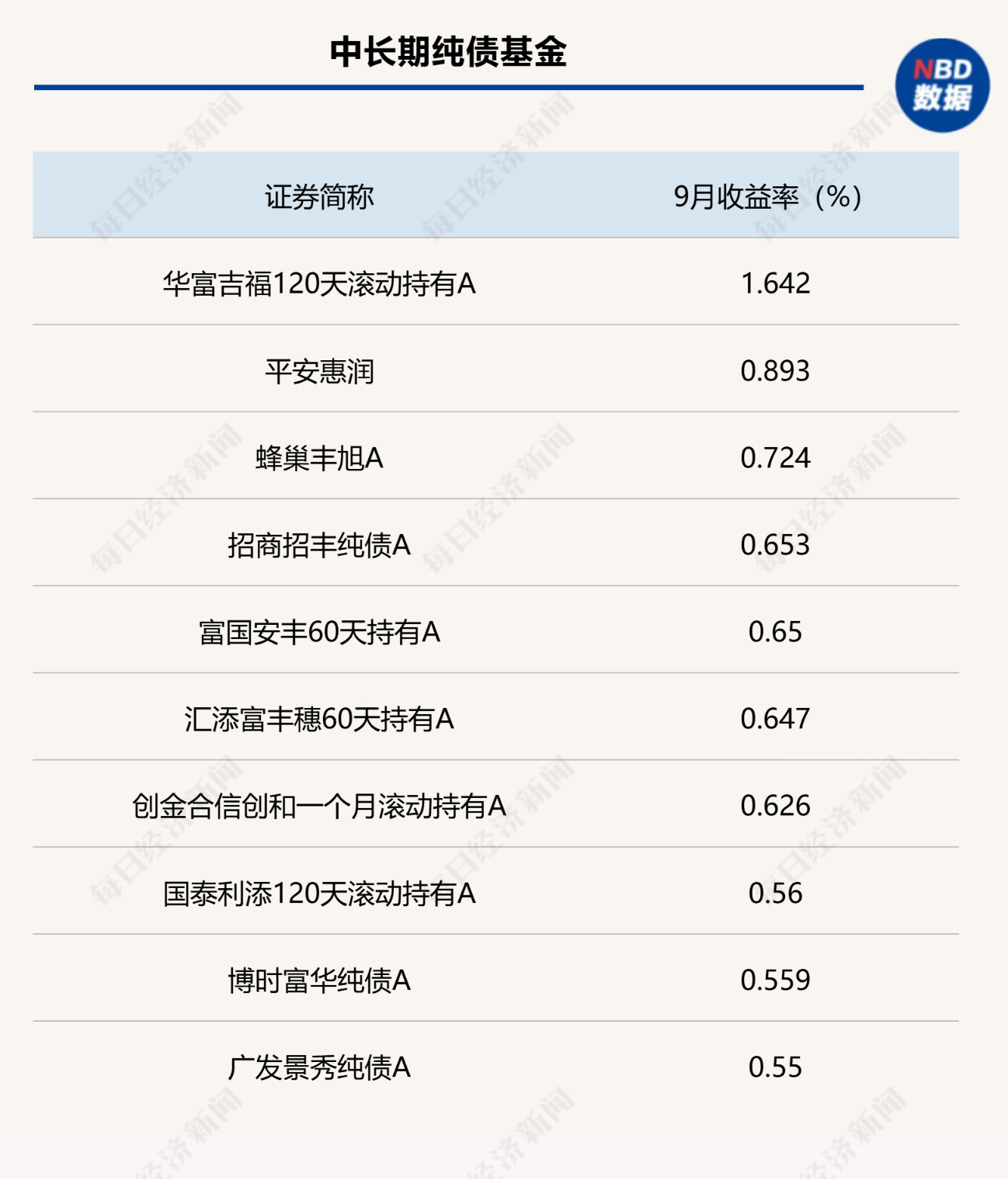
Group 1 - The core viewpoint indicates that the bond market continues to experience a weak and volatile trend, with pure bond funds underperforming, as evidenced by the average monthly return of medium to long-term pure bond funds being negative as of September 28 [1][2] - The highest yield for bond funds in September reached 5.57%, with "fixed income +" funds outperforming pure bond funds significantly, highlighting a growing disparity in performance [2][10] - Despite the overall weak performance of pure bond funds, "fixed income +" products have shown resilience, with some top-performing products achieving returns exceeding 5% in September [2][3] Group 2 - The bond market sentiment remains cautious as the end of the quarter approaches, with credit bond rates rising and credit spreads widening, raising concerns about the lack of incremental funds in the market [4][5] - Analysts express that the impact of new regulations on bond funds is likely to be temporary and not indicative of a long-term decline in demand, as there remains strong allocation demand from wealth management and insurance funds [5] - The performance of pure bond funds has been lackluster, with the total index for bond funds rising by only 1.5% this year compared to a mere 0.39% increase for pure bond funds, indicating a shift in investor preference towards more flexible and risk-controlled strategies [3][4] Group 3 - The average monthly return for medium to long-term pure bond funds was reported at -0.18%, while short-term bond funds had a marginally positive return of 0.004% as of September 28 [2] - The top-performing pure bond funds in September had yields ranging from 0.559% to 1.642%, indicating a significant underperformance compared to "fixed income +" funds [7] - The top short-term bond funds yielded between 0.214% and 0.499%, further illustrating the challenges faced by pure bond funds in the current market environment [9]

【公募基金】美联储降息落地,债市延续区间震荡——公募基金泛固收指数跟踪周报(2025.09.15-2025.09.19)
华宝财富魔方· 2025-09-22 09:08
Market Overview - The bond market experienced significant fluctuations last week (September 15-19, 2025), with the 1-year government bond yield decreasing by 1 basis point to 1.39%, while the 10-year and 30-year yields increased by 1.19 basis points to 1.88% and 1.56 basis points to 2.20%, respectively. The market sentiment improved in the first half of the week due to expectations of central bank bond purchases, but weakened in the latter half due to poor bond issuance results and other factors [3][16][17]. Public Fund Market Dynamics - On September 12, the National Index announced the launch of the National Index Free Cash Flow Market Bond Mixed Index series on September 17, which includes various indices with different asset allocation targets [4][19]. Fund Index Performance Tracking - The Money Enhanced Index rose by 0.03% last week, with a cumulative return of 4.07% since inception. The Short-term Bond Fund Index also increased by 0.03%, with a cumulative return of 4.20% [5][6][21]. - The Mid-to-Long-term Bond Fund Index saw a 0.04% increase, accumulating a return of 6.11%. Conversely, the Low Volatility Fixed Income + Fund Index decreased by 0.05%, with a cumulative return of 3.80% [7][8][9][10][21]. - The Convertible Bond Fund Index fell by 1.37%, but has a cumulative return of 19.22% since inception. The QDII Bond Fund Index increased by 0.11%, with a cumulative return of 10.13% [11][12][21]. REITs Market - The REITs market showed mixed performance, with the China Securities REITs Total Return Index rising by 0.12%. As of September 19, 2025, there have been 16 successful REITs issuances this year, totaling 33.65 billion yuan [13][18][21].

博时宏观观点:债市或维持震荡格局
Xin Lang Ji Jin· 2025-09-16 09:05
Group 1 - The certainty of the Federal Reserve's interest rate cut is increasing, leading to an appreciation of the RMB and an accelerated inflow of foreign capital into Chinese assets [1][2] - Domestic policies aimed at stabilizing growth, particularly in the real estate sector, are expected to improve the external environment for equity assets, suggesting a bullish outlook [1][2] - Recommended sectors include media, computer technology, electrical equipment, non-bank financials, non-ferrous metals, food and beverage, and pharmaceutical biology [1][2] Group 2 - In the bond market, the recent marginal tightening of the funding environment has not significantly impacted the resilience of the equity market, with expectations of continued support from the central bank [2] - The basic economic indicators show a continuation of weak fundamentals, but the central bank's actions indicate a commitment to maintaining liquidity [2] - The A-share market is expected to benefit from the anticipated interest rate cuts and the favorable external environment [2] Group 3 - The expectation of a rate cut by the Federal Reserve is likely to create a favorable financial condition for non-U.S. markets, including Hong Kong stocks [3] - Weak demand for crude oil is projected for 2025, with ongoing supply releases putting downward pressure on oil prices [4] - The anticipated easing of financial conditions before the Federal Reserve's rate cut is expected to positively influence gold performance [5]
债市延续震荡格局 投资者应保持定力
Sou Hu Cai Jing· 2025-09-11 22:10
Group 1 - The recent decline in the national bond market has led to the main contract of bond futures hitting a six-month low, with the 30-year bond futures weighted index nearing its yearly low [1] - The yield on the 10-year active bond has risen above 1.8%, increasing from 1.63% to a peak of 1.83% over two months, marking a 20 basis points rise [1] - The cumulative yield of the China Securities Comprehensive Bond Index for the year is only 0.33%, with passive index bond funds and medium-to-long-term pure bond funds showing negative average net values in August [1] Group 2 - The current adjustment in the bond market is driven by two main factors: the continuous bull run in the stock market, which has increased investor risk appetite, and the implementation of anti-involution policies that have raised inflation expectations [1] - The equity market's rising risk appetite is expected to continue, with the Shanghai and Shenzhen stock exchanges seeing over 10 trillion yuan in trading volume for 76 consecutive trading days [2] - Despite the bullish expectations, the real economy still requires further improvement, with weak demand in real estate and exports limiting the upward pressure on prices [2]
利率后市或低位震荡,关注十年国债ETF(511260)逢低布局机会
Sou Hu Cai Jing· 2025-09-11 01:27
Group 1 - The ten-year government bond ETF (511260) showed weak performance, declining by 0.22% on September 10 and 0.45% over the past five days, indicating a bearish signal in the short term [1] - The current macroeconomic fundamentals and funding environment suggest that the bond market is in a range-bound oscillation, with upward and downward limits on interest rates, recommending a focus on swing trading and monitoring rebound opportunities [1][2] - The widening gap between social financing scale and RMB loans is driven by government bonds and leveraging to support the economy, with fiscal policies aimed at boosting domestic demand and improving profit expectations [2] Group 2 - Despite support for the bond market, there are constraints from policies and funding, making it difficult for the ten-year government bond yield to drop below 1.7% or 1.6% [2] - The narrow interest rate spread indicates that the central bank's easing policies aim to maintain existing low rates rather than push rates further down, limiting the downward momentum for long-term rates [2] - There are risks of breaking the narrow oscillation, particularly from rising inflation expectations and potential actions from the central bank regarding interest rate cuts and government bond purchases [3]
重提“防范资金空转”,有何含义?
Changjiang Securities· 2025-09-10 14:15
Report Industry Investment Rating No relevant content provided. Core Viewpoints - The People's Bank of China's mention of "preventing idle capital circulation" aims to correct the irrational credit structure and aligns with the overall spirit of "anti-involution." It is expected that the growth rate of social financing has gradually peaked, and credit will decline year-on-year in the second half of the year. Interest rate cuts may be more inclined to "effectively cope with external shocks." The bond market is currently intertwined with bullish and bearish factors, and is likely to continue its weak oscillation pattern in the near future [1][7]. Summary by Related Catalogs What is "Idle Capital Circulation"? - The first type of idle capital circulation refers to the situation where the base currency does not convert into social financing according to the full money multiplier but accumulates in the financial system. For example, it can be retained through the non-bank loan - interbank deposit method. When the marketization degree of interbank deposit interest rates is insufficient, it is prone to trigger various arbitrage models. However, normal "deposit transfer" by residents will also boost the growth rate of non-bank deposits, which is a normal credit expansion function of non-bank institutions, and M2 will decrease in this process [7][13][14]. - The second type of idle capital circulation is related to the credit structure of the real economy. In reality, due to greater economic downward pressure, the financing demand of small and medium - sized enterprises is not strong, but banks have a natural inclination for loan scale. Therefore, they conduct "large - customer stacking" through "involution - style" lending, concentrating excessive credit on large enterprises and potentially reducing credit interest rates in an "involution - style" manner. This violates the People's Bank of China's emphasis on "preventing idle capital circulation and maintaining a balance between financial support for the real economy and self - health" [7][20][21]. How to View Social Financing and Credit, and Will There Be an Interest Rate Cut? - It is expected that the growth rate of social financing has gradually peaked, and credit will decline year - on - year in the second half of the year. After the "large - customer stacking" credit funds are released, the overall real - economy financing demand is still weak, so it is difficult for other types of enterprises to fully absorb these funds. As the peak of government bond issuance passes, the growth rate of social financing is expected to gradually peak [7][22]. - Short - term fluctuations in credit do not directly constitute a necessary reason for an interest rate cut. In the context of certain downward pressure on the economic operation and the adjustment of the real estate market, the effective loan demand is weak, and the correlation between loan interest rates and loan growth has significantly weakened in recent years. Interest rate cuts may have limited effect on directly boosting credit. With the further development of "reciprocal tariffs," subsequent interest rate cuts and other aggregate tools may be more inclined to "effectively cope with external shocks" [7][25]. - The current bond market is intertwined with bullish and bearish factors, with insufficient odds in the short term and lacking a basis for significant adjustment. The stock - bond "see - saw" effect may continue, and it is expected that the bond market may continue to maintain a weak oscillation pattern in the near future [1][7][25].
国债月报:债市或延续震荡-20250905
Wu Kuang Qi Huo· 2025-09-05 13:24
Report Industry Investment Rating No relevant content provided. Core Viewpoints of the Report - Fundamentally, the manufacturing PMI in August improved compared to the previous month but remained below the boom-bust line. Both supply and demand showed a month-on-month improvement, and the price level rebounded under the "anti-involution" policy. However, the export may face pressure in the future as the effect of pre-exporting weakens. In terms of funds, the central bank maintains an attitude of supporting funds, and it is generally expected that the funds will remain loose in the future. Looking ahead, with weak domestic demand recovery and the likelihood of continued loose funds, interest rates are expected to have downward room. However, in terms of rhythm, attention should be paid to the seesaw effect between stocks and bonds, and the bond market is expected to be in a short-term volatile pattern. The bond market should be considered for long positions on dips in the medium to long term [15]. Summary by Relevant Catalogs 1. Monthly Assessment and Strategy Recommendation - **Economic and Policy Environment**: The manufacturing PMI data in August showed a slight overall improvement, with both supply and demand ends recovering. The "anti-involution" policy boosted price expectations, but the coordination between demand and production needs further observation. In terms of exports, although the import and export data in July exceeded expectations due to the pre-exporting effect, exports may face pressure in the future due to the overdraft of pre-exporting and the rising base in the second half of the year. Overseas, the market has strong expectations for a US interest rate cut in September, which is beneficial for financial market liquidity. On September 5, the central bank conducted a 10000 - billion - yuan outright reverse repurchase operation with a term of 3 months to maintain sufficient liquidity in the banking system [14]. - **Liquidity**: This week, the central bank conducted 10684 billion yuan in reverse repurchase operations, with 22731 billion yuan in reverse repurchases maturing, resulting in a net withdrawal of 12047 billion yuan. The DR007 interest rate closed at 1.45% [15]. - **Interest Rates**: The latest 10Y Treasury yield closed at 1.80%, down 4.76BP week - on - week; the 30Y Treasury yield closed at 2.07%, down 6.85BP week - on - week. The latest 10Y US Treasury yield was 4.17%, down 6.00BP week - on - week [15]. - **Trading Strategy**: It is recommended to take long positions on dips for a single - sided strategy, with a profit - loss ratio of 3:1 and a recommended period of 6 months. The core driving logic is loose monetary policy and the difficulty of credit improvement [17]. 2. Futures and Spot Markets - **Contract Performance**: The report presents the closing prices, annualized discounts, settlement prices, and net basis of T, TL, TF, TS contracts, as well as the closing prices and trading volumes of TS and TF, T and TL contracts, but no specific analysis conclusions are provided [20][23][26][29][32][33]. 3. Main Economic Data Domestic Economy - **GDP and PMI**: In the second quarter of 2025, the actual GDP growth rate was 5.4%, exceeding market expectations. The manufacturing PMI in August was 49.4%, up 0.1 percentage points from the previous value, and the service industry PMI was 50.5%, up 0.5 percentage points from the previous value [38]. - **Manufacturing PMI Sub - items**: In August, both supply and demand in the manufacturing industry recovered. Industries such as pharmaceuticals and computer communication and electronic equipment had production and new order indices higher than the overall manufacturing PMI, while industries such as textile and clothing, wood processing and furniture, and chemical raw materials and chemicals were below the boom - bust line [44]. - **Price Index**: In July, the year - on - year CPI was 0.0%, the core CPI was up 0.8% year - on - year, and the PPI was down 3.6% year - on - year. The month - on - month CPI was 0.4%, the core CPI was 0.4%, and the PPI was - 0.2%. The increase in the month - on - month CPI was mainly driven by seasonal factors and the rise in consumer goods prices, while the year - on - year decline in PPI remained flat and the month - on - month decline narrowed [47]. - **Export Data**: In July, China's imports and exports recovered due to pre - exporting, with exports (in US dollars) increasing by 7.2% year - on - year and imports increasing by 4.1% year - on - year. Exports to the US decreased by 21.67% year - on - year, while exports to ASEAN maintained a high growth rate of 16.59% year - on - year [50]. - **Industrial and Consumption Data**: In July, the year - on - year growth rate of industrial added value was 5.7%, and the year - on - year growth rate of total retail sales of consumer goods was 3.7%, both showing a slowdown [53]. - **Investment and Real Estate Data**: From January to July, the cumulative year - on - year growth rate of fixed - asset investment was 1.6%, and the real estate investment growth rate was - 12.0%. In July, the month - on - month price of second - hand housing in 70 large and medium - sized cities was - 0.5%, and the year - on - year price was - 5.9%. The new construction area in July was 352060000 square meters, with a year - on - year decrease of 19.4%, and the new construction area under construction was 6387310000 square meters, with a year - on - year decrease of 9.2%. The completion data in July decreased by 29.46% year - on - year, and the new home sales data in 30 large - and medium - sized cities weakened [56][59][62]. Foreign Economy - **US Economy**: In the second quarter, the annualized US GDP at current prices was 30331 billion US dollars, with a real year - on - year growth rate of 1.99% and a quarter - on - quarter growth rate of 3.0%. In July, the unadjusted CPI in the US increased by 2.7% year - on - year, the seasonally adjusted CPI increased by 0.2% month - on - month, and the PPI increased by 3.3% year - on - year. The durable goods orders in July were 3028 billion US dollars, with a year - on - year increase of 3.26%. The non - farm payrolls increased by 73000 in July, and the unemployment rate was 4.2%. In August, the ISM manufacturing PMI was 48.7, and the non - manufacturing PMI was 52 [65][68][71]. - **European Economy**: In the second quarter, the EU's GDP increased by 1.5% year - on - year and 0.2% quarter - on - quarter. In August, the preliminary value of the eurozone's CPI increased by 2.1% year - on - year and 0.2% month - on - month, and the core CPI increased by 2.3% year - on - year and 0.3% month - on - month. The manufacturing PMI in August was 50.7, and the service industry PMI was 50.5 [71][74]. 4. Liquidity - **Money Supply and Social Financing**: In July, the growth rate of M1 was 5.6%, and the growth rate of M2 was 8.8%. The incremental social financing in July was 1.16 trillion yuan, with an increase of 3893 billion yuan year - on - year. The new RMB loans were nearly - 500 billion yuan, and social financing mainly came from the growth of government bonds. Both corporate and household credit weakened [79]. - **MLF and Reverse Repurchase**: In August, the MLF balance was 55500 billion yuan, with a net injection of 3000 billion yuan. This week, the central bank conducted 10684 billion yuan in reverse repurchase operations, with 22731 billion yuan in reverse repurchases maturing, resulting in a net withdrawal of 12047 billion yuan, and the DR007 interest rate closed at 1.45% [85]. 5. Interest Rates and Exchange Rates - **Interest Rate Changes**: The report provides the latest interest rates, daily, weekly, and monthly changes of various types of interest rates, including repurchase rates, Treasury bond yields, and US Treasury bond yields [88]. - **Interest Rate and Exchange Rate Charts**: The report presents charts of Treasury bond yields, bank - to - bank pledged repurchase rates, US Treasury bond yields, and exchange rates, but no specific analysis conclusions are provided [92][95][96].
债市震荡格局何时休?汇安基金固收团队中报拆解
Jiang Nan Shi Bao· 2025-09-04 03:23
Group 1 - The bond market is under significant pressure while the stock market is experiencing volatility and reaching new highs, leading to investor concerns about the duration of this turbulent bond market environment [1][2] - The investment strategy focuses on maintaining low interest rates and reducing social financing costs to support economic growth, indicating that the bond market may continue to experience wide fluctuations due to supportive monetary policy and fundamental factors [2][4] - The performance of short-duration bond funds has become increasingly attractive amid heightened volatility in the bond market, with specific funds demonstrating strong returns compared to their benchmarks [3][6] Group 2 - The outlook for the bond market suggests that supportive monetary policies will remain in place, but the market may experience narrow fluctuations unless inflation targets or policies to expand domestic demand are introduced [4] - The convertible bond market is benefiting from the recovery in the equity market, with funds maintaining a steady allocation to convertible bonds while focusing on undervalued and fundamentally strong assets [5][6] - The performance of specific funds in the convertible bond sector has been notable, achieving significant excess returns compared to their performance benchmarks, indicating effective management strategies [6]
债市日报:9月2日
Xin Hua Cai Jing· 2025-09-02 07:50
Core Viewpoint - The bond market experienced a slight decline, with an overall increase in market risk appetite, leading to a drop in government bond futures and a rise in interbank bond yields [1][2]. Market Performance - Government bond futures closed lower across the board, with the 30-year main contract down 0.18% to 116.680, the 10-year main contract down 0.03% to 107.955, the 5-year main contract down 0.02% to 105.57, and the 2-year main contract down 0.02% to 102.412 [2]. - The yields on major interbank bonds generally increased, with the 10-year policy bank bond yield rising by 0.1 basis points to 1.871%, and the 10-year government bond yield increasing by 0.15 basis points to 1.77% [2]. Liquidity and Monetary Policy - The central bank conducted a reverse repurchase operation of 2,557 billion yuan at a fixed rate of 1.40%, resulting in a net withdrawal of 1,501 billion yuan for the day [4]. - The Shibor rates for short-term products mostly declined, with the overnight rate down 0.1 basis points to 1.314%, and the 7-day rate down 0.7 basis points to 1.431%, marking a new low since September 2022 [4]. Institutional Insights - Financial institutions suggest that while the bond market may not be overly pessimistic, the overall liquidity in the secondary market remains weak, with structural highlights in certain floating-rate bonds [5]. - The outlook for September indicates that the central bank will maintain a reasonable liquidity level, especially considering the seasonal pressures from the end of the quarter [5].
9月固定收益月报:把握调整后的结构性机会-20250831
Western Securities· 2025-08-31 09:00
1. Report Industry Investment Rating No relevant content provided. 2. Core Views of the Report - The current economic fundamentals are still favorable for the bond market, but the subsequent continuous implementation of growth - stabilizing policies will marginally be negative for the bond market [1][9]. - The central bank is expected to continue to support liquidity, keeping the overall capital situation stable, but it will also prevent capital idling [1][11]. - Some banks may have a need to raise the price of inter - bank certificates of deposit (CDs), and the capital movement of non - bank institutions may slow down marginally [2][13]. - The bond market is difficult to break out of the volatile trend. It is recommended to control the duration, seize the allocation and trading opportunities after adjustments, and focus on structural opportunities such as taxable bonds and new - old bonds [2][22]. 3. Summary According to the Table of Contents 3.1 9 - Month Bond Market Outlook: Seize Structural Opportunities after Adjustments - **Fundamentals and Policies**: The current economic situation has difficulties and challenges, which are favorable for the bond market. However, the subsequent continuous implementation of growth - stabilizing policies such as "anti - involution", major infrastructure projects, and fertility subsidies will be marginally negative for the bond market [9]. - **Liquidity**: The central bank is expected to continue to support liquidity to maintain stable capital prices and prevent financial market risks. It may also provide long - term funds and take other measures, but will prevent capital idling [11]. - **Inter - bank CDs**: In September, banks' demand for supplementing liabilities through CDs increases, but the issuance demand may be weaker than the seasonal level. The price increase of CDs may be structural [13]. - **Non - bank Institutions' Capital Movement**: The risk premium of equities relative to treasury bonds has decreased, reducing the marginal attractiveness to insurance funds. The long - term and ultra - long - term treasury bond yields have higher cost - effectiveness compared to lending rates, increasing the marginal attractiveness to bank funds [16]. - **Investment Strategy**: The bond market is likely to remain volatile. It is recommended to control the duration, allocate medium - and short - term credit bonds, and seize opportunities after adjustments. Taxable bonds and new - old bonds have certain investment opportunities [22]. 3.2 August Bond Market Review 3.2.1 Bond Market Trend Review - **First Week**: The 10Y treasury bond rate dropped 2bp to 1.69%. The market digested the impact of VAT adjustment, and the demand for old bonds increased. The capital was loose, and the issuance results of the first batch of taxed local bonds were better than expected [24]. - **Second Week**: The 10Y treasury bond rate rose 6bp to 1.75%. The market risk appetite increased, the equity market rose, and the bond market sentiment was under pressure [25]. - **Third Week**: The 10Y treasury bond rate rose 4bp to 1.78%. The stock - bond seesaw effect continued, and the bond market basically continued to decline. After the MLF was over - renewed, the capital pressure eased [26]. - **Fourth Week**: The 10Y treasury bond rate rose 6bp to 1.84%. The equity market was strong at the end of the month, the bond market yield fluctuated widely, and the curve steepened [27]. 3.2.2 Capital Situation - The central bank net - injected 5466 billion yuan through four major tools. The capital situation in August was reasonably abundant. The average monthly values of R001, R007, DR001, and DR007 decreased. The 3M inter - bank CD issuance rate fluctuated upward, and the 3M national - share bank bill rate changed in a complex way [28][31]. 3.2.3 Secondary Market Trends - In August, the bond market showed a bear - steep trend. Except for the 1y treasury bond rate, other key - term treasury bond rates rose. Most key - term treasury bond spreads widened [37]. 3.2.4 Bond Market Sentiment - In August, the inter - bank leverage ratio and bond fund duration both decreased. The turnover rate of ultra - long bonds decreased, and the spreads of 50Y - 30Y and 20Y - 30Y treasury bonds narrowed [49]. 3.2.5 Bond Supply - In August, the net financing of interest - rate bonds increased compared to July but decreased compared to the same period last year. The net financing of treasury bonds and policy - financial bonds increased, while that of local government bonds decreased. The net repayment of inter - bank CDs slightly expanded [56][64]. 3.3 Economic Data - In July, the decline in industrial enterprise profits continued to narrow. Since August, new - home sales and freight rates have been weak, while movie consumption has been relatively strong. Industrial production has weakened marginally [68]. 3.4 Overseas Bond Market - The US core inflation reached a new high since February. The Fed officials released signals of interest - rate cuts. In August, US bonds, as well as the bond markets in South Korea and Singapore, rose [78][79]. 3.5 Major Asset Performance - In August, the CSI 300 index strengthened significantly. The performance of major assets was: CSI 1000 > CSI 300 > Convertible Bonds > Shanghai Gold > Shanghai Copper > Chinese - funded US Dollar Bonds > China Bonds > US Dollar > Rebar > Live Pigs > Crude Oil [82]. 3.6 Policy Review - **August 28**: The "Opinions on Promoting High - Quality Urban Development" was released, aiming to achieve important progress in building modern people - centered cities by 2030 and basically complete the construction by 2035 [86]. - **August 27**: The Ministry of Commerce will introduce policies to expand service consumption in the next month, focusing on policy promotion, key areas, and consumption scenarios [89]. - **August 26**: The "Opinions on Deeply Implementing the 'Artificial Intelligence +' Initiative" was issued, setting goals for the development of artificial intelligence from 2027 to 2035 [90]. - **August 25**: Shanghai optimized and adjusted real - estate policies, including housing purchase restrictions, housing provident fund policies, and mortgage loan interest - rate mechanisms [91]. - **August 22**: The State Council emphasized the effectiveness of large - scale equipment renewal and consumer goods trade - in policies and the development of the sports industry [92]. - **August 20**: The "Guiding Opinions on Regulating the Construction and Operation of Existing Government - Social Capital Cooperation Projects" was issued to ensure the construction of ongoing projects and the stable operation of existing projects [93]. - **August 19**: The People's Bank of China Shanghai Head Office called for greater efforts in financial reform and innovation and the implementation of monetary policies [94].