
大宗商品超级周期

Search documents
AI狂潮如何重塑全球大宗商品超级周期?
Hua Er Jie Jian Wen· 2025-11-20 03:53
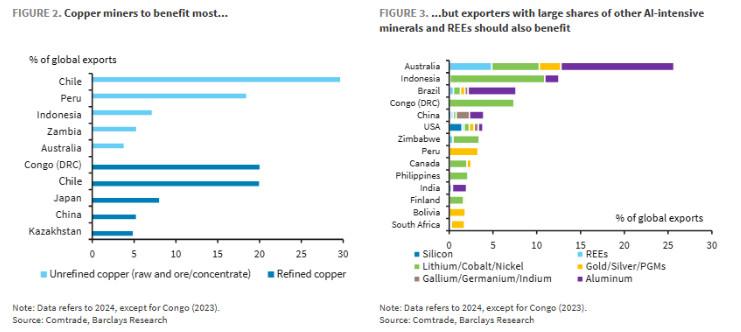
Core Insights - The Barclays research report highlights that the ongoing upgrade of AI infrastructure will lead to a significant increase in demand for specific minerals and rare earth elements, benefiting mineral-exporting countries over a multi-year investment cycle [1][4]. Group 1: AI Investment and Commodity Demand - The demand for copper is particularly emphasized as the most prominent beneficiary among AI-driven commodities, with countries like Chile, Peru, the Democratic Republic of Congo, and Australia expected to experience prolonged investment prosperity [1][5]. - The report estimates that capital expenditures from hyperscale cloud service providers will exceed $2.5 trillion over the next five years, indicating that related commodities such as energy, electrical infrastructure, and cooling systems will benefit from this AI investment cycle [4][6]. Group 2: Historical Context and Trade Dynamics - Historical commodity booms, particularly those driven by China in the early 21st century, show that commodity-exporting countries saw significant increases in fixed capital formation, contributing to GDP growth [10][13]. - The report notes a positive correlation between high export growth and the appreciation of the real effective exchange rate (REER), especially during commodity bull markets [14]. Group 3: Copper and Oil Price Decoupling - A notable feature of the current cycle is the decoupling of copper prices from oil prices, which traditionally moved in tandem. This decoupling is seen as a significant opportunity for investors [16][19]. - Countries that are major exporters of AI-critical minerals and net oil importers, such as Chile and Peru, will benefit from improved trade conditions, providing stronger support for their currencies [19][21]. Group 4: Future Outlook for Currencies - The report suggests that currencies like the Chilean peso, Peruvian sol, and Australian dollar are expected to perform well due to the copper-oil decoupling, indicating a new macroeconomic landscape driven by AI investments [22].


有色牛背后的隐形大佬
远川研究所· 2025-10-22 13:15
Core Viewpoint - The article discusses the rising significance of copper in the AI era, likening it to "new oil," and highlights the wealth accumulation of key players in the resource sector amid a super cycle in commodities [6][7][9]. Group 1: Copper and Market Dynamics - Goldman Sachs' reports have significantly influenced global markets, particularly regarding copper's role in the AI era [6]. - A supply shock occurred when Indonesia's second-largest copper mine halted operations due to a landslide, leading to a surge in international copper prices [7]. - The demand for various metals, including copper, silver, and gold, has intensified, with copper being viewed as a critical resource for the future [7]. Group 2: Key Players in the Resource Sector - Yu Yong, the head of Hongshang Group, has become a notable figure in the current metals bull market, with his wealth increasing by over 40 billion yuan due to the rise in Luoyang Molybdenum's stock price [13][14]. - Yu Yong's investment strategy includes acquiring significant stakes in various mining operations globally, positioning his company as a major player in the copper and cobalt markets [17][20]. - The article highlights the strategic investments made by Yu Yong, including a series of acquisitions that have expanded Luoyang Molybdenum's global footprint [17][20]. Group 3: Investment Strategies and Trends - The article emphasizes the importance of long-term investment strategies in the resource sector, particularly in the context of the current super cycle [22]. - It notes that savvy investors like Yu Yong and others have capitalized on low points in the commodity cycle, investing billions in copper and cobalt [22]. - The article also mentions the growing trend of investing in gold, with significant profits reported by traders like Bian Ximing, who has successfully navigated the gold market [24][29].



黄金早参丨美经济数据及股市扰动,金价高位震荡,黄金回调不影响牛市架构
Mei Ri Jing Ji Xin Wen· 2025-09-27 10:28
Group 1 - Gold prices experienced fluctuations, dropping to $3751.9 per ounce before closing at $3780.5 per ounce, a 0.33% increase [1] - The U.S. Q2 GDP growth was revised up to an annualized rate of 3.8%, significantly higher than the previous estimate of 3.3%, marking the fastest growth in nearly two years [1] - Initial jobless claims in the U.S. fell by 14,000 to 218,000, the lowest level since mid-July, and well below market expectations of 235,000 [1] Group 2 - Year-to-date, gold has risen approximately 42%, currently in a consolidation phase around $3780 per ounce [1] - Ole Hansen, head of commodity strategy at Saxo Bank, indicated that the recent pause in gold's upward trend is a healthy correction, suggesting that even a drop to $3600 per ounce would not significantly damage the overall bullish market structure [1] - Large institutional investors are reportedly still underweight in their gold holdings [1]
美经济数据及股市扰动,金价高位震荡,黄金回调不影响牛市架构
Mei Ri Jing Ji Xin Wen· 2025-09-26 01:40
Core Viewpoint - Gold prices experienced fluctuations, initially dropping to $3751.9 per ounce before closing at $3780.5 per ounce, influenced by stronger-than-expected U.S. GDP growth and declining unemployment claims [1] Economic Indicators - The final annualized GDP growth rate for the U.S. in Q2 was revised up to 3.8%, significantly higher than the previous estimate of 3.3%, marking the fastest growth in nearly two years [1] - The core PCE price index was adjusted from 2.5% to 2.6% [1] - Initial jobless claims fell by 14,000 to 218,000, the lowest level since mid-July, and well below the market expectation of 235,000 [1] Gold Market Analysis - Gold has seen a year-to-date increase of approximately 42%, currently in a consolidation phase around $3780 per ounce [1] - According to Ole Hansen, head of commodity strategy at Saxo Bank, the recent pause in gold's upward trend is considered a healthy correction, and even a drop to $3600 per ounce would not significantly disrupt the overall bullish market structure [1] - Large institutional investors are reportedly still underweight in their gold holdings [1]
大宗商品分析框架
2025-09-10 14:35
Summary of Key Points from Conference Call Records Industry Overview - The conference call primarily discusses the **commodity market**, focusing on the dynamics of supply and demand, price fluctuations, and the impact of geopolitical and economic factors on commodity prices [1][6][30]. Core Insights and Arguments 1. **Commodity Supercycle**: The current commodity market is in a down phase of the previous supercycle, driven by urbanization and industrialization, with no new cycle formation expected due to weak growth in emerging markets and de-globalization trends [1][6][7]. 2. **CTA Strategy Performance**: The Commodity Trading Advisor (CTA) strategies have shown significant volatility, with expectations for improved efficiency starting in 2025. The strategies are influenced by fundamental changes and external factors [1][8]. 3. **Tariff Policies**: Tariff policies have had a notable impact on the commodity market, particularly in metals, with U.S. policies and geopolitical risks acting as significant variables [1][9]. 4. **Market Sentiment Monitoring**: Market sentiment can be gauged through CFTC positions, changes in gold ETFs, and options market data, indicating risk appetite and price distribution [1][10]. 5. **Demand-Side Challenges**: Demand-side forecasting models have limited explanatory power, often relying on simple models that do not account for the dollar variable to avoid error transfer. Economic growth is expected to be under pressure in 2025, suppressing commodity prices [1][11]. 6. **Supply-Side Constraints**: Insufficient upstream investment in oil, gas, and metal mining is leading to capacity constraints, which will frequently impact prices from 2025 to 2026 [1][12][13]. 7. **Relative Oversupply Expectation**: A significant decline in demand growth expectations is leading to a relative oversupply in the commodity market for 2025, despite ongoing supply-side stories [1][14]. Additional Important Insights 1. **Geopolitical Risks**: Geopolitical tensions have a substantial impact on energy markets, with oil prices fluctuating significantly due to these risks [1][21][22]. 2. **Copper Market Dynamics**: Changes in demand and supply for copper have been significant, with new demand sources emerging from electrification and green energy, while supply remains tight [1][33]. 3. **Black Metals Market**: The black metals market faces challenges due to a downturn in the real estate cycle and potential new production releases, which may lower prices in the long term [1][34]. 4. **Agricultural Market Influences**: Agricultural markets are influenced by various factors, including weather disturbances and trade relations, which can lead to domestic shortages [1][35]. 5. **Gold Market Factors**: The gold market is influenced by interest rates, risk aversion, and central bank purchases, with the latter's impact diminishing recently as rates and ETF dynamics gain prominence [1][37][38]. Conclusion The conference call provides a comprehensive analysis of the commodity market, highlighting the interplay between supply and demand, the effects of geopolitical risks, and the evolving dynamics of specific commodities like gold and copper. The insights suggest a cautious outlook for the commodity market in the near term, with significant attention needed on policy changes and economic indicators.
“反内卷”掩映下的商品超级周期
2025-07-29 02:10
Summary of Conference Call Records Industry or Company Involved - The discussion primarily revolves around the **commodity supercycle** and the impact of **anti-involution policies** on the **midstream materials and manufacturing industries**. Core Points and Arguments 1. **Impact of Anti-Involution Policies**: Anti-involution policies may lead to a revaluation of midstream materials and manufacturing industries, similar to the utility price increase trend observed in 2023-2024. Focus on industries with negative ROC minus VAC indicators, such as **coke, rebar, plastics, fiberglass, and photovoltaic equipment** [1][2][5]. 2. **Drivers of Commodity Supercycle**: The commodity supercycle is driven by **de-globalization** and **de-dollarization**. De-globalization restricts factor flow, raising inflation, while de-dollarization leads to increased commodity pricing. Historical parallels are drawn to the 1970s commodity bull market due to similar conditions [3][9]. 3. **Renminbi Exchange Rate**: The Renminbi's exchange rate is highly correlated with market trends. In the medium term, the price gap between China and the US supports Renminbi appreciation, although short-term risks from US debt issuance could pressure the A-share market [1][6]. 4. **Investment Strategy**: It is recommended to follow the **Barbell Strategy**, allocating 80% of investments to safe assets like **gold, banks, resources, and utilities**, and 20% to sectors with potential catalysts such as **domestic computing power, robotics, and Hainan Free Trade Zone** [1][7]. 5. **US Treasury Account and Interest Rates**: The US Treasury General Account (TGA) needs to be replenished quickly, which may lead to a rise in the 10-year US Treasury yield to near or above 5%. This could impact dollar liquidity and put pressure on the A-share market, particularly growth-style stocks [1][8]. 6. **Historical Context of Anti-Involution**: The current anti-involution policy is seen as part of a broader strategy to address economic deflation, with historical precedents in 1999 and 2015-2016. The focus should also be on demand-side policies [5][11]. 7. **Measuring Industry Involution**: The difference between ROIC and WACC serves as a measure of industry involution. Negative values indicate industries that are not creating value, with many midstream manufacturing and materials sectors currently in this state [12]. 8. **Recent Performance of Involved Industries**: Industries with high involution levels, such as **coke, rebar, plastics, fiberglass, and photovoltaic equipment**, have shown significant recent performance improvements, indicating potential investment opportunities [14]. Other Important but Possibly Overlooked Content 1. **Commodity Price Trends**: From July 2022 to the present, gold and silver prices have increased by 100%, while platinum has risen by over 40%. Scarce metals have also seen significant price increases, suggesting a likely upward trend in commodity pricing [10]. 2. **Sector-Specific Insights**: Certain commodities like **alumina and live pigs** have seen price increases not due to anti-involution but rather as part of the broader commodity supercycle, indicating the complexity of market dynamics [15][16]. 3. **Asset Allocation Recommendations**: In the absence of a fundamental reversal in globalization trends, a suggested asset allocation strategy includes 80% in safe assets and 20% in technology and AI sectors, providing a balanced approach to risk management [17].
研客专栏 | 国内期货史上,从跌势转涨势比较大的几波行情都是什么?
对冲研投· 2025-07-09 12:54
Core Viewpoint - The article discusses significant market reversals in the domestic futures market driven by macro policies, supply-demand changes, and geopolitical events, highlighting historical trends and potential future implications. Group 1: Historical Market Trends - From 2001 to 2007, a super cycle in commodities was driven by the rapid industrialization of China post-WTO accession and a drop in U.S. interest rates to 1% [2][4]. - Notable price increases included copper rising from 15,000 CNY/ton in 2002 to 85,000 CNY/ton in 2006, and rubber increasing from 6,000 CNY/ton in 2001 to 30,000 CNY/ton in 2006, primarily due to infrastructure demands and supply constraints [3][4]. Group 2: Recovery Post-Financial Crisis - The period from 2008 to 2011 saw a recovery following the global financial crisis, with China's "four trillion" stimulus plan and loose monetary policy [6][7]. - Cotton prices surged from 10,000 CNY/ton in 2008 to 33,000 CNY/ton in 2010, driven by reduced production in Xinjiang and a recovery in the textile industry [7]. - Rebar prices increased from 3,400 CNY/ton in early 2009 to 5,000 CNY/ton in 2011, supported by infrastructure investments [8]. Group 3: Supply-Side Reforms - In 2016, supply-side reforms led to a reversal in the black series commodities market, with forced capacity reductions following years of overproduction [11][12]. - Coking coal prices rose from 515 CNY/ton at the end of 2015 to 1,600 CNY/ton in 2016 due to mine closures and production limits [13]. - Rebar prices increased from 1,616 CNY/ton to 3,500 CNY/ton, influenced by a recovery in real estate and infrastructure [14]. Group 4: Post-Pandemic Recovery and New Energy Revolution - The period from 2020 to 2021 was marked by a recovery from the pandemic, with global central banks injecting liquidity and China resuming production first [17][18]. - Copper prices rose from 35,000 CNY/ton in March 2020 to 78,000 CNY/ton in July 2021, driven by demand from green transition initiatives [18]. - The shipping index for Europe surged from 1,000 points in June 2020 to 10,000 points in October 2021, reflecting a recovery in global demand [18]. Group 5: Current and Future Trends - The period from 2023 to 2025 is characterized by geopolitical conflicts and resource nationalism, with significant events impacting supply chains [20][21]. - The ban on mining in Wa State in April 2023 led to a global tin supply crisis, with prices spiking due to reduced imports from China [21]. - The shipping index for Europe increased from 701.6 points in October 2023 to 4,769.9 points by July 2024, driven by geopolitical tensions and supply shortages [22]. Group 6: Key Insights - Market reversals are often triggered by sudden events (e.g., mine closures, wars) or strong policies (e.g., supply-side reforms, monetary easing) [25]. - Supply-demand mismatches, particularly under low inventory and rigid demand conditions, can lead to significant price volatility [25]. - The current market is in a "high volatility norm," with a focus on copper (due to new energy demand), shipping (geopolitical risks), and tin (resource scarcity) [26].

信号频现!大宗商品或开启十年超级周期
Jin Shi Shu Ju· 2025-04-14 08:34
Group 1 - The rise in commodity prices has led analysts to speculate about the formation of a "supercycle," driven by changes in the global trade environment and supply-demand shocks [1] - Philippe Gijsels, Chief Strategist at Societe Generale, believes the commodity supercycle has already begun, influenced by potential trade policies under a possible Trump administration [1] - Gijsels predicts that the next supercycle could be the largest on record, with supply-demand shocks potentially affecting commodity prices for the next decade [1] Group 2 - Gijsels emphasizes the importance of metals like gold, silver, and copper, forecasting that spot gold could rise to $4,000 per ounce and silver could increase by approximately 59% from recent levels [1] - Despite short-term pressures on copper and silver due to market concerns over tariffs, Gijsels maintains a positive outlook on these metals, viewing any price corrections as buying opportunities [1] - Not all commodities are expected to rise significantly; Gijsels specifically mentions cobalt and nickel as unlikely to see substantial price increases [1] Group 3 - Soft commodities such as coffee and cocoa are expected to rise due to climate change and supply vulnerabilities, with cocoa being particularly affected as 51% of global supply comes from Ivory Coast [2] - Pat Kennedy from AllSource Investments notes that many companies will struggle to absorb cost increases from tariffs, leading to a necessary rise in prices for key commodities like steel, aluminum, and agricultural products [2] - BMI analysts project price increases for coffee and corn by 3.2% and 3.4% respectively, with copper expected to rise by 7.9% by year-end and gold projected to increase by 29.7% by 2025 [2] Group 4 - André Castro Silva, an economics professor, expresses skepticism about the trade war benefiting commodities, suggesting that tariffs typically harm the imposing country and may not significantly alter international commodity prices [2] - Silva warns that a global recession could lead to a decline in all commodity prices, particularly for construction-related commodities like copper [2] - Market instability may increase demand for commodities, but Silva believes this demand will likely not be enough to counteract the downward price trends caused by a potential global recession [2]
2025年全球大宗商品展望 - 中金公司2025年度春季投资策略会
中金· 2025-03-11 01:47
Investment Rating - The report indicates a cautious outlook on the commodity market, suggesting a mixed investment strategy with a focus on low volatility commodities [2][3][10]. Core Insights - The commodity market has shown significant changes recently, with a notable shift from macro-driven trends to a focus on fundamental pricing mechanisms [3][6]. - The report highlights the impact of geopolitical factors, such as U.S. tariffs and Trump's policies, on various commodity sectors, emphasizing the need for a nuanced understanding of these influences [4][5][12]. - Supply risks are evolving from a binary to a more complex three-dimensional framework, incorporating spatial, temporal, and geopolitical dimensions [7][9]. - The report suggests that while some commodities may face supply constraints, others may not see significant price movements due to balanced supply and demand dynamics [10][11]. Summary by Sections Commodity Market Overview - The correlation index among commodities has decreased, indicating a shift in market dynamics [2]. - The market is transitioning from a macro-driven environment to one where fundamental factors play a more significant role in pricing [3][6]. Geopolitical Influences - U.S. tariff policies are causing disruptions in the commodity market, particularly affecting aluminum and steel prices [4][5]. - The report discusses the potential impacts of Trump's policies on oil prices, highlighting the complexity of these influences [4][12]. Supply and Demand Dynamics - The report notes that the commodity market is moving towards a state of oversupply, with a potential return to a more balanced state by 2025 [6][10]. - Supply risks are now viewed through a three-dimensional lens, considering spatial, temporal, and geopolitical factors [7][9]. Specific Commodity Insights - Oil prices are expected to face upward pressure due to supply constraints, particularly in the context of OPEC's production limits [10][12]. - The aluminum sector may experience cost increases due to tariff impacts, while the steel market is likely to see price increases domestically [4][5]. - Agricultural commodities, particularly soybeans, are expected to remain under pressure from supply dynamics, with a focus on South American production [18].
