滞涨

Search documents
ETF日报:随着煤价下跌,煤炭板块有所回调,煤炭股息率进一步提升,具有较大的股息吸引力,可关注煤炭ETF
Xin Lang Ji Jin· 2025-08-06 12:07
Market Performance - The Shanghai Composite Index closed up 16.39 points, a 0.45% increase, reaching 3633.99 points, with a trading volume of 707.22 billion yuan, marking a new three-year closing high [1] - The Shenzhen Component Index rose by 70.82 points, a 0.64% increase, closing at 11177.78 points, with a trading volume of 1026.847 billion yuan [1] - The ChiNext Index increased by 15.57 points, a 0.66% rise, closing at 2358.95 points, with a trading volume of 525.173 billion yuan [1] Sector Performance - Strong performances were noted in sectors such as military, gaming, coal, and robotics, while previously popular sectors like biomedicine and innovative drugs experienced corrections [1] - The coal sector showed significant gains, with prices for coking coal futures returning to an upward trend and port inventory decreasing [5][6] Investment Opportunities - The coal sector's dividend yield has increased, with the China Coal Index currently yielding over 5%, making it attractive for long-term investors [7][9] - The recommendation includes investing in coal ETFs (515220) and steel ETFs (515210) to capture potential rebound opportunities under the "anti-involution" policy [5][9] Economic Outlook - Policies aimed at improving macroeconomic expectations are expected to support coal prices from both supply and demand sides [9] - The market sentiment is gradually forming a consensus on the medium to long-term confidence in the Chinese economy, driven by a shift in policy focus from quantity to price [1][4] Technical Analysis - The A-share market has shown a strong upward trend, with significant participation from external funds, and the potential for further gains as the market approaches previous high points [2][4] - The likelihood of a significant correction is considered low, with various support levels in place [2][4] Gold Market Insights - The gold ETF (518800) has seen net inflows exceeding 300 million yuan in the past five days, driven by geopolitical risks and concerns over the U.S. economy [10][12] - The weakening of the dollar's credit system and the ongoing geopolitical tensions are expected to provide long-term support for gold prices [13]

【黄金期货收评】关税滞美联储政策受缚 沪金日内上涨1.36%
Jin Tou Wang· 2025-08-04 09:09
Group 1 - The core viewpoint is that gold prices have rebounded due to disappointing U.S. non-farm employment data, leading to a decline in the dollar and increased market risk aversion [1] - On August 4, the Shanghai gold spot price was quoted at 777.17 yuan per gram, which is a discount of 4.25 yuan per gram compared to the futures price of 781.42 yuan per gram [1] - The U.S. non-farm payrolls for July showed an increase of only 73,000 jobs, significantly below the expected 104,000, with the unemployment rate rising to 4.2% [1] Group 2 - The market's focus is shifting towards U.S. economic growth expectations and labor market demand, despite a second-quarter GDP growth of 3% exceeding the expected 2.5% [2] - Personal consumption expenditure growth of 1.4% in the second quarter was slightly below expectations, indicating ongoing inflation risks [2] - The PCE index showed a year-on-year increase in June, suggesting a rebound in inflation [2] Group 3 - Haitong Futures suggests that the U.S. economy is facing stagflation concerns due to tariff impacts, limiting the Federal Reserve's monetary policy options [3] - If market risk aversion continues, gold prices are expected to rise, potentially leading silver back into an upward trend [3] - The forecast for COMEX gold prices is between $3,200 and $3,500, with a strategy to buy gold and silver on dips [3]
暴跌之后,预测大师震撼发声
Sou Hu Cai Jing· 2025-08-03 06:06
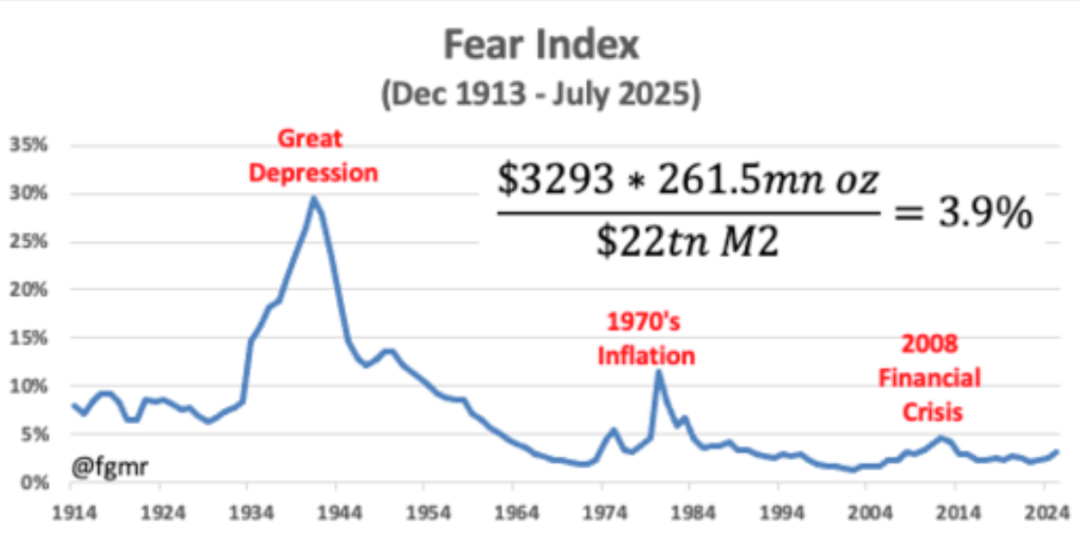
Core Insights - The interview highlights the significant impact of currency devaluation on gold prices, emphasizing that gold serves as a static asset that preserves purchasing power rather than generating new wealth [1][2][4] - The current low ratio of M2 money supply to gold reserves, referred to as the "fear index," suggests that gold is severely undervalued relative to the money supply, indicating potential for substantial price increases in the future [2][5] Currency and Economic Conditions - The U.S. dollar experienced a sharp decline, particularly against the Japanese yen, reflecting heightened sensitivity in currency exchange rates and a shift in focus towards gold as a safe haven [1] - Recent economic data, including higher-than-expected core PCE and disappointing non-farm payroll figures, point towards a combination of economic weakness and high inflation, reminiscent of the stagflation period of the 1970s [1][4] Gold as a Safe Haven - Gold is viewed as a hedge against the devaluation of fiat currencies, with its purchasing power remaining relatively stable over decades, unlike fiat currencies which rely on government and central bank promises [2][4] - The potential for gold prices to rise significantly is linked to the historical context of the M2 to gold reserve ratio, which is currently at 3.9%, compared to much higher levels during past economic crises [2][5] Future Projections - If the M2 money supply doubles and the gold reserve ratio returns to historical levels, gold prices could see dramatic increases, potentially reaching around $20,000 or even $51,000 if the ratio aligns with Great Depression levels [5][6] - The silver market is also expected to experience upward movement, particularly if the gold-silver ratio decreases significantly, indicating a potential surge in silver prices [6][7]
ETF日报:作为市场中交易量最大的单一债券品种,十年期国债规模与流动性占据绝对主导,关注十年国债ETF
Xin Lang Ji Jin· 2025-08-01 11:49
Market Overview - The Shanghai Composite Index closed down 13.26 points, a decline of 0.37%, at 3559.95 points, with a trading volume of 684.6 billion yuan [1] - The Shenzhen Component Index fell 18.45 points, down 0.17%, closing at 10991.32 points, with a trading volume of 913.7 billion yuan [1] - The total trading volume of both markets was approximately 1.6 trillion yuan, a decrease of over 300 billion yuan compared to the previous day [1] - Small-cap stocks were favored, with over 3300 stocks rising in the market [1] Global Economic Impact - On July 31, U.S. President Trump signed an executive order imposing "reciprocal tariffs" ranging from 10% to 41% on multiple countries and regions [1] - This news caused significant volatility in global capital markets, with the South Korean Composite Index experiencing a maximum drop of 3.7% and the Nikkei 225 Index dropping over 1% before stabilizing [1] Investment Strategy - In light of the increasing asset price volatility, a balanced asset allocation strategy of "stocks-bonds-commodities" is recommended to mitigate risks [2] - The China A500 ETF is suggested for capturing long-term economic growth opportunities in China [2] - Ten-year government bonds are highlighted for their defensive and offensive attributes, making them worthy of investor attention [2] - Gold is recommended for its safe-haven and monetary properties, supporting both short-term and long-term price trends [2] Economic Policy Insights - The "anti-involution" policies reflect a shift in focus from quantity to price by policymakers, fostering growing confidence in China's long-term economic outlook [3] - The Producer Price Index (PPI) has been below zero for 33 consecutive months since October 2022, indicating a need for policy intervention [3] Technical Analysis - The A-share market showed strong performance in July, with a significant increase in trading volume and price, although a recent pullback occurred due to profit-taking [4] - The Shanghai Composite Index had ten consecutive trading days where the closing price was above the five-day moving average, indicating a strong upward trend [4] Bond Market Insights - The ten-year government bond ETF is recommended for its unique advantages, including T+0 trading, low fees, transparency in holdings, and the ability to pledge for repurchase [7] - The ten-year government bond serves as a benchmark in the bond market, providing a stable base for asset allocation [8] Gold Market Dynamics - Recent geopolitical tensions in the Middle East, India-Pakistan, and Russia-Ukraine have heightened market risk aversion, supporting gold prices [9] - The weakening of the U.S. dollar's credit system due to challenges to the Federal Reserve's independence further strengthens the case for gold as a stable asset [10] - The U.S. economy faces challenges, with concerns about "stagflation" emerging, which may increase demand for gold as a hedge against inflation [11]
宏观经济研究:2025年8月大类资产配置报告
Great Wall Securities· 2025-07-28 12:58
Group 1: Global Economic Outlook - The US is experiencing reduced uncertainty in economic growth due to the resolution of tariff negotiations with major trading partners, but inflation concerns are resurfacing[1] - Global inflation risks are increasing, potentially reversing expectations for interest rate cuts, which may impact financial markets in August and September[1] - The US government recorded a fiscal surplus of $27 billion in June, the first surplus in June in nearly eight years, which may alleviate some fiscal pressure from tax cuts[8] Group 2: Domestic Economic Conditions - China's economic stabilization in the first half of 2025 was primarily driven by increased fiscal spending and rapid export growth, but the real estate sector continues to face contraction pressures[1] - The "anti-involution" policy may become a central theme in the second half of the year, potentially improving market supply-demand relationships and restoring market confidence[1] - Real estate sales in the first half of 2025 saw a significant decline, with new residential prices in 70 major cities dropping by 0.3% month-on-month in June[14] Group 3: Asset Allocation Insights - International stock markets have been the main source of profit in July, buoyed by positive sentiment from US-EU trade agreements, offsetting declines in domestic and international bond markets[2] - The strategy for August maintains the July allocations, with a focus on hedging positions in Japanese and Italian stocks against German stocks, while being bearish on the international bond market[2] - Commodity prices, particularly crude oil, have seen seasonal increases, while gold remains attractive as a safe-haven asset amidst geopolitical uncertainties[2]
冠通期货热点评论:“大美丽法案”通过对大宗商品的影响
Guan Tong Qi Huo· 2025-07-07 06:31
1. Report Industry Investment Rating - Not mentioned in the provided content 2. Core View of the Report - The passage of the "Great Beauty" Act may serve as a relay for the "anti-involution" action, further boosting commodity prices. It can be observed from both macro - aggregate and structural - variety dimensions. The act will have different impacts on the economy, inflation, and various commodity prices in the short and long term [2] 3. Summary According to Related Content Event Summary - On July 4, 2025, US President Trump signed the "Great Beauty" tax and spending bill into law. The bill passed the House of Representatives on July 3 with 218 votes in favor and 214 against, and was approved by the Senate on July 1. It is a landmark legislative agenda after Trump returned to the White House in early 2025, covering corporate tax cuts, personal and family tax cuts, reduction of clean - energy subsidies, compression of Medicaid, and cuts to the Supplemental Nutrition Assistance Program (SNAP) [1] Impact on the Macro - Aggregate - Globally, the "Great Beauty" Act's measures such as raising the debt ceiling and corporate tax cuts will boost US economic growth and inflation in the short term but damage US credit and increase the possibility of stagflation in the long term. It will also affect the Fed's interest - rate cut rhythm. Asset prices will show a weak dollar, rising US Treasury yields and US stocks, and commodities will benefit in the short term. Domestically, the act is expected to support the rebound of commodity prices [2] Impact on Structural Varieties - **Gold**: Benefited from short - term dollar weakness and long - term US credit weakening, but the slowdown of Fed's interest - rate cut expectations weakens the increase in gold prices [4] - **New - energy - related Commodities**: Measures like abolishing new - energy tax credits in the act will hit the terminal demand of the new - energy industry, reducing the industrial demand for silver, copper, polysilicon, lithium carbonate, etc. [4] - **Traditional Energy (Crude Oil)**: It will benefit in the short term but face long - term supply increases due to policies in the act, showing a short - term positive and long - term negative impact [4] - **Agricultural Products**: The impact is less than that on industrial products. The cut to the SNAP will suppress short - term consumer demand and indirectly reduce the demand for agricultural products [4]
镍半年报:弱现实与强成本博弈,镍价低位震荡
Tong Guan Jin Yuan Qi Huo· 2025-07-07 06:09
Report Industry Investment Rating The report does not explicitly mention an industry investment rating. Core Views of the Report - In the first half of 2025, the nickel market was characterized by a bearish fundamental outlook, with frequent policy disturbances leading to periodic price rebounds. The macro - economic expectations were volatile, but nickel prices were largely desensitized. - In the second half, the U.S. economic outlook remains unclear with stagflation risks. Domestically, policies focus on supply, lacking determination to improve consumption. In the industry, Indonesia and the Philippines aim to control nickel mines, and the nickel ore market may not ease this year. The nickel price will oscillate due to the game between weak market reality and strong cost pressure. - It is expected that the main contract of Shanghai nickel will trade between 115,000 - 130,000 yuan/ton in the second half of the year, and LME nickel will fluctuate between 14,000 - 16,000 US dollars/ton [3][45]. Summary by Relevant Catalogs 1. First - Half Review - In the first half of 2025, the bearish fundamental logic prevailed. Overseas policy disturbances were frequent, such as the Philippines' plan to ban nickel ore exports and Indonesia's series of policies on mineral resources. Trump's global tariff policy in April led to a spread of pessimistic expectations. In June, the cancellation of the Philippines' nickel ore export ban and Indonesia's increase in RKAB nickel ore approvals, along with weak consumption, accelerated the decline of nickel prices [8]. 2. Macroeconomic Analysis 2.1 United States - In the first half, the U.S. faced stagflation risks. The real GDP in Q1 was - 0.5%, affected by increased imports and weakened personal consumption. Inflation showed a complex trend, with the CPI rising slightly in May. Fiscal support boosted residents' consumption, but the "Big and Beautiful" bill may impact residents' income. The tariff policy was implemented, and trade negotiations were slow [13][14][15]. - In the second half, tariffs and crude oil may support high inflation, while weak consumption may drag down economic growth [16][17]. 2.2 China - In the first half, the domestic labor market improved, with the unemployment rate decreasing and fiscal personal income tax increasing. Social consumption showed some recovery, but there was a lack of strong autonomous consumption. Corporate profits improved with structural differentiation, and private - sector industrial enterprises performed better [18][19]. - In the second half, the situation is uncertain, and attention should be paid to policy directions [19]. 3. Fundamental Analysis 3.1 Policy Disturbances and Nickel Ore Shortage - In the first half, overseas nickel ore resources were scarce. The price of Philippine laterite nickel ore rose by 23.53%. The Philippines attempted to ban nickel ore exports, and Indonesia increased policy intervention. China's nickel ore imports decreased from January to May, and port inventories were lower than seasonal levels [23][24][25]. 3.2 Sufficient Supply and Resource Flow to LME - In the first half, domestic pure - nickel production increased significantly, with new production capacity coming online. Pure - nickel imports mainly came from Russia and South Africa, and exports increased, with resources flowing to the LME. The proportion of LME Asian warehouse resources increased [27][28]. 3.3 Nickel Iron: First Rise then Fall with High Cost Pressure - In the first half, domestic and Indonesian nickel - iron production increased. The profit of nickel - iron plants first rose then fell. China's nickel - iron imports mainly came from Indonesia. In the second half, new production capacity will be put into operation, but demand may remain weak, and prices may oscillate at a low level [30][31]. 3.4 Stable Sulfuric Acid Nickel Price with Limited Consumption Growth - In the first half, domestic sulfuric acid nickel production decreased slightly, and imports increased slightly. The price first rose then fell. In the second half, consumption may not improve significantly due to weak demand expectations [33]. 3.5 Low - Level Stainless Steel Consumption and Slow De - stocking - In the first half, stainless - steel prices fluctuated with the real - estate market. Production increased, but inventory remained high. In the second half, the fundamental situation may remain weak, and trade policies may provide short - term support [35][36]. 3.6 Doubtful Terminal Consumption Resilience and Policy - Driven Car - Manufacturer Production Cut - In the first half, domestic new - energy vehicle production and sales increased, mainly driven by subsidy policies. In the second half, domestic demand may be affected by the end of subsidies and corporate cash - flow pressure. Overseas, the growth of new - energy vehicle consumption in Europe and the U.S. may slow down [39][40][41]. 3.7 Excess Resources Flow Outward, and Domestic Inventory Remains Stable - In the first half, pure - nickel inventory first increased then decreased, with resources flowing to the LME. In the second half, due to narrowed export profits, domestic inventory may increase [43][44]. 4. Market Outlook - Supply: The export window remains open, keeping pure - nickel supply at a relatively high level (neutral). - Demand: The real - estate market continues to bottom out, and new - energy consumption lacks independent driving force, resulting in limited demand growth (neutral). - Cost: Nickel ore shortage due to policy pressure provides strong cost support (bullish). - Macroeconomics: The U.S. stagflation expectation persists, and domestic deflation pressure may continue (bearish). Overall, the nickel price will oscillate due to the game between weak reality and strong cost [45].
美联储古尔斯比:目前没有出现类似1970年代那样的滞涨前景。通胀和就业同时恶化的可能性肯定存在。
news flash· 2025-06-30 18:02
Core Viewpoint - The Federal Reserve's Goolsbee indicates that there is currently no sign of a stagflation scenario similar to the 1970s, although the possibility of simultaneous deterioration in inflation and employment does exist [1] Summary by Relevant Categories Economic Outlook - Goolsbee emphasizes that the current economic conditions do not mirror the stagflation experienced in the 1970s, suggesting a more stable outlook for the economy [1] Inflation and Employment - There is a recognized risk that both inflation and employment could worsen at the same time, highlighting potential challenges ahead for economic stability [1]
夏日黄金行情席卷,皇御贵金属新客福利助您畅快交易!
Sou Hu Cai Jing· 2025-06-30 11:35
Group 1 - Recent international market events include a subtle downgrade of the US credit rating, rising tensions between India and Pakistan, and ongoing conflicts in the Middle East, prompting central banks globally to increase gold reserves, with China adding to its holdings for seven consecutive months [1][3] - The Federal Reserve has decided to maintain the federal funds rate target range at 4.25% to 4.50%, marking the fourth consecutive meeting without a rate change, reflecting a cautious approach towards future rate cuts [3] - There is a significant divergence in the outlook for gold prices, with Citigroup predicting a decline below $3,000 per ounce in the coming quarters, while Goldman Sachs forecasts a rise to $4,000 by mid-next year, citing supply shortages and inflation concerns as key drivers [4] Group 2 - Upcoming economic data releases include the US ISM Manufacturing PMI, ADP employment figures, non-farm payroll report, CPI data, and retail sales, which are expected to influence market sentiment and trading strategies [6] - The company is offering a promotional bonus of $50,000 for new customers to encourage trading in gold and silver, alongside providing real-time strategy analysis and trading services to assist investors in navigating market fluctuations [6]

选股关注超跌+滞涨加热门题材
Sou Hu Cai Jing· 2025-06-27 07:15
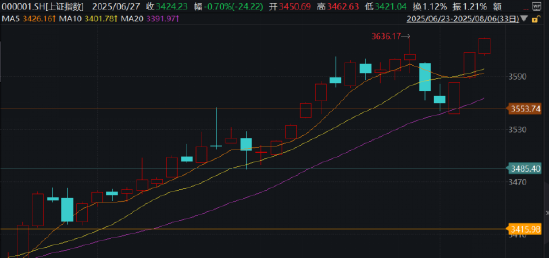
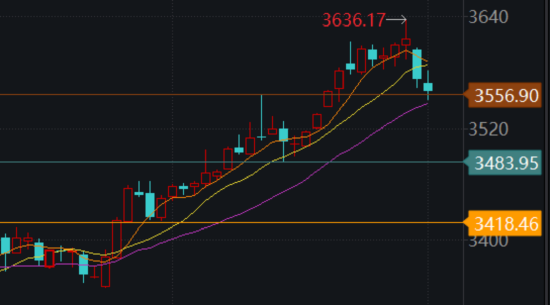
Group 1 - The article predicts market fluctuations in the coming days, with a support level identified between 3400 and 3420 points, indicating that short-term volatility is not yet over [1] - The Shanghai Composite Index has reached a new high for the year, and the total market capitalization of A-shares has set a record, primarily driven by bank stocks [1] - The article highlights five key sectors for investment: financial technology, technology, humanoid robots, solid-state batteries, and biomedicine, with a particular focus on technology stocks and humanoid robots for potential rebound [1] Group 2 - The article suggests that the recent rise in bank stocks has a siphoning effect, but maintaining trading volume is crucial for market stability [1] - It emphasizes the importance of stock selection, recommending a focus on undervalued and stagnant stocks that are also popular themes [1] - Overall, the article maintains a bullish outlook on the A-share market, suggesting that after a breakthrough, pullbacks present buying opportunities for quality undervalued stocks [2]