
生柴政策

Search documents
多空因素交织,棕榈油宽幅震荡
Tong Guan Jin Yuan Qi Huo· 2025-10-20 01:51
1. Report Industry Investment Rating No relevant content provided. 2. Core Viewpoints of the Report - Last week, the domestic oil and fat sector oscillated and declined, mainly dragged down by the drop in international oil prices. Palm oil showed a wide - range oscillation. The production and demand of Malaysian palm oil both increased in the first half of October, with expected subsequent production slowdown and inventory reduction. Indonesia plans to raise export taxes to support the B50 biodiesel policy in 2026, which provides support for prices. The easing of China - Canada trade relations may lead to a restart of Canadian rapeseed imports, making rapeseed oil relatively weak. The continuous shutdown of the US government has suspended data reports, causing a lack of market guidance, but the higher - than - expected soybean crushing demand released by NOPA has boosted the price of US soybean oil. Overall, palm oil is expected to oscillate widely in the short term [5][9][13]. 3. Summary by Relevant Catalogs Market Data - CBOT soybean oil main - continuous contract rose 1.13 to 51.1 cents per pound, an increase of 2.26%. BMD Malaysian palm oil main - continuous contract fell 72 to 4,474 ringgit per ton, a decrease of 1.58%. DCE palm oil contract 01 fell 130 to 9,308 yuan per ton, a decrease of 1.38%. DCE soybean oil contract 01 fell 46 to 8,256 yuan per ton, a decrease of 0.55%. CZCE rapeseed oil contract 01 fell 200 to 9,861 yuan per ton, a decrease of 1.99%. ICE rapeseed active contract rose 7.6 to 631 Canadian dollars per ton, an increase of 1.22% [5][6][8]. - The spot price of 24 - degree palm oil in Guangzhou, Guangdong dropped 210 to 9,250 yuan per ton, a decrease of 2.22%. The spot price of first - grade soybean oil in Rizhao dropped 10 to 8,520 yuan per ton, a decrease of 0.12%. The spot price of imported third - grade rapeseed oil in Zhangjiagang, Jiangsu dropped 210 to 10,120 yuan per ton, a decrease of 2.03% [6]. Market Analysis and Outlook - Production and demand data: From October 1 - 15, 2025, Malaysian palm oil yield per unit area increased by 5.76% month - on - month, oil extraction rate by 0.21% month - on - month, and production by 6.86% month - on - month. The export volume data from different institutions showed increases ranging from 12.3% to 49.8% compared with the same period last month [10]. - Policy and inventory: Malaysia lowered the reference price of crude palm oil in November to 4,262.23 ringgit per ton (1,008.1 US dollars), while keeping the export tariff at 10%. Indonesia plans to raise the export tax on crude palm oil from 10% to 15% to support the transition from B40 to B50 biodiesel. As of October 10, 2025, the total inventory of the three major oils in key domestic regions was 238.17 million tons, with soybean oil inventory increasing, palm oil inventory decreasing, and rapeseed oil inventory decreasing [11][12][15]. - Consumption data: In India, palm oil imports in September dropped 16.3% to 829,017 tons, the lowest since May, while soybean oil imports surged 36.8% to 503,240 tons, the highest since July 2022, and sunflower oil imports increased by about 6% to 272,386 tons, the highest since January [12]. - Transaction volume: As of the week of October 17, 2025, the average daily trading volume of soybean oil in key domestic regions was 11,800 tons, and that of palm oil was 847 tons [13]. Industry News - It is expected that Malaysia's palm oil inventory will decline in the coming months, reaching about 1.7 million tons by the end of the year, due to seasonal production decline and increased demand during festivals [14]. - Due to increased production and more working days in October, Malaysia's palm oil inventory is expected to increase by 3% month - on - month to 2.4 million tons. Indonesia's plan to implement the B50 biodiesel mandate in mid - 2026 and the seasonal low - production period from November to February may keep palm oil prices between 4,000 and 4,500 ringgit per ton. Analysts have raised the price forecast for Malaysian palm oil in 2025 by 130 ringgit to 4,330 ringgit per ton and in 2026 by 100 ringgit to 4,200 ringgit per ton [14][15]. - Indonesia plans to raise the export tax on crude palm oil from 10% to 15% to support the transition from B40 to B50 biodiesel, and the tax - increase plan is still under discussion among ministries [15]. Relevant Charts - The report provides multiple charts, including the price trends of Malaysian palm oil, US soybean oil, and three major domestic oils, the spot price trends of palm oil, soybean oil, and rapeseed oil, the inventory trends of Malaysian and Indonesian palm oil, and the commercial inventory trends of domestic three major oils [17][18][20].
美豆周度报告-20251019
Guo Tai Jun An Qi Huo· 2025-10-19 11:12
1. Report Industry Investment Rating No relevant content provided. 2. Core Viewpoint of the Report - The overall view is that due to the expected high - yield in South America, there is no basis for a bull market; however, cost support reduces the probability of a significant decline. The market is expected to be generally oscillating with an upward bias, within the range of 950 - 1150 cents per bushel [5]. - Negative factors include the deterioration of Sino - US relations pressuring US soybean exports, the return of the rainy season in Brazil improving precipitation and accelerating the sowing progress, and the expected increase in Brazil's planting area in the 2025/26 season [5]. - Positive factors are the possible intensification of biodiesel policies supporting prices, the expectation of improved Sino - US relations, and the possible reduction of South American soybean production due to La Nina weather [5]. 3. Summary by Relevant Catalogs 3.1 Market Price - This week, the price of US soybeans oscillated and closed higher. The market started to trade on the meeting between the two heads of state during the APEC at the end of the month, and the return of the rainy season in Brazil is expected to speed up the planting progress. Next week, attention should be paid to the follow - up progress of Sino - US relations, the weather conditions in South American main producing areas, and the progress of biodiesel policies [7]. - This week, the price of US soybean meal oscillated and closed higher, mainly in an oscillating pattern [10][12]. - This week, the price of US soybean oil oscillated, with no obvious driving factors for both bulls and bears, and the current core contradiction has shifted to macro - expectations [13]. - Since September 19, the USDA has suspended data updates [15][17][19]. - On October 17, the spot price of soybeans in Mato Grosso, Brazil, rose to 119.19 reais per bag, and the spot price at Brazilian ports rose to 138.17 reais per bag [21][23]. 3.2 Supply Factors - The drought situation in US soybean - producing areas has not improved, with a drought rate of 68%, the same as last week [26]. - In the next two weeks, the temperature in US producing areas will be warmer, with no threat of early frost, and precipitation in the Great Lakes region will be higher than normal [28][30]. - The rainy season in Brazil has returned, improving precipitation conditions, but precipitation in the central and northern regions is slightly less than normal [32]. - Precipitation in Argentine soybean - producing areas is basically normal, and the sowing work is about to start [34]. - As of the week of September 26, the good - to - excellent rate of US soybeans was 62%, up from 61% last week but lower than 64% in the same period last year [36]. 3.3 Demand Factors - As of October 10, the US soybean crushing profit was 2.72 dollars per bushel, down from 2.82 dollars last week [40]. - The weekly export volume of US soybeans was 512,300 tons, down from 837,100 tons last week; the weekly export inspection and quarantine volume was 484,100 tons, down from 804,300 tons last week; the net sales volume this year was 724,400 tons, down from 923,000 tons last week; the sales volume for the next year was 0 tons, down from 220,000 tons last week; and the quantity shipped to China last week was 0 tons [42][44][46][48][50]. 3.4 Other Factors - The latest value of the ENSO (NINO3.4 anomaly index) is - 0.943, indicating that it has entered the La Nina range [53]. - The soybean planting costs in Brazil and the US have decreased [55][57]. - As of September 23, the net short position of soybeans in CFTC was 18,200 lots, up from 14,400 lots last week; the net long position of soybean oil was 8,040 lots, down from 35,000 lots last week; and the net short position of soybean meal was 82,700 lots, up from 59,400 lots last week [61][63][65].
供需面有支撑、政策面存利多 四季度豆油或偏强运行
Xin Hua Cai Jing· 2025-10-14 13:59
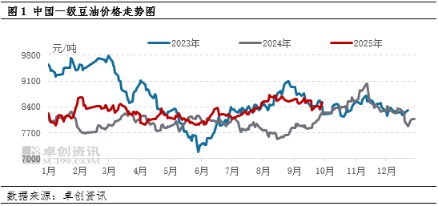
Core Viewpoint - The domestic soybean oil market experienced fluctuations in Q3 2025, initially supported by costs and fundamentals, but later declined due to external market influences and unexpected news. The outlook for Q4 suggests a potential for stronger soybean oil prices due to tightening supply and ongoing supportive factors in the domestic and international vegetable oil markets [1][7]. Group 1: Price Trends - In Q3 2025, the price of domestic first-grade soybean oil first rose and then fell, reaching a low of 8069 CNY/ton on July 7 and a high of 8730 CNY/ton on August 13. The average price for the quarter was 8428 CNY/ton, reflecting a 4.08% increase from the previous quarter and a 7.30% increase year-on-year [1]. - The supply-demand dynamics in Q3 showed an increase in both supply and demand for soybean oil, but the growth in inventory limited the price increase [1][5]. Group 2: Import Costs and Supply - The increase in soybean import costs was a significant factor supporting soybean oil prices in Q3. The cost of imported soybeans rose to 4130 CNY/ton, up 6.63% quarter-on-quarter and 3.92% year-on-year, driven by strong demand for Brazilian soybeans amid ongoing trade issues [3]. - The volume of soybean imports increased, with China importing 8618 million tons from January to September 2025, a year-on-year increase of 5.29%. The average operating rate of key domestic crushing enterprises was 67%, up 11 percentage points from the previous quarter, resulting in a soybean oil output of 527 million tons, a quarter-on-quarter increase of 22.56% [3]. Group 3: Demand and Inventory - Domestic demand for soybean oil saw limited growth in Q3, with total consumption reaching 497 million tons, a quarter-on-quarter increase of 19.18%. However, the increase in production led to a significant rise in inventory, with port soybean oil stocks reaching 122 million tons, up 41.86% from the previous quarter [5]. - The demand situation was influenced by seasonal factors and market uncertainties, leading to increased purchasing activity from downstream customers ahead of traditional holidays, despite a weaker restaurant industry impacting overall demand [5]. Group 4: External Market Influences - By the end of Q3, external market prices for soybean oil declined, with CBOT soybean oil dropping to 49.44 cents/pound, a decrease of 12.85% from its quarterly high, and Malaysian palm oil prices falling by 4.58% [7]. - Looking ahead to Q4, the supply of Brazilian soybeans is expected to decline, and domestic oil mill operating rates are anticipated to decrease, tightening soybean oil supply. However, seasonal reductions in consumption are also expected [7]. Group 5: Policy and Market Outlook - The biodiesel policy remains a significant factor influencing the vegetable oil market, with expectations of increased demand supporting both domestic and international vegetable oil markets despite uncertainties surrounding U.S. biodiesel policy implementation [7]. - Overall, the soybean oil market is expected to experience a strong performance in Q4, with prices projected to range between 8300 and 8700 CNY/ton, supported by fundamental supply-demand factors and international market influences [7].

橡胶利空尚未兑现,但市场情绪维持偏弱
Zhong Xin Qi Huo· 2025-10-14 02:35
1. Report Industry Investment Ratings - The report does not explicitly provide an overall industry investment rating. However, it gives individual outlooks for different agricultural products, including "oscillating" for some and "oscillating weakly" for others [5][6][7][8][9][11][13][14][15][17][18][20] 2. Core Viewpoints of the Report - The report analyzes various agricultural products. Overall, the market shows a mixed trend with some products facing downward pressure while others are in a state of oscillation. The macro - environment, supply - demand relationship, and policy factors all have an impact on the market [1][5][6][7][8][9][11][13][14][15][17][18][20] 3. Summary by Relevant Catalogs 3.1 Market Outlook for Each Product - **Oils and Fats**: Concerned about the effectiveness of the lower technical support. Due to the pessimistic outlook for US soybean export demand, the market is in an oscillating and downward - adjusting state. Palm oil may continue to accumulate inventory, while domestic soybean oil inventory may peak and decline, and rapeseed oil inventory may continue to decrease. Overall, the oils and fats market may continue to oscillate and consolidate [5] - **Protein Meal**: The sentiment boost is limited, and the market continues to oscillate at a low level. US soybeans are facing challenges in exports, and the domestic supply pressure is large in the short - term, but the demand may increase steadily in the long - term [5][6] - **Corn/Starch**: With the new grain selling pressure coming, the spot price drives the futures price to decline significantly. In the short - term, the market needs to deal with the new grain listing pressure, and in the long - term, it may show a pattern of short - term bearish and long - term bullish [6][7] - **Pigs**: The planned slaughter volume in October increases, and the pig price is under pressure. In the short - term, the supply pressure increases, and in the long - term, if the capacity reduction is implemented, the supply pressure may ease in the second half of 2026 [8] - **Natural Rubber**: The negative factors have not been realized, but the market sentiment remains weak. The futures price may have over - declined due to sentiment. NR may show a relatively strong performance in the near - term. In the short - term, it can be considered from a long - bias perspective of oversold rebound, but the increase range is limited [1][9][11] - **Synthetic Rubber**: The raw material has weakened significantly, and the futures price has dropped sharply. The high production volume and high inventory are the main pressures, and the market is expected to oscillate at the bottom [13] - **Cotton**: The decline of cotton price has slowed down, and attention should be paid to the purchase price. Based on the expected increase in production, the cotton price is expected to oscillate weakly. It is recommended to adopt a short - on - rebound strategy [14] - **Sugar**: Both domestic and international sugar prices have weakened. In the medium - and long - term, the sugar market is expected to be in a bearish pattern due to the expected increase in global supply [15] - **Pulp**: The game of the virtual - to - real ratio may lead to intraday fluctuations, but the effectiveness needs to be observed. The high supply and the issue of birch pulp warehouse receipts are the main downward drivers [17] - **Double - Glued Paper**: The spot price is stable, and the futures price oscillates. The market supply and demand are in a loose pattern, and the price may decline slightly after the festival [18] - **Logs**: The peak season is not prosperous, and the logs oscillate weakly. The weak demand and high inventory are the main factors affecting the market [20] 3.2 Variety Data Monitoring - The report mentions the data monitoring of various varieties, including oils and fats, corn, starch, pigs, cotton, sugar, pulp, double - glued paper, and logs, but does not provide specific data analysis content [22][54][67][113][126][140][163] 3.3 Rating Standards - The report provides rating standards, including "strong", "oscillating strongly", "oscillating", "oscillating weakly", "weakly", with a time cycle of 2 - 12 weeks and a standard deviation calculation method [175]
印尼B50题材预期,棕榈油支撑较强
Tong Guan Jin Yuan Qi Huo· 2025-10-13 02:43
Group 1: Investment Rating - No investment rating information is provided in the report. Group 2: Core Views - The Indonesian government plans to enforce the B50 biodiesel program in the second half of 2026, which will generate an additional demand for 530,000 tons of crude palm oil. However, the progress of the US biodiesel policy remains uncertain due to the government shutdown [4]. - The September MPOB report showed an increase in the ending inventory to 2.36 million tons, which was bearish for the market. But the production in the producing areas will enter the off - season, leading to a gradual contraction in supply. In India, the palm oil imports decreased in September due to more soybean oil imports. In China, the palm oil trading was sluggish, with weekly inventory decreasing and expected to be stable in the future. The domestic soybean oil inventory is at a five - year high, while the import of rapeseed products is expected to decrease [4]. - The Sino - US trade conflict has escalated, reducing the market's expectation of easing at the APEC meeting. The US dollar index continues to fluctuate at a low level, and the oil price is weakening. The Malaysian palm oil production is entering the off - season, and there is support from the Indonesian B50 policy. However, the September MPOB report showed lower - than - expected consumption, increasing the ending inventory and limiting price increases. It is expected that palm oil will fluctuate widely in October with strong support at the bottom [4]. Group 3: Summary by Directory 3.1:油脂市场行情回顾 - Since September, the oil and fat sector has been oscillating. In the domestic market at the end of September, the palm oil 01 contract fell 88 to 9228 yuan/ton (-0.94%), the soybean oil 01 contract fell 218 to 8140 yuan/ton (-2.61%), and the rapeseed oil 01 contract rose 255 to 10044 yuan/ton (+2.60%). In the overseas market, the BMD Malaysian palm oil main contract fell 55 to 4351 ringgit/ton (-1.25%), the CBOT US soybean oil main contract fell 2.66 to 49.44 cents/pound (-5.11%), and the ICE rapeseed active contract fell 23.6 to 603.9 Canadian dollars/ton (-3.76%). In the spot market, the palm oil in Guangzhou fell 260 to 9060 yuan/ton (-2.79%), the first - grade soybean oil in Shandong fell 170 to 8300 yuan/ton (-2.01%), and the imported third - grade rapeseed oil in Jiangsu rose 350 to 10250 yuan/ton (+3.54%) [9]. 3.2:基本面分析 3.2.1: MPOB Report - In August 2025, Malaysia's palm oil production was 1.855 million tons (+2.35% month - on - month), exports were 1.3247 million tons (-0.29% month - on - month), imports were 49,000 tons (-19.66% month - on - month), and the ending inventory increased to 2.2025 million tons (+4.18% month - on - month). The report was slightly bearish [19]. 3.2.2: Malaysian Palm Oil Production and Exports - From September 1 - 30, 2025, the Malaysian palm oil production decreased by 2.42% month - on - month according to SPPOMA, and by 2.35% according to MPOA, with an estimated total production of 1.81 million tons in September. Different institutions' data on September exports varied, with ITS showing a 9.6% increase, AmSpec showing a 7.3% increase, and SGS showing a 13.41% decrease compared to the previous month [22][23]. 3.2.3: Indonesian Situation - In July 2025, Indonesia's palm oil production was 5.606 million tons, exports were 3.537 million tons, domestic consumption was 2.034 million tons, and the inventory was 2.568 million tons. Compared with the previous year and the five - year average, there were significant changes in production, exports, and consumption [29]. 3.2.4: Indian Vegetable Oil Imports - In August 2025, India's vegetable oil imports were 1.62 million tons. Among them, palm oil imports were 991,000 tons, soybean oil imports were 368,000 tons, and sunflower oil imports were 257,000 tons. There were changes compared with the previous month and the previous year [31][32]. 3.2.5: Chinese Oil and Fat Imports - In August 2025, China's palm oil imports were 340,000 tons, rapeseed oil imports were 138,000 tons, and sunflower oil imports were 20,000 tons. The cumulative imports from January to August also showed different trends compared with the previous year [36]. 3.2.6: Domestic Oil and Fat Inventory - As of September 26, 2025, the total inventory of the three major oils in key domestic regions was 2.3794 million tons, with soybean oil inventory at 1.2487 million tons, palm oil inventory at 552,200 tons, and rapeseed oil inventory at 578,500 tons. There were changes compared with the previous week and the previous year [41]. 3.3:总结与后市展望 - The Indonesian B50 biodiesel policy will generate additional demand for palm oil, but the US biodiesel policy has uncertainties. The September MPOB report was bearish, but the production will enter the off - season. In India, palm oil imports decreased, and in China, the palm oil inventory is expected to be stable. The Sino - US trade conflict has escalated, and the US dollar index and oil price are weak. Palm oil is expected to fluctuate widely in October with strong support at the bottom [44][45].
美豆周度报告-20251012
Guo Tai Jun An Qi Huo· 2025-10-12 07:17
Report Industry Investment Rating - Not provided in the given content Core Viewpoints - The overall view of US soybeans is that there is no basis for a bull market due to a bumper harvest in South America, but the probability of a sharp decline is small due to cost support. It is expected to oscillate with a slight upward trend, ranging from 950 - 1150 cents per bushel [5] Summary by Relevant Catalogs Market Price - This week, the price of US soybeans oscillated lower, affected by the deterioration of Sino - US relations and the return of the rainy season in Brazil. Next week, attention should be paid to the follow - up progress of Sino - US relations, weather conditions in South American main producing areas, and the progress of biodiesel policies [8] - This week, the price of US soybean meal oscillated with no obvious driving factors [10][11] - This week, the price of US soybean oil oscillated. There were no obvious driving factors for both long and short positions, and the current core contradiction has shifted to macro - expectations [13] - Since September 19, the USDA has suspended data updates [15][17][19] - On October 10, the spot price in Mato Grosso, Brazil, rose to 119.43 reais per bag, and the spot price at Brazilian ports rose to 137.19 reais per bag [21][24] Supply Factors - The drought situation in US soybean producing areas has worsened, with a drought rate of 68%, compared to 60% last week [27] - In the next two weeks, the temperature in US producing areas will be warmer, with no threat of early frost, and precipitation in main US soybean producing areas will be low, which is conducive to crop harvesting [29][31] - The rainy season in Brazil has returned, with improved precipitation conditions, but slightly less precipitation in the central - western region [33] - Precipitation in Argentine soybean producing areas is basically normal, and sowing work is about to start [35] - As of the week ending September 26, the excellent - good rate of US soybeans was 62%, compared to 61% last week and 64% in the same period last year [37] Demand Factors - As of October 3, the US soybean crushing profit was 2.82 dollars per bushel, compared to 2.84 dollars last week [41] - The weekly export volume of US soybeans was 512,300 tons, compared to 837,100 tons last week; the weekly export inspection and quarantine volume was 484,100 tons, compared to 804,300 tons last week [43][45] - The net sales volume of US soybeans this year was 724,400 tons, compared to 923,000 tons last week; the sales volume for the next year was 0 tons, compared to 220,000 tons last week [47][49] - The quantity of US soybeans shipped to China last week was 0 tons (0 ships), the same as last week [51] Other Factors - The latest value of the ENSO (NINO3.4 anomaly index) is - 1.068, indicating the entry into the La Nina range [54] - The soybean planting costs in Brazil and the US have decreased [56][58] - As of September 23, the net short position of soybeans in CFTC was 18,200 lots, compared to 14,400 lots last week; the net long position of soybean oil was 8,040 lots, compared to 35,000 lots last week; the net short position of soybean meal was 82,700 lots, compared to 59,400 lots last week [62][64][66]
昨日棕油领涨油脂市场,关注MPOB报告
Zhong Xin Qi Huo· 2025-10-10 01:32
1. Report Industry Investment Rating The industries covered in the report are classified as follows according to the outlook provided: - **Oils and Fats**: Palm oil, rapeseed oil, and soybean oil are expected to be "oscillating with an upward bias" [1][8]. - **Protein Meal**: Soybean meal and rapeseed meal are expected to "oscillate" [9]. - **Corn and Starch**: Expected to be "oscillating with a downward bias" [10]. - **Pigs**: Expected to be "oscillating with a downward bias" [13]. - **Natural Rubber**: Expected to "oscillate" [15]. - **Synthetic Rubber**: Expected to "oscillate within a range" [16]. - **Cotton**: Expected to be "oscillating with a downward bias" [17]. - **Sugar**: Expected to be "oscillating with a downward bias" [19]. - **Pulp**: Expected to be "oscillating with a downward bias" [20]. - **Offset Paper**: Expected to "oscillate" [21]. - **Logs**: Expected to be "oscillating with an upward bias" [23]. 2. Core Viewpoints of the Report - **Oils and Fats**: Palm oil led the rise in the oil market yesterday. The market should pay attention to the MPOB report. The main bullish factors include the expected positive impact of Indonesia's biodiesel policy, increased consumption of palm oil by biodiesel in Indonesia, palm oil gradually entering the production - reduction season, continued reduction of domestic rapeseed oil inventory, and a high probability of a decline in US soybean yield [1][8]. - **Protein Meal**: After the holiday, the spot price stabilized, and the futures price oscillated at a low level. Domestically, in the short term, the price is supported by post - holiday restocking, while in the long term, supply is expected to be sufficient. In the international market, US soybeans are facing both bullish and bearish factors and are likely to continue oscillating [9]. - **Corn and Starch**: With the arrival of the new grain selling pressure, the price is oscillating with a downward bias. In the short term, there may be a slight rebound due to tight inventory, but in the long term, the market is expected to be "short - term bearish and long - term bullish" [10][11]. - **Pigs**: After the holiday, it is the off - season for consumption, and pig prices are falling. In the short term, the pig market is under supply pressure, while in the long term, if capacity reduction is implemented, the supply pressure is expected to ease in the second half of 2026 [13]. - **Natural Rubber**: Attention should be paid to the post - holiday performance of downstream industries. In the short term, there is support, but the long - term expectation is weak, and it is expected to maintain a range - bound oscillation [15]. - **Synthetic Rubber**: The range - bound oscillation pattern remains unchanged. In the medium term, there is strong bottom support, but there is no continuous upward driving force [16]. - **Cotton**: Cotton prices are under pressure and weakening. In the fourth quarter, with the increase in supply, the price is under downward pressure. The market should pay attention to whether the new - year production increase is less than expected and changes in macro - trade negotiations [17]. - **Sugar**: The supply pressure is marginally alleviated, and sugar prices are rebounding. In the short term, the price is expected to oscillate and consolidate, while in the long term, the price is in a bearish pattern [19]. - **Pulp**: During the holiday, there were no significant changes, and pulp continued its weak pattern. The market is constrained by high supply and weak demand [20]. - **Offset Paper**: Tendering has limited boosting effect, and offset paper is oscillating with a downward bias. The market supply pressure is increasing, and the price may decline slightly after the holiday [21]. - **Logs**: Supported by the increase in spot prices, logs are performing strongly. In the short term, the price is supported, while in the long term, there may be seasonal inventory accumulation after the peak season [23]. 3. Summary by Related Catalogs 3.1 Market Quotes and Views - **Oils and Fats**: Palm oil led the rise yesterday. Due to factors such as the rebound of US soybeans and soybean oil, Indonesia's planned biodiesel B50 policy in 2026, and the expected decline in Malaysian palm oil inventory in September, the domestic oil market was boosted. The market should pay attention to the MPOB report [1][8]. - **Protein Meal**: Internationally, US soybeans are facing both bullish and bearish factors and are expected to oscillate. Domestically, in the short term, the price is supported by post - holiday restocking, while in the long term, supply is expected to be sufficient [9]. - **Corn and Starch**: New grain selling pressure is emerging, and the price is oscillating with a downward bias. In the short term, inventory is tight, and there may be a slight rebound, while in the long term, the market is "short - term bearish and long - term bullish" [10][11]. - **Pigs**: After the holiday, consumption decreased, and pig prices fell. In the short term, the market is under supply pressure, while in the long term, if capacity reduction is implemented, supply pressure may ease in the second half of 2026 [13]. - **Natural Rubber**: Attention should be paid to the post - holiday performance of downstream industries. In the short term, there is support, but the long - term expectation is weak, and it is expected to oscillate within a range [15]. - **Synthetic Rubber**: The range - bound oscillation pattern remains unchanged. In the medium term, there is strong bottom support, but there is no continuous upward driving force [16]. - **Cotton**: Cotton prices are under pressure and weakening. In the fourth quarter, with the increase in supply, the price is under downward pressure. The market should pay attention to production and trade negotiation changes [17]. - **Sugar**: The supply pressure is marginally alleviated, and sugar prices are rebounding. In the short term, it is expected to oscillate and consolidate, while in the long term, it is in a bearish pattern [19]. - **Pulp**: During the holiday, there were no significant changes, and pulp continued its weak pattern. The market is constrained by high supply and weak demand [20]. - **Offset Paper**: Tendering has limited boosting effect, and offset paper is oscillating with a downward bias. Supply pressure is increasing, and the price may decline slightly after the holiday [21]. - **Logs**: Supported by the increase in spot prices, logs are performing strongly. In the short term, the price is supported, while in the long term, there may be seasonal inventory accumulation after the peak season [23]. 3.2 Variety Data Monitoring - **Oils and Fats, Protein Meal, Corn, Starch, Pigs, Cotton, Sugar, Pulp, Offset Paper, Logs**: The report lists relevant data for these varieties, such as prices, production, and inventory, but specific data details are not fully presented in the provided text [25][45][58]. 3.3 Rating Standards The report provides a rating standard for the outlook of varieties, including definitions of "upward - biased", "oscillating with an upward bias", "oscillating", "oscillating with a downward bias", "downward - biased", and explanations of the time period and standard deviation [180]. 3.4 Commodity Index - **Comprehensive Index**: The commodity 20 index is 2541.25, up 1.66%; the industrial products index is 2238.71, up 0.87% [182]. - **Agricultural Products Index**: On October 9, 2025, the index was 937.50, with a daily decline of 0.37%, a 5 - day decline of 1.42%, a 1 - month decline of 3.48%, and a year - to - date decline of 1.80% [184].
油脂市场点评:印尼生柴政策预期利好,棕油领涨油脂市场
Zhong Xin Qi Huo· 2025-10-09 08:32
Report Overview - Report Title: "Grease Market Review: Positive Expectations from Indonesia's Biodiesel Policy, Palm Oil Leads the Grease Market" [1] - Date: October 9, 2025 [1] 1. Report Industry Investment Rating - Not provided in the given content 2. Core Viewpoints - The market outlook for palm oil, rapeseed oil, and soybean oil is oscillating upward. Key positive factors include favorable expectations from Indonesia's biodiesel policy, increased palm oil consumption for biodiesel in Indonesia, palm oil entering the production - reduction season, continuous reduction of domestic rapeseed oil inventory, and a high probability of reduced US soybean yield [5] 3. Summary by Directory Price Performance - Today, palm oil led the domestic grease market. The closing price change rate of palm oil's 01 contract was 4.13%, that of soybean oil's 01 contract was 2.69%, and that of rapeseed oil's 01 contract was 2.01% [2] Fundamental Analysis - **Market Analysis** - Palm oil led the grease market today due to the recent rebound of US soybeans and US soybean oil, Indonesia's plan to enforce the B85 biodiesel policy in 2026, and the expected decline in Malaysia's palm oil inventory in September [4] - Macroeconomic environment: The US federal government is in a "shutdown" state, and geopolitical and economic uncertainties are increasing. The US dollar has been strengthening recently, and crude oil prices are fluctuating [4] - US soybeans: Affected by the US government shutdown, recent US soybean data updates have been suspended. Considering the US soybean's good - to - excellent rate and weather conditions this year, there is a high probability of a decline in US soybean yield and production in the later period. The market hopes for a package of assistance plans for farmers from the US government and demand improvement. However, China has not imported US soybeans yet, and Sino - US trade relations are still uncertain, so US soybean export demand faces great uncertainty. The expected seasonal decline in domestic imported soybeans may lead to a peak - to - decline in domestic soybean oil inventory [4] - Palm oil: MP0A and SPPOMA data show that Malaysia's palm oil production in September decreased by 2.35% and 2.42% month - on - month respectively. ITS and AmSpec data show that Malaysia's palm oil exports in September increased by 9.6% and 7.3% month - on - month respectively. The market expects a slight decline in Malaysia's palm oil inventory in September. Indonesia's biodiesel demand for palm oil is expected to increase. GAKPI data shows that from January to July 2025, Indonesia's domestic biodiesel consumption of palm oil was 7.24 million tons, a year - on - year increase of 793,000 tons. If Indonesia enforces the B85 biodiesel policy in 2026, the domestic biodiesel consumption of palm oil will reach 20.1 billion liters, a year - on - year increase of about 29% [4] - Rapeseed oil: Affected by China's restrictions on Canadian rapeseed imports and the fact that Russian rapeseed has not been widely available on the market, the expected volume of domestic rapeseed imports is low, and domestic rapeseed oil inventory may continue to decline [4]
油脂油料四季报:油粕或先抑后扬,关注套利机会
Fo Shan Jin Kong Qi Huo· 2025-10-09 05:10
1. Report Industry Investment Rating No relevant content provided. 2. Core Viewpoints of the Report - The report predicts that in the 2025/26 period, the global oilseed supply will remain relatively loose, mainly due to the recovery of rapeseed and sunflower seed production and a slight increase in soybean production. The prices of oils and protein meals are expected to be weak in the early fourth - quarter, but may rise towards the end of the year if the La Nina weather is strong. [5][6][8] - For trading strategies, it is recommended to take a bearish view on oils and protein meals in the short - term, look for opportunities to go long on oils at the end of the year in the medium - term, and consider long - short spread trading strategies such as going long on rapeseed oil and short on palm oil, and going long on the oil - meal ratio in the medium - to long - term. [8] 3. Summary According to the Table of Contents 3.1 Viewpoint Strategy - **Supply**: The global oilseed supply in 2025/26 will be relatively loose. Rapeseed and sunflower seed production will recover, and soybean production will slightly increase. In the US, soybean planting area decreases but with high yield; in Argentina, the planting area drops and there is a high probability of La Nina, which may lead to significant production reduction; in Brazil, the planting area increases, expected to offset the reduction from the US and Argentina. In China, soybean imports are large, palm oil imports are low, and rapeseed inventory in oil mills is at a low level. [6] - **Demand**: Global vegetable oil consumption increases annually, with a 2.5% growth in edible consumption and a 5.13% increase in industrial consumption in 2025/26. India's edible demand and the bio - fuel policies of Indonesia, the US, and Brazil are key factors. Protein meal demand is expected to decline due to the reduction of sow inventory and other factors. [7] - **Outlook and Strategies**: Oils and protein meals are expected to be weak in the early fourth - quarter. If La Nina is strong at the end of the year, oils may rise. Short - term: bearish on oils and protein meals; Medium - term: look for long - oil opportunities at the end of the year; Arbitrage: long rapeseed oil and short palm oil, long oil - meal ratio. [8] 3.2 Oil and Oilseed Market Review - **Oil Single - sided Review**: In the first three quarters of 2025, oils showed a wave - like upward trend. They were affected by various factors such as US tariff policies, bio - fuel policies, and geopolitical conflicts. [11][14][15] - **Oil Spread Review**: The spreads between different oils fluctuated throughout the year. Palm oil was strong in some periods, while rapeseed oil was relatively resistant in others, leading to changes in spreads. [19][20] - **Protein Meal Single - sided Review**: Protein meal prices were affected by factors such as USDA reports, tariff policies, and soybean import costs. They showed an overall volatile trend. [23] - **Protein Meal Spread Review**: The spread between soybean meal and rapeseed meal was mainly affected by tariff policies and market supply - demand changes, with significant fluctuations in some periods. [27] 3.3 Global Oil and Oilseed Supply - Demand Analysis - **Global Oilseed Supply**: In 2025/26, global oilseed production, consumption, and ending inventory all increase, indicating a relatively loose supply. [31] - **Global Vegetable Oil Supply - Demand**: In 2025/26, global vegetable oil supply and demand both increase, but demand growth is greater than supply, and ending inventory slightly decreases. [32] - **Global Protein Meal Supply - Demand**: In 2025/26, global protein meal supply and demand both increase, with ending inventory slightly rising, showing a loose supply. [37] - **Global Soybean Supply - Demand**: In 2025/26, global soybean supply is relatively loose. US soybean production decreases, while Brazil's production increases. Argentina's production may be affected by La Nina. [40] - **Palm Oil Supply - Demand**: In 2025, Malaysia's palm oil production is similar to last year, but exports are weak and inventory is high. Indonesia's palm oil production recovers, exports increase, and inventory remains low. [90][94][98] - **Rapeseed and Sunflower Seed Supply - Demand**: In 2025/26, global rapeseed production recovers and inventory rises; global sunflower seed production increases and inventory slightly increases. [109][134] - **Oil Demand**: Global vegetable oil industrial consumption growth is expected to pick up in 2025/26. India's import demand is large, while the US bio - diesel production and consumption are low. Indonesia's bio - diesel demand increases, and Brazil's soybean oil demand rises due to the increase in blending ratio. [142][147][167] 3.4 Domestic Oil and Oilseed Supply - Demand Analysis - **Soybean Imports**: In 2025, from January to August, soybean imports increased by 4% year - on - year, mainly from South America. The proportion of US soybean imports decreased. [171] - **Soybean Inventory**: Oil mill soybean inventory is expected to be higher than the same period in previous years from October to December. [175] - **Soybean Import Cost and Profit**: As of September 29, 2025, the import cost and profit of Brazilian and Argentine soybeans vary. The purchase of Argentine soybeans is active due to good profit. [179] - **Oil Mill Operation Rate**: Since May, the oil mill operation rate has been high, and the soybean crushing volume in the first 38 weeks of 2025 increased by 5.06% year - on - year. [183] - **Palm Oil Import**: As of September 26, palm oil import losses are heavy, and the import volume is low. [190][192]
美豆周度报告-20250928
Guo Tai Jun An Qi Huo· 2025-09-28 11:13
Report Industry Investment Rating No relevant content provided. Core View - The overall view of US soybeans is that there is no basis for a bull market due to a bumper harvest in South America, but the probability of a sharp decline is small due to cost support. The market is expected to fluctuate with a slight upward trend, ranging from 950 to 1150 cents per bushel [5]. Summary by Directory Market Price - China continues to be absent from the US soybean export market, and Argentina's tax - free policy stimulates agricultural exports, squeezing US soybean exports. The US soybean price oscillated and closed lower this week [8][10]. - The US soybean meal price declined this week because Argentina's tax - free policy led global buyers to increase purchases of Argentine agricultural products, putting pressure on US soybean meal exports [11][12]. - The US soybean oil price oscillated lower this week as Argentina's soybean oil exports increased significantly due to the tax - free policy, causing export pressure on US soybean oil [15]. - As of the week ending September 19, the spot price of soybeans at US Gulf ports was $10.83 per bushel, and the purchase price at farms (Iowa) was $9.51 per bushel, slightly down. As of September 26, the spot price of soybeans in south - western Iowa was $9.5375 per bushel [17][19][21]. - On September 26, the spot price of soybeans in Mato Grosso, Brazil, slightly decreased to 116.07 reais per bag, and the spot price at Brazilian ports slightly decreased to 134.88 reais per bag [23][25]. Supply Factors - The drought situation in US soybean - producing areas has improved slightly, with a drought rate of 56% this week compared to 58% last week [28]. - In the next two weeks, the temperature in US soybean - producing areas will be relatively warm, with no threat of early frost, and precipitation will be relatively low, which is conducive to crop harvesting [30][32]. - In Brazil, most of the producing areas have slightly less precipitation, the southern region is relatively humid, the sowing in Paraná state is progressing quickly, but the progress in the central - western regions such as Mato Grosso is slow [35]. - Precipitation in Argentina's soybean - producing areas is normal to high, and the sowing work is expected to start in October [37]. - As of the week ending September 9, the good - to - excellent rate of US soybeans was 61%, compared with 63% last week and 64% in the same period last year [39]. Demand Factors - As of September 19, the US soybean crushing profit was $3.22 per bushel, up from $3.14 last week [42]. - The weekly export volume of US soybeans was 512,300 tons, down from 837,100 tons last week; the weekly export inspection and quarantine volume was 484,100 tons, down from 804,300 tons last week [45][47]. - The net sales of US soybeans this year were 724,400 tons, down from 923,000 tons last week; the sales of US soybeans for the next year were 0 tons, down from 220,000 tons last week [49][51]. - The quantity of US soybeans shipped to China last week was 0 tons (0 ships), the same as last week [53]. Other Factors - The latest value of the ENSO (NINO3.4 anomaly index) is - 1.068, indicating that it has entered the La Nina range [56]. - The soybean planting costs in Brazil and the US have decreased [58][60]. - As of September 23, the net short position of soybeans in CFTC was 18,200 lots, compared with 14,400 lots last week; the net long position of soybean oil was 8,040 lots, down from 35,000 lots last week; the net short position of soybean meal was 82,700 lots, compared with 59,400 lots last week [64][66][68].