
股债汇三杀

Search documents
美债拍卖遇冷,美遭遇股债汇三杀!金饰价格再涨回1000元!哪吒2延长上映至6月30日!董明珠孟羽童官宣直播!
新浪财经· 2025-05-22 00:43
Group 1 - The U.S. stock market experienced significant declines, with the Dow Jones dropping over 800 points, a decrease of 1.91%, influenced by a weak 20-year Treasury auction [2] - The yield on the 20-year U.S. Treasury bond reached a high of 5.127%, while the 30-year bond yield peaked at 5.094%, indicating a sell-off in U.S. government bonds [2] - Bitcoin surged to a historical high of $109,770, surpassing its previous peak of $109,358 on January 20, 2023, driven by regulatory dynamics in the U.S. [4] Group 2 - Gold prices on COMEX rose above $3,300 per ounce for the first time since May 9, 2023, with local gold jewelry prices in Shenzhen reaching around 780 yuan per gram, up from a low of 742 yuan per gram on May 15 [6] - Brand gold jewelry prices exceeded 1,000 yuan per gram, reflecting an increase of nearly 25 yuan compared to the previous day [6] Group 3 - The animated film "Nezha: Birth of the Demon Child" has extended its release until June 30, marking its fourth extension [9] - Meng Yutong and Dong Mingzhu are set to co-host a live stream on May 23, 2023, following Meng's departure from Gree Electric Appliances and her transition to social media [13][16]


深夜爆雷!全线杀跌!
券商中国· 2025-05-21 23:25
受20年期美债拍卖疲软影响,美国遭遇"股债汇三杀"。隔夜美股收盘,道指重挫超800点,大跌1.91%;标普500指数、纳指均跌超1%。美国20年期国债收益率日内 一度冲高至5.127%,30年期国债收益率一度升至5.094%。美元对主要货币亦同步走弱,美元指数跌0.42%。恐慌指数VIX飙涨超15%。 华尔街人士分析称,这确实是一场"糟糕的"拍卖,虽称不上"灾难性",但糟糕的程度足以让美国长期国债价格明显走低。 美债市场雷声不断。 在美国国债遭遇抛售的同时,比特币大幅飙涨,一度创出历史新高。北京时间5月21日晚间,比特币一度上涨至10.977万美元,超过今年1月20日10.9358万美元的新 高。分析认为,比特币价格持续走高,与美国监管的动态密切相关。 全线杀跌 美东时间5月21日美股盘中,美国20年期国债拍卖遭遇了低迷的需求,导致美债、美股和美元全线杀跌。 截至收盘,道指重挫超800点,大跌1.91%;标普500指数跌1.61%,纳指跌1.41%,均创一个月来的最大跌幅。 美国科技巨头多数下跌,特斯拉跌2.68%、苹果跌2.31%、英伟达跌1.92%、亚马逊跌1.45%、微软跌1.22%、超微半导体跌1.2 ...

中金研究 | 本周精选:宏观、策略、大类资产、房地产
中金点睛· 2025-05-17 01:04
Strategy - The article discusses the recent "triple kill" in the U.S. stock, bond, and currency markets following Trump's announcement of "reciprocal tariffs," which led to a significant market downturn, with the S&P 500 experiencing a maximum drawdown of 10% and the 10-year U.S. Treasury yield rising by 50 basis points to nearly 4.5% [3] - The concerns stem from the potential erosion of global investors' confidence in U.S. dollar assets as a long-term safe haven, alongside the immediate market volatility caused by policy uncertainty [3] - Historical instances of similar "triple kill" scenarios since 1970 are analyzed, identifying common triggers such as stagflation fears, monetary tightening, and reduced relative attractiveness of the dollar [3] Real Estate - The article highlights the evolving framework of China's real estate policies since 2022, emphasizing the need for dynamic responses to market challenges [9] - It suggests that enhancing asset circulation at both macro and micro levels could lead to a more balanced real estate market and effective risk mitigation [9] - The article advocates for synchronized policy deepening on both supply and demand sides, particularly enriching supply-side policy tools to improve industry supply-demand dynamics and asset price expectations [9] Macroeconomy - A joint statement from the U.S. and China indicates a significant reduction in tariffs, with the effective U.S. tariff rate dropping from 28.4% to 15.5%, which is expected to alleviate inflationary pressures in the U.S. and reduce export risks for China [11] - The outcome of the trade talks is seen as a positive development for market sentiment, with implications for both U.S. supply shocks and Chinese demand shocks [11] - The article notes that the future trajectory of China's economy will largely depend on the strength of macroeconomic policies, especially fiscal measures [11] Major Assets - The "triple kill" scenario in April is linked to significant changes in the inflation environment and the dollar cycle, indicating a decline in the safe-haven capacity of U.S. dollar assets [16] - The article warns of the potential for repeated and prolonged "triple kill" events, suggesting that the scarcity of safe assets like U.S. Treasuries may enhance the appeal of gold and other non-dollar assets [16] - It also points out that the uncertainty surrounding U.S. equities may increase the attractiveness of non-U.S. risk assets, particularly in Europe and China [16]
中金:股债汇“三杀”与美元资产困局
中金点睛· 2025-05-14 23:43
Core Viewpoint - The article discusses the phenomenon of "triple kill" in the US stock, bond, and currency markets, indicating a significant change in the inflation environment and the dollar cycle, where the hedging ability of safe assets like bonds and cash has declined, making it difficult to offset losses in risk assets like stocks and commodities [1][3][11]. Group 1: Historical Context of "Triple Kill" - The "triple kill" phenomenon is rare in the US market, primarily because US stocks have historically been in a bull market, with bonds and the dollar typically rising during stock downturns to prevent such occurrences [4][6]. - Historical instances of prolonged "triple kill" occurred during the high inflation era of the 1970s and 1980s, where high inflation eroded asset values, leading to simultaneous declines in stocks and bonds [6][7]. - The article highlights that since 2022, the "triple kill" has resurfaced, with increased frequency due to a shift in the inflation environment, causing a positive correlation between stocks and bonds [8][11]. Group 2: Current Market Dynamics - The decline in the hedging ability of US bonds and the dollar has led to a scarcity of safe assets, increasing the appeal of gold as a hedge [11][25]. - The article suggests that the attractiveness of non-US risk assets, particularly European and Chinese stocks, is rising due to the uncertainty surrounding US stocks [11][34]. - The article emphasizes the need to be cautious about the potential for a prolonged and recurring "triple kill" in US assets, as negative shocks could still occur despite recent improvements in US-China trade relations [12][13]. Group 3: Investment Recommendations - The article recommends maintaining a low allocation to US stocks due to their high valuation and sensitivity to negative shocks, while suggesting an overweight position in Chinese bonds as a safer asset [17][33]. - It also notes that European stocks may offer relative advantages due to favorable policies and valuation, with a significant discount compared to US stocks [39]. - The article concludes that while gold prices have surged, they may be overvalued, indicating potential volatility ahead, but the long-term bullish trend for gold remains intact [27][31].

大涨背后的裂痕:今夏美国再现股债汇三杀?
Sou Hu Cai Jing· 2025-05-14 04:44
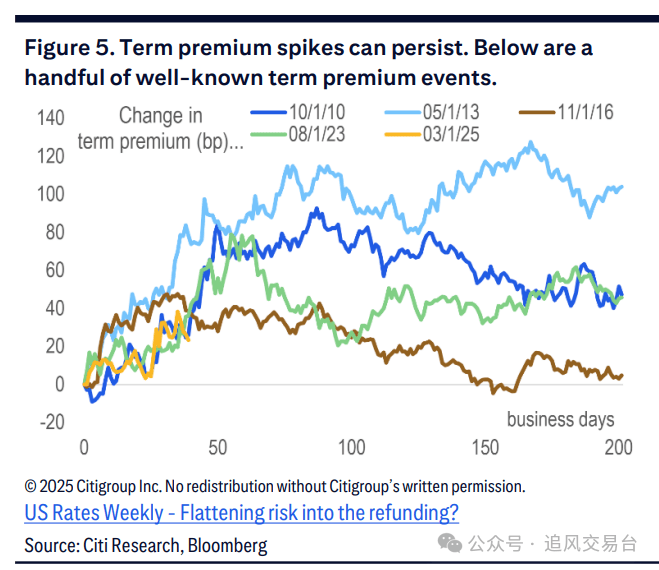
| | | 大涨背后的裂痕:今夏美国再现股债汇三杀? 美股连续大涨,市场情绪再度转热,但大涨背后的裂痕已经出现。 当市场焦点从眼前的关税缓解转向减税,夏季美国市场将面临新的"股债汇三杀"风险。 花旗认为特朗普的政策原本是一套组合拳,其中: 也就是说DOGE和关税进展都不顺,而减税推进则愈发带来市场对债务的忧虑,尤其是外资: 当前财政赤字的背景:当前正值美国的期限溢价已经处于高位。历史上,期限溢价的飙升可能会持续较 长时间( 图1),预计这种情况将再次出现,尤其是在预算问题成为焦点时。 外国投资者需求的挑战:外国投资者对美国国债的需求仍然是一个阻力,这进一步增加了风险。 而这个夏季可能会出现"减税+就业数据恶化"的基本面组合: 财政赤字扩大与经济数据疲软:今年夏天的风险是双重的: 一方面,随着财政赤字扩大,可能会出现另一轮期限溢价飙升; 另一方面,一些经济数据的疲软可能开始显现。这些因素可能会导致美联储的政策重新定价为更偏鸽派 (尤其是考虑到最近市场对2025年美联储降息预期从100个基点迅速调整到仅略高于50个基点)。 劳动力市场的季节性疲软:值得注意的是,我们即将进入劳动力市场数据季节性疲软的时期(见图 2 ...
中金:上次“股债汇三杀”发生了什么?
中金点睛· 2025-05-11 23:45
Core Viewpoint - The article discusses the recent "triple kill" in the U.S. stock, bond, and currency markets triggered by Trump's announcement of "reciprocal tariffs," highlighting concerns over inflation, economic stagnation, and the long-term trust in U.S. dollar assets [1][38]. Historical Context of "Triple Kill" - Since 1970, there have been 10 notable instances of "triple kill," primarily associated with stagflation concerns, monetary tightening, and a decline in the relative attractiveness of the U.S. dollar [2][19]. - Common triggers include economic stagnation or stagflation worries, monetary tightening to combat inflation, and a weakening of the U.S. dollar's relative appeal [2][19]. Economic Stagnation and Inflation - Historical instances of "triple kill" often occurred during periods of economic downturn and high inflation, where the Federal Reserve had to tighten monetary policy, leading to a dual impact on both stock and bond markets [2][19]. - For example, during the 1973-1974 period, the S&P 500 dropped by 15.8%, and the 10-year Treasury yield increased by 60 basis points [4][6]. Federal Reserve's Role - The Federal Reserve's delayed or inconsistent response to inflation has historically exacerbated inflation expectations, contributing to market volatility [9][19]. - In 1987, for instance, the Fed's shift to a hawkish stance led to a significant rise in bond yields and a corresponding drop in stock prices [19][21]. Recent Market Dynamics - The recent "triple kill" was primarily triggered by Trump's unexpected "reciprocal tariffs," which raised short-term market volatility and long-term concerns about inflation and economic growth [38][40]. - The tariffs are projected to increase U.S. inflation by 1.6 to 1.8 percentage points and reduce GDP growth by 0.9 percentage points [40][48]. Long-term Implications for Dollar Assets - While the tariffs may undermine investor confidence in U.S. dollar assets, the article argues that the long-term impact on the dollar's status as a reserve currency will take time to materialize [49][51]. - The current structure of U.S. debt and the predominance of domestic holders of U.S. Treasuries suggest that the dollar's position as a global reserve currency remains intact for now [51][56]. Future Outlook - The article suggests that if negotiations on tariffs or tax cuts progress positively, it could alleviate market pressures and stabilize investor sentiment [56]. - Conversely, persistent stagflation pressures could hinder the Federal Reserve's ability to lower interest rates quickly, potentially exacerbating market volatility [56][57].

人大重阳发布报告 揭示美债濒临“庞氏骗局”破产边缘
Sou Hu Cai Jing· 2025-05-05 12:15
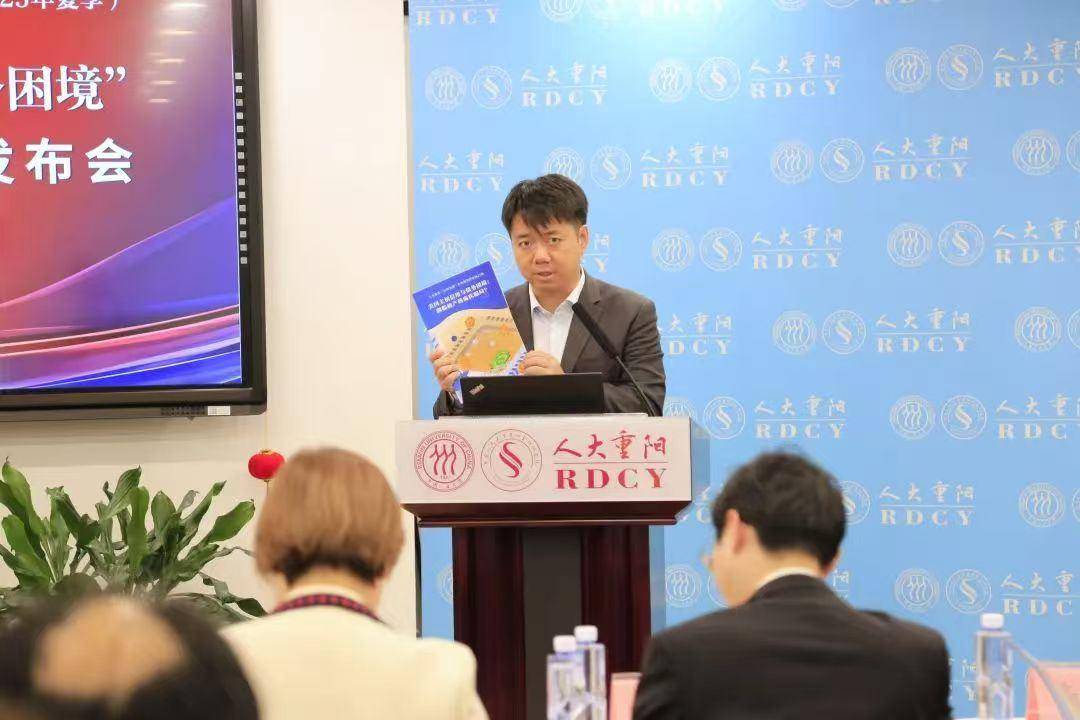
Core Viewpoint - The report from Renmin University of China's Chongyang Institute for Financial Studies warns of a significant risk of collapse in the U.S. economy and its debt system, predicting that 2025 may mark the year of a U.S. debt crisis, likening it to a Ponzi scheme nearing bankruptcy [1][4]. Economic and Financial Analysis - The U.S. national debt has reached $36.2 trillion, accounting for 123% of GDP, significantly exceeding the internationally recognized warning line of 60% [4]. - The report highlights that the U.S. government is increasingly reliant on "borrowing to pay off old debts," with approximately $9.3 trillion of public debt maturing in the 2025 fiscal year, representing one-third of total debt [4]. - Interest payments on U.S. debt are projected to reach $882 billion in the 2024 fiscal year, a 33.7% increase year-over-year, surpassing military spending for the first time [4]. - Cumulative interest payments over the next decade could total $13.8 trillion, nearly double the inflation-adjusted total from the past 20 years [4]. Policy Implications - The report criticizes the policies of the Trump administration, particularly the "reciprocal tariffs" and extreme fiscal tightening, which have led to a significant rise in inflation expectations and a drop in consumer confidence [3]. - It suggests that the combination of high tariffs and tax cuts will exacerbate social inequality and push inflation closer to 5%, further destabilizing the economy [4][5]. - The report warns that the U.S. government's loss of credibility under the current administration could lead to a market collapse similar to that of 2008 [3][4]. Global Economic Impact - The report indicates that the U.S. is increasingly viewed as a global adversary due to its aggressive tariff policies, which could lead to a contraction in global trade [5]. - It predicts that the collapse of U.S. debt will not signify the end of the international financial system but rather the beginning of a long process of restructuring the global credit system, with a shift towards a multipolar currency system [5]. Recommendations for China - The report advises China to strengthen its financial defenses against the risks posed by U.S. debt, including establishing a monitoring and early warning system for U.S. debt defaults [6]. - It emphasizes the need for China to enhance its economic resilience, improve domestic consumption, and promote the internationalization of the Renminbi [6].
“对等关税”或推高长期美债利率
2025-04-30 02:08
"对等关税"或推高长期美债利率 20250429 • 美国意图通过对等关税增加关税收入、促进出口、推动军备购买、吸引投 资及直接收款,实为变相收取"保护费",但实际落地可能仅为 10%的最 低基准关税,旨在施压谈判。 • 对等关税公布后,美国资本市场出现股债汇三杀,虽 CPI 数据良好,但市 场反应负面,反映出政策实施受到资本市场波动的制约,高频数据显示基 差交易、日本投资者和公募基金卖出债券是重要因素。 • 中长期来看,对中国以外国家加征 10%的对等关税可能导致美国利差下降, 预计每年美元供给和美元资产需求均减少 2,400 亿美元,其中美债需求每 年将减少超过 1,200 亿美元,对美债市场产生深远影响。 • 股债汇三杀在美国市场发生概率约为 9.8%,通常由对美关税担忧和美元 信用受损预期引发。2025 年 4 月 10 日的三杀事件在历史上排名较高,反 映出资本流出导致外资抛售股票、债券和美元。 • 对等关税政策实施后,美国 10 年期国债收益率在 2025 年 4 月 4 日至 4 月 11 日间上行 47 个基点,为极端走势,发生概率极低,表明大量投资者 抛售国债,市场流动性受到影响。 Q&A ...
热点思考 | 美债,风险“解除”了吗?——关税“压力测试“系列之四
赵伟宏观探索· 2025-04-28 16:00
以下文章来源于申万宏源宏观 ,作者赵伟 陈达飞 赵宇 申万宏源宏观 . 申万宏源证券研究所 | 宏观研究部 作者: 赵 伟 申万宏源证券首席经济学家 陈达飞 首席宏观分析师 赵 宇 高级宏观分析师 联系人: 赵 宇 摘要 对等关税冲击后,美元-美债的避险属性备受考验。从资金流量及期货空头头寸看,基差交易及海外抛售可能均非美债下跌的主因。谁在"抛售"美债?未来还 需关注哪些潜在风险? 一、 热点思考:美债,风险"解除"了吗? (一) 股债汇"三杀",这次有何不同? 70年代以来,美国出现过8次股债汇"三杀",其中3次出现了衰退。 股债汇"三杀"的宏观场景有:一是美联储政策剧烈调整;二是大宗或地缘冲击;三是经 济、金融重大冲击。期间,美股单日平均下跌4.6个点,10年美债利率平均上涨15BP,美元平均下跌1.3个百分点。 对等关税冲击后,美元、美债的避险属性均未体现。 2020年3月,美国市场出现资金争夺(Dash for Cash),各类资产均被抛售以换取现金,但美债指数短期 下跌后,2月至3月仍上涨15%,避险功能未受质疑;2025年的不同之处在于,美债出现更长时间的下跌。 从资金流量观察,美国债券市场资金流 ...
上一次股债汇“三杀”发生了什么?
2025-04-28 15:33
上一次股债汇"三杀"发生了什么?20250428 摘要 • 类滞胀压力及关税政策制约美联储降息空间,基建和对华关税可能推升 PCE 至年底 4%左右,若未来一两个月关税无显著进展,市场预期 6 月降 息面临挑战,美债避险效果不佳。 • 政治局会议释放扩内需信号,消费、科技(国产替代)、基建和房地产开 发链有望受益,其中科技领域景气度高且有政策支持,消费类行业处于偏 左侧机会,基建和地产链需观察房地产未来趋势。 • 黄金价格受多种因素影响,包括美债利率、美元汇率、央行购金量及美国 赤字等,长期来看美国赤字率对实际金价有强解释力,央行购金量与实际 金价呈正相关,消费者预期越差实物资产价格越高。 • 2025 年黄金价格显著上涨,估值相对较高,但避险需求、抗通胀特性及 美元、美债避险能力减弱导致黄金稀缺性增加,长期投资角度看,黄金仍 具备吸引力,年化回报率与股票相当。 • 外资对中国市场看法略有变化,倾向于等待政策进一步明确信号再进行配 置,中国市场配置比例从上个月快速转为低配水平,行业方面,AI 和半导 体仍受青睐,分红和回购风格成为第二选择。 Q&A 美国股债汇三杀的背景和含义是什么?历史上发生过类似情况吗? ...