资金面

Search documents
债市日报:2月10日
Xin Hua Cai Jing· 2026-02-10 07:53
Core Viewpoint - The bond market is experiencing a period of consolidation, with the 10-year government bond yield breaking below its recent trading range, indicating potential resistance at the 1.80% level, which may act as a support if maintained by the central bank [1][7]. Market Performance - The closing performance of government bond futures showed mixed results, with the 30-year and 10-year contracts slightly up, while the 5-year and 2-year contracts remained unchanged [2]. - The interbank market saw a continuation of a warm trend in major interest rate bonds, with notable declines in yields for various government bonds [2]. Overseas Market Trends - In North America, U.S. Treasury yields mostly fell, with the 10-year yield at 4.202%, while the 30-year yield increased slightly [3]. - Asian markets saw a decline in Japanese bond yields, while European markets also reported decreases in yields for various government bonds [3]. Primary Market Activity - The Ministry of Finance reported weighted average yields for newly issued government bonds, with the 7-year bond at 1.6130% and a strong bid-to-cover ratio across different maturities [4]. - The China Development Bank's financial bonds also showed competitive yields and bid-to-cover ratios, indicating healthy demand [4]. Liquidity Conditions - The central bank conducted a reverse repurchase operation, injecting 205.9 billion yuan into the market, with a fixed interest rate of 1.40% [5]. - Short-term Shibor rates increased across various maturities, indicating tightening liquidity conditions [5]. Institutional Insights - Analysts suggest that the 10-year bond yield's downward space is limited below 1.80%, with significant buying pressure from funds and brokerages [6][7]. - The current market sentiment is relatively subdued, with no strong catalysts to push long-term rates beyond their current range, especially ahead of the upcoming holiday [7].
节前债市表现稳定
Qi Huo Ri Bao· 2026-02-10 06:06
Group 1 - The bond market sentiment has improved due to the central bank's support and a weak performance of risk assets, with a net purchase of 100 billion yuan in government bonds in January, slightly exceeding market expectations [1] - The central bank's actions, including structural interest rate cuts and significant long-term liquidity injections, have stabilized market expectations, with a total of 1.1 trillion yuan in long-term liquidity provided in January, equivalent to a 0.5 basis point reserve requirement cut [1] - The 10-year government bond yield has dipped to around 1.8%, indicating a warm sentiment in the bond market [1] Group 2 - The supply-demand gap is widening, with ongoing structural differentiation and weak internal momentum, while prices are stabilizing, supporting nominal growth recovery in the first half of the year [2] - Attention is needed on the impact of global policy synchronization on manufacturing cycles and exports, as well as the effects of ongoing declines in the real estate sector on household balance sheets [2] - Seasonal performance indicates that years with a later Spring Festival typically see stronger macro data in January and February, with potential impacts on production and investment data in the first quarter [2] Group 3 - The upcoming National People's Congress is expected to release policy signals, with local GDP growth targets for 2026 being adjusted downward, indicating a potential reduction in national economic growth targets [3] - The expectation of a downward adjustment in incremental policy strength may have a positive impact on the bond market, although medium to long-term macro policies remain supportive [3] - The bond market is likely to see increased volatility post-holiday, with institutional investors favoring "holding bonds over the holiday," which may lead to a relatively stable bond market performance [3] Group 4 - Weak domestic demand and loose liquidity are the main supports for the bond market, with improved supply-demand dynamics for local government bonds driving the current bond market recovery [5] - The expectation of stable liquidity and the historical calendar effect of the Spring Festival suggest that institutional willingness to "hold bonds over the holiday" will increase, potentially leading to slight price increases in the bond market [5] - Post-holiday, the bond market may experience differentiation and increased volatility, influenced by macroeconomic conditions, risk asset rebounds, and policy signals [5]

债市日报:2月9日
Xin Hua Cai Jing· 2026-02-09 07:40
Core Viewpoint - The bond market continues to show strength, with government bond futures rising across the board and interbank bond yields generally declining, indicating a positive sentiment ahead of the Chinese New Year [1][2]. Market Performance - Government bond futures closed higher, with the 30-year main contract up 0.14% at 112.73, the 10-year contract up 0.06% at 108.49, the 5-year contract up 0.08% at 106.025, and the 2-year contract up 0.04% at 102.484 [2]. - The yield on the 10-year government bond "25附息国债16" decreased by 0.7 basis points to 1.795%, while the yield on the 10-year policy bank bond "25国开20" fell by 2.25 basis points to 1.94% [2]. Overseas Market Trends - In North America, U.S. Treasury yields rose across the board, with the 2-year yield increasing by 5.54 basis points to 3.498% and the 10-year yield rising by 2.99 basis points to 4.206% [3]. - In Asia, Japanese government bond yields also saw significant increases, with the 5-year and 10-year yields rising by 4.9 basis points and 5.4 basis points, respectively [3]. Primary Market Activity - Agricultural Development Bank's financial bonds had successful bids with yields of 1.4406% for 1.0356-year, 1.5793% for 3-year, and 1.9286% for 10-year bonds, with bid-to-cover ratios of 3.08, 2.89, and 4.42 respectively [4]. - The 10-year "26陕西债04" bond had a yield of 1.92% with a bid-to-cover ratio of 34.64, indicating strong demand [4]. Funding Conditions - The central bank conducted a 7-day reverse repo operation of 1130 billion yuan at a rate of 1.40%, resulting in a net injection of 380 billion yuan for the day [5]. - Short-term Shibor rates mostly increased, with the overnight rate down 0.7 basis points to 1.27% and the 7-day rate up 7.0 basis points to 1.505% [5]. Institutional Insights - Citic Securities noted that the bond market is warming up due to reduced profitability in equities and commodities, alongside expectations of total easing, suggesting a potential recovery in the bond market [7]. - Huatai Fixed Income highlighted that while the bond market may perform steadily before the holiday, the post-holiday trend will depend on fundamental factors and policy signals [7]. - Xingzheng Fixed Income emphasized that under stable funding conditions, leveraging strategies and short-duration credit bond strategies remain effective [7].
乐观情绪带动 沪铜企稳【盘中快讯】
Wen Hua Cai Jing· 2026-02-09 01:23
Core Viewpoint - The recent performance of copper prices is primarily driven by macroeconomic sentiment and liquidity conditions, with both domestic and international copper prices rising over 2% [2] Group 1: Market Performance - Shanghai copper opened higher in the morning, with both domestic and international copper prices increasing by over 2% [2] - On Friday, the decline in U.S. stocks and cryptocurrencies negatively impacted market sentiment, causing Shanghai copper to briefly fall below the 100,000 yuan mark [2] - Following a stabilization in U.S. tech stocks, concerns over market liquidity eased, leading to an improvement in risk appetite and a rebound in precious metals, which also positively influenced copper prices [2]

每日债市速递 | 央行14天逆回购呵护跨节流动性
Wind万得· 2026-02-08 22:43
Group 1: Open Market Operations - The central bank conducted a 315 billion yuan 7-day reverse repurchase operation at a fixed rate of 1.40%, with a total bid and winning amount of 315 billion yuan [1] - Additionally, a 3000 billion yuan 14-day reverse repurchase operation was carried out, with a total of 6000 billion yuan in 14-day reverse repos conducted over two days to support the liquidity during the Spring Festival [1] Group 2: Funding Conditions - The interbank market is experiencing a more relaxed funding environment, with the weighted average rate of DR001 dropping over 4 basis points to around 1.27% [3] - Overnight quotes in the anonymous click (X-repo) system fell to 1.25%, indicating ample supply, while non-bank institutions borrowed overnight against credit bonds at rates below 1.5% [3] - The latest overnight financing rate in the U.S. stands at 3.65% [3] Group 3: Interbank Certificates of Deposit - The latest transaction for one-year interbank certificates of deposit in the secondary market is around 1.590% [7] Group 4: Bond Market Overview - The yields on major interbank rate bonds have mostly decreased, with specific yields for various maturities showing declines, such as the 1-year government bond yield at 1.3125% and the 10-year yield at 1.8010% [10] - The data indicates a general downward trend in yields across different types of bonds, including government bonds and policy bank bonds [10] Group 5: Recent Economic Indicators - The Asian Manufacturing Purchasing Managers' Index (PMI) for January 2026 is reported at 51%, a slight decrease of 0.1 percentage points from the previous month, indicating continued expansion in the manufacturing sector [14] - The global manufacturing PMI increased by 1.5 percentage points to 51% in January [14] Group 6: Global Monetary Policy - The European Central Bank has maintained its benchmark interest rate, marking the fifth consecutive pause in rate cuts since June of the previous year, with officials closely monitoring the impact of euro appreciation on export competitiveness and inflation [16]

浙商固收:本次春节假期前后资金面的关注点
Sou Hu Cai Jing· 2026-02-08 14:14
Group 1 - The central bank began to inject 14-day reverse repos starting February 5, aligning with expectations for the amount and timing across the Spring Festival holiday [1][3] - The current low deposit certificate and credit spreads reflect a market expectation of stable and loose liquidity, with remaining arbitrage opportunities [1][3] - The Spring Festival holiday's impact on interbank liquidity is primarily driven by changes in M0, with cash withdrawals for "red envelopes" still prevalent despite digital payment methods [1][2] Group 2 - The cash leakage due to residents' withdrawals during the Spring Festival is expected to exceed 1.7 trillion, compounded by a funding gap of over 2.2 trillion before the holiday [2] - The central bank's balance sheet measures M0 changes, which may show smaller increases if the holiday falls mid-month due to cash returning to banks later [2] - The 2026 Spring Festival, lasting 9 days, is anticipated to cause significant cash leakage and delayed cash return to banks, similar to trends observed in previous years [1][4] Group 3 - The central bank's reverse repo operations are expected to total 2.4 trillion if maintained at 300 billion daily from February 9 to February 14, matching the anticipated funding gap [3] - Attention should be paid to the speed of cash return to banks and the potential appreciation of the RMB during the holiday [4] - The 2023 Spring Festival saw a significant increase in residents returning home and delayed work resumption, leading to a tightening of liquidity post-holiday [4]
(2026.2.2-2026.2.6):债市窄幅波动,超长债率先上涨破局——利率回顾
INDUSTRIAL SECURITIES· 2026-02-08 10:48
Group 1: Report Industry Investment Rating - No information provided Group 2: Core Viewpoints of the Report - The bond market showed narrow fluctuations from February 2nd to February 6th, with the ultra-long end rising slightly and breaking the situation. The market is in a repeated game near key points, and the follow - up needs to focus on policy signals and the defense and offense of key points [1] Group 3: Summary by Related Catalogs 1. Capital Market - The capital market was generally balanced and loose. From February 2nd to February 6th, DR007 traded in the range of 1.26 - 1.59%, and the capital price declined slightly. The central bank had a net withdrawal of 656 billion yuan in total [1] 2. Primary Market - The demand was high, and the bidding sentiment for treasury bonds and China Development Bank bonds was good. From February 2nd to February 6th, the cumulative issuance of interest - rate bonds was 1.1607 trillion yuan, and the average daily issuance was at a relatively high level [1] 3. Secondary Market - The bond market fluctuated narrowly, with the short - end falling slightly, the long - end basically flat, and the ultra - long end rising slightly. The yield of the active 10 - year treasury bond 250022 decreased by 0.25bp in total during the week [1] 4. Term Spread - The yield curve showed a reverse trend, and the 10Y - 1Y term spread of treasury bonds narrowed. From February 2nd to February 6th, the 10Y - 1Y spread of treasury bonds decreased by 2.18bp to 49bp, and the 10Y - 1Y spread of China Development Bank bonds decreased by 0.88bp to 39bp [1]
流动性与同业存单跟踪:本次春节假期前后资金面的关注点
ZHESHANG SECURITIES· 2026-02-08 08:49
1. Report Industry Investment Rating No investment rating information is provided in the report. 2. Core Viewpoints - The key factors affecting the inter - bank capital situation during the Spring Festival holiday are the change in M0. The 9 - day Spring Festival in 2026 may lead to greater cash leakage and slower cash return to banks, resulting in a lower excess reserve level in the commercial banking system [2][12]. - The cash leakage (M0 month - on - month increase) caused by residents' cash withdrawals during the Spring Festival may exceed 1.7 trillion yuan, and with the 500 - billion - yuan 6M term repurchase "maturity - placement" misalignment, the pre - Spring Festival capital gap may exceed 2.2 trillion yuan [3][13]. - The central bank started to issue 14 - day reverse repurchase on February 5, and the start date and amount of the reverse repurchase across the Spring Festival holiday met expectations. The current low certificate of deposit spread and credit spread fully reflect the market expectation of stable and loose funds and remaining carry trade space [1][4]. - During the Spring Festival holiday, more attention should be paid to the speed of cash return to banks and the appreciation of the RMB. The 9 - day holiday may cause residents to return to work later, and RMB appreciation may consume commercial bank excess reserves [4][15]. 3. Summary by Directory 3.1 The Focus on the Capital Situation around the Spring Festival Holiday - The main factor affecting the inter - bank capital situation during the Spring Festival is the change in M0. The 9 - day Spring Festival in 2026 will lead to greater cash leakage and slower cash return to banks, resulting in lower excess reserves in the commercial banking system [2][12]. - The cash leakage (M0 month - on - month increase) during the Spring Festival may exceed 1.7 trillion yuan, and combined with the 500 - billion - yuan 6M term repurchase "maturity - placement" misalignment, the pre - Spring Festival capital gap may exceed 2.2 trillion yuan [3][13]. - The central bank issued 14 - day reverse repurchase on February 5, and the start date and amount of the reverse repurchase across the Spring Festival holiday met expectations. The current low spreads reflect the market expectation of stable and loose funds [1][4]. - Attention should be paid to the speed of cash return to banks and RMB appreciation during the holiday [4][15]. 3.2 Narrow - sense Liquidity 3.2.1 Central Bank Operations - Short - term liquidity: The central bank conducted peak - shaving and valley - filling operations. From February 2 to February 6, the net issuance of pledged reverse repurchase was - 756 billion yuan. Medium - and long - term liquidity: The 3M term repurchase was renewed with an excess of 100 billion yuan [16]. 3.2.2 Institution's Lending and Borrowing Situations - Capital supply (lenders): The net lending of large - scale banks reached a record high. Capital demand (borrowers): The absolute financing balance was high, and the relative leverage ratio increased [22][34]. 3.2.3 Repurchase Market Transaction Situation - Capital volume and price: The volume was abundant, and the price was stable. The capital sentiment index showed a gradual easing trend [42][45]. 3.2.4 Interest Rate Swaps - The cost of interest rate swaps decreased slightly, and the spread between CDs and IRS remained at a low level [49]. 3.3 Government Bonds 3.3.1 Next Week's Net Payment of Government Bonds - The net payment of government bonds next week will increase significantly. The net payment in the past week was 460.4 billion yuan, and it is expected to be 643.7 billion yuan next week [52]. 3.3.2 Government Bond Maturity Structure - The report presents the issuance and proportion of government bonds with different maturities in 2024, 2025, and 2026, including treasury bonds and local government bonds [57][58]. 3.4 Certificates of Deposit 3.4.1 Absolute Yield - The report shows the SHIBOR yield curve and the AAA - rated certificate of deposit yield curve and their changes compared with the previous week [62]. 3.4.2 Issuance and Stock Situations - As of February 6, the issuance and stock structures of certificates of deposit of different types of banks are presented, including the issuance and stock amounts and proportions of different maturities [66][67]. 3.4.3 Relative Valuation - The report analyzes the spreads of certificates of deposit, including the spreads between the 1 - year AAA - rated certificate of deposit yield and R007, DR007, and the 10 - year treasury bond yield, and their quantiles since 2020 [69].

流动性与机构行为周度跟踪260207:DR001时隔1月重回1.3下方存单年内首现净融资-20260208
Huafu Securities· 2026-02-08 07:30
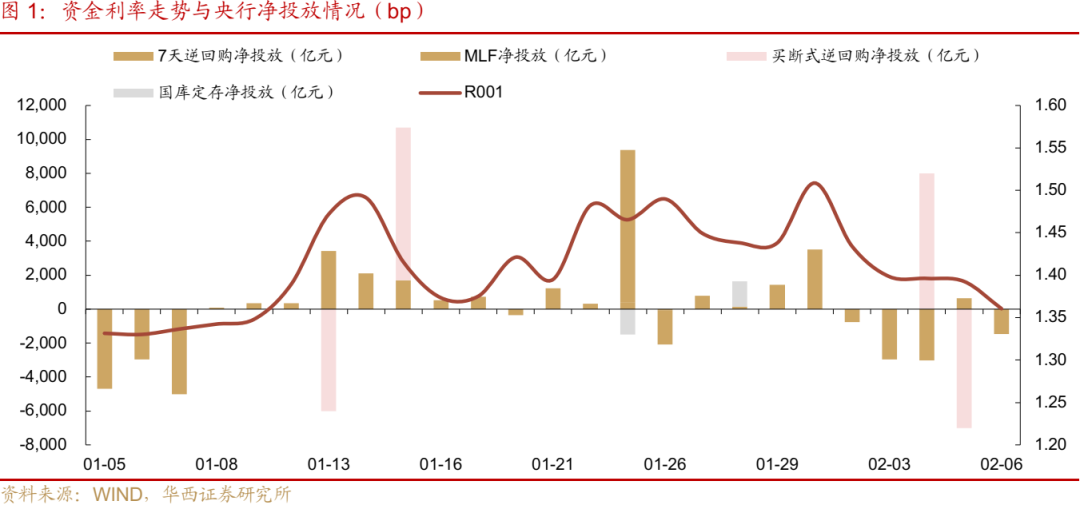
Report Industry Investment Rating No relevant content provided. Core View of the Report - The central bank's over - renewal of repurchase and large - scale 14 - day reverse repurchase reflect its intention to maintain liquidity stability before the Spring Festival. As long as the central bank's attitude remains unchanged, the capital market around the Spring Festival is expected to remain loose. The net financing of certificates of deposit this week may be due to banks' need to maintain stable liabilities before the festival, and it's hard to infer a significant increase in banks' liability pressure. The government bond net payment scale may rise next week, but considering the central bank's measures, the capital market is still expected to be relatively loose [5][38][60]. Summary According to the Table of Contents 1. Money Market 1.1 This Week's Capital Market Review - The central bank carried out a net withdrawal of 756 billion yuan through 7 - day and 14 - day reverse repurchases this week. On Wednesday, it conducted an 800 - billion - yuan 3 - month term repurchase, with an over - renewal of 10 billion yuan. After the month - end, the OMO shifted to net withdrawal, but the capital demand at the beginning of the month was limited. Despite the increasing pressure of government bond payments in the second half of the week, the over - renewal of the 3 - month repurchase and the subsequent 14 - day OMO operations made the capital market looser, and DR001 fell below 1.3% on Friday [3][17]. - After the month - end, the trading volume of pledged repurchase continued to rise, with the average daily trading volume increasing by 0.95 trillion yuan to 8.75 trillion yuan. The overall scale of pledged repurchase rose rapidly at the beginning of the month and then fluctuated, remaining above 13 trillion yuan on Friday. The net lending of large - scale banks continued to rise, while that of small and medium - sized banks decreased slightly. The net lending of non - bank institutions showed different trends, and the capital gap index generally declined [4][24]. - The progress of cross - Spring Festival financing in the inter - bank and exchange markets was at the lowest level in recent years, and the gap compared with previous years in the inter - bank market continued to widen. The overall cross - Spring Festival progress in the whole market was 13.1%, 8.1 percentage points lower than the average of the same period from 2020 - 2025 [29]. 1.2 Next Week's Capital Outlook - This week, the net payment of government bonds was 46.04 billion yuan. Next week, the issuance of 7 - year treasury bonds is about 20 billion yuan, and 8 regions will issue local bonds worth 32.21 billion yuan. Due to the low maturity scale of government bonds next week, the net payment scale of government bonds may rise to 71.41 billion yuan [39][41]. - The central bank's use of 14 - day reverse repurchase operations shows its clear attitude of protecting liquidity. The 6 - month repurchase due next week is expected to be over - renewed, so the capital market is expected to remain relatively loose [60]. 2. Inter - bank Certificates of Deposit - The 1 - year Shibor rate decreased by 1.11 BP to 1.6169% compared with January 30th. The secondary rate of 1 - year AAA - rated inter - bank certificates of deposit decreased by 1 BP to 1.585% compared with last week [61]. - This week, the issuance scale of inter - bank certificates of deposit increased while the maturity scale decreased, resulting in a net financing of 37.27 billion yuan, an increase of 46.29 billion yuan compared with last week. The net financing scales of state - owned banks, joint - stock banks, city commercial banks, and rural commercial banks were 9.46 billion yuan, 8.82 billion yuan, 13.69 billion yuan, and 2.59 billion yuan respectively. The issuance proportion of 9 - month certificates of deposit was the largest, and the issuance proportion of 1 - year certificates of deposit decreased by 17 percentage points to 13% compared with last week. Next week, the maturity scale of certificates of deposit is about 97.82 billion yuan, an increase of 84.43 billion yuan compared with this week [67]. - The issuance success rates of state - owned banks, joint - stock banks, city commercial banks, and rural commercial banks all increased compared with last week, and were around the average level in recent years. The issuance spread of 1 - year certificates of deposit between city commercial banks and joint - stock banks widened [68]. - The willingness of money market funds to increase the holding of certificates of deposit in the primary market recovered, and the willingness of fund companies to reduce the holding in the secondary market weakened. The relative strength index of certificates of deposit rebounded counter - seasonally in the second half of the week, rising by 3.9 percentage points to 19.6% compared with last week. Except for the 9 - month supply - demand index, the supply - demand indexes of other terms increased [75]. 3. Bill Market - This week, bill interest rates first decreased and then increased, with a large decline on Monday. As of February 6th, the 3 - month and 6 - month bill interest rates of state - owned and joint - stock banks decreased by 44 BP and 16 BP respectively compared with January 30th, to 1.01% and 0.95% [82]. 4. Bond Trading Sentiment Tracking - This week, the yields of interest - rate bonds fluctuated downward, and the credit and perpetual bond spreads generally widened passively. Large - scale banks generally tended to reduce their bond holdings, with an increased willingness to reduce local bonds and a decreased willingness to increase inter - bank certificates of deposit, 5 - year policy - financial bonds, 5 - year and 10 - year treasury bonds. Trading - type institutions generally tended to increase their bond holdings, with different trends among different institutions. Allocation - type institutions generally tended to increase their bond holdings, with different trends among different institutions [85].
春节前,政府债净缴款升至7000亿+
Xin Lang Cai Jing· 2026-02-07 15:36
Core Viewpoint - The liquidity in the financial market remains loose despite pressures from government bond payments, supported by central bank interventions and fiscal spending [1][2][5]. Group 1: Market Liquidity - In the first week of February, the liquidity remained loose, with R001 and R007 rates declining to 1.40% and 1.55% respectively, indicating a significant drop from the previous month [1][2]. - The central bank has injected a total of 1.2 trillion yuan in medium to long-term funds from January to February, with a net withdrawal of 756 billion yuan in the first week of February [1][5]. - The average net lending from the banking system exceeded 5 trillion yuan, indicating a high supply level, with major banks increasing their net lending significantly [5][11]. Group 2: Government Bonds - The estimated net payment for government bonds in the week of February 9-14 is approximately 713.7 billion yuan, marking a significant increase from the previous week [20][21]. - The planned issuance of government bonds for the same week is 452.1 billion yuan, which is lower than the previous week's issuance [20][21]. - The net payment pressure from government bonds has increased due to deferred payments from the previous week, with both national and local bonds experiencing heightened net payment pressures [20][21]. Group 3: Interbank Certificates of Deposit - The issuance rate for interbank certificates of deposit remained stable, with a weighted issuance rate of 1.59% during the first week of February [24][25]. - The net financing from interbank certificates of deposit reached 373.3 billion yuan, indicating a strong demand despite the stable rates [24][25]. - The maturity scale of interbank certificates of deposit is expected to rise, with a total of 978.2 billion yuan maturing in the week of February 9-14, which is relatively high compared to historical data [24][25].