以旧换新

Search documents
税收数据显“两新”政策成效 新能源车销量同比增81.7%丨数据看板
Sou Hu Cai Jing· 2025-08-15 08:45
Group 1 - The "equipment update" policy has significantly contributed to industrial transformation and upgrading, with machinery equipment procurement amount increasing by 7.3% year-on-year from April 2024 to July 2025, and industrial enterprises seeing a 9.8% increase [1][2] - The information transmission and software industry, along with technology services, experienced substantial growth in equipment procurement, with increases of 27.8% and 28.3% respectively [1] - Private enterprises also showed a notable increase in equipment procurement by 9.3%, indicating the effective transformation of policy benefits into new driving forces for industrial upgrading [1] Group 2 - The "old-for-new" policy has stimulated diverse consumer demand, with retail sales of daily household appliances and audio-visual equipment increasing by 44.5% and 22.8% respectively from April 2024 to July 2025 [1] - Sales of furniture and sanitary ware also saw significant growth, with increases of 30.1% and 13.6% respectively, while the service robot manufacturing industry experienced a remarkable 51.1% growth [1] - The automotive sector benefited from the policy as well, with nationwide sales of new energy vehicles soaring by 81.7% during the same period [1] Group 3 - The implementation of the policies has created a positive interaction of "policy-driven - demand release - industrial upgrading," leading to a 5.8% year-on-year increase in manufacturing sales revenue from April 2024 to July 2025 [2] - The tax authority emphasizes the importance of a "policy + service" dual-drive approach to ensure the continued effectiveness of the "two new" policies, thereby injecting stronger momentum into high-quality economic development [2]
7月份经济数据解读:内生动能复苏有待宏观政策进一步呵护
Yin He Zheng Quan· 2025-08-15 08:37
Economic Overview - In July, China's economic data showed a slight contraction in both supply and demand, with GDP growth estimated at 4.8%, down from 5.4%[2] - Industrial value added grew by 5.7% year-on-year, a decrease from 6.8% in the previous month, influenced by extreme weather conditions[2] - The service sector maintained strong growth, with a production index increase of 5.8%[2] Consumer Trends - Retail sales of consumer goods increased by 3.7% year-on-year in July, significantly down from 6.4% and 4.8% in May and June respectively[2] - Dining revenue growth remained low at 1.1%, indicating weak consumer spending in the restaurant sector[5] - The "old-for-new" policy continued to show diminishing returns, with retail growth in related sectors declining for two consecutive months[5] Investment Insights - Fixed asset investment growth for January to July was recorded at 1.6%, with real estate investment declining by 12.0%[21] - Infrastructure investment growth was only 3.2%, significantly lower than seasonal expectations, with July's investment growth estimated at -5.07%[4] - Manufacturing investment saw a marginal decline of 1.3 percentage points to 6.2%, with equipment updates being the only positive contributor[24] Real Estate Market - New residential property sales area decreased by 4.0% year-on-year, with sales value dropping by 6.5%[39] - The average price of new homes in major cities showed a narrowing decline, while second-hand home prices continued to fall, indicating unstable demand[39] - Real estate development investment totaled 53,580 billion yuan, with a monthly estimated decline of 17%[45] Employment Situation - The urban unemployment rate rose to 5.2%, with local household unemployment increasing to 5.3%[58] - The demand for labor from external sources remained strong due to robust industrial production, but uncertainty in future employment needs led to higher local unemployment rates[64]
7月经济数据点评:消费还有哪些潜在空间?
Soochow Securities· 2025-08-15 08:18
Economic Overview - In July, industrial added value increased by 5.7% year-on-year, down from 6.8% in June, while the service production index rose by 5.8%[1] - External demand showed unexpected strength with exports growing by 7.2%, surpassing the expected 5.9%, while internal demand weakened with retail sales increasing by only 3.7% compared to 4.8% in June[1] Consumer Trends - Retail sales growth declined from 6.4% in May to 4.8% in June and further to 3.7% in July, primarily driven by a slowdown in goods sales[1] - The sales growth of "trade-in" subsidy products fell from an average of 17.5% to 12.7%, indicating a significant impact on overall retail performance[1] Investment Insights - Fixed asset investment growth dropped from 2.6% in June to 1.6% in July, with construction investment showing negative growth for the first time since August 2020, at -0.8%[1] - Manufacturing investment growth decreased from 7.5% in June to 6.2% in July, highlighting a divergence in investment performance across different sectors[2] Future Outlook - Despite potential pressures in Q4 due to high base effects and demand front-loading, there are three supporting factors for consumer growth in the second half of the year: gradual recovery in dining growth, the release of childbirth subsidies, and consumer loan interest subsidies[1] - The construction sector is expected to face continued pressure in August due to adverse weather conditions, but policy-driven financial tools may provide support in Q4[2]
2025年7月经济数据点评:7月经济数据的不寻常
Minsheng Securities· 2025-08-15 07:28
Economic Overview - In July 2025, the industrial added value for large-scale enterprises increased by 5.7% year-on-year and 0.38% month-on-month[3] - The total retail sales of consumer goods grew by 3.7% year-on-year but decreased by 0.14% month-on-month[3] - From January to July, fixed asset investment (excluding rural households) rose by 1.6% year-on-year[3] Investment Trends - Both infrastructure and manufacturing investment growth turned negative in July, with broad infrastructure down by 1.9% and narrow infrastructure down by 5.1%[4][8] - Manufacturing investment growth fell from 5.1% in June to -0.3% in July, indicating a significant decline in investment momentum[6][23] Consumption Insights - The decline in retail sales growth to 3.7% in July was primarily driven by a decrease in automobile sales and weak demand in other categories[8][9] - The effectiveness of the "trade-in" policy for stimulating consumption has weakened, with significant drops in categories like automobiles and home appliances[9][34] Employment Concerns - The urban surveyed unemployment rate increased, indicating a potential rise in youth unemployment, particularly among the 16-24 age group[4][15] - The number of college graduates in 2025 is projected to be 12.22 million, higher than the previous year's 11.79 million, raising concerns about job market saturation[4] Risks and Challenges - The current economic environment shows signs of "production stability, weak consumption, and weak investment," posing risks for the second half of the year[3] - External shocks and insufficient effective demand remain significant challenges for economic performance in the latter half of 2025[3][10]
对话市商务局局长张非梦:深圳外贸“含新量”不断上升
Nan Fang Du Shi Bao· 2025-08-15 03:09
Core Viewpoint - Shenzhen is set to enhance its role as a high-level international trade hub, driven by the recent policy document issued by the central government, amidst a complex international landscape and trade uncertainties [2][4][6]. Economic Performance - Shenzhen's economy shows resilience and positive momentum, with foreign trade import and export volumes leading among mainland cities, and a notable increase in high-tech product exports [2][7]. Policy Initiatives - The "2025 Shenzhen Foreign Trade Support Policy" and "2025 Shenzhen Service Trade Development Support Policy" have been introduced to stabilize foreign trade and promote consumption, with a focus on supporting enterprises in expanding international markets [10][20]. Trade Facilitation - Efforts are being made to enhance cross-border trade facilitation, including the establishment of a favorable institutional environment for new trade models and the promotion of comprehensive pilot zones for cross-border e-commerce [8][11]. Consumer Market - The Shenzhen government has implemented 39 measures to boost consumption, including a successful "old-for-new" policy that has benefited over 11 million people and generated significant sales [20][21]. Service Trade Development - Shenzhen is advancing service trade innovation, with a focus on creating demonstration platforms and enhancing the integration of service and goods trade [13][14]. Future Outlook - The city aims to continue expanding its international competitiveness through initiatives like the promotion of high-value-added customs maintenance services and the development of new retail formats [16][17][23].


太仓沙溪政企联动助力电动车“以旧换新”
Xin Hua Ri Bao· 2025-08-14 21:39
Core Viewpoint - The article highlights the safety concerns surrounding electric bicycles and the proactive measures taken by the local government in Taicang City to enhance safety through a special initiative focused on old electric bikes [1] Group 1: Safety Initiative - The initiative titled "Safe Travel, Peaceful Families" aims to address safety issues related to old electric bicycles by conducting fire safety inspections and offering trade-in programs [1] - The program features a three-pronged approach: fire inspections, safety awareness campaigns, and replacement subsidies for old electric bikes [1] Group 2: Implementation Details - Fire safety personnel are actively inspecting communities for safety hazards in old electric bicycles, while technical staff conduct safety assessments on-site [1] - Residents can receive a maximum subsidy of 800 yuan for trading in their old bikes, which may have issues such as battery aging and exposed wiring, upon presenting a "Fire Safety Recommendation" [1] Group 3: Future Plans - The local government plans to organize fire safety drills and establish safe charging demonstration points for electric bicycles in various residential areas to strengthen the fire safety network [1]
京东高管解读Q2财报:外卖和即时零售是京东很重要的长期战略方向
Xin Lang Ke Ji· 2025-08-14 14:28
详见:京东第二季度营收3567亿元 经调净利润74亿元 财报发布后,京东集团CEO许冉、CFO单甦出席了分析师电话会议,对财报进行了解读,并回答了分析 师提问。 以下即为本次电话会议分析师问答环节实录: 高盛分析师Ronald Keung:我的第一个问题有关京东的"以旧换新"。在"618"活动期间,我们看到有一 些省份短暂地暂停了"国补"。另外,明年的"国补"也有一定不确定性,其他平台的竞争也加剧了。我们 看到,在第二季度京东的表现也非常努力。我想请问管理层,您对今年下半年和明年"带电品类"有哪些 策略?您计划如何提升市场份额? 我的第二个问题有关京东的外卖业务。从现在的竞争情况来看,不止是三家(京东、美团、淘宝闪 购),其实还有更多公司参与竞争,大家要拼的是耐力、执行力还有差异化。从目前的竞争来看,排在 第一位的规模最大,排在第二名的有非常雄厚的资金背景。对京东来说,管理层如何思考京东的投入和 长期的决心?作为目前的第三名,公司未来应该还要持续投入一段时间,这期间也可能产生亏损。我们 应该如何评估流量入口的获客以及交叉销售?管理层计划如何改善业务的单位经济效益(UE)? 许冉:首先,在"国补"政策落地期间, ...

刘元春:下半年经济怎么干?|宏观经济
清华金融评论· 2025-08-14 10:21
Core Viewpoint - The economic development in China during the first half of the year exceeded expectations, with a GDP growth rate of 5.3%. However, structural issues remain severe, indicating potential uncertainties ahead [2][3]. Group 1: Economic Growth and Structural Issues - The GDP growth rate of 5.3% in the first half of the year reflects a stronger-than-expected economic performance, but structural problems are still significant, as indicated by data from June [2][3]. - Investment remains crucial for stabilizing growth, as evidenced by the data from the first half of the year [7]. Group 2: Consumer Demand and Policy Measures - Expanding consumer demand is a strategic priority for China, which requires systemic adjustments rather than short-term stimulus measures. Key areas include ensuring residents' income, asset balance, and social security systems [5]. - Various policies have been introduced to support consumer spending, including subsidies for education and services for vulnerable groups, which are expected to continue in the second half of the year [6]. Group 3: Investment and Market Dynamics - The slowdown in real estate and private investment growth in June poses a significant challenge for the second half of the year. To counter this, measures to stimulate private investment and improve expected returns are being implemented [7]. - The government is focusing on enhancing the space for private investment and ensuring that the expected returns for private enterprises are safeguarded through fiscal and monetary policies [7]. Group 4: Market Competition and Innovation - The phenomenon of many companies not being profitable despite advancements in technology and industry upgrades highlights the need to address disordered competition and market chaos. This requires actions to ensure effective competition and sustainable profitability for enterprises [8]. - The initiative to combat "involution" is essential for optimizing market order and addressing the macroeconomic issues of low price levels and supply-demand imbalances [8]. Group 5: Foreign Trade and Investment Stability - The political bureau meeting emphasized the need to stabilize foreign trade and investment, acknowledging the changing landscape of international trade, particularly concerning U.S. tariff negotiations [9][10]. - The emergence of "black swan" events and extreme situations necessitates preemptive measures to mitigate potential impacts on foreign trade [11]. Group 6: Consumption Policies and Future Expectations - The "old-for-new" program has a total budget of 300 billion yuan, with over half already implemented in the first half of the year. The remaining budget is expected to expand in scope and variety, including new consumer goods and services [12]. - Future policies will focus on enhancing consumer potential and ensuring that consumption support measures are effective in the medium term [12]. Group 7: Risk Management and Urban Development - The emphasis on high-quality urban renewal indicates a shift in policy focus to address changing risk dynamics, particularly in the real estate sector, which is moving towards a new development model [13]. - The adjustment of real estate policies aims to reduce risks and promote stability in the market, reflecting a proactive approach to managing economic challenges [13].
毕马威中国经济研究院院长蔡伟:消费市场的积极变化将利好消费板块的估值修复
Zheng Quan Ri Bao Wang· 2025-08-13 11:05
Group 1 - The positive changes in the consumption market will benefit the valuation recovery of the consumption sector, enhancing performance growth expectations for companies supported by policy and market demand [1] - The investment attractiveness of the consumption sector is expected to increase further, boosting investor confidence and attracting more capital inflow [1] Group 2 - In July, the PPI decline in industries such as coal, steel, cement, photovoltaic, and lithium batteries has narrowed, while CPI for fuel and new energy vehicles has stabilized after several months of decline [2] - To consolidate the foundation for moderate price recovery, it is necessary to strengthen policy coordination on both supply and demand sides, promoting industrial upgrades and demand creation [2] - On the supply side, improving standards for technology, energy consumption, and emissions is essential to phase out outdated capacity and replace it with high-quality capacity [2] Group 3 - The new consumption sector is expected to further contribute to domestic demand, particularly through the acceleration of service consumption potential, innovation in consumption scenarios and channels, and the emergence of the emotional economy [3] - The "self-care economy" trend is driving growth in new sectors such as light luxury, trendy toys, pet care, and fitness, becoming new engines for industrial upgrades and economic growth [3] Group 4 - The implementation of policies like "old for new" has led to positive changes in the consumption market, with suggestions to expand subsidy coverage to essential goods and services [4] - The focus should also be on balancing the pace of subsidy distribution to ensure policy continuity and optimize financial support and tax incentives [4] - The emotional economy-related sectors in the A-share market have shown active performance, indicating high market recognition of their growth potential [4] Group 5 - The younger consumer group increasingly values "emotional value" and "cultural identity," making "emotional price ratio" a significant factor in their purchasing decisions [5] - The rise of national brands and cultural exports is driving high growth in sectors like trendy toys and IP derivatives, with companies that possess brand advantages and innovation capabilities standing out [5]
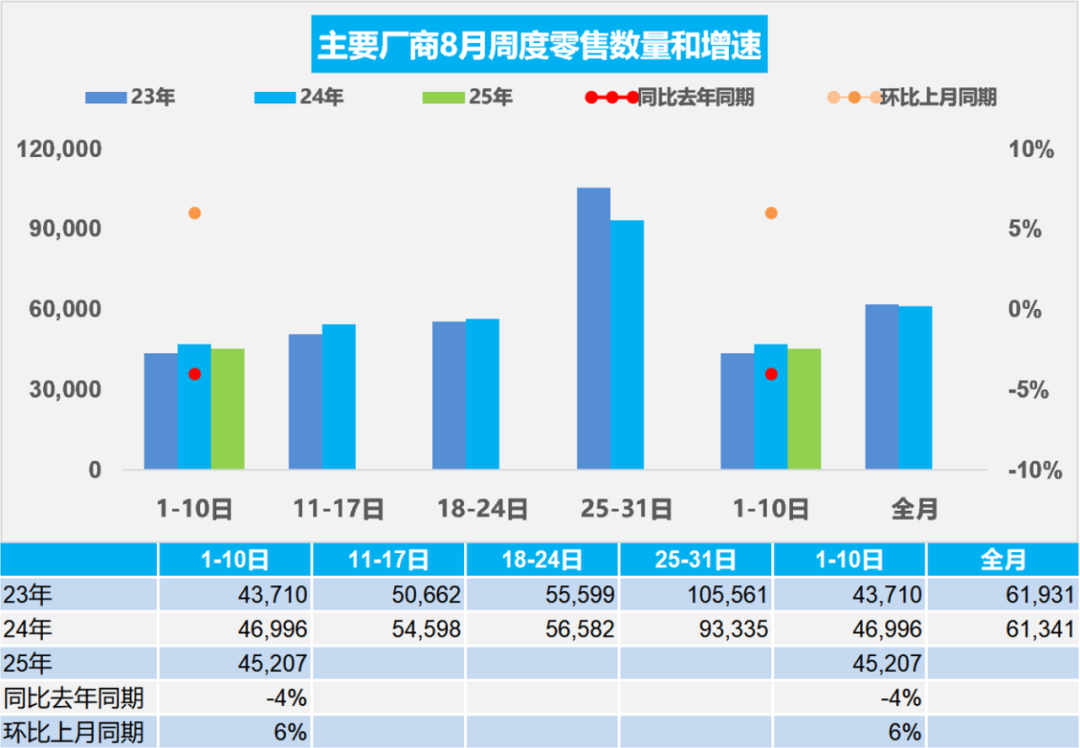
乘联分会:8月1-10日全国乘用车市场零售45.2万辆 新能源零售渗透率约58%
智通财经网· 2025-08-13 09:07
Group 1: Market Performance - From August 1 to 10, the national passenger car retail market sold 452,000 units, a year-on-year decrease of 4%, but a month-on-month increase of 6%. Cumulative retail sales for the year reached 13.198 million units, a year-on-year increase of 10% [1][4] - During the same period, wholesale sales of passenger cars reached 403,000 units, a year-on-year increase of 16%, but a month-on-month decrease of 3%. Cumulative wholesale sales for the year reached 15.927 million units, a year-on-year increase of 13% [1][8] Group 2: New Energy Vehicles - In the first ten days of August, retail sales of new energy passenger cars reached 262,000 units, a year-on-year increase of 6%, with a retail penetration rate of 57.9%. Cumulative retail sales for the year reached 6.717 million units, a year-on-year increase of 28% [1][4] - Wholesale sales of new energy vehicles during the same period were 229,000 units, a year-on-year increase of 15%, with a wholesale penetration rate of 56.8%. Cumulative wholesale sales for the year reached 7.862 million units, a year-on-year increase of 35% [1][4] Group 3: Market Trends and Policies - Recent promotional policies in various regions have been steadily advancing, with the third batch of subsidy funds distributed, and the "trade-in" program gradually restarting, which is expected to improve sales growth in August [4] - The automotive industry is experiencing a dual push from both domestic and international demand, with a notable improvement in industry order due to the rapid implementation of macro policies [8] - The second-hand car market is also showing signs of improvement, with a total transaction volume of 9.57 million units in the first half of 2025, reflecting a year-on-year increase of 2% [9]