
反内卷

Search documents
渤海证券研究所晨会纪要(2026.01.23)-20260123
BOHAI SECURITIES· 2026-01-23 01:10
Macro and Strategy Research - The market is expected to continue its oscillation and consolidation, with a focus on expanding domestic demand and addressing internal competition issues. The A-share market shows mixed performance, with the Shanghai Composite Index rising by 0.24% and the ChiNext Index falling by 1.17% over the past five trading days [2][3] - Fixed asset investment in December 2025 decreased by 3.8% year-on-year, indicating a weakening trend in investment. Meanwhile, retail sales growth also slowed down due to policy withdrawal and high base effects. Overall, the economic growth rate for 2025 is expected to show a pattern of high first and low second half, with a successful completion of the annual target [2][3] - The government is focusing on strengthening domestic circulation and addressing supply-demand imbalances. A new strategy for expanding domestic demand from 2026 to 2030 is being developed, alongside measures to improve capacity exit mechanisms and control "involution" competition [3] Industry Research - The computer industry is experiencing a downturn, with the sector declining by 7.27% from January 15 to January 21. Most sub-sectors within the computer industry also saw declines, with IT services dropping by 9.54% [6] - The Ministry of Industry and Information Technology is accelerating breakthroughs in key technologies such as training chips and heterogeneous computing power, which is expected to speed up the development of the domestic computing power industry. Domestic cloud computing companies are anticipated to see a rebound in capital expenditure [6][8] - AI applications are expanding, with Alibaba's Qianwen App integrating various services within its ecosystem, indicating a strong potential for AI commercial applications. The report suggests focusing on leading companies that demonstrate strong capabilities in AI technology implementation and scene adaptation [6][8]

多部门部署规范招商引资 “反内卷”制度性政策将落地
Di Yi Cai Jing· 2026-01-22 13:42
(文章来源:第一财经) 纵深建设全国统一大市场、深入整治"内卷式"竞争,正迎来密集的政策部署。与以往不同,此次并非单 纯的行政手段,而是从制度上优化竞争机制,推动经济高质量发展。记者注意到,近几日,国家发改 委、财政部、工信部、市场监管总局接连对"反内卷"发声,从加强重点行业产能治理、规范财政补贴等 多个方面作出部署。全国统一大市场建设条例、妨碍建设全国统一大市场事项清单、招商引资鼓励和禁 止事项清单等政策文件有望出台,"反内卷"将有更多的法治保障和制度性支持。 ...
多部门部署规范招商引资,“反内卷”制度性政策将落地
Di Yi Cai Jing· 2026-01-22 13:35
Group 1 - The core focus is on optimizing the competitive mechanism through institutional reforms rather than solely relying on administrative measures to combat "involution" in competition and promote high-quality economic development [1] - Recent policy deployments from various government departments aim to strengthen capacity governance in key industries and regulate fiscal subsidies, with new policy documents expected to support the construction of a unified national market [1][2] - The National Development and Reform Commission emphasizes the need to shift from price competition to value competition, addressing the issue of oversupply in certain sectors [1][2] Group 2 - The government is taking steps to standardize local government economic promotion behaviors to eliminate local protectionism and market segmentation, which has been a focus since the 20th National Congress [2] - The State Administration for Market Regulation has initiated actions to curb the abuse of administrative power that restricts competition, with significant investigations and resolutions already undertaken [2] - The Ministry of Finance is addressing potential violations in local fiscal subsidies, with plans for a special task force to oversee and rectify these issues by 2025 [2] Group 3 - The analysis indicates that the primary source of tax revenue in China is the value-added tax, which incentivizes local governments to attract investments through tax incentives, leading to "involution" in competition [3] - A nationwide list of encouraged and prohibited behaviors for local investment attraction is being developed to standardize practices and prevent excessive competition [3][5] - The central government is set to clarify the boundaries of local investment attraction practices by 2026, aiming to eliminate improper agreements and ensure fair competition [3] Group 4 - Local governments are actively working to align with the construction of a unified national market by regulating investment attraction behaviors and enhancing the bidding system [4] - There is a recognition of the need to reform the fiscal and tax systems to reshape local government incentives and reduce improper market interventions [5] Group 5 - The central government has outlined clear policies for capacity governance in key industries, with a focus on monitoring and regulating irrational competition in sectors like automotive and renewable energy [6][7] - The approach to industry governance is characterized by a long-term, systematic strategy that emphasizes legal compliance and industry self-regulation [7] Group 6 - The current regulatory framework for the unified national market is incomplete, necessitating improvements in fiscal, statistical, and assessment systems to better support market construction [8] - The National Development and Reform Commission is prioritizing the establishment of a legal framework and clear guidelines to facilitate the unified market's development [8][9] Group 7 - The emphasis is on addressing persistent issues such as low-price competition and local government procurement practices, with mechanisms being established for problem identification and resolution [9][10] - The goal is to create a balanced economic order that allows for both active market participation and effective regulation, fostering a competitive environment for all business entities [10]
中国人工作时长结束9年连涨,但还远远不够
经济观察报· 2026-01-22 12:38
Core Viewpoint - The long working hours in China's labor market reflect low employment quality, and there is a need to adjust the minimum wage standards for full-time workers to an hourly basis to address this issue [1][4][28]. Group 1: Working Hours Trends - After nine consecutive years of growth, the average weekly working hours for employees in China have shown a slight decline in 2025, with all months except January reporting lower hours compared to the same period in 2024 [2][21]. - The average weekly working hours in China remain high, exceeding the legal standards of 8 hours per day and 44 hours per week, indicating a significant issue in the labor market [4][8]. - The proportion of urban employed individuals working over 48 hours per week increased from 50.2% in 2018 to 44.6% in 2022, highlighting the persistent issue of excessive working hours [14]. Group 2: Factors Influencing Working Hours - The increase in average working hours since 2016 is not solely explained by economic cycles, as China's GDP growth has been declining while working hours have continued to rise [8][9]. - Rising fixed costs for companies, including social insurance expenses, have led businesses to extend working hours instead of hiring more employees to maximize profits [9][10]. - The mismatch between actual working hours and workers' desired hours contributes to job dissatisfaction and reflects the low quality of employment [12]. Group 3: Structural Issues in Employment - The coexistence of long working hours and insufficient working hours in different sectors indicates structural contradictions in labor allocation in China [16]. - Competitive industries, such as hospitality and construction, tend to have longer working hours, while government sectors and individual businesses often experience insufficient working hours [17][19]. - The issue of insufficient working hours is particularly pronounced among women, low-educated individuals, and those in informal employment, leading to increased income inequality [19]. Group 4: Recommendations for Improvement - To address the issue of excessive working hours, it is essential to enhance macroeconomic demand by increasing the income of low- and middle-income groups, thereby boosting their consumption capacity [22]. - Reducing the social insurance burden on companies is crucial, as China's social insurance costs are among the highest globally [22]. - Adjusting the wage determination mechanism for full-time workers to an hourly basis, similar to non-full-time workers, is recommended to improve employment quality [23][24].


炼化新风“引爆”荣盛石化,沙特阿美离“解套”还有多远?
Xin Lang Cai Jing· 2026-01-22 11:57
Group 1 - The core viewpoint of the articles highlights the recovery of Rongsheng Petrochemical, a leading private refining company, with its stock price rising nearly 70% over the past seven months, leading to a market capitalization increase of over 54.3 billion yuan [1][2][3] - As of January 22, 2025, Rongsheng Petrochemical's stock closed at 13.53 yuan, marking a year-to-date increase of approximately 16% and a total market value of 135.1 billion yuan [2][3] - The recovery in the refining industry is attributed to the stabilization of oil prices and the ongoing "anti-involution" efforts, which have led to the closure of smaller capacities and improved industry conditions [4][5] Group 2 - Despite the positive performance of Rongsheng Petrochemical, its major shareholder, Saudi Aramco, is facing significant losses, with a current estimated loss of around 10.9 billion yuan [2][8] - Saudi Aramco invested 24.3 yuan per share for a total of 24.6 billion yuan to acquire a 10.13% stake in Rongsheng Petrochemical, which was at a nearly 90% premium at the time of purchase [7][8] - The partnership between Rongsheng Petrochemical and Saudi Aramco has deepened, with agreements for stable crude oil supply and other raw materials, indicating a strategic collaboration beyond mere investment [9][12] Group 3 - Rongsheng Petrochemical's core assets include the Zhejiang Petrochemical integrated refining project, which has a processing capacity of 40 million tons of crude oil annually, along with other significant refining and chemical production capabilities [6] - The company reported a revenue of 227.8 billion yuan for the first three quarters of 2025, a year-on-year decrease of 7.09%, but a significant turnaround in the third quarter with a net profit of 286 million yuan, reflecting a year-on-year increase of 1427% [6] - The refining sector's recovery is expected to continue, with forecasts indicating that Brent crude oil prices will stabilize in the range of 50-60 USD per barrel in 2026, which could further benefit leading companies like Rongsheng Petrochemical [5]


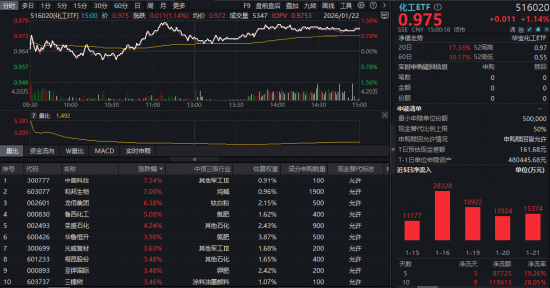
化工产品掀涨价潮,化工ETF(516020)收涨1.14%斩获四连阳!机构:盈利拐点将至
Xin Lang Cai Jing· 2026-01-22 11:36
Group 1 - The chemical sector continues to rise, with the Chemical ETF (516020) experiencing fluctuations before a significant increase, closing up 1.14% after reaching a peak intraday gain of 1.56% [1][6] - Key stocks in the sector include Zhongjian Technology, which surged by 7.54%, and Hebang Biology, which rose by 7%, along with other notable gains from Longbai Group, Luxi Chemical, and Rongsheng Petrochemical [1][7] - Recent price increases in basic chemical products have been reported, with sulfur prices reaching a near ten-year high, prompting the phosphate fertilizer industry to take measures to stabilize supply and prices [9] Group 2 - According to Huafu Securities, the chemical industry has undergone a bottoming process in profitability and valuation, with expectations for a recovery in 2026 as the industry enters a new phase of supply-demand rebalancing [3][9] - The Chemical ETF (516020) tracks the CSI sub-sector chemical industry theme index, covering stocks related to AI computing power, anti-involution policies, robotics, and new energy, providing a potentially efficient way to invest in the sector [3][9] - The ETF's performance is supported by the recent upward trends in the prices of key chemical products, indicating a favorable market environment for investors [9]



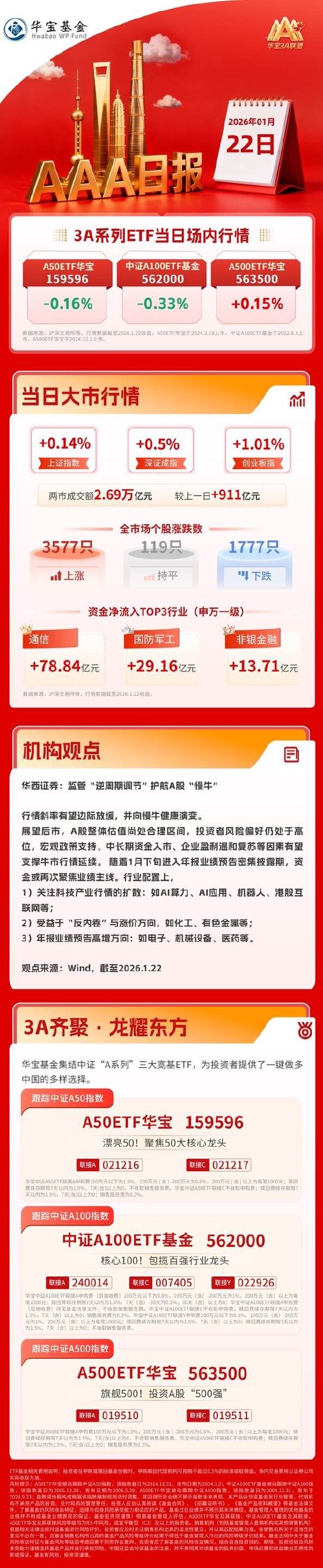
商业航天概念再度爆发,华西证券:“逆周期调节”护航A股“慢牛” | 华宝3A日报(2026.1.22)
Xin Lang Cai Jing· 2026-01-22 11:36
Market Overview - The A-share market is experiencing a "slow bull" trend supported by macro policies, moderate recovery in corporate earnings, and high investor risk appetite [2][6] - The overall valuation of A-shares remains within a reasonable range, with a market turnover of 2.69 trillion yuan, an increase of 911 billion yuan from the previous day [6][2] Industry Insights - Key sectors attracting capital inflow include defense and military, non-bank financials, and telecommunications, with net inflows of 29.16 billion yuan, 13.71 billion yuan, and 78.84 billion yuan respectively [6][2] - Investment focus is shifting towards technology sectors such as AI computing, AI applications, and robotics, as well as industries benefiting from "anti-involution" and price increases like chemicals and non-ferrous metals [2][7] ETF Products - The company offers a range of ETFs tracking major indices, including the A50 ETF, A100 ETF, and A500 ETF, providing investors with diverse options to invest in China's market [2][7] - The A50 ETF focuses on 50 leading companies, while the A100 ETF encompasses the top 100 industry leaders, and the A500 ETF targets the top 500 companies in A-shares [7][2]

中加基金固收周报|市场面临降温
Xin Lang Cai Jing· 2026-01-22 08:23
Market Overview - A-shares showed mixed performance last week with major indices fluctuating and trading volume declining from high levels [1][8] Macro Data Analysis - China's exports in December increased by 6.6% year-on-year in USD terms, exceeding market expectations and also showing month-on-month growth [4][13] - For the entire year of 2025, exports are projected to grow by 5.5%, making it the largest contributor to economic growth among the three driving forces [4][13] - The strong export performance in December is attributed to sustained external demand during the global manufacturing cycle and a rush to export due to reduced domestic tax rebates [4][13] - The new export orders index for China's manufacturing PMI rose by 1.4 percentage points to 49.0% in December, while JPMorgan's global manufacturing PMI recorded 50.4%, indicating robust external demand [4][16] - Key export items included computers, integrated circuits, and automobiles, with the latter showing the strongest growth, potentially influenced by the EU's proposed minimum import price policy for Chinese cars [4][16] - ASEAN remains China's largest export destination [4][16] Short-term Market Strategy - The market is experiencing a cooling phase after a period of heightened enthusiasm, with a rapid decline in trading volume and financing levels [8][18] - Factors supporting the market include favorable liquidity conditions, a weak dollar cycle, and a gradual appreciation of the RMB [8][18] - The spring rally is driven by hotspots in commercial aerospace and AI applications, enhancing market risk appetite [8][18] - Regulatory measures have been implemented to cool down the market due to the rapid accumulation of risks from strong momentum [8][18] - The market's trading heat is quickly diminishing, and short-term thematic trends may enter a consolidation phase [8][18] Mid-term Market Outlook - Technology growth remains a favored direction, with expectations of improving economic fundamentals gradually accumulating [9][19] - The current economic fundamentals and technology narratives have not fundamentally changed, and the technology sector remains a priority for allocation [9][19] - Defensive dividend sectors may enter an observation period, with potential for fund allocation if aggressive sectors continue to face pressure [22] Long-term Market Perspective - The long-term dynamics of the US-China struggle are becoming clearer, with increasing skepticism about the US government's governance and institutional credibility [10][20] - Despite uncertainties in the US economic outlook and the Fed's interest rate cuts, the credit of the dollar remains intact [10][20] - The trend of long-term capital inflow into the Chinese equity market is expected to strengthen due to regulatory policies promoting passive investment products [10][20] - The increase in equity market profitability is likely to encourage residents to allocate more of their excess deposits into the stock market [10][20] Industry Insights - For defensive dividend sectors, a short-term observation period is recommended, with attention to potential fund allocation in response to worsening market sentiment [22] - In aggressive sectors, technology remains a key focus, particularly in AI and commercial aerospace, which are expected to continue driving performance [22] - The market should monitor the stabilization of AI applications and aerospace sectors for potential investment opportunities [22]
快递行业2025年12月数据点评:件量增速继续探底,单票收入维持稳定
Dongxing Securities· 2026-01-22 08:07
Investment Rating - The industry investment rating is "Positive" [3][30] Core Insights - The express delivery industry in China experienced a total delivery volume of 216.5 billion pieces in 2025, with a year-on-year growth of 11.5%. The express delivery volume reached 199 billion pieces, growing by 13.7% year-on-year. The total revenue for the postal industry was 1.8 trillion yuan, with express delivery revenue at 1.5 trillion yuan, reflecting year-on-year growth of 6.4% and 6.5% respectively [1][6] - In December 2025, the national express service companies completed a business volume of 18.21 billion pieces, a year-on-year increase of approximately 2.3%. The express business revenue was about 138.87 billion yuan, showing a slight increase compared to the same period last year. The average revenue per piece was approximately 7.63 yuan, a year-on-year decrease of about 1.6% [1][6][8] Summary by Sections 1. December Industry Overview - The industry volume growth rate fell below 3%, with stable performance in average revenue per piece. The December express delivery volume growth rate decreased further compared to November, attributed to high base effects from last year's price wars and weak demand since Double Eleven [2][6][8] - Major companies saw a decline in year-on-year volume growth rates, with YTO dropping from 13.6% in November to 9.0%, Yunda from -4.2% to -7.4%, and Shentong from 14.7% to 11.1%. SF Express's growth rate fell to 9.3% [2][6][12] 2. Express Business Volume - The express delivery business volume in December 2025 was approximately 18.21 billion pieces, with a year-on-year growth of about 2.3%. The growth rate continued to decline due to the ongoing internal competition and weak demand since Double Eleven [8][10] 3. Average Revenue per Piece - The average revenue per piece in December 2025 saw a year-on-year decline of 1.6%, with a narrowing decrease in the price drop trend. The overall price indicators remained positive, indicating a supportive effect from the internal competition [7][22][28] - The revenue per piece for major companies showed mixed results, with YTO's revenue per piece increasing by 0.4%, while Yunda and Shentong saw decreases of 0.5% and 3.3% respectively. SF Express's revenue per piece increased by 2.5% month-on-month, with a narrowing year-on-year decline [23][25][27] 4. Investment Recommendations - Despite the pressure from lower-than-expected demand since Double Eleven, the stability in average revenue per piece for major companies reflects the supportive role of internal competition on pricing. The ongoing internal competition is expected to exceed expectations, indicating the industry is in the early stages of an upward cycle, with profitability likely to continue recovering [3][30] - The shift from high-growth to a focus on existing market importance suggests a change in competitive logic, emphasizing service quality for sustainable development. Key companies to watch include Zhongtong and YTO, which lead in service quality, and Shentong, which has shown significant operational improvements [3][30]



本钢板材(000761) - 2026年1月21日投资者关系活动记录表
2026-01-22 07:52
Group 1: Investor Relations Activities - The investor relations activity was a targeted research event held on January 21, 2026, from 10:00 to 11:00 in Benxi City [2][3] - Participants included representatives from various asset management firms and funds, such as Taibao Asset and Morgan Stanley Huaxin [3] Group 2: Major Asset Restructuring - The company disclosed a major asset restructuring plan in June 2023, which may significantly increase reliance on controlling shareholders and affect independent operations [4] - The feasibility and compliance of the restructuring plan are under further scrutiny, with ongoing evaluations and necessary disclosures to be made [4] Group 3: Convertible Bond Management - The company is preparing for the maturity of its convertible bonds by enhancing market value management and exploring financing channels [4] - Strategies include cost reduction, efficiency improvements, and professional integration to enhance profitability [4] Group 4: Industry Competition and Strategy - Following the restructuring of the controlling shareholder, there is a recognition of overlapping competition with Angang Group, which will be addressed through asset restructuring and business adjustments [4] - The company aims to respond to industry trends and optimize production while adhering to market demands [4] Group 5: Financial Performance and Future Goals - The company has faced three consecutive years of losses, with measures in place to comply with Shenzhen Stock Exchange regulations to avoid being classified as ST [4] - The target for automotive steel sales in 2026 is to focus on high-end products, aiming for significant growth and positioning as a core supplier to mid-to-high-end customers [4][5]
