
反内卷

Search documents
供给格局优化+价格上行,石油石化、基础化工行业估值持续回升,化工行业ETF易方达(516570)备受关注
Sou Hu Cai Jing· 2026-01-22 06:44
平安证券指出,石油石化行业—2023年以来,基本面宽松预期下,油价高位回落,而石油石化指数持续 走高,一方面我国油气资源具有一定稀缺性,头部开采企业在国内持续推进增产上储,同时积极在海外 投资油气项目,优质资源禀赋的价值凸显。另一方面石化企业加深炼化一体化布局,降本增效成果较 好,中国石油、恒力石化等企业业绩表现出强韧性,随着石化品供给格局优化、价格从底部渐进上行, 企业估值有望进一步提升。 基础化工行业—2025年以来,国补促内需、制造业高端化,反内卷刺激产业优化供给格局,化工业从被 动去库渐往主动补库过渡,行业估值持续回升,其中,受益于反内卷和供给端格局优化的化工细分领域 均表现出不错的行情走势,2026年,平安证券认为,反内卷和供给格局好转的主线仍有机会。 化工行业ETF易方达(516570,场外联接A/C: 020104/020105)一键打包三桶油、万华化学等石油石 化、基础化工产业龙头,跟踪的中证石化产业指数指数构成接近于石化化工板块中哑铃策略标的,同时 涵盖高股息+高成长成份券,2023年以来收益表现在可比化工行业指数中保持领先。 截至2026年1月22日 14:21,中证石化产业指数(H110 ...
化工行情燃爆!化工ETF(516020)突然拉升涨超1%,资金疯狂涌入!
Xin Lang Cai Jing· 2026-01-22 03:23
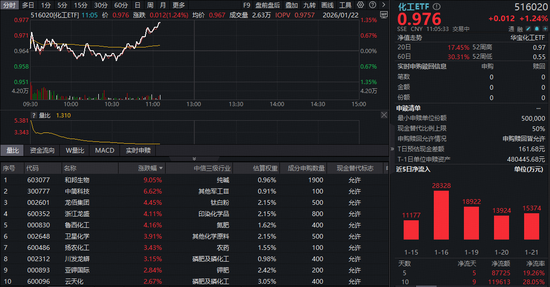
Core Viewpoint - The chemical sector is experiencing a strong upward trend, with the chemical ETF (516020) showing a price increase of 1.24% as of January 22, 2026, driven by significant gains in stocks such as Hebang Biotechnology and Zhongjian Technology [1][8]. Group 1: Market Performance - The chemical ETF (516020) has seen a net inflow of over 870 million yuan in the last five days and nearly 1.2 billion yuan in the last ten days [3][10]. - Key stocks in the sector include Hebang Biotechnology, which surged over 9%, and Zhongjian Technology, which rose over 6% [1][8]. Group 2: Industry Outlook - Dongfang Securities is optimistic about the chemical industry, citing a collective shift in corporate strategies that could lead to improved market conditions [3][10]. - The report highlights five areas of focus: MDI, petrochemicals, phosphate chemicals, PVC, and polyester bottle chips [3][10]. Group 3: Investment Opportunities - Huaxin Securities notes that while the overall chemical industry remains weak, certain sub-sectors like lubricants have outperformed expectations [3][11]. - Investment opportunities are suggested in glyphosate, fertilizers, import substitution, domestic demand, and high-dividend assets [3][11]. Group 4: ETF Structure - The chemical ETF (516020) tracks the CSI sub-sector chemical industry theme index, with nearly 50% of its holdings in large-cap leading stocks like Wanhua Chemical and Salt Lake Industry [4][11]. - The remaining 50% is diversified across leading stocks in phosphate fertilizers, fluorine chemicals, and nitrogen fertilizers [4][11].






日度策略参考-20260122
Guo Mao Qi Huo· 2026-01-22 03:17
1. Report Industry Investment Ratings No relevant content provided. 2. Core Views of the Report - With policies cooling the market's speculative sentiment, raising the proportion of margin trading funds, and Central Huijin selling a large amount of broad - based index ETFs, the stock index is in shock adjustment. The policy aims for a "slow - bull" market rather than suppressing it, and the short - term shock adjustment space is expected to be limited. Long - term bulls can choose the opportunity to layout [1]. - Asset shortage and weak economy are beneficial to bond futures, but the central bank has recently warned of interest - rate risks. Attention should be paid to the Bank of Japan's interest - rate decision [1]. - With the US postponing the tax on key minerals, the short - term concern about copper hoarding has eased, and the copper price is expected to fluctuate at a high level. The aluminum price has fallen from a high level due to limited industrial drivers and weakening macro sentiment. The domestic alumina market has strong supply and weak demand, and the price is under pressure but is expected to fluctuate around the cost line [1]. - The zinc price fluctuates in a range due to the stabilization of the cost center and the appearance of inventory pressure. The nickel supply is still tight despite the announced RKAB target in 2026, and the nickel price is expected to fluctuate at a high level in the short term, affected by the resonance of the non - ferrous metal sector. Stainless steel futures have risen significantly, and attention should be paid to the actual production of steel mills and the risk of short squeezes [1]. - The tin price has corrected due to the repeated macro sentiment, but there is still upward momentum due to the vulnerability of tin - ore supply. Precious metals are supported by geopolitical and trade uncertainties, but the silver price may be weaker than the gold price. Platinum and palladium are expected to fluctuate widely in the short term, and long - platinum and short - palladium arbitrage strategies can be considered in the medium - to - long term [1]. - For industrial silicon, there is an increase in production in the northwest and a decrease in the southwest, and the production schedules of polysilicon and organic silicon in December have declined. For new - energy vehicles, it is the off - season, while the energy - storage demand is strong, and there is a rush for exports. The rebar and iron - ore prices are under pressure, and the trading strategies are to leave the market for single - side long positions and participate in cash - and - carry arbitrage [1]. - The soda - ash price is under pressure as it follows the glass market and the medium - term supply - demand is more relaxed. The coking - coal and coke prices are bearish, and the previous low - long strategy may need to be changed [1]. - Palm oil is expected to fluctuate strongly, soybean oil is recommended to be over - allocated in the oil market, and rapeseed oil is recommended to be observed. The cotton market is currently in a situation of "having support but no driver", and attention should be paid to relevant policies and market conditions in the future. The sugar market is in a global surplus, and the short - term fundamentals lack continuous drivers [1]. - The corn price is expected to fluctuate in the short term, and the soybean price is expected to fluctuate weakly. The pulp price is recommended to be observed cautiously, and the log price is expected to fluctuate in the range of 760 - 790 yuan/m³. The live - pig market has stable spot prices, and the production capacity still needs to be further released [1]. - The fuel - oil and asphalt prices are affected by multiple factors such as OPEC+ policies and geopolitical situations. The BR rubber price is in a phased correction, and the PTA, MEG, short - fiber, and styrene prices are affected by supply - demand and cost factors [1]. - The urea price has limited upward space due to weak domestic demand but is supported by anti - involution and cost. The PF price is under supply pressure and affected by geopolitical factors. The PVC price is expected to trade based on fundamentals, and the LPG price is supported by import - gas costs and has a changing inventory situation [1]. - The container - shipping price on the European route is expected to peak in mid - January, and there is still pre - holiday replenishment demand [1]. 3. Summaries According to Related Catalogs Stock Index - Policy cools speculative sentiment, and the stock index is in shock adjustment. The short - term adjustment space is limited, and long - term bulls can layout [1]. Bond Futures - Asset shortage and weak economy are beneficial, but the central bank warns of interest - rate risks. Attention to the Bank of Japan's interest - rate decision [1]. Non - Ferrous Metals - Copper: The short - term concern about hoarding eases, and the price fluctuates at a high level [1]. - Aluminum: Falls from a high level due to limited industrial drivers and weakening macro sentiment [1]. - Alumina: Strong supply and weak demand, price under pressure, expected to fluctuate around the cost line [1]. - Zinc: Fluctuates in a range due to cost and inventory factors [1]. - Nickel: Supply remains tight, price fluctuates at a high level in the short term, affected by sector resonance [1]. - Stainless Steel: Futures rise significantly, attention to production and short - squeeze risks [1]. - Tin: Corrects due to macro sentiment, but has upward momentum due to supply vulnerability [1]. Precious Metals and New Energy - Precious Metals: Supported by geopolitical and trade uncertainties, silver may be weaker than gold [1]. - Platinum and Palladium: Fluctuate widely in the short term, long - platinum and short - palladium strategies can be considered in the medium - to - long term [1]. Industrial Silicon and New - Energy Vehicles - Industrial Silicon: Production changes in different regions, polysilicon and organic silicon production schedules decline [1]. - New - Energy Vehicles: Off - season, strong energy - storage demand, rush for exports [1]. Black Metals - Rebar: Price under pressure, single - side long positions leave the market, participate in cash - and - carry arbitrage [1]. - Iron Ore: Upward pressure is obvious, not recommended to chase long [1]. - Soda Ash: Follows glass, medium - term supply - demand is more relaxed, price under pressure [1]. - Coking Coal and Coke: Bearish, previous low - long strategy may change [1]. Agricultural Products - Palm Oil: Expected to fluctuate strongly [1]. - Soybean Oil: Recommended to be over - allocated [1]. - Rapeseed Oil: Observe due to complex factors [1]. - Cotton: "Having support but no driver", attention to future policies and conditions [1]. - Sugar: Global surplus, short - term fundamentals lack continuous drivers [1]. - Corn: Expected to fluctuate in the short term [1]. - Soybean: Expected to fluctuate weakly [1]. - Pulp: Observe cautiously due to market fluctuations [1]. - Log: Expected to fluctuate in the range of 760 - 790 yuan/m³ [1]. - Live Pig: Spot prices are stable, production capacity needs further release [1]. Energy and Chemicals - Fuel Oil: Affected by OPEC+ policies and geopolitical factors [1]. - Asphalt: Affected by multiple factors such as supply - demand and profit [1]. - BR Rubber: In a phased correction, affected by supply - demand and cost [1]. - PTA: Market has a sharp rise, supported by fundamentals and demand [1]. - MEG: Rebounds due to supply - side news, demand exceeds expectations [1]. - Short - Fiber: Price follows cost closely [1]. - Styrene: Futures price rebounds due to improved fundamentals [1]. - Urea: Limited upward space, supported by anti - involution and cost [1]. - PF: Under supply pressure, affected by geopolitical factors [1]. - PVC: Expected to trade based on fundamentals, price under pressure [1]. - LPG: Supported by import - gas costs, inventory situation changes [1]. Container Shipping - European route price expected to peak in mid - January, pre - holiday replenishment demand exists [1].
反内卷效果显现,关注石化板块投资机会
Sou Hu Cai Jing· 2026-01-22 03:11
Group 1 - The anti-involution movement has been ongoing for over a year, with varying results across different sectors, showing significant improvement in the petrochemical sector compared to others like large commodities and new energy [1] - The industry has seen effective production cuts that have boosted corporate profitability, with major products like PTA and polyester expected to stabilize in price as new capacity is set to be completed by the end of 2026 [1] - Strong downstream demand is facilitating price recovery, with leading chemical companies recently disclosing positive earnings forecasts for 2025, indicating a rebound in multiple sub-sectors [1] Group 2 - The petrochemical industry is currently at the bottom of a four-year downturn, but the ongoing anti-involution and expansion of domestic demand are expected to accelerate the industry's cyclical recovery [6] - As a crucial industrial raw material, the rise in chemical prices suggests that the industry is gradually moving out of a phase of demand stagnation and inventory adjustment, entering a period of upward momentum, making it an area of significant investment interest [6]
中国资产全面爆发!港股科技50ETF(159750)、港股通科技ETF招商(159125)携手高开!华虹半导体领涨
Jin Rong Jie· 2026-01-22 01:57
Group 1 - The core viewpoint of the article highlights a positive trend in Chinese technology stocks, driven by overnight gains in the US stock market, with significant increases in Hong Kong's technology ETFs [1] - The Hong Kong Technology 50 ETF (159750) and the Hong Kong Stock Connect Technology ETF (159125) saw increases of 0.95% and 0.65% respectively, with intraday highs of 1.52% and 1.29% [1] Group 2 - Goldman Sachs' Chief China Equity Strategist Liu Jinjun projects a target of 100 points for the MSCI China Index and 5200 points for the CSI 300 Index by the end of 2026 [2] - The expected return rate for the Chinese stock market in 2026 is estimated to be between 15% and 20%, primarily driven by earnings growth, with a projected earnings growth rate of 14% for Chinese stocks [2] Group 3 - Three main factors are identified to drive earnings growth in Chinese stocks: 1. The AI industry is expected to contribute significantly, with annual contributions of 2% to 3% to overall market earnings growth over the next 3 to 5 years as the focus shifts from computing power to application and commercialization [2] 2. The overseas strategy shows potential, as companies listed in the US S&P 500 have 28% of their revenue from overseas, compared to only 16% for Chinese companies, indicating substantial room for growth [2] 3. The "anti-involution" trend is also anticipated to positively impact earnings growth [3]

中信建投期货:1月22日能化早报
Xin Lang Cai Jing· 2026-01-22 01:46
Group 1 - The price of domestic all-latex rubber increased to 15,500 CNY/ton, up by 100 CNY/ton from the previous day, while Thai 20 mixed rubber rose to 14,800 CNY/ton, up by 50 CNY/ton [4] - As of January 18, 2026, China's natural rubber social inventory reached 1.273 million tons, an increase of 17,000 tons, or 1.3% from the previous period [4] - The total inventory of dark rubber in China was 850,000 tons, also up by 1.7%, with specific increases in Qingdao and decreases in Yunnan and Vietnam [4] Group 2 - With the arrival of winter in the Northern Hemisphere, the global market is expected to transition from dynamic pricing based on supply and demand to static pricing based on inventory levels, leading to high volatility in RU, NR, and Sicom prices [5] - Despite a projected moderate growth in demand for rubber products like tires by 2026, the growth will take time and may be limited by ongoing global trade barriers [5] - It is anticipated that the peak of the current rebound in prices will not exceed the levels seen in late July 2025 before the Lunar New Year in 2026 [5] Group 3 - The PX industry in China saw a decrease in operating load by 1.5 percentage points to 89.4%, while the Asian industry load decreased by 0.6 percentage points to 80.6% [26] - The overall supply of PX is expected to remain ample due to lower maintenance plans compared to previous years and increased operational plans from overseas factories [26] - The demand side is under pressure due to numerous maintenance plans in downstream PTA facilities, leading to a projected loosening of the PX supply-demand balance in the first quarter [26] Group 4 - The PTA industry load decreased by 1.9 percentage points to 76.3%, indicating a low level compared to historical data, with expectations of reduced supply due to maintenance plans [27] - The overall demand environment is weak, with a continuous decline in operating rates in the Jiangsu and Zhejiang regions [27] - The current TA-polyester segment fundamentals still have support, but the sustainability of this support will be tested by expectations of reduced polyester production [27] Group 5 - The EG industry load increased by 0.5 percentage points to 74.4%, with the synthetic gas production load rising to 80.2%, indicating high levels compared to historical data [29] - Despite high domestic supply, the demand side is weak, with expectations of inventory accumulation in January and potential peak inventory pressure in February [29] - The macro environment shows signs of warming, but supply pressure remains the dominant factor in the industry [29] Group 6 - The PR industry load decreased by 6.4 percentage points to 68.4%, with expectations of continued supply contraction due to maintenance plans [32] - The demand side is weak due to the traditional off-season for beverage consumption, limiting production recovery potential in January and February [32] - Recent tightening of spot supply and rapid expansion of processing fees indicate a strong basis for PR prices [32] Group 7 - The soda ash market saw a slight decline in futures prices, with a recent increase in production leading to increased supply pressure [33] - Downstream demand has slightly decreased, with recent inventory reductions indicating a weakening purchasing sentiment [33] - The overall market sentiment remains mixed, with macroeconomic factors showing neutral influences [34]


中泰期货晨会纪要-20260122
Zhong Tai Qi Huo· 2026-01-22 01:12
1. Report Industry Investment Rating There is no information about the report industry investment rating in the provided content. 2. Core Viewpoints of the Report - Based on fundamental analysis, different futures varieties are classified into trend - bearish, oscillating - bearish, oscillating, oscillating - bullish, and trend - bullish categories. For example, eggs, red dates, and live pigs are in the oscillating - bearish category; soda ash, glass, and sugar are in the oscillating category; synthetic rubber, lithium carbonate, and 30 - year government bonds are in the oscillating - bullish category [5]. - Based on quantitative indicators, futures varieties are divided into bearish, oscillating, and bullish categories. For instance, Shanghai gold, soybean No. 2, and soybean oil are in the bearish category; rebar, coking coal, and soybean No. 1 are in the oscillating category; Shanghai copper, manganese - silicon, and rubber are in the bullish category [9]. - Various macro - economic events have impacts on the financial market. For example, the agreement on Greenland by the US President Trump leads to a rise in US stocks and a fall in spot silver; the speech of NVIDIA CEO Huang Renxun on AI infrastructure construction has implications for related industries; the EU's new network security policy and China's response also affect the market [11]. 3. Summary by Relevant Catalogs 3.1 Macro - finance - **Stock Index Futures**: Short - term operations should focus on volume and price, and profit - taking operations can be considered. The A - share market shows an oscillating upward trend, but if there is no further increase in volume and a reverse - enveloping negative line is not formed, the stock index may enter an adjustment phase [16][17]. - **Treasury Bond Futures**: The ultra - long - end may continue to rebound due to the decline in risk appetite. The short - end is supported by the capital market, and the overall idea of the central bank is still to expand credit, with bond yields remaining steep [18]. 3.2 Black - **Coking Coal and Coke**: The prices of coking coal and coke may oscillate and decline in the short term. In the medium term, the domestic mine operating rate is capped, and the supply - demand contradiction may improve during the Spring Festival [20]. - **Ferroalloys**: For silicon - iron, it is recommended to go long on dips in the medium term as there is a small supply gap. For manganese - silicon, it is suggested to hold short positions from previous high levels and not to enter new single - sided positions [21]. - **Soda Ash and Glass**: It is advisable to wait and see for now. For soda ash, focus on the supply stability of leading enterprises and the progress of new capacity production. For glass, pay attention to the implementation of production line changes and the linkage between the spot and futures markets [22]. 3.3 Non - ferrous Metals and New Materials - **Shanghai Lead**: It is recommended to wait and see, and hold previous short positions. The lead inventory is increasing, and the consumption is poor, but there may be some support if the price continues to decline [24]. - **Lithium Carbonate**: In the short term, it is expected to oscillate strongly, with demand improving and supply being restricted [25]. - **Industrial Silicon and Polysilicon**: Industrial silicon is under pressure at the upper limit and oscillates, waiting for opportunities to sell out - of - the - money call options. Polysilicon may continue to price the rectification of anti - involution and oscillate weakly [26]. 3.4 Agricultural Products - **Cotton**: It is in a short - term consolidation state, and short - term trading is recommended. The supply is currently loose, but the long - term supply is expected to shrink, and attention should be paid to pre - holiday restocking and the decline in开工 rates [28][29]. - **Sugar**: The domestic sugar market is in a season of high supply and demand, and it is recommended to conduct short - term trading in the low - price range. The global sugar supply is in surplus, and the domestic market is under supply pressure [30][31]. - **Eggs**: As the Spring Festival approaches, the pre - holiday spot price of eggs may weaken. The futures of the 02 - 03 contracts are for the post - Spring Festival off - season, with limited upside space. The egg - laying hen inventory is expected to decline, and the far - month contracts may weaken [32][33]. - **Apples**: The futures may run strongly. The current apple market is in a game between supply support and demand constraints, and the price is expected to oscillate within a range [34][35]. - **Corn**: The price has large differences in the market, and short - term trading is recommended. The price is affected by factors such as supply and demand, policy grain release, and import supplements, and is likely to oscillate within a range [36]. - **Red Dates**: It is recommended to closely monitor the performance of the consumer market during the peak season, and currently, the market is expected to oscillate weakly [37]. - **Live Pigs**: The market sentiment has peaked, and the spot price is likely to decline. It is advisable to consider shorting near - month contracts on rallies [38]. 3.5 Energy and Chemicals - **Crude Oil**: Geopolitical conflicts in the Middle East support the price, but the supply surplus is still severe. As the geopolitical premium fades, the price may weaken, and attention should be paid to Iran's actions [40]. - **Fuel Oil**: The price follows the trend of crude oil, and the supply - demand situation has marginally improved. The short - term trading focus is on the impact of geopolitically - influenced crude oil prices [41]. - **Plastics**: Polyolefins have large supply pressure and weak demand, but the upstream losses may support a small - scale rebound. It is recommended to adopt an oscillating trading strategy [42]. - **Rubber**: The pre - holiday restocking by downstream enterprises and the upcoming suspension of production in overseas producing areas may support the price. It is advisable to sell out - of - the - money put options on dips [43]. - **Synthetic Rubber**: It may oscillate strongly due to the good fundamentals of butadiene. It is recommended to go long on dips or sell put options [44]. - **Methanol**: The short - term inventory is decreasing, but there is still a risk of inventory accumulation at the end of the month. In the long term, the fundamentals are improving, and it is advisable to consider a slightly long - position configuration for far - month contracts after a pullback [46]. - **Caustic Soda**: The operating rate and inventory are high, and the price of liquid chlorine is firm, but the support from the downstream of liquid chlorine is uncertain. It is recommended to adopt an oscillating trading strategy [47]. - **Asphalt**: The price follows the trend of crude oil and may oscillate strongly in the short term. Attention should be paid to the change in the premium of raw materials [48]. - **Polyester Industry Chain**: The market is currently strong due to sentiment and supply disruptions, but the expectation of weakening demand is increasing. It is advisable to consider positive spreads between the May and September contracts of PX and PTA on dips [49]. - **Liquefied Petroleum Gas (LPG)**: The geopolitical situation in Iran has eased, and the import cost provides support. In the short term, the downside space is limited, but in the long term, it is advisable to consider going short with a light position [50]. - **Pulp**: The spot market trading sentiment has weakened, and the price has corrected. The futures price is expected to oscillate, and attention should be paid to international and macro factors [52]. - **Logs**: The fundamentals are weakly oscillating, and the spot price has temporarily stabilized. The market is expected to maintain a weak supply - demand balance, and the futures price is expected to oscillate [53]. - **Urea**: The spot market trading atmosphere has worsened in the short term, but the market is still relatively optimistic about the future. It remains to be seen whether the futures can maintain a strong trend before the Spring Festival [54].
中金 • 部院联合 | “反内卷”的绿色含义
中金点睛· 2026-01-21 23:36
Core Viewpoint - The article discusses the interplay between "anti-involution" and green transformation in China, emphasizing that while "anti-involution" may temporarily lower clean energy prices, it could ultimately hinder long-term innovation and cost reduction in clean energy sectors [2][5]. Group 1: Impact of Involution on Green Transformation - "Involution" in competition negatively affects green transformation by leading to low-quality, low-profit environments that reduce R&D investments, ultimately delaying the cost reduction of clean energy [2][20]. - The annual average growth rate of carbon emissions increased from 1.3% during the 13th Five-Year Plan to 3% during the first four years of the 14th Five-Year Plan, indicating challenges in achieving carbon peak goals [7]. - The competition intensity in industries such as photovoltaics and cement is high, leading to declining revenue and profit growth, which further exacerbates the issue of overcapacity [9][20]. Group 2: Quantitative Analysis of Anti-Involution - Under ideal conditions, "anti-involution" could reduce the green premium by 8-11 percentage points, with coal prices expected to rise by approximately 23%, increasing coal power costs by about 16% [3][28][31]. - The estimated carbon reduction from "anti-involution" could reach approximately 100 million tons by 2025, accounting for about 0.85% of total carbon emissions, through improved energy efficiency and reduced production in high-carbon industries [4][48]. - The article highlights that the reduction in fixed asset investment could lead to a maximum carbon reduction of 5.5 million tons, emphasizing the importance of controlling inefficient investments [45][48]. Group 3: Policy Recommendations for Synergy - To better leverage the synergy between "anti-involution" and green transformation, policies should focus on enhancing green standards, eliminating outdated capacities, and promoting green consumption [5][49]. - The article suggests that effective implementation of energy efficiency standards and technological innovation is crucial for achieving the desired outcomes of "anti-involution" [37][49]. - The framework of "policy strength-execution challenge" is proposed to assess the effectiveness of "anti-involution" measures across different industries, indicating that stronger policies with fewer execution challenges yield better results [49].

代理行业如何规范发展?
Xin Lang Cai Jing· 2026-01-21 16:27
Core Viewpoint - The article emphasizes the importance of fair competition in the agency industry and the need for regulatory measures to eliminate "involution" and promote a healthy competitive environment [2][3][5]. Group 1: Industry Challenges - The agency industry has been experiencing intense competition, leading to a phenomenon known as "involution," characterized by inefficient and unfair competition, resulting in a "lose-lose" situation for many agencies [2][3]. - Agencies are facing pressure from declining service fees and increasing operational standards, which challenge their profitability and employee compensation [2][3]. - Various irregularities have emerged in the industry, such as collusion between evaluators and agencies, manipulation of scoring, and unauthorized fees, undermining fair competition in government procurement [3][4]. Group 2: Regulatory Measures - The Ministry of Finance, along with other regulatory bodies, has initiated a special rectification campaign targeting four types of illegal activities in government procurement, including improper fees and late return of deposits [3][4]. - New regulations have been established to create a supervision and inspection mechanism for agencies, detailing responsibilities, principles, and procedures for checks, which will be categorized based on agency performance and compliance [4][5]. - The implementation of these regulations aims to enhance the accountability of agencies and prevent illegal activities, thereby fostering a more competitive and fair market environment [5][6]. Group 3: Promoting Healthy Competition - The article advocates for a shift from price competition to a focus on innovation, service quality, and professionalism among agencies [6][7]. - Some agencies are exploring technological advancements, such as artificial intelligence, to improve risk management and streamline procurement processes, thereby enhancing their service offerings [6][7]. - Agencies are encouraged to develop their professional capabilities through training and establishing clear job responsibilities, which will help them provide higher quality services to clients [7][8].

利好!高盛最新发声
Xin Lang Cai Jing· 2026-01-21 12:59
Core Viewpoint - Goldman Sachs predicts China's GDP growth rate will be 4.8% in 2026, supported by strong export growth. The MSCI China Index target is set at 100 points, and the CSI 300 Index target is 5200 points by the end of 2026. Net inflows from southbound funds are expected to reach $200 billion (approximately 1.4 trillion yuan), a new record high [1][9]. Export Support Factors - China's export growth is projected to maintain a rate of 5%-6%, significantly higher than the global trade growth of 2%-3%. This forecast is based on three core factors: steady global economic recovery boosting demand, China's cost advantages across various industries, and unique capabilities in rare earths and supply chains, making it difficult for international tariffs to be imposed [2][11]. - The negative impact of the real estate sector on economic growth is expected to diminish over time, with the most significant effects occurring in 2024 and 2025. As the market size shrinks, the downward pressure on GDP growth will lessen [2][11]. Currency Outlook - The RMB is expected to appreciate moderately, with an estimated undervaluation of about 25%. By the end of 2026, the RMB/USD exchange rate is projected to reach 6.85, further strengthening to 6.54 by the end of 2027, indicating an annual appreciation of approximately 2%-3% [3][11]. Stock Market Valuation and Returns - The dynamic P/E ratios for the MSCI China Index and CSI 300 Index have returned to historical averages, at approximately 13 times and 15 times, respectively. The expected stock market return for 2026 is between 15%-20%, primarily driven by earnings growth, with a projected earnings growth rate of 14% [4][12]. - Three main factors are anticipated to drive earnings growth: contributions from the AI industry, expansion into overseas markets, and positive impacts from the "anti-involution" trend [4][12][13]. Liquidity Support - Net inflows from southbound funds are expected to reach $200 billion (approximately 1.4 trillion yuan), reflecting increased demand for stock allocations from domestic individuals and institutions [6][14]. - There is still room for improvement in overseas fund allocations to Chinese stocks, which currently account for less than 8% of total risk exposure among hedge fund clients tracked by Goldman Sachs. Recent communications indicate a growing interest from overseas investors in Chinese investments [6][14]. - Personal investors are projected to contribute approximately 2 trillion yuan to the stock market over the next 12 months, driven by expectations of stock returns between 10%-15% and improved inflation expectations [6][14]. Sector Preferences - Goldman Sachs maintains a high allocation recommendation for AI and technology hardware, reflecting strong confidence in the AI narrative. The materials sector is also favored, while insurance is newly recommended for overweight allocation due to its potential for higher investment returns in a slow bull market and attractive dividend characteristics [8][15]. Policy Focus - The concept of "investing in people" is highlighted as a key policy direction, expected to manifest in various initiatives, including annual childcare subsidies of 3600 yuan. This focus is anticipated to continue and expand, covering the entire life cycle from birth to retirement, with policy support likely to strengthen to improve living standards and increase birth rates [8][16].