滞胀

Search documents
海外高频 | 中美日内瓦谈判实现关税互降,金价回落
赵伟宏观探索· 2025-05-18 23:47
Group 1 - The article discusses the recent US-China trade negotiations in Geneva, resulting in mutual tariff reductions, with the US tariff on China decreasing to 42% and China's tariff on the US decreasing to 27% [2][26][31] - The US overall average tariff rate has dropped from 27% to 16%, although the new tariffs may still lead to a 0.65% decline in US GDP and a 1.7% increase in inflation [2][26] - The article highlights the performance of major stock indices, with the Nasdaq rising by 7.2% and the S&P 500 by 5.3% during the week [2][3] Group 2 - The article notes that the US CPI for April was 2.3%, slightly below the market expectation of 2.4%, indicating ongoing inflationary pressures influenced by tariffs [40] - Retail sales in the US for April showed a slight increase of 0.1%, which was better than the expected 0%, but excluding automobiles and gasoline, the retail performance was weaker than anticipated [44] - Initial jobless claims in the US were reported at 229,000, slightly above the market expectation of 228,000, suggesting potential upward pressure on the unemployment rate [46] Group 3 - The article mentions that the US 10-year Treasury yield rose by 6 basis points to 4.43%, while yields in other developed markets showed mixed movements [12][14] - The dollar index increased by 0.6% to 100.98, with most other currencies depreciating against the dollar [17] - Commodity prices were mixed, with WTI crude oil rising by 2.4% to $62.5 per barrel, while gold prices fell by 4.0% to $3191.8 per ounce [21][23]



深度专题 | 美国经济:关税冲击的监测框架——关税“压力测试”系列之八
赵伟宏观探索· 2025-05-18 23:47
文 | 赵伟、陈达飞、王茂宇 联系人 | 王茂宇 摘要 截止到5月中旬,美国进口商品的平均关税税率已经降至16%左右,但仍处历史高位。目前已进入数据验 证期,如何观察美国的"抢进口"动能和"滞胀"压力?本文提出了一个监测框架。 热点思考: 美国经济:关税冲击的监测框架 一、关税冲击进入数据"验证期",如何监测其经济影响?三大维度:贸易、价格、风险偏好 关税冲突虽有缓和,但美国税率仍处历史高位。 5月12日以来,美国对华进口平均关税税率降至42%,总 体平均税率降至16%,但仍处于历史高位。耶鲁大学预算实验室的测算认为,该关税或使美国GDP下降 0.65个点,通胀上升1.7个点。所以,"滞胀"是基准假设。 关税对美国经济的传导,可从贸易(数量)、价格、风险偏好三个维度进行监测。 1)贸易方面,关税 冲击体现为美国进口先增后减(抢进口)、出口受抑,并影响国内需求;2)价格方面,关税将由进口价 格传导至生产和消费价格,抑制实际消费需求;3)风险偏好方面,关税推升政策不确定性,影响金融压 力、美元指数,进而降低居民消费意愿、企业投资意愿。 二、短期内,应该关注哪些核心经济指标?进口、库存和通胀压力 一季度,美国开始抢 ...

黄金还会跌多久?
Hu Xiu· 2025-05-18 22:35
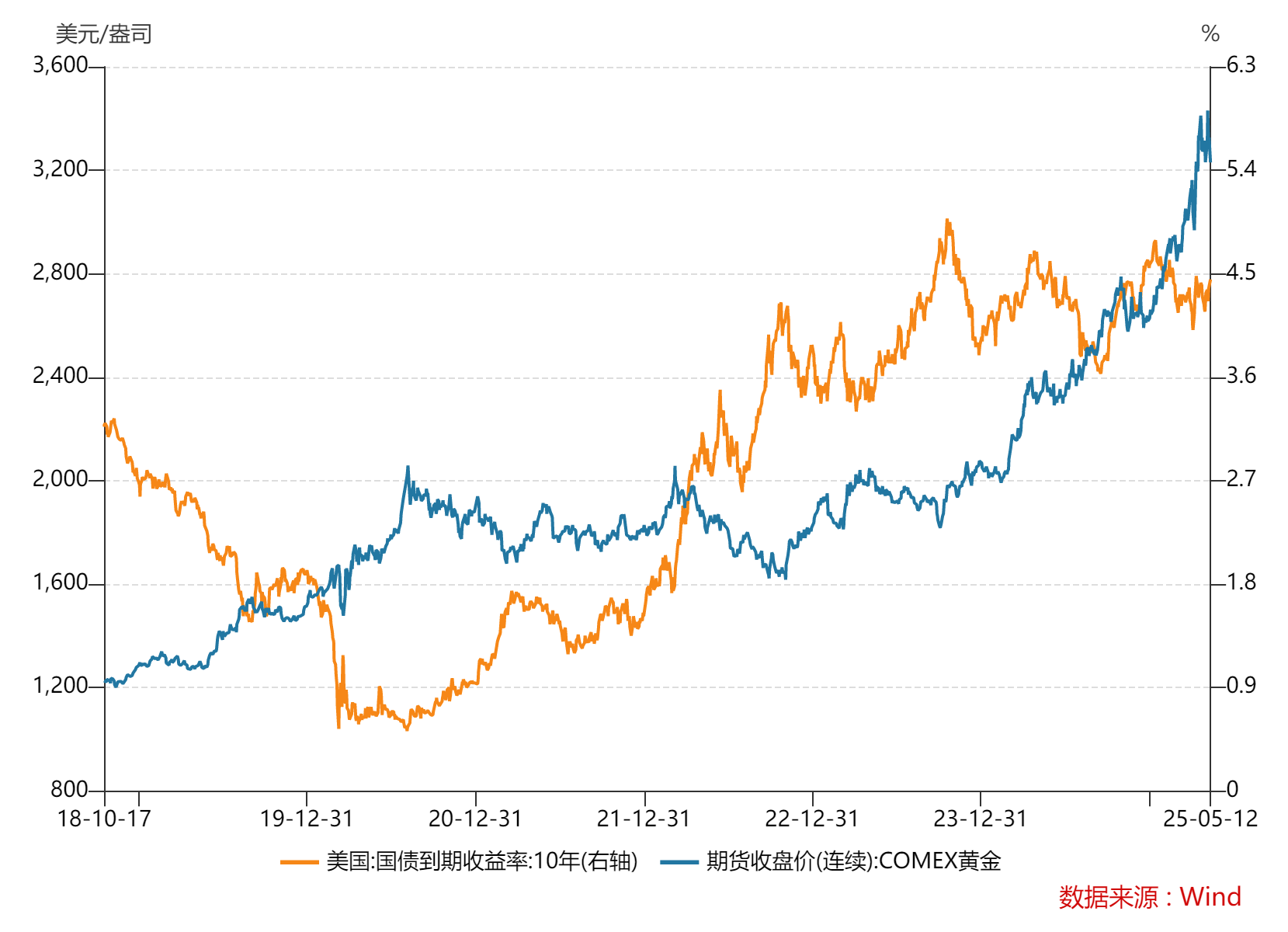
出品 | 妙投APP 作者 | 丁萍 头图 | 视觉中国 在一片上涨中,黄金成为了少数下跌的例外。 自2025年5月12日以来,美股迎来了一波反弹,标普500指数和纳斯达克期货分别上涨了5.27%和7.15%,美元指数也突破了101,人民币兑美元的汇率最低更 是跌破了7.18。但黄金却在这一波涨潮中逆势下行,COMEX黄金价格一度跌至3123.3美元/盎司,跌幅达4%。 这一切背后,最大的推手是中美两国在关税战中的博弈终于有了转机,市场的风险偏好明显上升,避险情绪减弱,但这一影响受限于90天的临时性协议期 限。黄金作为传统的避险资产,受到了明显的压力。 除此之外,短期内的超买状态也引发了技术性调整——根据CFTC数据显示,4月黄金非商业净多头头寸达到了历史峰值38.2万手,较五年均值高出47%;另 外,地缘冲突的缓和也是一个因素。 事实上,这已经不是黄金今年第一次出现回调。2025年一季度,COMEX黄金价格上涨了20%,一度触及3509.9美元/盎司的历史高点,随后就开始了震荡下 行,回撤幅度一度超过了11%。 问题来了,黄金究竟还要跌多久?会一直跌下去吗? 中期交易美国滞胀 短期来看,黄金价格的走势已经脱 ...
关税“压力测试”系列之八:美国经济:关税冲击的监测框架
Shenwan Hongyuan Securities· 2025-05-18 11:44
Group 1: Tariff Impact on the US Economy - As of mid-May, the average tariff rate on US imports has decreased to approximately 16%, yet remains at a historical high[15] - The average tariff on imports from China is now 42%, with the overall average tariff rate dropping from 27% to 16% following recent agreements[19] - The Yale Budget Lab estimates that these tariffs could reduce US GDP by 0.65 percentage points and increase inflation by 1.7 percentage points[23] Group 2: Monitoring Economic Indicators - The economic impact of tariffs can be monitored through three dimensions: trade, prices, and risk appetite[31] - In the short term, key economic indicators to watch include imports, inventory levels, and inflation pressures[2] - The first quarter saw a significant "import rush" in the US, with inventory levels rising, but the inventory-to-sales ratio remained stable[2] Group 3: Inflation and Consumer Behavior - The inflation effects of tariffs are becoming apparent, although the response of import prices has been insufficient so far[3] - Tariffs are expected to transmit increased costs from import prices to production and consumer prices, suppressing actual consumption demand[32] - There are signs that consumer purchasing power is weakening, with previous "panic buying" trends showing signs of exhaustion[3] Group 4: Economic Outlook - The US economy may follow a dynamic path from "stagflation" to "slowdown" or "recession," depending on how tariff conflicts evolve[3] - High-frequency indicators suggest that investment, consumption, and employment in the US may weaken in the near term[3] - The potential for a "recession panic" cannot be ruled out if inflationary pressures continue to rise while economic growth slows[3]
深度专题 | 美国经济:关税冲击的监测框架——关税“压力测试”系列之八
申万宏源宏观· 2025-05-18 11:26
Group 1 - The article discusses the monitoring framework for assessing the economic impact of tariff shocks in the U.S., focusing on trade, prices, and risk preferences [3][27] - As of mid-May, the average tariff rate on U.S. imports has decreased to around 16%, but it remains at a historical high, with potential GDP decline of 0.65% and inflation increase of 1.7% due to tariffs [4][13][10] - The article emphasizes that the current economic condition is characterized by "stagflation," which is the baseline assumption for the short term [18][19] Group 2 - In the short term, key economic indicators to monitor include imports, inventory levels, and inflation pressures, with a notable increase in imports and stable inventory turnover ratios [4][39] - The article highlights that the inflation effects of tariffs may be delayed but are expected to manifest, impacting consumer demand [4][58] - The U.S. economy is likely to follow a dynamic path from "stagflation" to "slowdown" or "recession," depending on how tariff conflicts evolve [5][105] Group 3 - The article notes that the U.S. has experienced a significant "import rush" in the first quarter, with a stable inventory-to-sales ratio, indicating robust domestic demand despite tariff impacts [4][39] - Tariffs have led to a shift in U.S. import patterns, with increased imports from countries with lower tariff rates, such as Canada and Mexico, while imports from China have decreased significantly [36][30] - The article suggests that certain U.S. export sectors, particularly oil, coal, and basic metals, may face significant challenges due to retaliatory tariffs [47][5] Group 4 - The inflation effects of tariffs are becoming evident, with U.S. retail prices starting to reflect the impact of tariffs on imported goods [58][61] - The article indicates that the inflationary pressures may suppress consumer spending, as observed in the correlation between inflation and consumer behavior [69][61] - The financial market's volatility and increased financial pressure could further suppress investment and consumer sentiment in the U.S. economy [75][88]

海外高频 | 中美日内瓦谈判实现关税互降,金价回落
申万宏源宏观· 2025-05-18 11:26
Group 1 - The article discusses the recent US-China trade negotiations in Geneva, resulting in mutual tariff reductions, with the US tariff on China decreasing to 42% and China's tariff on the US decreasing to 27% [2][26][31] - The US overall average tariff rate has dropped from 27% to 16%, although the new tariffs may still lead to a 0.65% decline in US GDP and a 1.7% increase in inflation [2][26] - The article highlights the performance of major stock indices, with the Nasdaq rising by 7.2% and the S&P 500 by 5.3% during the week [2][3] Group 2 - The article notes that the US CPI for April was 2.3%, slightly below the market expectation of 2.4%, indicating ongoing inflationary pressures influenced by tariffs [40] - Retail sales in the US for April showed a slight increase of 0.1%, which was better than the expected 0%, but excluding automobiles and gasoline, the retail performance was weaker than anticipated [44] - Initial jobless claims in the US were reported at 229,000, slightly above the market expectation of 228,000, suggesting potential upward pressure on the unemployment rate [46] Group 3 - The article mentions that the US 10-year Treasury yield rose by 6 basis points to 4.43%, while the yields in other developed countries showed mixed movements [12][14] - The dollar index increased by 0.6% to 100.98, with most other currencies depreciating against the dollar [17] - The article also highlights the performance of commodities, with WTI crude oil rising by 2.4% to $62.5 per barrel, while gold prices fell by 4.0% to $3191.8 per ounce [21][23]

以史为鉴,中美关税调降后,金属市场走向何方?
对冲研投· 2025-05-16 12:18
Core Viewpoint - The risk of stagflation in the US remains, with significant implications from the recent tariff policies that could lead to retaliatory measures from trade partners, negatively impacting both the US and global economic growth while potentially increasing inflation in the long term [1][2]. Group 1: US Economic Outlook - The current US GDP growth rate is stable at over 2%, with an unemployment rate of 4.2%, indicating a relatively healthy economy [19]. - The Federal Reserve is expected to implement 5-6 rate cuts by the end of 2025, although there is a possibility of accelerating these cuts to stimulate the economy [19]. Group 2: Tariff Policy Impact - The recent US tariff policies are more aggressive than previous rounds, raising concerns about their potential to cool down the global economy [2]. - Historical data shows that previous tariff increases have led to significant declines in both imports and exports, as seen during the Smoot-Hawley Tariff Act of 1930, which resulted in a 66% drop in US imports from 1930 to 1933 [22]. Group 3: China Economic Performance - China's economy showed resilience in the first quarter, but the likelihood of a slowdown in the second quarter has increased, suggesting a cautious outlook for the year [3]. - The Chinese government has set a GDP growth target of around 5% for 2025, indicating a stable but cautious economic strategy [26]. Group 4: Commodity Market Trends - The performance of various metals since May indicates a mixed response to tariff announcements, with gold and silver prices declining by 3.9% and 1.3% respectively, while aluminum and tin saw increases of 1.7% and 1.8% [9]. - The volatility in the commodity market is expected to decrease in the second quarter, reflecting a more stable trading environment [31]. Group 5: Supply Chain and Industry Dynamics - Close attention is required on supply-side disruptions that could affect commodity pricing and availability [5]. - The influence of precious metals on the pricing dynamics of the non-ferrous sector is a critical area for monitoring [4].

申万期货品种策略日报:贵金属-20250516
Shen Yin Wan Guo Qi Huo· 2025-05-16 03:52
20250516申万期货品种策略日报-贵金属 | | | | 申银万国期货研究所 林新杰(从业编号:F3032999 交易咨询号:Z0014722) linxj@sywgqh.com.cn | 021-50586279 | | | | --- | --- | --- | --- | --- | --- | --- | | | | 沪金2506 | 沪金2512 | 沪银2506 | 沪银2512 | | | | 现价 | 752.26 | 757.90 | 8110.00 | 8176.00 | | | 期 | 前收盘价 | 759.70 | 765.62 | 8172.00 | 8237.00 | | | 货 | | | | | | | | | 涨跌 | -7.44 | -7.72 | -62.00 | -61.00 | | | 市 | 涨跌幅 | -0.98% | -1.01% | -0.76% | -0.74% | | | 场 | 持仓量 | 67172 | 55950 | 161604 | 125287 | | | | 成交量 | 69209 | 14621 | 253713 | 33734 | | ...
施罗德:Q1美国高收益债韧性凸显 但关税与滞胀风险加剧市场分化
Zhi Tong Cai Jing· 2025-05-16 03:11
Group 1: High Yield Bond Market - The high yield bond market showed resilience in Q1 2025, not experiencing the severe downturn expected amid broader economic uncertainty, with positive absolute returns but no excess returns above risk-free rates, as yields were 113 basis points lower than neutral U.S. Treasury rates [1] - There was a clear bifurcation in the high yield bond sector, with BB-rated bonds outperforming lower-rated bonds, indicating a shift towards higher quality bonds by investors in response to economic uncertainty [1] - The high yield bond market is supported by favorable technical factors, including suppressed default rates and extended refinancing schedules, with many bonds maturing as late as 2029, providing a buffer amid slowing economic growth [6] Group 2: Macroeconomic Impact of Tariffs - The implementation of new tariffs by the Trump administration is a direct catalyst for market volatility, with the IMF estimating a potential 0.9% reduction in U.S. GDP and a 1% increase in inflation if average tariff rates rise as announced [2] - The labor market shows mixed signals, with stable unemployment claims but increasing targeted layoffs, particularly in sectors reliant on federal spending, leading to concerns about the employment outlook as small business optimism declines [3] - The Federal Reserve is maintaining a cautious stance, with expectations of 2.5 rate cuts in 2025, but market consensus suggests potential for more aggressive cuts if inflation remains high amid economic stagnation [3] Group 3: Investment Grade Corporate Bonds - The investment-grade corporate bond market reflects increasing unease, with credit spreads widening from 80 basis points to 93 basis points by the end of Q1 2025, although still within neutral ranges [4] - Corporate fundamentals remain resilient, with EBITDA showing a stable growth of 3.5% year-over-year, and interest coverage ratios at a solid 9.3 times, indicating that companies can withstand moderate economic downturns [4] - Demand dynamics for U.S. investment-grade corporate bonds are being closely monitored, particularly from foreign investors, which could enhance bond prices if U.S. Treasury yields remain stable [5] Group 4: Mortgage-Backed Securities (MBS) and Asset-Backed Securities (ABS) - The MBS and ABS markets are affected by renewed interest rate volatility due to tariff expectations, with a preference for high-quality auto loan structures despite rising concerns over consumer repayment capabilities [6] - The demand for high-quality assets may offset potential outflows from the MBS market, while lower yields could lead to increased prepayment rates, complicating the risk-return trade-off for investors [7]
独家洞察 | 美国通胀攀升与潜在经济衰退对投资影响的情景测试
慧甚FactSet· 2025-05-15 10:27
Core Viewpoint - The article discusses the scenario analysis conducted on investment portfolios in light of concerns over slowing economic growth and rising prices due to tariffs in the U.S. [1] Inflation Scenario - The inflation rate is set to increase by 0.5% and 1%, rising from the current rate of 2.8% to 3.3% and 3.8% respectively, which is incorporated into various inflation scenarios [8] - The analysis utilizes the 5-year zero-coupon bond inflation rate as a factor for stress testing, calculating returns based on its correlation with inflation [8][9] Recession Scenario - The article outlines the potential for a recession, with the Atlanta Federal Reserve predicting negative GDP growth in Q1 2025, raising market concerns despite the absence of current negative GDP data [7] - Historical impacts of various economic recessions are reviewed to establish representative factors for the recession scenario [10] Historical Recession Analysis - The article presents historical return rates during different recession periods, indicating significant declines in stock and high-yield bond returns, while government bonds showed varying performance [11] - Two recession scenarios are defined: mild and severe, with corresponding impacts on asset returns [13] Investment Strategy Impact - The analysis explores how different investment strategies perform under various economic conditions, highlighting that strategies with higher equity allocations tend to underperform during recession scenarios [19] - Core bond strategies demonstrate resilience in mild recession scenarios, mitigating the negative impacts of declining stock returns [19] Conclusion - The article illustrates how to test investment strategies under changing macroeconomic conditions such as rising inflation, recession, or stagflation, emphasizing the use of selected factors and indicators for robust analysis [20]