
即时零售

Search documents
2477亿营收暴击!阿里云市占率碾压
Xin Lang Cai Jing· 2025-11-26 07:56
Core Insights - Alibaba's Q2 FY2026 results exceeded market expectations, with revenue reaching 247.8 billion RMB, showcasing significant improvement in core business profitability [1][2] - Alibaba Cloud's revenue grew by 34% year-on-year, and AI-related product revenue has maintained triple-digit growth for nine consecutive quarters [1] - Instant retail business revenue surged by 60% year-on-year, contributing to a double-digit increase in monthly active consumers on the Taobao app [1] Financial Performance - For the three months ending September 30, 2025, Alibaba reported a revenue of 247.8 billion RMB, a 5% increase compared to the previous year [2] - Key segments showed varied growth: - Cloud revenue increased by 34% - Instant retail revenue rose by 80% - International business revenue grew by 10% [2] - Despite strong financial results, Alibaba's stock experienced a decline, with Hong Kong shares down 1.33% and US shares down 2.31% on the reporting day [2] Market Position and Strategy - Alibaba's dual strategy of "deepening foundational models and accelerating industry solutions" is yielding results, with significant engagement from global developers [4] - The company is focusing on AI integration in both B2B and B2C sectors, aiming to capture more market share in AI cloud and instant retail [4] - Analysts remain optimistic about Alibaba's long-term prospects, with target prices from major investment banks indicating confidence in revenue growth driven by AI, cloud, and e-commerce synergies [4] Operational Efficiency - The financial report indicates a shift towards improved efficiency, with Alibaba Cloud becoming a core profit driver due to increased demand for AI services [5] - Instant retail metrics such as user retention and average order value have shown significant improvement, suggesting a transition from mere scale expansion to a balanced focus on scale and profitability [5] - Overall, Alibaba's Q2 results validate the resilience of its core business and the effectiveness of its AI and consumer strategy [5]


阿里烧钱拼外卖 到底值不值?
Mei Ri Jing Ji Xin Wen· 2025-11-26 07:33
Core Insights - The recent financial report from Alibaba shows steady overall revenue growth, with total revenue reaching 247.795 billion yuan, a year-on-year increase of 15% after excluding sold businesses. However, the operating profit has significantly declined by 85% to 5.365 billion yuan, indicating pressure from the ongoing food delivery competition [1] - The food delivery battle has also affected Meituan and JD.com, both of which reported revenue growth but a notable decline in net profits. This trend highlights the financial strain caused by the competitive landscape [1] - Alibaba's CEO of the China e-commerce division, Jiang Fan, mentioned that the first phase of scale expansion for Taobao Flash Purchase has ended, and the company is now entering a phase focused on efficiency optimization [1] Industry Analysis - The food delivery business is no longer a new trend, and major players are struggling to find innovative strategies beyond aggressive price subsidies. The current high spending model, which involves burning over 100 million yuan daily, is deemed unsustainable in the long term [1] - Alibaba's strategy appears to integrate food delivery into its broader e-commerce ecosystem, aiming to drive overall growth. JD.com has shifted its focus from the food delivery battle to other sectors like travel and in-store services, launching new apps to capture new markets [2] - Meituan has been significantly impacted by the competition, with a reported 89% decline in net profit due to high spending to maintain market share. Despite this, Meituan's stock performed relatively well after Alibaba's earnings report, likely due to market speculation that its third-quarter performance may have bottomed out [2]


瑞银:随双十一落幕电商行业有望触底 竞争在第四季末趋缓和
智通财经网· 2025-11-26 06:13
Core Insights - UBS reports that from early 2025 to now, the China Internet ETF (KWEB) has risen by 37%, with a 5% increase in the current quarter, but earnings expectations have been downgraded by 19%, primarily due to e-commerce investments in instant retail [1] Group 1: Market Sentiment and Valuation - Favorable market sentiment has driven valuation multiples higher, with major internet companies' valuation multiples expanding by approximately 58% to around 17 times the 2025E adjusted P/E ratio, while the U.S. "Tech Seven" has a valuation of about 31 times [2] - Small and mid-cap vertical companies continue to outperform as investors avoid competition pressures among e-commerce giants, with emotional consumption scenarios like online gaming and music showing strong performance [2] - Low-allocated stocks have seen significant rebounds when performance meets expectations [2] Group 2: Structural Highlights in the Macro Environment - The online entertainment sector has exceeded expectations due to adequate content supply and capturing consumer spending, particularly in online gaming and music [3] - China's retail sales have grown by 3.7% year-on-year, with online sales of physical goods performing even better at a 6.3% increase, driven by extended shopping festivals and optimized platform algorithms [3] - Advertising technology and AI-related companies have positive outlooks, while traditional media platforms are underperforming [3] Group 3: Trends in the Internet Industry - Chinese internet giants are increasing capital expenditures and investing in AI, with a focus on GPU efficiency and flexibility in adjusting investment targets based on demand [4] - Domestic AI chip performance is improving due to ongoing self-research investments and local GPU manufacturers' development, with advancements in system-level technologies like "super node" technology [4] - Major cloud companies are maintaining full-year capital expenditure guidance, emphasizing chip utilization and deployment efficiency amid supply chain uncertainties [5] Group 4: Instant Retail Investments - Platforms are increasing investments in instant retail to drive low-frequency e-commerce business through high-frequency delivery transactions, with signs of short-term competition stabilizing [6] - Market share appears to be stabilizing, and the industry is expected to bottom out post "Double Eleven" shopping festival, with competition returning to normal by the end of Q4 [7] - Long-term challenges remain, including intensified competition and the need to accelerate online penetration of delivery services among merchants and consumers [7]
阿里称AI泡沫不存在:3800亿元资本开支偏保守,不排除进一步增加
Feng Huang Wang· 2025-11-26 05:29
Core Viewpoint - Alibaba Group's CEO expressed confidence that an AI bubble is unlikely to emerge within the next three years, highlighting strong demand for both new and older GPU models in the industry [1] Financial Performance - For the second quarter of fiscal year 2026, Alibaba reported a revenue increase of 5% year-on-year to 247.795 billion yuan, exceeding market expectations, with a 15% growth when excluding divested businesses [1] - The adjusted EBITA decreased by 78% to 9.073 billion yuan, while net profit attributable to ordinary shareholders fell by 52% to 20.99 billion yuan [1] - Non-GAAP net profit was 10.352 billion yuan, down 72% year-on-year [1] - Alibaba's stock fell by 2.31% in the US market and 1.14% in Hong Kong following the earnings report [1] Capital Expenditure and AI Investment - Alibaba announced a conservative capital expenditure plan of 380 billion yuan for AI infrastructure over three years, with potential for increased investment if demand continues to outpace supply [2] - The CFO noted that the current growth in server deployment is lagging behind customer orders, indicating a need for further investment [2] - The cloud intelligence segment generated 39.824 billion yuan in revenue, a 34% increase driven by public cloud business growth, including AI-related product adoption [2] AI Application Development - Alibaba launched the Qianwen App, which has surpassed 10 million downloads in its first week, aiming to integrate AI into both B2B and B2C sectors [3] - The app is expected to leverage Alibaba's ecosystem to create a future AI lifestyle entry point [3] Supply Chain and Resource Allocation - In response to ongoing supply chain fluctuations, Alibaba is prioritizing resource allocation for core model training and AI services, balancing internal needs with external customer demands [4] - The CEO emphasized that AI demand growth is certain over the next three years, with a global shortage of AI server resources expected to persist [4] E-commerce and Retail Strategy - Alibaba's China e-commerce group reported a revenue of 132.578 billion yuan for the second quarter, a 16% year-on-year increase, despite a 76% drop in adjusted EBITA due to investments in instant retail and technology [5] - Instant retail revenue reached 22.906 billion yuan, reflecting a 60% increase [6] - The company is optimizing its user experience in instant retail, with significant improvements in operational efficiency noted since October [6] - As of October 31, approximately 3,500 Tmall brands integrated their offline stores into instant retail, contributing to a substantial increase in daily orders during the Double 11 shopping festival [6] Marketing and Cash Flow - Sales and marketing expenses doubled to 66.496 billion yuan, accounting for 26.8% of total revenue, up from 13.7% the previous year, primarily due to investments in user experience [7] - Net cash flow from operating activities decreased by 68% to 10.099 billion yuan, while free cash flow turned negative at 21.840 billion yuan, down from a positive 13.735 billion yuan the previous year [7] - As of September 30, 2025, Alibaba's cash and other liquid investments totaled 573.889 billion yuan [7]
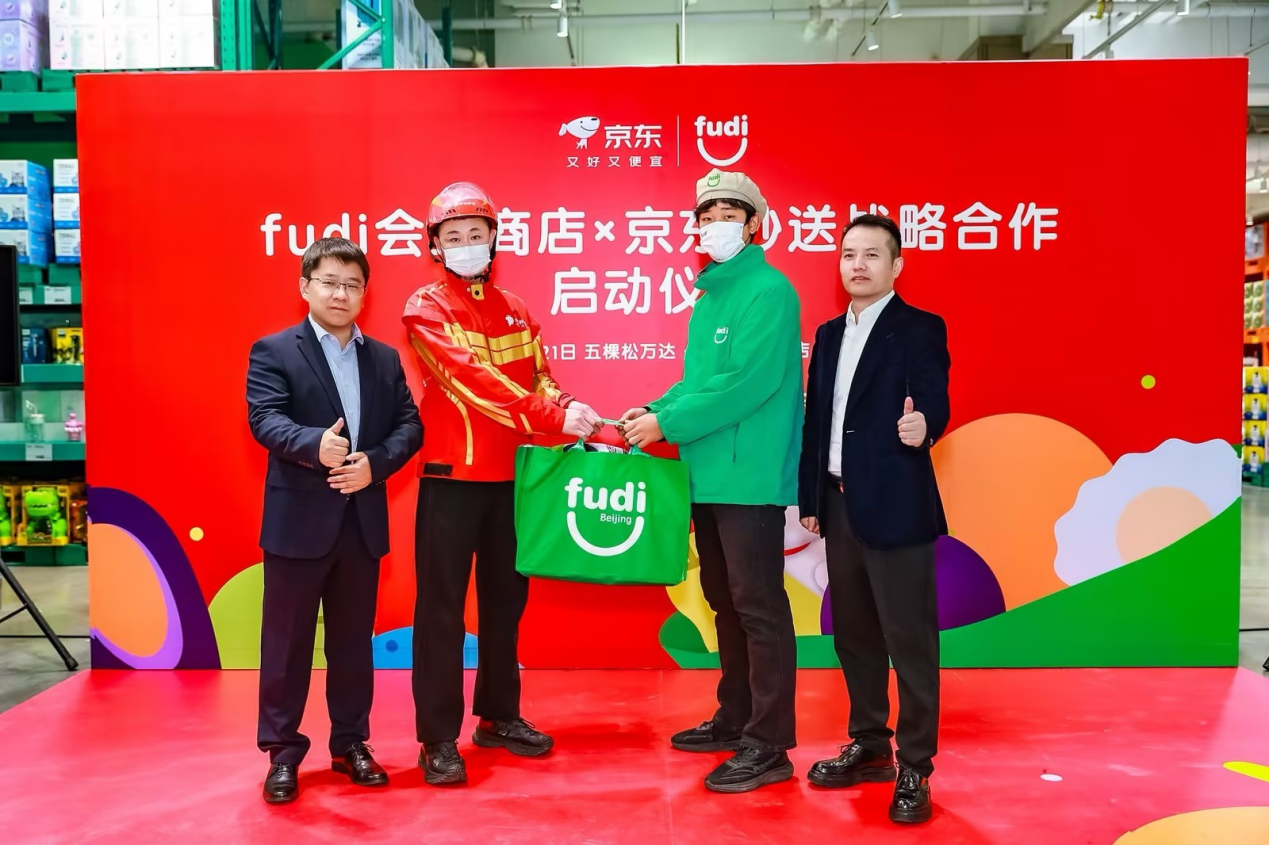
强强联合! fudi与京东秒送达成独家战略合作,共筑会员制超市“中国样本”
Zhong Jin Zai Xian· 2025-11-26 04:26
Core Insights - Fudi, a local membership-based retail brand in China, has entered into an exclusive strategic partnership with JD Instant Delivery, integrating all of its stores into the JD Instant Delivery platform [1] - The collaboration focuses on enhancing instant retail services and member systems, aiming to create a "Chinese model" for local membership supermarkets [1] Group 1: Instant Retail Services - JD Instant Delivery will leverage its digital capabilities to integrate Fudi's supply chain resources, enabling over 4,000 member products to be delivered in as fast as 30 minutes [3] - A dynamic inventory coordination mechanism will be implemented to ensure accurate fulfillment of online orders by synchronizing store inventory in real-time [3] - JD Instant Delivery will provide customized delivery services for Fudi, tailoring aspects such as capacity allocation, delivery personnel attire, and service standards to enhance the customer experience [3] Group 2: Membership System Integration - The partnership will facilitate the integration of Fudi's membership with JD PLUS membership, allowing for mutual point exchange, exclusive discounts, and joint marketing efforts [3] - This marks the first deep cross-industry integration of JD PLUS membership with a membership retail brand, potentially serving as a replicable model for other retailers [3] Group 3: Warehouse and Supply Chain Innovation - Both companies will explore collaborative innovations in the supply chain, promoting the two-way flow and sharing of quality product resources to expand the coverage of high-quality goods [4] - JD Instant Delivery has accumulated experience in establishing front warehouses for membership supermarkets, which will assist Fudi in rapidly building its front warehouse network and accelerating national market expansion [3] Group 4: Promotional Offers - As Fudi launches on JD Instant Delivery, several promotional offers will be introduced, including a limited-time exclusive deal of 9.9 yuan for selected products starting November 26 [6] - New Fudi members on the JD Instant Delivery platform will receive a special coupon package worth 188 yuan, enhancing the experience of high-quality products with rapid delivery [6]
万科:公司所持贝壳股票已经全部出售|首席资讯日报
首席商业评论· 2025-11-26 04:08
Group 1 - Vanke has completely sold its shares in Beike [2] - Amazon encourages engineers to use its own AI coding tool Kiro instead of third-party options [2] - Huawei officially launched the Mate 80 series with starting prices of 4699 yuan for Mate 80 and 5999 yuan for Mate 80 Pro [3] Group 2 - Zhihu reported a net loss of 46.7 million yuan in Q3 2025, compared to a net loss of 9 million yuan in the same period last year [4] - The Ministry of Commerce's research institute forecasts an average annual growth rate of 12.6% for the instant retail industry during the 14th Five-Year Plan period [5] - China's instant retail market reached 781 billion yuan in 2024, growing by 20.15% year-on-year, outpacing national online retail growth by 12.95% [5] Group 3 - Pony.ai reported Q3 2025 revenue of 25.4 million USD, a 72% increase from 14.8 million USD in Q3 2024, driven by strong growth in autonomous driving services [6] - Analyst Ming-Chi Kuo refuted claims of financial irregularities at Nvidia, stating that the increase in Days Sales Outstanding (DSO) and inventory is part of normal business expansion [7] - The first China (Zhejiang) Cross-Border E-Commerce Import and Export Trade Fair opened in Yiwu, featuring over 1,000 domestic and international e-commerce platforms [8] Group 4 - The National Retail Federation (NRF) predicts a record high of 186.9 million American consumers will shop during the Thanksgiving shopping season [9] - New regulations for power banks are expected to increase costs by 20%-30%, with existing 3C products still allowed on flights [10] - Huawei announced the launch of AI deep research capabilities in HarmonyOS 6, enhancing search and analytical functions [11] Group 5 - Singapore's national AI program has shifted from Meta's model to Alibaba's Qwen, marking a significant expansion of Chinese open-source AI models globally [12]



美团闪购与华为鸿蒙合作升级,华为Mate 80将通过“美团闪电新品”首发
Ge Long Hui· 2025-11-26 03:36
Group 1 - Huawei will launch the Mate 80 series and other products on November 25, featuring the HarmonyOS 6, with significant advancements expected in mobile imaging [1] - The collaboration between Meituan Flash Purchase and Huawei will allow for simultaneous pre-sale of new models, enabling consumers to receive their devices within 30 minutes from local stores [1] - The number of Huawei authorized stores on Meituan Flash Purchase has rapidly increased to nearly 6,500, reflecting the popularity of the "30-minute delivery" service [2] Group 2 - During the Double 11 shopping festival, the transaction volume of Huawei authorized stores on Meituan Flash Purchase saw a year-on-year increase of 101%, with new customer acquisition rising by 158% compared to regular days [2] - Meituan Flash Purchase has introduced the exclusive IP "Meituan Lightning New Products" to support the launch of new electronic products, providing dedicated traffic, resource exposure, and user benefits [2] - Consumers purchasing new HarmonyOS devices will have the opportunity to receive 12 months of Meituan Black Diamond membership benefits [2]
美团(03690)涨6.26% 竞争对手阿里第二财季即时零售业务资本支出高增
Xin Lang Cai Jing· 2025-11-26 03:28
来源:金吾财讯 金吾财讯 | 美团(03690)股价走高,截至发稿,涨6.26%,报104.4港元,成交额58亿港元。 消息面上,竞争对手阿里昨日公布财报。截至9月30日止三个月,归属普通股股东的净利润为209.9亿元 (人民币,下同),同比减少52.16%。期内,收入为2477.95亿元,同比增长4.77%。期内,电商业务收入 为1029.33亿元,相较2024年同期增长9%。其中,即时零售业务收入为229.06亿元,相较2024年同期增 长60%,主要是得益于2025年4月底推出的"淘宝闪购"所带来的订单量增长。公告中称,第三季经营活 动产生的现金流量净额为人民币100.99亿元,同比下滑68%。自由现金流的下降主要归因于对即时零售 的投入以及公司的云基础设施支出增加。 另外,里昂预测美团第三季度核心本地生活业务收入同比减少1.3%,新业务收入同比增长17.7%。 ...
美团酒饮闪电仓大会在南京举行,“宁”聚共识锚定酒业新航道
Jiang Nan Shi Bao· 2025-11-26 03:27
10月16日上午,"酒类行业新机遇·美团酒饮闪电仓大会"在南京成功举办。作为第113届全国糖酒会的重 要组成部分,本次大会在全国糖酒会组委会与中国酒类流通协会的共同指导下,聚焦"酒类即时零售"新 趋势,致力于推动酒类行业向数字化、连锁化、场景化方向转型,助力品牌与商家抢占即时零售新赛 道。 会议围绕"酒饮闪电仓"这一创新模式展开深入探讨,涵盖战略发布、商家实战分享、系统赋能解析等多 个维度,为行业提供了从模式构建到运营落地的完整解决方案参考。 行业聚焦,共探酒类即时零售新路径 本次大会由行业权威机构联合指导,汇聚了来自产业链各环节的核心代表。中粮会展(北京)有限公司 副总经理、全国糖酒会组委会副秘书长王昊,中国酒类流通协会监事长、办公室主任刘雪清,江苏酒类 行业协会常务副秘书长龚诺,美团酒饮闪电仓负责人夏国佼等行业协会领导和嘉宾莅临现场,展现了行 业对即时零售新赛道的高度重视。大会还邀请了酒易淘、布马甜酒铺等知名酒商代表参与分享。 大会开场,全国糖酒会组委会代表在致辞中指出,当前食品行业正处于结构升级、酒类行业深度调整的 关键阶段。她强调,美团酒饮闪电仓代表着一种全新的即时零售酒水供给模式,精准契合了年轻一 ...
即时零售报告:行业迈向万亿级规模,平台需构建高标准服务体系
Bei Ke Cai Jing· 2025-11-26 03:17
Core Insights - The instant retail industry in China is at a critical juncture, moving towards a trillion-yuan scale, with a focus on building a healthy ecosystem for high-quality development [1] - The competition in the industry is shifting from price-driven to user experience-driven, marking a new phase that emphasizes efficiency and quality [1] Group 1: Industry Development - The report indicates that the industry is evolving from "fast fulfillment" to "stable service" and "quality products" [1] - Establishing a high-standard service system centered around "assurance" is crucial for helping merchants achieve sustainable operations [1] Group 2: "Assurance Flash Purchase" Initiative - The "Assurance Flash Purchase" plan has expanded to 20 services since its launch in May, covering the entire shopping process and helping nearly one million merchants reduce unnecessary losses from consumer disputes [2] - The initiative is built on a comprehensive assurance system that includes "assured quality," "assured service," and "assured after-sales," supported by an AI governance system and diverse evaluation rules [2] Group 3: Consumer Experience Enhancements - The platform has introduced a minute-level "assured after-sales" experience, with official return services covering nearly 400,000 merchants across 53 cities [3] - The first industry-wide free return shipping service funded entirely by the platform is available to millions of premium members and across all product categories [3]