
中期选举

Search documents
周四10点,特朗普将全美讲话:回顾“伟大”的一年,预告明年新政
Hua Er Jie Jian Wen· 2025-12-16 21:18
Core Points - President Trump is set to deliver a crucial speech to the nation amid declining approval ratings and economic challenges, aiming to outline his policy agenda and achievements [1] - Recent polls indicate a nearly 10 percentage point drop in public approval regarding Trump's handling of economic and immigration issues since March [1][3] - The upcoming midterm elections will serve as a test of Trump's political influence and the Republican Party's ability to maintain control of Congress [1] Economic Challenges - Economic issues have emerged as a primary challenge for Trump, with concerns over wage growth slowing and rising household costs becoming central to voter concerns [2][3] - Political opponents are criticizing Trump's tariff policies, attributing rising consumer prices and inflation to these measures [3] - Trump has initiated a domestic campaign to address economic pressures, including policies aimed at reducing costs and providing assistance to farmers affected by low agricultural prices and tariffs [3] Policy and Governance - Since returning to the White House, Trump has focused on reshaping the U.S. economic and national security landscape through tariffs on trade partners and key industries [4] - His administration has tested the boundaries of executive power by reducing the federal workforce and cutting funding for programs criticized by conservatives [4] - Trump is also working to fulfill campaign promises related to immigration, including large-scale deportations and tightening legal entry pathways [4]
2026年海外市场展望:先抑后扬
Tebon Securities· 2025-12-16 11:17
Group 1 - The 2026 US economy is expected to follow a "first suppress then rise" rhythm, influenced by midterm elections and monetary policy [3][8] - The midterm elections will see intensified political competition, with Trump likely to focus on maintaining support for large tech companies through tax incentives while also addressing issues for small businesses and low-income groups [3][11] - The monetary policy is anticipated to be cautious until the Fed chair transition in May 2026, with a potential shift to a more accommodative stance thereafter [3][26] Group 2 - Investment in the AI sector has been a significant driver of the US economy, with major tech companies' capital expenditures expected to slow down in 2026, leading to a cooling market sentiment [3][33] - The capital expenditures of the seven major tech companies are projected to be over 50% of their operating cash flow, with Amazon reaching over 90%, indicating a need for revenue growth to sustain such investments [3][38] - The geopolitical landscape remains turbulent, with ongoing pressures from the midterm elections potentially prompting the Trump administration to seek breakthroughs in the Russia-Ukraine situation [3][41] Group 3 - The report highlights the importance of asset allocation strategies, focusing on opportunities within the US AI sector and European defense and manufacturing industries [3][45] - The anticipated economic growth from the "Great Beautiful Act" is projected to increase GDP by 0.9% in 2026, supporting the overall economic outlook [3][22] - The report suggests that traditional industries and small businesses may benefit more from interest rate declines compared to large tech firms, which are less sensitive to rate changes [3][32]
固收-2026海外:大浪之前
2025-12-16 03:26
Summary of Key Points from the Conference Call Industry Overview - The discussion primarily revolves around the U.S. economic outlook for 2026, focusing on tax policies, inflation, employment, and the impact of the AI sector on the market [1][4][11]. Core Insights and Arguments - **Tariff Legality and Impact**: The legality of Trump's IEP tariffs is under challenge, with a market expectation of over 70% probability that they will be deemed illegal by the Supreme Court. This could significantly affect stock trading strategies [1][3]. - **Economic Growth from the Inflation Reduction Act**: The Inflation Reduction Act is expected to boost GDP growth by approximately 0.4 percentage points in 2026 through tax cuts, despite potential declines in social welfare programs [1][5]. - **Midterm Elections Influence**: The Trump administration may implement measures to stabilize the stock market and avoid actions that could harm it, as the midterm elections approach. This includes potential reductions in tariffs on consumer goods and food [1][6]. - **Deficit Projections**: The U.S. deficit rate is projected to decrease to about 5.9% in 2025 due to spending cuts and increased tariff revenues, but is expected to rebound to approximately 6.2% in 2026 due to fiscal expansion [1][7][8]. - **AI Bubble Concerns**: There are rising concerns about an AI bubble, characterized by high market concentration and overvaluation in the tech sector. The bubble is expected to remain stable until 2026, with potential risks of bursting in 2027 or 2028 [1][9][10]. Additional Important Content - **Inflation and Employment Forecasts**: The CPI growth rate for 2026 is anticipated to fluctuate between 2.8% and 3.1%, with unemployment peaking at 4.6% in early 2026 before gradually declining to 4.3%-4.4% by year-end [4][11]. - **Investment Trends**: AI-related investments are expected to continue growing but at a slower rate, while non-AI investments may rebound due to lower interest rates and improved confidence in capital expenditures [4][12]. - **Market Outlook**: The stock market is projected to continue rising in 2026, albeit with increased volatility. Short-term bond yields are expected to decrease, while long-term yields will remain high [4][13][14]. This summary encapsulates the key points discussed in the conference call, providing insights into the economic landscape and potential investment opportunities and risks for 2026.
超级周,黄金强势暴涨!
Jin Tou Wang· 2025-12-15 10:27
Economic Data - The upcoming week will see the release of significant economic data, including the non-farm payroll (NFP) and Consumer Price Index (CPI) reports, which will be published simultaneously for the first time in history [3] - The NFP report, set to be released on Tuesday, is expected to show a decrease of 10,000 jobs for October due to many former federal employees delaying their departure, but a strong rebound of 130,000 jobs is anticipated for November [3] - The CPI report will be released on Thursday, with expectations of a 0.3% month-on-month increase for both overall and core CPI, leading to year-on-year rates of 3.1% and 3.2% respectively, driven by tariff cost transmission [3] Federal Reserve Insights - New York Fed President John Williams will speak tonight, marking his first statement since November and the first after the December Fed meeting, which is crucial for market sentiment [5] - The market is currently in a delicate position, where slight negative data could lead to a forced rate cut, while slightly positive data could result in a pause in rate cuts [5] - According to CME FedWatch, the probability of a 25 basis point rate cut in January 2026 is 24.4%, while the probability of maintaining the current rate is 75.69% [5] Market Predictions - Robert Edwards, CIO of Edwards Asset Management, predicts that the S&P 500 index will reach 7,000 points by the end of this year and continue to rise in 2026 [7] - Goldman Sachs has reaffirmed its forecast for the S&P 500 to reach 7,600 points in 2026, indicating approximately 10% upside potential from current levels [7] - Multiple institutions, including Morgan Stanley and Deutsche Bank, also project over 10% upside for the U.S. stock market [7] International Affairs - Significant progress has been made in U.S.-Ukraine talks regarding a "peace plan," with Ukraine's President Zelensky indicating a willingness to accept bilateral security guarantees instead of NATO membership [9] - In the Middle East, tensions have escalated following an attack by ISIS on U.S. troops in Syria, leading to a response from President Trump, and Israeli airstrikes in Gaza have further complicated the situation [11]


美联储为何将在2026年大幅降息
2025-12-15 01:58
Summary of Key Points from the Conference Call Industry or Company Involved - The discussion revolves around the Federal Reserve (Fed) and its monetary policy, particularly in the context of the upcoming 2026 elections and the potential appointment of a new Fed Chair. Core Points and Arguments - **Federal Reserve Chair Candidates**: The list of candidates for the new Fed Chair has narrowed down to five individuals, with Kevin Hassett being the most likely choice according to market speculation [1][3][4]. - **Political Pressure for Rate Cuts**: President Trump has expressed a desire for the new Fed Chair to lower interest rates, indicating that this will be a test of their capabilities [3][5]. - **Current Economic Context**: The Fed is currently operating under a tight monetary policy, with federal funds rates above neutral levels, which is slowing economic growth [5][6]. - **Predictions for Rate Cuts**: It is anticipated that the Fed will lower rates to neutral or even lower before the midterm elections in November 2026, with a target range of 2.75%-3.00% by September 2026 [10][20]. - **Inflation Concerns**: There are concerns that rate cuts could lead to higher inflation expectations, which may counteract the intended effects of lowering long-term rates [11][12]. - **Impact of New Fed Chair**: The new Fed Chair is expected to align closely with the White House's agenda, particularly if they are a loyal supporter of Trump, which could lead to a more coordinated monetary policy [18][24]. - **Potential for Asset Purchases**: If long-term rates rise unexpectedly, the Fed may consider large-scale asset purchases to manage the yield curve [15][25]. Other Important but Possibly Overlooked Content - **Political Dynamics**: The potential for a majority of Trump loyalists on the Fed Board could significantly influence monetary policy decisions, especially if there are attempts to remove current board members [19][22][23]. - **Economic Policy Coordination**: The relationship between government policies aimed at controlling inflation and the Fed's monetary policy will be crucial, especially if inflation remains persistent [16][25]. - **Market Reactions**: The market's perception of the Fed's ability to achieve its inflation target will be closely tied to the actual rate cuts and the economic data leading up to the elections [11][12]. This summary encapsulates the critical insights from the conference call regarding the Federal Reserve's future actions and the political landscape influencing these decisions.
情况有变!民主党出手,特朗普自身难保,高市早苗最后的幻想破灭
Sou Hu Cai Jing· 2025-12-12 03:19
Group 1 - Trump's influence on the international political stage is diminishing, impacting countries and leaders that rely on him, such as Japan's Suga Yoshihide [1] - The recent victory of Democratic candidate Erin Higgins in the Miami mayoral election, defeating Trump's endorsed Republican candidate, signifies a significant blow to Trump's political clout [1][3] - Polls indicate a drastic shift in public opinion against Trump, driven by rising living costs, immigration policy failures, and mishandling of the Epstein case, posing serious challenges to his political future [3] Group 2 - Trump's economic policies, particularly the imposition of high import tariffs, have led to a surge in inflation, surpassing the Federal Reserve's 2% target, revealing the fragility of the U.S. economy [3] - Despite Republican economic policies being perceived as superior, the gap in public support is narrowing, indicating potential further declines in Trump's approval ratings [3] - Suga's attempts to engage with Trump, including proposing a meeting in a third country, appear unrealistic given Trump's indifference towards U.S.-Japan relations and the minimal benefits Japan can offer [5] Group 3 - Suga's domestic political issues, including a scandal involving illegal donations, undermine her credibility and may lead her to seek Trump's support to regain public favor, which could backfire [5][7] - The tension in U.S.-China relations is exacerbated by Suga's passive diplomatic approach, which fails to build trust and may hinder any potential improvement in bilateral relations [5][7] - The future of U.S.-China relations and Suga's role in it remains uncertain, with her political survival increasingly dependent on breaking the current deadlock [7][8]
特朗普催墨西哥还“水债”否则加征5%关税 墨西哥有何苦衷?
Di Yi Cai Jing· 2025-12-10 14:05
Core Points - The article discusses the water debt issue between the United States and Mexico, highlighting President Trump's threat to impose tariffs on Mexican products if Mexico does not comply with water supply obligations [1][2] - Mexico's President, Sinaloa, plans to increase water supply to the U.S. despite challenges posed by drought and infrastructure limitations [1][2] - The historical context of the water-sharing agreement and the impact of climate change on Mexico's ability to meet its obligations are emphasized [2][3] Group 1: Water Supply Obligations - The U.S. claims Mexico owes over 980 million cubic meters of water, requiring Mexico to release 247 million cubic meters by December 31 [1][2] - The 1944 treaty stipulates that Mexico must supply approximately 2.158 billion cubic meters of water every five years, with penalties for non-compliance [2] Group 2: Climate and Agricultural Impact - Mexico has faced severe drought conditions, with 46.5% of its land experiencing moderate to extreme drought as of mid-year [2] - The agricultural sector in Texas, which relies on the Rio Grande, is suffering due to reduced water supply, impacting crops like sugar and corn [4] Group 3: Political and Economic Pressures - The Mexican government is under pressure to balance domestic water needs with international obligations, complicating compliance with the water-sharing agreement [2][3] - Trump's recent threats are seen as politically motivated, especially with midterm elections approaching, reflecting a focus on agricultural state interests [4]
Johnson: I think the market is looking for more stimulus
Youtube· 2025-12-10 12:23
Market Outlook - The market is anticipating more stimulus, and a hawkish cut could lead to disappointment if no further cuts are indicated for early 2024 [1][2] - The overall popular averages, including the Dow and S&P, may not see significant gains, particularly in mega-cap stocks [2][3] Stock Performance - A hawkish message from the Fed could result in mid and small-cap stocks performing better, while MAG7 stocks are expected to lag [4] - The S&P 500 price target for 2026 is set at 7150, reflecting a 4% increase from current levels, despite historical trends suggesting lower returns after three consecutive years of gains [5][6] Volatility and Market Trends - Historical data indicates that after three years of strong returns, the fourth year typically experiences consolidation or pullbacks [6][7] - 2026 is projected to be a year of higher volatility, with potential strength in the first half and a significant drawdown expected in Q3 due to midterm elections [8][10] Catalysts for Market Movements - A potential 20% drawdown could occur around Q2 or Q3, driven by midterm elections and possible shifts in congressional control [9][10] - Following the elections, additional Fed cuts may serve as a catalyst for market recovery, although the path forward will differ from previous years [11]

纽约联储调查:美国消费者通胀预期持稳 对就业前景看法有所改善
智通财经网· 2025-12-08 23:53
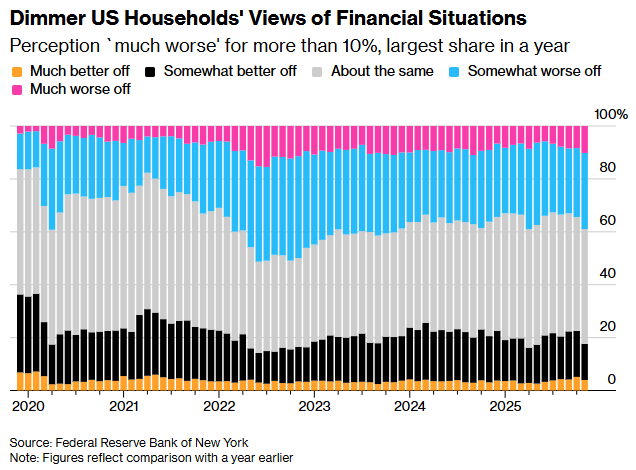
Group 1 - The core viewpoint of the articles highlights the stability of consumer inflation expectations in the U.S. for November, with a maintained one-year inflation expectation of 3.2% and a three to five-year expectation of 3% [1] - The New York Fed's survey indicates an improvement in consumer sentiment regarding the job market, with the probability of unemployment decreasing to 13.8%, the lowest level this year [1] - Despite the positive outlook on employment, a significant portion of households reported worsening financial conditions, with 39% stating their financial situation is worse than a year ago, the highest level in two years [1] Group 2 - Senior aides to former President Trump are urging him to address inflation and economic issues more effectively, as concerns over living costs are impacting his presidency and the Republican Party [4] - Trump has dismissed the focus on "affordability" as a Democratic narrative, claiming it is a misleading term that does not resonate with the public [5] - There are plans for Trump to shift his public engagements to focus more on economic issues, especially in light of the upcoming midterm elections, with a particular emphasis on addressing inflation [5][6]
2026年度展望:海外政策&海外宏观
2025-11-26 14:15
Summary of Key Points from the Conference Call Industry and Company Overview - The discussion primarily revolves around the U.S. economy and the implications of the 2026 midterm elections under the Trump administration, focusing on fiscal and monetary policies, inflation, and investment opportunities in AI and gold. Core Insights and Arguments - **Economic Outlook**: The U.S. economy is expected to experience a rebound in the second half of 2026 after a short-term impact from government shutdowns, with fiscal and monetary policies driving expansion in Q3 and rising inflation pressures in Q4 [1][2] - **Fiscal Policy**: The Trump administration is likely to continue implementing expansionary fiscal policies, including a proposed $2,000 tax credit per person, to stimulate economic growth and garner voter support ahead of the midterm elections [1][8] - **Monetary Policy**: The new Federal Reserve chair is anticipated to focus more on economic downturn risks, potentially leading to more interest rate cuts than the market expects, with analysts predicting three rate cuts in 2026 [7] - **Inflation Trends**: Inflation is expected to remain sticky in the first three quarters of 2026, with a potential increase in inflationary pressures as the economy expands in Q4, raising concerns about a second wave of inflation risks [1][11] - **Investment Opportunities**: Gold and AI are identified as the best investment combinations, each representing half of the recommended portfolio, alongside stocks, commodities, and short-term U.S. Treasury bonds benefiting from loose fiscal and monetary policies [1][2][12] Additional Important Content - **Midterm Election Challenges**: The 2026 midterm elections pose significant challenges for Trump, with predictions indicating a 70% chance for Democrats to gain control of the House, which could lead to a divided government [3][4] - **Trade Policy**: Trump may leverage trade policies, including tariffs, to secure votes from key regions while also creating external conflicts to pressure the Federal Reserve into lowering interest rates [6] - **Market Sentiment**: While market sentiment may gradually improve, there are risks of sudden deterioration due to trade policy fluctuations and economic conditions [2] - **Asset Performance**: The macroeconomic environment is expected to favor lower dollar rates and a weaker dollar index, with gold prices likely to rise and stock and commodity markets benefiting from expansionary policies [13][14] This summary encapsulates the critical insights and projections regarding the U.S. economy, fiscal and monetary policies, and investment strategies as discussed in the conference call.