
房地产市场止跌回稳

Search documents
行业周报:新房二手房成交面积环比增长,编制智能化市政基础-20251019
KAIYUAN SECURITIES· 2025-10-19 12:13
Investment Rating - The industry investment rating is "Positive" (maintained) [1] Core Views - The report indicates that new and second-hand housing transaction areas have increased month-on-month, with 68 cities showing growth in new housing transactions and 20 cities in second-hand housing transactions. The report emphasizes the establishment of an intelligent municipal infrastructure based on existing census results and supplementary survey data [5][56] - The overall real estate market in China is moving towards stabilization, with potential for slight fluctuations in housing prices during this process. The report anticipates further stabilization of the real estate market under the influence of various policies aimed at stopping the decline [5][56] Summary by Sections 1. Intelligent Municipal Infrastructure - The Ministry of Housing and Urban-Rural Development is working on gathering data related to urban water supply, drainage, electricity, gas, heating, fire hydrants, and underground comprehensive corridors to create an intelligent municipal infrastructure [6][14] 2. Sales Sector: Growth in Transaction Areas - In the 42nd week of 2025, the total transaction area for residential properties in 68 cities was 2.61 million square meters, showing a year-on-year decrease of 28% but a month-on-month increase of 95%. Cumulatively, the transaction area from the beginning of the year to date is 94.37 million square meters, with a year-on-year decrease of 12% [19][30] - The transaction area for second-hand homes in 20 cities was 1.92 million square meters, with a year-on-year growth rate of -17%, improving from -45% previously. The cumulative transaction area for the year is 78.61 million square meters, with a year-on-year growth rate of 7% [35][36] 3. Investment Sector: Decrease in Land Transaction Areas - In the 42nd week of 2025, the planned land area released in 100 major cities was 14.26 million square meters, with a transaction area of 17.07 million square meters, reflecting a year-on-year decrease of 52%. The average transaction premium rate was 1.6% [40][41] 4. Financing Sector: Increase in Credit Bond Issuance - In the 42nd week of 2025, the issuance of credit bonds was 4.45 billion yuan, a year-on-year decrease of 4% but a month-on-month increase of 373%. The cumulative issuance of credit bonds stands at 319.31 billion yuan, remaining stable year-on-year [47][50] 5. Weekly Market Review - The real estate index fell by 2.35%, underperforming the Shanghai and Shenzhen 300 index, which decreased by 2.22%. The report highlights the performance of individual stocks within the real estate sector, noting significant gains for certain companies [50][54] 6. Investment Recommendations - The report maintains a "Positive" rating for the industry, citing the month-on-month growth in transaction areas and the expected acceleration of urban renewal projects under favorable fiscal and monetary policies [56]
高频跟踪周报20251018:地产销售“环比升、同比降”-20251018
Tianfeng Securities· 2025-10-18 15:11
1. Report Industry Investment Rating No relevant content provided. 2. Core Views of the Report - This week, the transaction volume of new real - estate properties increased month - on - month but decreased year - on - year, while the transaction volume of second - hand properties increased month - on - month. Automobile consumption heated up, and movie box office decreased. The demand for consumption showed differentiation. [1][2] - In the production field, the operating rates showed differentiation. The PTA operating rate decreased, and the petroleum asphalt operating rate increased. [1][3] - In terms of investment, the apparent consumption of rebar recovered, but its price decreased. The cement price and inventory - to - capacity ratio were lower than the same period last year. [1][4] - Commodity futures prices fluctuated. Futures prices of non - ferrous metals such as lithium carbonate, polysilicon, and copper led the gains. [1][5] - The central government highly values the continuous pressure on the real - estate market. Recently, first - tier cities have relaxed purchase restrictions, and it is expected that the real - estate policy toolbox may be further opened, aiming for a soft - landing of the market. [1][11] 3. Summary According to the Directory 3.1 Demand - Real - estate: The transaction area of commercial housing in 20 cities increased month - on - month and decreased year - on - year. The transaction area of second - hand properties in key cities increased month - on - month. As of the week of October 17, the transaction area of commercial housing in 20 cities was 242.9 million square meters, up 166% month - on - month and down 22% year - on - year. [2][11] - Consumption: Automobile consumption heated up rapidly, with the daily average retail sales of passenger cars up 94.1% month - on - month and 6.7% year - on - year. Movie consumption decreased year - on - year, with the national movie box office down 78.3% month - on - month and 38.5% year - on - year. The national migration scale index continued to decline, and subway ridership in first - tier cities increased. [2][36] 3.2 Production - Mid - and upstream: The operating rate of Tangshan blast furnaces increased 1.1% month - on - month, the PTA operating rate decreased 1.6% month - on - month, the operating rate of polyester filament in the Jiangsu and Zhejiang regions remained flat, the rebar operating rate increased 1.3 pct to 41.3%, and the operating rate of petroleum asphalt plants increased 1.3 pct to 35.8%. [45] - Downstream: The operating rates of automobile tires recovered. The operating rate of all - steel tires increased 20.6% month - on - month, and that of semi - steel tires increased 26.2% month - on - month. [45] 3.3 Investment - Rebar: The apparent consumption of rebar increased 50.5% month - on - month to 219.8 million tons, and the price decreased 1.1% month - on - month to 3224.8 yuan/ton. The asphalt price decreased 3.9% month - on - month to 3231 yuan/ton. [64] - Cement: As of the week of October 17, the cement price index decreased 1.9% month - on - month to 102.8 points. As of the week of October 10, the cement shipping rate decreased 2.1 pct to 37.9%, and the cement inventory - to - capacity ratio increased 1.7 pct to 63.3%. [64] 3.4 Trade - Export: The container throughput of ports decreased 6.1% month - on - month and was higher than the same period last year. The CCFI composite index decreased 4.1% month - on - month. The freight rates of European, East - American, and West - American routes decreased month - on - month. The BDI index increased 5.9% month - on - month. [76] - Import: The CICFI composite index was 633.2 points, down 2.2% month - on - month. [76] 3.5 Price - CPI: The agricultural product wholesale price 200 index increased 0.4% month - on - month. The prices of pork and eggs decreased, while the prices of vegetables and fruits increased month - on - month. [5][89] - PPI: The Nanhua industrial product price index decreased 2.2% month - on - month. The spot price of Brent crude oil decreased 6.1% month - on - month, the COMEX gold futures price increased 5.0% month - on - month, and the LME copper spot price decreased 1.2% month - on - month. In the commodity futures market, lithium carbonate, polysilicon, and copper led the gains, while hot - rolled coils, asphalt, and glass led the losses. [5][96] 3.6 Interest - Bearing Bond Tracking - Next week (October 20 - 24), the planned issuance of interest - bearing bonds is 91.42 billion yuan, with a net financing of - 7.74 billion yuan. Among them, the issuance of national bonds is 63.3 billion yuan, with a net financing of - 3.25 billion yuan; the issuance of local bonds is 24.72 billion yuan, with a net financing of 16.58 billion yuan; the issuance of policy - financial bonds is 3.4 billion yuan, with a net financing of - 21.06 billion yuan. [6][113] - As of October 17, the cumulative issuance progress of replacement bonds this year reached 99.6%, the cumulative issuance progress of new general bonds was 84.0%, and the cumulative issuance progress of new special bonds was 84.0%. [6][115][117] 3.7 Policy Weekly Observation - High - level meetings: On October 14, Li Qiang presided over a symposium of economic experts and entrepreneurs, emphasizing the need to implement counter - cyclical adjustments. [124] - Monetary policy: On October 15, the central bank carried out a 60 - billion - yuan outright reverse repurchase operation for 6 months. [124] - Fiscal policy: The Ministry of Finance will continue to issue in advance the new local government debt limit for 2026. [124] - Macro data: In September, China's exports and imports denominated in US dollars increased year - on - year. The year - on - year decline of CPI narrowed to 0.3%, and the year - on - year decline of PPI narrowed to 2.3%. The M2 - M1 gap reached a new low this year. [124] - Overseas news: OPEC maintained its global economic growth forecast. Powell hinted at a possible interest - rate cut, and the Fed's Beige Book showed that the US economic activity changed little. [124][125] - Real - estate policy: Shanghai will implement urban renewal, Tianjin allowed the withdrawal of housing provident funds for elevator installation in existing residential buildings, and Chengdu implemented a new policy for converting commercial housing loans to provident fund loans. [125]

2025年三季度中国房地产市场总结与趋势展望报告
Sou Hu Cai Jing· 2025-10-17 12:40
Core Insights - The report indicates that the recovery of China's real estate market is evident in core cities, but a differentiated pattern will continue to persist [1][7] - The overall market remains in a critical phase of "stabilizing after a decline," with ongoing policy support necessary for sustained recovery [1][7] Market Supply and Demand - From January to August 2025, the national sales area of commercial housing reached 570 million square meters, with a sales amount of 5.5 trillion yuan, showing a year-on-year decline that has narrowed compared to last year, although the decline has expanded since the second quarter [2][15] - Existing home sales have outperformed new homes, with existing home sales area reaching 200 million square meters, a year-on-year increase of 11.7%, reflecting a growing preference for delivery certainty among buyers [2][15] - In key cities, the transaction volume of new homes showed a slight year-on-year decline in the first three quarters, but a recovery was noted in September due to increased supply [2][16] Price Trends - New home prices in 100 cities increased by 1.54% from January to August, while second-hand home prices fell by 5.08%, indicating a divergence in price trends between new and second-hand homes [4][21][22] - The average price of new homes in August was 16,910 yuan per square meter, while the average price of second-hand homes was 13,481 yuan per square meter, marking a continuous decline for 40 months [4][21][22] Land Market Dynamics - The land market exhibited extreme differentiation, with residential land transfer fees in 300 cities increasing by approximately 13% year-on-year, while the area sold decreased by 8.5% [5][23] - Core cities are seeing a concentration of land acquisition, with the top 20 cities accounting for 61% of the national land transfer fees, reflecting a focus on high-quality land in major urban areas [5][25] Development Investment - From January to August 2025, national real estate development investment amounted to 6 trillion yuan, a year-on-year decrease of 12.9%, indicating ongoing pressure on the development side [6][14] Future Outlook - The market is expected to continue its differentiated pattern, with core cities benefiting from new quality land entering the market, while other cities will focus on inventory reduction [7][13] - Policy measures are anticipated to strengthen in the fourth quarter, with a focus on stabilizing the market and promoting reasonable housing demand [7][12]

房地产行业月报:金九楼市回暖,继续聚焦“止跌回稳”-20251013
BOCOM International· 2025-10-13 09:55
Investment Rating - The report maintains a "Buy" rating for several companies in the real estate sector, including New World Development (9.70 HK), China Resources Land (35.30 HK), and Yuexiu Property (10.70 HK) [3][4][12]. Core Insights - The overall real estate market showed signs of recovery in September 2025, with total sales from the top 100 developers increasing by 20.9% month-on-month to 266.1 billion RMB [4][12]. - The report highlights that state-owned enterprises (SOEs) dominate the sales rankings, with nine out of the top ten developers being SOEs, and Poly Developments maintaining the top position [4][12]. - The central government continues to implement policies aimed at stabilizing the real estate market, focusing on urban renewal and improving housing standards [4][14][35]. Summary by Sections Market Performance - The report indicates that the stock performance of Chinese enterprises has generally outperformed that of mainland developers, with the industry net asset value discount slightly narrowing to 83.7% [5][12]. Sales Performance - In September 2025, the sales of 21 tracked listed developers increased by 4.4% month-on-month, driven by significant growth from China Resources Land and Jianfa Properties, which saw increases exceeding 30% [12][13]. - The average selling price rose by 13.7% month-on-month, while the sales area decreased by 9.1% [12][13]. Market Dynamics - The report notes a 14.75% month-on-month increase in new home transaction volumes across ten cities in September, with supply rising by 42.5% [21][22]. - The inventory turnover period has expanded to approximately 19.13 months, indicating a need for further market adjustments [21][22]. Policy Review - Central policies in September 2025 focused on stabilizing the real estate market, enhancing housing support, and promoting urban renewal projects [35][37]. - Local governments have introduced measures to lower purchasing thresholds and optimize credit support to stimulate market demand [37][38]. Company Updates - Kaisa Group's offshore debt restructuring became effective, involving the issuance of new notes totaling 6.686 billion USD [39]. - China Resources Land reported a significant increase in contract sales, reflecting its strong market position [4][12]. - Poly Developments is actively engaging in asset-backed securities projects to optimize its capital structure [45].




轻工制造行业快评报告:必选食饮制造行业利润正增长,可选消费行业表现平淡
Wanlian Securities· 2025-10-10 10:01
Investment Rating - The industry investment rating is "Outperform the Market," indicating an expected increase of over 10% in the industry index relative to the broader market in the next six months [9]. Core Insights - The profit of major industrial enterprises in China improved significantly in August 2025, with total profits reaching CNY 46,929.7 billion, a year-on-year increase of 0.9%. This marks a turnaround from negative to positive growth, with August profits alone showing a year-on-year increase of 20.4% [2][3]. - In the consumer goods manufacturing sector, essential food and beverage manufacturing industries experienced positive profit growth, while optional consumer sectors showed lackluster performance. Specifically, the agricultural and sideline food processing sector saw profits rise by 11.8% year-on-year, while nine other sectors reported negative growth, with declines exceeding 10% in five sectors [3][4]. Summary by Relevant Sections Industrial Profit Performance - From January to August 2025, major industrial enterprises achieved a total profit of CNY 46,929.7 billion, reflecting a year-on-year increase of 0.9% and an improvement of 2.6 percentage points compared to the previous month [2]. - The total operating revenue for the same period was CNY 896,231.9 billion, with a year-on-year growth of 2.3%, remaining stable compared to the previous month [2]. Consumer Goods Manufacturing - Among 13 major categories in consumer goods manufacturing, four sectors, including agricultural and sideline food processing, food manufacturing, beverage and tea, and tobacco products, reported positive profit growth from January to August 2025 [3]. - The beverage and tea sector saw a profit growth rate increase of 22.7% compared to the previous month, while the chemical fiber and paper industries also experienced slight improvements [3]. Investment Recommendations - The report suggests focusing on the following sectors: 1. **Food and Beverage**: The white liquor industry is seen as bottoming out, with low valuations and high dividends providing strong support. The report anticipates a market upturn ahead of financial performance improvements [4]. 2. **Social Services**: As a key driver of consumption recovery, sectors like tourism, duty-free, hotels, and restaurants are expected to benefit from policy support [4]. 3. **Retail**: The gold and jewelry sector is highlighted due to its appeal as a safe-haven asset amid global trade uncertainties, while domestic cosmetics brands are gaining traction [4]. 4. **Light Industry Manufacturing**: The report notes potential demand recovery in home appliances and furniture due to government policies aimed at stabilizing the real estate market [4].
多地房管部门牵头搞活动,有城市提出促销房源“销售价格下限不受限制”
Mei Ri Jing Ji Xin Wen· 2025-09-30 12:14
Core Viewpoint - Various local governments are introducing housing purchase incentives and subsidies to stimulate the real estate market ahead of the National Day and Mid-Autumn Festival holidays [1][5][6] Group 1: Government Policies - Wuhan has adjusted the housing provident fund loan recognition standards, allowing families to apply for loans without counting one currently listed property from October 1, 2025, to June 30, 2026 [1] - Shenzhen is collaborating with multiple real estate companies to launch special promotional events, offering limited-time discounts and gifts across nearly 100 properties [1][4] - Yiwu has announced a new round of real estate policies starting October 1, including a total of 200 million yuan in purchase subsidies, with first-time homebuyer subsidies of 1,000 yuan per square meter [5] Group 2: Market Activities - During the National Day holiday from October 1 to 8, Shenzhen will host a real estate exhibition featuring nearly 30 projects from various developers [4] - Taiyuan will initiate a "2025 Taiyuan City Commodity Housing Joint Promotion Month" with a unified theme and promotional platform [4] - Developers are expected to offer various promotional activities, including special price reductions and limited-time discounts, to attract buyers during the holiday [5][6] Group 3: Developer Strategies - Developers like Longfor Group and China Jinmao are launching promotional campaigns across multiple cities, offering discounts and special deals to boost sales during the holiday season [6] - The overall marketing strategy for the National Day holiday will continue the trend from September, combining various promotional methods to attract market attention [6] - In the first three quarters of the year, new home sales in key cities have seen a slight decline, while second-hand home transactions have increased, with significant growth in cities like Shenzhen and Shanghai [6][7]

新房市场整体平稳,二手房市场持续“以价换量”
3 6 Ke· 2025-09-30 01:32
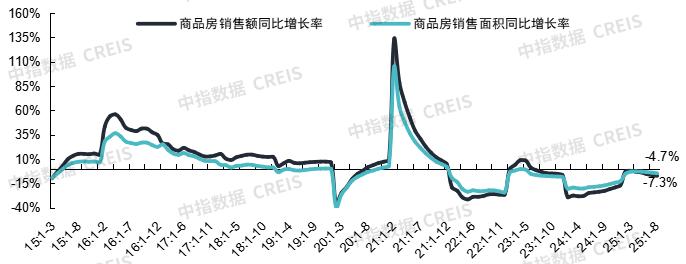
Market Overview - The Chinese real estate market has shown signs of recovery since the policy meeting on September 26, 2022, aimed at stabilizing the market, with core cities experiencing better sales performance and an increase in second-hand housing transactions [1][2][4] - However, the momentum of recovery has weakened since the second quarter, and the market remains in a phase of stabilization [1][5] - The State Council reiterated the need for strong measures to consolidate the stabilization of the real estate market in August, leading to policy optimizations in major cities like Beijing, Shanghai, and Shenzhen, which slightly improved the market in September [1][10] Sales Performance - In the first eight months of 2025, the national new housing sales area was 570 million square meters, a year-on-year decrease of 4.7%, with sales revenue at 5.5 trillion yuan, down 7.3% [4][39] - The sales of existing homes continued to outperform new homes, with existing home sales accounting for 35.4% of total sales in the first eight months, showing a year-on-year increase of 11.7% [4][7] - In key cities, the transaction volume of second-hand homes increased by approximately 9% year-on-year in the first three quarters, with notable growth in cities like Shenzhen and Shanghai [7][10] Policy Adjustments - Major cities have implemented policy adjustments to stimulate demand, including easing purchase restrictions and optimizing loan conditions [10][55] - The policies in Beijing and Shanghai have allowed for unlimited purchases outside core areas for eligible families, while Shenzhen has significantly reduced purchase restrictions in non-core areas [10][55] - The government has also focused on activating demand through various measures, including increasing housing subsidies for families with multiple children [54][57] Land Supply and Demand - In the first three quarters of 2025, the land transfer revenue in 300 cities increased by about 13% year-on-year, although the area of land sold decreased by 9% [22][36] - The average premium rate for land transactions has decreased, indicating a cautious approach from developers amid ongoing market adjustments [29][36] - The focus of land acquisition remains on core cities, with developers showing strong interest in high-quality land parcels [22][32] Investment Trends - Real estate development investment in the first eight months of 2025 was 6 trillion yuan, down 12.9% year-on-year, indicating continued pressure on short-term investments [39][43] - The funding for real estate development companies has also decreased, with total funds down 8% year-on-year, reflecting ongoing financial challenges in the sector [42][43] - Major developers are increasingly focusing on cities with higher sales certainty, leading to intensified competition for land in these areas [35][36]
中信证券:房地产市场具备止跌回稳的基础
Zheng Quan Shi Bao Wang· 2025-09-29 00:22
Core Viewpoint - The real estate market is still in a downward phase, but the oversupply of new homes has been reversed, and the situation of excessively high housing prices has significantly eased, providing a foundation for stabilization [1] Group 1: Real Estate Market - The new home supply situation has improved, indicating a potential for market stabilization [1] - The high housing price issue has been alleviated, suggesting a more favorable environment for buyers [1] Group 2: Development Business - Companies with strong capabilities in constructing quality homes and sufficient new inventory are favored, particularly those focused on regions like Hangzhou, Shanghai, and Chengdu [1] Group 3: Operational Real Estate - Companies with outstanding operational capabilities and superior asset portfolios are viewed positively in the operational real estate sector [1]

开源证券-房地产行业周报:新房成交面积环比增长,上海“好房子”新规落地-250928
Xin Lang Cai Jing· 2025-09-28 14:52
Core Viewpoint - The new housing transaction area has increased month-on-month, and Shanghai's "Good Housing" regulations have been implemented [1] Group 1: Market Performance - The transaction area of new houses in 68 cities increased by 27% month-on-month, but decreased by 22% year-on-year, totaling 2.45 million square meters in week 39 of 2025 [3] - The cumulative transaction area for new houses in 68 cities from the beginning of the year reached 88.46 million square meters, a year-on-year decrease of 10% [3] - The transaction area of second-hand houses in 20 cities was 1.88 million square meters, with a year-on-year growth rate of 9% [3] Group 2: Land Transactions - The total planned construction area of land launched in 100 major cities was 22.71 million square meters, with a transaction area of 24.31 million square meters, a year-on-year increase of 32% [3] - First-tier cities saw a 53% year-on-year increase in land transaction area, totaling 1.19 million square meters [3] - Second-tier cities had a transaction area of 7.78 million square meters, a year-on-year increase of 36% [3] Group 3: Financing Trends - The issuance scale of domestic credit bonds increased by 140% month-on-month, reaching 14.48 billion yuan, with a year-on-year increase of 203% [4] - The average weighted interest rate for credit bonds was 2.35%, a decrease of 16 basis points [4] - The cumulative issuance scale of credit bonds was 311.55 billion yuan, remaining stable year-on-year [4] Group 4: Policy Initiatives - Shanghai's planning and natural resources bureau introduced 17 specific measures to enhance residential quality, focusing on urban design optimization, community environment improvement, and old community renovations [2] - The central government reported that 21,700 old urban communities were newly started in the first eight months of 2025, achieving 86.8% of the annual target [1][2]
行业周报:新房成交面积环比增长,上海“好房子”新规落地-20250928
KAIYUAN SECURITIES· 2025-09-28 13:57
Investment Rating - The industry investment rating is "Positive" (maintained) [1] Core Viewpoints - The new housing transaction area has increased month-on-month, and the "Good Housing" regulations in Shanghai have been implemented. The tracked 68 cities show a month-on-month increase in new housing transactions, with 20 cities also experiencing a month-on-month increase in second-hand housing transactions. The land transaction area has increased year-on-year, and the premium rate has decreased month-on-month. The issuance of domestic credit bonds has increased month-on-month. The report suggests that with various policies promoting the stabilization of the real estate market, the overall market is moving towards stabilization, although slight fluctuations in housing prices may still occur [5][63]. Summary by Sections 1. Urban Old Community Renovation Progress - The Ministry of Housing and Urban-Rural Development reported that from January to August 2025, 21,700 urban old communities were newly started, achieving 86.8% of the annual target of 25,000 [6][14]. 2. Sales Side: New Housing Transaction Area Month-on-Month Growth - In the 39th week of 2025, the transaction area of commercial residential properties in 68 cities was 2.45 million square meters, a year-on-year decrease of 22% but a month-on-month increase of 27%. The cumulative transaction area from the beginning of the year to date is 88.46 million square meters, with a year-on-year decrease of 10% [19][32]. 3. Investment Side: Land Transaction Area Year-on-Year Growth - In the 39th week of 2025, 100 major cities launched land planning with a total area of 22.71 million square meters, and the transaction area was 24.31 million square meters, a year-on-year increase of 32%. The premium rate for land transactions was 1% [41][44]. 4. Financing Side: Domestic Credit Bond Issuance Scale Month-on-Month Growth - In the 39th week of 2025, the issuance of credit bonds was 14.48 billion yuan, a year-on-year increase of 203% and a month-on-month increase of 140%. The cumulative issuance scale of credit bonds is 311.55 billion yuan, which is basically flat year-on-year [52][56]. 5. Weekly Market Review - The real estate index fell by 0.16%, underperforming the Shanghai and Shenzhen 300 index, which rose by 1.07%. The report highlights the performance of individual stocks within the real estate sector [58][61].