
期限利差

Search documents
信用债性价比提升,公司债ETF(511030)投资机会凸显
Sou Hu Cai Jing· 2025-08-05 01:46
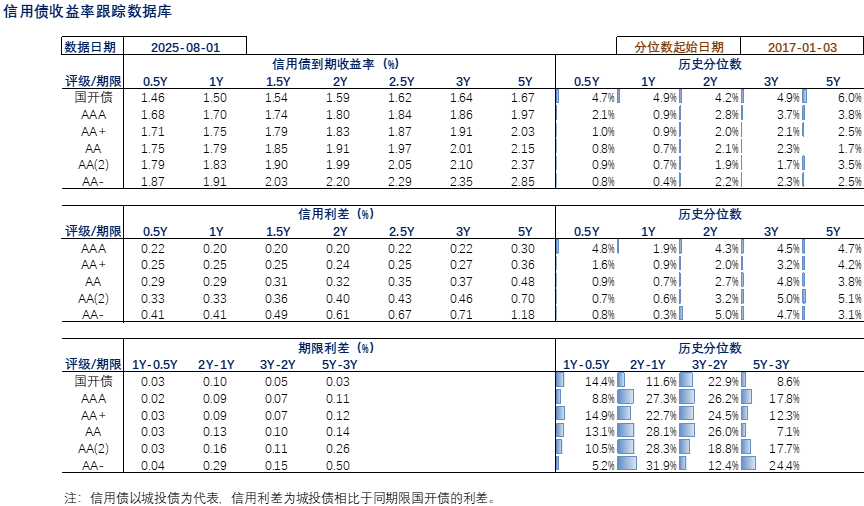
Group 1 - The overall credit bond market experienced a downward trend last week, with spreads mostly remaining stable or slightly widening, influenced by tax policy changes that had a limited positive effect on credit bonds due to low overall spreads (<5%) [1] - The yield on commercial paper bonds decreased overall last week, leading to a further compression of spreads, indicating limited value for commercial paper bonds at their current spread levels [1] - The yield data for various credit bonds shows that the yields for AAA-rated bonds range from 1.68% for 1-year to 1.97% for 5-year, while AA-rated bonds range from 1.75% for 1-year to 2.15% for 5-year [2] Group 2 - The recent interest tax policy has objectively improved the cost-effectiveness of credit bonds, suggesting that there may still be opportunities in the credit market, although credit spreads remain low [3] - There is a recommendation to pay attention to the performance of the Sci-Tech Innovation Board bond ETF and the investment opportunities in corporate bond ETF (511030) [3]

8月信用策略:缓慢的修复
GOLDEN SUN SECURITIES· 2025-08-01 02:50
Group 1 - The report indicates a significant adjustment in the bond market, with credit bonds experiencing a larger decline compared to interest rate bonds, particularly in the period from July 18 to July 25, where 3Y and above interest rate bonds rose by 7-9 basis points, while credit bonds fell by 8-12 basis points [1][8][11] - The primary reasons for the market decline include a rebound in equity and commodity prices, a tightening of the funding environment, and increased redemption pressure [1][11][21] - Following the market adjustment, the report suggests that the credit market may enter a slow recovery phase, with the "stock-bond seesaw" effect being a short-term disturbance rather than a long-term trend [2][21][25] Group 2 - The report highlights a seasonal characteristic in credit bond net financing, with supply expected to rise from June to August, followed by a decline in September as corporate financing needs weaken [3][25][26] - It notes that the recent adjustments in the credit bond ETF market have led to a slowdown in growth, with some ETFs experiencing a slight contraction in scale [2][15][19] - The report emphasizes that the current credit market is relatively weak, with significant volatility and limited space for narrowing credit spreads, particularly in the short to medium term [3][27]
6月信用债利差月报 | 信用利差走势分化,长久期低评级信用利差压缩明显
Xin Lang Cai Jing· 2025-07-28 08:50
Credit Bond Yield Performance - In June, overall credit bond yields declined, with short-term credit bond spreads widening while medium to long-term spreads narrowed [1][4] - The AA- rated credit bond spreads mostly narrowed, while other ratings saw mixed results in 1-year and 3-year spreads, indicating a market trend towards longer durations and lower credit quality for yield enhancement [4][10] Industry-Specific Credit Bond Spreads Industrial Bonds - In June, the credit spreads for AAA-rated industrial bonds varied across industries, with the financial holding sector experiencing the largest narrowing of 12.31 basis points, while the textile and apparel sector saw the largest widening of 3.26 basis points [12][13] - The pharmaceutical and biological sector in private placements had the largest narrowing of spreads at 8.83 basis points, while the public utility sector experienced the largest widening of 9.65 basis points [12][13] Local Government Financing Bonds - The credit spreads for local government financing bonds showed a mixed trend, with lower-rated spreads continuing to narrow while mid to high-rated spreads fluctuated upwards [1][4] - In May, most provinces and entities saw a narrowing of credit spreads, with private placements showing a more significant reduction [1][4] Financial Bonds - In June, the credit spreads for bank perpetual bonds exhibited mixed results, with the lowest-rated spreads compressing the most, while the spreads for securities company subordinated bonds and insurance company capital replenishment bonds all declined [1][4]

债市机构行为周报(7月第3周):债市横盘三个月后的微观变化-20250720
Huaan Securities· 2025-07-20 11:51
1. Report Industry Investment Rating No relevant content provided. 2. Core Viewpoints of the Report - The bond market has been in a sideways trend for three months. After the equal - tariff disturbance in early April, the yield of the 10 - year Treasury bond dropped to 1.65% and has since fluctuated between 1.65% and 1.70% [2][10]. - There are four changes in institutional behavior during the sideways period of the bond market, including changes in the behavior of large banks, the actions of funds and other asset management products, the allocation preferences of insurance institutions, and the change in the lending volume of 10 - year Treasury bonds [2][3][10]. 3. Summary According to the Directory 3.1 This Week's Institutional Behavior Review - **Four Changes in Institutional Behavior during the Sideways Period of the Bond Market** - Large banks not only increase their purchases of short - term Treasury bonds but also their demand for certificates of deposit. Their weekly demand for certificates of deposit has rebounded to over 100 billion yuan since late May, indicating improved liability - side pressure. After the mid - month tax period disturbance, the liquidity may further loosen [2][10]. - Funds extend the duration of their bond holdings, and asset management products such as trusts increase their purchases. The median duration of interest - rate bond funds has risen to 3.92 years, about 1 year higher than at the beginning of the sideways period, suggesting that non - bank institutions are holding bonds in anticipation of price increases [3][10]. - Insurance institutions have almost stopped buying Treasury bonds in the secondary market and mainly allocate local government bonds, especially 30 - year and 20 - year ones [3][11]. - The lending volume of 10 - year Treasury bonds has significantly declined, while the lending volume of 10 - year China Development Bank bonds has remained flat. The decrease in Treasury bond borrowing by securities firms may be due to limited space for reverse arbitrage strategies in the futures market [3][11]. - **Yield Curve**: The yields of Treasury bonds and China Development Bank bonds have generally declined. For Treasury bonds, the 1Y yield dropped 2bp, the 3Y about 2bp, etc. For China Development Bank bonds, the 1Y yield dropped about 1bp, the 5Y about 2bp, etc [12]. - **Term Spread**: The spread between Treasury bonds and China Development Bank bonds has increased. For Treasury bonds, the term spread has generally widened; for China Development Bank bonds, the medium - and long - term spreads have widened [15][16]. 3.2 Bond Market Leverage and Liquidity - **Leverage Ratio**: It has dropped to 107.09%. From July 14 to July 18, 2025, the leverage ratio first increased and then decreased during the week [19]. - **Pledged Repurchase**: The average daily trading volume of pledged repurchase this week was 7.2 trillion yuan, with an average daily overnight trading volume accounting for 88.54%. The average daily trading volume decreased by 0.97 trillion yuan compared with last week [25]. - **Liquidity**: Banks' net lending has fluctuated upwards. As of July 18, the net lending of large banks and policy banks was 4.18 trillion yuan; the average daily net lending of joint - stock banks and city and rural commercial banks was 0.77 trillion yuan, and they had a net borrowing of 0.75 trillion yuan on July 18 [29]. 3.3 Duration of Medium - and Long - Term Bond Funds - **Median Duration**: The median duration of medium - and long - term bond funds remained at 2.87 years (de - leveraged) and 3.22 years (leveraged). On July 18, the de - leveraged median duration was the same as last Friday, while the leveraged median duration increased by 0.01 year [42]. - **Duration of Interest - Rate Bond Funds**: The median duration of interest - rate bond funds (leveraged) remained at 3.92 years, and the median duration of credit - bond funds (leveraged) rose to 2.99 years, an increase of 0.01 year compared with last Friday [46]. 3.4 Comparison of Category Strategies - **Sino - US Yield Spread**: It has generally narrowed. The 1Y spread narrowed by 5bp, the 2Y by 7bp, etc [52]. - **Implied Tax Rate**: The short - term implied tax rate has widened, while the medium - and long - term rates have shown differentiation [53]. 3.5 Changes in Bond Lending Balance On July 18, the lending concentration of the active bonds of 10 - year Treasury bonds, 10 - year China Development Bank bonds, and 30 - year Treasury bonds showed an upward trend, while that of the second - active bonds of 10 - year Treasury bonds and 10 - year China Development Bank bonds showed a downward trend. Except for securities firms, the lending concentration of all other institutions increased [54].
债市调整中信用相对强势1Y期收益率逆势下行
Xinda Securities· 2025-07-12 13:22
Report Industry Investment Rating No relevant content provided. Core View of the Report In the bond market adjustment, credit bonds were relatively strong, with the yields of 1Y - term varieties declining against the trend. The yields of interest - rate bonds rose across the board this week due to the increased risk appetite brought by the rise in the equity market. Credit bond yields generally followed the interest - rate increase but showed relative strength. Credit spreads mostly declined, and the spreads of urban investment bonds and industrial bonds also showed various downward trends, while the performance of secondary perpetual bonds was weaker than that of ordinary credit bonds, and the excess spreads of industrial perpetual bonds remained flat while those of urban investment bonds increased slightly [2]. Summary According to the Directory 1. Credit bonds were relatively strong in the bond market adjustment, and the yields of 1Y - term varieties declined against the trend - Affected by the increased risk appetite from the equity market, the yields of interest - rate bonds rose across the board this week. The yields of 1Y, 3Y, 5Y, 7Y, and 10Y term China Development Bank bonds rose by 5BP, 4BP, 5BP, 3BP, and 3BP respectively. Credit bond yields generally followed the interest - rate increase, but 1Y - term and some 10Y - term varieties had declining yields. The yields of 1Y - term credit bonds of all ratings declined by 1 - 2BP [2][5]. - Credit spreads mostly declined, with high - grade 7Y - term varieties rising slightly. Rating spreads and term spreads mostly remained flat or declined [2][5]. 2. The spreads of urban investment bonds declined across the board, and medium - and low - grade varieties performed better - The credit spreads of external - rated AAA, AA +, and AA - grade urban investment platforms declined by 3BP, 4BP, and 5BP respectively. The spreads of most AAA - grade platforms declined by 2 - 4BP, with Inner Mongolia down 8BP; the spreads of most AA + - grade platforms declined by 3 - 5BP, with Heilongjiang, Inner Mongolia, Liaoning, and Tibet having relatively large declines; the spreads of most AA - grade platforms declined by 4 - 6BP, with Yunnan down 9BP and Guizhou down 12BP [2][9]. - By administrative level, the credit spreads of provincial, prefecture - level, and district - county - level platforms declined by 3BP, 4BP, and 4BP respectively [2][15]. 3. Most spreads of industrial bonds declined, and the spreads of AAA - grade coal bonds declined significantly - This week, the spreads of central and local state - owned enterprise real - estate bonds declined by 5 - 6BP, the spreads of mixed - ownership real - estate bonds declined by 1BP, and the spreads of private - enterprise real - estate bonds rose by 2BP. Longfor's spreads declined by 20BP, Midea Real Estate's by 5BP, Vanke's by 5BP, and Gemdale's by 4BP, while CIFI's rose by 151BP [2][13]. - The spreads of AAA, AA +, and AA - grade coal bonds declined by 13BP, 5BP, and 3BP respectively; the spreads of AAA and AA + - grade steel bonds declined by 5BP and 2BP respectively; the spreads of all - grade chemical bonds declined by 4 - 6BP [2][13]. 4. The performance of secondary perpetual bonds was weaker than that of ordinary credit bonds, and the spreads of 3Y - term varieties rose - Affected by the increase in certificate of deposit prices, the performance of secondary perpetual bonds was weaker than that of ordinary credit bonds this week, and the spreads of 3Y - term varieties rose. The yields of 1Y - term secondary perpetual bonds of all ratings rose by 3 - 4BP, and the spreads compressed by 1 - 2BP. The yields of 3Y - term AAA - grade secondary capital bonds rose by 6BP, and those of other ratings rose by 4BP, with spreads rising by 0 - 2BP; the yields of all - grade perpetual bonds rose by 5BP, and the spreads rose by 1BP [2][25][27]. 5. The excess spreads of industrial perpetual bonds remained flat, and the excess spreads of urban investment bonds increased slightly - This week, the excess spreads of 3Y - term AAA industrial perpetual bonds remained flat at 3.82BP, at the 0.95% quantile since 2015; the 5Y - term excess spreads remained flat at 8.51BP, at the 6.38% quantile. The excess spreads of 3Y - term AAA urban investment perpetual bonds rose by 0.64BP to 4.40BP, at the 0.59% quantile; the 5Y - term excess spreads rose by 0.21BP to 10.12BP, at the 10.27% quantile [2][29]. 6. Credit spread database compilation instructions - Market - wide credit spreads, commercial bank secondary perpetual spreads, and urban investment/industrial perpetual bond credit spreads are calculated based on ChinaBond Medium - and Short - Term Notes and ChinaBond Perpetual Bonds data, with historical quantiles since the beginning of 2015. Urban investment and industrial bond - related credit spreads are compiled and statistically analyzed by Cinda Securities R & D Center, with historical quantiles since the beginning of 2015 [35]. - Industrial and urban investment individual - bond credit spreads = individual - bond ChinaBond valuation (exercise) - same - term China Development Bank bond yield to maturity (calculated by linear interpolation method), and then the credit spreads of industries or regional urban investments are obtained by the arithmetic mean method [35]. - Excess spreads of bank secondary capital bonds/perpetual bonds = credit spreads of bank secondary capital bonds/perpetual bonds - credit spreads of bank ordinary bonds of the same rating and term; excess spreads of industrial/urban investment perpetual bonds = credit spreads of industrial/urban investment perpetual bonds - credit spreads of medium - term notes of the same rating and term [35].
超长债周报:资金利率进一步走低,50年国债快速上涨-20250706
Guoxin Securities· 2025-07-06 13:39
Group 1: Report's Industry Investment Rating - No information provided in the content Group 2: Core Viewpoints - After crossing the quarter - end, the funding situation returned to ease, overnight interest rates continued to decline to 1.3%, the central bank did not initiate treasury bond transactions in June, and the PMI continued to rise slightly. The bond market resumed its upward trend, with ultra - long bonds rising slightly. The trading activity of ultra - long bonds decreased slightly last week but remained quite active. The term spread of ultra - long bonds widened, and the variety spread narrowed. Considering the economic data, although the economy showed resilience in May, there are still downward pressures. After the half - year mark, the funding rate declined again, and the probability of the bond market rising is greater. However, the term spread of 30 - year treasury bonds and the variety spread of 20 - year CDB bonds are still low, with limited spread protection [1][2][3] Group 3: Summary by Relevant Catalogs Weekly Review Ultra - long Bond Review - After the quarter - end, the funding became looser, overnight rates dropped to 1.3%, the central bank did not trade treasury bonds in June, PMI rose slightly, the bond market went up, and ultra - long bonds had a small increase. Trading activity of ultra - long bonds decreased slightly but was still active. The term spread widened, and the variety spread narrowed [1][9] Ultra - long Bond Investment Outlook - **30 - year Treasury Bonds**: As of July 4, the spread between 30 - year and 10 - year treasury bonds was 21BP, at a historically low level. In May, the estimated GDP growth was about 5.0% year - on - year, down 0.1% from April but still above the annual target. With CPI at - 0.1% and PPI at - 3.1% in May, deflation risks remain. Exports declined rapidly in May, and domestic housing prices turned negative month - on - month. After the half - year mark, the funding rate fell again, and the bond market is more likely to rise. However, the term spread of 30 - year treasury bonds is low, with limited protection [2][10] - **20 - year CDB Bonds**: As of July 4, the spread between 20 - year CDB bonds and 20 - year treasury bonds was 3BP, at a historically extremely low level. Similar to the 30 - year treasury bonds, considering the economic situation in May and the decline in the funding rate after the half - year mark, the bond market is likely to rise. But the variety spread of 20 - year CDB bonds is low, with limited protection [3][11] Ultra - long Bond Basic Overview - The balance of outstanding ultra - long bonds exceeded 22.2 trillion. As of June 30, the total amount of ultra - long bonds with a remaining maturity of over 14 years was 222,528 billion, accounting for 14.5% of all bonds. Local government bonds and treasury bonds are the main varieties. By variety, treasury bonds accounted for 26.3%, local government bonds 67.5%, etc. By remaining maturity, the 25 - 35 - year variety accounted for the highest proportion at 40.4% [12] Primary Market Weekly Issuance - Last week (June 30 - July 4, 2025), ultra - long bond issuance decreased significantly, with a total of 359 billion yuan issued. By variety, local government bonds accounted for 344 billion, and mid - term notes 15 billion. By term, 15 - year bonds accounted for 139 billion, 20 - year for 70 billion, and 30 - year for 151 billion [17] This Week's Scheduled Issuance - This week's announced ultra - long bond issuance plan totals 768 billion. By variety, ultra - long local government bonds account for 748 billion, and mid - term notes 20 billion [22] Secondary Market Trading Volume - Last week, ultra - long bond trading was quite active, with a turnover of 11,010 billion, accounting for 13.1% of all bonds. Trading activity decreased slightly compared to the previous week. Ultra - long treasury bond turnover decreased by 2,214 billion, and its proportion decreased by 1.5%; ultra - long local bond turnover decreased by 688 billion, and its proportion decreased by 14.1%; ultra - long policy - bank bond turnover increased by 4 billion, and its proportion increased by 0.1%; ultra - long government - agency bond turnover increased by 78 billion, and its proportion increased by 37.2% [24] Yield - After the quarter - end, the funding situation eased, overnight rates dropped to 1.3%, the central bank did not trade treasury bonds in June, PMI rose slightly, the bond market went up, and ultra - long bonds had a small increase. Yields of 15 - year, 20 - year, 30 - year, and 50 - year treasury bonds changed by 0BP, 0BP, 0BP, and - 3BP respectively to 1.79%, 1.89%, 1.85%, and 1.94%. Yields of representative individual bonds also changed, such as the 30 - year treasury bond active bond 24 special treasury bond 06 yield changing by - 2BP to 1.89% [38][39] Spread Analysis - **Term Spread**: Last week, the term spread of ultra - long bonds widened but remained at a low absolute level. The spread between 30 - year and 10 - year treasury bonds was 21BP, up 1BP from the previous week, at the 5% percentile since 2010 [45] - **Variety Spread**: Last week, the variety spread of ultra - long bonds narrowed and was at a low absolute level. The spread between 20 - year CDB bonds and treasury bonds was 3BP, and between 20 - year railway bonds and treasury bonds was 7BP, down 1BP and 2BP respectively from the previous week, at the 6% percentile since 2010 [46] 30 - year Treasury Bond Futures - Last week, the 30 - year treasury bond futures main contract TL2509 closed at 121.20 yuan, an increase of 0.26%. The total trading volume was 408,900 lots (- 8,046 lots), and the open interest was 151,000 lots (10,690 lots). The trading volume decreased slightly, and the open interest increased slightly compared to the previous week [51]
债市机构行为周报(7月第1周):大行资金融出为何高达5.3万亿?-20250706
Huaan Securities· 2025-07-06 12:09
Group 1 - The report highlights that the current net financing by major banks has reached an unprecedented level of 5.3 trillion yuan, which is historically high and linked to the central bank's liquidity support [2][12][16] - It notes that the trend of easing liquidity can be linearly extrapolated, and any disruption to this trend would require additional variables [3][13] - The report suggests that if the liquidity remains loose in July, the long-term interest rates may decline further, with the current 10Y-1Y yield spread at 30 basis points, the highest since mid-February [3][12][13] Group 2 - The report indicates that the leverage ratio in the bond market has risen to 107.85%, reflecting an increase in borrowing activity [23] - It mentions that the average daily transaction volume of pledged repos was approximately 7.6 trillion yuan, with overnight repos accounting for 89.71% of the total [27][31] - The report states that the median duration of medium- to long-term bond funds remains at 2.87 years, indicating stability in fund management strategies [49]
中国30年期AAA级企业债收益率估值创2006年以来纪录新低
news flash· 2025-06-25 23:58
Core Viewpoint - Since June, the performance of China's bond yield curve, particularly the ultra-long end, has been impressive, with significant interest from institutions in 20-year and 50-year government bonds, as well as credit bonds with maturities over 20 years [1] Summary by Relevant Categories Bond Market Performance - The yield on 50-year government bonds has decreased by over 9 basis points this month, leading declines across all maturities [1] - The spread between 50-year and 10-year bonds has narrowed significantly, reaching the largest reduction since July 2023 [1] Credit Bonds - The 30-year AAA-rated corporate bond yield fell below 2.2% last week, marking a new record low since 2006 [1] - The performance of ultra-long credit bonds has also been strong, reflecting a favorable market environment [1]
5月信用债利差月报 | 5月信用利差全线收窄
Xin Lang Cai Jing· 2025-06-23 08:41
Credit Spread Performance - In May, the supply of credit bonds decreased, leading to a general decline in credit spreads, with lower-rated credit bonds experiencing a more significant narrowing [1] - The AAA-rated industrial bonds saw a uniform narrowing of credit spreads across all sectors, with the real estate sector showing the largest reduction of 18.98 basis points, while the financial holding sector had the smallest reduction of 2.36 basis points [8][9] - For private placement bonds, the pharmaceutical and biological sector had the largest narrowing of 17.18 basis points, while the environmental protection sector had the smallest at 0.99 basis points [8][9] City Investment Bonds - In May, credit spreads for city investment bonds across major ratings and maturities all declined, with the largest narrowing observed in Qinghai province for both public and private bonds [1] - The overall trend indicates that credit spreads for city investment bonds are moving downward across various regions and issuer levels [1] Financial Bonds - The credit spreads for bank perpetual bonds and other financial instruments generally narrowed, with most varieties experiencing a decrease, although some maturity spreads widened [1] - Securities companies' subordinated bonds and insurance companies' capital replenishment bonds saw a complete decline in credit spreads during the month [1] Historical Context - By the end of May, various types of credit bonds maintained historically low credit spreads, particularly for short-duration non-financial credit bonds and short-duration financial bonds, while medium to long-term financial bonds remained at relatively high historical percentiles [1][6]
超长债周报:非活跃券大涨-20250622
Guoxin Securities· 2025-06-22 05:05
Report Industry Investment Rating No relevant content provided. Core Views - Last week, after the release of May economic data, with the year-on-year growth rate of social consumption reaching 6.4% and the estimated monthly GDP at 5.0%, and the tightening of the capital market, bond yields continued to decline, and non-active ultra-long bonds rose significantly. The trading activity of ultra-long bonds increased slightly, and the term spread remained flat while the variety spread widened [1][3][11]. - As of June 20, the spread between 30-year treasury bonds and 10-year treasury bonds was 20BP, at a historically low level. The May economic data showed resilience, with an estimated GDP growth rate of about 5.0%, a 0.1% decline from April but still higher than the annual target. With deflation risks, a decline in exports, a negative month-on-month change in housing prices, and a decrease in capital interest rates, the bond market sentiment improved. It is expected that the bond market is more likely to continue rising in the short term, but the term spread protection is limited [2]. - As of June 20, the spread between 20-year CDB bonds and 20-year treasury bonds was 4BP, at a historically extremely low level. Similar to the 30-year treasury bonds, considering the economic situation and market conditions, the bond market is expected to rise in the short term, but the variety spread protection is limited [3]. Summary by Directory Weekly Review Ultra-long Bond Review - After the release of May economic data, with the year-on-year growth rate of social consumption reaching 6.4% and the estimated monthly GDP at 5.0%, and the tightening of the capital market, bond yields continued to decline, and non-active ultra-long bonds rose significantly. The trading activity of ultra-long bonds increased slightly and was quite active. The term spread remained flat, and the variety spread widened [1][11]. Ultra-long Bond Investment Outlook - **30-year Treasury Bonds**: As of June 20, the spread between 30-year and 10-year treasury bonds was 20BP, at a historically low level. The May economic data showed resilience, with an estimated GDP growth rate of about 5.0%, a 0.1% decline from April but still higher than the annual target. With deflation risks, a decline in exports, a negative month-on-month change in housing prices, and a decrease in capital interest rates, the bond market sentiment improved. It is expected that the bond market is more likely to continue rising in the short term, but the term spread protection is limited [2][12]. - **20-year CDB Bonds**: As of June 20, the spread between 20-year CDB bonds and 20-year treasury bonds was 4BP, at a historically extremely low level. Similar to the 30-year treasury bonds, considering the economic situation and market conditions, the bond market is expected to rise in the short term, but the variety spread protection is limited [3][13]. Ultra-long Bond Basic Overview - The balance of outstanding ultra-long bonds exceeded 21.6 trillion. As of May 31, the total amount of ultra-long bonds with a remaining term of over 14 years was 216,823 billion (excluding asset-backed securities and project revenue notes), accounting for 14.4% of the total bond balance. Local government bonds and treasury bonds were the main varieties. By variety, treasury bonds accounted for 26.1%, local government bonds 67.8%, policy financial bonds 2.1%, government agency bonds 2.0%, commercial bank subordinated bonds 0.2%, corporate bonds 0.5%, enterprise bonds 0.1%, medium-term notes 1.2%, private bonds 0.0%, and directional instruments 0.0%. By remaining term, the 14 - 18-year (inclusive) category accounted for 26.7%, the 18 - 25-year (inclusive) 26.9%, the 25 - 35-year (inclusive) 40.3%, and over 35 years 6.2% [14]. Primary Market Weekly Issuance - Last week (June 16 - 20, 2025), the issuance of ultra-long bonds was relatively small, with a total issuance of 1,147 billion yuan. Compared with the week before last, the total issuance of ultra-long bonds increased significantly. By variety, treasury bonds accounted for 500 billion, local government bonds 505 billion, policy bank bonds 0 billion, government-supported agency bonds 0 billion, medium-term notes 30 billion, corporate bonds 113 billion, directional instruments 0 billion, enterprise bonds 0 billion, and bank subordinated bonds 0 billion. By term, 149 billion were issued with a term of 15 years, 684 billion with 20 years, 315 billion with 30 years, and 0 billion with 50 years [19]. This Week's Pending Issuance - The announced issuance plan for ultra-long bonds this week totals 3,663 billion. By variety, ultra-long treasury bonds account for 710 billion, ultra-long local government bonds 2,788 billion, ultra-long corporate bonds 0 billion, and ultra-long medium-term notes 165 billion [25]. Secondary Market Trading Volume - Last week, the trading of ultra-long bonds was quite active, with a trading volume of 11,298 billion, accounting for 11.0% of the total bond trading volume. By variety, the trading volume of ultra-long treasury bonds was 7,764 billion, accounting for 29.8% of the total treasury bond trading volume; ultra-long local bonds 2,799 billion, accounting for 51.4% of the total local bond trading volume; ultra-long policy financial bonds 103 billion, accounting for 0.3% of the total policy financial bond trading volume; and ultra-long government agency bonds 89 billion, accounting for 78.8% of the total government agency bond trading volume. The trading activity of ultra-long bonds increased slightly compared with the week before last, with an increase of 2,330 billion in trading volume and a 0.1% increase in the proportion. Among them, the trading volume of ultra-long treasury bonds increased by 1,474 billion, but the proportion decreased by 6.3%; the trading volume of ultra-long local bonds increased by 388 billion, and the proportion increased by 3.5%; the trading volume of ultra-long policy financial bonds decreased by 5 billion, and the proportion decreased by 0.1%; the trading volume of ultra-long government agency bonds increased by 66 billion, and the proportion increased by 66.2% [28]. Yield - After the release of May economic data, with the year-on-year growth rate of social consumption reaching 6.4% and the estimated monthly GDP at 5.0%, and the tightening of the capital market, bond yields continued to decline. For treasury bonds, the yields of 15-year, 20-year, 30-year, and 50-year bonds changed by -3BP, -5BP, -1BP, and -5BP to 1.78%, 1.87%, 1.84%, and 1.95% respectively. For CDB bonds, the yields of 15-year, 20-year, 30-year, and 50-year bonds changed by -5BP, -6BP, -1BP, and -5BP to 1.86%, 1.90%, 2.02%, and 2.19% respectively. For local bonds, the yields of 15-year, 20-year, and 30-year bonds changed by -5BP, -4BP, and -4BP to 1.98%, 2.03%, and 2.03% respectively. For railway bonds, the yields of 15-year, 20-year, and 30-year bonds changed by -5BP, -4BP, and -4BP to 1.92%, 1.95%, and 2.05% respectively. For representative individual bonds, the yield of the 30-year treasury bond active bond 24 Special Treasury Bond 06 changed by -2BP to 1.88%, and the yield of the 20-year CDB bond active bond 21 CDB 20 changed by -5BP to 1.89% [44][45]. Spread Analysis - **Term Spread**: Last week, the term spread of ultra-long bonds remained flat, and the absolute level was low. The spread between the benchmark 30-year and 10-year treasury bonds was 20BP, unchanged from the week before last, at the 4% percentile since 2010 [53]. - **Variety Spread**: Last week, the variety spread of ultra-long bonds widened, and the absolute level was low. The spread between the benchmark 20-year CDB bonds and treasury bonds was 4BP, and the spread between 20-year railway bonds and treasury bonds was 9BP, with a 0BP and 1BP change from the week before last respectively, at the 6% and 5% percentiles since 2010 [54]. 30-year Treasury Bond Futures - Last week, the main 30-year treasury bond futures contract TL2509 closed at 121.32 yuan, an increase of 0.68%. The total trading volume was 327,300 lots (5,583 lots), and the open interest was 137,700 lots (13,009 lots). The trading volume and open interest increased slightly compared with the week before last [60].