
美元走强

Search documents
策略日报:高筑墙-20251105
Tai Ping Yang Zheng Quan· 2025-11-05 13:45
Group 1: Investment Strategy Overview - The report emphasizes a cautious investment approach, suggesting to "build high walls" (focus on dividends), "store grain" (control positions), and "wait for the king" (exercise caution while waiting for external risks to be fully released) [4][6][9] - The A-share market showed resilience despite initial declines, with the Shanghai Composite Index needing to maintain a low point of 3922 to avoid further downturns [4][18] - The technology sector has seen significant gains, with many leading tech stocks reaching new highs, but investors without positions are advised against chasing high volatility at elevated levels [4][18] Group 2: Market Analysis - The U.S. stock market experienced declines due to the Federal Reserve's officials striking down December rate cut expectations and profit-taking in tech stocks, indicating a high-risk environment for investors [5][25] - The report notes that the dollar index has broken through the previously indicated strong point of 99, with expectations for continued strength in the dollar against other currencies, particularly the RMB [30][31] - Commodity markets are advised to adopt a wait-and-see approach, with a noted decline in the Wenhua Commodity Index by 0.2% due to the strong dollar and ongoing market conditions [33][34] Group 3: Sector Performance - The report highlights that sectors such as coal, banking, and photovoltaic are still at low levels, suggesting that buying in less popular areas can yield excess returns [4][18] - The technology sector's absorption rate remains high, indicating limited room for further declines, while "old" sectors with lower volatility are expected to provide better returns in the fourth quarter [4][18] - The report identifies the Hainan Free Trade Zone as a strong performer, continuing to show resilience in the market [19][22]
QCP:BTC 跌至 10 万美元关键支撑,ETF 连续净流出令短线承压
Sou Hu Cai Jing· 2025-11-05 11:27
Core Insights - Bitcoin has dropped to a critical support level of $100,000, influenced by a stronger dollar and uncertainty surrounding Federal Reserve policies [1] - The U.S. spot Bitcoin ETF has seen a net outflow of approximately $1.3 billion over the past four days, compounded by over $1 billion in long liquidations and increased volatility due to options hedging [1] - Analysts suggest that if ETF fund flows stabilize and no new macroeconomic negatives emerge, market sentiment may improve [1]
KCM Trade分析师Tim汇评 | 科技股估值过高是否合理?
Sou Hu Cai Jing· 2025-11-05 10:24
Group 1 - The core viewpoint of the article highlights the volatility in the U.S. tech stocks, with the Nasdaq index dropping by 2%, despite large tech companies exceeding earnings expectations during the earnings season [1] - Palantir reported earnings per share (EPS) and revenue that surpassed expectations, along with an optimistic performance outlook, yet its stock price declined due to concerns over inflated valuations in AI-related technologies [1][3] - The current valuation of the S&P 500 index is around 23 times expected earnings, significantly higher than the historical average of approximately 17 times, raising concerns about potential overvaluation [1] Group 2 - The article draws parallels between the current AI-driven market surge and the internet bubble of the early 2000s, noting similarities in high valuations but differences in actual profit generation and interest rate trends [3] - The strong U.S. dollar has impacted various markets, including gold and oil, with gold prices retreating from the $4000 mark and U.S. crude oil prices falling to $60.20 per barrel [3][4] - The upcoming U.S. non-farm payroll (NFP) data is anticipated to be delayed due to government shutdown, increasing the significance of the ADP employment data, which is expected to show an addition of approximately 30,000 jobs [6]


刚刚,全线暴跌!日韩股市,大跳水!
券商中国· 2025-11-05 01:10
Core Viewpoint - The ongoing sell-off in technology stocks has led to significant declines in the Japanese and South Korean stock markets, with major indices experiencing sharp drops due to concerns over high valuations and a strengthening dollar [1][2][4]. Group 1: Market Performance - The Nikkei 225 index in Japan fell over 1300 points, a decline exceeding 2%, while the KOSPI index in South Korea dropped over 4% [1][2]. - Major technology stocks such as SoftBank Group, Samsung Electronics, and SK Hynix saw significant declines, with SoftBank's stock plummeting over 10% [1][4]. - The KOSPI 200 index futures experienced a drop of more than 5%, triggering a trading halt mechanism in South Korea [1]. Group 2: Investor Sentiment - Analysts suggest that after a period of rapid gains, investors are increasingly concerned about the overvaluation of AI and semiconductor stocks, leading to profit-taking [1][4]. - The Nasdaq Composite in the U.S. also saw a significant drop of over 2%, reflecting a broader trend in technology stocks [4]. - High-profile investors, including Michael Burry, have expressed bearish sentiments, further heightening market anxiety [4]. Group 3: Currency Impact - The strengthening U.S. dollar has added pressure on high-valuation technology stocks, with the dollar index surpassing the 100 mark for the first time since August [1][5]. - The rise in the dollar is attributed to internal divisions within the Federal Reserve regarding interest rate cuts, which has led traders to adjust their expectations [7][8]. - The British pound has weakened significantly, contributing to the dollar's strength, as the UK faces economic challenges [7][10].


深夜暴击!全球市场 “血流成河”,超40万人爆仓
Feng Huang Wang Cai Jing· 2025-11-05 00:09
Group 1: Market Overview - Global markets are under multiple pressures, with U.S. stock indices collectively declining. The Dow Jones fell by 0.53%, the Nasdaq dropped by 2.04%, and the S&P 500 decreased by 1.17% [2] - Major technology stocks were significant contributors to the decline, with Intel down approximately 6%, Tesla down about 5%, and Qualcomm falling over 4%. Other notable declines included Oracle, AMD, Broadcom, and Google, all down over 2%, while Meta and Amazon fell over 1% [2] Group 2: Hedge Fund Activity - Nvidia, the second most traded stock, closed down 3.96% with a trading volume of $37.031 billion. Michael Burry's hedge fund, Scion Asset Management, disclosed a rare short position, with approximately 80% of its portfolio focused on shorting Nvidia and Palantir, amounting to a nominal value exceeding $1 billion [3] - The put options for Palantir had a nominal value of $912 million (equivalent to 5 million shares), while those for Nvidia were valued at $186 million [3] Group 3: Currency and Economic Factors - The U.S. dollar index rose above the 100 mark, reaching a three-month high, driven by increased internal policy divergence within the Federal Reserve and a significant reduction in interest rate cut expectations [4][5] - The market's expectation for a 25 basis point rate cut in December dropped from 94% to 69.1%, which directly supported the dollar's strength [6] Group 4: Cryptocurrency Market - The cryptocurrency market faced significant declines, with Bitcoin dropping below $100,000 for the first time since June, hitting a low of $99,000, with a maximum intraday drop of 7.11% [7] - Ethereum also experienced a sharp decline, falling below $3,100 with a maximum drop of 14.08% [8] - Over 400,000 traders faced liquidation, resulting in $1.799 billion (approximately 12.8 billion yuan) evaporating from the market. The breach of the $100,000 level for Bitcoin is seen as a critical psychological and technical support point [9] - Analysts suggest that if Bitcoin remains below $100,000, it could trigger further sell-offs, with a potential target near the April low of approximately $74,000, indicating a potential downside of about 30% from current levels [10]

美元强势席卷亚洲汇市 新加坡元和印尼卢比跌至数月低位
Xin Hua Cai Jing· 2025-11-04 07:30
Group 1 - The U.S. federal government shutdown has reached its 35th day, tying the record for the longest government shutdown in U.S. history [1] - The Congressional Budget Office (CBO) estimates that if the shutdown lasts for 4 weeks, the annual GDP growth rate could decline by approximately 1 to 2 percentage points, resulting in an economic loss of about $7 billion [1] - If the shutdown extends to 6 weeks, the economic loss is projected to increase to $11 billion, and if it reaches 8 weeks, the loss could be as high as $14 billion [1] Group 2 - Despite the economic pressures from the government shutdown, the U.S. dollar index surpassed the 100 mark during Asian trading hours, marking the first time since August 1 [1] - The dollar strengthened against the Japanese yen, reaching a high of 154.48, the highest level since mid-February [1] - Following comments from Japan's Finance Minister regarding market volatility, the yen temporarily rebounded to 153.49 [1] Group 3 - The euro fell by 0.15% against the dollar, touching the 1.15 level, while the Singapore dollar dropped to 1.3070, the lowest since May 12 [2] - The Indonesian rupiah also declined by 0.5% to 16,733, marking a new low since September 26 [2] - The Indian rupee experienced a rebound after suspected intervention by the Reserve Bank of India, rising by 0.4% to 88.3925, the largest single-day gain since October 15 [2]
美联储官员鹰派表态推升美元 铜价延续跌势
智通财经网· 2025-11-04 07:24
Group 1 - The price of copper has declined from its record high due to uncertainties surrounding the Federal Reserve's interest rate cuts in December, with LME three-month copper contracts falling by 1.62% to $10,669.00 per ton [1] - Copper is considered a "barometer" of the global economy, widely used in construction, electricity, and manufacturing. It reached a record high of $11,200 per ton last week, driven by optimistic expectations from US-China trade talks [3] - Supply uncertainties have been a significant driver for recent copper price increases, with major mining companies like Glencore and Anglo American warning of production shortfalls, and Freeport-McMoRan reducing its 2026 production guidance by 35%, equating to a loss of approximately 270,000 tons of copper [3] Group 2 - Analysts suggest that the recent rise in copper prices is largely priced in, as market sentiment shifts back to the Federal Reserve's policy outlook, with a stronger dollar making dollar-denominated commodities less attractive [4] - The Federal Reserve's recent statements indicate a cautious approach to interest rate cuts, with several officials expressing skepticism about the need for further reductions, which has contributed to the uncertainty in the market [6][7] - Current market expectations place the probability of a Federal Reserve rate cut in December at approximately 67%, but economic data gaps and inflation trends are creating a more uncertain policy outlook [8]
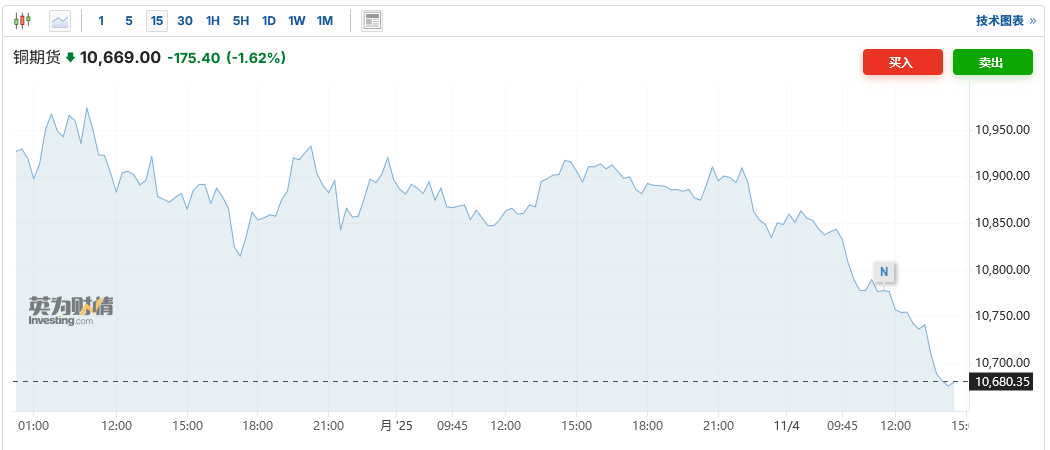
美元持续走强施压 沪铜价格高位回调
Jin Tou Wang· 2025-11-04 06:34
Core Viewpoint - The strengthening of the US dollar is pressuring copper prices, leading to a high-level correction in domestic copper futures, with the main contract reported at 85,760 yuan/ton, down 1.52% [1] Market Overview - LME copper futures have declined due to the strong US dollar, which has dampened market sentiment. However, concerns over supply shortages are helping to limit the decline in copper prices [2] - Chile's copper production in September was 456,663 tons, showing a month-on-month increase of 7.79% but a year-on-year decrease of 4.5% [2] - As of November 3, domestic electrolytic copper inventories were at 206,000 tons, an increase of 17,400 tons from October 27. Shanghai's inventory rose by 12,800 tons, Guangdong's by 200 tons, and Jiangsu's by 6,000 tons [2] - The US ISM manufacturing PMI for October fell to 48.7%, indicating continued contraction for eight months, with weak demand and employment, while inflation is cooling. The Eurozone's manufacturing PMI for October was finalized at 50, with Germany and France continuing to contract, and weak new orders hampering recovery [2] Institutional Insights - According to a report from Industrial Futures, the strong dollar is pressuring copper prices, but the trend of liquidity easing remains unchanged. The easing of US-China trade tensions is seen as a positive macro environment, and ongoing supply concerns from major mining companies reducing annual production guidance are supporting copper prices. The strategy suggests that the recent correction in copper prices is limited, and previous long positions can be maintained [3] - Everbright Futures noted that the recent high-to-low fluctuations in copper prices indicate weak short-term bullish sentiment. November marks a transition between peak and off-peak seasons, and the continuous inventory accumulation in the domestic market raises concerns about demand at high copper prices. However, there is no panic sentiment in the market, suggesting that the correction in copper prices may be limited, presenting a buying opportunity on dips, with a focus on long positions in the first half of next year [3]
澳大利亚黄金股指数大跌 北方之星等股价下挫11月3日跌1.3%,今年迄今涨87.8%
Sou Hu Cai Jing· 2025-11-03 07:33
Core Points - The Australian gold stock index (AXGD) fell by 1.3% to 15,816 points on November 3, marking the largest single-day decline since October 28 [1] - The drop in gold and silver prices is attributed to a stronger US dollar and reduced expectations for further interest rate cuts by the Federal Reserve [1] - Easing trade tensions have also put pressure on gold prices [1] - Major industry players Northern Star Resources (NST.AX) and Evolution Mining saw their stock prices decline by 1.5% and 2.3%, respectively [1] - Year-to-date, the index has increased by 87.8% [1]
澳股异动丨黄金股下跌 因金价疲软
Sou Hu Cai Jing· 2025-11-03 04:11
Group 1 - The Australian gold stock index (AXGD) fell by 1.3% to 15,816 points, marking the largest single-day decline since October 28 [1] - The decline in gold and silver prices is attributed to a stronger US dollar and reduced expectations for further interest rate cuts by the Federal Reserve [1] - Major companies in the industry, Northern Star Resources (NST.AX) and Evolution Mining, saw their stock prices drop by 1.5% and 2.3% respectively [1] Group 2 - Despite the recent decline, the AXGD index has increased by 87.8% year-to-date [1]