
美联储降息

Search documents
道指下挫近700点,芯片股普跌,英特尔跌超4%,英伟达、苹果跌2%,原油直冲100美元
2 1 Shi Ji Jing Ji Bao Dao· 2026-03-12 14:45
Market Overview - US stock market opened lower with all three major indices falling over 1%, with the Dow Jones down 1.46%, nearly 700 points, the Nasdaq down 1.57%, and the S&P 500 down 1.25% [1][2] - The total trading volume was 788.57 million, with 3,802 stocks declining and 1,366 advancing [2] Technology Sector - Major technology stocks experienced declines, with the "Tech Seven" index down 1.53%. Apple and NVIDIA both fell over 2%, while Tesla, Facebook, and Google dropped more than 1.5% [2][3] - Chip stocks collectively fell, with Teradyne and GlobalFoundries down over 5%, and companies like TSMC, Intel, and Micron Technology down over 4% [3][4] Automotive Sector - Honda Motors reported its first annual loss since its listing in 1957, with a projected total cost and loss of up to 2.5 trillion yen (approximately 108.2 billion RMB) due to a reassessment of its electrification strategy [4] Energy Sector - Oil and gas stocks performed well, with the energy sector rising by 7.6%. Notable gains included Murphy Oil up 3.8% and Occidental Petroleum up 3.3% [5] - Brent crude oil futures surged by 9% to reach $100 per barrel, while WTI crude also rose over 8% to $94.83 per barrel [6][7] Precious Metals - Gold and silver prices showed mixed results, with spot gold experiencing a short-term drop of $25, currently at $5,157.4 per ounce, while silver rose by 0.59% to $86.23 per ounce [6][7] Economic Indicators - Initial jobless claims in the US for the week ending March 7 were reported at 213,000, slightly below expectations [8]

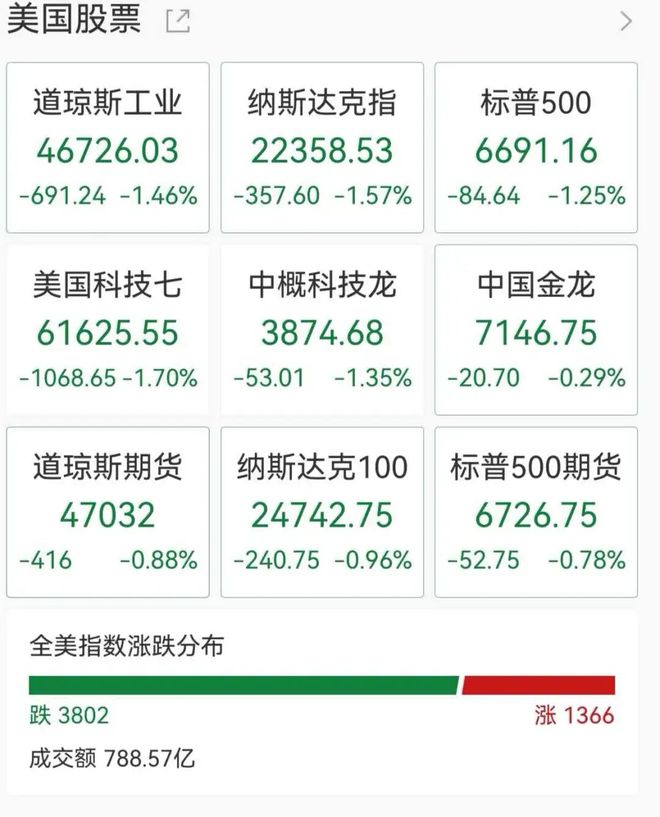
道指下挫近700点,芯片股普跌,英特尔跌超4%,英伟达、苹果跌2%,原油直冲100美元
21世纪经济报道· 2026-03-12 14:42
Market Overview - US stock market opened lower with all three major indices falling over 1%, with the Dow Jones down 1.46%, Nasdaq down 1.57%, and S&P 500 down 1.25% [1][2] Technology Sector - Major technology stocks experienced a decline, with the "Big Seven" tech index down 1.53%. Apple and Nvidia fell over 2%, while Tesla, Facebook, and Google dropped over 1.5% [3][4] - Chip stocks collectively fell, with Teradyne and GlobalFoundries down over 5%, and other major players like TSMC and Intel down over 4% [5] Automotive Sector - Honda Motors reported its first annual loss since its listing in 1957, with a projected total cost and loss of up to 2.5 trillion yen (approximately 108.2 billion RMB) due to a reassessment of its electrification strategy [5] Energy Sector - Oil and gas stocks performed well, with US energy stocks rising by 7.6%. Notable increases included Murphy Oil up 3.8% and Occidental Petroleum up 3.3% [6] - International crude oil prices surged, with Brent crude futures rising by 9% to reach $100 per barrel, while WTI crude also increased by over 8% [6][7] Precious Metals - Gold and silver prices showed mixed results, with spot gold experiencing a significant drop before stabilizing at $5157.4 per ounce, while silver rose by 0.59% to $86.23 per ounce [6][7] Economic Indicators - Initial jobless claims in the US for the week ending March 7 were reported at 213,000, slightly below expectations [10]





[3月12日]指数估值数据(市场波动的原因;红利指数估值表更新;《个人养老金投资指南》荣登榜首)
银行螺丝钉· 2026-03-12 14:05
Market Overview - The market experienced slight declines across large, mid, and small-cap stocks, with overall volatility remaining low [2][5] - Value styles such as dividends and cash flow showed resilience, while growth styles faced more significant declines [3][4] Oil Price Impact - The primary reason for market fluctuations is the recent sharp rise in oil prices, which increased by 10% at one point [7] - Concerns about inflation due to rising oil prices could hinder the Federal Reserve's ability to lower interest rates, negatively impacting asset prices [8] - The market has gradually adapted to the volatility of oil prices, with previous spikes causing more significant global market reactions [9][10] - A-shares experienced a correction of approximately 5%, while global non-US markets saw a 9% pullback during the initial oil price surge [11] Growth vs. Value Styles - Recent weeks have shown a "seesaw" effect between small-cap growth stocks and dividend/value stocks, with rising oil prices negatively impacting small-cap and growth styles [17] - Small-cap growth stocks have benefited the most from the liquidity provided by lower interest rates over the past two years [18][19] - Conversely, rising oil prices favor dividend and value styles, as many dividend indices are heavily weighted in energy sectors [21][22] Investment Suitability of Dividend Indices - The market has been reacting to dividend indices for some time, with these indices underperforming growth styles last year [27][28] - Many dividend indices were undervalued at the end of last year and have started to rise since mid-January [30][31] - Currently, indices like the CSI Dividend Low Volatility are still considered undervalued, suggesting potential for price appreciation [32] Valuation Insights - A valuation table for dividend and cash flow indices has been provided for reference, detailing metrics such as earnings yield, dividend yield, and ROE [34] - The valuation insights indicate that certain indices are still undervalued and may present investment opportunities [36] Upcoming Events - A live session is scheduled to discuss valuation metrics and their significance for investors, including P/E ratios and dividend yields [38]

国泰海通|宏观:油价冲击:或在3月通胀显现——2026年2月美国通胀数据点评
国泰海通证券研究· 2026-03-12 14:03
Core Insights - The article discusses the moderate inflation in the U.S. as of February, indicating that the impact of rising oil prices has not yet fully reflected in the data, making it less significant for analysis [1] - As of March 9, U.S. gasoline prices have increased by 20% compared to two weeks prior, which could push the March CPI up by 0.5 percentage points if this trend continues [2] - The article highlights the potential risk of "stagflation" if oil prices rise significantly and persistently, suggesting that the Federal Reserve may prioritize economic stability over inflation control, keeping the interest rate cut window open [1][2] Inflation Data Summary - In February, the U.S. CPI year-on-year was 2.4%, and the core CPI was 2.5%, both unchanged from the previous month and in line with market expectations [1] - The CPI month-on-month increased by 0.1 percentage points to 0.3%, while the core CPI decreased by 0.1 percentage points to 0.2% [1] - Food and energy components saw a month-on-month increase, but core services declined, primarily due to drops in airfares, video and audio services, and miscellaneous personal services [1] Oil Price Impact - There is a strong correlation between U.S. retail gasoline prices and the CPI energy component; a 10% increase in gasoline prices is expected to raise the CPI energy component by 4% [2] - If retail gasoline prices maintain the 20% increase observed, it could lead to an 8 percentage point rise in the CPI energy component and a 0.5 percentage point increase in the overall CPI for March [2] - The article suggests that while rising oil prices may lead to a quick spike in inflation data, the impact on core inflation may be limited, especially if oil prices decline rapidly [2]

数据点评 | 风暴将至——2026年2月美国CPI数据点评(申万宏观·赵伟团队)
申万宏源宏观· 2026-03-12 11:07
Core Viewpoint - The February CPI data in the U.S. was "mediocre," with market reactions being relatively calm, shifting focus to how rising oil prices will impact inflation and how the Federal Reserve will balance "stagflation" risks in 2026 [1][6]. Summary by Sections CPI Performance - February U.S. CPI year-on-year was 2.4%, unchanged from the previous value, while month-on-month it increased by 0.3%, showing slight warming. Core CPI year-on-year was 2.5%, also unchanged, with a month-on-month increase of 0.2%, slightly lower than January's 0.3% [1][6]. - The core goods index rose by 0.08% month-on-month, up from 0.04% in January, while core services decreased to 0.27% from 0.39% in January [1][6]. Core Goods and Services - Core goods saw a slight increase, primarily driven by clothing and used cars. Clothing rose from 0.31% to 1.28% month-on-month, likely due to seasonal changes and new product launches. The decline in used car prices narrowed to -0.38%, indicating potential future inflation in vehicle prices [9][14]. - Core services experienced a decline, mainly due to transportation services. The largest component, housing (Shelter), remained stable at 0.2%. Medical services increased from 0.3% to 0.6%, reflecting rising labor costs. Transportation services dropped significantly from 1.4% in January to 0.2% in February, influenced by the base effect of January's airfare prices [14][2]. Market Reaction - Following the CPI data release, market reactions were "calm." The 10-year U.S. Treasury yield only fluctuated by 1-2 basis points, continuing its upward trend. The dollar and gold prices also showed weak responses, indicating that market focus remains on oil prices and geopolitical situations in the Middle East, with concerns about future inflation risks [2][6]. Future Outlook - The impact of high oil prices since March is expected to significantly affect PPI and overall CPI, with limited effects on core CPI. It is estimated that a 10% increase in oil prices could raise overall CPI by 24-28 basis points and core CPI by 4-7 basis points. The relationship between oil prices and U.S. PPI has a high coefficient of determination (R2) of 0.57 [20][21]. - The current resilience of domestic demand in the U.S. is weaker than in 2021-2022, suggesting that the current high oil prices may have a more pronounced negative effect on household incomes [20][32]. - The Federal Reserve's interest rate cut expectations for 2026 have been revised from "1-2 cuts" to "at most 1 cut," with risks stemming from AI and private credit sectors. The Fed will need to balance the risks of "stagflation" and inflation, as rising oil prices increase inflation while also exerting downward pressure on the economy [32][34].
2月美国CPI数据:市场已开始定价能源通胀预期
Yin He Zheng Quan· 2026-03-12 07:57
Inflation and Energy Prices - The current baseline assumption is that WTI crude oil will stabilize slightly above $80 per barrel, corresponding to a nominal CPI fluctuation between 2.7% and 3.1%[1] - In extreme scenarios where oil prices remain above $100 per barrel, the CPI could rise to between 2.9% and 3.7%[1] - If energy prices remain high, the Federal Reserve's rate cut space may be compressed to 0 to 1 cut, down from an expected 2-3 cuts totaling 50-75 basis points[1] CPI Trends - February's nominal CPI met expectations at 2.4%, with core CPI at 2.5%[2] - The upward pressure on CPI is primarily driven by rising energy and food prices, while used car prices continue to show negative growth[2] - The nominal inflation is expected to rebound starting in March, influenced by Middle Eastern tensions affecting energy prices[2] Oil Price Impact on CPI - Different oil price levels correspond to varying CPI increases: $80 per barrel leads to a 0.50% increase, $90 to a 0.74% increase, and $100 to a 0.99% increase in CPI[2] - The average monthly CPI inflation increases by 0.26 percentage points for every $70 per barrel of WTI[2] Economic Context - The inflationary pressures observed in 2021-2022 were due to multiple factors, including excess liquidity and labor market conditions, which are not present in 2026[3] - High oil prices may lead to a rise in inflation expectations, but they could also suppress consumer spending and economic growth expectations[3]
宏观点评:兼评美国2月CPI:警惕美国通胀走高的市场压力-20260312
GOLDEN SUN SECURITIES· 2026-03-12 07:40
Inflation Data Summary - The U.S. February CPI increased by 2.4% year-on-year and 0.3% month-on-month, aligning with market expectations[1] - Core CPI rose by 2.5% year-on-year and 0.2% month-on-month, also meeting market forecasts[1] Market Reactions - Following the CPI release, U.S. stock markets, bonds, and gold prices fell, while the U.S. dollar strengthened[2] - The S&P 500 and Dow Jones indices dropped by 0.08% and 0.61%, respectively, while the 10-year Treasury yield increased by 7.2 basis points to 4.23%[5] Inflation Outlook - The market anticipates a reduction in interest rate cuts for 2026, now expected at 1.09 times[2] - Concerns remain regarding persistent service inflation and rising oil prices due to geopolitical tensions, which could complicate the Federal Reserve's dual mandate of employment and inflation control[2][8] Sector Performance - Food inflation rose from 2.9% in January to 3.1% in February, while energy inflation increased from -0.1% to 0.5%[4] - Core goods inflation decreased from 1.1% to 1.0%, indicating weakness, while non-housing core services inflation remained sticky at 2.75%[4] Future Policy Considerations - The Federal Reserve is likely to maintain a wait-and-see approach in its upcoming meetings, with significant policy changes expected after the May leadership transition[8] - The focus will also be on U.S. dollar liquidity, as non-bank sectors may face liquidity risks in 2026[2][8]
2026年2月美国通胀数据点评:油价冲击:或在3月通胀显现
GUOTAI HAITONG SECURITIES· 2026-03-12 07:05
Inflation Data - In February 2026, the US CPI increased by 2.4% year-on-year, while the core CPI rose by 2.5%, both remaining stable compared to the previous month[8] - The month-on-month CPI rose by 0.1 percentage points to 0.3%, while the core CPI decreased by 0.1 percentage points to 0.2%[8] Oil Price Impact - As of March 9, 2026, US retail gasoline prices increased by 20% compared to two weeks prior, which could push the March CPI up by 0.5 percentage points if this trend continues[19] - A 10% increase in retail gasoline prices is expected to raise the CPI energy component by 4%[19] Federal Reserve Outlook - The risk of a short-term hawkish shift by the Federal Reserve is relatively low, as the impact of rising oil prices on core inflation is expected to be limited[20] - If oil prices stabilize at a higher level, it could lead to significant negative impacts on economic activity and increase the risk of stagflation, prompting the Fed to prioritize economic stability over inflation control[20] Risk Factors - Ongoing geopolitical tensions could sustain elevated oil prices, posing risks to economic stability[21]
——2026年2月美国CPI数据点评:高油价如何影响美国通胀?
EBSCN· 2026-03-12 06:41
Inflation Data Overview - February CPI year-on-year increased by 2.4%, matching market expectations and previous values[2] - Core CPI year-on-year also rose by 2.5%, consistent with market expectations and prior figures[2] Price Trends - Food prices saw a month-on-month increase of 0.4%, up from 0.2% in January, driven by higher fruit and vegetable prices[5] - Energy prices increased by 0.6% month-on-month, reversing a decline of 1.5% in January, with gasoline prices rising by 0.8%[5] Core Inflation Insights - Core goods prices rose by 0.1% month-on-month, a slight increase from 0% in January, influenced by a narrowing decline in used car prices[6] - Medical care services prices increased by 0.6% month-on-month, up from 0.3% in January, although some components showed a downward trend[8] Oil Price Impact - Current geopolitical tensions have not yet reflected in the February inflation data, but oil prices are expected to remain high, potentially impacting future CPI readings[3] - If oil prices stay between $80-$90 per barrel for the next three months, CPI could rise by 0.3-0.4 percentage points, pushing the reading to a range of 3%-3.2%[3] Federal Reserve Outlook - The market anticipates the first interest rate cut to be delayed until September, with only one cut expected this year[9] - The Fed is likely to maintain a cautious stance in March due to inflationary pressures from rising oil prices, despite weak employment data[10]
农业上游回升,化工中游分化
Hua Tai Qi Huo· 2026-03-12 05:36
1. Report Industry Investment Rating - Not provided in the given content 2. Core View of the Report - The upstream of the agricultural industry is recovering, while the middle - stream of the chemical industry is showing differentiation. The production and service industries are affected by various factors such as geopolitical conflicts and inflation [1] 3. Summary by Related Catalogs 3.1. Production and Service Industries - **Production Industry**: 32 IEA member countries agreed to release 400 million barrels of oil from their emergency reserves. Japan plans to release national oil reserves as early as the 16th, and Germany will release 2.4 million tons of national oil reserves [1] - **Service Industry**: In February, the US CPI increased by 2.4% year - on - year, and the core CPI increased by 2.5% year - on - year. There is a risk of inflation rebound in the US, and the market expects the Fed to cut interest rates in July [1] 3.2. Industry Overview 3.2.1. Upstream - **Energy**: The prices of liquefied natural gas and international crude oil are continuously rising [2] - **Agriculture**: The prices of eggs and palm oil are recovering [2] - **Non - ferrous Metals**: The price of aluminum has a slight recovery [2] 3.2.2. Middle - stream - **Chemical Industry**: The PX operating rate remains high, while the polyester operating rate is low [3] - **Energy**: The coal consumption of power plants is at a low level [3] - **Infrastructure**: The operating rate of road asphalt is at a low level [3] 3.2.3. Downstream - **Real Estate**: The sales of commercial housing in first - and second - tier cities have a seasonal decline [4] - **Service**: The number of domestic flights has decreased [4] 3.3. Key Industry Price Indicators - **Agriculture**: The spot prices of corn, eggs, palm oil, and cotton have increased to varying degrees, while the average wholesale price of pork has decreased [35] - **Non - ferrous Metals**: The spot price of aluminum has increased, while the prices of copper, zinc, and nickel have decreased [35] - **Ferrous Metals**: The spot prices of螺纹钢, iron ore, and wire rod have increased [35] - **Non - metals**: The spot prices of natural rubber and glass have increased, and the China Plastic City price index has also increased significantly [35] - **Energy**: The spot prices of WTI crude oil, Brent crude oil, and liquefied natural gas have increased, while the coal price has decreased slightly [35] - **Chemical Industry**: The spot prices of PTA, polyethylene, urea, and soda ash have increased [35] - **Real Estate**: The cement price index has decreased, while the building materials comprehensive index has increased slightly, and the concrete price index has remained unchanged [35]