
新零售

Search documents
金一文化上半年营收4.12亿元同比增117.11%,归母净利润-2427.35万元同比降551.58%,净利率下降1.75个百分点
Xin Lang Cai Jing· 2025-08-29 11:24
Core Viewpoint - Jin Yi Culture reported significant revenue growth in the first half of 2025, but faced substantial net losses, indicating potential challenges in profitability despite increased sales [1][2]. Financial Performance - The company's revenue for the first half of 2025 was 412 million yuan, a year-on-year increase of 117.11% [1]. - The net profit attributable to shareholders was -24.27 million yuan, a year-on-year decline of 551.58% [1]. - The non-recurring net profit attributable to shareholders was 12.28 million yuan, a year-on-year increase of 224.47% [1]. - Basic earnings per share were -0.01 yuan [2]. - The gross profit margin for the first half of 2025 was 30.34%, an increase of 8.13 percentage points year-on-year [2]. - The net profit margin was -3.71%, a decrease of 1.75 percentage points compared to the same period last year [2]. Quarterly Insights - In Q2 2025, the gross profit margin was 31.96%, up 5.77 percentage points year-on-year and 4.64 percentage points quarter-on-quarter [2]. - The net profit margin for Q2 was 2.10%, an increase of 12.00 percentage points year-on-year and 16.62 percentage points quarter-on-quarter [2]. Expense Analysis - Total operating expenses for the first half of 2025 were 87.68 million yuan, an increase of 39.74 million yuan year-on-year [2]. - The expense ratio was 21.27%, a decrease of 3.98 percentage points compared to the previous year [2]. - Sales expenses increased by 30.21%, management expenses rose by 51.97%, and financial expenses surged by 92.19% year-on-year [2]. Shareholder Dynamics - As of the end of the first half of 2025, the total number of shareholders was 67,200, an increase of 38,200 or 132.16% from the previous quarter [2]. - The average market value per shareholder decreased from 239,900 yuan at the end of the previous quarter to 137,000 yuan, a decline of 42.90% [2]. Company Overview - Jin Yi Culture, established on November 26, 2007, and listed on January 27, 2014, is based in Haidian District, Beijing [3]. - The company's main business involves the research, design, and sales of precious metal crafts and jewelry, with jewelry sales accounting for 90.87% of total revenue [3]. - The company operates in the textile and apparel industry, specifically in the jewelry and watch sector, and is associated with concepts such as digital currency, blockchain, fintech, mobile payments, and new retail [3].

盒马十年路,一部中国新零售的进化与反思史
东京烘焙职业人· 2025-08-29 08:33
Core Viewpoint - The article emphasizes that new retail has not disappeared but has returned to its essence, focusing on core business models and product strength after a decade of exploration and competition in the industry [5][26]. Group 1: New Retail Evolution - In 2015, Alibaba initiated the "NB project," which later became Hema, marking the beginning of a new retail era in China [10]. - Hema's first store opened in January 2016, quickly gaining popularity with its unique model of "store as warehouse + instant delivery," achieving approximately 250 million yuan in revenue in its first year [12]. - The period from 2016 to 2019 is described as the "golden three years" for new retail, with significant investments and interest from various sectors [14]. Group 2: Challenges Faced - High operational costs and difficulties in achieving profitability were significant challenges, with delivery costs and other expenses compressing profit margins [15]. - Blind expansion led to cash flow issues, as companies pursued new business models without a clear path to profitability [15]. - The supply chain transformation lagged behind, resulting in product homogeneity and consumer dissatisfaction [15]. Group 3: Strategic Shifts - Major players like Hema have begun to retract their strategies, focusing on core businesses such as Hema Fresh and community discount stores [16]. - Hema's CEO emphasized that "product strength" is the core competitive advantage, leading to a renewed focus on product and service quality [18]. - Hema aims to build a "data-supply chain-experience" system to enhance product strength and consumer experience [18]. Group 4: Return to Retail Fundamentals - The article discusses the skepticism surrounding the future of new retail, with significant corporate actions indicating a shift in strategy [28]. - Hema's integration into Alibaba's ecosystem through platforms like Taobao and 88VIP enhances its user base and operational efficiency [28]. - The competition in the next phase will focus on the essence of retail, including product strength, supply chain efficiency, and consumer experience [26]. Group 5: Future Outlook - Hema's journey from its first store in 2016 to its current brand proposition reflects the evolution of new retail from concept to practical application [29]. - The article suggests that as competition centers on product strength and supply chain efficiency, new retail may enter a phase of significant value creation [29].


东海证券晨会纪要-20250829
Donghai Securities· 2025-08-29 08:07
Key Insights - The report highlights significant growth in the performance of several companies, including Cambrian (688256), Zhejiang Dingli (603338), Juhua (600160), and Laobaixing (603883), with each company showing strong revenue and profit increases in the second quarter of 2025 [3][6][13][18][22]. Group 1: Cambrian (688256) - Cambrian reported a substantial increase in revenue for the first half of 2025, achieving 2.881 billion yuan, a year-on-year increase of 4347.82%, and a net profit of 1.038 billion yuan, marking a return to profitability [6][7]. - In Q2 2025, Cambrian's revenue reached 1.769 billion yuan, up 4425.01% year-on-year and 59.19% quarter-on-quarter, with a net profit of 683 million yuan, reflecting a year-on-year increase of 324.97% and a quarter-on-quarter increase of 92.03% [6][7]. - The company plans to raise 3.985 billion yuan through a private placement to invest in software and hardware platform projects, which is expected to enhance its R&D capabilities and product upgrades [9][11]. Group 2: Zhejiang Dingli (603338) - Zhejiang Dingli achieved a revenue of 4.336 billion yuan in the first half of 2025, a year-on-year increase of 12.35%, and a net profit of 1.052 billion yuan, up 27.63% [13][14]. - The company experienced growth in overseas revenue, with a 21.25% increase in its main business income from international markets, despite a decline in overall exports in the industry [14][15]. - R&D investment reached 144 million yuan, a year-on-year increase of 21.82%, focusing on innovative technologies in electric, green, digital, and unmanned developments [15][16]. Group 3: Juhua (600160) - Juhua reported a revenue of 13.331 billion yuan in the first half of 2025, a 10.36% increase year-on-year, and a net profit of 2.051 billion yuan, up 146.97% [18][19]. - The company benefited from rising refrigerant prices, with significant price increases for various products, including R22 and R32, which saw year-on-year increases of 18.33% and 66.20%, respectively [19][20]. - Juhua's production quotas for refrigerants are highly concentrated, positioning the company to benefit from ongoing industry demand and supply tightening [20][21]. Group 4: Laobaixing (603883) - Laobaixing's revenue for the first half of 2025 was 10.774 billion yuan, a slight decrease of 1.51% year-on-year, with a net profit of 398 million yuan, down 20.86% [22][23]. - The company is expanding its franchise business and focusing on new retail strategies, with online sales growing by approximately 32% year-on-year [23][24]. - Laobaixing's store network optimization includes a net increase of 305 franchise stores, while reducing the number of direct stores, indicating a strategic shift towards a franchise model [24].


周黑鸭(01458):单店店效同比转正,新渠道快速放量
CMS· 2025-08-29 08:05
Investment Rating - The report upgrades the investment rating of the company to "Strong Buy" [2][5]. Core Insights - The company reported a revenue of 1.223 billion HKD for H1 2025, a year-on-year decrease of 3.4%, while net profit increased by 228% to 108 million HKD. The second quarter saw a positive year-on-year growth in same-store sales, and new channels such as membership supermarkets are expanding rapidly. The company successfully entered markets in Malaysia and Singapore in H1 2025 [5][6]. - For H2 2025, the company plans to continue engaging with new retail channels and promote brand and product upgrades through various marketing strategies. The focus will also be on optimizing cost efficiency and improving both revenue and profit [5][6]. Financial Performance - In H1 2025, the company's revenue from self-operated stores, franchised stores, online channels, and other channels were 710 million HKD, 270 million HKD, 170 million HKD, and 70 million HKD respectively, with year-on-year changes of +2.2%, -18.6%, -4.2%, and +27.5% [5]. - The gross profit margin for H1 2025 was 58.61%, an increase of 3.2 percentage points year-on-year, attributed to lower material costs and supply chain optimization [5][6]. - The company adjusted its net profit forecasts for 2025-2027 to 210 million HKD, 240 million HKD, and 280 million HKD, with corresponding EPS of 0.09, 0.10, and 0.12 HKD [5][6]. Market Position - The total market capitalization of the company is 5.2 billion HKD, with a current share price of 2.42 HKD. The company has a total share capital of 2.16 billion shares and a net asset value per share of 1.7 HKD [2][5]. - The company has a return on equity (ROE) of 2.7% and a debt-to-asset ratio of 21.0% [2][5].
金牌家居(603180):渠道转型效果显著,新零售、家装渠道快速增长
Xinda Securities· 2025-08-29 07:32
Investment Rating - The investment rating for the company is not explicitly stated in the provided documents, but the report indicates a positive outlook on the company's performance and growth strategies. Core Viewpoints - The company is experiencing significant growth in its new retail and home decoration channels, with a strategic focus on integrating its four main business areas: retail, home decoration, refined decoration, and overseas markets [2]. - The retail business achieved revenue of 820 million yuan in H1 2025, representing a year-on-year increase of 20.27%, indicating the effectiveness of the new retail strategy [2]. - The home decoration channel saw a revenue of 292 million yuan in H1 2025, with an impressive growth rate of approximately 30% [2]. - The overall gross profit margin improved to 27.86% in H1 2025, reflecting the company's ongoing efforts to enhance efficiency and reduce costs [4]. Summary by Sections Financial Performance - In H1 2025, the company reported total revenue of 1.469 billion yuan, a decrease of 3.4% year-on-year, and a net profit attributable to shareholders of 64 million yuan, down 8.4% year-on-year [1]. - The company’s Q2 2025 revenue was 882 million yuan, showing a slight increase of 0.3% year-on-year, while the net profit decreased by 13% [1]. Business Segments - Retail: Revenue reached 820 million yuan in H1 2025, with a gross margin of 31.89%, up 0.60 percentage points year-on-year [2]. - Home Decoration: Revenue from home decoration channels was 292 million yuan, achieving about 30% growth [2]. - Refined Decoration: Revenue was 439 million yuan, down 26.94% year-on-year, with a gross margin of 13.87% [2]. - Overseas: Revenue was 151 million yuan, down 8.96% year-on-year, with a gross margin of 29.48% [2]. Profitability and Efficiency - The company’s gross profit margin improved to 27.86% in H1 2025, while the net profit margin was 4.33%, slightly down from the previous year [4]. - The operating cash flow was negative at -230 million yuan in H1 2025, a decrease of 35 million yuan year-on-year [4]. Future Projections - The company is projected to achieve net profits of 240 million yuan, 260 million yuan, and 290 million yuan for the years 2025, 2026, and 2027, respectively, with corresponding P/E ratios of 13.0X, 11.7X, and 10.8X [5].

“玩花活”救不了汽车之家
3 6 Ke· 2025-08-29 06:44
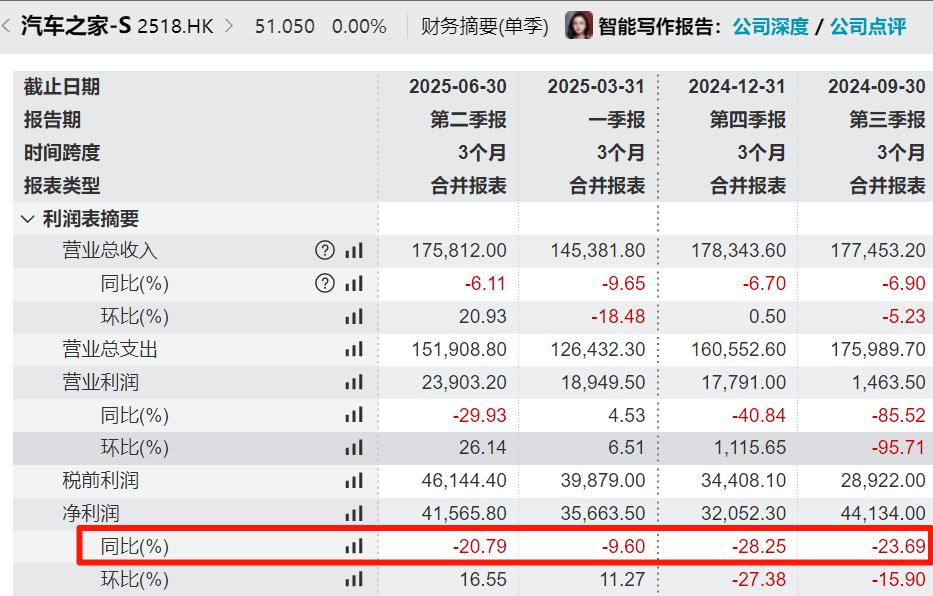
Core Viewpoint - The recent acquisition of Autohome by Haier highlights the company's struggles and the challenges it faces in transforming its business model amidst increasing competition and declining media revenue [1][2][14]. Group 1: Business Performance - Autohome's Q2 2025 net revenue was RMB 1.758 billion, a 6.14% decrease from RMB 1.873 billion in the same period of 2024 [3][4]. - The company's net profit for Q2 2025 was RMB 415.7 million, down approximately 20.79% from RMB 524.8 million in Q2 2024 [3][4]. - Autohome's media services revenue fell to RMB 279.4 million in 2025, a 35.46% decline from RMB 432.9 million in 2024, indicating a significant drop in advertising income [5][6]. Group 2: Competitive Landscape - Competitors like Dongchedi and Yiche are leveraging resources from ByteDance and Tencent, intensifying market competition and eroding Autohome's media revenue [7][8]. - The shift in advertising strategies among traditional fuel vehicle manufacturers towards more effective channels has further diminished Autohome's attractiveness as a media platform [6][8]. Group 3: Strategic Transformation - Under Haier's leadership, Autohome is focusing on AI technology and new retail models, but the increased operational costs from offline expansions pose significant challenges [2][13]. - The "offline space station" initiative aims to create a multi-brand display and experience platform, but the effectiveness of this strategy remains uncertain [9][11]. - Autohome's operational costs surged by 45.4% year-on-year to RMB 503 million in Q2 2025, primarily due to the costs associated with new business ventures [13]. Group 4: Ownership Changes and Historical Context - Haier's acquisition of a 43% stake in Autohome for approximately USD 1.8 billion marks another ownership change in the company's turbulent history [1][14]. - Autohome has undergone multiple ownership transitions, with significant strategic shifts and leadership changes impacting its long-term stability and execution [15][16].
格力电器上半年净利144.12亿元
Zheng Quan Ri Bao Wang· 2025-08-29 04:45
Group 1 - Gree Electric achieved a total operating revenue of 97.325 billion yuan in the first half of 2025, with a net profit attributable to shareholders of 14.412 billion yuan, representing a year-on-year increase of 1.95% [1] - The net profit after deducting non-recurring gains and losses was 13.946 billion yuan, showing a year-on-year growth of 0.59% [1] - The net cash flow from operating activities reached 28.329 billion yuan, a significant increase of 453.06% year-on-year [1] Group 2 - Gree Electric's industrial products and green energy segment achieved operating revenue of 9.591 billion yuan, a substantial year-on-year increase of 17.13% [2] - The smart equipment segment generated operating revenue of 314 million yuan, reflecting a year-on-year growth of 20.90% [2] - The company is actively promoting a "new retail" system that integrates online and offline sales, with online live-streaming sales exceeding 5 billion yuan in the first half of the year [2] Group 3 - The air conditioning sector is identified as a high-quality sub-sector within the home appliance industry, benefiting from dual barriers in consumption and manufacturing [3] - The industry enjoys long-term growth potential, with significant room for improvement in both domestic sales and international penetration rates [3] - Product upgrades driven by smart technology and functional innovation are becoming key growth engines for the industry [3]

安踏体育(02020.HK):品牌矩阵拉动 2025上半年收入与核心利润均双位数增长
Ge Long Hui· 2025-08-29 03:02
Core Insights - The company reported a 14.3% year-on-year revenue growth to 38.54 billion yuan in the first half of 2025, with a net profit increase of 14.5% to 7.03 billion yuan, excluding gains from the Amer Sports listing [1] - The overall gross margin decreased by 0.7 percentage points to 63.4%, attributed to the increased contribution from lower-margin e-commerce and footwear businesses, while operating profit margin improved by 0.6 percentage points to 26.3% due to effective cost control and increased government subsidies [1] - The company declared an interim dividend of 1.37 HKD per share, with a payout ratio of 50.2%, and has repurchased nearly 2 billion HKD worth of shares since the announcement of the buyback plan [1] Brand Performance - Anta's main brand revenue grew by 5.4% to 16.95 billion yuan, while FILA's revenue increased by 8.6% to 14.18 billion yuan, and other brands saw a significant growth of 61.1% to 7.41 billion yuan [2] - Operating profit margins for Anta, FILA, and other brands were 23.3%, 27.7%, and 33.2%, reflecting a mixed performance across the brand portfolio [2] - The acquisition of JACK WOLFSKIN in May 2025 further strengthened the outdoor brand matrix, and a joint venture with MUSINSA aims to explore the integration of sports, fashion, and new retail [2] Management Outlook - Management remains confident in the company's growth trajectory, updating the 2025 guidance with expectations of single-digit growth for Anta and FILA brands, while other brands are projected to grow over 40% [2] - The profit contribution from the Amer Sports joint venture is also expected to continue growing rapidly [2] Financial Projections - The company maintains its profit forecasts for 2025-2026, with slight upward adjustments for 2027, projecting net profits of 13.48 billion, 15.46 billion, and 17.36 billion yuan for 2025-2027, respectively [3] - The reasonable valuation has been adjusted to 119-124 HKD, corresponding to a 2025 PE of 23-24X, maintaining an "outperform" rating [3]

千味央厨(001215):零售新势力贡献增量 餐饮基本盘有待修复
Xin Lang Cai Jing· 2025-08-29 02:39
Core Insights - The company reported a total revenue of 886 million yuan for the first half of 2025, a year-on-year decrease of 0.72% [1] - The net profit attributable to the parent company was 36 million yuan, down 39.67% year-on-year [1] - In Q2 2025, total revenue was 416 million yuan, a decrease of approximately 3.1% year-on-year, with net profit down about 41.9% [1] Revenue Channels - The retail new force channel contributed positively, while the distribution channel faced ongoing competition [1] - In H1 2025, revenue from direct sales increased by 5.3% year-on-year, while revenue from distribution channels decreased by 6.4% [2] - The growth in direct sales was primarily driven by new retail channel customers, particularly in the bakery segment with new clients like Hema [1][2] Profitability and Cost Structure - The gross profit margin in Q2 2025 decreased by 2.3 percentage points to 22.7%, influenced by a higher sales proportion of lower-margin bakery and frozen products [1] - The sales expense ratio and management expense ratio increased by 0.4 and 0.3 percentage points to 5.6% and 10.8%, respectively, due to intensified market competition and increased marketing expenditures [2] - The company's net profit margin excluding non-recurring items was 3.2%, down 2.7 percentage points year-on-year [2] Strategic Focus - The company aims to stabilize partnerships with core restaurant clients like Yum China and expand new retail channels through product customization and R&D advantages [2] - The strategy includes enhancing cooperation with clients such as Hema and Walmart, while adjusting distribution strategies to improve channel quality and profitability [2]
罗莱生活涨2.01%,成交额2145.65万元,主力资金净流入136.13万元
Xin Lang Zheng Quan· 2025-08-29 02:04
Company Overview - 罗莱生活科技股份有限公司 is located in Shanghai and was established on May 23, 2002, with its listing date on September 10, 2009 [2] - The company specializes in the production and sales of household textiles, hotel textiles, and hats [2] - Main business revenue composition includes: comforters 32.16%, standard sets 30.03%, furniture 17.98%, pillows 6.91%, summer products 6.58%, and others 6.33% [2] Stock Performance - As of August 29, 罗莱生活's stock price increased by 2.01% to 8.61 CNY per share, with a market capitalization of 7.182 billion CNY [1] - Year-to-date stock price growth is 16.35%, with a recent 5-day decline of 0.23%, a 20-day increase of 1.77%, and a 60-day decline of 2.93% [2] - The stock saw a net inflow of 1.3613 million CNY from main funds, with large orders accounting for 12.24% of purchases [1] Financial Performance - For the first half of 2025, 罗莱生活 achieved a revenue of 2.181 billion CNY, representing a year-on-year growth of 3.60% [2] - The net profit attributable to shareholders for the same period was 185 million CNY, showing a year-on-year increase of 16.97% [2] Shareholder Information - As of June 30, 2025, the number of shareholders was 23,200, a decrease of 3.95% from the previous period [2] - The average circulating shares per person increased by 4.12% to 35,663 shares [2] - Cumulative cash dividends since the A-share listing amount to 5.181 billion CNY, with 1.504 billion CNY distributed over the last three years [3] Institutional Holdings - As of June 30, 2025, Hong Kong Central Clearing Limited is the sixth-largest circulating shareholder, holding 23.3957 million shares, an increase of 13.7603 million shares from the previous period [3]
