
逆周期调节

Search documents
国家外汇管理局:适时开展逆周期调节,维护外汇市场稳定和国家经济金融安全
news flash· 2025-08-01 13:06
Core Viewpoint - The State Administration of Foreign Exchange emphasizes the importance of preventing and mitigating external shock risks while maintaining foreign exchange market stability and national economic and financial security [1] Summary by Relevant Categories Foreign Exchange Management - The meeting highlighted the need for enhanced monitoring and analysis of foreign exchange conditions [1] - It called for strengthening macro-prudential management of cross-border capital flows and guiding expectations [1] Economic Stability - The administration plans to implement counter-cyclical adjustments as necessary to ensure stability in the foreign exchange market [1] - The focus is on safeguarding the overall economic and financial security of the country [1]
下半年经济与政策节奏的再思考:水线下的冰山
Guoxin Securities· 2025-07-31 11:34
Economic Performance - In the first half of the year, China's GDP growth reached 5.3%, marking the best performance for the same period in nearly four years[21] - Export growth has shown a downward trend since March, with rates of 12.3%, 8.1%, and 4.7%, before a slight rebound to 5.9% in June[28] - The actual export scale remains stable around $300 billion, with a similar surplus situation[28] Policy Adjustments - The Politburo meeting on April 25 emphasized the implementation of more proactive macro policies and strengthening counter-cyclical adjustments[17] - Fiscal financing progress is ahead of schedule but does not significantly deviate from recent trends[10] - Monetary policy has shifted from a "tight" stance in Q1 to a "neutral" stance, with interest rate cuts not exceeding conventional levels[10] External Trade Dynamics - The trade war has led to a permanent gap in export scale, with an estimated $190 billion/month deficit due to tariffs imposed in 2018-2019[66] - The U.S. inventory replenishment cycle is nearing its end, which may impact China's net export demand[73] Consumer Behavior - Consumption showed resilience, with sales driven by trade-in programs amounting to 2.9 trillion yuan in the first half of the year, although year-on-year growth was approximately -8.1%[79] - Short-term loans for residents have not turned positive, indicating ongoing consumer caution[85] Real Estate Investment - Real estate investment continues to decline, with high-tier cities' weekly transaction volumes dropping to levels below those of 2024[91] - The demographic trend suggests a potential long-term decline in housing demand post-2028[97] Overall Economic Outlook - The growth target of around 5% for the year appears manageable, with Q3 growth projected between 4.9% and 5.0%, and Q4 expected to drop to 4.6%-4.7%[101]
国债期货日报:财政货币发力,国债期货全线收涨-20250731
Hua Tai Qi Huo· 2025-07-31 05:04
国债期货日报 | 2025-07-31 财政货币发力,国债期货全线收涨 市场分析 宏观面:(1)宏观政策:5月20日,中国人民银行公布LPR下调:1年期LPR由3.1%降至3.0%,5年期以上品种由3.6% 降至3.5%,为近半年首次下调。同日,多家国有大行与部分股份制银行同步下调存款挂牌利率,涵盖活期、整存 整取及通知存款等多类型产品。此次降息与降存款利率同步实施,延续了央行5月初提出的 "政策利率—LPR—存 款利率" 联动调控路径;7月LPR报价持稳,1年期LPR报3%,上次为3%;5年期以上品种报3.5%,上次为3.5%。 2) 通胀:6月CPI同比上升0.1%。 资金面:(3)央行:2025-07-30,央行以固定利率1.4%、数量招标方式开展了3090亿元7天的逆回购操作。(4)货 币市场:主要期限回购利率1D、7D、14D和1M分别为1.317%、1.501%、1.620% 和1.550%,回购利率近期回落。 市场面:(5)收盘价:2025-07-30,TS、TF、T、TL收盘价分别为102.34元、105.63元、108.30元、118.36元。涨跌 幅:TS、TF、T和TL涨跌幅分别为0.0 ...
王宇:在不确定环境中以适度宽松的货币政策应对经济挑战
Xin Lang Cai Jing· 2025-07-31 00:03
Core Viewpoint - The implementation of a moderately loose monetary policy is crucial for promoting sustained economic recovery and high-quality development in the face of a complex and changing internal and external economic environment [1][2][8]. Economic Environment - The global economy is experiencing a slowdown, with the World Bank lowering its 2025 global growth forecast from 2.7% to 2.3% and international trade growth forecast from 3.4% to 1.8%, marking the slowest growth since the 2008 financial crisis [3][4]. - China's economy is under pressure from insufficient domestic demand and low price levels, necessitating a stronger emphasis on expanding domestic demand and implementing a moderately loose monetary policy [2][8]. Domestic Economic Performance - In 2025, China's GDP grew by 5.4% year-on-year in the first quarter, with retail sales increasing by 5.0% from January to May, and fixed asset investment rising by 3.7% [7][8]. - Despite positive growth indicators, challenges remain, including a negative GDP deflator for eight consecutive quarters and a consumer price index (CPI) increase of only 0.1% in June, indicating persistent low demand [8][15]. Monetary Policy Characteristics - Monetary policy serves as a tool for total demand management and counter-cyclical adjustment, aiming to restore balance between total supply and demand while maintaining price stability [9][10]. - A moderately loose monetary policy involves dynamic adjustments based on economic conditions, including lowering interest rates and increasing money supply to reduce financing costs and stimulate demand [10][11]. Policy Implementation and Effects - Since 2025, the People's Bank of China has lowered policy rates, resulting in a reduction of corporate and personal housing loan rates by approximately 50 and 55 basis points, respectively, leading to historically low financing costs [15][16]. - The total social financing (TSF) increased by 2.29 trillion yuan in May, with a year-on-year growth of 8.7%, indicating robust credit growth [16]. Strategic Focus Areas - The implementation of moderately loose monetary policy should focus on three aspects: total volume, price, and structure, to ensure sustained economic growth and stability [17][18]. - Emphasis on optimizing financial resource allocation, enhancing the efficiency of financial services to the real economy, and supporting key sectors and vulnerable areas through targeted monetary policy tools [18].
7月政治局会议学习心得
ZHONGTAI SECURITIES· 2025-07-30 14:19
Group 1: Economic Outlook - The Politburo meeting on July 30 maintained the tone from April, emphasizing stable demand and high-quality development, focusing on "stabilizing employment, enterprises, markets, and expectations" [6] - GDP growth for the first half of the year was 5.3%, with a projected 4.7% growth in the second half, aiming for an overall target of around 5% for the year [6] - The importance of the "14th Five-Year Plan" was highlighted, with a shift towards balancing qualitative improvements and reasonable quantitative growth [6] Group 2: Policy Measures - Macro policies will focus on implementing existing measures, with limited new demand-side policies anticipated [6] - Consumer spending is expected to be supported by potential new policies for service consumption, with "old-for-new" programs showing a 11.4% year-on-year growth in related retail categories [6] - Investment will continue to prioritize "two heavy" projects, with a focus on infrastructure while avoiding new hidden debts [6] Group 3: Monetary and Fiscal Policy - Monetary policy is expected to utilize structural tools rather than interest rate cuts, with no anticipated rate decrease in Q3 [6] - The fiscal deficit usage rate for the first half of the year was 33.3%, indicating room for increased spending in the second half [6] - The emphasis on "people-oriented" fiscal measures reflects a shift towards consumption-driven growth, including subsidies for specific vulnerable groups [6] Group 4: Market Dynamics - The term "low-price" was removed from discussions on competition, indicating a shift in focus due to rising prices in many goods [7] - The need for coordinated supply and demand improvements to address price volatility was emphasized, with a focus on rational pricing [7] - The adjustment in capacity governance reflects a more complex landscape compared to previous reforms, requiring time for supply-demand balance improvements [7]
下半年宏观政策向哪“适时发力”
经济观察报· 2025-07-30 13:10
Core Viewpoint - The Central Political Bureau meeting emphasizes the need for sustained macroeconomic policy efforts and timely enhancements to address current economic challenges and ensure stable growth [1][7]. Group 1: Macroeconomic Policy - The meeting calls for a more proactive fiscal policy and moderately loose monetary policy to fully unleash policy effects [1][7]. - There is a focus on accelerating government bond issuance and improving fund utilization efficiency to support economic recovery [1][7]. - The concept of "flexibility and foresight" in macroeconomic policy is introduced, indicating that policies should be stable yet adaptable to changing circumstances [3][4]. Group 2: Economic Growth and Challenges - China's economy achieved a growth rate of 5.3% in the first half of the year, supported by consumption policies and investment from special bonds [4]. - The second quarter growth rate was 5.2%, showing resilience compared to the previous year, where growth rates declined significantly [4]. - However, challenges remain, including potential consumption declines due to high base effects and real estate market instability [5][6]. Group 3: Policy Implementation and Future Directions - The meeting outlines the need for continuous policy efforts and the possibility of further policy enhancements in response to economic conditions [8][9]. - Specific policy tools are suggested, including expanding fiscal spending, timely support for affected industries, and promoting consumption through subsidies [10][11][12]. - The potential establishment of a "real estate stability fund" is proposed to alleviate liquidity pressures on real estate companies [13]. Group 4: Monetary Policy - The meeting reiterates the importance of maintaining ample liquidity and reducing overall financing costs in the economy [14]. - There is an acknowledgment that while monetary policy remains supportive, the primary reliance for economic growth may shift towards fiscal expansion [14].


下半年宏观政策向哪“适时发力”
Jing Ji Guan Cha Wang· 2025-07-30 12:32
Core Viewpoint - The Central Political Bureau meeting emphasizes maintaining policy continuity and stability while enhancing flexibility and foresight in macroeconomic policies to address current economic challenges and achieve annual development goals [2][5]. Economic Growth and Policy Context - China's economy grew by 5.3% in the first half of the year, supported by consumption policies and investment from special bonds, despite facing external and internal challenges [3][4]. - The second quarter's economic growth rate was 5.2%, only slightly down from the first quarter, contrasting with the previous year's declining trend [4]. Risks and Challenges - The meeting acknowledged ongoing risks, including potential consumption declines due to high base effects and falling real estate prices, which could impact consumer spending [5][6]. - The trade tensions with the U.S. remain a concern, with high tariffs potentially affecting export performance [5][6]. Policy Recommendations - The meeting calls for proactive fiscal policies and moderate monetary easing to fully leverage policy effects, including timely adjustments based on economic conditions [6][9]. - Specific measures include increasing government bond issuance, enhancing financial support for affected industries, and expanding consumption incentives [7][8]. Future Outlook - The economic growth is expected to follow a "U-shaped" trajectory, with stronger performance in the first half and potential slowdowns later in the year due to various pressures [5][6]. - The government plans to utilize special bonds and long-term bonds as key tools for investment and consumption stimulation in the upcoming months [8][9].
国家发改委:更好发挥政府投资基金跨周期、逆周期调节作用,对评优基金予以优待
Bei Jing Shang Bao· 2025-07-30 03:26
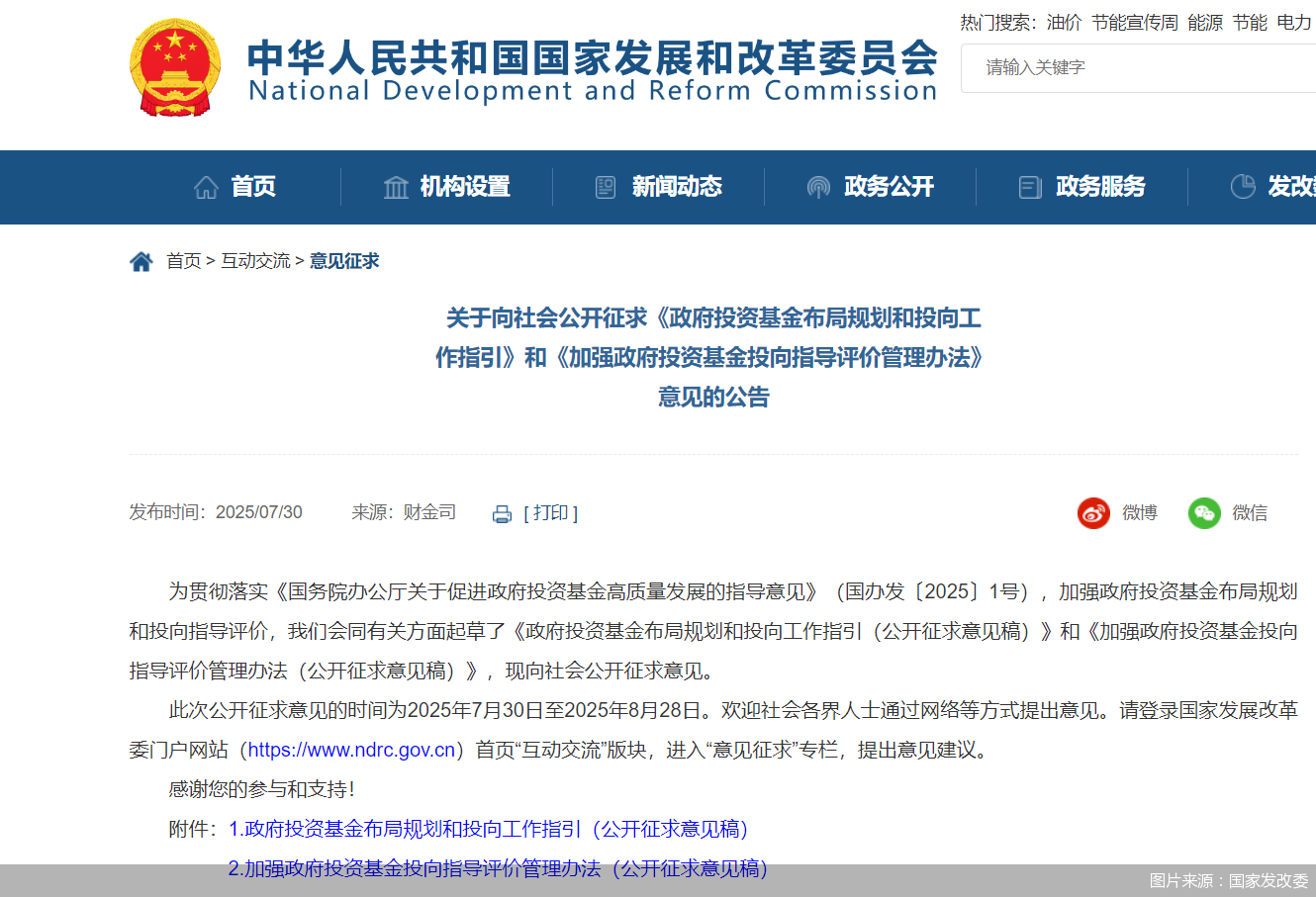
Core Viewpoint - The National Development and Reform Commission (NDRC) is soliciting public opinions on the "Guidelines for the Layout Planning and Investment Direction of Government Investment Funds" and the "Management Measures for Strengthening the Guidance and Evaluation of Government Investment Fund Directions" [1] Group 1 - The "Management Measures for Strengthening the Guidance and Evaluation of Government Investment Fund Directions" outlines three fundamental principles for guiding evaluation management: emphasizing fund positioning, promoting effective market and proactive government integration, and focusing on policy objectives to support major strategies and key areas [3] - The guidelines aim to attract more social capital to support the construction of a modern industrial system, accelerate the cultivation of new productive forces, and promote deep integration of technological and industrial innovation [3] - The guidelines emphasize the importance of long-term investment in certain fields, enhancing the role of funds as long-term and patient capital for cross-cycle and counter-cyclical adjustments [3] Group 2 - The evaluation results of fund directions will be applied, with incentives for top-ranked funds including commendation, demonstration promotion, project recommendations, and resource guarantees [4] - National-level funds are encouraged to collaborate more with local exemplary funds in terms of investment and project funding [4] - For lower-ranked funds, the NDRC and relevant departments will strengthen guidance on investment directions and may implement corrective measures such as interviews, notifications, and warning letters [4]
人行北京分行:6月末房贷余额同比涨7.5%,年内增速逐月提升
Sou Hu Cai Jing· 2025-07-30 03:22
21世纪经济报道 记者杨希,实习生刘晴 2025年7月29日,中国人民银行北京市分行、国家外汇管理局北京市分局举行2025年第三季度新闻发布 会,重点围绕2025年上半年北京市金融统计数据、做好金融"五篇大文章"、经理国库40周年、推进跨境 贸易高水平开放试点等工作介绍政策落实情况和工作成效。人行北京市分行调查统计处副处长刘前进介 绍,上半年北京地区信贷总量平稳增长,信贷结构持续优化,实体经济融资成本低位下行,有力支持首 都经济高质量发展。 推进服务消费与养老再贷款政策落地是市场关注的热点话题。此次记者从发布会上了解到,今年5月, 人民银行设立服务消费与养老再贷款,以促进扩大服务消费供给、提振服务消费需求。人行北京市分行 信贷政策管理处副处长李媛在答问环节对记者表示,再贷款工具设立以来,该行多措并举指导金融机构 用好服务消费与养老再贷款。截至6月末,辖内银行发放符合政策支持的服务消费重点领域和养老产业 贷款80.4亿元,支持市场主体近3000户。 企业贷款加权平均利率同比下降40个基点 据介绍,今年以来,人行北京市分行坚决贯彻中央经济工作会议精神和《政府工作报告》部署,按照人 民银行总行各项工作要求,落实好适 ...
中国财政系列十四:支出靠前发力、收入温和修复
Hua Tai Qi Huo· 2025-07-28 11:47
Report Summary 1. Report Industry Investment Rating No information provided. 2. Core Viewpoints - The overall operation of general public budget revenue in the first half of 2025 was weak, with insufficient tax recovery momentum and limited support from non - tax revenue. The economic recovery foundation is still unstable, and the pressure on fiscal revenue growth remains significant. Meanwhile, the general public budget expenditure accelerated its expansion, focusing on people's livelihood and innovation, but the overall expenditure progress was slightly lower than the annual budget [3][4]. - The government - funded budget revenue in the first half of 2025 was under pressure, especially the land transfer revenue. In the context of the continuous adjustment of the real estate market, the growth of fund revenue lacks stable support. However, the government - funded budget expenditure accelerated, showing an active orientation of fiscal policies to stabilize growth and expand domestic demand [5]. 3. Summary by Related Catalogs General Public Budget Revenue - In the first half of 2025, the national general public budget revenue was 1.15566 trillion yuan, a year - on - year decrease of 0.3%. Tax revenue was 929.15 billion yuan, down 1.2% year - on - year, while non - tax revenue was 226.51 billion yuan, up 3.7% year - on - year. Central revenue was 485.89 billion yuan, down 2.8% year - on - year, and local revenue was 669.77 billion yuan, up 1.6% year - on - year [35]. - Main tax items: domestic VAT was 363.93 billion yuan, up 2.8% year - on - year; domestic consumption tax was 89.8 billion yuan, up 1.7% year - on - year; enterprise income tax was 249.1 billion yuan, down 1.9% year - on - year; personal income tax was 79.45 billion yuan, up 8% year - on - year; export tax rebates were 127.02 billion yuan, up 11.6% year - on - year; etc [36][37][38][39][40]. General Public Budget Expenditure - In the first half of 2025, the national general public budget expenditure was 1.41271 trillion yuan, a year - on - year increase of 3.4%. Central expenditure was 199.14 billion yuan, up 9% year - on - year, and local expenditure was 1.21357 trillion yuan, up 2.6% year - on - year [46]. - Main expenditure items: education expenditure was 214.83 billion yuan, up 5.9% year - on - year; science and technology expenditure was 47.9 billion yuan, up 9.1% year - on - year; social security and employment expenditure was 245.04 billion yuan, up 9.2% year - on - year; etc [47][48][50]. Government - Funded Budget Revenue - In the first half of 2025, the national government - funded budget revenue was 194.42 billion yuan, a year - on - year decrease of 2.4%. Central revenue was 21.73 billion yuan, up 4.8% year - on - year, and local revenue was 172.69 billion yuan, down 3.2% year - on - year. The state - owned land use right transfer income was 142.71 billion yuan, down 6.5% year - on - year [57]. Government - Funded Budget Expenditure - In the first half of 2025, the national government - funded budget expenditure was 462.73 billion yuan, a year - on - year increase of 30%. Central expenditure was 63.08 billion yuan, up 6.2 times year - on - year, and local expenditure was 399.65 billion yuan, up 15.1% year - on - year. The expenditure related to the state - owned land use right transfer income was 206.01 billion yuan, down 6.4% year - on - year [58][59].