
日历效应

Search documents
A股:大家要准备好,节后第一周,股市很有可能要这样走
Sou Hu Cai Jing· 2025-10-08 16:41
Core Viewpoint - The A-share market is expected to experience a positive trend in the first trading week after the National Day holiday, with historical data indicating a high probability of gains due to factors such as capital inflow, favorable policies, and market sentiment [1][3]. Market Performance - Historical data shows that since 2010, the Shanghai Composite Index has risen in 10 out of 15 post-National Day trading weeks, with a notable inverse relationship between pre- and post-holiday performance [3]. - The index closed at 3882.78 points before the holiday, just 17 points shy of the previous high of 3899 points, indicating a potential breakout opportunity [1]. Sector Analysis - Leading sectors post-holiday are likely to align with strong performances in overseas markets during the holiday, particularly in technology and AI-related stocks [3]. - Energy metals and lithium sectors, which were active before the holiday, may continue to perform well [3]. Policy Environment - The People's Bank of China announced a significant liquidity injection of 300 billion yuan through reverse repos, alongside a new round of consumption subsidies totaling 69 billion yuan, effective until the end of 2025 [3]. - The China Securities Regulatory Commission emphasized reforms in the Sci-Tech Innovation Board and the Growth Enterprise Market as part of the "14th Five-Year Plan" [3]. Liquidity and Technical Analysis - Expectations for liquidity easing have strengthened, with a record financing balance exceeding 2 trillion yuan before the holiday [5]. - Technical indicators suggest a bullish trend for the Shanghai Composite Index, with a potential breakout above the 3899-point resistance level if brokerage stocks lead the charge [5]. Market Sentiment - Market sentiment is currently high, with trading volumes exceeding 1 trillion yuan for 16 consecutive trading days before the holiday [7]. - However, a decline in trading volume post-holiday could lead to differentiation among previously favored technology stocks, particularly those lacking earnings support [7]. Institutional Outlook - Most institutions maintain an optimistic outlook for the first week post-holiday, citing manageable external risks and positive policy signals [9]. - Strategies suggest maintaining a moderate stock position to capitalize on potential liquidity-driven market movements while being prepared to adjust holdings dynamically [9][10].

创年内新高后意外回落,港股“日历效应”将如何演绎?
第一财经· 2025-10-03 13:15
Market Overview - After a significant rise, the Hong Kong stock market experienced a notable pullback on October 3, with the Hang Seng Index closing down 0.54% and the Hang Seng Tech Index down 0.9% [5][6] - The automotive sector was a major drag on the market, with BYD shares falling 3.95% and other new energy vehicle makers like Li Auto and Xpeng also declining over 2% [5][6] - Despite the overall market decline, hydrogen energy stocks showed resilience, with Shanghai Electric surging 13%, reaching a new closing high not seen in over a decade [5][6] Performance Analysis - In September, the Hong Kong stock market performed well, with the Hang Seng Tech Index rising 13.9%, significantly outperforming other major global indices [7][8] - Historical data indicates a strong "calendar effect" during the National Day holiday, with the Hang Seng Index showing an 86.7% probability of rising during this period since 2010 [8][10] Future Outlook - Short-term market sentiment appears cautious, with expectations of a pullback following the holiday surge, as the "calendar effect" dissipates within a week [10][11] - However, medium to long-term outlook remains optimistic, with analysts suggesting that the current bull market for Hong Kong stocks, which began in Q4 of last year, is still in its mid-stage [10][11] - Key sectors such as industrial products, materials, energy, and healthcare are identified as having high price-to-book ratios, indicating potential for valuation recovery [10][11]




创年内新高后意外回落,港股“日历效应”将如何演绎?
Di Yi Cai Jing· 2025-10-03 11:36
Market Performance - After a significant rise, the Hong Kong stock market experienced a notable pullback on October 3, with the Hang Seng Index closing down 0.54% and the Hang Seng Tech Index down 0.9% [1][2] - The automotive sector was a major drag on the market, with BYD Co. Ltd. falling 3.95% and other new energy vehicle manufacturers like Li Auto and Xpeng also declining over 2% [2][3] - Despite the overall market decline, hydrogen energy stocks showed resilience, with Shanghai Electric surging 13%, reaching a new closing high not seen in over a decade [1][3] Sector Analysis - The automotive and components sector saw a decline of over 2%, significantly impacting the overall market performance [2] - Gold stocks reversed their earlier strong performance, with companies like Tongguan Gold and Lingbao Gold dropping 4.17% and 3.53%, respectively, amid a decrease in international gold prices [2] - The technology sector experienced volatility, particularly Alibaba, which initially dropped 4.7% but later closed up 1.09% [3] Historical Context and Future Outlook - Historically, the Hong Kong market exhibits a "calendar effect" during the National Day holiday, with an 86.7% probability of the Hang Seng Index rising during this period [4][6] - In September, the Hang Seng Tech Index rose 13.9%, leading among global indices, while the Hang Seng Index and Hang Seng China Enterprises Index increased by 7.1% and 6.8%, respectively [4][5] - Analysts suggest that while short-term adjustments are expected, the medium to long-term outlook for the Hong Kong market remains positive, driven by structural industry recovery and valuation improvements in certain sectors [6][7]
揭秘A股日历效应 市场有望迎来“红十月”?
Sou Hu Cai Jing· 2025-10-03 04:41
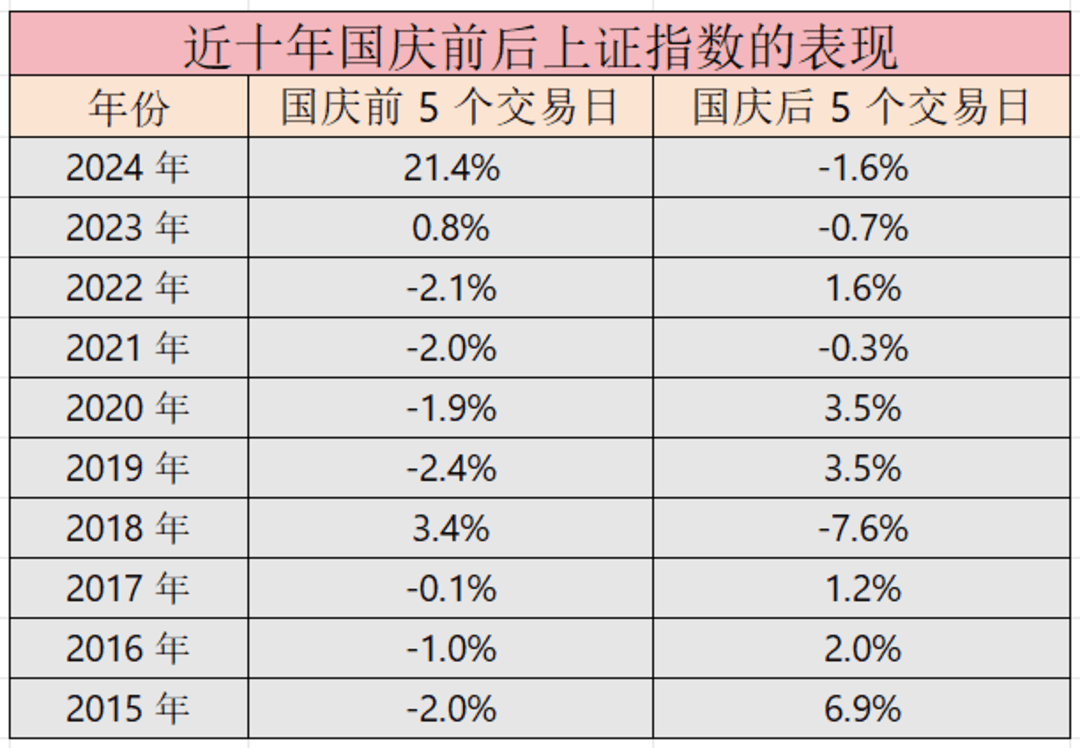
Core Viewpoint - The A-share market exhibits a "calendar effect," characterized by a pattern of subdued trading before holidays and a high probability of rebound afterward, particularly following the National Day holiday [2]. Group 1: Calendar Effect Explanation - The "calendar effect" refers to abnormal returns and volatility in financial markets associated with specific dates, leading to a pattern of "first suppression, then rise" in the A-share market [2]. - Investors tend to liquidate or reduce positions before holidays to avoid uncertainties during long breaks, resulting in decreased trading volume and noticeable capital outflows [2]. - After the holiday, capital flows back into the market, especially from margin financing, which shows a pattern of "contraction before the holiday, explosion after" [2]. Group 2: Historical Performance Data - Over the past decade, the Shanghai Composite Index has shown a 70% probability of decline in the five trading days before the National Day holiday and a 60% probability of increase in the five trading days after [4]. - The performance of the index before and after the holiday varies, with notable fluctuations in percentage changes across different years [3]. Group 3: Investment Opportunities Post-Holiday - The A-share market is expected to experience a "red October," with a high probability of a positive opening after the holiday [5]. - Key sectors likely to benefit include cyclical industries such as finance, real estate, and infrastructure, which are closely tied to macroeconomic performance [5]. - Emerging industries like renewable energy, artificial intelligence, and semiconductors are anticipated to attract market attention and lead the rebound [5]. Group 4: Market Outlook and Recommendations - The upcoming third-quarter earnings reports are expected to intensify market structural adjustments, with a recommendation for investors to maintain moderate positions and focus on policy direction and fundamental data [6]. - Various brokerage firms suggest that the market may experience a rebalancing process in Q4, with a shift towards cyclical styles and a rotation within technology sectors [7].
国庆长假前投资攻略来了→
Di Yi Cai Jing Zi Xun· 2025-09-30 10:06
Core Viewpoint - The A-share market is experiencing significant volatility as investors face the classic dilemma of holding stocks or cash before the National Day holiday, with historical data suggesting a higher probability of market gains post-holiday [2][4][5]. Market Performance - On September 29, the A-share market stabilized, with the Shanghai Composite Index rising by 0.9% to 3862.53 points, and the ChiNext Index increasing by 2.74% to 3238.01 points, indicating active trading with a daily turnover of 2.18 trillion yuan [3]. - Historical patterns show that the A-share market tends to perform poorly before the holiday but recovers positively afterward, with a notable "calendar effect" observed [5][9]. Investment Strategies - Analysts suggest that holding stocks during the holiday may offer better opportunities for gains, especially in the technology sector, which remains a focal point amid economic pressures [4][7]. - The recommendation includes maintaining a balanced asset allocation while being open to opportunities across different markets and asset classes [2][7]. Gold as an Investment Option - The rising international gold prices, which recently surpassed $3870 per ounce, have introduced "holding gold" as a new investment strategy, with significant returns on related financial products [8]. - Gold prices have increased over 16% since August, indicating a strong performance compared to traditional fixed-income products [8]. Bond Market Outlook - The bond market is currently experiencing weak sentiment, with a neutral outlook from institutions, as the ten-year government bond yield rose above 1.83% before retreating due to central bank interventions [6][10]. - The bond market's performance is expected to be influenced by stock market trends in the short term, but long-term movements will depend on economic fundamentals [10].

国庆长假前投资攻略来了→
第一财经· 2025-09-30 09:27
Core Viewpoint - The article discusses the investment strategies of holding stocks versus holding cash during the National Day holiday, highlighting the historical tendency of the A-share market to rise after the holiday and the emerging trend of "holding gold" as a new investment option [3][9]. Market Performance - On the last trading day before the National Day holiday, the A-share market showed significant volatility, with the Shanghai Composite Index closing at 3862.53 points, up 0.52%, and the Shenzhen Component Index rising by 0.35% [6][10]. - Historical data indicates that the A-share market has a higher probability of rising after the National Day holiday, with a noted "calendar effect" where the market tends to perform poorly before the holiday but recovers positively afterward [7][8]. Investment Strategies - Analysts suggest that investors should consider a balanced approach, focusing on large-cap indices while being prepared to invest in sectors like technology, new energy, and precious metals during market adjustments [10][11]. - The article emphasizes the importance of asset quality, recommending that investors hold stocks of companies with strong fundamentals while being cautious with overvalued stocks [11]. Gold as an Investment Option - The price of international gold reached a historical high of $3871.73 per ounce, marking a more than 16% increase since August and over 45% since the beginning of 2025, making "holding gold" a viable option for investors [9][12]. - The rise in gold prices has positively impacted related financial products, with many gold "fixed income+" products offering annualized returns between 2.00% and 4.00%, outperforming traditional fixed-income products [12]. Stock and Bond Market Dynamics - The article notes a "stock-bond seesaw" effect, where the A-share market has shown a pattern of rising more than falling since late June, while bond yields have been under pressure [14][15]. - Despite short-term pressures on the bond market, analysts maintain a long-term optimistic outlook for the A-share market, driven by advancements in sectors like AI and high-end manufacturing [14][15].




国庆节后A股行情如何演绎?券商热议日历效应
Nan Fang Du Shi Bao· 2025-09-30 08:49
Core Viewpoint - The A-share market is currently experiencing a sideways adjustment around the 3850-point level, with increased volatility due to the tug-of-war between bulls and bears. There is a divergence in opinions among brokerage firms regarding whether the market has reached a temporary bottom and the direction of the market post-National Day holiday [2] Group 1: Calendar Effect - The "calendar effect" refers to abnormal return differences associated with specific dates in financial markets, with seasonal and holiday effects being significant manifestations. For the National Day holiday, it is noted that low-valued and early-cycle sectors tend to perform better in the fourth quarter, provided that macroeconomic expectations remain stable [2] - Historical data from 2010 onwards indicates that the A-share market typically experiences a downturn in the ten days leading up to the National Day holiday, followed by a significant rebound in the five days after the holiday, with an average increase and higher win rates for small-cap stocks compared to large-cap stocks [3] - Analysis from Tianfeng Securities shows that the median return for the market in the five trading days before the holiday is -0.81%, while the first five days after the holiday see a median return of 2.27% with an 80% win rate [4] Group 2: Macro Perspective - Brokerages are analyzing the A-share market's performance post-National Day from a macro perspective, focusing on global policy interactions, domestic economic data, and medium to long-term strategic layouts. Key concerns include overseas variables and domestic policy windows [5] - Huatai Securities highlights that overseas policy and economic variables, such as new tariffs announced by the Trump administration and upcoming U.S. economic data releases, may influence investor sentiment and risk appetite [5] - The market is expected to see a marginal recovery in trading willingness post-holiday, with potential policy and performance layout opportunities arising from significant upcoming political meetings and corporate earnings reports [5] Group 3: Investment Direction - Resource stocks are shifting from a cyclical to a dividend-oriented valuation approach due to supply constraints and global geopolitical uncertainties, while leading Chinese manufacturing firms are expected to leverage their market share for pricing power and profit margin improvements [6] - The A-share and Hong Kong markets may benefit from long-term policy layouts and a relatively loose liquidity environment in October, with opportunities concentrated in the technology growth sector for A-shares and unique market structures for Hong Kong stocks [6] - The market is anticipated to enter a consolidation phase, waiting for the next policy trigger, as the A-share market has already accumulated significant gains since the June 23 rally [7]

持币、持股还是持金?国庆长假前投资攻略来了
Di Yi Cai Jing· 2025-09-30 08:04
Core Viewpoint - The article discusses the classic investment strategy dilemma of holding stocks versus holding cash as the National Day holiday approaches, highlighting historical trends and current market conditions that favor holding stocks over the holiday period [1][3][4]. Market Performance - On the last trading day before the National Day holiday, the Shanghai Composite Index experienced fluctuations around 3880 points, with a notable increase in trading volume, reaching a daily turnover of 2.18 trillion yuan [2][4]. - Historical data indicates that A-shares have a higher probability of rising after the National Day holiday, with a recorded 80% chance of an increase if trading volume expands in the last three trading days before the holiday [4]. Investment Strategies - Analysts suggest that investors should maintain a balanced asset allocation while considering their risk tolerance, with a focus on opportunities across different markets and asset classes [1][6]. - The "calendar effect" observed in A-shares suggests that holding stocks during the holiday may yield better returns, as evidenced by past performance trends [4][6]. Sector Focus - The technology sector remains a focal point for investors, particularly in the context of economic pressures, with expectations of policy catalysts following significant meetings in October [3][4]. - The recent surge in international gold prices, which reached a historical high of $3871.73 per ounce, has introduced "holding gold" as a new investment option for the holiday period [6][7]. Bond Market Outlook - The bond market is currently experiencing weak sentiment, with a neutral outlook from institutions, as the ten-year government bond yield rose above 1.83% before retreating due to central bank interventions [5][9]. - Despite short-term pressures from the stock market, long-term bond market trends are expected to align with economic fundamentals, indicating a potential decoupling from stock market movements [9].
读研报 | 四季度更容易风格切换?
中泰证券资管· 2025-09-30 07:03
Core Viewpoint - The article discusses the potential for a style shift in the A-share market in the fourth quarter, based on historical trends and market dynamics [2][4]. Group 1: Historical Trends and Market Behavior - Historical data indicates that there is often a noticeable style shift from Q3 to Q4, with sectors that performed well in Q3 typically underperforming in Q4 [2][4]. - A report from Dongwu Securities highlights that from 2010 to 2024, industries that ranked high in Q3 often see a decline in their rankings in Q4, with sectors like banking and home appliances showing a high excess return probability of 60% [2][4]. Group 2: Institutional Behavior and Market Dynamics - The fourth quarter is crucial for institutions as they aim to lock in profits and avoid ranking volatility, leading to potential profit-taking in previously high-performing sectors [4]. - The current market is characterized by a high degree of structural divergence, which may trigger a style shift as institutions adjust their strategies [4][5]. Group 3: Credit Cycle and Growth Trends - Historical patterns suggest that credit cycles last between 11 to 23 months, with the current credit cycle showing signs of recovery, which may favor technology and growth sectors in Q4 [7]. - Reports indicate that since 2010, technology earnings and credit cycles have been closely aligned, suggesting that a recovery in credit could benefit growth stocks [7][8]. Group 4: Investment Strategies and Market Outlook - The article emphasizes the importance of maintaining a growth-oriented investment strategy, as historical cycles show that growth sectors tend to outperform during recovery phases [8]. - Factors that typically catalyze a shift from growth to value include strong economic recovery or significant policy stimulus, but current conditions suggest limited potential for such shifts, favoring growth styles instead [8].

受芯片需求与日历效应提振 韩国9月出口增速有望创13个月新高
Zhi Tong Cai Jing· 2025-09-29 06:33
Core Insights - A recent survey indicates that South Korea's export growth in September is expected to reach a 13-month high, driven by strong technology demand and calendar effects, with a projected year-on-year increase of 7.2% compared to a revised 1.2% growth in the previous month [1][2] - The increase in exports is attributed to record semiconductor shipments and pre-holiday shipments ahead of the Chuseok holiday [1] - Despite the positive export outlook, concerns remain regarding the prospects of US-Korea trade negotiations, as a formal agreement has not yet been signed [1] Export Performance - Exports to the US are expected to grow by 6.1%, while exports to China are projected to increase by 1.6%. Exports to the EU and Southeast Asian countries are showing even more significant growth [2] - In the first 20 days of September, overall exports grew by 13.5%, with semiconductor exports surging by 27%. However, the average daily export value decreased by 10.6% year-on-year, indicating a significant base effect due to the increase in working days [1] Import and Trade Balance - Imports are expected to rise by 5.6% in September, reversing a 4.1% decline in August, marking the fastest growth in 13 months [2] - The estimated trade surplus for September is projected to be $7.81 billion, up from $6.51 billion in the previous month [2] Upcoming Data Release - South Korea's official trade data for September will be released on October 1 at 9 AM KST [3]