
美元指数

Search documents
银河期货: 美元延续涨势 贵金属市场承压
Jin Tou Wang· 2025-11-05 10:47
Group 1: Macro News - The U.S. government shutdown is ongoing, approaching a record of 35 days [2] - The probability of a 25 basis point rate cut by the Federal Reserve in December is 70.1%, while the probability of maintaining the current rate is 29.9% [2] - The probability of a cumulative 25 basis point rate cut by January is 55.8%, with a 19.3% chance of no change and a 24.8% chance of a cumulative 50 basis point cut [2] Group 2: Institutional Perspectives - There is significant internal disagreement among Federal Reserve officials regarding the potential rate cut in December [3] - The ongoing government shutdown is hindering the assessment of the U.S. macroeconomic situation due to the lack of key economic data [3] - Market expectations for a December rate cut have been adjusted, leading to a stronger U.S. dollar index, which has pressured precious metal prices [3] - The precious metals market currently lacks significant bullish factors, but there is some buying support during price pullbacks, indicating potential long-term buying interest [3]
百利好晚盘分析:美元指数走强 金价短期承压
Sou Hu Cai Jing· 2025-11-05 10:18
美国政府延续停摆状态,重要的经济数据缺失,将导致美联储在后续货币政策的决策上更加谨慎,市场对美联储在12月降息预 期有所降温。 黄金方面: 据白宫官网,美国联邦政府停摆已经进入第36天,打破了2018年年底至2019年年初停摆35天的历史纪录,成为美国持续时间最 长的政府停摆。美国政府停摆将不利于改善美国的就业市场,虽然美国停摆期间非农就业人口数据没有公布,但是市场预期美 国就业市场难言乐观。 技术面:日线上,近期连续3个交易日行情冲高回落且收下影线较长影线,显示短期行情偏弱势。指标上看,行情仍然处于20日 均线上方运行,暗示下方有一定的支撑,短期不宜过分看空。日内关注上方62美元一线压力,下方关注59.50美元一线支撑。 美元指数: 美国政府停摆时间已经创造了历史,众多的重要数据缺失,极有可能导致美联储在货币政策方面更加谨慎。这也导致美联储官 员对于后续的货币政策分歧更加明显。 百利好特约智昇研究资深分析师辰宇认为,美联储12月份降息预期降温以及避险情绪的降温将在短期令金价承压。 技术面:日线上,上一个交易日行情自高位回落且收阴线,显示短期行情偏弱势。4小时线上,行情跌破20日均线,短期空头占 优势。日内关 ...


金价早盘继续震荡下跌,关注支撑位多单布局方案
Sou Hu Cai Jing· 2025-11-05 07:18
美国政府停摆已持续35天,劳工部月度就业报告周五铁定缺席,投资者只能将希望寄托于周三出炉的 ADP全国就业报告。若10月ADP数据大幅不及预期(市场共识约+2.5万),将坐实劳动力市场降温信 号,12月降息概率或瞬间回升至80%以上,金价有望借机反弹;反之,若数据超预期,美元将继续高歌 猛进,黄金恐再探3900美元整数关口。此外,财政部周三还将公布季度再融资计划,巨额发债若推高长 端收益率,黄金承压将雪上加霜。短期内,ADP报告将成为决定金价生死的关键节点——弱于预期则空 头回补,强于预期则空头继续碾压。但放眼长期,全球央行购金势头不减、中东地缘风险暗流涌动、通 胀粘性仍存,黄金作为终极避险资产的战略价值并未动摇。投资者不妨在3900美元附近埋伏低吸机会, 一旦避险情绪反转,多头反攻或一触即发。此外,投资者还需关注美国10月ISM非制造业PMI数据,市 场预期为50.8。另外,留意美国最高法院对特朗普"对等关税"合法性的审判。 政府停摆或创历史最长,数据真空放大不确定性美国政府停摆已持续一个月,本周可能成为有史以来最 长的一次,劳工统计局关键数据包括非农就业报告全部暂停发布。投资者只能转而盯紧周三ADP民间就 ...

专家分析美元指数突破100大关
Xin Lang Cai Jing· 2025-11-05 06:32
Core Insights - The US Dollar Index has surpassed the 100 mark for the first time since early August, reaching a peak of 100.21, marking a three-month high [1] - The internal policy divergence within the Federal Reserve is identified as a direct catalyst for the short-term rebound of the dollar [1] - Market expectations for a rate cut in December have significantly decreased from 94% to 69%, which has quickly driven the dollar's recovery [1] Group 1 - The US government shutdown has entered its 35th day, tying the record for the longest shutdown in US history [1] - Despite being seen as a potential negative for the dollar, the shutdown has temporarily reinforced the dollar's safe-haven status [1] - The risks associated with the shutdown are primarily related to internal fiscal execution rather than external repayment capabilities [1] Group 2 - The dollar is expected to maintain a strong oscillating pattern in the short term, although its upward movement may be limited [1] - If the government shutdown continues, the decision-making process for the Federal Reserve may become more challenging, leading the market to reassess the sustainability of dollar policies [1]
黄金ETF持仓量报告解读(2025-11-5)金价跌势加速 下挫至3930
Sou Hu Cai Jing· 2025-11-05 06:08
Core Viewpoint - The SPDR Gold Trust, the world's largest gold ETF, reported a total holding of 1,038.63 tons of gold, reflecting a decrease of 3.15 tons from the previous trading day, coinciding with a significant drop in spot gold prices [5]. Group 1: Gold ETF Holdings - As of November 4, the SPDR Gold Trust's holdings were 1,038.63 tons, down by 3.15 tons from the previous day [5]. - The decline in gold ETF holdings occurred alongside a notable drop in spot gold prices, which fell to a low of $3,929.14 per ounce, marking the lowest level since October 30 [5]. Group 2: Market Conditions - On November 4, spot gold prices experienced a significant decline, closing at $3,931.78 per ounce, down $69.38 or 1.73% [5]. - The overall market sentiment was affected by a decline in global stock markets and risk assets, leading to a downward trend in commodities such as gold, silver, and oil [5]. Group 3: Economic Factors - The strengthening of the US dollar and rising bond yields have contributed to the pressure on gold prices, with expectations for a December rate cut diminishing [6]. - Economic uncertainty stemming from the potential government shutdown has provided some support for gold prices, as Congress remains deadlocked over funding proposals [6]. Group 4: Technical Analysis - Recent weeks have seen key technical levels breached, particularly the psychological $4,000 mark, triggering technical selling and long liquidation [6]. - The technical outlook for gold indicates an increased risk of correction, with daily momentum indicators showing a downward trend and a weakening bullish sentiment [6][7]. - Short-term support for gold is identified in the $3,910-$3,900 range, with potential challenges to $3,850 and even $3,800 if further declines occur [7].

有色金属数据日报-20251105
Guo Mao Qi Huo· 2025-11-05 05:48
| 工G国留留信 | 投资咨询业务资格:证监许可【2012】31号 | | | | | | | | | | | | | | | --- | --- | --- | --- | --- | --- | --- | --- | --- | --- | --- | --- | --- | --- | --- | | 色金属数据目报 | | | | | | | | | | | | | | | | 投资咨询号:Z0015300 从业资格号:F3043701 | 国贸期货研究员 | 方言詞 | 2025/11/05 | 投资咨询号:Z0015788 从业资格号:F3040017 | 有色金属研究中心 谢灵 | | | | | | | | | | | 价格指标 | 变化(%) | 变化 (%) | 15:00期货价格 | 现货价格 | 图表 | 10872. 5 | -0. 3 | -0. 27 | 10855. 5 | 铜 | LME有色金属期货库存(吨) | | | | | 0.8 | 锌 | 3190 | 0. 63 | 3090 | 1500000 | LME | 品 | -0. 25 | 1995 | 2893 ...
突发暴跌!美元流动性危机来了?
Sou Hu Cai Jing· 2025-11-05 04:54
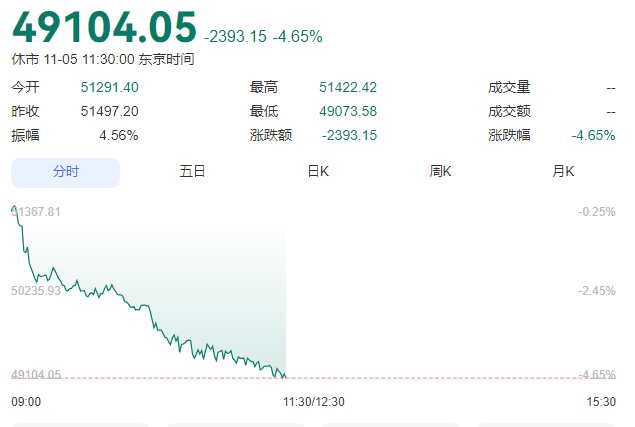
Core Viewpoint - The global stock markets are experiencing significant declines, influenced by the performance of the US stock market and a sudden strengthening of the US dollar, leading to a liquidity crisis in the market [1][6][11]. Group 1: Market Performance - Japanese and Korean stock markets opened sharply lower, with the Nikkei 225 index dropping 4.7% and breaking below 50,000 points [1]. - The Korean Composite Index fell over 6% at one point, with the Kospi 200 futures dropping more than 5% before programmatic trading sell orders were suspended [4]. - European indices also declined, with the Euro Stoxx 50 down 0.27%, CAC 40 down 0.52%, and DAX 30 down 0.6% [6]. Group 2: US Market Influence - On November 4, all three major US indices closed lower, with the Dow Jones down 0.53%, S&P 500 down 1.17%, and Nasdaq down 2.04%, losing nearly 500 points [6]. - The decline in global stock markets is attributed to the performance of US equities [6]. Group 3: Commodity and Cryptocurrency Markets - The precious metals market also saw significant declines, with COMEX gold futures down 1.81% to $3,941.30 per ounce and COMEX silver futures down 2.40% to $46.90 per ounce [6]. - Major cryptocurrencies faced sharp drops, with Ethereum falling below $3,100 (down 14%) and Bitcoin dropping over 7% to below $99,000 [6]. Group 4: Dollar Strength and Market Liquidity - The sudden strengthening of the US dollar, which reached a high of 100.25 points, is seen as a key factor behind the global asset declines [7][9]. - The increase in dollar demand is attributed to unclear interest rate cut expectations and a flight to safety amid falling gold and cryptocurrency prices [9][10]. - The US Treasury's significant cash absorption from the market, exceeding $700 billion in the past three months, has led to a liquidity crisis, impacting global markets [10][11].
澳洲通胀超预期支撑利率震荡
Jin Tou Wang· 2025-11-05 03:35
Core Viewpoint - The Australian dollar (AUD) is experiencing a slight decline against the US dollar (USD), with traders focusing on the Reserve Bank of Australia's (RBA) latest policy statements and upcoming data for re-evaluation of market trends [1] Group 1: Monetary Policy and Economic Indicators - The RBA has maintained the cash rate at 3.6%, aligning with market expectations, while inflation remains a key constraint on policy direction [1] - The Consumer Price Index (CPI) for Q3 accelerated to 1.3% quarter-on-quarter, surpassing the expected 1.1% and the previous value of 0.7%, indicating persistent price momentum above tolerable levels [1] - The RBA is adopting a cautious approach in balancing "controlling inflation" and "stabilizing growth," which may extend the period of tight monetary policy if inflation remains sticky [1] Group 2: Currency Market Dynamics - The unchanged policy stance and a "hawkish patience" from the RBA could provide marginal support for the AUD, particularly if inflation persists [1] - Conversely, if economic growth shows signs of fatigue or inflation declines faster than expected, the market may preemptively price in future easing, putting pressure on the AUD [1] - The upcoming release of the September trade balance is anticipated to provide additional insights into cyclical commodities and external demand [1] Group 3: Technical Analysis of AUD/USD - Following a retreat from the 0.6562 high, the AUD/USD is moving within a short-term descending channel, with a low of 0.6491 reached [2] - The 0.6500 level serves as an immediate psychological barrier, while the 0.6517 level has become a short-term resistance; failure to surpass this level may result in a technical correction [2] - The MACD indicators suggest that while downward momentum is slowing, the overall trend remains bearish, with the RSI indicating a weak position but not yet in extreme oversold territory [2]
沪铜日评:美元指数走强压制铜价-20251105
Hong Yuan Qi Huo· 2025-11-05 02:21
Report Summary 1. Report Industry Investment Rating No information provided. 2. Core Viewpoint The Sino-US reached a one-year economic and trade agreement, and there are production disturbances in multiple overseas copper mines. However, due to the Fed's more hawkish stance on interest rate cuts, the strengthening of the US dollar index and the tightening of liquidity may lead to an adjustment in the price of Shanghai copper [2]. 3. Summary by Relevant Catalogs Market Data - **Shanghai Copper**: On November 4, 2025, the closing price was 85,740, a decrease of 1,560 compared to the previous day. The trading volume was 166,742 lots, an increase of 16,145 lots. The open interest was 227,549 lots, a decrease of 21,213 lots. The inventory was 41,147 tons, an increase of 1,081 tons [2]. - **LME Copper**: On November 4, 2025, the 3 - month copper futures closing price (electronic trading) was 10,649, a decrease of 170 compared to the previous day. The LME copper futures 0 - 3 - month contract spread was -30.45, a decrease of 4.75 [2]. - **COMEX Copper**: On November 4, 2025, the closing price of the active copper futures contract was 4.9255, a decrease of 0.19 [2]. Supply - Demand - Inventory Analysis - **Supply**: There are production disturbances in multiple domestic and foreign copper mines, resulting in a continuous negative import index of copper concentrates in China, leading to a tight supply - demand expectation of domestic copper concentrates. The supply of scrap copper has increased, and the processing fees for domestic crude copper or anode plates have risen. The maintenance capacity of copper smelters in November has decreased month - on - month [2]. - **Demand**: The capacity utilization rates of refined copper rods, copper wires and cables, and copper enameled wires have decreased compared to last week, while the capacity utilization rates of recycled copper rods, copper strips, and copper tubes have increased [2]. - **Inventory**: The social inventory of electrolytic copper in China has increased compared to last week. The inventory of electrolytic copper in the London Metal Exchange has decreased compared to last week, and the inventory of COMEX copper has increased compared to last week [2]. Trading Strategy - Short - term: Lightly short the main contract on rallies. Pay attention to the support level of 81,000 - 83,000 and the resistance level of 86,000 - 89,000 for Shanghai copper. For LME copper, the support level is around 10,200 - 10,500 and the resistance level is around 11,500 - 12,000. For US copper, the support level is around 4.5 - 4.8 and the resistance level is around 5.5 - 6.0 [2].
研究所晨会观点精萃-20251105
Dong Hai Qi Huo· 2025-11-05 01:59
Report Industry Investment Rating No relevant information provided. Core View of the Report - Overseas, the divergence within the Fed has raised doubts about another rate cut this year, and risk aversion has led investors to seek the dollar as a safe - haven, causing the dollar index to strengthen. Large banks have warned of a potential stock market pullback, reflecting growing concerns about over - valuation, which has significantly cooled global risk appetite. Domestically, China's manufacturing sentiment declined in October, and economic growth slowed, dampening optimistic expectations. The strengthening dollar has weakened the RMB exchange rate in the short term, affecting domestic risk appetite. However, the Fourth Plenary Session of the CPC has enhanced policy stimulus expectations, which helps boost domestic risk appetite. The short - term upward macro - drive has weakened, and future attention should be paid to domestic economic growth and the implementation of incremental policies [2]. Summary by Related Catalogs Macro Finance - **Stock Index**: Affected by sectors such as energy metals, precious metals, and industrial metals, the domestic stock market declined. With the decline in China's manufacturing sentiment in October and economic slowdown, along with the short - term weakening of the RMB due to the strong dollar, the short - term macro - upward drive has weakened. After the Fourth Plenary Session of the CPC, policy stimulus expectations have increased. It is recommended to observe cautiously in the short term [2][3]. - **Treasury Bonds**: Treasury bonds are expected to oscillate and rebound in the short term, and it is advisable to go long cautiously [2]. - **Commodity Sector**: - **Black Metals**: They are expected to oscillate in the short term, and it is recommended to observe cautiously [2]. - **Non - ferrous Metals**: They are expected to oscillate in the short term, and it is recommended to observe cautiously [2]. - **Energy and Chemicals**: They are expected to oscillate in the short term, and it is advisable to go long cautiously [2]. - **Precious Metals**: After a short - term high - level correction, they are expected to adjust in the short term while maintaining a long - term upward trend. It is recommended to observe in the short term and buy on dips in the long term [2][3]. Black Metals - **Steel**: On Tuesday, the domestic steel futures and spot markets oscillated and declined. With a lack of macro - drive, the market is mainly focused on fundamental logic. Although the apparent consumption of the five major steel products continued to rise last week, it is generally expected that the demand peak in the second half of the year has passed. Due to losses in some varieties, the steel production capacity release has weakened, and with more environmental protection restrictions, supply may contract further. The steel market is expected to oscillate within a range in the short term [4]. - **Iron Ore**: On Tuesday, the decline in iron ore futures and spot prices widened. With the continuous narrowing of steel mill profits and the upgrading of environmental protection restrictions, pig iron production continued to decline, and steel mill ore inventories also decreased. The global iron ore arrivals this week increased by 1.2298 million tons to 3.3141 million tons, and port inventories increased by 167,000 tons on Monday. The supply pressure remains high, and iron ore prices are expected to fall further [6]. - **Silicon Manganese/Silicon Iron**: On Tuesday, the spot price of silicon manganese declined slightly, while that of silicon iron remained flat, and the futures prices also declined slightly. The production of the five major steel products increased slightly, and the demand for ferroalloys is acceptable. The supply of silicon manganese shows that the national capacity utilization rate is 42.99%, a slight decrease from last week, and the daily output increased by 45 tons. The prices of silicon iron in the main production areas are stable, and the raw material prices are also stable. The prices of silicon iron and silicon manganese futures are expected to continue to oscillate within a range [7]. Non - ferrous Metals and New Energy - **Copper**: The US manufacturing PMI in October was lower than expected, and the US copper inventory has reached a historical high, restricting future import demand. There are concerns about the restart of a Panamanian copper mine. In China, the copper de - stocking is not as expected, and the social inventory is at a relatively high level. However, the shutdown of Indonesia's second - largest copper mine intensifies the global copper shortage, supporting the futures price, which is expected to oscillate at a high level in the short term [9][10]. - **Aluminum**: On Tuesday, the closing price of Shanghai aluminum declined. The overall market sentiment cooled, and domestic commodities generally fell, which is negative for aluminum prices. The previous sharp rise deviated from fundamentals due to market speculation. With high domestic supply and imports, weakening demand, and difficulty in de - stocking, along with a significant increase in foreign aluminum inventories, the price is expected to oscillate in the short term. If the price rises above 20,800 yuan/ton, short - selling can be considered [10]. - **Tin**: The Philadelphia Semiconductor Index dropped significantly overnight due to renewed concerns about the AI bubble. The smelting start - up rate has rebounded significantly and is at a high level, and the supply of tin ore is expected to increase. The demand side is still weak, with the tin solder start - up rate at a low level and limited improvement in downstream orders. The high tin price has suppressed physical demand, but due to previous low inventory levels, some downstream enterprises have carried out small - scale replenishment, and the inventory has decreased. In the medium and short term, the price has support below but limited upside space, and it is expected to oscillate at a high level [11]. - **Lithium Carbonate**: On Tuesday, the main contract of lithium carbonate declined. The weighted contract reduced its position significantly. With rumors of a mine restart and a short - term macro - negative environment, it is recommended to hold a light position and wait patiently for the "emotional bottom" [12]. - **Industrial Silicon**: On Tuesday, the main contract of industrial silicon declined. The weighted contract increased its position. The demand is relatively stable, and the social inventory has slightly increased at a high level. The market is expected to oscillate within a range, and attention should be paid to the cash - flow cost support of large enterprises [12]. - **Polysilicon**: On Tuesday, the main contract of polysilicon declined. The weighted contract reduced its position. There is a stalemate between strong policy expectations and weak reality. The policy provides support for the spot price, but weak terminal demand restricts price increases. It is expected to oscillate in a high - level range, and interval trading is recommended [13]. Energy and Chemicals - **Crude Oil**: The dollar has reached a five - month high, pressuring crude oil prices. Although Russian seaborne crude oil exports have decreased significantly due to sanctions, some doubt the long - term effectiveness of the sanctions. In the short term, oil prices will face a divergence between short - and long - term trends, and the medium - term pressure remains high [14]. - **Asphalt**: With a slight decline in oil prices, the asphalt futures price dropped significantly, and the basis continued to narrow. There is a slight inventory accumulation pressure in social and factory warehouses, and the pressure will increase as the demand off - season approaches. Although the profit has increased slightly due to the decline in crude oil prices, and the supply pressure has decreased temporarily, future crude oil prices may be affected by OPEC+ production increases, and asphalt still has a large selling pressure [14]. - **PX**: As crude oil prices declined, the polyester sector was weak, and PX oscillated. With high PTA start - up rates, PX still has some demand support. The PXN spread has slightly adjusted, and PX remains in a tight supply situation. Short - term price changes are mainly driven by crude oil cost fluctuations [15]. - **PTA**: PTA remained weak. Although downstream start - up rates have increased slightly and winter textile demand has increased, the long - awaited production cut agreement among leading manufacturers has not been achieved. With new device replacements, the overall supply remains high, and there is a great inventory accumulation pressure in November. The decline in oil prices also exerts pressure on PTA [15]. - **Ethylene Glycol**: Ethylene glycol prices dropped, and the port inventory has accumulated again. Although the downstream start - up rate is neutral in the short term, the shipping volume is low, and the arrivals are at a relatively high level. There is a large inventory accumulation pressure in November, and the downstream start - up rate may decline. Caution is required before entering the market [15]. - **Short - fiber**: Short - fiber oscillates in the short term but faces greater pressure in the future. Terminal orders are seasonally declining, and the start - up rate has decreased in some areas, with limited inventory accumulation. It is recommended to go short on rallies in the medium term [16]. - **Methanol**: The methanol market shows regional differentiation. The port inventory is at a high level but is slightly decreasing without a significant increase in imports and stable MTO demand. Inland, due to increased device start - up rates and weakening demand, enterprise inventories have accumulated, and prices have weakened. In the short term, the market sentiment is bearish, but with the approaching winter gas restrictions, the supply contraction expectation will gradually emerge, and the downward space is expected to be limited, with the market likely to enter an oscillatory consolidation phase [16]. - **PP**: In the PP market, supply growth continues to outpace demand recovery, and the industrial chain inventory is relatively high. However, demand has shown marginal improvement, and the recent rebound in crude oil prices supports the cost, limiting the downward space. In the short term, the price is expected to oscillate weakly [17]. - **LLDPE**: The core contradiction in the polyethylene market is the continuous accumulation of supply pressure. With the release of new production capacity and the planned restart of previously shut - down devices, supply is increasing. Demand is expected to weaken after peaking in early November, and the weak crude oil price provides limited cost support. The price is expected to continue to be under pressure [17]. - **Urea**: The urea supply is expected to increase, and the overall supply is becoming more abundant. With the recent price rebound, downstream replenishment has slowed down. Local agricultural demand is gradually ending, and industrial demand remains weak. The export is expected to stay at a low level due to unclear policies [17]. Agricultural Products - **US Soybeans**: Overnight, the CBOT January soybean contract declined. With the Sino - US economic and trade consultations reaching a phased consensus, the trade window for agricultural products may open, and US soybeans may strengthen. The USDA may increase the export forecast in subsequent reports, and if the yield per acre is further reduced, the cost - repair logic of US soybeans will be enhanced [18]. - **Soybean and Rapeseed Meal**: The pressure of concentrated soybean arrivals in China is increasing, and oil mills are maintaining high - level crushing, resulting in sufficient soybean meal supply. With the repair of Sino - US agricultural trade relations, the cost of imported soybeans will increase, and the risk of future soybean shortages will decrease, which may lead to inventory accumulation of soybean meal and limit its upside potential. The spread between soybean meal and rapeseed meal is expected to narrow. Attention should be paid to whether China cancels the 10% reciprocal tariff and opens the market - oriented import window [19]. - **Palm Oil**: After continuous declines, palm oil has entered a technically oversold stage, and the risk of short - selling is increasing. Although the unexpected increase in Malaysian palm oil production in October has caused short - term adjustment pressure, the rising prices of international oilseeds and crude oil provide some support. As palm oil enters the production - reduction cycle, the seasonal inventory - reduction trend remains unchanged. The domestic spot basis is stable with a slight decline, and palm oil continues to operate weakly [19]. - **Soybean and Rapeseed Oil**: Soybean oil continues to adjust weakly in a narrow range, with a supply - exceeding - demand situation. Supported by the rising cost of imported soybeans, it is relatively more resistant to decline compared to palm oil. Rapeseed oil inventory is still at a high level, but rapeseed inventory is running out. Affected by the uncertainty of Sino - Canadian trade, the sentiment of traders to hold back supply and support prices is strong, and the basis continues to strengthen [19]. - **Corn**: The pressure of wet corn sales is gradually weakening, and the prices in production areas are stable, but the intention of traders to build inventories is still general. The situation of a bumper harvest and market pressure has gradually stabilized. The futures prices are running weakly recently, but the phased bottom - range market may provide effective support [20]. - **Hogs**: In late October, the overall slaughter rhythm of large - scale pig farms was adjusted, but there was no significant reduction in supply, and the average slaughter weight decreased. It is expected that the supply will continue to increase in November, and the pig - raising profit will remain in the red. Before the small peak of pickled meat consumption around the Winter Solstice in December, it is difficult for pig prices to rebound significantly [20].