
新能源

Search documents
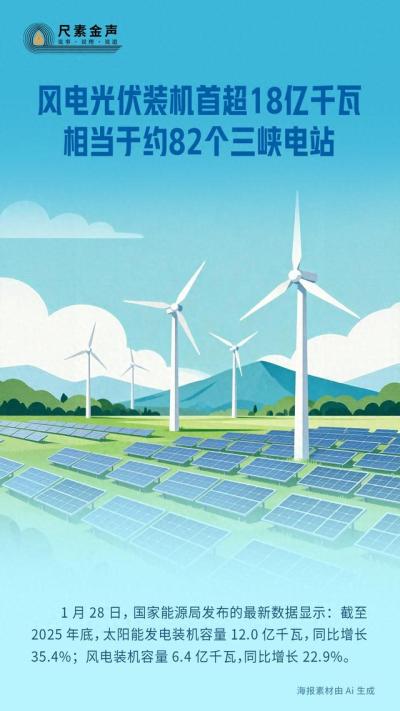
风电光伏装机首超18亿千瓦,相当于约82个三峡电站
Ren Min Ri Bao· 2026-02-03 03:47
1月28日,国家能源局发布的最新数据显示:截至2025年底,太阳能发电装机容量12.0亿千瓦,同比增 长35.4%;风电装机容量6.4亿千瓦,同比增长22.9%。 这是我国风电光伏累计装机首次超过18亿千瓦、达到18.4亿千瓦,相当于约82个三峡电站总装机,占比 达47.3%。 看技术进步,"十四五"时期,我国新能源等技术装备领跑全球,光伏转换效率、海上风电单机容量等不 断刷新世界纪录,技术创新和产品迭代推动成本快速下降。不仅如此,抽水蓄能、新型储能等调节存储 技术快速发展、特高压技术创新应用、智能微电网建设加快等,为破解新能源电力消纳瓶颈提供了支 撑。 看企业活力,我国新能源市场环境开放、经营主体多元、市场竞争充分,绝大多数的光伏设备制造企业 和60%以上的风电整机制造企业都是民营企业。 纵向比,我国风电光伏从2020年底的5.3亿千瓦增加到2025年底的18.4亿千瓦,风电光伏累计装机连续跨 越13个亿级台阶,2025年历史性超过火电装机。通过坚持集中式与分布式、陆上与海上并举,风电光伏 发展速度更快、电量占比更高,当前平均度电成本已比煤电低三成左右。 横向看,我国风电光伏装机规模均连续10余年稳居全球第 ...

大行评级丨交银国际:维持长城汽车“买入”评级,中期仍受惠于高端化+新能源+出海方向
Ge Long Hui· 2026-02-03 03:28
交银国际发表研报指,长城汽车去年净利润按年跌21.7%至99.12亿元,主要由于销量及收入增长同时, 公司加速构建直连用户的新渠道模式,并加大新车型及新技术上市宣传及品牌提升投入。去年收入按年 升10.2%至2227.9亿元,单车收入按年提升约4500元,至16.83万元,20万元以上车型销量按年增加逾9 万辆,反映高端化与结构升级仍在推进。展望2026年,公司指引海外销量挑战60万辆,且去年第四季已 于多个区域加快渠道签约,为2026年增量奠定基础。该行认为公司中期仍受惠于高端化+新能源+出海 方向,但去年第四季已体现投入加大对利润的阶段性挤压;维持"买入"评级,H股目标价22.5港元。 ...

数说公募主动权益基金四季报:规模/份额双降、周期/金融配置权重上升
SINOLINK SECURITIES· 2026-02-03 02:53
1. Report Industry Investment Rating - No relevant content provided 2. Core Viewpoints of the Report - In Q4 2025, after nearly a year of upward trend, the A - share market started to move sideways and fluctuate, with wide - based indices showing mixed performance. Large and mid - cap value indices significantly outperformed growth indices, and the active equity fund scale and share decreased while the issuance quantity and scale slightly increased [3][8]. - The average stock position of equity funds slightly shrank, and the Hong Kong stock position also declined. Institutions increased the allocation in cyclical and financial sectors and adjusted the allocation in technology, medicine, and consumption sectors [3]. - The performance of theme funds in various industries was differentiated. Cyclical theme funds performed the best, while pharmaceutical theme funds performed the worst [3]. - Among the top 20 fund companies in terms of active equity fund scale, the scale changes compared to Q3 were mixed, with some companies' rankings changing [3]. - In Q4, the active equity fund most heavily held by FOF in terms of holding ratio and quantity was "Fuguo Steady Growth" [3]. 3. Summary by Related Catalogs 3.1 Fund Market Overview - **Performance Review**: In Q4 2025, the A - share market moved sideways and fluctuated after a year - long upward trend. Only the Shanghai Composite Index rose by 2.22% among wide - based indices, while others like the Shenzhen Component Index and the ChiNext Index declined. In terms of style, large and mid - cap value indices outperformed growth indices. The Hang Seng Index and related Hong Kong stock indices also declined [8]. - **Industry Index Performance**: Except for 9 industries such as medicine and beauty care, the remaining 22 industries in the Shenwan 31 - industry index achieved positive returns in Q4. Resources and military industries performed well, while the pharmaceutical industry was weak overall. The top 5 industries in terms of increase were non - ferrous metals (16.25%), petroleum and petrochemicals (15.31%), communication (13.61%), national defense and military industry (13.1%), and light industry manufacturing (7.53%) [11]. - **Equity Fund Performance**: In Q4 2025, ordinary stock - type funds, partial - stock hybrid funds, and flexible allocation funds declined by 1.94%, 1.60%, and 0.04% respectively, while balanced hybrid funds rose by 0.87%. In terms of risk, balanced hybrid funds with lower stock positions had the best drawdown performance, and flexible allocation funds showed better risk - return performance in the long - term [31]. - **Scale and Share**: By the end of Q4 2025, the total scale of active equity funds was 3.81 trillion yuan, a slight decrease of 4.53pct compared to the previous quarter, and the total share was 2.56 trillion shares, a decrease of 2.91pct. Among them, partial - stock hybrid funds had the largest scale, and balanced hybrid funds had the smallest scale [34]. - **Newly Issued Fund Situation**: In Q4, the number and scale of newly issued active equity funds slightly increased. A total of 100 funds were newly issued, with a total scale of 441.67 billion yuan, an increase of 4.72 billion yuan compared to the previous quarter. Partial - stock hybrid funds had the largest newly issued scale [36]. 3.2 Fund Holding Characteristics - **Stock/Hong Kong Stock Position**: In Q4 2025, the equity fund position slightly shrank, with the average stock position at 88.05%, a decrease of 0.88 percentage points compared to the end of the previous quarter. The Hong Kong stock position also decreased, with the average investment market value of Hong Kong stocks accounting for 11.62% of the net value, a decrease of 1.85 percentage points compared to the previous quarter [43]. - **Heavy - Holding Stock Sector Allocation**: In Q4, technology was the most heavily held sector by active equity funds. Except for cyclical, manufacturing, and financial sectors, the proportion of other sectors decreased. Institutions increased the allocation in cyclical and financial sectors and adjusted the allocation in technology, medicine, and consumption sectors [48]. - **Heavy - Holding Stock Industry Allocation**: The electronics industry was still the largest heavily - held industry by equity funds, but the allocation ratio decreased, and non - ferrous metals were significantly increased. The concentration of the top five industries slightly decreased from 58.58% in Q3 to 58.40% [50]. - **Individual Stock Level**: The top 10 individual stocks in terms of heavy - holding market value accounted for by equity funds were Zhongji Innolight, Xinyisheng, CATL, Tencent Holdings, Zijin Mining, Alibaba - W, Cambricon - U, Luxshare Precision, SMIC, and Kweichow Moutai. The market value proportion of Zhongji Innolight, Xinyisheng, and Ping An of China increased significantly, while that of Industrial Fuxing, Alibaba - W, and EVE Energy decreased relatively more [52]. - **Heavy - Holding Stock Market Value and Concentration**: The market value style of equity fund holdings continued to strengthen towards mid - and large - cap stocks. The concentration of the top 50, 100, and 200 heavy - holding stocks slightly decreased, but basically continued the previous trend [61]. 3.3 Fund Company Analysis - **Scale Ranking**: In Q4 2025, the scale changes of the top 20 fund companies in terms of active equity fund scale compared to Q3 were mixed. The top 5 institutions were E Fund, China Europe Asset Management, GF Fund, Fuguo Fund, and Huatai - PineBridge Fund. Among the companies ranked 6 - 20, the equity scale of Yongying Fund further increased, and its ranking rose by 2 places [64]. - **TOP20 Fund Company Heavy - Holding Industries**: The first - largest heavily - held industries of the top 20 fund companies were mainly electronics and medicine and biology. Dacheng Fund's first - largest heavily - held industry was non - ferrous metals, showing certain differences [65]. - **TOP20 Fund Company Heavy - Holding Stocks**: In Q4, the average concentration of the top three heavy - holding stocks of the top 20 fund companies in terms of active equity fund scale was 14.27%, and the concentration of the top five heavy - holding stocks was 21.04%, slightly increasing compared to the previous quarter. Xingquan Fund had the highest concentration of the top three heavy - holding stocks [67]. 3.4 Theme Fund Analysis - **Fund Performance**: In Q4, the performance of theme funds in various industries was differentiated. Cyclical theme funds performed the best, with a quarterly increase of 10.10%, followed by financial and manufacturing theme funds. Pharmaceutical theme funds had the worst performance, with a quarterly decline of 13.15% [71]. - **Pharmaceutical and Consumption Themes**: In pharmaceutical theme funds, the sub - sectors with a relatively high market value proportion in heavy - holding stocks were chemical preparations and other biological products. The sub - sectors with a relatively large increase in heavy - holding proportion were medical R & D outsourcing and traditional Chinese medicine. In consumption theme funds, the sub - sectors with a relatively high market value proportion were liquor and agriculture, forestry, animal husbandry, and fishery. The sub - sectors with a relatively large increase in heavy - holding proportion were food processing and social services [75]. - **Technology and New Energy Themes**: In technology theme funds, the sub - sectors with a relatively high market value proportion in heavy - holding stocks were artificial intelligence and consumer electronics industries. The sub - sectors with a relatively large increase in heavy - holding proportion were optical modules and IDC. In new energy theme funds, the sub - sectors with a relatively high market value proportion were energy storage and solid - state batteries. The sub - sectors with a relatively large increase in heavy - holding proportion were resource stocks and solid - state batteries [79]. 3.5 FOF Holding Analysis - **High - Holding - Ratio Funds**: In Q4 2025, the active equity fund with the highest holding ratio among FOF heavy - holding funds was "Fuguo Steady Growth", with a fund manager of Fan Yan. The fund's holding market value accounted for 2.53% of the total market value of all heavy - holding funds, an increase of 0.13% compared to the previous quarter [81]. - **High - Holding - Quantity Funds**: In Q4 2025, the active equity fund most heavily held by FOF in terms of quantity was still "Fuguo Steady Growth", followed by "Bodaojiu Hang" and "China Europe Dividend Premium Selection" [83]. - **Ratio/Quantity Changes**: In Q4 2025, the active equity funds with the largest increase in holding ratio and quantity among FOF heavy - holding funds were "Huatai - PineBridge Extended Growth Theme" and "China Europe Dividend Premium Selection" respectively [85]. - **New - Generation Fund Managers**: Among the active equity funds managed by new - generation fund managers with less than 3 years of management experience, the fund with the highest holding ratio among FOF heavy - holding funds in Q4 was "Rongtong Industrial Trend Selection", with a fund manager of Li Jin. The fund's holding market value accounted for 0.70% of the total market value of all heavy - holding funds, a quarter - on - quarter increase of 0.37% [87]. - **Holding Own Funds**: Different FOF institutions such as E Fund, China Europe Asset Management, Invesco Great Wall, Fuguo Fund, Huatai - PineBridge Fund, and Xingzheng Global Fund had different situations in holding their own equity funds, with different scales and top - held funds [89][91][94][96][98].





国信证券:石化行业盈利逐渐企稳复苏 推荐油气、炼油炼化、钾肥、磷化工的投资方向
Sou Hu Cai Jing· 2026-02-03 02:42
Core Viewpoint - The petrochemical industry is experiencing a gradual recovery, with a year-on-year increase of 10.56% in net profit attributable to shareholders in the first three quarters of 2025, indicating stabilization in industry profitability [1] Supply Side - Investment in fixed assets in the chemical raw materials and products manufacturing industry turned negative starting June 2025, with capital expenditure in several sub-sectors declining for multiple consecutive quarters, signaling the end of the current expansion cycle [2] - The "anti-involution" policy introduced in July aims to address low-price competition and promote the orderly exit of outdated production capacity, with various sub-sectors responding by developing industry guidelines [2] - The industry is expected to see stricter approvals for new chemical product capacities and accelerated clearance of outdated capacities, effectively alleviating the oversupply issue in the petrochemical sector [2] Demand Side - Traditional demand is anticipated to recover moderately due to global central banks entering a rate-cutting cycle and fiscal stimulus measures [3] - Emerging demand driven by sectors such as renewable energy and AI is expected to support the technological upgrade of key chemical materials [3] Overseas Chemical Capacity Clearance - The European chemical industry has faced a wave of plant closures since 2025 due to high energy costs and aging facilities, while China's chemical product sales account for over 40% of the global market [4] - The domestic petrochemical industry chain is well-established, and many chemical products are highly competitive globally, suggesting that Chinese chemical companies will continue to increase their market share amid overseas capacity clearance and anticipated demand recovery [4] Macroeconomic and Chemical Product Prices - As of January 2026, China's comprehensive PMI output index was 49.8%, indicating a slowdown in production activities compared to the previous month [5] - The chemical product price index (CCPI) reported at 4120 points on January 30, 2026, a decrease of 4.83% from the end of the previous year, although the ex-factory prices of major chemical products have increased [5] Oil Prices - Geopolitical risks have increased in January, leading to fluctuations in international oil prices, with WTI and Brent crude oil prices rising by 13.57% and 16.17% respectively compared to the end of the previous year [6]

美欧安全战略转向对亚太市场的影响:环球市场动态2026年2月3日
citic securities· 2026-02-03 02:40
Market Overview - Global markets experienced significant volatility, with the Chinese market collectively weakening, particularly in metals and semiconductors, while European markets showed a recovery driven by improved economic sentiment[3] - The U.S. stock market stabilized with a rebound, supported by better-than-expected manufacturing data, alleviating concerns over the next Federal Reserve chair[3] Commodity and Currency Movements - International oil prices dropped over 4% due to reduced conflict risks in Iran and a sharp decline in commodity prices[3] - The U.S. dollar index rose for two consecutive days, reflecting positive manufacturing activity data, while precious metals continued to decline[3] Fixed Income Insights - U.S. Treasury yields increased slightly, with the yield curve flattening; the ISM manufacturing index reached its highest growth rate since 2022[3][30] - Oracle issued $25 billion in bonds to support cloud infrastructure expansion, contributing to a significant increase in global bond issuance[30] Asia-Pacific Market Trends - The Asia-Pacific stock markets generally declined, with South Korea's KOSPI index falling 5.3% and Indonesia's index down 4.9%[20] - India's Nifty index rose 1.1% following the U.S. reduction of tariffs on Indian goods, contrasting with the overall regional downturn[20] Sector Performance - In the U.S., 8 out of 11 S&P sectors rose, with consumer staples leading the market with a 1.58% increase[9] - Conversely, the Hong Kong market saw significant declines in precious metals and technology sectors, with the Hang Seng Index dropping 2.23%[11] Key Economic Indicators - The U.S. ISM manufacturing index surpassed expectations at 52.6, indicating stronger economic momentum and reducing expectations for further monetary easing[30] - France's government successfully passed its budget, alleviating political uncertainty and stabilizing market conditions[30]


亚洲市场举措叠加纳斯达克新规,2026年亚洲公司赴美上市路怎么走?
Sou Hu Cai Jing· 2026-02-03 02:39
Core Insights - Hong Kong is projected to have 119 companies complete IPOs in 2025, raising over HKD 285.8 billion (approximately USD 36.7 billion), with at least 7 companies raising over USD 1 billion each [1] - The Hong Kong Stock Exchange (HKEX) is expected to surpass the New York Stock Exchange and NASDAQ as the leading exchange for Chinese companies by 2025 [1] - The Singapore Exchange (SGX) is collaborating with NASDAQ to streamline dual listings for companies in the US and Singapore, with a new Global Listing Board set to launch in mid-2026 [1][2] - NASDAQ has made several rule changes to increase the minimum public float and fundraising requirements for new listings, impacting companies seeking to go public [4][5][6] Group 1: Hong Kong IPO Market - In 2025, Hong Kong is expected to see a significant increase in IPO activity, with a total of 119 companies projected to go public [1] - The total funds raised through these IPOs are anticipated to exceed HKD 285.8 billion (around USD 36.7 billion) [1] - At least 7 companies are expected to raise over USD 1 billion each, including those already listed in mainland China [1] Group 2: Singapore Exchange Developments - SGX announced a partnership with NASDAQ to simplify the dual listing process for companies in the US and Singapore, aiming to attract more listings [1][2] - A new Global Listing Board is set to be established by mid-2026, allowing companies with a market cap of at least SGD 2 billion (approximately USD 1.6 billion) to enter both markets simultaneously [1][2] - The Singapore government has introduced a SGD 5 billion (approximately USD 3.9 billion) stock market development plan to stimulate investment in local stocks [1] Group 3: NASDAQ Rule Changes - NASDAQ has raised the minimum public float requirements for new listings, increasing the minimum market value of unrestricted public shares from USD 500,000 to USD 1.5 million [4] - New rules allow NASDAQ to exercise discretion in rejecting IPO applications based on factors that may lead to market manipulation, affecting companies from China and the Asia-Pacific region [5][6] - A proposed rule would require companies based in mainland China, Hong Kong, and Macau to raise at least USD 25 million through public offerings to qualify for listing [6]

11万亿千瓦时!我国用电规模持续爬坡
Zhong Guo Dian Li Bao· 2026-02-03 01:53
Core Viewpoint - The China Electricity Council (CEC) predicts that by 2025, China's total electricity consumption will exceed 10 trillion kilowatt-hours, with a balanced supply-demand situation and significant growth in renewable energy capacity, particularly solar power, which is expected to surpass coal power for the first time by 2026 [1][7]. Group 1: Electricity Consumption Growth - In 2025, China's total electricity consumption is projected to grow by 5.0% year-on-year, reaching 10.37 trillion kilowatt-hours, maintaining its position as the world's largest electricity consumer [2]. - The secondary industry remains the primary driver of electricity demand, accounting for 6.64 trillion kilowatt-hours, or 64.0% of total consumption, contributing 47.5% to the growth [2][3]. - The tertiary industry is emerging as a new growth engine, with electricity consumption reaching 1.99 trillion kilowatt-hours, a year-on-year increase of 8.2%, contributing 30.7% to overall growth [3]. Group 2: Renewable Energy Capacity - By the end of 2025, China's total installed power generation capacity is expected to reach 3.89 billion kilowatts, a year-on-year increase of 16.1%, with non-fossil energy sources accounting for 61.7% of total capacity [4][5]. - Wind and solar power installations are projected to account for over 80% of new capacity additions, with a total of 4.4 billion kilowatts added in 2025 [5]. - Renewable energy generation is expected to constitute 42.9% of total electricity generation by 2025, with a significant increase in new generation capacity from wind, solar, and biomass sources [5]. Group 3: Future Projections for 2026 - In 2026, solar power generation capacity is anticipated to surpass coal power for the first time, with total installed capacity reaching approximately 4.3 billion kilowatts [7]. - Total electricity consumption in 2026 is projected to grow by 5-6%, supported by favorable economic conditions and government policies [7][8]. - The new infrastructure initiatives and advancements in digital technologies are expected to drive significant growth in electricity consumption across various sectors [9][10].
中金公司港股晨报-20260203
Xin Da Guo Ji Kong Gu· 2026-02-03 01:48
Core Insights - The report highlights a positive outlook for the Hong Kong stock market, with the Hang Seng Index showing short-term support around 26,000 points, driven by anticipated policy actions in mainland China and a strong performance in AI-related sectors [3][4] - The Macau gaming sector is expected to benefit from higher-than-expected January gaming revenue, with the upcoming Spring Festival acting as a catalyst for growth [4] - The report notes a significant increase in China's manufacturing PMI to 50.3 in January, indicating improved economic conditions and a potential boost in production and employment [8] Market Review - The Hang Seng Index experienced a decline, closing at 26,775 points, down 2.2%, with a trading volume of 347.9 billion [6] - The report mentions that despite geopolitical uncertainties affecting risk appetite, the AI sector remains robust, supporting market activity [3][6] Sector Focus - The Macau gaming stocks are highlighted as a sector with strong potential due to favorable revenue trends and seasonal demand [4] - The report indicates that the memory interconnect chip market is projected to grow at a compound annual growth rate of 27.4% from 2024 to 2030, with a leading market share of 36.8% held by a specific group [6] Economic Indicators - China's insurance industry is projected to see a 7.4% increase in premium income by 2025, reaching 6.12 trillion yuan [9] - The report discusses the anticipated growth in the new energy heavy truck market, with sales expected to increase by 182% in 2025 [10] - The report also notes that the new energy sector accounted for 97.1% of the total increase in electricity consumption in China, highlighting its growing importance [10]
国泰君安期货商品研究晨报:绿色金融与新能源-20260203
Guo Tai Jun An Qi Huo· 2026-02-03 01:33
2026年02月03日 国泰君安期货商品研究晨报-绿色金融与新能源 | 观点与策略 | | --- | | 镍:宏观情绪主导边际,基本面与投机盘博弈 | 2 | | --- | --- | | 不锈钢:二月检修减产频出,镍铁预期托底下方 | 2 | | 碳酸锂:下游陆续采购,盘面下方空间较有限 | 4 | | 工业硅:硅厂减产落地,下方空间不深 | 6 | | 多晶硅:关注现货成交情况 | 6 | 国 泰 君 安 期 货 研 究 所 请务必阅读正文之后的免责条款部分 1 期货研究 商 品 研 究 2026 年 2 月 3 日 2)新华社 12 月 12 日从商务部获悉,商务部、海关总署日前印发公告,决定对部分钢铁产品实施出口 许可证管理。公告自 2026 年 1 月 1 日起执行。 3)根据钢联,印尼镍矿商协会 (APNI) 透露,能源和矿产资源部(ESDM)将于 2026 年初修订镍矿商 品的基准价格公式,修订要点之一是政府将开始将镍的伴生矿钴视为独立商品并征收特许权使用费。 镍:宏观情绪主导边际,基本面与投机盘博弈 不锈钢:二月检修减产频出,镍铁预期托底下方 张再宇 投资咨询从业资格号:Z0021479 ...
研判2026!中国钙钛矿电池行业产业链、产能、市场规模、重点企业布局情况及发展趋势分析:应用范围十分宽广,市场规模有望突破100亿元[图]
Chan Ye Xin Xi Wang· 2026-02-03 01:28
Core Viewpoint - Perovskite batteries are emerging as a promising technology with significant potential for efficiency improvement and cost reduction, with a wide range of applications. China has made rapid progress in this field despite a late start, with breakthroughs in technology and the establishment of GW-level production lines leading to initial industrial transformation and market release [1][4]. Group 1: Market Size and Capacity - The market size for perovskite batteries in China is projected to grow from 130 million yuan in 2022 to 3.75 billion yuan by 2025, with an expected capacity increase to 4 GW [4]. - By 2026, the market size is anticipated to exceed 10 billion yuan, with new capacity reaching approximately 16 GW [4]. - The total capacity of perovskite batteries in China is expected to reach 161 GW by 2030 [4]. Group 2: Industry Chain - The upstream of the perovskite battery industry chain includes materials such as TCO glass, target materials, POE adhesive films, and butyl rubber, as well as equipment like coating and laser devices [4]. - The midstream involves the production and manufacturing of perovskite batteries and components, while the downstream applications are primarily in the photovoltaic sector, including BIPV, vehicle-mounted photovoltaics, and indoor photovoltaics [4]. Group 3: Competitive Landscape - Leading research teams globally include the European Thin-Film Solar Cell Research Alliance, Berlin University of Technology, Helmholtz Berlin Institute, UNIST, and several prominent universities and research institutions in the U.S. and China [6][7]. - The domestic landscape features key players such as GCL-Poly, Xinao Photovoltaic, and Extreme Electric Energy, alongside traditional photovoltaic giants like LONGi Green Energy, Trina Solar, and JA Solar [7]. Group 4: Development Trends - Perovskite solar cells have made significant advancements in efficiency and stability over the past decade, positioning them as a key technology in the photovoltaic field, comparable to silicon-based solar cells and other technologies [7][8]. - Future trends indicate a focus on further theoretical research, overcoming technical bottlenecks, reducing costs, enhancing stability, and optimizing structures, which are essential for the development of perovskite batteries [7].
