
滞胀

Search documents
“对等关税”,美国“滞胀”风险显著
SINOLINK SECURITIES· 2025-04-03 06:59
Core Insights - The implementation of "reciprocal tariffs" is significantly stronger than market expectations, with a baseline tariff of 10% and additional tariffs based on the perceived tariff levels of trading partners, leading to potential increases in average import tariffs in the U.S. by approximately 17 percentage points to around 22% [2][4] - The tariffs are particularly high for countries with significant trade surpluses with the U.S., such as China (34%), Vietnam (46%), and Japan (24%), indicating a strategic aim to reduce trade deficits and promote domestic manufacturing [3][4] - The unexpected introduction of these tariffs may serve as a starting point for new trade negotiations, with a more lenient approach towards Canada and Mexico, suggesting that countries willing to negotiate may avoid the highest tariffs [3] Industry Implications - The new tariff measures are likely to accelerate the risk of "stagflation" in the U.S., with inflationary pressures and economic growth risks expected to be more pronounced than during previous trade disputes [4] - The broader scope and magnitude of the tariffs could lead to retaliatory measures from trade partners, further exacerbating negative economic impacts on the U.S. economy [4] - The U.S. stock market is anticipated to enter a comprehensive downward trend, influenced by the global trade disruptions and the potential for an economic recession [4]
美股一线 | “对等关税”推动避险情绪狂飙:纳指期货暴跌逾4%,现货黄金再创历史新高
2 1 Shi Ji Jing Ji Bao Dao· 2025-04-03 02:21
Group 1: Tariff Policy - The U.S. has implemented a 10% "minimum baseline tariff" on trade partners, with higher tariffs on specific countries, effective April 5 and April 9 [1] - The "reciprocal tariffs" include 34% on China, 20% on the EU, and varying rates on other countries such as 46% on Vietnam and 49% on Cambodia [1] - Certain goods, including steel, aluminum, and specific minerals, are exempt from these tariffs [1] Group 2: Market Reaction - Following the announcement of the tariffs, U.S. stock futures dropped significantly, with Nasdaq futures down over 4% and S&P 500 futures down over 3% [2] - The S&P 500 index has seen a cumulative decline of approximately 6.4% in the first 50 trading days of Trump's second term, marking one of the worst performances since 1950 [2] - Asian markets also reacted negatively, with Japan's Nikkei 225 index dropping 1.91% at the open [2] Group 3: Economic Impact - The Atlanta Fed's GDPNow model has revised the U.S. GDP forecast for Q1 2025 down to -3.7%, indicating a worsening economic outlook [3] - The American Retail Federation warns that tariffs will be passed on to consumers, negatively impacting millions of U.S. businesses [3] - Piper Sandler predicts that tariffs will increase U.S. inflation by 2.6 percentage points and lead to a 1% annualized contraction in the economy over the next three months [3] Group 4: International Response - International criticism of U.S. protectionism is growing, with various countries expressing opposition to the tariff policies [4] - Chinese Foreign Minister Wang Yi emphasized that the U.S. should address its own issues rather than blaming others, warning that such actions could disrupt global markets [5] - Canadian Prime Minister Mark Carney and EU Commission President Ursula von der Leyen indicated that their governments are preparing countermeasures against U.S. tariffs [5]
EBC黄金ETF持仓量报告解读(2025-4-1)关税战风险加剧通胀压力
Sou Hu Cai Jing· 2025-04-01 03:15
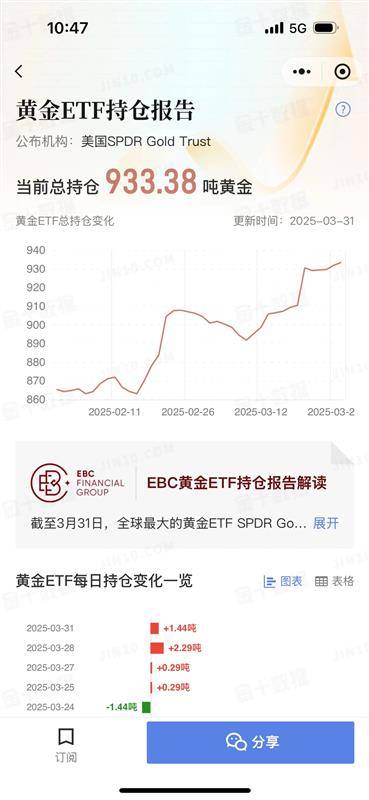
从3月表现来看,现货黄金继续今年以来亮眼表现,累计涨幅超过9%,已经连续三个月收涨,且今年一 季度涨幅超18%,创下1986年以来最佳季度表现,主要得益于特朗普政府的关税不确定性以及经济增长 担忧,促使资金涌入黄金避险。 本周,市场最关注的事件当属4·2对等关税日。如果没有预期的那么严重,那么黄金可能会开始回落, 因为高位获利回吐可能会被触发。此外,投资者还需要关注周五4月4日出炉的美国非农就业报告,这将 影响美联储的降息预期。如果就业市场恶化,将会支撑美联储进一步的降息行动,从而影响黄金价格。 技术面来看,日线图显示,14日相对强弱指数(RSI)进入高度超买区域,使得多头保持谨慎。不过,黄 金目前处于上升通道内,支持长期看涨倾向。4小时图显示,在持续大涨之后,技术指标进入超买区 间,或暗示金价短线将迎来技术性调整。 截至3月31日,全球最大的黄金ETFSPDR GoldTrust持仓量为933.38吨,较前一个交易日增加1.44吨。3 月31日,现货黄金飙涨40美元,盘中接连突破3100、3110、3120美元/盎司关口,最高触及31278.26美 元/盎司,继续刷新纪录高位,收盘仍然位于3120关口上方, ...

深夜,美股大跌!
21世纪经济报道· 2025-03-31 15:26
Market Overview - The U.S. stock market opened lower on Monday, with all three major indices declining, particularly the technology sector, where the Nasdaq index fell approximately 2% and Tesla dropped nearly 6% [1][4] - European and Asian markets also experienced significant declines following the U.S. market trend [4] Economic Concerns - The S&P 500 index has been under pressure since reaching a historical high in mid-February, down about 9% from its peak on February 19, while the Nasdaq has dropped approximately 14% since its highest close on December 16 of the previous year [6][7] - The upcoming announcement of "reciprocal tariffs" by President Trump on April 2 is expected to have a substantial impact on the market, with analysts warning of potential negative outcomes [7][11] Consumer Sentiment and Inflation - Consumer confidence in the U.S. has reached its lowest level in over two years, with the University of Michigan's consumer sentiment index revised down to 57 from 57.9 [8] - Long-term inflation expectations have risen to the highest level in 32 years, with the one-year inflation expectation increasing from 4.9% to 5% and the long-term expectation rising to 4.1% [8][9] Inflation Data - The PCE price index for February showed a month-over-month increase of 0.3% and a year-over-year increase of 2.5%, aligning with expectations [9] - The core PCE price index, excluding food and energy, rose 0.4% month-over-month, marking the highest level since January 2024, with a year-over-year increase from 2.7% to 2.8% [9][10] Market Sentiment - Wall Street is currently experiencing heightened anxiety due to the uncertainty surrounding Trump's tariff policies, with many investors adopting a "sell on rallies" mentality [11][12] - There are concerns that the S&P 500 index could drop to 5000 points if economic conditions worsen, with predictions of a potential recession looming [12][13] Investment Outlook - Some analysts suggest that emerging markets may become more attractive as investors shift focus away from U.S. assets due to the prevailing economic uncertainties [13] - Conversely, there are optimistic views from certain institutions predicting a rebound in U.S. stocks, with expectations of a 10%-15% increase this spring [13]

【招银研究|季度策略】当美国不再“例外”——招商银行研究院House View(2025年二季度)
招商银行研究· 2025-03-31 12:57
Asset Allocation Recommendations - The recommendation for major asset classes indicates a preference for high allocation in USD bonds and high dividend stocks, while suggesting a neutral allocation for A-shares and gold [1] - The outlook for the USD is a strong oscillation, while the Euro, RMB, and JPY are expected to show weak oscillation [1] Investment Strategy Recommendations - Cash and pure debt products are recommended for standard allocation, with a focus on increasing positions in long-term pure debt products when the 10-year government bond yield exceeds 2.0% [2] - For fixed income, a balanced approach is suggested, including strategies like quantitative neutral and multi-asset strategies [2] - A balanced allocation of growth, dividend, and consumer funds is recommended for equity investments, with a focus on technology as a long-term theme [2] Economic Overview - The U.S. economy is facing "stagflation" concerns, with a mixed outlook where consumer spending is weak but investment is recovering [5][6] - The European economy is showing signs of recovery, with fiscal policies supporting growth and a potential pause in interest rate cuts by the ECB [20] U.S. Economic Insights - The U.S. economy's growth forecast is negative at -1.8% due to trade deficits, but excluding trade, the outlook improves significantly [6] - Inflation concerns persist, with the CPI dropping to 2.8% and core CPI at 3.1%, indicating a potential for future rate adjustments by the Fed [11][16] European Economic Insights - Germany and the EU are increasing defense spending, which may enhance economic growth prospects, leading to a potential slowdown in rate cuts by the ECB [20] - The ECB has noted improvements in loan growth, reducing the necessity for continuous rate cuts [20] Japanese Economic Insights - Japan's wage growth is at a 33-year high, indicating a strengthening "wage-price" cycle, which may open up room for future interest rate hikes [25] - The Bank of Japan maintains a cautious stance, with market expectations for rate hikes increasing in the second half of the year [25] Commodity Market Insights - Gold is showing signs of overheating, with valuations nearing historical highs, suggesting caution for investors [50][55] - Oil prices are expected to stabilize, with Brent crude potentially rising above $85 per barrel due to supply constraints and macroeconomic stability [56] Chinese Economic Insights - China's economy is showing signs of recovery, with domestic demand improving and industrial production growth outpacing expectations [59][63] - The fiscal policy is becoming more proactive, with significant increases in government bond issuance to support economic growth [73][74]

瑞银:关税升级尚未被完全定价 建议进行这两种交易策略
智通财经网· 2025-03-31 08:57
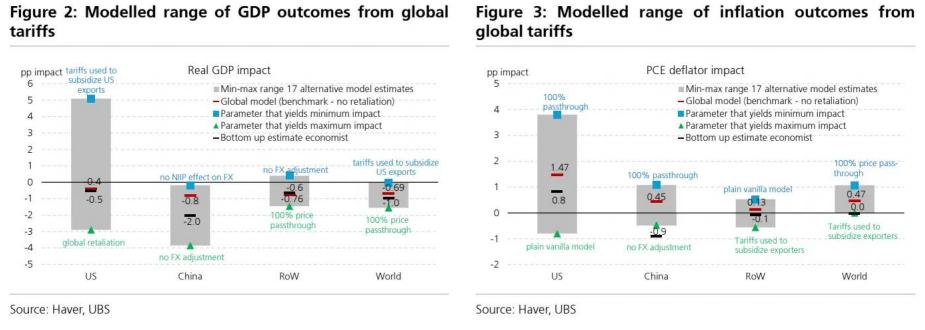
Core Viewpoint - UBS reports that de-globalization is a significant trend driving stagflation, with tariffs and de-globalization leading to inefficiencies and potential reductions in actual economic growth rates, alongside increased inflationary pressures [1] Group 1: Economic Impact of Tariffs - UBS estimates that imposing a 60% tariff on 75% of Chinese goods exported to the U.S. and a 10% tariff on goods from other countries could result in a global GDP decline of 0.5% [1] - Inflationary pressures are expected to be volatile, primarily affecting the U.S. economy [1] Group 2: Market Reactions - The bond and stock markets are adjusting to the anticipated tariff increases, with U.S. 10-year real yields dropping by 30-50 basis points and 2-year inflation expectations rising by 70 basis points since January [5] - Tariff-sensitive stocks in the U.S. have underperformed the broader market by 17%, while in Europe, the underperformance is 9% [5] Group 3: Sector Analysis - Analysts in the U.S. are broadly downgrading revenue and earnings growth expectations for tariff-sensitive sectors such as durable goods, automotive, and retail [5] - In Europe, analysts maintain resilient expectations for sectors like automotive, luxury goods, and pharmaceuticals, which are also sensitive to tariffs [5] Group 4: Investment Strategies - UBS suggests that hard assets (gold and energy) are likely to outperform other asset classes due to rising credit and yield risk premiums, with a projected 3% decline in the S&P 500 index [8] - Investors are advised to consider selling put options on gold ETFs (GDX.US) and buying put options on financial sector ETFs (XLF.US) to "harden" risk exposure [8] Group 5: Future Economic Outlook - UBS believes that while the European market shows resilience, cyclical investors face risks, particularly as tariff-sensitive stocks may decline further by 10% due to lowered earnings expectations [9] - The impact of de-globalization is expected to lead to lower actual economic growth rates, increased inflation expectations, and heightened risk premiums associated with corporate profit growth [12]

午评:沪金涨超1% 氧化铝跌超3%
Xin Lang Qi Huo· 2025-03-31 03:42
| ○ 序号 | | 合约名称 | 涨幅% | 最新 现手 | 买价 | 卖价 | 买量 卖量 成交量 | | --- | --- | --- | --- | --- | --- | --- | --- | | + 1 | | 氧化铝2505™ | -3.28% | 2946 | 6 2945 | 2946 | 50 41 195424 | | 4 | 2 | 焦煤2505 w | -2.88% | 994.0 | 993.5 6 | 994.0 | 12 4 273324 | | + | 3 | 焦炭2505 -2.63% | | 1575.5 | 1 1575.0 1576.0 | 2 | 6 18604 | | + | বাঁ | 中原2505 W | -2.32% | 2486 | 16 2485 | 2486 1939 | 21 686963 | | + | 5 | 玻璃2505 M | -2.31% | 1185 | 47 1185 | 1186 2157 | 133 1592938 | | + | 6 | 鸡蛋2505 W | -2.28% | 2960 | 6 2960 | 2961 | 64 ...

寻求第三次总统任期?特朗普称“有办法可以做到”
Mei Ri Jing Ji Xin Wen· 2025-03-31 03:11
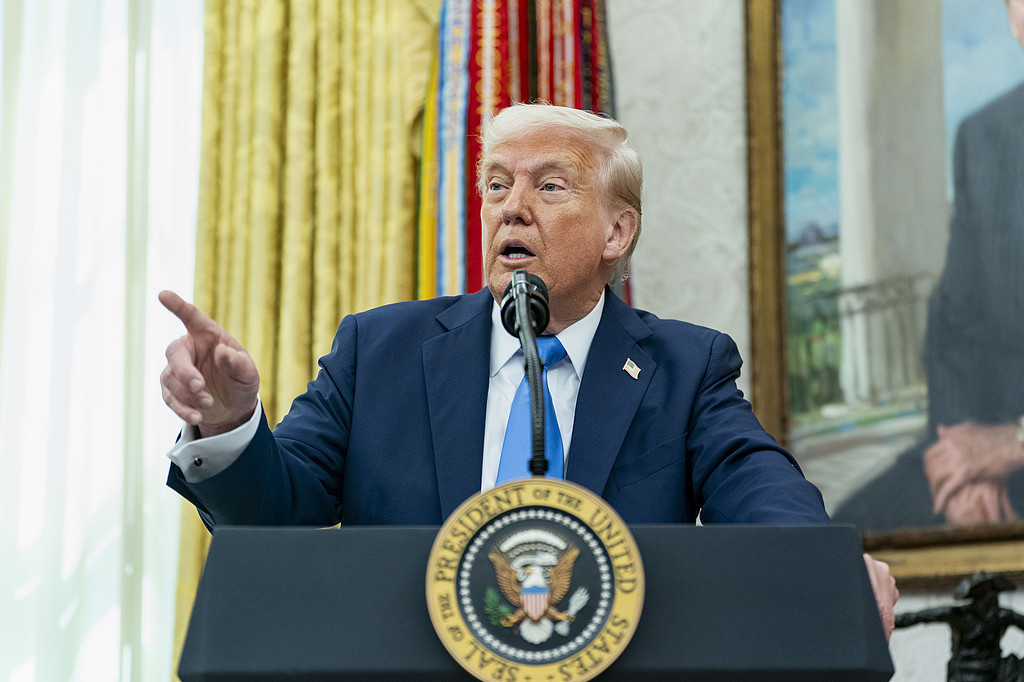
Group 1 - Trump has expressed the possibility of seeking a third presidential term, stating that it is too early to consider it seriously, and mentioned that "there are ways to do it" [1] - The 22nd Amendment of the U.S. Constitution limits presidents to two four-year terms, making it extremely difficult to overturn this amendment, requiring a two-thirds majority in both houses of Congress and approval from three-fourths of state legislatures [1] - Trump, at the age of 78, became the oldest president to assume office, surpassing Biden's record [1] Group 2 - Trump has run for president three times, first winning the election in 2016 and later losing in 2020, before announcing his candidacy again in 2022 [2] - Trump's political career began in 2015 when he announced his candidacy as a Republican, and he was officially nominated as the Republican candidate for the 2024 election in July 2024 [2] Group 3 - Concerns over a potential "Trump recession" have significantly impacted the U.S. stock market, with the market capitalization of the "Tech Seven" dropping by $2.7 trillion in three weeks [3] - Analysts warn that Trump's escalating tariff policies could lead to a recession or stagflation, drawing parallels to the policies of President Hoover during the Great Depression [3] - Goldman Sachs reported that the price-to-earnings ratio of the S&P 500 has increased by 25% over the past two years, indicating a potentially risky valuation for investors, with the current P/E ratio around 28 times [3] Group 4 - The cyclically adjusted P/E ratio of the S&P 500 is approximately 35 times, and historically, when this ratio exceeds 30, major U.S. stock indices have experienced declines ranging from 20% to 89% [4]
金荣中国:特朗普关税措施持续引爆行情,金价再创新高警惕见顶风险
Sou Hu Cai Jing· 2025-03-31 02:03
行情回顾: 国际黄金周五(3月28日)大幅收涨,开盘价3086.77美元/盎司,最高价3086.77美元/盎司,最低价3047.58美元/ 盎司,收盘价3083.71美元/盎司。 美国消费者信心指数终值与本月初的初步数据一致,连续第三个月下降,较2月份大幅下跌了12%。预期指数 更是急剧下降了18%,自2024年11月以来已累计下跌超过30%。本月的下降反映出,在所有不同人口统计特征 和政治倾向的群体中都达成了一个明确的共识:自2月份以来,共和党人同无党派人士和民主党人一样,对自 身的个人财务状况、商业环境、失业情况和通货膨胀的预期都在恶化。消费者们仍在担忧,在不断变化的经济 政策背景下,可能会面临经济困境。值得注意的是,三分之二的消费者预计未来一年失业率将会上升,这是自 2009年以来的最高值。鉴于近年来强劲的劳动力市场和收入一直是支撑消费者支出的主要力量,这一趋势揭示 了消费者群体的一个关键脆弱点。 荷兰国际集团分析称,美国2月份核心个人消费支出数据高于预期,这引发了人们对滞胀以及关税在未来可能 扮演的角色的新担忧。荷兰国际集团经济部门在一份报告中称:"美国正朝着错误的方向发展,令人担忧的 是,关税会带来 ...

美媒:担忧滞胀,美出现“典型避险交易日”
Huan Qiu Shi Bao· 2025-03-30 22:43
Group 1 - The US stock market experienced a significant decline, with the Dow Jones Industrial Average dropping over 700 points, marking a 1.7% decrease, the largest single-day drop since March 10 [1] - The Nasdaq index fell by 2.7%, resulting in a loss of approximately $505 billion in market value for the "Big Seven" tech companies [1] - The S&P 500 index decreased by nearly 2%, with 10 out of its 11 sectors closing lower, indicating a typical risk-off trading day characterized by rising bond prices and widening spreads [1] Group 2 - Recent economic data has raised concerns about stagflation in the US, with inflation levels falling short of expectations and consumer confidence deteriorating [2] - The core PCE price index for February showed a month-over-month increase of 0.4% and a year-over-year increase of 2.8%, both exceeding expectations [2] - The consumer confidence index for March dropped to 57, the lowest level since 2022, with consumers anticipating a 4.1% inflation rate over the next 5-10 years, the highest since February 1993 [2]