结构性降息

Search documents
宏观经济周报:基本面降息是储备而非标配-20260117
Guoxin Securities· 2026-01-17 14:31
Monetary Policy - The central bank has lowered the interest rates of various structural monetary policy tools by 25 basis points to 1.25%, below the short-term policy rate of 1.4%[1] - The central bank indicated that there is still room for further rate cuts in 2026, but these are likely to be used as a reserve tool rather than a routine operation[1][11] - Current monetary policy focuses on structural rate cuts rather than comprehensive rate cuts, reflecting internal constraints such as low net interest margins for commercial banks[1][11] Economic Indicators - Fixed asset investment has decreased by 2.6% year-on-year[3] - Retail sales have increased by 1.3% year-on-year[3] - Exports have risen by 6.6% year-on-year[3] Fiscal Policy - Fiscal spending is expected to increase in Q1 2026, supported by a significant carryover of surplus funds from 2025[2][12] - The combination of structural monetary easing and fiscal policy aims to effectively expand domestic demand and solidify economic recovery[12] Market Trends - Production remains strong, with high demand in sectors like machinery and textiles, while real estate transactions continue to decline[13][14] - Port cargo throughput has increased by 4.82% year-on-year, indicating robust foreign trade momentum[22] Risks - There are uncertainties in overseas markets that could impact economic stability[2][51]
中金研究 | 本周精选:宏观、策略、银行
中金点睛· 2026-01-17 01:08
Macroeconomy - The argument that the Chinese yuan is significantly undervalued based on the price of McDonald's hamburgers in China compared to the US is misleading. This perspective relies on the absolute purchasing power parity theory, which does not adequately account for asset price factors and misrepresents the nature of McDonald's pricing as a potentially non-tradable good [3]. Strategy - A-share market has seen a significant rise with a 16-day consecutive increase, reaching new highs, while the Hong Kong stock market has lagged behind, with the Hang Seng Tech Index experiencing a 20% decline since last October. The divergence raises questions about whether A-shares or Hong Kong stocks are mispriced, and the potential for a catch-up rally in Hong Kong stocks remains uncertain [6]. Industry - The narrative surrounding the trend of "deposit migration" has resurfaced, particularly with a large volume of deposits maturing. Common misconceptions about the implications of these maturing deposits and their actual flow are addressed, clarifying seven prevalent market misunderstandings [8]. Strategy - As the peak period for annual report previews approaches, the A-share market has shown a notable upward trend, with improved trading sentiment. Approximately 1.8% of A-share companies have disclosed their annual report forecasts, indicating potential sectors and companies that may exceed performance expectations [10]. Monetary Policy - The central bank's recent decision to lower various structural monetary policy tool rates by 0.25 percentage points reflects a commitment to maintaining moderate monetary easing while emphasizing structural adjustments. This aligns with the broader economic policy focus on quality and efficiency, amidst stable external demand [12].


2025年12月金融数据点评:社融受政府债券拖累,企业信贷需求持续回暖
East Money Securities· 2026-01-16 13:06
Social Financing - In December 2025, the domestic social financing scale increased by 22,075 billion yuan, a year-on-year decrease of 6,462 billion yuan[1] - The new government bond issuance in December was 6,833 billion yuan, a year-on-year decrease of 10,733 billion yuan, primarily due to the earlier issuance schedule in 2025[5] - The total amount of new government bonds issued in 2025 was 13.84 trillion yuan, an increase of 2.54 trillion yuan compared to 2024[5] Loans and Deposits - In December 2025, non-financial companies and other sectors added 10,700 billion yuan in new RMB loans, a year-on-year increase of 5,800 billion yuan[10] - Fiscal deposits decreased by 1.38 trillion yuan in December, indicating a potential acceleration of fiscal funds into the real economy[10] - Resident household loans in December were negative at -916 billion yuan, reflecting weak consumer demand[15] Monetary Supply - M2 grew by 8.5% year-on-year in December, with an increase of 0.5 percentage points from the previous month, while M1 grew by 3.8%, down by 1.1 percentage points[16] - The M2-M1 gap widened to 4.7 percentage points, an increase of 1.6 percentage points from the previous month[16] Interest Rates - The central bank announced a structural interest rate cut of 0.25 percentage points, aimed at reducing financing costs for the real economy[20] - The weighted average interbank lending rate in December was 1.36%, down by 0.06 percentage points from the previous month[20]
国证国际港股晨报-20260116
国投证券国际· 2026-01-16 12:26
Group 1: Market Overview - The Hong Kong stock market experienced a decline, with the Hang Seng Index falling by 0.28%, the Hang Seng China Enterprises Index down by 0.52%, and the Hang Seng Tech Index decreasing by 1.35% [2] - The total market turnover was HKD 290.455 billion, with short selling amounting to HKD 35.078 billion, representing 13.62% of the total turnover [2] - Southbound capital saw a net outflow of HKD 1.515 billion, with Alibaba, Tencent, and SMIC being the most bought stocks, while China Mobile, Xiaomi, and CNOOC faced the most selling pressure [2] Group 2: Sector Performance - The AI healthcare and internet healthcare sectors faced adjustments, with notable declines in stocks such as Jingtai Holdings down 10.74% and Alibaba Health down 7.84% [2] - The OTA platform Trip.com Group saw a significant drop of 19.23% due to an investigation by the State Administration for Market Regulation for alleged monopolistic behavior [3] - The optical communication sector performed well, with stocks like Huiju Technology rising by 8.89% and Cambridge Technology increasing by 7.75% [3] Group 3: Monetary Policy and Economic Measures - The People's Bank of China announced a series of targeted monetary easing measures, including a structural interest rate cut of 0.25 percentage points, aimed at reducing financing costs in specific sectors [4] - A total of CNY 1 trillion was allocated to support private enterprises, with an additional CNY 500 billion specifically for small and medium-sized private companies [4] - The bank also increased the quota for technology innovation and technical transformation loans by CNY 400 billion, bringing the total to CNY 1.2 trillion [4] Group 4: Company Analysis - 361 Degrees - 361 Degrees reported better-than-expected performance with offline retail growth of approximately 10% for both its main brand and children's clothing [7] - The company continues to see strong growth in e-commerce, achieving high double-digit growth rates [7] - The launch of new products across various categories, including running, basketball, and outdoor gear, reflects the company's commitment to innovation and brand development [8] Group 5: Investment Outlook for 361 Degrees - The company is expected to benefit from the introduction of new store formats, which will contribute positively to its performance [9] - The forecast for EPS from 2025 to 2027 is projected at CNY 0.60, CNY 0.69, and CNY 0.76, respectively, with a target price of HKD 7.6 based on a 10x PE ratio for 2026 [9]
【笔记20260116— 你大哥永远是你大哥】
债券笔记· 2026-01-16 10:52
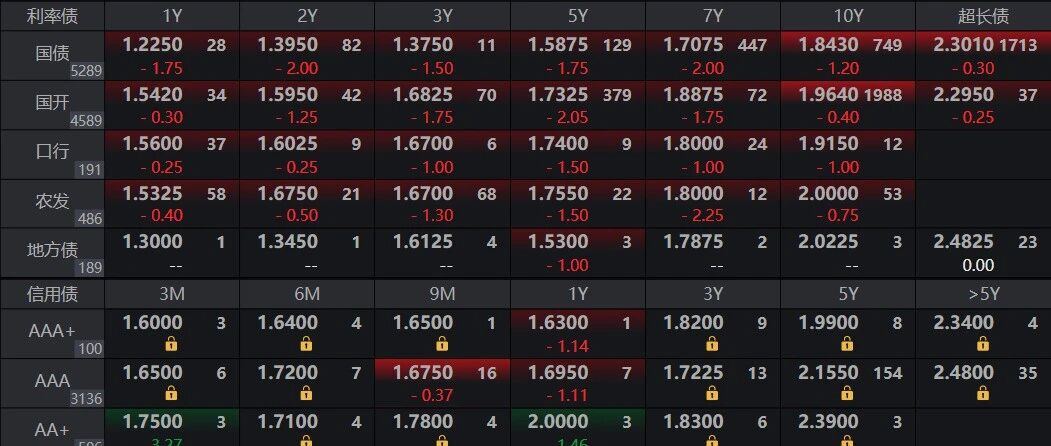
Group 1 - The core viewpoint emphasizes that in trading, it is more important to respond to market trends rather than predict market movements [1] Group 2 - The interbank funding environment is balanced, with a slight decline in long-term bond yields. The central bank conducted a 7-day reverse repurchase operation of 867 billion yuan, with a net injection of 527 billion yuan after 340 billion yuan matured [3] - The funding rates have continued to decline, with DR001 around 1.32% and DR007 around 1.44% [3] Group 3 - The stock market opened high but closed slightly lower, with a calm news environment and a slight decline in bond market rates. The 10-year government bond yield fluctuated around 1.848% before settling at approximately 1.8325% [5] - The first rule of survival in the stock and bond markets is that regulation is always the dominant force, impacting market behavior significantly [5]
(经济观察)降准降息信号释放 专家认为“还有空间”不是“大水漫灌”
Zhong Guo Xin Wen Wang· 2026-01-16 10:29
中新社北京1月16日电 (陶思阅)根据当前经济金融形势需要,中国央行打开政策"工具箱",宣布推出八 项结构性货币政策措施,并透露今年降准降息"还有一定空间"。后续政策怎么走,受到市场高度关注。 此番结构性货币政策措施包括:下调各类结构性货币政策工具利率0.25个百分点,单设额度1万亿元(人 民币,下同)的民营企业再贷款,下调商业用房购房贷款最低首付比例至30%等。这套"组合拳"旨在提 高银行重点领域信贷投放的积极性,进一步助力经济结构转型优化。 面对市场的流动性需求,中国央行并未直接调整公开市场操作利率,而是下调各类结构性货币政策工具 利率。分析认为,这种结构性"降息"虽非全面降息,但其信号意义不容忽视。 "结构性货币政策工具利率下调,将直接降低银行从中国央行获取再贷款资金的成本,激励银行以更低 的利率向科技创新、绿色转型等重点领域发放贷款,降低实体经济综合融资成本。"招联首席研究员董 希淼说。 中信证券研究团队认为,考虑到当前的金融市场环境,中国央行以结构性"降息"和对全面降息的积极表 态,兼顾了稳定市场预期和避免推升金融泡沫的目标。 本轮结构性"降息"计划于1月19日落地。市场将继续关注,全面降准降息还有 ...
国债期货周报:结构性降息落地,期债偏强震荡-20260116
Rui Da Qi Huo· 2026-01-16 09:25
瑞达期货研究院 「2026.1.16」 国债期货周报 结构性降息落地,期债偏强震荡 研究员 廖宏斌 期货从业资格号 F30825507 期货投资咨询从业证号 Z0020723 关 注 我 们 获取更多资讯 目录 1、行情回顾 2、消息回顾与分析 3、图表分析 4、行情展望与策略 政策及监管:1、沪深北交易所发布通知调整融资保证金比例,将投资者融资买入证券时的融资保证金最低比例从80%提高至100%。此次调整仅 限于新开融资合约,调整实施前已存续的融资合约及其展期仍按照调整前的相关规定执行;2、央行打出"组合拳"支持经济高质量发展。其中 包括:下调再贷款、再贴现利率0.25个百分点;合并使用支农支小再贷款与再贴现额度,增加支农支小再贷款额度5000亿元,总额度中单设1万 亿元民营企业再贷款,重点支持中小民营企业;科技创新和技术改造再贷款额度增加4000亿元并扩大支持范围;拓展碳减排支持工具支持领域; 将商业用房购房贷款最低首付比例下调至30%。央行表示,今年降准降息还有一定空间;3、财政部、税务总局发布公告,自2026年1月1日起至 2027年12月31日止,对境外机构投资境内债券市场取得的债券利息收入暂免征收 ...
瑞达期货宏观市场周报-20260116
Rui Da Qi Huo· 2026-01-16 09:23
Report Investment Rating - No investment rating for the industry is provided in the report. Core Viewpoints - The A-share market had a mixed performance this week, with most major indices rising except for the Shanghai Composite Index. The four stock index futures also showed differentiation, with small and medium-cap stocks outperforming large-cap blue-chip stocks. The release of positive economic data drove the market up, but the increase in margin requirements for margin trading cooled market sentiment [9][15]. - The bond market strengthened this week. The central bank's structural interest rate cut aims to guide commercial banks to allocate credit resources precisely. However, the weak market allocation demand and the continuous supply pressure of long-term bonds may cause short-term interest rates to fluctuate [9]. - The commodity market faced upward pressure in the short term. Although domestic price recovery is expected to boost the commodity index, the strengthening of the US dollar index and the decline of crude oil prices due to eased supply risks have affected the index [9]. - The foreign exchange market is affected by geopolitical tensions and the Fed's policy. The US dollar may fluctuate within a range, and the euro may be moderately supported in the long term, while the Japanese yen may continue to fluctuate in the short term [9]. Summary by Directory This Week's Summary and Next Week's Allocation Suggestions - **Stock Market**: The Shanghai and Shenzhen 300 Index fell 0.57%, and the Shanghai and Shenzhen 300 stock index futures fell 0.35%. A-share major indices generally rose this week, except for the Shanghai Composite Index. The four stock index futures showed differentiation, with small and medium-cap stocks stronger. The release of inflation and import-export data drove the market up, but the increase in margin requirements for margin trading led to a decline. The allocation suggestion is to buy on dips [9][15]. - **Bond Market**: The 10-year Treasury bond yield fell 0.17%, and the main 10-year Treasury bond futures rose 0.27%. The bond market strengthened this week. The central bank's structural interest rate cut aims to guide credit allocation, but the weak market demand and supply pressure may cause short-term interest rate fluctuations. The allocation suggestion is to operate within a range [9]. - **Commodity Market**: The Wind Commodity Index rose 14.29%, and the CSI Commodity Futures Price Index rose 2.97%. The commodity market faced short-term upward pressure due to the strengthening of the US dollar index and the decline of crude oil prices. The allocation suggestion is to wait and see [9]. - **Foreign Exchange Market**: The euro against the US dollar fell 0.19%, and the euro against the US dollar 2603 contract fell 0.24%. Geopolitical tensions and the Fed's policy have led to increased uncertainty in the foreign exchange market. The US dollar may fluctuate within a range, and the euro may be moderately supported in the long term, while the Japanese yen may continue to fluctuate in the short term. The allocation suggestion is to be cautious and wait and see [9]. Important News and Events - **Domestic News**: The State Council deployed a package of policies to promote domestic demand through fiscal and financial cooperation; the National Business Work Conference outlined key tasks for 2026; four departments jointly issued a work plan for government investment funds; and the Ministry of Commerce reported progress in the China-EU electric vehicle case [17]. - **International News**: The Fed released its economic "Beige Book"; the criminal investigation of Fed Chairman Powell continued to ferment; the World Bank raised the global economic growth forecast for 2026; and Trump announced a 25% tariff on all business partners of Iran [19]. This Week's Domestic and International Economic Data - **China**: In December, the year-on-year export rate in US dollars was 6.6%, the import rate was 5.7%, the M1 money supply growth rate was 3.8%, and the M2 money supply growth rate was 8.5% [20]. - **US**: In December, the unadjusted CPI annual rate was 2.7%, the unadjusted core CPI annual rate was 2.6%, the November retail sales monthly rate was 0.6%, the November PPI annual rate was 3%, and the initial jobless claims for the week ending January 10 were 198,000 [20]. - **EU**: In November, the industrial output monthly rate in the eurozone was 0.7% [20]. - **UK**: In November, the three-month GDP monthly rate was 0.1%, and the manufacturing output monthly rate was 2.1% [20]. - **Germany**: The full-year GDP growth rate in 2025 was 0.2% [20]. - **France**: In December, the CPI monthly rate was 0.1% [20]. - **Japan**: In November, the trade balance was 625.3 billion yen [20]. Next Week's Important Economic Indicators and Economic Events - **January 20**: China's one-year loan prime rate, Germany's December PPI monthly rate, and the UK's December unemployment rate [82]. - **January 21**: The UK's December CPI monthly rate, retail price index monthly rate, and the US's December pending home sales index monthly rate [82]. - **January 22**: The US's initial jobless claims for the week ending January 17, the third-quarter real GDP annualized quarterly rate, the third-quarter real personal consumption expenditure quarterly rate, and the third-quarter core PCE price index annualized quarterly rate [82]. - **January 23**: Japan's central bank target rate, Japan's December core CPI annual rate, the UK's December seasonally adjusted retail sales monthly rate, and the US's January University of Michigan consumer confidence index final value [82].

资金观察,货币瞭望:政策宽松加结构性降息,预计1月市场利率下行
Guoxin Securities· 2026-01-16 09:09
Core Insights - The report indicates a policy easing combined with structural interest rate cuts, predicting a decline in market interest rates in January [4][52][77] Group 1: Overseas Monetary Market Indicators - The expectation for interest rate cuts in overseas markets has weakened, with short-term US Treasury rates rebounding to around 3.7% [6] - The Federal Funds rate and SOFR rates have remained stable since December [6] Group 2: Domestic Monetary Market Indicators - Price indicators show that the interbank and exchange repo rates generally increased in December, with R001, GC001, R007, and GC007 changing by -7BP, 14BP, 7BP, and 14BP respectively [11][19] - Volume indicators reveal that the overnight transaction volume in both interbank and exchange markets increased compared to the previous month, although the proportion slightly declined [34] - The excess reserve ratio is estimated to be 1.6% for December and 1.1% for January [4][42] Group 3: January Funding Outlook - The central bank's supportive stance, combined with the seasonal tendency for liquidity to ease after the year-end, suggests a decline in market interest rates in January [4][52] - The central bank is expected to net withdraw liquidity in January, with a slight decrease in the excess reserve ratio anticipated [72] Group 4: Short-term Bond Yield Changes - In December, the yields on short-term bonds showed mixed trends, with 1-year government bonds and 1-year policy bank bonds changing by -3BP and -2BP respectively [25] - The yield spread between 1-year AAA short-term financing bonds and government bonds slightly widened by 6BP [25] Group 5: Money Market Fund Returns - The 7-day annualized yield for the Yu'ebao fund was 1.02% in December, with the average yield for the top ten money market funds showing a slight increase [28] Group 6: Seasonal Trends in Monetary Indicators - December saw a significant reduction in fiscal deposits, with a decrease of 13,845 billion yuan, while January is expected to see a seasonal increase in fiscal deposits of around 4,000 billion yuan [59] - The M0 increased by 3,892 billion yuan in December, with an expected increase of 7,000 billion yuan in January due to cash demand ahead of the Spring Festival [53]
刚刚!市场突现三大变数!
券商中国· 2026-01-16 04:22
Core Viewpoint - The market's expectations are changing, with a notable shift in sentiment following a structural interest rate cut, leading to adjustments in various market segments [1]. Group 1: Liquidity Expectations - The M1 growth rate fell in December, with a monthly increase of 2.6 trillion yuan, raising debates about liquidity transmission and corporate investment willingness [2][3]. - Some analysts believe the decline in M1 growth is due to a high base effect, while others point to a decrease in corporate and household liquidity willingness, as indicated by a drop in M0 and demand deposits [3]. - M2 growth increased by 0.5 percentage points to 8.5%, but M1 did not show a corresponding improvement, suggesting that credit expansion has not effectively converted into demand deposits [3]. Group 2: Interest Rate Cut Expectations - On January 15, the central bank announced a 25 basis point cut in the re-lending and rediscount rates, which initially boosted market sentiment [5]. - However, subsequent market performance indicated a divergence from initial expectations, with analysts suggesting that the likelihood of further interest rate cuts before the Spring Festival has decreased, although a reserve requirement ratio cut remains possible [6]. Group 3: Investor Profit Expectations - Market participants' profit expectations are shifting, with State Grid announcing a 4 trillion yuan fixed asset investment plan for the 14th Five-Year Plan, a 40% year-on-year increase [7]. - Despite the initial positive response in the smart grid sector, the overall market sentiment has cooled, as evidenced by a nearly 1 trillion yuan drop in trading volume [7]. - Analysts suggest that a temporary cooling of market sentiment is not necessarily negative, as maintaining high trading volumes could deplete market liquidity and disrupt market ecology [7].