
量化紧缩(QT)

Search documents
美联储“量化紧缩终结”是一场静默的流动性反转
Di Yi Cai Jing· 2025-11-02 12:35
Core Viewpoint - The Federal Reserve's transition from a shrinking balance sheet to a liquidity stabilizing anchor marks a key point in the normalization of monetary policy in the post-pandemic era [1] Summary by Sections Federal Reserve's Balance Sheet Management - The Federal Reserve announced the end of its quantitative tightening (QT) plan effective December 1, 2025, ceasing the active reduction of its securities holdings [1] - The total assets of the Federal Reserve stood at $6.54 trillion as of October 22, 2025, down from a peak of $8.96 trillion in April 2022, maintaining a ratio of approximately 22% of nominal GDP [1] QT Process Review - QT began on June 1, 2022, amid the highest inflation since December 1981, with a maximum monthly reduction of $95 billion in liquidity from the financial system [2] - The pace of QT was adjusted multiple times, with the monthly reduction slowing to approximately $38.5 billion by April 2025 [2] Balance Sheet Structure - The holdings of U.S. Treasury securities decreased from a peak of $5.77 trillion in 2022 to $4.20 trillion by October 2025, while MBS holdings fell from $2.74 trillion to $2.07 trillion [3] - Significant interruptions in the QT process occurred during the banking crises in March 2023 and due to seasonal tax payments in January 2025 [3] Monetary Market Pressure Signals - Key indicators in the monetary market showed stress, including a significant drop in the Federal Reserve's overnight reverse repurchase agreement (ON RRP) balance, which fell from $2.55 trillion to $219 billion [4] - The effective federal funds rate (EFFR) and interest on excess reserves (IOER) spread widened, indicating increased volatility in short-term financing markets [4] Policy Adjustment Details - The FOMC unanimously agreed to end QT, with a focus on reinvesting the principal payments from maturing securities into short-term T-bills [6] - The Federal Reserve aims to align its balance sheet with banking reserve needs and nominal GDP growth, indicating a shift towards a more dynamic management approach [6] Impact of Reinvestment on Liquidity - The end of QT allows for the reinjection of funds into the financial system, which is expected to lower long-term interest rates and improve liquidity conditions [7] - The reinvestment strategy is projected to lead to a monthly balance sheet expansion of $25 billion to $35 billion due to the natural reduction of MBS holdings [8] Bond Market Reaction - The bond market reacted swiftly to the end of QT, with a notable decline in the yields of 10-year and 30-year U.S. Treasury securities [9] - The narrowing of swap spreads indicates a renewed interest in trading strategies that bet on the convergence of Treasury yields and swap rates [9] Mortgage and Corporate Financing - The housing market is expected to benefit from declining long-term interest rates, with forecasts suggesting a drop in 30-year fixed mortgage rates [10] - Corporate financing conditions are improving, with a significant increase in investment-grade corporate bond issuance and a reduction in high-yield bond spreads [11] Currency and Bitcoin Trends - The U.S. dollar weakened significantly following the announcement, with the dollar index experiencing its largest single-day drop since July 2024 [12] - Bitcoin's price showed volatility post-announcement, reflecting mixed market sentiment regarding future liquidity conditions [13] Policy Framework Adjustment - The end of QT signifies a deeper evolution in the Federal Reserve's monetary policy framework, moving towards a model that adjusts reserves in line with economic activity [14] - Economic data supports a cautious easing path, with expectations of potential interest rate cuts in 2026 [14] 2025 Outlook - The Federal Reserve's balance sheet is expected to stabilize around $6.54 trillion until the end of 2025, with a potential shift to net purchases of Treasury securities in early 2026 [15] - The overall liquidity improvement is anticipated to positively impact various sectors, including real estate and small business financing, while putting pressure on the dollar [15]
花旗:美联储12月是否降息,或许取决于“美国政府关门何时结束”
美股IPO· 2025-11-02 06:28
Core Viewpoint - The ongoing U.S. government shutdown is creating a "data fog" for the Federal Reserve, making its December interest rate decision uncertain. The longer the shutdown lasts, the less likely a rate cut will occur, according to Morgan Stanley, while Citigroup remains optimistic about a resolution within two weeks, allowing for potential rate cuts [1][4][12]. Group 1: Impact of Government Shutdown - The duration of the government shutdown directly affects the availability of key economic data, which the Federal Reserve relies on for decision-making. A longer shutdown leads to a higher probability of pausing rate cuts [4][9]. - The Federal Reserve's Chairman Jerome Powell has indicated that the lack of data will lead to more cautious actions, comparing the situation to "driving in fog" [3][5]. Group 2: Market Perspectives - Morgan Stanley believes that the longer the shutdown continues, the lower the chances of a rate cut, emphasizing the importance of timely data for the Fed's decisions [4][11]. - In contrast, Citigroup expresses confidence that the government will reopen within two weeks, which would provide the Fed with sufficient data to support a rate cut in December [12][16]. Group 3: Scenarios Based on Shutdown Duration - Scenario 1: If the shutdown ends next week, the Fed could receive multiple employment reports and key inflation data, supporting a rate cut decision [11]. - Scenario 2: If the shutdown ends by mid-November, the Fed may only have limited data, but state-level unemployment data could still provide some insights [11]. - Scenario 3: If the shutdown extends past Thanksgiving, the Fed may only have access to September's data, increasing the likelihood of pausing rate cuts unless strong negative signals emerge [11]. Group 4: Immediate Economic Pressures - The shutdown has already impacted social welfare programs, with the Supplemental Nutrition Assistance Program (SNAP) benefits ceasing on November 1, affecting up to 42 million Americans [13]. - There is an impending crisis regarding military pay, as funds for military salaries are running low [14]. - Upcoming local elections may create new political momentum to resolve the shutdown [15].



美联储12月是否降息,或许取决于“美国政府关门何时结束”
Hua Er Jie Jian Wen· 2025-11-02 04:28
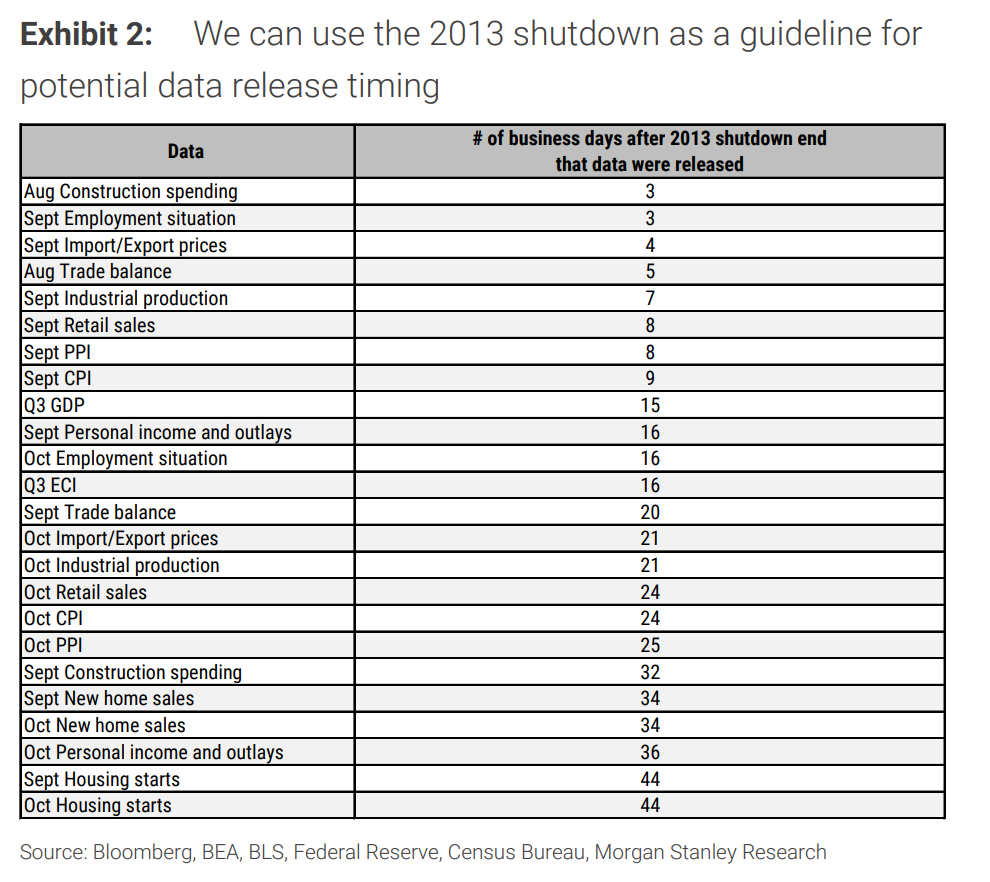
Core Viewpoint - The ongoing U.S. government shutdown is creating a "data fog" for the Federal Reserve, making its December interest rate decision uncertain [1] Group 1: Federal Reserve's Position - Fed Chairman Powell's recent statements have shifted from a dovish to a more hawkish tone, indicating that a rate cut in December is "far from certain" [1][2] - Powell emphasized that the Fed's monetary policy is "not on a preset path" and will increasingly rely on data, highlighting the challenges posed by the current lack of economic data [2] - The Fed announced it will halt quantitative tightening (QT) starting December 1, which some market participants view as a dovish countermeasure [2] Group 2: Impact of Government Shutdown - The duration of the government shutdown directly affects the data available for the Fed's decision-making [3] - Morgan Stanley's analysis suggests that the longer the shutdown lasts, the lower the probability of a rate cut [5] - Historical data from the 2013 government shutdown indicates that the timing of data releases is critical for the Fed's decision-making process [4] Group 3: Market Perspectives - Morgan Stanley believes that if the shutdown continues, the Fed will have limited data to support a rate cut, while Citi expresses optimism that the shutdown may end within two weeks, allowing for timely data releases [7][8] - Citi forecasts that if the government reopens soon, the Fed could receive multiple employment reports before the December meeting, supporting a potential rate cut [7] - Different scenarios regarding the end of the shutdown illustrate varying levels of data availability, impacting the Fed's ability to make informed decisions [8]
美联储再降息25个基点,12月是否继续降息远未定局
Sou Hu Cai Jing· 2025-10-30 18:05
Core Viewpoint - The Federal Reserve announced a 25 basis point interest rate cut, marking the second reduction this year, but Chairman Powell's hawkish remarks created uncertainty about future cuts [1][3][10]. Group 1: Interest Rate Decision - The Federal Reserve's decision to cut rates was in line with market expectations, with a high probability of a cut predicted before the meeting [3]. - The FOMC noted that economic activity is expanding at a moderate pace, with employment growth slowing and inflation rates remaining high [3]. - There was internal dissent within the Fed regarding the rate cut, with some members advocating for a more aggressive 50 basis point cut while others preferred to maintain current rates [8][10]. Group 2: Market Reaction - Powell's hawkish comments led to a significant market reaction, with major U.S. stock indices dropping during his press conference, while the dollar index rose sharply [15]. - Following Powell's remarks, traders adjusted their expectations for a December rate cut, reducing the probability from 90% to 71% [15]. Group 3: Economic Context - The Fed's meeting occurred amid a government shutdown, which has delayed the release of key economic data, including employment figures [18]. - Powell acknowledged that the shutdown would temporarily impact economic activity but emphasized that the Fed has alternative data sources to monitor the economy [18]. Group 4: Future Rate Path - There are notable divisions among Fed officials regarding future rate cuts, with some predicting additional cuts in the coming months while others express concerns about inflation [20]. - The market is left uncertain as Powell did not commit to a December rate cut, contrasting with previous market expectations [20].
DLS外汇:鲍威尔保持“可选”态度,降息后美元还能守住强势吗?
Sou Hu Cai Jing· 2025-10-30 09:47
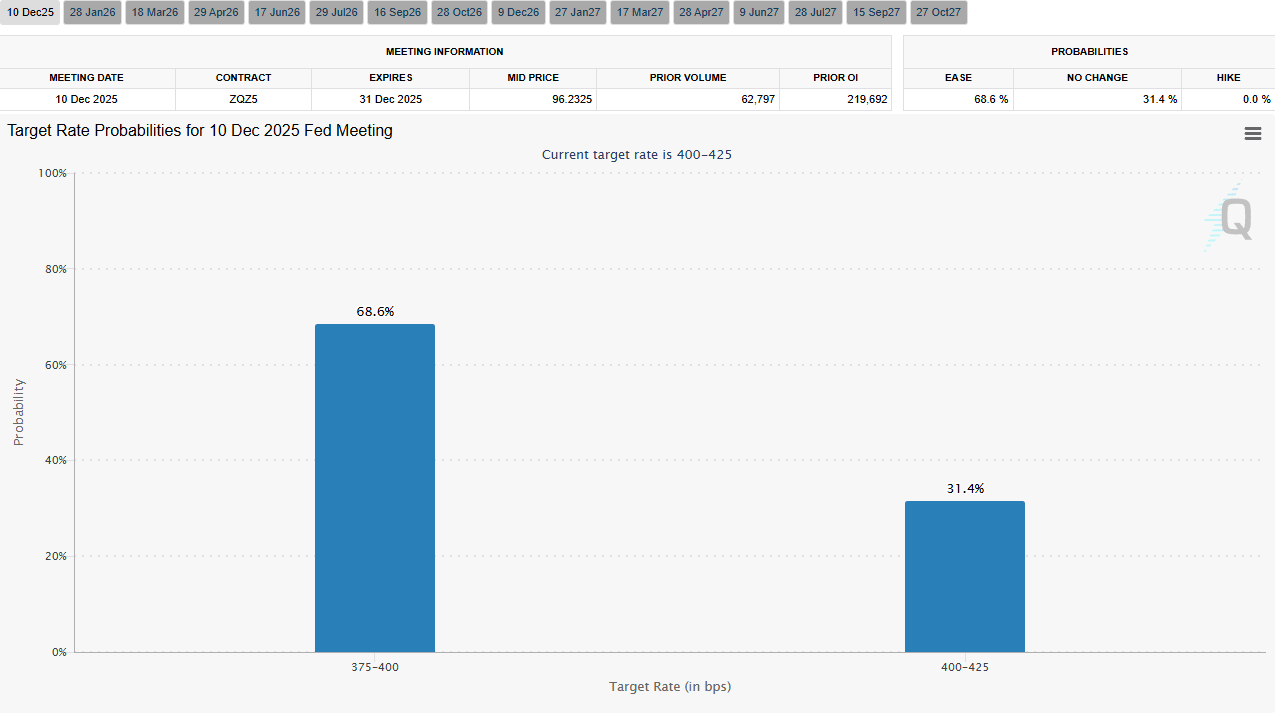
Group 1 - The Federal Reserve lowered the interest rate by 25 basis points to a target range of 3.75%–4.00% and confirmed that quantitative tightening (QT) will end on December 1, while restoring policy flexibility before the end of the year [1][3] - Market expectations indicate a 68.6% probability of another rate cut in December, with a 31.4% chance of maintaining the current rate [4] - Powell's cautious statements have led to a more measured market response, reducing expectations for aggressive easing [3][6] Group 2 - The October rate cut provides the Federal Reserve with the flexibility to pause if data stabilizes, while the end of QT on December 1 will slightly increase liquidity, reducing the urgency for further rate cuts [6] - Key economic data releases in November, including CPI, employment, and GDP, will be critical for decision-making [6] - The dollar remains strong despite the rate cut, as the move was anticipated and the Fed's credibility remains intact [8][12] Group 3 - The dollar index is currently stabilizing within the fair value gap (FVG) range of 98.63–99.35, maintaining a bullish outlook as long as it holds above 98.60 [10][14] - A breakout above the FVG range could target levels of 99.35–99.70, while a drop below 98.63 would shift the short-term trend to bearish [12][14] - The overall strategy of the Federal Reserve is seen as proactive rather than reactive, with a focus on maintaining vigilance against inflation while restoring policy flexibility [14]
【环球财经】新加坡大华银行:美联储再降息 预计年内仍将再降息一次
Xin Hua Cai Jing· 2025-10-30 05:22
Core Points - The Federal Reserve decided to lower the federal funds rate target range by 25 basis points to 3.75%-4.00% during its meeting on October 28-29, marking the second rate cut in 2025 following September's decision [1] - The Fed announced it will stop monthly reductions of its balance sheet starting December 1, effectively ending the quantitative tightening process that began in 2022 [1] - UOB's macro research report indicates a possibility of another 25 basis point rate cut in December, with two additional cuts expected in 2026 [1] Summary by Sections Federal Reserve Decision - The rate cut decision was not unanimous, with a vote of 10 to 2, indicating differing opinions among Fed officials [1] - Fed Governor Miran opposed the decision, advocating for a 50 basis point cut, while Kansas City Fed President Schmid preferred to keep rates unchanged [1] Economic Context - Fed Chair Powell described the October rate cut as a "risk management measure" aimed at aligning policy closer to a neutral stance [2] - Powell acknowledged the limitations in obtaining key economic data due to the ongoing government shutdown, suggesting a cautious approach for the December decision [2] Market Expectations - Despite Powell's cautious remarks, market expectations for a December rate cut decreased from "almost certain" to 67.1%, yet UOB maintains its forecast for a 25 basis point cut [2] - UOB predicts that by the end of 2025, the upper limit of the federal funds rate target range will reach 3.75%, with two additional cuts anticipated in 2026, bringing the terminal rate to 3.25% [2] Upcoming Meetings - The next FOMC meeting is scheduled for December 9-10 [3]

新加坡大华银行:美联储再降息,预计年内仍将再降息一次
Sou Hu Cai Jing· 2025-10-30 04:05
Core Points - The Federal Reserve decided to lower the federal funds rate target range by 25 basis points to 3.75%-4.00% during the meeting on October 28-29, marking the second rate cut in 2025 following September's decision [1] - The Fed announced it will halt the monthly reduction of its balance sheet starting December 1, effectively ending the quantitative tightening (QT) process that began in 2022 [1] - UOB's macro research report indicated that the Fed may cut rates by another 25 basis points in December and potentially two more cuts in 2026 [1] - The rate decision was not unanimous, with a vote of 10 to 2; Fed Governor Miran opposed the decision, advocating for a 50 basis point cut, while Kansas City Fed President Schmid preferred to maintain rates [1]
新加坡大华银行:美联储再降息 预计年内仍将再降息一次
Xin Lang Cai Jing· 2025-10-30 03:46
Group 1 - The Federal Reserve decided to lower the federal funds rate target range by 25 basis points to 3.75%-4.00%, marking the second rate cut in 2025 following September's decision [1] - The Fed announced it will stop monthly reductions of its balance sheet starting December 1, ending the quantitative tightening process that began in 2022 [1] - UOB's macro research report indicates a possibility of another 25 basis point rate cut in December, with two additional cuts expected in 2026 [1][2] Group 2 - The rate decision was not unanimous, with a vote of 10 to 2; dissenting opinions included a call for a 50 basis point cut and a preference to maintain the current rate [1] - Fed Chair Powell described the October rate cut as a "risk management measure" aimed at aligning policy closer to a neutral stance, acknowledging data limitations due to the government shutdown [2] - Market expectations for a December rate cut decreased from "almost certain" to 67.1% following Powell's cautious remarks, although UOB maintains its forecast for a 25 basis point cut [2]
国际银寻找低点上涨 美联储量化紧缩将画句号
Jin Tou Wang· 2025-10-30 03:28
Group 1 - The Federal Reserve announced the resumption of limited Treasury bond purchases, officially ending years of quantitative tightening (QT) policy, which is expected to stabilize bond holdings and slow monetary market tightening [2] - The plan includes maintaining a maximum of $35 billion in mortgage-backed securities (MBS) per month without reinvestment, with all MBS maturity funds reinvested into Treasury bonds starting December 1 [2] - Market expectations for a rate cut in December have significantly cooled due to the Fed's hawkish stance, as indicated by comments from Fed Chair Powell [2] Group 2 - International silver is currently trading below $47.52, with a slight decline of 0.33% to $47.36 per ounce, indicating a short-term bearish trend [1] - Despite the current bearish sentiment, the silver market shows strong fundamentals and potential for future price increases, with a target of $49.5 expected this week [2] - The previous strategy of buying silver around $46 remains unchanged, with expectations for continued bullish momentum [2]
美联储降息25基点,12月结束缩表
3 6 Ke· 2025-10-30 02:51
Group 1 - The Federal Reserve continues its interest rate cut by 25 basis points and plans to end its balance sheet reduction (QT) in December [1][2] - The target range for the federal funds rate is lowered from 4.00%-4.25% to 3.75%-4.00%, marking the first consecutive rate cuts in a year [1][2] - Market expectations have fully absorbed the likelihood of three rate cuts this year, with a 99.9% probability for the recent cut and a 91% probability for another cut in December [2] Group 2 - The decision to end the balance sheet reduction means that the Fed's QT actions will conclude after three and a half years, with short-term Treasury securities replacing maturing MBS holdings starting in December [2][3] - The Fed will reinvest principal payments from maturing securities into short-term U.S. Treasury bonds, with specific limits on the amounts for different securities [3] Group 3 - Fed Chair Powell indicated that there is significant disagreement among committee members regarding the potential for another rate cut in December, emphasizing that future policy is not predetermined [5][6] - Economic activity is expanding at a moderate pace, with GDP growth at 1.6% for the first half of the year, lower than the previous year's 2.4% [6] - The labor market is showing signs of cooling, with employment growth slowing and increased risks to job stability noted [6][8]