
纯碱等

Search documents
《能源化工》日报-20260313
Guang Fa Qi Huo· 2026-03-13 01:49
1. Report Industry Investment Ratings No relevant content provided. 2. Core Views of the Reports Pure Benzene and Styrene - Due to the tense geopolitical situation, the supply of pure benzene is expected to decline, and the supply - demand outlook has improved. However, the price will fluctuate with oil prices. The strategy is to wait and see on a single - side basis and shrink the EB04 - BZ04 spread when it is high [1]. - The supply of styrene in March remains high, and the supply - demand is expected to slightly reduce inventory. The price will follow oil price fluctuations, and the strategy is the same as that for pure benzene [1]. Urea - The short - term price of urea is relatively firm, but there may be a downward trend after the return - green fertilizer season in mid - March, mainly affected by sentiment. The main contract should focus on whether it can break through the 1860 - 1900 range, and the strategy is to go long at low levels [2]. PVC and Caustic Soda - The short - term rise of caustic soda is due to the optimistic expectations from geopolitical conflicts. The supply - demand situation is still severe, and attention should be paid to the actual delivery volume of downstream and the price fluctuation of liquid chlorine [3]. - The price of PVC is expected to be passively pushed up. The supply - demand situation has slightly changed, and the cost - end transmission has uncertainties [3]. Natural Rubber - The new rubber supply is gradually being released, and the demand has uncertainties. The price is expected to fluctuate within the range of 16500 - 17500, and attention should be paid to the reduction of tire demand in the Middle East [4]. Glass and Soda Ash - The supply of soda ash is strong and the demand is weak, and it is affected by macro fluctuations. The market is expected to fluctuate, and the range is 1150 - 1300. The strategy is to wait and see on a single - side basis and consider the arbitrage of short soda ash and long glass [5]. - The supply of glass has a low daily melting volume, and the inventory has been well reduced. The strategy is to wait and see, with a range of 1000 - 1150, and go long at low levels after the macro situation stabilizes. Also, consider the arbitrage of short soda ash and long glass [5]. Polyolefins - The short - term market of LLDPE and PP is strong due to cost support, supply reduction, and demand recovery expectations. Attention should be paid to the sustainability of cost support and the actual procurement demand of downstream [6]. Methanol - The price of methanol is widely fluctuating due to geopolitical sentiment. The supply may have an actual reduction, the demand is gradually recovering, and the inventory has started to reduce. Attention should be paid to the progress of the conflict, the inventory reduction rhythm, and the implementation of maintenance [7]. Crude Oil - In the short term, oil prices will maintain a pattern of "policy suppression + geopolitical support", and Brent is likely to fluctuate in the range of 80 - 100 US dollars per barrel [8]. Polyester Industry Chain - For PX, the supply is expected to decline, but attention should be paid to the downstream negative feedback. The price will follow oil price fluctuations, and the strategy is to go long at low levels after the market stabilizes [10]. - For PTA, the self - driving force is limited, and the price follows the cost - end. The strategy is to wait and see on a single - side basis [10]. - For ethylene glycol, the supply in March has decreased significantly, and the inventory reduction amplitude may increase. The price has the momentum to rise, but attention should be paid to the risk of a sharp fall [10]. - For short - fiber, the supply - demand pattern is weak, and it follows the raw material fluctuations. The strategy is the same as that for PTA [10]. - For bottle - chips, the supply is expected to increase in March, and the supply - demand is expected to be tight. The strategy is the same as that for PTA [10]. LPG No specific view statement provided. 3. Summaries According to Relevant Catalogs Pure Benzene - Styrene - **Upstream Prices and Spreads**: On March 12, the prices of Brent crude oil, WTI crude oil, CFR Japan naphtha, etc. all increased compared with March 11, while the spreads of pure benzene - naphtha and ethylene - naphtha decreased [1]. - **Benzene - Styrene - Related Prices and Spreads**: The prices of benzene - styrene spot and futures increased slightly, but the spreads and cash - flows decreased to varying degrees [1]. - **Downstream Cash - Flows**: The cash - flows of downstream products such as phenol, caprolactam, and aniline changed, with some increasing and some decreasing [1]. - **Inventory and Operating Rates**: The inventories of pure benzene and benzene - styrene in Jiangsu ports decreased, and the operating rates of some industries changed slightly [1]. Urea - **Futures and Spot Prices**: The futures prices of urea increased, and the spot prices were generally stable [2]. - **Raw Materials and Downstream Products**: The prices of upstream raw materials were mostly stable, and the prices of some downstream products increased slightly [2]. - **Supply and Demand**: The daily production of urea decreased slightly, the operating rate remained high, and the inventory decreased slightly. The demand from agriculture and industry is in a state of recovery [2]. PVC and Caustic Soda - **Spot and Futures Prices**: The prices of caustic soda and PVC increased to varying degrees, and the basis and spreads changed [3]. - **Overseas Quotes and Export Profits**: The overseas quotes of caustic soda and PVC changed, and the export profits increased [3]. - **Supply and Demand**: The operating rate of the caustic soda industry decreased slightly, and the operating rate of the PVC industry decreased slightly. The demand for downstream products of caustic soda and PVC improved [3]. - **Inventory**: The inventory of caustic soda factories increased slightly, and the inventory of PVC upstream factories and the total social inventory decreased [3]. Natural Rubber - **Spot Prices and Basis**: The price of natural rubber in Yunnan increased, and the basis changed significantly [4]. - **Monthly Spreads**: The monthly spreads of natural rubber changed [4]. - **Fundamental Data**: The production of natural rubber in some countries changed, the operating rates of tire industries increased, and the import and export volumes and inventories also changed [4]. Glass and Soda Ash - **Prices and Spreads**: The prices of glass and soda ash increased slightly, and the basis and spreads changed [5]. - **Supply**: The operating rate and weekly output of soda ash increased slightly, and the daily melting volume of glass decreased [5]. - **Inventory**: The inventories of glass and soda ash factories decreased [5]. - **Real Estate Data**: The year - on - year changes in real estate data such as new construction area, construction area, completion area, and sales area improved to varying degrees [5]. Polyolefins - **Futures and Spot Prices**: The futures prices of LLDPE and PP increased, and the spot prices also increased. The basis and spreads changed [6]. - **Upstream and Downstream Operating Rates**: The operating rates of PE and PP devices decreased, and the operating rates of downstream industries increased [6]. - **Inventory**: The enterprise inventory of PE increased, and the social inventory decreased. The enterprise inventory of PP increased slightly, and the trader inventory decreased [6]. Methanol - **Prices and Spreads**: The futures prices of methanol increased, and the basis and spreads changed [7]. - **Inventory**: The inventories of methanol enterprises, ports, and the society decreased [7]. - **Upstream and Downstream Operating Rates**: The operating rate of upstream domestic enterprises remained stable, and the operating rates of some downstream industries increased [7]. Crude Oil - **Prices and Spreads**: The prices of Brent, WTI, and SC crude oil increased significantly, and the spreads also changed [8]. - **Refined Oil Prices and Spreads**: The prices of refined oil products increased, and the spreads and cracking spreads changed [8]. Polyester Industry Chain - **Upstream and Downstream Product Prices and Cash - Flows**: The prices of upstream raw materials such as crude oil and naphtha increased, and the prices and cash - flows of downstream polyester products also changed [10]. - **PX - Related Prices and Spreads**: The prices and spreads of PX changed [10]. - **PTA - Related Prices and Spreads**: The prices and spreads of PTA changed, and the processing fees decreased [10]. - **MEG - Related Prices and Spreads**: The prices and spreads of MEG changed, and the import profit increased [10]. - **Operating Rates**: The operating rates of various industries in the polyester industry chain changed, with some increasing and some decreasing [10]. LPG - **Prices and Spreads**: The futures prices of LPG increased, and the basis and spreads changed [11]. - **External Market Prices**: The external market prices of LPG increased [11]. - **Inventory**: The refinery storage ratio of LPG decreased, and the port inventory and storage ratio increased [11]. - **Upstream and Downstream Operating Rates**: The operating rate of upstream main refineries increased slightly, and the operating rates of downstream industries also increased [11].
现实缺乏亮点,上?驱动有限
Zhong Xin Qi Huo· 2026-03-06 01:47
Report Industry Investment Rating - The mid - term outlook for the black building materials industry is "oscillation" [6] Core Viewpoints - During the Two Sessions, the expectation of policy - driven stable growth provides demand support for the infrastructure and manufacturing sectors, and the "anti - involution" policy adjustment strengthens the price bottom support. Geopolitical risks increase energy valuations and shipping costs, strengthening cost - side support. However, the current steel inventory is relatively high year - on - year, the fundamental contradictions remain unresolved, the peak - season expectations are still cautious, the first round of coke price cuts has started, and there is still pressure on coking coal supply, so the upward driving force of the sector is limited [1] - Overall, it is still the off - season, the fundamentals lack highlights, the peak - season expectations are cautious, the upward driving force of the market is limited, and there is a risk of a high - level correction after the price rally. Attention should be paid to geopolitical risks and the realization of peak - season demand [6] Summary by Relevant Catalogs 1. Iron Element - **Iron Ore**: The supply - side shipments have recovered but there are still disturbance expectations. The pressure of high shipments and high inventory is difficult to relieve in the short term. With the end of the Spring Festival, the weight of fundamental pricing is expected to increase. After the weakening of macro disturbances, the fundamental pressure is still large, and iron ore is expected to oscillate weakly [2][8] - **Scrap Steel**: The short - term supply - demand weakness pattern in the scrap steel market is gradually improving. Demand recovery is slightly faster than supply, and the fundamentals provide some support for prices, which are expected to oscillate [2][9] 2. Carbon Element - **Coke**: Although there are short - term disturbances in hot metal, there is still long - term rigid demand support for coke. After the first round of spot price cuts, the possibility of further cuts is small, and the futures market is expected to follow the cost - side coking coal [2][11] - **Coking Coal**: The resumption of coal mines is still restricted, but under the high import of Mongolian coal, there is still real - world pressure on the fundamentals of coking coal. The spot is expected to run weakly and stably, and the futures price is expected to oscillate widely [2][12] 3. Alloys - **Manganese Silicon**: The manganese silicon market has strong supply and weak demand, with insufficient fundamental support. There is resistance in cost - side downward transmission, and the upstream inventory is high. There is obvious selling - hedging pressure above the futures price, and there is a risk of correction when the futures price rises above the cost line [2][16] - **Silicon Iron**: The silicon iron market has weak supply and demand, and the fundamental driving force is limited. Continuous price increases may accelerate the resumption of production by manufacturers, weakening the supply - demand relationship. There is a risk of high - level correction when the futures valuation quickly recovers above the cost line [2][17] 4. Glass and Soda Ash - **Glass**: Supply still has disturbance expectations, but the inventory of middle and downstream is moderately high. The current supply - demand is still in surplus. If there is no obvious improvement in demand after the Lantern Festival, high inventory will always suppress prices [3][6][13] - **Soda Ash**: Supply is stable at a high level in the short term, and the overall supply - demand is still in surplus. It is expected to oscillate in the short term. In the long run, the supply surplus pattern will further intensify, and the price center will decline, promoting capacity reduction [6][13][15] 5. Steel - The spot market is gradually recovering. After the Spring Festival, the output of rebar has increased, but the output of hot - rolled coils has decreased slightly. The overall output of the five major steel products has changed little. Demand is slowly recovering, but it is still at a low level. Steel inventories continue to accumulate, and the fundamental contradictions need time to be resolved. The upward driving force of the market is limited, and attention should be paid to the peak - season demand [8] 6. Commodity Index - On March 5, 2026, the comprehensive index of CITIC Futures commodities showed that the commodity index was 2510.23, up 1.04%; the commodity 20 index was 2869.81, up 1.11%; the industrial products index was 2430.86, up 1.36%. The steel industry chain index on March 5, 2026, was 1929.45, with a daily increase of 0.38%, a 5 - day increase of 1.42%, a 1 - month decrease of 2.30%, and a year - to - date decrease of 2.36% [102][104]
地缘扰动不断,成本波动加剧
Zhong Xin Qi Huo· 2026-03-05 01:34
1. Report Industry Investment Rating - The mid - term outlook for the industry is "oscillating" [7] 2. Core View of the Report - The cost side is strongly supported due to the convening of the Two Sessions, geopolitical disturbances, rising energy valuations, and increasing shipping costs. Iron ore and alloy prices are strong, and steel prices are firm. However, real - world demand lacks highlights, coking coal demand release is limited, the first round of coke price cuts has begun, and the fundamentals of glass and soda ash still face pressure, with the futures market struggling to rise [3][4]. 3. Summary by Relevant Catalogs 3.1 Iron Element - **Supply**: Overseas mine shipments have increased slightly and remain at a high level. The current arrival at ports is low but is expected to rebound. There are still hurricane disturbances in Australia. The supply of scrap steel is in a seasonal recovery stage [4][9]. - **Demand**: The resumption and maintenance of blast furnaces are staggered, and the iron - water output has increased significantly. The profitability of steel mills has slightly recovered, and the rigid demand has marginally increased. During the Two Sessions, production in some regions will be restricted, affecting the recovery rhythm of iron - water. The demand for scrap steel is also in a seasonal recovery stage [4][9]. - **Inventory**: Iron ore port inventory has increased, and the inventory at steel mills has decreased significantly. The inventory of scrap steel at steel mills has also decreased, and some steel mills have rigid restocking needs [4][9][11]. - **Outlook**: Iron ore is expected to oscillate weakly. Scrap steel prices may oscillate within a narrow range [4][10][11]. 3.2 Carbon Element - **Coke** - **Supply**: Coking profits are stable, but during the Two Sessions, some coke oven production capacity may be restricted, and supply may decrease slightly [13]. - **Demand**: The resumption and maintenance of steel - mill blast furnaces coexist, and the overall number of resumed furnaces is more than that of maintained ones. However, production restrictions during the Two Sessions may drag down the recovery of iron - water, but there is still rigid demand support [13]. - **Inventory**: Before the festival, inventory replenishment at all links was basically in place. During the festival, steel mills consumed their own inventory, and coke enterprises accumulated inventory. With the recovery of logistics, the inventory pressure is acceptable [13]. - **Outlook**: In the long term, both supply and demand of coke are expected to increase slightly. In the short term, the supply - demand structure will remain healthy. After the first - round price cut, the possibility of further cuts is small, and the futures market will follow the cost of coking coal [14]. - **Coking Coal** - **Supply**: Most domestic coal mines have resumed production, and the import of Mongolian coal has returned to normal, with overall imports remaining high [15]. - **Demand**: Coke production has increased slightly. Before the festival, mid - and downstream inventory replenishment was basically completed. During the Spring Festival, there was little procurement, and most enterprises consumed in - house inventory. With the accelerated resumption of coal - mine production, the upstream has slightly accumulated inventory [15]. - **Outlook**: After the Spring Festival, the resumption speed of coal mines will accelerate, but the supply level is still limited. The fundamentals of coking coal face pressure, but the overall contradiction is not prominent. Spot prices are expected to be weakly stable, and the futures market is expected to oscillate widely due to capital sentiment [15]. 3.3 Alloys - **Manganese Silicon** - **Cost**: The price of manganese ore is strong, and the cost of manganese silicon is gradually rising [18]. - **Demand**: Steel production is increasing, but the resumption rhythm of some steel mills may be affected during major meetings. Steel mills will first digest their previous raw - material inventory, and the restocking demand recovers slowly [18]. - **Supply**: The start - up of southern manufacturers remains low, but the production control in the north is limited, and with the continuous release of new production capacity, market inventory may further accumulate [18]. - **Outlook**: The market has strong supply and weak demand, with insufficient fundamental support. There is resistance in cost transmission, and there is significant selling - hedging pressure above the futures market. When the futures price rises above the cost line, there is a risk of a callback [18]. - **Silicon Iron** - **Cost**: There is an expectation of rising energy prices, and the cost support for silicon iron is expected to strengthen [19]. - **Demand**: Steel production is increasing, but the resumption rhythm of some steel mills may be affected during major meetings. Steel mills will first digest their previous raw - material inventory, and the restocking demand recovers slowly. The demand for steel - making has limited support for silicon - iron prices. The production of magnesium metal remains high, and the price of magnesium ingots is firm [19]. - **Supply**: The daily output of silicon iron is still at a low level, and the upstream inventory pressure is limited. However, with the strengthening of the futures market and the increasing steel production, manufacturers' willingness to resume production is increasing [19]. - **Outlook**: The market has weak supply and demand, with limited fundamental contradictions and insufficient driving forces. Continuous price increases may accelerate the resumption of production by manufacturers, leading to a marginal weakening of the supply - demand relationship. There is a risk of a high - level callback when the futures valuation quickly recovers above the cost line [19]. 3.4 Glass and Soda Ash - **Glass** - **Supply**: The spot price is low, and glass manufacturers are in large - scale losses. In the long term, the daily melting volume should show a downward trend [16]. - **Demand**: After the Spring Festival, downstream demand has not recovered, and real demand needs to be verified after the Lantern Festival. The mid - stream inventory is large, and the downstream inventory is neutral, with limited restocking ability [16]. - **Outlook**: It is expected to oscillate. There are still expectations of supply disturbances, but the mid - and downstream inventories are moderately high. Currently, supply exceeds demand. If there is no obvious improvement in demand after the Lantern Festival, high inventory will always suppress prices [16]. - **Soda Ash** - **Supply**: The daily output increased yesterday, and supply remains high in the short term [16]. - **Demand**: Heavy - soda ash is expected to maintain rigid procurement. There is an expectation of a decline in glass daily melting volume, corresponding to a weakening of heavy - soda ash demand. The downstream procurement of light - soda ash has not changed significantly [16]. - **Outlook**: It is expected to oscillate in the short term. In the long term, the pattern of oversupply will intensify, and the price center will continue to decline, promoting capacity reduction [16]. 3.5 Steel - **Supply**: After the festival, with the gradual resumption of electric - arc furnaces, the output of rebar is expected to increase month - on - month, and the supply pressure of steel will gradually increase [9]. - **Demand**: In the off - season and affected by the holiday, the recovery of post - festival demand still takes time. Currently, the demand for building materials is at a seasonal low, and the demand for the manufacturing industry is also in the off - season. The downstream restocking willingness is low, and the overall demand is at a low level [9]. - **Inventory**: After the festival, steel inventory continues to accumulate, especially the inventory of rebar. The overall inventory level is still moderately high, and the fundamental contradiction has not been alleviated [9]. - **Outlook**: Currently, the fundamental contradiction has not been alleviated, and the expectation for the peak season is still cautious. With the convening of the Two Sessions and many geopolitical disturbances, there is still uncertainty in the macro - environment. The futures market is expected to oscillate. Attention should be paid to the policy expectations of important meetings and the recovery of demand [9].
钢材,铁矿石:黑色建材日报2026-03-05-20260305
Wu Kuang Qi Huo· 2026-03-05 01:13
Report Industry Investment Rating - Not provided in the content Core Viewpoints - The current fundamentals of the black series are significantly weaker than pre - holiday expectations. In the short term, inventory digestion and demand verification remain the core contradictions. Before the real demand in the peak season is confirmed, prices are unlikely to reverse their trend and will probably continue to fluctuate weakly within a range [3]. - In the medium - to - long - term, the upward trend of commodities is expected to continue, but the short - term market may enter a period of oscillation and volatility reduction, suppressing the overall atmosphere. The black sector remains weak among all commodities and is likely to be shorted in the short term [9][15]. Summary by Directory Steel Market Information - The closing price of the rebar main contract was 3071 yuan/ton, down 3 yuan/ton (- 0.09%) from the previous trading day. The registered warehouse receipts were 9328 tons, with no change from the previous day. The main contract's open interest decreased by 42377 lots to 1.8395 million lots. The Tianjin and Shanghai aggregated prices remained unchanged at 3120 yuan/ton and 3190 yuan/ton respectively [2]. - The closing price of the hot - rolled coil main contract was 3212 yuan/ton, down 7 yuan/ton (- 0.21%) from the previous trading day. The registered warehouse receipts increased by 10596 tons to 443394 tons. The main contract's open interest decreased by 16252 lots to 1.4356 million lots. The Le Cong and Shanghai aggregated prices remained unchanged at 3240 yuan/ton [2]. Strategy Viewpoints - The hot - rolled coil production is basically the same as before the holiday. The post - holiday apparent demand has recovered quickly, but the inventory is still at a relatively high level in the past five years. Attention should be paid to the de - stocking rhythm and sustainability. Rebar shows a pattern of weak supply and demand. The production and sales recovery rhythm has not fully recovered, and the inventory accumulation speed is relatively fast, but it is still within a controllable range [3]. Iron Ore Market Information - The main contract of iron ore (I2605) closed at 752.00 yuan/ton, down 0.20% (- 1.50). The open interest decreased by 7288 lots to 525600 lots. The weighted open interest was 940200 lots. The spot price of PB fines at Qingdao Port was 752 yuan/wet ton, with a basis of 45.89 yuan/ton and a basis rate of 5.75% [5]. - Some steel enterprises in North China have received a notice of temporary independent emission reduction during the 2026 National Important Meeting from March 4th to March 11th, requiring enterprises to implement phased emission reduction controls and reduce blast furnace loads by no less than 30% [5]. Strategy Viewpoints - In terms of supply, overseas ore shipments fluctuate slightly at a high level. Australian shipments decreased, while Brazilian shipments continued to increase, and shipments from non - mainstream countries increased. The near - end arrival volume continued to decline. In terms of demand, the latest daily average hot - metal production increased to 2.3328 million tons. Some blast furnaces were restarted as planned before the Spring Festival, and most of the maintenance started in late February. The steel mill profitability rate increased slightly. During the important meeting, hot - metal production is expected to be temporarily affected. In terms of inventory, port inventory has started to accumulate again, and the steel mill's imported ore inventory has dropped to a low level [6]. Manganese Silicon and Ferrosilicon Market Information - On March 4th, the main contract of manganese silicon (SM605) rose 0.03% to close at 6120 yuan/ton. The spot price of 6517 manganese silicon in Tianjin was 5900 yuan/ton, up 50 yuan/ton from the previous day, with a basis of 30 yuan/ton. The main contract of ferrosilicon (SF605) rose 0.55% to close at 5818 yuan/ton. The spot price of 72 ferrosilicon in Tianjin was 6100 yuan/ton, up 50 yuan/ton from the previous day, with a basis of 282 yuan/ton [8]. Strategy Viewpoints - Last week, the rise of ferroalloys was mainly affected by rumors of rising power costs in South Africa and the imposition of an ecological export tariff on manganese ore (the ecological export tariff rumor was proven false), which stimulated speculative enthusiasm. In addition, rumors of energy - consumption monitoring, dual - control of energy consumption, and "anti - involution" near the "Two Sessions" also led to market expectations and speculation [9]. - In terms of fundamentals, the supply - demand pattern of manganese silicon remains unfavorable, with a loose structure, high inventory, and weak downstream demand. The supply - demand structure of ferrosilicon remains basically balanced, with marginal improvement due to some factory maintenance and production conversion [10]. Coking Coal and Coke Market Information - On March 4th, the main contract of coking coal (JM2605) fell 2.66% to close at 1097.0 yuan/ton. The spot price of low - sulfur main - coking coal in Shanxi was 1504.2 yuan/ton, with a basis of 215.5 yuan/ton. The main contract of coke (J2605) fell 1.30% to close at 1672.0 yuan/ton. The spot price of quasi - first - grade wet - quenched coke at Rizhao Port was 1470 yuan/ton, with a basis of 53.5 yuan/ton [12]. Strategy Viewpoints - Last week, the prices of coking coal and coke fluctuated weakly. After the pre - holiday restocking by downstream steel mills and coking plants ended, the downstream will enter the active de - stocking stage until mid - April, which restricts consumption. At the same time, coal mines gradually resume production after the holiday, and March is usually the peak production month of coal. For coke, the downstream also enters the active de - stocking stage, and the weakening price of coking coal reduces the lower - bound support [14]. - In the medium - to - long - term, the upward trend of commodities is expected to continue, but in the short term, the market may oscillate and reduce volatility. The black sector is weak, and coking coal and coke may face short - term downward pressure. However, coking coal may have a relatively smooth upward trend in 2026, especially from June to October [15]. Industrial Silicon and Polysilicon Market Information - The main contract of industrial silicon (SI2605) closed at 8515 yuan/ton, up 3.78% (+ 310). The weighted contract open interest decreased by 46920 lots to 414499 lots. The spot prices of 553 and 421 industrial silicon in East China decreased by 50 yuan/ton [17]. - The main contract of polysilicon (PS2605) closed at 42200 yuan/ton, down 3.43% (- 1500). The weighted contract open interest decreased by 3274 lots to 59650 lots. The average spot prices of N - type granular silicon, N - type dense material, and N - type re - feed material decreased [19]. Strategy Viewpoints - The industrial silicon market was affected by rumors of rising purchased - electricity costs of a large factory in Xinjiang, causing the price to rise significantly. After the holiday, the number of open furnaces in Xinjiang increased, and production is expected to rise slightly in March. The production in Southwest China has limited short - term growth. The demand for polysilicon and silicone is expected to improve marginally. Overall, industrial silicon is expected to show a pattern of both supply and demand growth, and the price may fluctuate [18]. - In March, the production schedule of polysilicon is expected to increase, but the factory inventory remains high, and the destocking is limited. The price of silicon wafers is low, and the feedback to the silicon - material sector is poor. The average spot transaction price of polysilicon has declined. The futures price of polysilicon is expected to continue to be under pressure [20]. Glass and Soda Ash Market Information - The main contract of glass closed at 1054 yuan/ton on Wednesday afternoon, up 1.05% (+ 11). The inventory of float - glass sample enterprises increased by 20.656 million boxes (+ 37.32%) to 76.008 million boxes on February 26th. The top 20 long - position holders reduced their positions by 6501 lots, and the top 20 short - position holders increased their positions by 2742 lots [22]. - The main contract of soda ash closed at 1218 yuan/ton on Wednesday afternoon, up 2.53% (+ 30). The inventory of soda - ash sample enterprises increased by 306400 tons (+ 37.32%) to 1.8944 million tons on February 26th. The top 20 long - position holders reduced their positions by 32796 lots, and the top 20 short - position holders reduced their positions by 27583 lots [24]. Strategy Viewpoints - There are rumors that four glass production lines with a total capacity of 2800 tons will undergo cold - repair this month, leading to a small market rebound. The demand release of downstream processing plants is slow, and traders are mostly on the sidelines. The industry inventory has increased significantly, and the price increase resistance is large. The glass market is expected to remain in a weak oscillation pattern, with the main contract reference range of 1015 - 1100 yuan/ton [23]. - There are rumors that a large enterprise plans to overhaul its soda - ash production line, increasing the expectation of supply reduction. The spot market is still in a wait - and - see state, and the demand release is slow. The soda - ash market is expected to maintain a narrow - range oscillation pattern, with the main contract reference range of 1160 - 1240 yuan/ton [25].
黑色建材日报-20260224
Wu Kuang Qi Huo· 2026-02-24 02:43
1. Report Industry Investment Rating No information provided in the report. 2. Core Viewpoints of the Report - The black series is currently in a bottom - game stage with a mix of long and short factors. After the Spring Festival, it is necessary to focus on the recovery intensity of plate demand, the policy trends of the Two Sessions, and whether there are marginal changes in "dual - carbon" related policies. In the short term, the black series is likely to continue the weak - range oscillation pattern, and the trend opportunity is not clear [2]. - In the medium - to - long - term, the commodity bulls are expected to continue, but in the short term, the sharp adjustment of precious metals after a sharp rise has dragged down the sentiment of non - ferrous metals and commodity bulls. The short - term market may enter an oscillation and volatility - reduction cycle, suppressing the overall atmosphere [8][15]. 3. Summary by Relevant Catalogs 3.1 Steel Products (Rebar and Hot - Rolled Coil) 3.1.1 Market Quotes - On the last trading day before the Spring Festival, the closing price of the rebar main contract was 3055 yuan/ton, up 5 yuan/ton (0.163%) from the previous trading day. The registered warehouse receipts on that day were 19,597 tons, a net increase of 2,694 tons. The main contract position was 1.9424 million lots, a net decrease of 87,095 lots. In the spot market, the aggregated price of rebar in Tianjin was 3150 yuan/ton, and that in Shanghai was 3220 yuan/ton, both unchanged from the previous day [2]. - The closing price of the hot - rolled coil main contract was 3222 yuan/ton, up 4 yuan/ton (0.124%) from the previous trading day. The registered warehouse receipts on that day were 332,840 tons, a net increase of 34,986 tons. The main contract position was 1.4822 million lots, a net decrease of 51,469 lots. In the spot market, the aggregated price of hot - rolled coil in Lecong was 3250 yuan/ton, and that in Shanghai was 3240 yuan/ton, both unchanged from the previous day [2]. 3.1.2 Strategy Views - Before the Spring Festival, the overall sentiment in the commodity market was cautious, and the prices of finished products continued to oscillate in the bottom range. Overseas policy uncertainties increased, and the market risk appetite declined, disturbing commodity prices. After the Spring Festival, it is necessary to focus on the recovery intensity of plate demand, the policy trends of the Two Sessions, and whether there are marginal changes in "dual - carbon" related policies. In the short term, the black series is likely to continue the weak - range oscillation pattern [2]. 3.2 Iron Ore 3.2.1 Market Quotes - On the last trading day before the Spring Festival, the main contract of iron ore (I2605) closed at 746.00 yuan/ton, with a decline of 2.10% (- 16.00). The position change was - 3368 lots, changing to 494,600 lots. The weighted position of iron ore was 866,600 lots. The spot price of PB powder at Qingdao Port was 756 yuan/wet ton, with a basis of 56.24 yuan/ton and a basis rate of 7.01% [4]. 3.2.2 Strategy Views - In terms of supply, after the weather disturbance in Australia during the Spring Festival was eliminated, overseas ore shipments returned to the high level of the same period. The shipments from Australia increased significantly, and those from Brazil increased slightly. The shipments from non - mainstream countries rebounded month - on - month. The near - end arrival volume continued to decline. In terms of demand, the daily average pig iron output according to the Steel Union's data before the festival increased to 230,490 tons. The resumption of blast furnaces was mainly due to the planned resumption after the previous blast furnace overhauls, and some blast furnaces in certain regions started annual overhauls. The profitability rate of steel mills declined slightly. During the holiday, the production activities of domestic steel mills were carried out normally and smoothly, and the daily average pig iron output was expected to increase slightly. In terms of inventory, the port inventory before the festival was at the highest level in the same period of the past five years, and the inventory was transferred to the factory faster, driving the high increase in the port clearance volume and the month - on - month decline in port inventory. Overall, after the end of the weather impact, overseas supply recovered, and the high inventory suppressed the price increase. The structural factors need to be resolved, and the price will mainly oscillate. After the festival, it is necessary to pay attention to the start - up situation of domestic terminal demand and the policy guidance of important meetings in March [5]. 3.3 Manganese Silicon and Ferrosilicon 3.3.1 Market Quotes - On February 13, the last day before the Spring Festival, the main contract of manganese silicon (SM605) closed down 0.52%, at 5770 yuan/ton. In the spot market, the quoted price of 6517 manganese silicon in Tianjin was 5680 yuan/ton, equivalent to 5870 yuan/ton on the disk, with a premium of 100 yuan/ton over the disk. The main contract of ferrosilicon (SF605) closed down 0.15%, at 5492 yuan/ton. In the spot market, the quoted price of 72 ferrosilicon in Tianjin was 5700 yuan/ton, with a premium of 208 yuan/ton over the disk. In the last week before the Spring Festival, the manganese silicon disk price showed an oscillating and weakening trend, with a week - on - week decline of 84 yuan/ton or - 1.43%. The ferrosilicon disk price also showed an oscillating and weakening trend, with a week - on - week decline of 144 yuan/ton or - 2.55% [7]. 3.3.2 Strategy Views - In the medium - to - long - term, the commodity bulls are expected to continue, but in the short term, the sharp adjustment of precious metals after a sharp rise has dragged down the sentiment of non - ferrous metals and commodity bulls. The short - term market may enter an oscillation and volatility - reduction cycle, suppressing the overall atmosphere. In terms of the fundamentals of the varieties themselves, the supply - demand pattern of manganese silicon is still not ideal, with a loose structure, high inventory, and weak downstream demand in the building materials industry. However, these factors have mostly been factored into the price and are not the main contradictions leading the future market. The supply - demand structure of ferrosilicon remains basically balanced, with some improvement due to the overhaul and production conversion of some factories. The main contradictions leading the market of manganese silicon and ferrosilicon in the future are, on the one hand, the direction guidance of the black sector or the influence of the overall market sentiment; on the other hand, the cost - pushing problem caused by manganese ore on the manganese silicon side and the supply contraction (or contraction expectation) problem caused by losses or "dual - carbon" on the ferrosilicon side. It is recommended to pay close attention to whether there are sudden situations in the manganese ore end (such as possible restrictive measures on manganese ore exports in South Africa and Gabon) and their possible strong driving force on the market. In addition, it is recommended to pay attention to the progress of the "dual - carbon" policy and its possible impact on the supply of ferroalloys [8][9]. 3.4 Coking Coal and Coke 3.4.1 Market Quotes - On February 13, the last day before the Spring Festival, the main contract of coking coal (JM2605) closed up 0.09%, at 1121.0 yuan/ton. In the spot market, the quoted price of low - sulfur main coking coal in Shanxi was 1547.1 yuan/ton, a month - on - month decrease of 3.5 yuan/ton. The spot price converted to the delivery price on the disk was 1356.5 yuan/ton, with a premium of 235.5 yuan/ton over the main contract. The quoted price of medium - sulfur main coking coal in Shanxi was 1270 yuan/ton, a month - on - month decrease of 10 yuan/ton. The spot price converted to the delivery price on the disk was 1253 yuan/ton, with a premium of 132 yuan/ton. The quoted price of Mongolian 5 clean coal in Wubulangjinquan Industrial Park was 1227 yuan/ton, a month - on - month decrease of 3 yuan/ton. The spot price converted to the delivery price on the disk was 1202 yuan/ton, with a premium of 81 yuan/ton. The main contract of coke (J2605) closed up 1.08%, at 1682.0 yuan/ton. In the spot market, the quoted price of quasi - first - grade wet - quenched coke at Rizhao Port was 1470 yuan/ton, unchanged from the previous day. The spot price converted to the delivery price on the disk was 1725.5 yuan/ton, with a premium of 43.5 yuan/ton over the main contract. The quoted price of quasi - first - grade dry - quenched coke in Lvliang was 1550 yuan/ton, unchanged from the previous day. The spot price converted to the delivery price on the disk was 1766 yuan/ton, with a premium of 84 yuan/ton over the main contract [11]. 3.4.2 Strategy Views - Last week, the prices of coking coal and coke weakened. On the one hand, as the Spring Festival approached, the downstream terminal replenishment ended, leading to a decline in relevant demand and restricting prices. On the other hand, the market still lacked confidence in the downstream steel terminal demand after the festival, and some long - position funds "fled" due to the need for position - closing and risk - avoidance before the festival, driving the price down. In the medium - to - long - term, the commodity bulls are expected to continue, but in the short term, the sharp adjustment of precious metals after a sharp rise has dragged down the sentiment of non - ferrous metals and commodity bulls. The short - term market may enter an oscillation and volatility - reduction cycle, suppressing the overall atmosphere. During the Spring Festival, the uncertainty of the US - Iran situation increased, and the large - scale military deployment of the US in the Middle East led to a significant rebound in crude oil and precious metal prices. The rise in energy prices may have a certain positive impact on coal prices. In terms of the variety itself, the short - term upward catalysis of coking coal prices is not strong. On the one hand, the fundamental support is not sufficient. The current structure of coking coal is relatively balanced, and the downstream terminal consumption performance has not shown obvious improvement or the expectation of improvement. The low disk profit limits the transmission of upstream price increases to the downstream. On the other hand, the market sentiment does not provide sufficient environmental support, making it difficult to form a resonant bull market and attract more speculative funds to push up the price. In addition, after the Spring Festival, it will soon enter March, when coal mines will start to resume production, which will be the month with the highest coal output in the whole year. With the end of the heating season (weakening coal demand) and the gradual rise of hydropower (increasing alternative supply of thermal power), historically, March - May is the period when coking coal prices are most likely to experience a callback. It is necessary to be vigilant about the risk of a phased price callback, unless there are sudden situations on the supply side. Although the short - term catalysis of coking coal is not strong, it is still expected to have a relatively smooth upward trend in 2026, but the time node is more likely to be between June and October, when factors such as the safety production month and the consumption peak season are superimposed, rather than the present [13][14][15]. 3.5 Industrial Silicon and Polysilicon 3.5.1 Market Quotes - **Industrial Silicon**: On the last trading day before the Spring Festival, the main contract of industrial silicon futures (SI2605) closed at 8395 yuan/ton, with a rise of 0.72% (+ 60). The weighted contract position changed by - 30,277 lots, changing to 386,817 lots. In the spot market, the quoted price of non - oxygen - passing 553 industrial silicon in East China was 9200 yuan/ton, unchanged from the previous day. The basis of the main contract was 805 yuan/ton. The quoted price of 421 industrial silicon was 9650 yuan/ton, unchanged from the previous day. After converting to the disk price, the basis of the main contract was 455 yuan/ton [17]. - **Polysilicon**: On the last trading day before the Spring Festival, the main contract of polysilicon futures (PS2605) closed at 49305 yuan/ton, with a rise of 0.59% (+ 290). The weighted contract position changed by - 1175 lots, changing to 63,145 lots. In the spot market, the average price of N - type granular silicon according to the SMM standard was 50 yuan/kg, unchanged from the previous day. The average price of N - type dense material was 52.25 yuan/kg, unchanged from the previous day. The average price of N - type re - feeding material was 53.25 yuan/kg, unchanged from the previous day. The basis of the main contract was 3945 yuan/ton [19]. 3.5.2 Strategy Views - **Industrial Silicon**: On the last trading day before the Spring Festival, industrial silicon oscillated and rebounded. From the perspective of the disk trend, the price was weak. On the supply side, in February, a large factory in the northwest of the industrial silicon industry shut down half of its production, and all production enterprises in Sichuan Province stopped production. The industry's operating rate declined under price pressure, and the supply side continued to contract. On the demand side, the production schedule of polysilicon in February declined. A leading enterprise had gradually shut down all its bases in January and maintained the shutdown in February. The operating rates of organic silicon and silicon - aluminum alloy were weakly stable, and the overall demand for industrial silicon weakened. Currently, the production contraction elasticity in the southwest region is significantly smaller than the expansion elasticity. The price support depends on the cost and the production - reduction intensity of northwest enterprises. If the large northwest factories resume production as planned in March, the price is expected to remain weak. At the same time, it is necessary to pay attention to the external impact of the coking coal trend on industrial silicon. Overall, the price of industrial silicon is expected to be weak. After the festival, it is necessary to pay attention to whether there are unexpected changes in the production of upstream and downstream enterprises [18]. - **Polysilicon**: In terms of supply and demand, a leading enterprise maintained a full - scale shutdown in February, and the supply continued to decrease. The production schedule of silicon wafers is expected to remain stable, and the supply - demand situation will improve marginally. The high inventory in the silicon material sector is expected to be slightly reduced. The prices of battery cells and components have increased due to pre - festival policies and cost promotion, but the silicon wafer sector is still in a state of low prices and high inventory. Therefore, the positive feedback from the real - world end to the silicon material sector is not smooth. It is necessary to pay attention to whether the demand can strengthen after the festival and be transmitted to the upstream. In terms of policy expectations, it is expected that anti - involution will continue to support the price, and the full cost below can be used as a reference for price support. At the same time, the anti - monopoly red line will be strengthened in legal operation. In terms of the disk, the position and liquidity of polysilicon futures have both declined to a relatively low level since listing, and the disk is expected to oscillate. It is recommended to wait and see. Pay attention to the post - festival demand feedback and spot prices [20][21]. 3.6 Glass and Soda Ash 3.6.1 Market Quotes - **Glass**: On Friday afternoon at 15:00, the main contract of glass closed at 1041 yuan/ton, a decrease of 2.25% (- 24). The quoted price of large - size glass in North China was 1030 yuan, unchanged from the previous day. The quoted price in Central China was 1110 yuan, unchanged from the previous day. On February 12, the weekly inventory of float glass sample enterprises was 55.352 million cases, a month - on - month increase of 2.288 million cases (+ 4.31%). In terms of positions, the top 20 long - position holders reduced their long positions by 10,494 lots, and the top 20 short - position holders increased their short positions by 11,965 lots [23]. - **Soda Ash**: On Friday afternoon at 15:00, the main contract of soda ash closed at 1150 yuan/ton, a decrease of 1.03% (- 12). The quoted price of heavy soda ash in Shahe was 1100 yuan, unchanged from the previous day. On February 12, the weekly inventory of soda ash sample enterprises was 1.588 million tons, a month - on - month increase of 0.0069 million tons (+ 4.31%), of which the
五矿期货黑色建材日报-20260213
Wu Kuang Qi Huo· 2026-02-13 02:09
1. Report Industry Investment Rating No relevant information provided. 2. Core Viewpoints of the Report - The black - building materials market is currently in a bottom - game stage with a mix of long and short factors. In the short term, the black - building materials are likely to continue the weak - range oscillation pattern, and the trend opportunity is not clear. Attention should be paid to inventory inflection points around the Spring Festival, the recovery strength of plate demand, and marginal changes in "dual - carbon" policies [2]. - For the whole year of 2026, it is still believed that the long - position trend of commodities will continue, but in the short term, the sharp adjustment of precious metals after a sharp rise has dragged down the sentiment of non - ferrous metals and commodity long - positions, which may still suppress the overall market atmosphere [8][15]. 3. Summary by Related Catalogs Steel Products Market Quotes - The closing price of the rebar main contract was 3050 yuan/ton, down 4 yuan/ton (- 0.13%) from the previous trading day. The registered warehouse receipts on that day were 16,903 tons, with a net decrease of 0 tons compared to the previous day. The position of the main contract was 2.0295 million lots, a decrease of 34,123 lots. In the spot market, the aggregated price of rebar in Tianjin was 3150 yuan/ton, and that in Shanghai was 3220 yuan/ton, both unchanged from the previous day [1]. - The closing price of the hot - rolled coil main contract was 3218 yuan/ton, down 10 yuan/ton (- 0.30%) from the previous trading day. The registered warehouse receipts on that day were 297,854 tons, an increase of 21,435 tons. The position of the main contract was 1.5337 million lots, a decrease of 18,682 lots. In the spot market, the aggregated price of hot - rolled coils in Lecong was 3250 yuan/ton, and that in Shanghai was 3240 yuan/ton, both unchanged from the previous day [1]. Strategy Views - The short - term impact of the "dual - carbon" policy on the steel supply - demand pattern is relatively limited, but it helps to raise the cost center and restrict the downward space of steel prices. Near the Spring Festival, the supply and demand of rebar have a seasonal decline, and the inventory is in the accumulation stage, but the overall inventory - accumulation rhythm is still controllable. The demand for hot - rolled coils has declined, the production decline is relatively slow, and the inventory has also increased slightly. The supply - demand structure is generally neutral [2]. Iron Ore Market Quotes - The main contract of iron ore (I2605) closed at 762.00 yuan/ton, with a change of - 0.07% (- 0.50). The position changed by - 9039 lots to 497,900 lots. The weighted position of iron ore was 854,500 lots. The spot price of PB fines at Qingdao Port was 767 yuan/wet ton, with a basis of 52.20 yuan/ton and a basis rate of 6.41% [3]. Strategy Views - In terms of supply, the overseas iron ore shipments in the latest period have declined significantly. Affected by cyclones, the shipments from Australia have dropped sharply, and the shipments of three major Australian mines have decreased significantly. The shipments from Brazil have decreased slightly, and the shipments from non - mainstream countries have remained stable. The near - end arrivals have decreased month - on - month. In terms of demand, the daily average pig iron output according to the Steel Union's statistics has increased to 2.3049 million tons. The resumption of blast furnaces is mainly due to the planned resumption after the previous blast furnace overhauls, and at the same time, some blast furnaces in certain regions have started annual overhauls. The profitability rate of steel mills has declined slightly. In terms of inventory, the port inventory is at the highest level in the same period of the past five years and has decreased month - on - month. Near the Spring Festival, the inventory has accelerated the transfer to the factories, driving up the port clearance volume. The steel mills' procurement rhythm has accelerated, and the imported ore inventory has increased significantly. Overall, overseas shipments are gradually entering the off - season and are declining month - on - month, while pig iron production is in a recovery trend, and there is no obvious marginal contradiction in supply and demand. Before the Spring Festival, there is a certain risk - aversion sentiment among funds, and it is expected that the iron ore price will oscillate weakly. Attention should be paid to overseas ore shipments, the start - up situation of domestic terminal demand after the Spring Festival, and the pig iron production rhythm [4]. Manganese Silicon and Ferrosilicon Market Quotes - On February 12, the main contract of manganese silicon (SM605) closed down 0.41% at 5800 yuan/ton. In the spot market, the price of 6517 manganese silicon in Tianjin was 5720 yuan/ton, equivalent to 5910 yuan/ton on the futures market, unchanged from the previous day, with a premium of 110 yuan/ton over the futures price. The main contract of ferrosilicon (SF605) closed down 1.36% at 5500 yuan/ton. In the spot market, the price of 72 ferrosilicon in Tianjin was 5700 yuan/ton, unchanged from the previous day, with a premium of 200 yuan/ton over the futures price [7]. Strategy Views - In the medium - to - long - term, it is still believed that the long - position trend of commodities will continue. In the short term, the sharp adjustment of precious metals has dragged down the market sentiment. From the perspective of the fundamentals of the varieties themselves, the supply - demand pattern of manganese silicon is still not ideal, with a loose structure, high inventory, and weak downstream demand in the building materials industry. However, these factors have mostly been reflected in the price. The supply - demand structure of ferrosilicon remains basically balanced, and there is marginal improvement with the overhaul and production conversion of some factories. The future market trends of manganese silicon and ferrosilicon are mainly affected by the direction of the black - building materials sector and the overall market sentiment, as well as the cost - push from manganese ore in the manganese - silicon segment and the supply contraction (or contraction expectation) in the ferrosilicon segment due to losses or "dual - carbon" policies. Particular attention should be paid to possible sudden situations in the manganese - ore segment and the progress of "dual - carbon" policies [9]. Coking Coal and Coke Market Quotes - On February 12, the main contract of coking coal (JM2605) closed down 0.31% at 1120.0 yuan/ton. In the spot market, the price of low - sulfur main coking coal in Shanxi was 1547.1 yuan/ton, a decrease of 3.5 yuan/ton from the previous day. The spot price converted to the delivery - warehouse price was 1356.5 yuan/ton, with a premium of 236.5 yuan/ton over the futures price. The price of medium - sulfur main coking coal in Shanxi was 1270 yuan/ton, unchanged from the previous day. The spot price converted to the delivery - warehouse price was 1253.0 yuan/ton, with a premium of 133 yuan/ton over the futures price. The price of Mongolian No. 5 clean coal in Wubulangjinquan Industrial Park was 1227 yuan/ton, unchanged from the previous day. The spot price converted to the delivery - warehouse price was 1202 yuan/ton, with a premium of 82 yuan/ton over the futures price. The main contract of coke (J2605) closed down 0.18% at 1664.0 yuan/ton. In the spot market, the price of quasi - first - grade wet - quenched coke at Rizhao Port was 1470 yuan/ton, unchanged from the previous day. The spot price converted to the delivery - warehouse price was 1725.5 yuan/ton, with a premium of 61.5 yuan/ton over the futures price. The price of quasi - first - grade dry - quenched coke in Lvliang was 1550 yuan/ton, unchanged from the previous day. The spot price converted to the delivery - warehouse price was 1766 yuan/ton, with a premium of 102 yuan/ton over the futures price [11]. Strategy Views - In the short term, although there are many overseas coal - related disturbances with a bullish atmosphere, they have no direct and substantial impact on the domestic coking - coal fundamentals. The sharp rise and fall of precious metals have magnified the overall volatility of the coking - coal futures price and put pressure on the market sentiment. In terms of the supply - demand structure, coking coal and coke are gradually becoming more relaxed. Although there is still some restocking by downstream enterprises, as the Spring Festival is approaching, the restocking is coming to an end, and the restocking willingness of downstream steel mills is significantly low. Therefore, the restocking is not expected to form a strong price - driving force. In addition, although the coking - coal futures price often shows abnormal fluctuations, the short - term upward driving force is not strong due to insufficient fundamental support and an unfavorable market - sentiment environment. Considering the current time node, there is a risk of a phased price correction after the Spring Festival. However, coking coal is expected to have a relatively smooth upward trend in 2026, especially from June to October [14][15][16]. Industrial Silicon and Polysilicon Market Quotes - Industrial silicon: The closing price of the main contract of industrial silicon (SI2605) was 8335 yuan/ton, with a change of - 0.42% (- 35). The weighted contract position changed by - 7100 lots to 417,094 lots. In the spot market, the price of non - oxygen - blown 553 industrial silicon in East China was 9200 yuan/ton, unchanged from the previous day, with a basis of 865 yuan/ton for the main contract. The price of 421 industrial silicon was 9650 yuan/ton, unchanged from the previous day, with a basis of 515 yuan/ton for the main contract after conversion [18]. - Polysilicon: The closing price of the main contract of polysilicon (PS2605) was 49015 yuan/ton, with a change of - 0.34% (- 165). The weighted contract position changed by - 808 lots to 64,320 lots. In the spot market, the average price of N - type granular silicon according to the SMM standard was 50 yuan/kg, unchanged from the previous day. The average price of N - type dense material was 52.25 yuan/kg, a decrease of 0.5 yuan/kg from the previous day. The average price of N - type re - feeding material was 53.25 yuan/kg, a decrease of 0.4 yuan/kg from the previous day. The basis of the main contract was 4235 yuan/ton [21]. Strategy Views - Industrial silicon: In February, the supply and demand of industrial silicon are both weak. The supply may contract significantly, and the demand is also weak. Although the supply - demand balance sheet is expected to improve to some extent, the upward driving force is insufficient in the weak commodity - market atmosphere. It is expected that the price of industrial silicon will oscillate weakly before the Spring Festival, and attention should be paid to the price adjustment caused by market - sentiment fluctuations [20]. - Polysilicon: In February, the supply of polysilicon continues to decrease, and the silicon - wafer production is expected to remain stable. The high inventory in the silicon - material segment is expected to be slightly reduced. The spot - price game continues, and the market is in a wait - and - see state before the Spring Festival. The polysilicon futures is expected to oscillate, and attention should be paid to the post - festival demand feedback and spot prices [22]. Glass and Soda Ash Market Quotes - Glass: On Thursday at 15:00, the main contract of glass closed at 1065 yuan/ton, down 0.56% (- 6). The price of large - size glass in North China was 1030 yuan, unchanged from the previous day, and that in Central China was 1110 yuan, also unchanged. On February 12, the weekly inventory of float - glass sample enterprises was 55.352 million cases, an increase of 2.288 million cases (+ 4.31%) from the previous week. In terms of positions, the top 20 long - position holders increased their long positions by 16,548 lots, and the top 20 short - position holders decreased their short positions by 7627 lots [24]. - Soda ash: On Thursday at 15:00, the main contract of soda ash closed at 1162 yuan/ton, down 1.36% (- 16). The price of heavy soda ash in Shahe was 1128 yuan, unchanged from the previous day. On February 12, the weekly inventory of soda - ash sample enterprises was 1.588 million tons, an increase of 0.0096 million tons (+ 0.961%). Among them, the inventory of heavy soda ash was 756,400 tons, an increase of 10,400 tons, and the inventory of light soda ash was 831,600 tons, a decrease of 800 tons. In terms of positions, the top 20 long - position holders decreased their long positions by 16,540 lots, and the top 20 short - position holders decreased their short positions by 8571 lots [26]. Strategy Views - Glass: Downstream processing enterprises are in the final stage of production, mainly making rigid - demand purchases, and their inventory is generally at a low level. The daily melting volume of glass is at a historical low, and there are still plans for cold - repair and transformation of production lines. However, due to the lack of substantial demand recovery or policy support, the market has insufficient upward momentum. It is expected that the market will continue to oscillate in the short term, with the main - contract reference range of 1030 - 1120 yuan/ton [25]. - Soda ash: The demand for heavy soda ash remains weak, and the daily melting volumes of float glass and photovoltaic glass are at a low level. In the relatively loose supply - demand structure, the market shows a weak and stable oscillation trend. Although the glass demand is expected to remain stable during the Spring Festival, there is no clear upward driving force, and it is expected that the soda - ash price will continue to run weakly. The main - contract reference range is 1140 - 1230 yuan/ton [27].
黑色建材日报 2026-02-09-20260209
Wu Kuang Qi Huo· 2026-02-09 02:04
Report Industry Investment Rating - Not provided in the report Core Viewpoints - The current black series is in a bottom - game stage with both long and short factors. In the short term, the black series will mainly operate within a range, and the trend opportunities are not clear yet. Attention should be paid to inventory changes around the Spring Festival, the recovery of plate demand, and possible marginal adjustments to "dual - carbon" policies [3]. - In the medium - to - long term, the commodity bulls are expected to continue, but in the short term, the sharp adjustment of precious metals after a sharp rise may drag down the sentiment of the non - ferrous and commodity bulls and suppress the overall market atmosphere [9][16]. - It is expected that the anti - involution policy will continue to support the price of polysilicon, and the full - cost below will be used as the price support reference. The polysilicon futures market is expected to operate in an oscillatory manner, and it is advisable to wait and see [23]. Summary of Each Section Steel - **Market Information**: The closing price of the rebar main contract was 3077 yuan/ton, down 24 yuan/ton (-0.77%) from the previous trading day. The registered warehouse receipts on the day were 16,015 tons. The main contract of hot - rolled coil closed at 3,251 yuan/ton, down 12 yuan/ton (-0.36%) from the previous trading day. The registered warehouse receipts on the day were 220,579 tons [2][7]. - **Strategy Viewpoint**: The supply and demand of rebar have both declined seasonally, and the inventory is accumulating, but the overall accumulation range is still controllable. The demand for hot - rolled coils is relatively stable, with a slight decline in production and a slight accumulation of inventory. In the short term, the black series will mainly operate in an oscillatory range [3]. Iron Ore - **Market Information**: The main contract of iron ore (I2605) closed at 760.50 yuan/ton, with a change of -1.04% (-8.00), and the position changed by -10,368 lots to 514,700 lots. The weighted position was 875,200 lots. The spot price of PB powder at Qingdao Port was 765 yuan/wet ton, with a basis of 51.52 yuan/ton and a basis rate of 6.34% [5]. - **Strategy Viewpoint**: Overseas iron ore shipments are gradually entering the off - season, and the supply pressure is marginally reduced. The inventory structural problem has not been solved, and the support effect of steel mills' pre - festival replenishment on prices is weakening. It is expected that the iron ore price will operate weakly in an oscillatory manner [6]. Ferroalloys (Manganese Silicon and Ferrosilicon) - **Market Information**: On February 6, the main contract of manganese silicon (SM605) closed down 0.48% at 5,856 yuan/ton. The main contract of ferrosilicon (SF605) closed down 0.46% at 5,624 yuan/ton [8]. - **Strategy Viewpoint**: The supply - demand pattern of manganese silicon is still not ideal, but most of the factors have been reflected in the price. The supply - demand structure of ferrosilicon remains basically balanced. The future market trend will be affected by the overall sentiment of the black sector, cost - push factors of manganese ore, and possible supply contractions due to losses or "dual - carbon" policies [10]. Coking Coal and Coke - **Market Information**: On February 6, the main contract of coking coal (JM2605) closed down 2.86% at 1,138.5 yuan/ton. The main contract of coke (J2605) closed down 2.27% at 1,698.5 yuan/ton [12]. - **Strategy Viewpoint**: Overseas coal - related disturbances have a certain positive impact on market sentiment, but the short - term upward driving force for coking coal prices is not strong. It is necessary to be vigilant against the risk of a phased price correction after the Spring Festival. Coking coal may have a relatively smooth upward trend from June to October [15][16][17]. Industrial Silicon and Polysilicon - **Market Information**: The main contract of industrial silicon (SI2605) closed at 8,500 yuan/ton, with a change of -1.22% (-105). The main contract of polysilicon (PS2605) closed at 49,285 yuan/ton, with a change of -0.53% (-265) [19][22]. - **Strategy Viewpoint**: In February, industrial silicon shows a pattern of weak supply and demand, and it is expected to operate weakly in an oscillatory manner. For polysilicon, the supply continues to decrease, the supply - demand relationship is marginally improved, and the high inventory is expected to be slightly reduced. The futures market is expected to operate in an oscillatory manner [21][23]. Glass and Soda Ash - **Market Information**: The main contract of glass closed at 1,072 yuan/ton, down 1.47% (-16). The weekly inventory of float glass sample enterprises on February 5 was 53.064 million boxes, a month - on - month increase of 500,000 boxes (+0.95%). The main contract of soda ash closed at 1,190 yuan/ton, down 1.57% (-19). The weekly inventory of soda ash sample enterprises on February 5 was 1.5811 million tons, a month - on - month increase of 36,900 tons (+0.95%) [25][27]. - **Strategy Viewpoint**: The downstream demand for glass is weak, and the market is expected to continue to oscillate and consolidate. The demand for heavy soda ash is still weak, and the soda ash price is expected to continue to operate weakly [26][28].
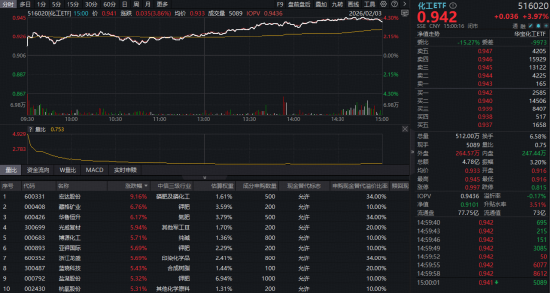
涨价潮+反内卷催化!化工板块全线反攻,化工ETF盘中涨超4%!机构:继续看好化工板块投资机会
Xin Lang Cai Jing· 2026-02-03 12:28
Core Viewpoint - The chemical sector experienced a significant rebound on February 3, 2026, with the chemical ETF (516020) rising by 3.97% and individual stocks in the phosphate, potash, and soda ash sectors showing notable gains [1] Group 1: Market Performance - The chemical ETF (516020) saw a maximum intraday increase of 4.3% before closing up 3.97% [1] - Key stocks included Hongda Co., which surged by 9.16%, and both Cangge Mining and Hualu Hengsheng, which rose over 6% [1] Group 2: Price Trends and Analysis - Recent price increases in various basic chemical products, including dyes and para-nitrochlorobenzene, have been attributed to the cancellation of export tax rebates, leading to a rush in exports [1] - Guojin Securities remains optimistic about investment opportunities in the basic chemical sector, recommending a focus on leading companies and those experiencing price increases from a low base [1] Group 3: Industry Outlook - The chemical sector has been on an upward trend since the "anti-involution" movement began in July 2025, with investment and supply-side logic strengthening since the fourth quarter of 2025 [1] - Demand from emerging sectors such as energy storage, AI, and commercial aerospace is accelerating, while traditional sectors like textiles and agriculture are expected to continue recovering [1] - Huafu Securities anticipates a rebound in profitability for the chemical industry in 2026, marking a new starting point for supply-demand rebalancing [1]


黑色建材日报 2026-02-03-20260203
Wu Kuang Qi Huo· 2026-02-03 01:18
1. Report Industry Investment Rating No relevant information provided. 2. Core Viewpoints of the Report - The black - building materials market is currently in a bottom - game stage with multiple factors at play. In the short term, it will mainly show range - bound fluctuations, and the trend opportunities are not clear yet. Attention should be paid to inventory changes around the Spring Festival, the recovery of plate demand, and possible marginal adjustments to "dual - carbon" policies [2]. - In the medium - to - long - term, the commodity bull market is expected to continue. However, in the short term, factors such as the sharp adjustment of precious metals, the appointment of the new Fed chairman, and the "technical shutdown" of the US federal government may suppress the overall market sentiment [8][14]. 3. Summary by Directory 3.1 Steel Products 3.1.1 Market Information - The closing price of the rebar main contract was 3098 yuan/ton, down 30 yuan/ton (-0.95%) from the previous trading day. The registered warehouse receipts were 14,841 tons, a decrease of 2,442 tons compared to the previous day. The main contract's open interest was 1.7841 million lots, an increase of 49,987 lots. The Tianjin aggregated price of rebar was 3,170 yuan/ton, unchanged, and the Shanghai aggregated price was 3,230 yuan/ton, a decrease of 20 yuan/ton [1]. - The closing price of the hot - rolled coil main contract was 3,261 yuan/ton, down 27 yuan/ton (-0.82%) from the previous trading day. The registered warehouse receipts were 199,447 tons, an increase of 9,124 tons. The main contract's open interest was 1.4988 million lots, a decrease of 30,859 lots. The Lecong aggregated price of hot - rolled coils was 3,260 yuan/ton, a decrease of 30 yuan/ton, and the Shanghai aggregated price was 3,260 yuan/ton, a decrease of 10 yuan/ton [1]. 3.1.2 Strategy Views - The overall sentiment in the commodity market was weak yesterday, and the prices of finished steel products continued to fluctuate in the bottom range. The rebar production remained high, the apparent demand decreased seasonally approaching the Spring Festival, and the inventory started to accumulate, but the overall increase was still controllable. The demand for hot - rolled coils was relatively stable, the production was moderately high, and the inventory continued to decline slightly. The black - building materials market is in a bottom - game stage with both long and short factors at play. In the short term, it will mainly show range - bound fluctuations [2]. 3.2 Iron Ore 3.2.1 Market Information - The main contract of iron ore (I2605) closed at 783.00 yuan/ton, with a change of -1.07% (-8.50). The open interest changed by -20,544 lots to 520,700 lots. The weighted open interest was 874,700 lots. The spot price of PB powder at Qingdao Port was 787 yuan/wet ton, with a basis of 52.93 yuan/ton and a basis ratio of 6.33% [4]. 3.2.2 Strategy Views - In terms of supply, the overseas iron ore shipments in the latest period rebounded month - on - month. The shipments from Australia decreased slightly, while those from Brazil increased significantly. Among the mainstream mines, Vale had a more significant increase. The shipments from non - mainstream countries decreased slightly. The near - term arrivals remained basically stable. In terms of demand, the daily average hot metal production according to the Steel Union's data was 227,980 tons, a slight month - on - month decrease. Some blast furnaces in certain regions were still undergoing annual inspections, and the复产 of blast furnaces was mainly due to the normal resumption after the end of maintenance. The profitability of steel mills decreased slightly month - on - month. In terms of inventory, the port inventory continued to accumulate, reaching the highest level in the same period in the past five years, exerting pressure on the absolute price. The inventory of imported iron ore in steel mills continued to rise, and the pre - holiday procurement and replenishment by steel mills continued. In the short term, the support for iron ore prices is relatively solid, and it is expected to fluctuate mainly. Attention should be paid to the steel mills' replenishment and hot metal production rhythm [5]. 3.3 Ferrous Alloys 3.3.1 Market Information - On February 2nd, the main contract of manganese - silicon (SM605) closed down 0.65% at 5,834 yuan/ton. The spot price of 6517 manganese - silicon in Tianjin was 5,780 yuan/ton, equivalent to 5,970 yuan/ton on the futures market, unchanged from the previous day, with a premium of 136 yuan/ton over the futures. The main contract of ferrosilicon (SF603) closed down 0.64% at 5,624 yuan/ton. The spot price of 72 ferrosilicon in Tianjin was 5,750 yuan/ton, a decrease of 50 yuan/ton from the previous day, with a premium of 126 yuan/ton over the futures [7]. 3.3.2 Strategy Views - The supply - demand pattern of manganese - silicon remains unfavorable, with a loose structure, high inventory, and weak downstream demand in the building materials industry. However, these factors are mostly reflected in the price and are not the main contradictions in the future market. The supply - demand structure of ferrosilicon remains basically balanced, with some improvement due to the maintenance and conversion of some factories. The future market of manganese - silicon and ferrosilicon will be mainly affected by the overall sentiment of the black - building materials market and the cost - push from manganese ore in the manganese - silicon segment and the supply contraction (or contraction expectation) in the ferrosilicon segment due to losses or "dual - carbon" policies. Attention should be paid to possible restrictions on manganese ore exports in South Africa and Gabon and the progress of "dual - carbon" policies [9]. 3.4 Coking Coal and Coke 3.4.1 Market Information - On February 2nd, the main contract of coking coal (JM2605) initially rose by more than 3% but then fell, closing down 1.21% at 1,141.5 yuan/ton. The spot price of low - sulfur main coking coal in Shanxi was 1,584.8 yuan/ton, unchanged. The spot price converted to the futures delivery price was 1,395 yuan/ton, with a premium of 253.5 yuan/ton over the futures. The main contract of coke (J2605) also showed a pattern of rising first and then falling, closing down 2.38% at 1,680.5 yuan/ton. The spot price of quasi - first - grade wet - quenched coke at Rizhao Port was 1,470 yuan/ton, unchanged. The spot price converted to the futures delivery price was 1,725.5 yuan/ton, with a premium of 45 yuan/ton over the futures [11]. 3.4.2 Strategy Views - The commodity market experienced significant fluctuations last week, mainly due to the appointment of the new Fed chairman, which led to expectations of a marginal tightening of the denominator. The previous strong lithium carbonate also declined significantly, suppressing the overall commodity sentiment. However, the black - building materials sector was supported by the relaxation of the "three red lines" in the real estate industry and the successful extension of Vanke's debt. In the short term, the supply - demand structure of coking coal and coke is relatively loose. Although the downstream is still replenishing inventory, the coking plants' coking coal inventory is approaching the level of the same period last year, and the steel mills' willingness to replenish inventory is low. The short - term replenishment is not expected to drive the price strongly. The firmness of Australian coal prices and the power shortage in the US may have a positive impact on sentiment. Considering the "scarcity" premium of coking coal resources, the prices of coking coal and coke are expected to continue to fluctuate in the short term [13][14]. 3.5 Industrial Silicon and Polysilicon 3.5.1 Market Information - Industrial silicon: The closing price of the main contract (SI2605) was 8,795 yuan/ton, with a change of -0.62% (-55). The weighted contract open interest changed by -16,591 lots to 336,548 lots. The spot price of 553 non - oxygen - blown industrial silicon in East China was 9,200 yuan/ton, unchanged, with a basis of 405 yuan/ton for the main contract. The spot price of 421 was 9,650 yuan/ton, unchanged, with a basis of 55 yuan/ton for the main contract [16]. - Polysilicon: The closing price of the main contract (PS2605) was 47,050 yuan/ton, with a change of -0.19% (-90). The weighted contract open interest changed by -5,716 lots to 70,398 lots. The average spot price of N - type granular silicon according to the SMM was 49 yuan/kg, unchanged; the average price of N - type dense material was 50.5 yuan/kg, unchanged; the average price of N - type re - feed material was 51.3 yuan/kg, unchanged, with a basis of 4,250 yuan/ton for the main contract [18][19]. 3.5.2 Strategy Views - Industrial silicon: The price fluctuated yesterday. In terms of supply, Sichuan's production enterprises maintained the furnace - shutdown state last week, and enterprises in Xinjiang and Inner Mongolia reduced production. The weekly output continued to decline. In terms of demand, a leading polysilicon enterprise shut down completely, and some other enterprises reduced production. The weekly output of silicone continued to decline slightly. The overall demand for industrial silicon was weak. In February, the production reduction plan of a large factory in Xinjiang will be implemented. If half of the furnaces are shut down, the supply - demand balance sheet of industrial silicon in February is expected to improve, and the sustainability depends on the shutdown duration. In the short term, there is an expectation of improved supply - demand, and the supply contraction provides strong support for the price. However, considering the approaching Spring Festival and the weakening downstream, the price is expected to fluctuate. Attention should be paid to the follow - up progress of the large factory's production reduction and the production adjustment rhythm of downstream enterprises [17]. - Polysilicon: The spot price of silicon material is in a stalemate, and market information is chaotic. Downstream enterprises have low acceptance of high prices, some enterprises try to lower prices, and futures - spot traders sell at low prices, resulting in a decline in the actual transaction price. The silicon wafer segment also faces pressure, as the loosening of silicon material prices weakens the cost support, and some enterprises sell at low prices. The terminal component price is rising, and the battery segment's price is rising due to non - silicon costs and overseas demand. The supply of polysilicon is expected to contract in the first quarter, and the supply - demand pattern is expected to improve. Policy expectations are expected to support the price, and the anti - monopoly red line is being strengthened. The open interest and liquidity of the polysilicon futures have fallen to relatively low levels since listing. Affected by the loosening of the spot price, the futures price is expected to be under pressure. Attention should be paid to the follow - up feedback of terminal demand and possible new policy adjustments [20]. 3.6 Glass and Soda Ash 3.6.1 Market Information - Glass: The main contract of glass closed at 1,056 yuan/ton on Monday afternoon, unchanged. The price of large - size glass in North China was 1,020 yuan, unchanged; the price in Central China was 1,110 yuan, unchanged. On January 30th, the weekly inventory of float glass sample enterprises was 52.564 million boxes, a decrease of 651,800 boxes (-1.22%). The top 20 long - position holders reduced their long positions by 22,822 lots, and the top 20 short - position holders reduced their short positions by 61,396 lots [22]. - Soda ash: The main contract of soda ash closed at 1,203 yuan/ton on Monday afternoon, down 0.08% (-1). The price of heavy soda ash in Shahe was 1,163 yuan, a decrease of 1 yuan. On January 30th, the weekly inventory of soda ash sample enterprises was 1.5442 million tons, an increase of 23,000 tons (1.22%), including 716,100 tons of heavy soda ash, an increase of 19,400 tons, and 828,100 tons of light soda ash, an increase of 3,600 tons. The top 20 long - position holders increased their long positions by 9,504 lots, and the top 20 short - position holders reduced their short positions by 2,330 lots [24]. 3.6.2 Strategy Views - Glass: As the Spring Festival approaches, downstream processing plants are gradually winding up, market demand is weakening, and the overall trading activity has declined. Purchases are mainly for immediate needs, and inventory replenishment is almost over. In terms of supply, a production line has been restarted and ignited recently, and there are no cold - repair plans, so the overall production capacity remains stable. The demand is limited due to the Spring Festival seasonality. The market lacks strong driving factors, and there is a general wait - and - see attitude. Manufacturers are not willing to adjust prices and mainly focus on stable - price sales and inventory reduction. The float glass market is expected to continue to fluctuate in the short term, with the main contract reference range of 1,025 - 1,125 yuan/ton [23]. - Soda ash: The supply in the industry remains loose. The equipment of enterprises such as Jiangsu Huachang has resumed operation after a short - term shutdown, and new production capacity is gradually being released, so the supply continues to increase. The demand is weak, and downstream enterprises mainly make purchases for immediate needs. Only a few enterprises replenish inventory moderately before the festival, and there is a strong wait - and - see attitude, with limited order growth. The current supply - demand structure of the soda ash market is relatively loose, and downstream procurement is cautious, so the price lacks upward momentum. The market is expected to continue to fluctuate weakly and steadily in the short term, with the main contract reference range of 1,160 - 1,250 yuan/ton [25].
黑色建材日报-20260127
Wu Kuang Qi Huo· 2026-01-27 01:12
Report Industry Investment Rating No relevant information provided. Core View of the Report - The overall sentiment in the commodity market is positive, and the prices of black series products continue to fluctuate within the bottom range. The actual terminal demand for steel remains weak, and the short - term macro - level is in a policy window period. Attention should be paid to the inventory reduction progress of hot - rolled coils, the possible marginal strengthening of "dual - carbon" policies, and their impact on the supply - demand pattern of the steel industry [2]. - The iron ore price fluctuates in the short term. Overseas shipments are entering the off - season, and the supply pressure is marginally reduced. The inventory structural problem is not solved. The pre - holiday purchase by steel mills provides some support. The production rhythm of hot metal is affected by safety supervision. Attention should be paid to the restocking of steel mills and the production rhythm of hot metal [5]. - For manganese silicon and ferrosilicon, the overall sentiment of the commodity market is expected to be bullish. The supply - demand pattern of manganese silicon is loose, and that of ferrosilicon is basically balanced. The future market is mainly affected by the overall market sentiment, the cost increase of manganese ore for manganese silicon, and the supply contraction of ferrosilicon due to losses or "dual - carbon" policies [9][10]. - The prices of coking coal and coke are expected to fluctuate strongly in the short term. The supply - demand structure is relatively loose, and the short - term restocking may not drive the price strongly. Attention should be paid to the short - term impact of market sentiment and high - volatility risks [15]. - The price of industrial silicon is expected to fluctuate. There is an expectation of improved supply - demand, and attention should be paid to the production reduction of large factories and the production adjustment rhythm of downstream enterprises [18]. - For polysilicon, the "anti - involution" expectation is unclear. The supply is expected to contract in the first quarter, and the supply - demand pattern is expected to improve. It is recommended to wait and see and pay attention to terminal demand feedback and policy adjustments [20][21]. - The glass market lacks substantial positive drivers and is expected to fluctuate narrowly in the short term [26]. - The soda ash market is in a relatively loose supply - demand pattern and is expected to continue to operate weakly in the short term [28]. Summary by Relevant Catalogs Steel **行情资讯** - The closing price of the rebar main contract in the afternoon was 3143 yuan/ton, up 1 yuan/ton (0.031%) from the previous trading day. The registered warehouse receipts on that day were 17,283 tons, a decrease of 1,204 tons from the previous day. The open interest of the main contract was 1.7309 million lots, a decrease of 10,906 lots. In the spot market, the aggregated price of rebar in Tianjin was 3170 yuan/ton, unchanged from the previous day; the aggregated price in Shanghai was 3280 yuan/ton, up 10 yuan/ton [1]. - The closing price of the hot - rolled coil main contract was 3302 yuan/ton, down 3 yuan/ton (- 0.09%) from the previous trading day. The registered warehouse receipts on that day were 179,126 tons, unchanged from the previous day. The open interest of the main contract was 1.5148 million lots, an increase of 27,500 lots. In the spot market, the aggregated price of hot - rolled coils in Lecong was 3300 yuan/ton, up 20 yuan/ton; the aggregated price in Shanghai was 3290 yuan/ton, unchanged from the previous day [1]. **策略观点** - The overall sentiment in the commodity market is positive, and the prices of finished steel products continue to fluctuate within the bottom range. The supply and demand of hot - rolled coils have both declined, and the inventory level is gradually decreasing and approaching a relatively reasonable range. For rebar, the output has increased against the seasonal trend, the apparent demand has continued to weaken, and the inventory has begun to accumulate slightly, but the overall pressure is still limited [2]. Iron Ore **行情资讯** - The main contract of iron ore (I2605) closed at 784.50 yuan/ton, with a change of - 1.32% (- 10.50). The open interest changed by - 636 lots to 568,200 lots. The weighted open interest of iron ore was 924,200 lots. The price of PB fines at Qingdao Port was 793 yuan/wet ton, with a basis of 57.96 yuan/ton and a basis rate of 6.88% [4]. **策略观点** - In terms of supply, the overseas iron ore shipments in the latest period have increased slightly. The shipments from Australia have increased, and those from Brazil have remained basically stable. Among the mainstream mines, the shipments of three Australian mines have increased, while Vale's shipments have decreased slightly. The shipments from non - mainstream countries have declined from the high level. The recent arrival volume has continued to decline. In terms of demand, the daily average hot metal output in the latest period was 228.10 tons, a slight increase. The复产 blast furnaces are mainly those that have resumed production after regular maintenance, and there is blast furnace maintenance in Inner Mongolia. The profitability rate of steel mills has continued to improve, rising to more than 40%. In the inventory, the port inventory has continued to accumulate, and the inventory is at the highest level in the same period in the past five years, which suppresses the absolute price. The inventory of imported ore in steel mills has continued to rise, and the pre - holiday restocking continues. Overall, the iron ore price fluctuates in the short term, and attention should be paid to the restocking of steel mills and the production rhythm of hot metal [5]. Manganese Silicon and Ferrosilicon **行情资讯** - On January 26, the main contract of manganese silicon (SM605) closed down 0.48% at 5828 yuan/ton. In the spot market, the price of 6517 manganese silicon in Tianjin was 5720 yuan/ton, converted to the futures price of 5910 yuan/ton, up 20 yuan/ton from the previous day, with a premium of 82 yuan/ton over the futures price. The main contract of ferrosilicon (SF603) closed down 0.42% at 5628 yuan/ton. In the spot market, the price of 72 ferrosilicon in Tianjin was 5800 yuan/ton, down 50 yuan/ton from the previous day, with a premium of 172 yuan/ton over the futures price [8]. **策略观点** - The explosion accident at Baogang Plate Factory last week led to the shutdown and maintenance of some production capacities and concerns about safety inspections. The resumption of hot metal production was inhibited, which dragged down the demand for furnace materials. After the market sentiment eased, there was a certain rebound. In the future, the overall sentiment of the commodity market is expected to be bullish, but the main contradiction in the market is currently concentrated in precious metals, non - ferrous metals, and lithium carbonate. The black sector currently lacks capital interest. For manganese silicon, the supply - demand pattern is loose, and for ferrosilicon, it is basically balanced. The future market is mainly affected by the overall market sentiment, the cost increase of manganese ore for manganese silicon, and the supply contraction of ferrosilicon due to losses or "dual - carbon" policies [9][10]. Coking Coal and Coke **行情资讯** - On January 26, the main contract of coking coal (JM2605) closed up 0.22% at 1159.5 yuan/ton. In the spot market, the price of low - sulfur main coking coal in Shanxi was 1589.8 yuan/ton, unchanged from the previous day, and the converted futures price was 1400 yuan/ton, with a premium of 240.5 yuan/ton over the futures price. The price of medium - sulfur main coking coal in Shanxi was 1300 yuan/ton, unchanged from the previous day, and the converted futures price was 1284 yuan/ton, with a premium of 124.5 yuan/ton over the futures price. The price of Mongolian 5 clean coal in Jinquan Industrial Park was 1234 yuan/ton, unchanged from the previous day, and the converted futures price was 1209 yuan/ton, with a premium of 49.5 yuan/ton over the futures price. The main contract of coke (J2605) closed down 0.17% at 1719.0 yuan/ton. In the spot market, the price of quasi - first - grade wet - quenched coke at Rizhao Port was 1460 yuan/ton, down 10 yuan/ton from the previous day, and the converted futures price was 1715 yuan/ton, with a discount of 4 yuan/ton to the futures price. The price of quasi - first - grade dry - quenched coke in Lvliang was 1495 yuan/ton, unchanged from the previous day, and the converted futures price was 1710.5 yuan/ton, with a discount of 8.5 yuan/ton to the futures price [12]. **策略观点** - The explosion accident at Baogang Plate Factory last week led to the shutdown and maintenance of some production capacities and concerns about safety inspections. The resumption of hot metal production was inhibited, which dragged down the demand for furnace materials. After the market sentiment eased, there was a certain rebound. In the future, the overall sentiment of the commodity market is expected to be bullish, but the main contradiction in the market is currently concentrated in precious metals, non - ferrous metals, and lithium carbonate. The black sector currently lacks capital interest. The supply - demand structure of coking coal and coke is relatively loose. The short - term restocking may not drive the price strongly. The prices of coking coal and coke are expected to fluctuate strongly in the short term, and attention should be paid to the short - term impact of market sentiment and high - volatility risks [14][15]. Industrial Silicon and Polysilicon **行情资讯 - Industrial Silicon** - The closing price of the main contract of industrial silicon (SI2605) was 8915 yuan/ton, with a change of + 1.08% (+ 95). The weighted open interest changed by + 22,646 lots to 397,436 lots. In the spot market, the price of 553 non - oxygen - blown industrial silicon in East China was 9200 yuan/ton, unchanged from the previous day, with a basis of 285 yuan/ton for the main contract; the price of 421 was 9650 yuan/ton, unchanged from the previous day, and the basis of the main contract after conversion was - 65 yuan/ton [17]. **策略观点 - Industrial Silicon** - The industrial silicon opened higher and closed in the red. In terms of supply, most production enterprises in Sichuan have shut down their furnaces, the number of operating furnaces of integrated enterprises in Inner Mongolia has continued to decrease, and the number of operating furnaces in Xinjiang has remained stable, with the weekly output continuing to decline. In terms of demand, the production reduction plans of leading polysilicon enterprises are being gradually implemented, the weekly output of silicone has decreased slightly, and the overall demand for industrial silicon is weakening. If the production reduction of a large factory in Xinjiang is implemented, the supply is expected to decrease significantly, and the supply - demand balance sheet is expected to change from relatively loose to inventory reduction. The price is expected to fluctuate, and attention should be paid to the production reduction of large factories and the production adjustment rhythm of downstream enterprises [18]. **行情资讯 - Polysilicon** - The closing price of the main contract of polysilicon (PS2605) was 51,280 yuan/ton, with a change of + 1.10% (+ 560). The weighted open interest changed by - 363 lots to 76,156 lots. In the spot market, the average price of N - type granular silicon was 50.5 yuan/kg, unchanged from the previous day; the average price of N - type dense material was 53.25 yuan/kg, unchanged from the previous day; the average price of N - type re - feed material was 54 yuan/kg, unchanged from the previous day, with a basis of 2720 yuan/ton for the main contract [19]. **策略观点 - Polysilicon** - The "anti - involution" expectation in the industry is unclear, and the wait - and - see attitude continues. In the spot market, the silicon material sector remains in a stalemate. Downstream silicon wafer factories continue to delay their purchasing rhythm due to high prices, while upstream enterprises maintain high prices but have few actual transactions. Some spot - futures traders sell at low prices, and the overall price has loosened slightly. The price of terminal components continues to rise, the overall operation rate of the battery sector is not high, and the price of the silicon wafer sector is differentiated. The supply of polysilicon is expected to contract in the first quarter, and the supply - demand pattern is expected to improve. The open interest and liquidity of polysilicon futures have fallen to a relatively low level since listing. It is recommended to wait and see and pay attention to terminal demand feedback and policy adjustments [20][21]. Glass and Soda Ash **行情资讯 - Glass** - At 15:00 on Monday, the main contract of glass closed at 1087 yuan/ton, up 2.16% (+ 23). The price of large - size glass in North China was 1010 yuan, unchanged from the previous day; the price in Central China was 1090 yuan, up 30 yuan from the previous day. On January 23, the weekly inventory of float glass sample enterprises was 53.2158 million cases, up 202,800 cases (+ 0.38%) from the previous week. In terms of open interest, the top 20 long - position holders reduced their long positions by 33,392 lots, and the top 20 short - position holders reduced their short positions by 61,787 lots [25]. **策略观点 - Glass** - The market sentiment was relatively weak last week. Affected by insufficient orders from downstream deep - processing enterprises, weak restocking willingness, and seasonal factors approaching the Spring Festival, the terminal demand was weak. The inventory in most regions increased slightly or remained stable, and the inventory reduction rhythm lacked sustainability. The glass market lacks substantial positive drivers, and market participants mostly adopt a wait - and - see attitude. The price is expected to fluctuate narrowly in the short term, with the main contract reference range of 1035 - 1130 yuan/ton [26]. **行情资讯 - Soda Ash** - At 15:00 on Monday, the main contract of soda ash closed at 1205 yuan/ton, up 0.58% (+ 7). The price of heavy soda ash in Shahe was 1165 yuan, up 7 yuan from the previous day. On January 23, the weekly inventory of soda ash sample enterprises was 1.5212 million tons, down 53,800 tons (- 3.42%). Among them, the inventory of heavy soda ash was 696,700 tons, down 41,300 tons, and the inventory of light soda ash was 824,500 tons, down 12,500 tons. In terms of open interest, the top 20 long - position holders increased their long positions by 2841 lots, and the top 20 short - position holders increased their short positions by 1736 lots [27]. **策略观点 - Soda Ash** - The supply - demand pattern of the soda ash market was generally loose last week. The supply was abundant, while the downstream demand was weak, and the purchasing attitude was cautious, mainly replenishing inventory on demand, which provided limited support for the spot price. The market lacks substantial positive drivers, the futures market fluctuates weakly, and the spot market sentiment is affected. The soda ash market is expected to continue to operate weakly in the short term, with the main contract reference range of 1160 - 1230 yuan/ton [28].