机械

Search documents
公募上周加仓电子、国防军工等行业
news flash· 2025-07-28 23:54
Group 1 - The average position of public actively managed equity mixed funds is approximately 85.99% as of July 25, reflecting an increase of 2.05 percentage points from the previous week [1] - The sectors with increased positions include electronics, defense and military industry, consumer services, machinery, and textile and apparel [1] - The sectors with decreased positions include telecommunications, agriculture, forestry, animal husbandry and fishery, media, home appliances, and oil and petrochemicals [1]
资金跟踪系列之四:北上与 ETF 有所回流,个人投资者加速买入
SINOLINK SECURITIES· 2025-07-28 09:09
Group 1: Macro Liquidity - The US dollar index has declined again, and the degree of "inversion" in the China-US interest rate spread has narrowed, with inflation expectations continuing to rise [1][11][14] - Offshore dollar liquidity has marginally eased, while the domestic interbank funding situation has shown a pattern of first easing and then tightening [1][14] Group 2: Market Trading Activity - Overall market trading activity has continued to rise, with most industry trading heat above the 80th percentile [2][20] - The volatility of major indices has also increased, with most industry volatilities below the 40th historical percentile [2][26] Group 3: Institutional Research - The electronic, computer, retail, communication, and pharmaceutical sectors have seen high research activity, while real estate and non-bank sectors have also experienced a rise in research heat [3][36] Group 4: Analyst Forecasts - Analysts have simultaneously lowered the net profit forecasts for the entire A-share market for 2025/2026, while increasing forecasts for sectors such as non-ferrous metals, light industry, steel, and utilities [4][19] - The net profit forecasts for the CSI 500 index for 2025/2026 have been raised, while those for the CSI 300, SSE 50, and ChiNext have been lowered [4][23] Group 5: Northbound Trading Activity - Northbound trading activity has rebounded, with overall net purchases of A-shares, particularly in sectors like non-ferrous metals, pharmaceuticals, and chemicals [4][31] - The ratio of buy/sell amounts for the top 10 active stocks has increased in sectors such as non-ferrous metals and pharmaceuticals [4][32] Group 6: Margin Financing Activity - Margin financing activity has continued to rise, reaching a year-to-date high, with significant net purchases in sectors like machinery, non-ferrous metals, and pharmaceuticals [6][10] - The proportion of financing purchases in real estate, consumer services, and utilities has increased [6][38] Group 7: Fund Activity - Active equity funds have slightly reduced their positions, primarily increasing allocations in sectors like computers, electronics, and banks [5][45] - ETFs have seen overall net subscriptions, particularly in sectors such as construction, steel, and chemicals, while electronic, pharmaceutical, and banking sectors have experienced net redemptions [5][53]
公募基金权益指数跟踪周报(2025.07.21-2025.07.25):“高低切”持续,关注低位科技-20250728
HWABAO SECURITIES· 2025-07-28 08:46
Report Industry Investment Rating No relevant content provided. Core Viewpoints of the Report - Last week, A-share market showed strong bullish sentiment, with significant trading volume increase. Cyclical stocks performed well, but funds shifted from high - risk themes to low - risk and high - certainty targets on Thursday and Friday. [2][11] - Active equity funds in the second - quarter adjusted their positions around prosperity and valuation repair, with a focus on the computing power chain, innovative drugs, military, and financial sectors. [12] - The "anti - involution" market is a theme - driven market under a capital - rich environment, and state - owned enterprises may see more marginal improvements. [13] - The technology wave is ongoing, with AI still having room for growth, and semiconductors are also worth attention due to potential low - level rebound. [4][13] Summary by Directory 1. Weekly Market Observation 1.1. Equity Market Review and Observation - **Market Performance**: From July 21 to 25, 2025, major A - share indices rose. The average daily trading volume was about 1.85 trillion yuan, a significant increase of 300 billion yuan compared to the previous week. Cyclical stocks led the rise, but funds shifted on Thursday and Friday. [11] - **Public Fund Q2 Report Adjustment**: Active equity funds increased their positions in the ChiNext and slightly raised their Hong Kong stock holdings. They concentrated less on heavy - position stocks. The top five industries for increased holdings were communication, medicine, non - bank finance, bank, and national defense and military industry, while the top five for reduced holdings were food and beverage, automobile, commerce and retail, power equipment and new energy, and machinery. [12] - **Re - discussion on "Anti - involution"**: The "anti - involution" theme stimulates traditional cyclical industries. It is a theme - driven market, and state - owned enterprises may have more marginal improvements. [13] - **Technology Sector Rebound**: The 2025 World Artificial Intelligence Conference was held. The AI industry is booming, and semiconductors may benefit from low - level rebound. [13] 1.2. Public Fund Market Dynamics - On July 24, the second batch of 12 new floating - rate funds was approved, including industry - themed products. Some funds adjusted their management fee thresholds to strengthen performance constraints. [4][14] 2. Active Equity Fund Index Performance Tracking 2.1. Active Stock Fund Selection - The index selects 15 funds equally weighted, with core positions balanced according to the style distribution of the CSI Active Stock Fund Index. Its performance benchmark is the Active Stock Fund Index (930980.CSI). It rose 1.67% last week and has a cumulative excess return of 12.31% since its establishment. [15][16] 2.2. Value Stock Fund Selection - The index includes value - style funds, selecting 10 funds based on style classification. Its performance benchmark is the CSI 800 Value Index (H30356.CSI). It rose 2.49% last week and has a cumulative excess return of - 3.41% since its establishment. [15][19] 2.3. Balanced Stock Fund Selection - The index selects 10 balanced - style funds. Its performance benchmark is the CSI 800 (000906.SH). It rose 1.25% last week and has a cumulative excess return of 6.01% since its establishment. [15][20] 2.4. Growth Stock Fund Selection - The index selects 10 growth - style funds. Its performance benchmark is the 800 Growth Index (H30355.CSI). It rose 1.68% last week and has a cumulative excess return of 18.39% since its establishment. [15][24] 2.5. Pharmaceutical Stock Fund Selection - The index selects 15 pharmaceutical - themed funds based on the intersection of equity holdings and the representative index. Its performance benchmark is the pharmaceutical - themed fund index. It fell 0.95% last week and has a cumulative excess return of 22.21% since its establishment. [15][26] 2.6. Consumption Stock Fund Selection - The index selects 10 consumption - themed funds based on the intersection of equity holdings and the representative index. Its performance benchmark is the consumption - themed fund index. It rose 0.84% last week and has a cumulative excess return of 14.87% since its establishment. [15][28] 2.7. Technology Stock Fund Selection - The index selects 10 technology - themed funds based on the intersection of equity holdings and the representative index. Its performance benchmark is the technology - themed fund index. It rose 2.35% last week and has a cumulative excess return of 17.37% since its establishment. [15][32] 2.8. High - end Manufacturing Stock Fund Selection - The index selects 10 high - end manufacturing - themed funds based on the intersection of equity holdings and the representative index. Its performance benchmark is the high - end manufacturing - themed fund index. It rose 1.67% last week and has a cumulative excess return of - 2.78% since its establishment. [15][32] 2.9. Cyclical Stock Fund Selection - The index selects 5 cyclical - themed funds based on the intersection of equity holdings and the representative index. Its performance benchmark is the cyclical - themed fund index. It rose 2.28% last week and has a cumulative excess return of - 0.40% since its establishment. [15][37]
A500ETF基金(512050)多股涨停,机构称补涨机会更值得关注
Xin Lang Cai Jing· 2025-07-28 05:21
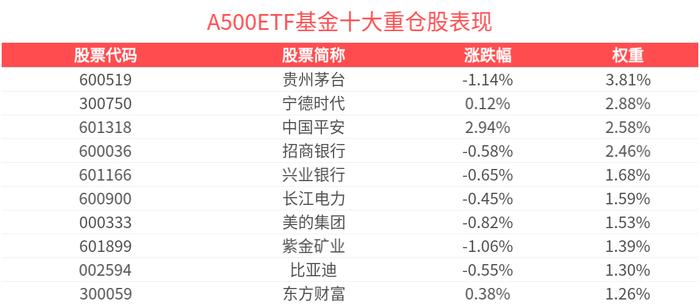
Group 1 - The A500 index (000510) increased by 0.02% as of July 28, 2025, with notable gains from companies such as Shenghong Technology (300476) up 12.77%, Xingsen Technology (002436) up 10.02%, and others [1] - As of July 27, 2025, 31 provinces in China released their mid-year economic performance, with 13 provinces reporting GDP exceeding 2 trillion yuan, including Guangdong and Jiangsu in the "6 trillion club" [1] - According to Everbright Securities, the current market trend is characterized by "rotational rebound," with a focus on sectors that have lagged behind in previous performance [1] Group 2 - The A500 ETF fund (512050) closely tracks the A500 index, which includes 500 securities selected for their large market capitalization and liquidity [2] - As of June 30, 2025, the top ten weighted stocks in the A500 index accounted for 20.67% of the index, with Kweichow Moutai (600519) being the largest [2] - The top ten stocks include notable companies such as Ningde Times (300750), China Ping An (601318), and BYD (002594) [2][3] Group 3 - The A500 ETF fund has several related funds, including the Huaxia A500 ETF Connect series, which offers different share classes [5]

出海欧洲—2025年荷兰公司注册全指南
Sou Hu Cai Jing· 2025-07-28 04:01
Core Points - The Netherlands is a developed, outward-oriented economy with a favorable investment environment, making it a key destination for Chinese investments in the EU [2] - The country serves as a significant hub for trade and investment, with around 700 Chinese companies operating in various sectors [2] - The article outlines the advantages of registering a company in the Netherlands, including tax benefits, ease of market access, and a friendly business environment [5][6][7] Group 1: Advantages of Registering a Company in the Netherlands - **Geographical Advantage**: The Netherlands is strategically located as a gateway to Europe, facilitating access to a market of nearly 500 million consumers [4][6] - **Tax Incentives**: The Dutch government offers a rich tax incentive system, including R&D tax credits and competitive corporate tax rates [5] - **Business Environment**: The political stability and favorable policies for foreign investors contribute to a conducive business environment [7] Group 2: Company Types and Registration Requirements - **Common Company Types**: The most common types of companies are the Limited Liability Company (BV) and the Public Limited Company (NV), each with specific ownership and management requirements [10] - **Registration Requirements**: Key requirements include a unique company name, at least one shareholder and director, a minimum registered capital of 1 Euro, and a business address in the Netherlands [13] - **Required Documents**: Essential documents for registration include an information collection form, power of attorney, and identification proofs of shareholders and directors [14][15] Group 3: Registration Process and Taxation - **Registration Process**: The process involves several steps, including name approval, document verification, and tax registration, typically completed within a few weeks [18] - **Tax Filing**: Companies must file VAT returns quarterly and corporate tax returns within specific deadlines, with the possibility of extensions [19][20] - **Annual Audit**: Companies are required to undergo annual audits if they exceed certain financial thresholds, ensuring compliance with Dutch law [22][23] Group 4: Common Questions about Company Registration - **Foreign Ownership**: There are no restrictions on foreign individuals or companies registering in the Netherlands, allowing full ownership [25] - **Local Presence**: A physical business address in the Netherlands is mandatory for registration, but personal presence is not required [27] - **Local Director Requirement**: For VAT registration, a local director is necessary, although this is not a general requirement for company registration [29]
【光大研究每日速递】20250728
光大证券研究· 2025-07-28 01:28
Group 1: Market Strategy - The current market trend is characterized by "rotational supplementary gains," with a focus on sectors that have lagged behind in performance but have shown strong historical results. Key sectors to watch include electronics and machinery, with specific attention to sub-sectors like chemical fibers, engineering machinery, military electronics, aerospace equipment, and automation equipment [3][5][6]. Group 2: Credit Bonds - During the week of July 21 to July 25, 2025, a total of 414 credit bonds were issued, amounting to 592.83 billion yuan, representing a week-on-week increase of 47.80%. The issuance of industrial bonds accounted for 219.28 billion yuan, up 24.66%, while municipal investment bonds and financial bonds saw increases of 2.90% and 122.44%, respectively [4]. Group 3: Banking Sector - As of the end of Q2 2025, the total balance of bank wealth management products reached 30.67 trillion yuan, with an increase of 0.72 trillion yuan in the first half of the year. Open-ended products maintained an 80% share, while the scale of current management products decreased to 6.4 trillion yuan. The asset allocation in Q2 showed a preference for public funds, cash, deposits, and interest rate bonds, while credit bond holdings decreased [5]. Group 4: Non-Banking Sector - The insurance sector is expected to benefit from a shift in preset interest rates, which may lead to a growth window for dividend insurance. Although new single growth may face short-term pressure, the increase in value rates is likely to support new business value (NBV). The recovery of the equity market, driven by stable growth policies, is anticipated to enhance the investment performance of insurance companies [6]. Group 5: Petrochemical Industry - The State-owned Assets Supervision and Administration Commission emphasized the importance of long-term strategies and the development of new productive forces in state-owned enterprises. The focus is on optimizing the allocation of state-owned assets and resisting "involution" competition, which includes restructuring and enhancing the integration of resources [7].

嘉实中证央企创新驱动ETF投资价值分析:一键布局具有创新活力的优质央企
Guotou Securities· 2025-07-27 10:29
Quantitative Models and Construction Methods Model Name: Central Enterprise Innovation Index (000861.CSI) - **Model Construction Idea**: The index selects 100 representative listed companies under the State-owned Assets Supervision and Administration Commission (SASAC) based on their innovation and profitability to reflect the overall performance of innovative central enterprises[8] - **Model Construction Process**: - **Sample Space**: All listed companies under SASAC[9] - **Step 1**: Rank the securities in the sample space by average daily trading volume over the past year and exclude the bottom 20%[9] - **Step 2**: Select the remaining securities controlled by SASAC and its subsidiaries[9] - **Step 3**: Exclude securities with negative operating cash flow in the past year and negative net profit excluding non-recurring items in the past two years[9] - **Step 4**: Calculate the innovation score for non-financial companies based on R&D expenditure, R&D personnel ratio, patent quality score, and participation in national or industry standards. For financial companies, use revenue, net profit, patent quality score, and participation in standards[9] - **Step 5**: Rank the remaining securities by innovation score and select the top 50% as innovation-themed securities[9] - **Step 6**: Calculate the quality score for non-financial companies based on ROE, net profit growth, earnings quality, and financial leverage. For financial companies, use ROE and net profit growth. Combine the quality score with the scale score (based on market cap) to get a comprehensive score[9] - **Step 7**: Select the top 100 securities by comprehensive score as index samples[9] - **Adjustment**: The index samples are adjusted semi-annually[9] - **Model Evaluation**: The index is designed to reflect the performance of innovative central enterprises, with a focus on maintaining representativeness and accuracy through regular adjustments[8][9] Model Backtesting Results - **Central Enterprise Innovation Index**: - **Cumulative Return Since Inception**: 138.08%[5][10] - **Excess Return Over Major Indices**: - CSI 300: 79.25%[5] - SSE Composite Index: 83.67%[5] - CSI 500: 54.40%[5] - CSI 800: 74.09%[5] - **5-Year Cumulative Return**: 33.70%[10] - **Excess Return Over Major Indices in 5 Years**: - CSI 300: 49.24%[10] - SSE Composite Index: 29.47%[10] - CSI 800: 47.94%[10] Quantitative Factors and Construction Methods Factor Name: Innovation Score - **Factor Construction Idea**: Evaluate the innovation capability of non-financial and financial companies based on specific indicators[9] - **Factor Construction Process**: - **Non-Financial Companies**: - R&D expenditure to market cap ratio (40% weight) - R&D personnel ratio (10% weight) - Patent quality score (40% weight) - Participation in national or industry standards (10% weight)[9] - **Financial Companies**: - Revenue (40% weight) - Net profit (10% weight) - Patent quality score (40% weight) - Participation in national or industry standards (10% weight)[9] - **Calculation**: Sum the weighted scores to get the innovation score[9] Factor Name: Quality Score - **Factor Construction Idea**: Assess the financial quality of companies based on profitability and financial stability[9] - **Factor Construction Process**: - **Non-Financial Companies**: - ROE (30% weight) - Net profit growth (35% weight) - Earnings quality (25% weight) - Financial leverage (10% weight)[9] - **Financial Companies**: - ROE (50% weight) - Net profit growth (50% weight)[9] - **Calculation**: Sum the weighted scores to get the quality score[9] Factor Backtesting Results - **Innovation Score**: - **Top 50% Selection**: Used to identify innovation-themed securities[9] - **Quality Score**: - **Comprehensive Score Calculation**: Combined with scale score to select top 100 securities[9]






金融工程市场跟踪周报:短线冲高或有压力,中长线仍维持乐观-20250726
EBSCN· 2025-07-26 13:57
The provided content does not contain any specific quantitative models or factors, nor does it include detailed construction processes, formulas, or backtesting results for such models or factors. The report primarily focuses on market analysis, index performance, valuation levels, and fund flows. Therefore, there are no quantitative models or factors to summarize based on the given content.



特朗普这下弄巧成拙?欧洲做好最坏准备:谈判破裂就对美加税!德国态度强硬,实属意外
Sou Hu Cai Jing· 2025-07-25 12:18
Group 1 - The core point of the news is the escalation of trade tensions between the US and the EU, particularly due to President Trump's announcement of a 30% tariff on EU imports starting August 1, which has led to a potential trade war [1][3] - The US has already imposed high tariffs on EU steel and aluminum products (50%) and automobiles (25%), with a baseline tariff of 10% on nearly all other goods [1][3] - The EU is preparing to retaliate with tariffs on nearly €100 billion worth of US goods, including Boeing aircraft, machinery, soybeans, US cars, and bourbon whiskey, which could affect one-third of US exports to the EU [3][6] Group 2 - The EU is considering activating the "Anti-Coercion Instrument" (ACI), which would allow it to impose trade and investment restrictions on countries that attempt to coerce EU member states [5][6] - Germany's stance has shifted from cautious to more aggressive in response to US tariffs, with leaders warning that escalating tariffs could severely impact Germany's export-driven economy [6][7] - The ongoing trade tensions have led to a significant decline in German exports to the US, with a 7.7% drop in May, marking the lowest level in over three years [6][7] Group 3 - Both the US and EU are showing a willingness to negotiate, with US Commerce Secretary expressing confidence in reaching an agreement, while the EU emphasizes the importance of negotiations [7][9] - The EU's strategy involves a combination of negotiation and readiness to impose retaliatory tariffs, aiming to achieve a more favorable position in talks [9] - Significant differences remain between the US and EU regarding tariff rates and market access, complicating the path to a potential agreement [9]
由创新高个股看市场投资热点
量化藏经阁· 2025-07-25 09:16
报 告 摘 要 乘势而起:市场新高趋势追踪 触及新高的个股、行业和板块可被视为市场的风向标。越来越多的研究表明动量、趋势跟踪策略的有效性。本报告旨在定期跟踪市场中创新高的个股及其 分布,以追踪市场趋势、把握市场热点。 截至2025年7月25日,上证指数、深证成指、沪深300、中证500、中证1000、中证2000、创业板指、科创50指数250日新高距离分别为0.33%、 2.84%、3.03%、0.49%、0.00%、0.00%、8.24%、6.45%。中信一级行业指数中基础化工、有色金属、钢铁、轻工制造、国防军工行业指数距离250 日新高较近,食品饮料、煤炭、房地产、消费者服务、计算机行业指数距离250日新高较远。概念指数中,5G、区块链、可转债正股、新能源汽车、工业 母机、金属非金属、万得双创等概念指数距离250日新高较近。 见微知著:利用创新高个股进行市场监测 截至2025年7月25日,共1178只股票在过去20个交易日间创出250日新高。其中创新高个股数量最多的是医药、机械、基础化工行业,创新高个股数量占 比最高的是银行、钢铁、有色金属行业。按照板块分布来看,本周制造、周期板块创新高股票数量最多;按照 ...