
服务业

Search documents
国家统计局:6月制造业PMI继续回升,制造业景气面有所扩大
Guo Jia Tong Ji Ju· 2025-06-30 01:36
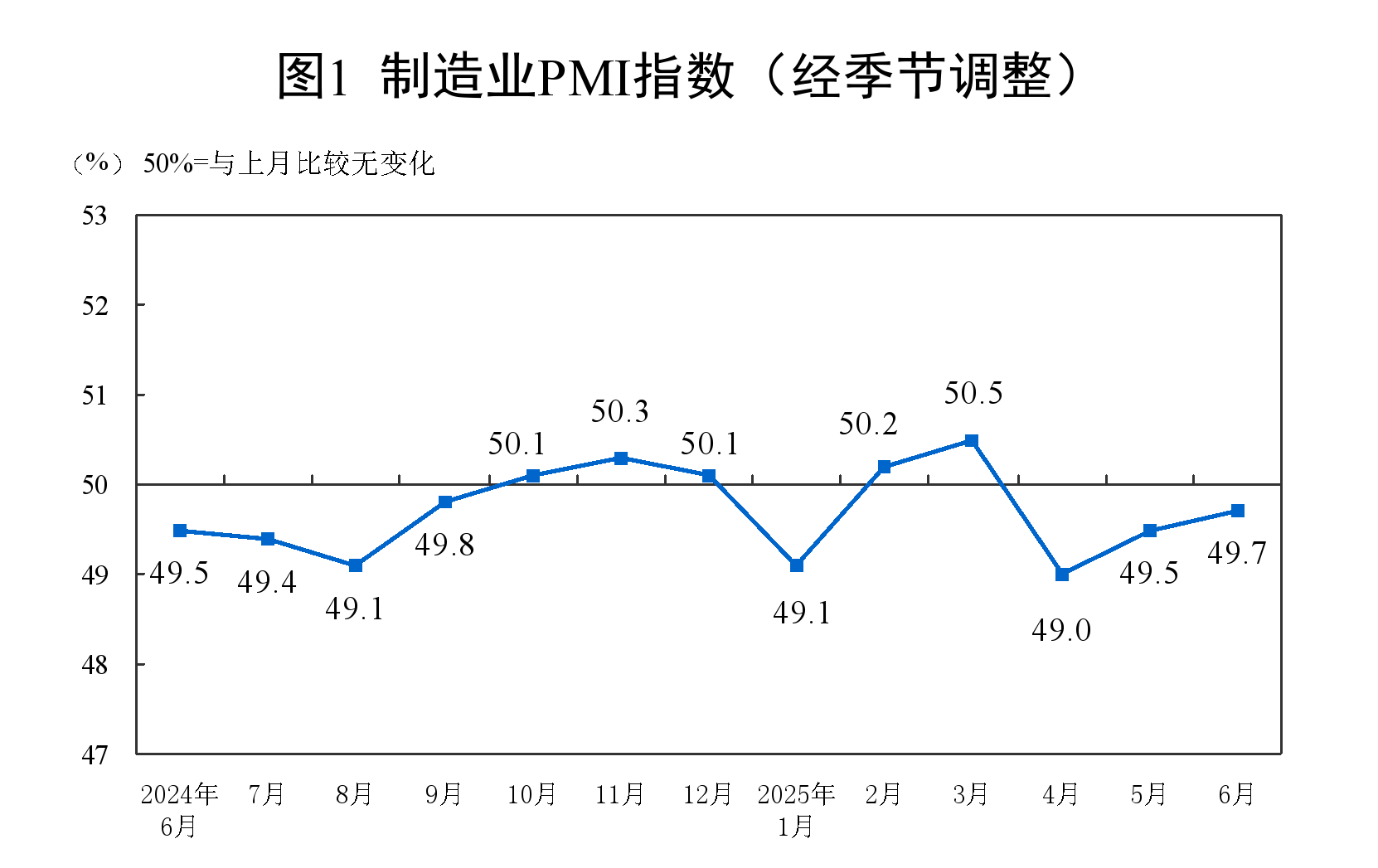
Group 1: Manufacturing Purchasing Managers Index (PMI) - In June, the manufacturing PMI rose to 49.7%, with 11 out of 21 surveyed industries in the expansion zone, an increase of 4 from the previous month, indicating an overall expansion in manufacturing sentiment [2] - The production index and new orders index were at 51.0% and 50.2%, respectively, both showing improvements of 0.3 and 0.4 percentage points, suggesting accelerated production activities and improved market demand [2] - Large enterprises reported a PMI of 51.2%, up 0.5 percentage points, indicating significant support for the manufacturing sector, while small enterprises saw a decline in PMI to 47.3%, down 2.0 percentage points [3] Group 2: Non-Manufacturing Business Activity Index - The non-manufacturing business activity index reached 50.5%, an increase of 0.2 percentage points, indicating continued expansion in the non-manufacturing sector [4] - The construction industry showed a notable increase with a business activity index of 52.8%, up 1.8 percentage points, reflecting a recovery in construction activities, particularly in civil engineering [4] - The business activity expectation index for the non-manufacturing sector was at 56.0%, indicating optimism among service industry enterprises regarding future developments [4] Group 3: Comprehensive PMI Output Index - The comprehensive PMI output index rose to 50.7%, an increase of 0.3 percentage points, indicating an acceleration in overall production and business activities across enterprises [5] - The manufacturing production index and non-manufacturing business activity index contributed to the comprehensive PMI output index, standing at 51.0% and 50.5%, respectively [5]
国家统计局服务业调查中心高级统计师赵庆河解读2025年6月中国采购经理指数
Guo Jia Tong Ji Ju· 2025-06-30 01:35
Group 1: Manufacturing PMI Insights - The manufacturing Purchasing Managers' Index (PMI) rose to 49.7% in June, with 11 out of 21 surveyed industries in the expansion zone, an increase of 4 industries from the previous month, indicating an overall improvement in manufacturing sentiment [2][3] - The production index and new orders index were at 51.0% and 50.2%, respectively, both showing increases of 0.3 and 0.4 percentage points from the previous month, suggesting accelerated production activities and improved market demand [3] - The purchasing volume index increased to 50.2%, up by 2.6 percentage points, reflecting enhanced procurement willingness among enterprises due to the recovery in production and demand [3] Group 2: Price Index Trends - The main raw material purchase price index and factory price index rose to 48.4% and 46.2%, respectively, both up by 1.5 percentage points, indicating an overall improvement in manufacturing market price levels [3] - The increase in prices was influenced by rising international crude oil prices, particularly affecting the petroleum and coal industries, while the black metal smelting and processing industries saw a decline in price indices due to falling iron ore prices and insufficient terminal demand [3] Group 3: Enterprise Size and Industry Performance - Large enterprises reported a PMI of 51.2%, up by 0.5 percentage points, indicating significant support for the overall manufacturing sector, while medium-sized enterprises saw a PMI of 48.6%, an increase of 1.1 percentage points, showing improved sentiment [4] - The equipment manufacturing, high-tech manufacturing, and consumer goods industries all maintained PMIs above 50, indicating continued expansion, with equipment manufacturing showing particularly strong activity with production and new orders indices above 53.0 [4] Group 4: Non-Manufacturing Sector Insights - The non-manufacturing business activity index rose to 50.5%, up by 0.2 percentage points, indicating continued expansion in the non-manufacturing sector [5] - The service sector's business activity index was stable at 50.1%, with certain industries like telecommunications and financial services showing strong growth, while consumer-related sectors experienced a decline in activity [5] - The construction sector's business activity index increased to 52.8%, up by 1.8 percentage points, reflecting a recovery in construction activities, particularly in civil engineering [5] Group 5: Comprehensive PMI Overview - The comprehensive PMI output index rose to 50.7%, up by 0.3 percentage points, indicating an acceleration in overall production and business activities across enterprises [6] - The manufacturing production index and non-manufacturing business activity index contributed to this increase, standing at 51.0% and 50.5%, respectively [6]
2025年6月中国采购经理指数运行情况
Guo Jia Tong Ji Ju· 2025-06-30 01:31
Group 1: Manufacturing PMI Overview - In June, the Manufacturing Purchasing Managers' Index (PMI) was 49.7%, an increase of 0.2 percentage points from the previous month, indicating continued improvement in manufacturing sentiment [1] - Large enterprises had a PMI of 51.2%, up 0.5 percentage points, while medium-sized enterprises had a PMI of 48.6%, up 1.1 percentage points, and small enterprises had a PMI of 47.3%, down 2.0 percentage points [4] - The production index was 51.0%, indicating accelerated production activities, and the new orders index was 50.2%, suggesting improved market demand [4][6] Group 2: Employment and Supplier Conditions - The employment index was 47.9%, a slight decrease of 0.2 percentage points, indicating a minor decline in employment sentiment within the manufacturing sector [5] - The supplier delivery time index was 50.2%, an increase of 0.2 percentage points, suggesting that suppliers' delivery times have improved compared to the previous month [6] Group 3: Non-Manufacturing PMI Overview - In June, the Non-Manufacturing Business Activity Index was 50.5%, an increase of 0.2 percentage points, indicating continued expansion in the non-manufacturing sector [10] - The construction industry had a business activity index of 52.8%, up 1.8 percentage points, while the services industry had a business activity index of 50.1%, down 0.1 percentage points [12] Group 4: Non-Manufacturing Demand and Pricing - The new orders index for non-manufacturing was 46.6%, an increase of 0.5 percentage points, indicating a slight recovery in market demand [16] - The input prices index was 49.9%, slightly below the critical point, indicating stable input prices for non-manufacturing activities [16] Group 5: Comprehensive PMI Output Index - The Comprehensive PMI Output Index was 50.7%, an increase of 0.3 percentage points, indicating an overall acceleration in production and business activities across sectors [23]

关税“压力测试”系列之十三:如果美国失业率升至4.6%?
Shenwan Hongyuan Securities· 2025-06-29 13:44
Labor Market Conditions - The U.S. labor market is showing signs of weakening, with both labor supply and demand declining, making it difficult for the unemployment rate to decrease[2] - The ratio of job vacancies to unemployed individuals has fallen below the levels seen at the end of 2019, indicating a tightening labor market[2] - Since early 2025, the U.S. economy has been weakening, and the impact of tariffs on the labor market is a concern for the second half of the year[2] Unemployment Rate Projections - The unemployment rate is projected to rise to approximately 4.5-4.6% by the end of the year, with a potential increase of 0.3-0.7 percentage points if GDP declines by 1% due to tariffs[4] - If the unemployment rate reaches 4.6%, it may trigger the "Sahm Rule" recession signal, which has historically indicated economic downturns[5] - The average monthly increase in the unemployment rate from January to May 2025 was about 0.06 percentage points, suggesting a continued upward trend[5] Tariff Impact on Employment - The tariffs are expected to have a significant negative impact on the U.S. job market, particularly in the manufacturing sector, where the Purchasing Managers' Index (PMI) shows signs of contraction[4] - The current economic cycle is characterized by a slowdown, and the tariffs are expected to exacerbate existing challenges such as declining wage growth and rising precautionary savings among consumers[4] Immigration Policy Effects - The tightening of immigration policies under the Trump administration has led to a supply shock in the labor market, further exacerbating the decline in job growth[3] - The influx of illegal immigrants has historically helped to stabilize the labor market, but recent reductions in immigration may lead to increased unemployment rates[31] Economic Indicators - The S&P 500 and Nasdaq indices reached new highs, while the U.S. dollar index fell by 1.5% to 97.26, indicating market volatility amid economic uncertainty[6] - The actual yield on 10-year U.S. Treasury bonds has decreased to 2.0%, reflecting changing investor sentiment and expectations regarding future interest rates[6]
热点思考 | 如果美国失业率升至4.6%?——关税“压力测试”系列之十三(申万宏观·赵伟团队)
赵伟宏观探索· 2025-06-29 13:43
Group 1 - The core viewpoint of the article highlights the rising risks of unemployment in the U.S. labor market, driven by weakening labor supply and demand, and the potential impact of tariffs on employment [2][3][4] - The U.S. labor market is crucial for the economy, with consumer spending significantly contributing to GDP growth, primarily driven by labor income [2][6] - The unemployment rate is expected to rise, with estimates suggesting it could reach 4.5-4.6% by the end of the year, influenced by the new tariffs [3][89] Group 2 - The article discusses the employment impact of tariffs, indicating that a 1% decline in GDP could lead to a 0.3-0.7% increase in unemployment, based on Okun's Law [3][89] - The current tariff situation is expected to have a more significant impact on the manufacturing sector compared to previous tariff implementations, with a broader economic slowdown anticipated [65][77] - The article notes that the current economic environment is characterized by declining wage growth and increased precautionary savings among consumers, which could further exacerbate employment challenges [77][81] Group 3 - The "Sahm Rule" is mentioned as a potential indicator of recession, suggesting that if the unemployment rate rises to 4.6%, it could trigger recession signals [4][99] - Historical data shows that the Sahm Rule has a high success rate in predicting recessions, with the article indicating that the current labor market conditions could lead to its activation in the coming months [99][100] - The article emphasizes that the labor market is currently in a "loosened" state, with demand-side weaknesses likely driving the unemployment rate upward [100]
6月海外月度观察:关税豁免期临近到期,关注贸易格局演变-20250627
Huachuang Securities· 2025-06-27 11:13
证 券 研 究 报 告 【债券分析】 关税豁免期临近到期,关注贸易格局演变 ——6 月海外月度观察 油价:6 月,国际原油先受中美元首通话提振油需前景,后受中东局势引发 供给担忧双重因素带动下强势上涨至 75.60 美元/桶,随后中东局势缓和,油 价回落至 64.92 美元/桶。 美国就业市场超预期疲软;金融市场流动性紧缩。 债券研究 经济方面,全球制造业景气度收缩,服务业保持高景气度。贸易方面,波罗 的海干散货指数先升后降,5 月前 20 日韩国出口同比跌幅收缩至-2.5%。货 币政策方面,关税政策加剧经济前景的不确定性,主要央行保持谨慎态度。 财政政策方面,德国政府内阁批准 2025 年财政预算草案和 2026 年财政预 算框架。 ❖ 发达经济体:关税冲击经济前景,通胀继续降温 美国经济景气度回落,制造业和服务业景气度均处于收缩区间;劳动力市场 温和走弱,时薪增速超预期;通胀继续降温,关税影响暂未体现;零售销售 继续走弱,消费者支出放缓;房贷利率居高不下以及持续上涨的房价加剧居 民购房负担。英国、日本制造业和服务业景气度分化,欧元区增长乏力。通 胀方面,欧元区、英国通胀降温,日本通胀水平继续处于政策目标上 ...
美国第一季度经济萎缩0.5%,关税进口激增拖累经济
Sou Hu Cai Jing· 2025-06-27 05:06
Economic Performance - In the first quarter of 2025, the US economy contracted by 0.5% on a year-over-year basis, which was below expectations and undermined confidence in sustained economic growth [1][3] - The contraction is attributed to complex structural issues within the economy, with tariff policies significantly impacting both imports and exports [1][5] Trade Dynamics - The US saw an import growth adjustment to 37.9% and export growth adjusted to 0.4%, with net imports dragging down GDP by nearly 4.7 percentage points [3] - The reliance on imports has increased, exacerbating the trade deficit and highlighting the imbalance in the economic structure [3][6] Consumer Spending - Personal consumption expenditure, which accounts for about 70% of GDP, contributed only approximately 0.3 percentage points to GDP growth in the first quarter, indicating a decline in consumer purchasing power [3][5] - Consumer confidence has weakened, particularly in an uncertain economic environment, which has become a significant factor in hindering economic growth [3][8] Tariff Policy Impact - The "America First" trade policy implemented by the Trump administration aimed to protect domestic manufacturing but resulted in increased prices for imported goods, raising production costs for US businesses [5][6] - This policy has inadvertently shifted the burden onto consumers, leading to a slowdown in overall economic growth [5][8] Global Economic Uncertainty - The interconnectedness of the US economy with global markets means that uncertainties in other major economies, such as China and the EU, directly affect US export growth [6][8] - The slowdown in global economic growth has led many US companies to reduce investment and production plans, further contributing to domestic economic contraction [6][8] Structural Issues - The current economic challenges reflect long-term structural problems, with the US economy's dependence on external markets making it vulnerable to global uncertainties [8] - Addressing these structural issues, including reducing reliance on imports and adjusting trade strategies, is crucial for sustainable economic growth in the future [8]
深观察丨欧盟:我们不怕与美国打关税战
Sou Hu Cai Jing· 2025-06-26 13:33
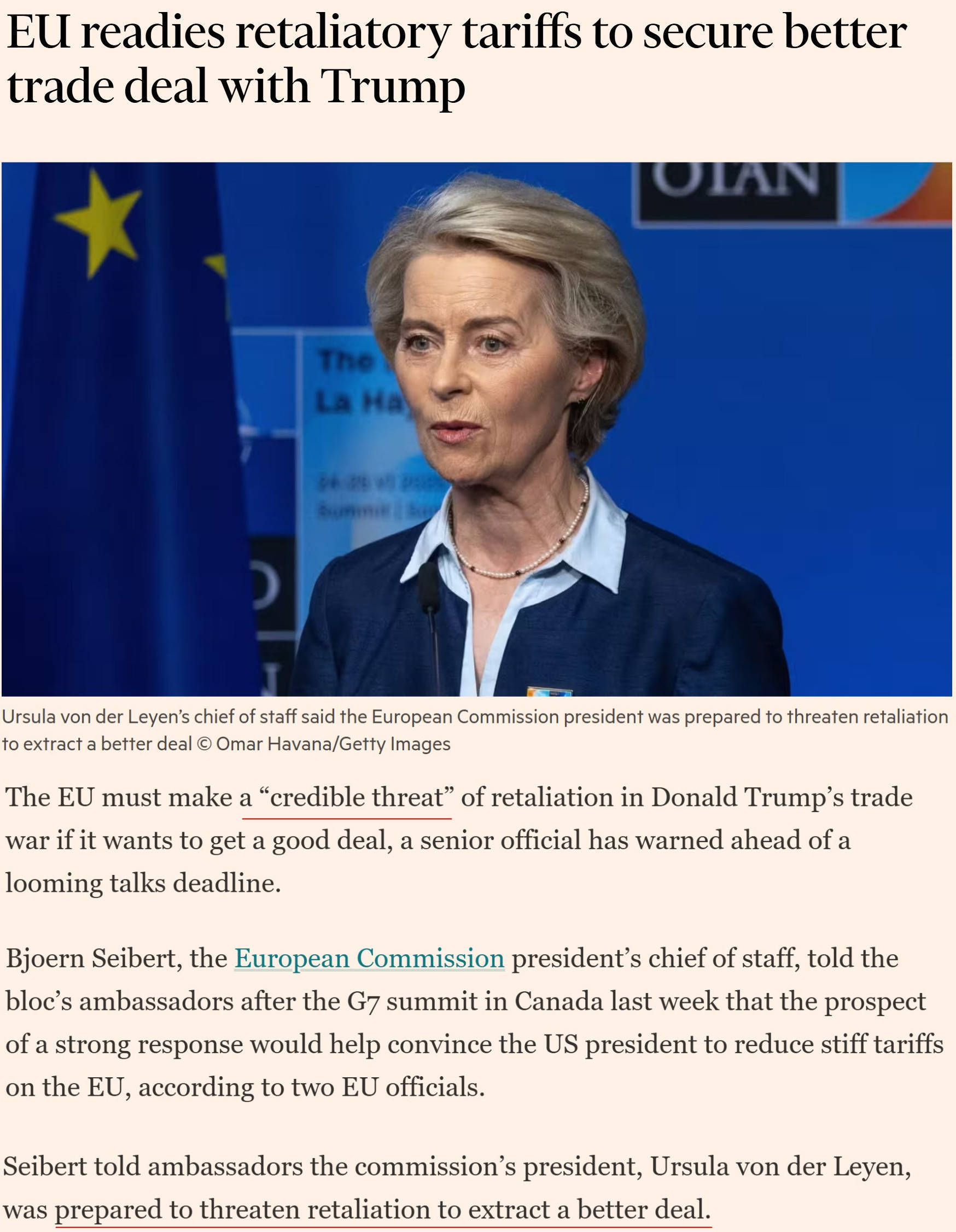
眼下距离7月9日这一美国政府暂停征收"对等关税"90天的截止期限仅剩十来天,欧盟与美国的关税谈判仍进展殊微。 而面对美国的咄咄逼人,欧盟再次亮明了态度。 欧盟委员会主席冯德莱恩的办公室主任比约恩·塞伯特日前强调,在最后期限到来之前,欧盟内部须统一立场,随时准备反制美国的关税措施。如果欧盟想 达成一项"好协议",就必须在美国挑起的贸易战中发出"可信的威胁"。 △英国《金融时报》报道截图 "欧盟正在为各种可能性做准备" 塞伯特是在加拿大七国集团(G7)峰会结束后不久,对欧盟各国驻布鲁塞尔大使做出上述提醒的。 欧盟原指望能借这次会议之机与美国总统特朗普就关税问题当面沟通,但特朗普提前离场回国,令欧盟大为失望。 不仅如此,特朗普还在回国途中向欧盟发出新的威胁:要么向美方提出一个"合理的协议",要么"按我们的要求支付更高关税"。 △法新社报道截图 作为美国最大的贸易伙伴之一,欧盟目前被美方加征的关税除了"对等关税"缓征期间10%的"基准关税"外,还有25%的汽车关税和50%的钢铝关税。 欧盟一直希望通过谈判与美国达成一份"双赢"的新贸易协议,但在谈判过程中,美国政府的反复无常却让欧盟越来越无所适从: 就在美欧同意"加快 ...
格林大华期货中国宏观经济半年报:全球经贸关系演化带来不确定
Ge Lin Qi Huo· 2025-06-26 13:00
Report Industry Investment Rating - Not provided in the content Core Viewpoints - In May, China's fixed - asset investment growth was lower than market expectations, and the growth rates of infrastructure investment, manufacturing investment, and real estate investment were all lower than those in April. Consumption growth in May was significantly better than market expectations, but it may not be sustainable. Industrial production maintained stable and rapid growth in May. China's exports showed resilience in May. The Chinese economy is expected to operate steadily in the second quarter. There is uncertainty in global economic and trade relations, which may pose challenges to China's economic growth in the third quarter [83]. Summary by Related Content 1. Fixed - Asset Investment - From January to May, national fixed - asset investment increased by 3.7% year - on - year, lower than the market expectation of 4.0% and the 4.0% growth from January to April. General infrastructure investment (including electricity) increased by 10.42% year - on - year from January to May, down from 10.85% in January - April. Narrow infrastructure investment (excluding electricity) increased by 5.6% year - on - year from January to May, down from 5.8% in January - April. Manufacturing investment increased by 8.5% year - on - year from January to May, in line with market expectations but lower than the 8.8% growth in January - April. National real estate development investment decreased by 10.7% year - on - year from January to May, more than the 10.3% decline in January - April [4]. - From January to May, equipment and tool purchase investment increased by 17.3% year - on - year, with a contribution rate of 63.6% to the growth of total investment and driving total investment growth by 2.3 percentage points [6]. 2. Real Estate - From January to May, the sales area of newly - built commercial housing decreased by 2.9% year - on - year, and the sales volume decreased by 3.8% year - on - year [9]. - In May, the sales price of second - hand residential properties in first - tier cities decreased by 0.7% month - on - month, with the decline rate expanding by 0.5 percentage points compared with the previous month. In second - and third - tier cities, the sales price of second - hand residential properties decreased by 0.5% month - on - month, with the decline rate expanding by 0.1 percentage points [12]. - From June 1 - 25, the average daily transaction area of commercial housing in 30 large - and medium - sized cities was 260,000 square meters, a 6% year - on - year decrease [14]. - The national second - hand housing price is in a bottom - grinding state, and the decline rate this year is slower than last year [16]. 3. Consumption - In May, the total retail sales of consumer goods reached 4.1326 trillion yuan, a 6.4% year - on - year increase, higher than the market expectation of 4.9%. From January to May, the total retail sales of consumer goods increased by 5.0% year - on - year [19]. - In May, the retail sales of household appliances and audio - visual equipment, communication equipment, and other categories had relatively large year - on - year increases. The retail sales of basic necessities and some upgraded consumer goods also showed good growth momentum [21]. - In May, the total retail sales of consumer goods increased by 0.94% month - on - month. The consumer goods replacement policy and the "618" e - commerce promotion activities accelerated the release of consumption demand. A total of 162 billion yuan of central funds have been allocated in the first and second quarters this year, and 138 billion yuan will be allocated in the third and fourth quarters [24]. - From January to May, the total service retail sales increased by 5.2% year - on - year. The retail sales of tourism consulting and leasing services, cultural and recreational services showed good growth, and catering revenue increased by 5.0% year - on - year [26]. 4. Exports and Imports - In May, China's exports increased by 4.8% year - on - year in US dollars, and imports decreased by 3.4% year - on - year. The trade surplus was 103.22 billion US dollars [32]. - In May, China's exports to ASEAN increased by 14.84% year - on - year, exports to the EU increased by 12.02% year - on - year, and exports to the US decreased by 34.52% year - on - year [35]. - In May, China's exports to regions other than the top five export destinations continued to grow at a high rate, with a year - on - year increase of 11.69% [38]. 5. Industrial Production - In May, the added value of industrial enterprises above the designated size increased by 5.8% year - on - year, slightly higher than the market expectation of 5.7% [41]. - In May, the added value of the equipment manufacturing industry above the designated size increased by 9.0% year - on - year, and the added value of the high - tech manufacturing industry increased by 8.6% year - on - year [43]. - In May, the product sales rate of industrial enterprises above the designated size was 95.9%, a 0.7 - percentage - point year - on - year decrease [46]. 6. Employment - In May, the national urban surveyed unemployment rate was 5.0%, a 0.1 - percentage - point decrease from the previous month [49]. - In May, the unemployment rate of 16 - 24 - year - old labor force (excluding students) in urban areas was 14.9%, 0.7 percentage points higher than the same period last year [52]. 7. Prices - In May, the CPI decreased by 0.1% year - on - year and 0.2% month - on - month. The year - on - month decline in CPI was mainly affected by the decrease in energy prices [54][57]. - In May, the PPI decreased by 3.3% year - on - year and 0.4% month - on - month, with the decline continuing for three consecutive months [67][68]. 8. Social Financing and Credit - In May, the scale of social financing increased by 2.29 trillion yuan, higher than the market expectation of 2.05 trillion yuan [72]. - In May, the RMB loans in the credit scope increased by 620 billion yuan, lower than the market expectation of 800 billion yuan [74]. - At the end of May, the balance of broad money (M2) was 325.78 trillion yuan, a 7.9% year - on - year increase, and the balance of narrow money (M1) was 108.91 trillion yuan, a 2.3% year - on - year increase [76]. - At the end of May, the stock of social financing scale increased by 8.7% year - on - year, and the balance of RMB loans increased by 7.1% year - on - year [79].
21专访|郭磊:促消费红利释放,做实内需应对潜在风险
2 1 Shi Ji Jing Ji Bao Dao· 2025-06-26 11:01
Group 1: Economic Performance Overview - In May, the retail sales of consumer goods increased by 6.4% year-on-year, marking the highest monthly growth rate of the year, outperforming exports and investments [1] - The industrial added value and total goods exports both showed a slowdown in growth, indicating resilience but a deceleration trend [1][5] - The overall economic growth momentum has improved, with actual GDP growth rebounding from 4.6% in Q3 of last year to 5.4% in Q1 of this year [2] Group 2: Consumer Sector Insights - The strong consumer growth is driven by several factors, including improved income expectations and reduced mortgage pressure due to lower interest rates [2] - The "Two New" policies are still in a concentrated release phase, contributing to the growth in retail sales of appliances and communication equipment [2][3] - The government has allocated 300 billion yuan for long-term special bonds to support consumption, with over 160 billion yuan already disbursed, indicating ongoing policy support [3] Group 3: Industrial Sector Analysis - The industrial added value grew by 5.8% year-on-year in May, reflecting a resilient but slowing trend [5] - The slowdown in exports, influenced by global tariff policies and a decline in the construction sector, has affected industrial production schedules [5][7] - High-tech manufacturing sectors continue to show growth, supported by China's manufacturing scale and efficiency advantages [6] Group 4: Export Market Dynamics - Despite a slowdown, exports remain resilient, with significant growth in exports to the EU (12.0%) and Africa (33.3%) in May [8] - The diversification of export markets has mitigated the impact of reduced exports to the US, which now accounts for only 9.1% of total exports [8] - High-end manufacturing products like automobiles and integrated circuits are maintaining strong export growth, contributing to overall export resilience [8] Group 5: Future Economic Outlook - The export-manufacturing sector is expected to slow down in the second half of the year, with construction and service sectors anticipated to provide some counterbalance [7][10] - The actual GDP growth rate may slightly decline in the second half but is still projected to achieve around 5% for the year [11] - Policies aimed at enhancing nominal GDP growth and addressing supply-demand imbalances are likely to be prioritized moving forward [11][12]