
汽车等

Search documents
决胜“十四五” 打好收官战·新华全媒头条|保持战略定力 集中精力办好自己的事——各地区各部门奋力打好“十四五”规划收官战
Xin Hua She· 2025-08-03 10:00
Group 1 - The "14th Five-Year Plan" is approaching its conclusion, with a focus on stabilizing employment, enterprises, markets, and expectations to ensure high-quality development [2][4] - The completion of major projects, such as the Yebatan Hydropower Station, is crucial for economic recovery, with efforts to enhance construction efficiency and ensure timely production [3][4] - Various regions are implementing targeted measures to stimulate consumption and support enterprises, including financial incentives and local initiatives [5][6] Group 2 - The development of new advantages is emphasized, particularly in the artificial intelligence sector, with significant investments and support for innovation ecosystems [7][8] - Financial institutions are adapting to support technology-driven enterprises, with increased funding for innovation and technology transformation [8] - The ongoing reforms in the Sci-Tech Innovation Board aim to enhance support for high-quality, unprofitable tech companies, reflecting a commitment to fostering innovation [9][10] Group 3 - The commitment to deepening reform and opening up is evident, with new policies to enhance market access and attract foreign investment [12][13] - International perceptions of China's economic prospects are improving, with forecasts for economic growth being revised upward by major financial institutions [13][14] - The emphasis on high-quality development and the ability to meet the goals of the "14th Five-Year Plan" is seen as a foundation for future economic stability [14]
金工ETF点评:宽基ETF单日净流入20.54亿元,有色、钢铁、建材拥挤依旧高位
Tai Ping Yang Zheng Quan· 2025-07-25 09:21
Quantitative Models and Construction Methods 1. Model Name: Industry Crowding Monitoring Model - **Model Construction Idea**: This model is designed to monitor the crowding levels of Shenwan First-Level Industry Indices on a daily basis, identifying industries with high or low crowding levels[4] - **Model Construction Process**: The model calculates the crowding levels of various industries based on specific metrics (not detailed in the report) and ranks them accordingly. For the previous trading day, industries such as steel, building materials, and non-ferrous metals had high crowding levels, while media, home appliances, and automobiles had lower levels[4] - **Model Evaluation**: The model provides a useful tool for identifying industry crowding trends and potential investment opportunities or risks[4] 2. Model Name: Premium Rate Z-Score Model - **Model Construction Idea**: This model identifies potential arbitrage opportunities in ETF products by calculating the Z-score of premium rates over a rolling window[5] - **Model Construction Process**: The Z-score is calculated as follows: $ Z = \frac{(P - \mu)}{\sigma} $ where: - $ P $ represents the premium rate of the ETF - $ \mu $ is the mean premium rate over the rolling window - $ \sigma $ is the standard deviation of the premium rate over the rolling window The model flags ETFs with significant deviations from their historical premium rates, indicating potential arbitrage opportunities[5] - **Model Evaluation**: The model is effective in identifying ETFs with potential mispricing but requires caution due to the risk of price corrections[5] --- Backtesting Results of Models 1. Industry Crowding Monitoring Model - No specific numerical backtesting results were provided for this model[4] 2. Premium Rate Z-Score Model - No specific numerical backtesting results were provided for this model[5] --- Quantitative Factors and Construction Methods No specific quantitative factors were detailed in the report. --- Backtesting Results of Factors No specific quantitative factor backtesting results were provided in the report.
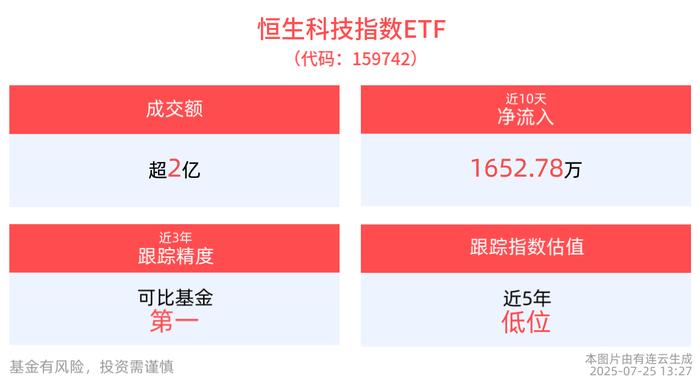
港股回调,恒生科技指数ETF(159742)近10日累计涨幅近10%,港股科技板块在AI驱动及产业催化下或具配置价值
Xin Lang Cai Jing· 2025-07-25 05:46
Group 1 - The Hang Seng Tech Index (HSTECH) decreased by 1.29% as of July 25, 2025, with mixed performance among constituent stocks [3] - Semiconductor stocks like SMIC (00981) and Hua Hong Semiconductor (01347) showed gains of 1.69% and 1.15% respectively, while Bilibili-W (09626) led the decline with a drop of 4.61% [3] - The Hang Seng Tech Index ETF (159742) fell by 1.28%, with a latest price of 0.77 yuan, but has seen a cumulative increase of 4.97% over the past week and 9.69% over the last ten trading days [3] Group 2 - Huachuang Securities noted that the tech sector is becoming more sensitive to industrial catalysts as tariff negotiations ease and earnings season concludes, with ongoing developments in AI applications [4] - The gaming sector is showing positive data for core products, suggesting potential investment opportunities [4] - The Hang Seng Tech Index ETF has a latest scale of 2.354 billion yuan, with recent inflows remaining balanced [4] Group 3 - The Hang Seng Tech Index ETF has seen a net value increase of 29.83% over the past three years, with a maximum monthly return of 33.70% since inception [5] - The ETF's Sharpe ratio for the past year is reported at 1.40, indicating a favorable risk-adjusted return [5] Group 4 - The ETF's management fee is 0.50% and the custody fee is 0.15%, with a tracking error of 0.047% over the past three years, the highest among comparable funds [7] - The latest price-to-earnings ratio (PE-TTM) for the Hang Seng Tech Index is 21.42, indicating it is at a historical low compared to the past five years [7] - The top ten weighted stocks in the Hang Seng Tech Index account for 70.32% of the index, including major companies like Tencent (00700) and Alibaba-W (09988) [7]

30股获杠杆资金净买入超亿元
Zheng Quan Shi Bao Wang· 2025-07-25 02:44
Core Insights - As of July 24, the total market financing balance reached 1.93 trillion yuan, an increase of 6.097 billion yuan from the previous trading day, marking four consecutive days of growth in financing balance [1] - On July 24, 1,965 stocks received net financing purchases, with 559 stocks having net purchases exceeding 10 million yuan, and 30 stocks exceeding 100 million yuan [1] - The top net financing purchase was for China Power Construction, with a net purchase of 725 million yuan, followed by Zhongjin Gold and Northern Rare Earth with net purchases of 512 million yuan and 304 million yuan, respectively [1][2] Financing Balance and Stock Performance - The average financing balance as a percentage of circulating market value for stocks with significant net purchases is 3.56%, with Jianghuai Automobile having the highest ratio at 9.22% [2] - The stocks with the highest net financing purchases on July 24 included: - China Power Construction: 725 million yuan, 10.04% increase - Zhongjin Gold: 511 million yuan, 4.41% decrease - Northern Rare Earth: 303 million yuan, 9.00% increase - Iron Construction Machinery: 298 million yuan, 8.43% increase - Huatai Securities: 296 million yuan, 3.28% increase [2][3] Industry Distribution - The industries with the most stocks receiving net financing purchases exceeding 100 million yuan include: - Non-ferrous metals: 5 stocks - Non-bank financials: 4 stocks - Machinery equipment: 3 stocks [1] - The distribution of significant net purchases shows that 25 stocks are from the main board, 3 from the ChiNext board, and 2 from the Sci-Tech Innovation board [1]


2025年二季度公募基金持仓分析:科技持仓持续增长,周期配置逐步抬升
Changjiang Securities· 2025-07-23 14:16
Group 1 - The overall fund positions increased marginally in Q2 2025, with a notable increase in the ChiNext index and a decrease in the main board [6][10][14] - In terms of industry allocation, public funds increased their holdings in technology and cyclical sectors while reducing exposure to manufacturing and consumer sectors [25][31] - The allocation to high-dividend sectors rose, with significant increases in insurance holdings [50][52] Group 2 - The public funds significantly increased their positions in the ChiNext index by 1.74 percentage points to 15.18% and reduced the main board by 1.87 percentage points to 72.46% [14][24] - The technology sector saw increased allocations, particularly in electronics, healthcare, and home appliance manufacturing, while the food and beverage sector saw a decline [31][34] - The telecommunications and financial sectors experienced notable increases in allocation, while discretionary and staple consumer sectors were reduced [28][31] Group 3 - The report highlighted a marginal increase in the stock positions of four types of funds, with the balanced mixed funds showing a more significant increase [11][19] - The concentration of the top ten holdings decreased, with the top ten holdings accounting for 16.70%, down 3.4 percentage points from the previous quarter [24] - The report indicated a continued rise in the allocation to Hong Kong stocks, while the allocation to the Hang Seng Technology index saw a decline [15][17]
市场流动性和情绪尚好,股指偏强运行
Guo Mao Qi Huo· 2025-07-21 09:27
Report Summary 1. Report Industry Investment Rating No relevant content provided. 2. Core Viewpoints of the Report - The current domestic and overseas factors are generally favorable. The "anti - involution" policy and the upcoming Politburo meeting at the end of the month have raised policy expectations. Overseas, the postponement of reciprocal tariffs to August and the TACO transaction have boosted market sentiment, while the recent expectation of a Fed rate cut has increased. A - share liquidity and market sentiment are strong, and stock index futures are expected to run strongly. The strategy is mainly to adjust and go long [3]. 3. Summaries According to Relevant Catalogs 3.1 Main Views and Strategy Overview - **Influence Factors and Their Driving Forces**: Economic and corporate earnings are neutral; macro - policies are neutral; overseas factors are slightly positive; liquidity is slightly positive [3]. - **Investment View and Strategy**: Adjust and go long. The trading strategy is to adjust and go long unilaterally, and pay attention to domestic policies and overseas geopolitical factors [3]. 3.2 Stock Index Market Review - **Index Performance**: Last week, the Shanghai - Shenzhen 300 rose 1.09% to 4058.5; the Shanghai Composite 50 rose 0.28% to 2764.5; the CSI 500 rose 1.2% to 6099.6; the CSI 1000 rose 1.41% to 6552.1 [5]. - **Industry Index Performance**: In the Shenwan Primary Industry Index, communication (7.6%), pharmaceutical biology (4%), automobiles (3.3%), machinery and equipment (2.9%), and national defense and military industry (2.3%) led the gains last week, while media (- 2.2%), real estate (- 2.2%), public utilities (- 1.4%), non - bank finance (- 1.2%), and banks (- 1%) led the losses [8]. - **Futures Volume and Open Interest**: The trading volume and open interest of various stock index futures showed different changes. For example, the trading volume of CSI 1000 futures decreased by 3.10%, and the open interest decreased by 11.96% [12]. - **Cross - Variety Spread Performance**: The spread between the Shanghai - Shenzhen 300 and the Shanghai Composite 50, and the spread between the CSI 1000 and the CSI 500 are at certain historical percentile levels [17]. 3.3 Stock Index Influence Factors - Liquidity - **Funds and Macro - liquidity**: The central bank conducted 17268 billion yuan of 7 - day reverse repurchase operations this week, achieving a net investment of 12011 billion yuan. Next week, 17268 billion yuan of reverse repurchases will expire, and 2000 billion yuan of MLF will expire on July 25 [23]. - **Market Liquidity Indicators**: As of July 17, the margin trading balance of A - shares was 18984.4 billion yuan, an increase of 285.5 billion yuan from the previous week. The average daily trading volume of A - shares last week increased by 323.8 billion yuan compared with the previous week [29]. 3.4 Stock Index Influence Factors - Economic Fundamentals and Corporate Earnings - **Macroeconomic Indicators**: In the first half of 2025, China's GDP totaled 660536 billion yuan, a year - on - year increase of 5.3%. In June, industrial added value increased by 6.8% year - on - year, but the demand side weakened. Real estate investment from January to June further declined to - 11.2%, and the growth rate of consumption in June was 4.8%, lower than last month's 6.4% [3]. - **Corporate Earnings Indicators**: The report provides the year - on - year growth rate of net profit attributable to the parent and ROE of major broad - based indexes and Shenwan primary industry indexes [44][45]. 3.5 Stock Index Influence Factors - Policy Driving - **Recent Macro - policy Trends**: A series of important meetings and policies have been introduced, including the central government's emphasis on promoting the construction of a unified national market, urban work deployment, and a series of monetary and fiscal policies [49][50][51]. 3.6 Stock Index Influence Factors - Overseas Factors - **US Economic Data**: In June, the US manufacturing PMI was 49%, an increase of 0.5 percentage points from the previous value; the non - manufacturing PMI was 50.8%, an increase of 0.9 percentage points from the previous value. The unemployment rate was 4.1%, and the number of new non - farm jobs was 147,000 [57]. - **Trump Team's Actions**: Trump's team has announced a series of tariff policies, which have a significant impact on international trade and the global economic situation [65][67][69]. 3.7 Stock Index Influence Factors - Valuation - **Index Valuation Levels**: As of July 18, 2025, the rolling price - to - earnings ratios of the Shanghai - Shenzhen 300, Shanghai Composite 50, CSI 500, and CSI 1000 were 13.4 times, 11.4 times, 29.8 times, and 40.2 times respectively, and were at the 71.4%, 81.4%, 70.6%, and 60.8% percentile levels in the past ten years [72].
三重优势持续释放 筑牢中国供应链对美企“磁吸力”
Zhong Guo Xin Wen Wang· 2025-07-20 14:56
Core Insights - Despite rising policy uncertainties, American companies are increasingly valuing the Chinese supply chain, as evidenced by a 15% year-on-year increase in U.S. exhibitors at the China International Supply Chain Promotion Expo, with 60% being Fortune 500 companies [1][2] - The U.S.-China Business Council's 2025 report indicates that losing access to the Chinese market would significantly weaken the global competitiveness of American firms [1] - The Chinese supply chain offers unparalleled advantages, including a complete industrial chain, cost-effectiveness, and a unique innovation ecosystem that integrates advanced technologies [2] Group 1: Supply Chain Advantages - China possesses a leading global industrial chain advantage, allowing for production processes that would require multiple countries in other regions [1] - The cost-effectiveness of the Chinese supply chain is not only about pricing but also about time and operational efficiency, even when tariffs are considered [1][2] Group 2: Deepening U.S.-China Cooperation - The deep interdependence between American companies and the Chinese supply chain is evident across various industries, with over 80% of Apple's major suppliers located in China and significant local operations by companies like Cargill and Tesla [2] - A recent survey by the American Chamber of Commerce indicates that most U.S. companies prefer to enhance local operations rather than withdraw from China in response to challenges [2][3] Group 3: Business Communication and Collaboration - Current communication between U.S. and Chinese business sectors is smooth, with a shared willingness to strengthen supply chain cooperation [3] - American companies remain committed to their strategic considerations in China, seeking deeper collaboration to stabilize economic relations and ensure the continuity of global supply chains [3]


抄底时刻?大宗商品三次历史大底模型5000字深度解析!
对冲研投· 2025-07-18 12:02
Core Viewpoint - The article emphasizes the importance of systematic thinking in analyzing commodity markets, highlighting the need to consider both macroeconomic factors and industry-specific dynamics to understand price movements and investment opportunities [9][10][21]. Group 1: Systematic Thinking - Systematic thinking involves a comprehensive approach that considers the broader context and main contradictions in commodity markets, rather than focusing on isolated targets [8][9]. - The article contrasts goal-oriented thinking with systematic thinking, using weight loss as an analogy to illustrate the difference between short-term goals and long-term behavioral changes [5][6]. Group 2: Commodity Price Dynamics - Commodity prices are influenced by a combination of valuation and driving factors, with macroeconomic conditions affecting long-term price expectations [10][13]. - Recent trends show a contradiction where prices are rising despite weak demand and increasing inventories, leading to confusion among industry participants [15][20]. Group 3: Tools for Analyzing Market Contradictions - The article identifies two key tools for resolving contradictions between macroeconomic and industry perspectives: inventory cycles and basis [22][24]. - A focus on basis is crucial for understanding the direction of commodity prices, particularly in the context of macroeconomic trends [25][28]. Group 4: Historical Analysis of Commodity Bottoms - Historical analysis reveals that significant price bottoms are often preceded by rising industrial profits and subsequent inventory replenishment cycles [46][49]. - The article discusses three historical bottoms (2008, 2015, 2020) and their characteristics, emphasizing the role of demand-driven price increases [44][46]. Group 5: Current Market Conditions - The current market does not exhibit strong demand signals, but there is potential for demand to emerge as prices become more attractive [85][86]. - The article suggests that while macroeconomic factors are important, industry-specific analysis is necessary to navigate current market conditions effectively [86].

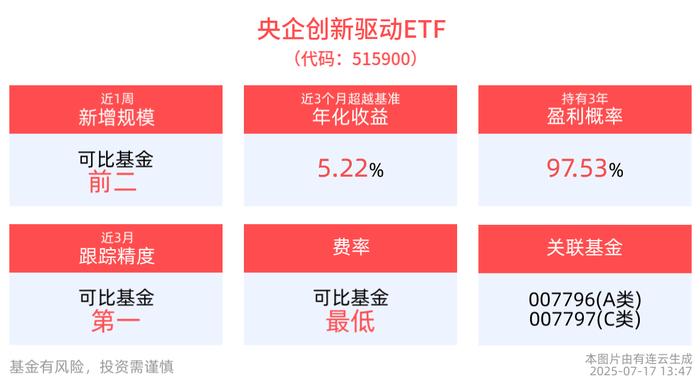
央企创新驱动ETF(515900)午后翻红,近1周规模增长显著,政策精准引导,电力央企获更稳定市场需求与发展空间
Xin Lang Cai Jing· 2025-07-17 06:11
Core Viewpoint - The Central State-Owned Enterprises Innovation-Driven ETF (515900) has shown positive performance, with a recent increase in value and significant growth in scale, reflecting the ongoing support for innovation and strategic industries in China [3][4][5]. Group 1: ETF Performance - As of July 16, 2025, the Central State-Owned Enterprises Innovation-Driven ETF has achieved a net value increase of 55.62% over the past five years, ranking in the top 8.44% among 995 index equity funds [5]. - The ETF has recorded a maximum monthly return of 15.05% since its inception, with an average monthly return of 3.97% during rising months [5]. - The ETF's management fee is 0.15% and the custody fee is 0.05%, making it the lowest among comparable funds [5]. Group 2: Market Trends and Developments - Recent government initiatives emphasize the importance of integrating state-owned enterprises with the national technology innovation system, focusing on strategic emerging industries and enhancing collaboration with various ownership enterprises [4]. - The demand for renewable energy consumption in industries such as steel and cement is expected to increase significantly, with an estimated additional demand of approximately 500 billion kilowatt-hours for wind and solar energy in the current year [4]. Group 3: Index Composition - The Central State-Owned Enterprises Innovation-Driven Index includes 100 representative listed companies evaluated for their innovation and profitability, with the top ten weighted stocks accounting for 34.87% of the index [6].
主力资金动向 28.23亿元潜入公用事业
Zheng Quan Shi Bao Wang· 2025-07-16 09:10
Core Insights - The report indicates that 12 industries experienced net inflows of capital, while 19 industries faced net outflows on the trading day [1][2] - The utility sector saw the highest net inflow of capital at 2.823 billion yuan, despite a slight decline of 0.20% in its stock price [1] - The communication sector recorded the largest net outflow of capital at 4.019 billion yuan, with a price increase of 0.37% [1] Industry Summary - **Utilities**: Net inflow of 2.823 billion yuan, trading volume of 4.061 billion shares, and a turnover rate of 1.02% [1] - **Pharmaceuticals**: Net inflow of 2.095 billion yuan, trading volume of 7.603 billion shares, and a turnover rate of 2.79% [1] - **Automotive**: Net inflow of 1.865 billion yuan, trading volume of 5.311 billion shares, and a turnover rate of 2.44% [1] - **Light Industry**: Net inflow of 1.071 billion yuan, trading volume of 1.919 billion shares, and a turnover rate of 2.29% [1] - **Social Services**: Net inflow of 0.390 billion yuan, trading volume of 1.192 billion shares, and a turnover rate of 2.64% [1] - **Household Appliances**: Net inflow of 0.362 billion yuan, trading volume of 1.402 billion shares, and a turnover rate of 1.82% [1] - **Food and Beverage**: Net inflow of 0.282 billion yuan, trading volume of 1.171 billion shares, and a turnover rate of 1.29% [1] - **Petrochemicals**: Net inflow of 0.145 billion yuan, trading volume of 1.080 billion shares, and a turnover rate of 0.29% [1] - **Transportation**: Net inflow of 0.141 billion yuan, trading volume of 2.742 billion shares, and a turnover rate of 0.65% [1] - **Retail**: Net inflow of 0.125 billion yuan, trading volume of 1.976 billion shares, and a turnover rate of 1.65% [1] - **Textiles and Apparel**: Net inflow of 0.068 billion yuan, trading volume of 1.901 billion shares, and a turnover rate of 2.70% [1] - **Comprehensive**: Net inflow of 0.045 billion yuan, trading volume of 0.379 billion shares, and a turnover rate of 2.07% [1] - **Agriculture, Forestry, Animal Husbandry, and Fishery**: Net outflow of 0.013 billion yuan, trading volume of 1.600 billion shares, and a turnover rate of 1.70% [1] - **Beauty and Personal Care**: Net outflow of 0.054 billion yuan, trading volume of 0.272 billion shares, and a turnover rate of 2.42% [1] - **Machinery and Equipment**: Net outflow of 0.071 billion yuan, trading volume of 7.694 billion shares, and a turnover rate of 2.85% [1] - **Coal**: Net outflow of 0.300 billion yuan, trading volume of 1.156 billion shares, and a turnover rate of 0.88% [1] - **Construction Materials**: Net outflow of 0.440 billion yuan, trading volume of 1.516 billion shares, and a turnover rate of 2.04% [1] - **Real Estate**: Net outflow of 0.478 billion yuan, trading volume of 4.052 billion shares, and a turnover rate of 1.86% [1] - **Construction Decoration**: Net outflow of 0.543 billion yuan, trading volume of 3.077 billion shares, and a turnover rate of 1.10% [2] - **Steel**: Net outflow of 0.588 billion yuan, trading volume of 3.090 billion shares, and a turnover rate of 1.57% [2] - **Media**: Net outflow of 0.654 billion yuan, trading volume of 4.495 billion shares, and a turnover rate of 3.07% [2] - **Banking**: Net outflow of 0.687 billion yuan, trading volume of 4.236 billion shares, and a turnover rate of 0.32% [2] - **Environmental Protection**: Net outflow of 0.869 billion yuan, trading volume of 1.505 billion shares, and a turnover rate of 1.69% [2] - **Basic Chemicals**: Net outflow of 1.276 billion yuan, trading volume of 5.444 billion shares, and a turnover rate of 2.06% [2] - **Defense Industry**: Net outflow of 1.450 billion yuan, trading volume of 1.865 billion shares, and a turnover rate of 1.73% [2] - **Electrical Equipment**: Net outflow of 1.686 billion yuan, trading volume of 6.202 billion shares, and a turnover rate of 2.50% [2] - **Non-Banking Financials**: Net outflow of 1.985 billion yuan, trading volume of 5.048 billion shares, and a turnover rate of 1.21% [2] - **Nonferrous Metals**: Net outflow of 2.084 billion yuan, trading volume of 4.361 billion shares, and a turnover rate of 1.99% [2] - **Computers**: Net outflow of 2.920 billion yuan, trading volume of 7.963 billion shares, and a turnover rate of 4.47% [2] - **Electronics**: Net outflow of 3.559 billion yuan, trading volume of 6.314 billion shares, and a turnover rate of 2.28% [2] - **Telecommunications**: Net outflow of 4.019 billion yuan, trading volume of 3.279 billion shares, and a turnover rate of 1.88% [2]