
饮料

Search documents
食品饮料周报:白酒有望加速出清,关注经营边际改善、高景气成长股-20251027
Tai Ping Yang Zheng Quan· 2025-10-27 15:09
Investment Rating - The report does not provide a specific industry rating but highlights the performance of various sub-sectors within the food and beverage industry [7] Core Insights - The food and beverage sector is currently under pressure, with the SW food and beverage index declining by 1.02%, ranking 30th among 31 sub-industries [12] - The white liquor sector is in a "supply clearing" phase, with expectations of increased pressure in the upcoming quarterly reports, indicating a potential acceleration in industry clearing [16] - The report emphasizes the importance of monitoring the new leadership strategies at Kweichow Moutai following a significant personnel change [16] - The beverage sector shows promising growth, particularly with Eastroc Beverage's strong performance in the first three quarters of 2025, achieving a revenue of 16.844 billion yuan, a year-on-year increase of 34.13% [17] Summary by Sections 1. Sector Performance - The SW food and beverage sector saw a decline of 1.02%, with notable drops in the white liquor, beer, and snack sub-sectors [12] - The top-performing sub-sectors included pre-processed foods, other alcoholic beverages, and meat products, with increases of 1.10%, 0.35%, and 0.33% respectively [12] 2. White Liquor Sector - The SW white liquor index fell by 1.12%, indicating a bottom adjustment phase [16] - The current price for Feitian Moutai is 1,720 yuan, down 30 yuan from the previous week, while the price for Pu'er Moutai is 8,155 yuan, down 5 yuan [16] - Recommended companies in this sector include Kweichow Moutai and Shanxi Fenjiu, which are expected to perform relatively well during the adjustment period [16] 3. Beverage Sector - Eastroc Beverage reported a revenue of 16.844 billion yuan for the first three quarters of 2025, reflecting a year-on-year growth of 34.13% [17] - The company also saw a net profit of 3.761 billion yuan, up 38.91% year-on-year [17] - Other companies like Jinzai Foods and Qiaqia Foods are facing challenges, with Jinzai reporting a revenue of 1.81 billion yuan, a slight increase of 2.1% year-on-year, but a net profit decline of 19.5% [17][19]




期货大佬改行卖饮料,3年卖20亿!
Sou Hu Cai Jing· 2025-10-27 13:55
Core Insights - The article highlights the journey of Song Wei, a prominent figure in China's futures market, who transitioned from a successful trading career to founding a beverage company, achieving significant sales growth in a relatively short period [1][3][11]. Group 1: Background and Early Career - Song Wei, born in 1968, graduated from Shanghai Jiao Tong University in 1991 and began his career at the Shanghai Material Trade Center [3]. - He became one of the first "Red Vests" in China's futures market, participating in the establishment of the Shanghai Metal Exchange in 1992, which marked the beginning of China's regulated futures trading [3][5]. - His initial wealth came from trading "subscription certificates" and later from high-risk futures trading, where he could earn tens of millions in a single day [5][6]. Group 2: Challenges in Futures Trading - Despite early success, Song Wei experienced anxiety due to the volatile nature of the futures market, which required constant market judgment and carried high risks [7][8]. - The number of original "Red Vests" dwindled from 109 to 20 within two years, highlighting the market's dangers and the high rate of failure among traders [7][8]. - A mentor advised him to avoid long-term futures trading, suggesting a shift to stocks or real industries for more stable returns [8][9]. Group 3: Transition to Real Industry - In 1997, after several ups and downs in the futures market, Song Wei decided to leave and ventured into the restaurant business, opening a successful establishment in Shanghai [10]. - He later founded a health product brand and identified a market opportunity in honey pomelo tea, leading to the creation of the "Youxiang Valley" brand [10][11]. - The brand faced competition but eventually thrived, with sales reaching 2 billion yuan in three years, driven by the launch of "Song Pomelo Juice" [11][12]. Group 4: Business Philosophy and Future Plans - Song Wei emphasizes the importance of long-term investment and stability in business, contrasting it with the quick but risky profits of futures trading [13][14]. - He aims for "Song Pomelo Juice" to achieve 10 billion yuan in sales by 2024 and plans for an IPO by the end of 2026 [12][14]. - His experience reflects a shift towards sustainable business practices, focusing on agricultural development and long-term growth rather than speculative trading [13][14].
Keurig Dr Pepper(KDP) - 2025 Q3 - Earnings Call Transcript
2025-10-27 13:47
Financial Data and Key Metrics Changes - The company reported a 6% revenue CAGR and an 11% EPS CAGR since its formation, placing it in the top tier of consumer packaged goods (CPG) peers [7][25] - The company expects year one EPS accretion of approximately 10% from the JDE Peet's acquisition [38] Business Line Data and Key Metrics Changes - The Refreshment Beverage segment has achieved a high single-digit net sales CAGR since 2018, driven by flagship brands like Dr Pepper [23] - The U.S. Coffee segment has maintained a steady low single-digit sales CAGR in recent years, with Keurig reinforcing its position as the number one North American single-serve system [24][25] Market Data and Key Metrics Changes - The global coffee category has experienced a post-COVID slowdown but is beginning to show signs of recovery, with a historical volume growth of 2% CAGR over 40 years [11][29] - The company anticipates that the acquisition of JDE Peet's will more than triple its coffee net sales to $16 billion, making it the second-largest global coffee player [31] Company Strategy and Development Direction - The company aims to create two focused pure-play entities: Beverage Co, a growth-oriented player, and Global Coffee Co, a steady grower with strong cash flow [34] - The acquisition of JDE Peet's is seen as a strategic move to maximize the value of the coffee business, leveraging economies of scale and enhancing global reach [30][31] Management's Comments on Operating Environment and Future Outlook - Management acknowledges the need for a refreshed approach to the coffee category, emphasizing the importance of structural tailwinds supporting future growth [27][30] - The company is committed to executing the integration and separation plans effectively, with a focus on maintaining business momentum and achieving synergy capture [40][41] Other Important Information - The company has established a transformation management office to oversee the integration and ensure successful execution of the acquisition and separation [36] - Recent actions have been taken to address investor concerns regarding capital structure, including minority investments to shore up the balance sheet [37] Q&A Session Summary Question: Why is JDE Peet's the right acquisition? - Management believes JDE Peet's represents the most attractive path for maximizing the value of the coffee business due to its scale and capabilities [19][30] Question: How will the separation into Beverage Co and Global Coffee Co uniquely enable growth? - The separation allows each entity to tailor its strategy and capital allocation priorities to align with distinct category and geographic exposures [34] Question: How will the company optimize its capital structure post-acquisition? - The company plans to target initial leverage ranges for Beverage Co and Global Coffee Co to ensure financial stability and attractive returns [37]

东鹏饮料(605499):全国化战略进入收获期,多元化产品矩阵成型
Wanlian Securities· 2025-10-27 12:55
Investment Rating - The investment rating for the company is "Add" [5] Core Insights - The company maintains high growth in performance, with Q3 2025 revenue reaching 6.107 billion yuan, a year-on-year increase of 30.36%, and net profit attributable to shareholders at 1.386 billion yuan, up 41.91% year-on-year [2][3] - The national strategy is entering a harvest period, with emerging markets like Southwest and North China showing strong growth, while traditional markets see a decline in revenue contribution [3][11] - The product matrix is diversifying, with core products continuing to grow, although at a slower pace compared to the first half of the year [4][11] Revenue and Profitability - In the first three quarters of 2025, the company achieved a total revenue of 16.844 billion yuan, a year-on-year increase of 34.13%, and a net profit of 3.761 billion yuan, up 38.91% year-on-year [2][3] - The gross margin for Q3 2025 was 45.21%, slightly down by 0.60% year-on-year, while the net margin improved to 22.68%, an increase of 1.83 percentage points year-on-year [12] Regional Performance - The Guangdong region remains the largest revenue contributor at 23.08%, while North China has surpassed East China to become the second-largest contributor with a revenue growth of 72.88% year-on-year [3][11] Product Performance - The core product, Dongpeng Special Drink, generated revenue of 12.563 billion yuan in the first three quarters, a year-on-year increase of 19.36%, while Dongpeng Water achieved 2.847 billion yuan, up 134.78% year-on-year [4][11] Future Projections - The company aims for over 20% growth in revenue and net profit for 2025, with adjusted net profit forecasts for 2025-2027 at 4.435 billion, 5.499 billion, and 6.822 billion yuan respectively [13]

二代接班,宗馥莉错失的“时间窗口”
3 6 Ke· 2025-10-27 12:08
Core Viewpoint - The transition of leadership in Chinese family-owned businesses, exemplified by Fuyao Glass's new chairman, reflects broader challenges in succession planning and the need for modernization in the face of evolving market conditions [1][2]. Group 1: Leadership Transition - Fuyao Glass announced the succession of 55-year-old Cao Hui as the new chairman, taking over from his father, Cao Dewang, after 36 years in the company [1]. - The transition is seen as a response to the challenges faced by many family-owned businesses in China, particularly as founders age and the market becomes more competitive [1][2]. - The phenomenon of succession is common among the approximately 3 million family-controlled small and medium-sized enterprises in China, many of which were established in the 1990s and are now facing leadership transitions [1]. Group 2: Challenges of Succession - The difficulties in succession are not merely financial but involve complex social relationships that blend tradition, legal authority, performance, and personal charisma [2]. - The concept of "power dynamics" in succession is critical, as successors must navigate existing power structures and establish their authority [5][12]. - Many second-generation leaders face the challenge of overcoming the "cognitive barriers" established by their predecessors, which can hinder their ability to implement change [5][12]. Group 3: Market Evolution and Business Model Transformation - The shift towards digitalization and new business models is essential for the survival of traditional manufacturing firms, which must adapt to online channels and smart manufacturing technologies [1][6]. - Successful transitions often involve a symbolic "patricide," where successors must challenge and redefine the legacy of their predecessors to establish their own leadership [6][11]. - The emergence of new business areas, particularly in e-commerce and digital marketing, provides opportunities for second-generation leaders to innovate without the constraints of traditional practices [9][10]. Group 4: Case Studies and Examples - The case of Wang Xiaolong taking over at Laoxiangji illustrates a successful transition where the new leader implemented digital management strategies and sought inspiration from international practices [8]. - The experience of companies like Wahaha highlights the difficulties faced by successors in navigating entrenched power structures and the need for a clear vision to drive transformation [5][6]. - The rise of brands like Yuanqi Forest demonstrates the potential for innovation in traditional sectors, emphasizing the importance of adapting to market trends while maintaining operational efficiency [10].


港股IPO关键时刻,546万年薪董秘蹊跷辞任,东鹏饮料怎么了?
Sou Hu Cai Jing· 2025-10-27 12:04
Core Viewpoint - Dongpeng Beverage has reported significant growth in its financial performance while experiencing a key management change, as the company prepares for its H-share IPO, raising questions about the timing and implications of the resignation of its board secretary [1][9]. Financial Performance - In the first three quarters of 2025, Dongpeng Beverage achieved a net profit of 3.761 billion yuan, surpassing the total for the entire year of 2024, marking a year-on-year increase of 38.91% [1][14]. - The company's revenue for the same period reached 16.844 billion yuan, reflecting a year-on-year growth of 34.13% [14]. - For 2024, Dongpeng Beverage's revenue and net profit were reported at 15.839 billion yuan and 3.327 billion yuan, respectively, with year-on-year increases of 40.63% and 63.09% [14]. Management Changes - Zhang Lei, the board secretary, resigned due to adjustments in job responsibilities but will continue to serve as a director and vice president, with a reported salary of 5.4655 million yuan for 2024, significantly higher than his previous position [2][8]. - The timing of Zhang's resignation coincides with the critical phase of the company's H-share IPO, leading to speculation about potential conflicts of interest or management stability concerns [1][11]. IPO Plans - Dongpeng Beverage is actively pursuing a dual listing in Hong Kong, having submitted its IPO application to the Hong Kong Stock Exchange, with plans to use the raised funds for capacity expansion and supply chain upgrades [9][11]. - The company previously attempted to list in Hong Kong in April 2023 but faced setbacks, leading to a renewed application in October 2023 [9][12]. Market Position - Dongpeng Beverage holds a dominant position in the energy drink market, with its flagship product, Dongpeng Special Drink, accounting for 74.63% of its revenue in the first three quarters of 2025 [17]. - The company has seen a significant increase in market share, with Dongpeng Special Drink capturing 47.9% of the domestic energy drink market sales volume in 2024 [14]. Sales and Marketing - The company has heavily invested in marketing, with sales expenses reaching 2.6813 billion yuan in the first three quarters of 2025, reflecting a year-on-year increase of 26.74% [15]. - Despite the high marketing expenditure, research and development spending has been notably low, indicating a reliance on sales over innovation [15][16]. Product Risks - Dongpeng Beverage's heavy reliance on its single product, Dongpeng Special Drink, poses a risk, as it contributes over 80% of total revenue [17]. - Recent consumer concerns regarding the high sugar content in Dongpeng Special Drink have emerged, with reports linking excessive consumption to health issues [18].
最新!祝丽丹已离职,办公室已搬空!她是宗馥莉宏胜集团关键人物,此前否认被带走调查
Mei Ri Jing Ji Xin Wen· 2025-10-27 11:24
Core Viewpoint - The recent management upheaval at Hongsheng Beverage Group, including the departure of key executive Zhu Lidan, raises concerns about the company's stability and future direction, particularly as it relates to the Wahaha brand and its strategic initiatives under the leadership of Zong Fuli [1][3][9] Group 1: Management Changes - Zhu Lidan, a core executive of the Wahaha system, has left her position, and her office has been vacated, with no official response from Wahaha [1] - Zhu Lidan was previously the Director of the Management Center and Head of Human Resources, but her position is now listed as "pending" [3] - Another key figure, Yan Xuefeng, was investigated for disciplinary issues but has since resumed his role as the Production Center Director and General Manager of Xun'er Company [3][5] Group 2: Brand Strategy - Zong Fuli has announced a reversal of the decision to replace the "Wahaha" brand with a new brand "Wawa Xiaozong," indicating a shift back to the established brand for future sales [7] - The company had previously communicated plans to transition to "Wawa Xiaozong" for the 2026 sales year, but recent directives to distributors suggest a renewed focus on the "Wahaha" brand [7] - The brand "Wawa Xiaozong" had seen extensive trademark applications, indicating a significant investment in developing this new brand prior to the recent decision reversal [7] Group 3: Strategic Implications - The management changes and brand strategy shifts occur against a backdrop of increased competition and internal challenges following the passing of the founder, Zong Qinghou [9] - Analysts suggest that the company faces significant challenges in maintaining brand integrity and ensuring stakeholder interests are aligned, particularly with ongoing disputes over trademark usage and profit distribution [8][9] - The future of the Wahaha brand and the overall market position of the company remain uncertain as it navigates these internal and external pressures [9]

数读「无糖茶」:潮涌之后,谁留下?谁离开?
3 6 Ke· 2025-10-27 10:27
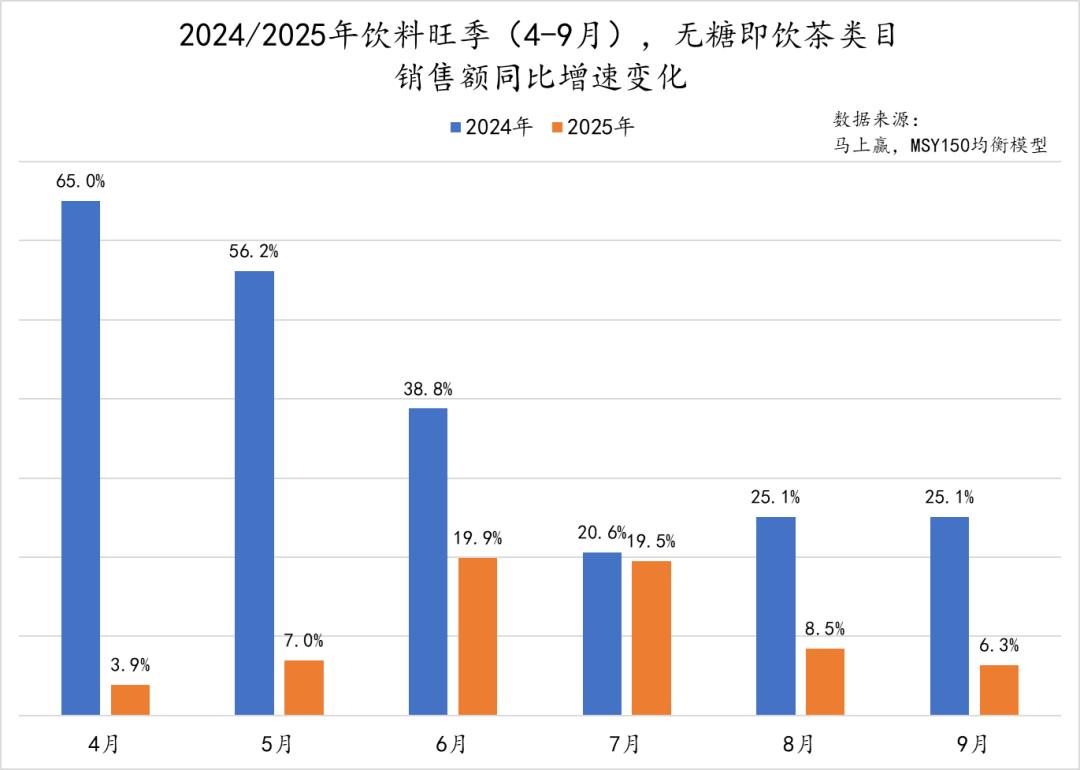
Core Insights - The performance of sugar-free tea in 2025 is not as robust as initially anticipated, with market competition returning to a more rational state [1][4] - Established brands like Nongfu Spring and Suntory are maintaining a steady approach, while emerging brands are showing signs of fatigue amid slowing category growth and price wars [1][4] Group 1: Market Performance - In the 2025 beverage peak season (April to September), the sales growth rate of sugar-free ready-to-drink tea has significantly slowed compared to 2024, with every month showing lower growth rates [4][6] - The average price per unit has increased from 5.1 yuan to 5.6 yuan, indicating that consumers are willing to spend more on larger sizes, reflecting a shift towards quality over price competition [6][10] - The average price per 100ml has shown a decreasing trend, but the decline has slowed down, suggesting a stabilization in pricing and a move away from aggressive price wars [6][10] Group 2: Market Structure - The overall slowdown in category growth is leading to a restructuring of market shares, with established sugar-free tea groups strengthening their market control [11][14] - In the 2025 peak season, established sugar-free tea groups maintained their dominant market position, while the market shares of comprehensive beverage groups and challengers decreased [14][18] - The combined market share of the top three roles exceeded 95%, indicating a high concentration in the category and limited space for new entrants [14][18] Group 3: Tea Type Analysis - Jasmine tea remains the most popular type, with stable market share, while Oolong tea saw fluctuations but rebounded in September [8][28] - The average price of Oolong tea has increased in the 2025 peak season compared to 2024, reflecting a positive trend in consumer acceptance of higher prices [10][28] - The market share of established brands in the Oolong tea segment exceeded 85%, with a notable decline in the market share of comprehensive beverage groups [28][35] Group 4: Consumer Trends - The trend of product diversification through tea blends is becoming increasingly important, with consumers showing interest in both single and blended Oolong teas [26][31] - The market for blended Oolong tea is growing, with challengers capturing a significant share, indicating a shift in consumer preferences towards more diverse flavor profiles [38][42] - Established brands are focusing on maintaining a loyal customer base while challengers aim to attract new consumers through innovative flavor combinations [38][42] Conclusion - The sugar-free tea market is transitioning from growth to maturity, with established brands solidifying their positions while challengers face increasing pressure [25][43] - The emphasis on product quality and brand loyalty is crucial for long-term success in a competitive landscape [43][44]

第一创业晨会纪要-20251027
First Capital Securities· 2025-10-27 10:25
Group 1: Industry Overview - JD Logistics plans to purchase 3 million robots, 1 million unmanned vehicles, and 100,000 drones over the next five years, indicating strong optimism about the rapid advancement of technology in the logistics supply chain [3] - The growth in domestic traffic is accelerating the deployment of 5.5G, and the recovery of demand in overseas markets is driving performance improvements in companies like Xintian Technology and Shuo Beid [3] Group 2: Advanced Manufacturing - Huichuan Technology emphasizes its leading position in industrial automation and joint power businesses in China, forecasting annual revenue to exceed 40 billion, with a focus on expanding overseas [6] - The company sees significant growth potential in smart robotics and digital energy management, with positive feedback on humanoid robots from various domestic and international manufacturers [6] Group 3: New Energy Sector - Guoxuan High-Tech reported Q3 revenue of 10.114 billion, up 20.68% YoY, and a net profit of 2.167 billion, up 1434%, although the profit surge is attributed to non-sustainable financial asset valuation changes [7] - The company faces operational pressures with a significant increase in inventory and accounts receivable, indicating a need for caution regarding operational quality and turnover [7] Group 4: Consumer Sector - Jieya Co. achieved revenue of 565 million in the first three quarters of 2025, a 38.4% YoY increase, with Q3 revenue growth accelerating to 255 million, up 107.2% YoY, driven by a shift of wet wipes production to outsourcing by international brands [9] - Dongpeng Beverage reported revenue of 16.844 billion in the first three quarters, a 34.13% YoY increase, with Q3 revenue of 6.107 billion, up 30.4% YoY, benefiting from reduced sales expenses and increased fair value changes [10] Group 5: Bond Market Analysis - The bond market experienced slight upward movement in yields, influenced by easing US-China trade tensions and a stable equity market, although the sentiment was initially strong due to expectations of monetary policy easing [12] - The bond market's main focus is not on fundamentals, and while there are opportunities for rate cuts, a triggering event is necessary for a downward trend in bond yields [12]
新疆改善型消费持续升温
Xin Hua Cai Jing· 2025-10-27 10:06
Core Insights - Xinjiang's consumer market is experiencing significant growth, driven by improved consumption patterns and an increase in retail sales [1] Group 1: Economic Performance - In the first three quarters, Xinjiang's total retail sales of consumer goods reached 294.034 billion yuan, marking a year-on-year increase of 4.6% [1] - The retail sales of books, newspapers, and magazines in large enterprises increased by 15.5%, while cultural and office supplies saw a remarkable growth of 48.2% [1] Group 2: Consumer Goods Growth - Sales of daily necessities are steadily increasing, with retail sales of beverages, grain and oil products, daily goods, and tobacco and alcohol rising by 16.0%, 14.2%, 11.7%, and 7.7% respectively [1] - The retail sales of new energy vehicles reached 18.38 billion yuan, showing a year-on-year growth of 33.2%, accounting for 37.5% of the total retail sales in the automotive sector [1]