国防军工

Search documents
“十五五”全解读!汇小鲸带你专访未来X大赛道
Zhong Guo Zheng Quan Bao· 2025-11-18 02:13
Core Insights - The "14th Five-Year Plan" outlines China's development blueprint for the next five years, emphasizing the importance of understanding it to identify future investment opportunities [2][16]. Group 1: Emerging Industries and Investment Opportunities - The plan aims to cultivate and expand emerging and future industries, potentially creating several trillion-level markets [7]. - The next decade could see the scale of new industries equivalent to recreating China's high-tech industry [7]. Group 2: Key Focus Areas for Technological Advancement - The plan emphasizes the need for breakthroughs in critical core technologies across various sectors, including integrated circuits, industrial mother machines, and high-end instruments [8]. - It highlights the role of enterprises in driving technological innovation and supporting the growth of high-tech and technology-oriented SMEs [9]. Group 3: Domestic Market Development - The strategy includes measures to strengthen the domestic market and facilitate a smooth domestic circulation, focusing on expanding consumption and developing international consumer center cities [10][11]. - It calls for a shift from price competition to quality competition among enterprises to establish a healthy market order [11]. Group 4: National Security and Emerging Fields - The plan addresses the need to enhance security capabilities in traditional areas like food and energy, as well as emerging fields such as artificial intelligence and biotechnology [12]. - This focus on security is expected to create new development opportunities in sectors like cybersecurity, national defense, and energy resources [12]. Group 5: Investment Themes in A-Share Market - Five key investment themes are identified: hard technology sectors such as artificial intelligence, integrated circuits, industrial mother machines, new energy, and biomanufacturing [14]. - The plan aims to rectify disorderly competition, which may benefit leading companies in solar energy, lithium batteries, and new energy vehicles [14]. - There is a strong emphasis on boosting consumption in sectors like automotive, housing, and tourism, indicating potential growth in these areas [14]. - The implementation of major national strategies and the enhancement of security capabilities are expected to drive growth in industries like construction materials, machinery, new energy, and cybersecurity [14]. - The financial sector is also highlighted, with banks, securities, and insurance institutions currently valued at historical lows, suggesting potential for recovery [14].


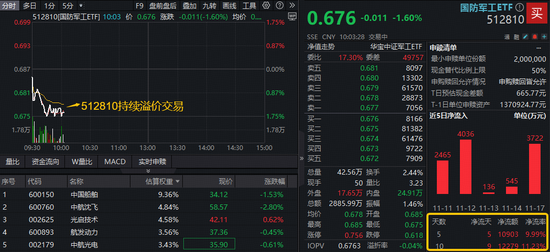
中字头军工股普跌,国防军工ETF回调逾1%触及半年线,场内溢价再起!资金连续6日净申购!
Xin Lang Ji Jin· 2025-11-18 02:11
Core Viewpoint - The defense and military industry sector is experiencing a significant pullback, with the popular defense ETF (512810) declining over 1% and hitting a six-month low, while major military stocks are also seeing declines [1][2]. Group 1: Market Performance - The defense military ETF (512810) has seen a decline of 1.60%, trading at 0.676, with a drop of 0.011 [2]. - Major military stocks such as AVIC Shenyang Aircraft Corporation and China Shipbuilding Industry Corporation have dropped nearly 3% and over 1% respectively [1]. Group 2: Investment Opportunities - The ETF has attracted over 100 million yuan in net subscriptions over the past six trading days, indicating active interest from investors [1]. - Analysts suggest that the fourth quarter may see the gradual realization of "14th Five-Year Plan" related orders, coupled with military trade catalysts, which could lead to a resurgence in the defense and military market [1]. - The defense industry is expected to benefit from geopolitical risks, technological advancements, and policy support, with potential for high-end weapon exports and a revaluation of core asset values [1]. Group 3: Strategic Insights - CITIC Securities' report indicates a shift in China's defense industry from "cyclical growth" to "comprehensive growth," driven by domestic demand, foreign trade expansion, and civilian contributions [3]. - The defense ETF (512810) is highlighted as an efficient tool for investing in core defense assets, covering various hot themes such as commercial aerospace, low-altitude economy, and military AI [3].
11月17日电力设备、计算机、国防军工等行业融资净买入额居前
Zheng Quan Shi Bao Wang· 2025-11-18 02:08
以幅度进行统计,综合行业融资余额增幅最高,最新融资余额为47.54亿元,环比增长1.97%,其次是农 林牧渔、电力设备、国防军工行业,环比增幅分别为1.61%、1.45%、0.96%;融资余额环比降幅居前的 行业有煤炭、家用电器、通信等,最新融资余额分别有144.16亿元、368.98亿元、1084.51亿元,分别下 降1.69%、1.10%、0.77%。(数据宝) 11月17日各行业融资余额环比变动 截至11月17日,市场最新融资余额为24823.20亿元,较上个交易日环比增加76.21亿元,分行业统计,申 万所属一级行业有21个行业融资余额增加,电力设备行业融资余额增加最多,较上一日增加32.28亿 元;融资余额增加居前的行业还有计算机、国防军工、基础化工等,融资余额分别增加9.07亿元、7.55 亿元、6.94亿元;融资余额减少的行业有10个,电子、通信、家用电器等行业融资余额减少较多,分别 减少8.46亿元、8.39亿元、4.10亿元。 | 代码 | 最新融资余额(亿元) | 较上一日增减(亿元) | 环比增幅(%) | | --- | --- | --- | --- | | 电力设备 | 2252. ...
申万宏源研究晨会报告-20251118
Shenwan Hongyuan Securities· 2025-11-18 01:48
Core Insights - The report indicates that China's defense equipment construction is entering a new cycle driven by both "steady growth in domestic demand" and "release of external potential" [15] - The global asset allocation environment is expected to transition from preventive interest rate cuts by the Federal Reserve to a re-inflation cycle driven by both fiscal and monetary policy easing [8][10] - The manufacturing industry is anticipated to experience a structural recovery, with a focus on cyclical assets as economic demand stabilizes and PPI (Producer Price Index) begins to rise [10][11] Group 1: Global Asset Allocation Strategy - The report outlines three major trading themes for 2025, including the breaking of the "American exceptionalism" narrative, the impact of a weak dollar, and the tightening of liquidity due to government shutdowns [8] - It emphasizes the importance of monitoring liquidity turning points and their effects on asset rotation, suggesting a shift from liquidity-driven to fundamental-driven asset logic in China [8][10] - Tactical strategies for 2026 include balancing equity and bond allocations initially, then shifting to an overweight position in equities as inflation and corporate earnings recover [8][10] Group 2: Industry-Specific Investment Strategies - The defense and military industry is highlighted as a key area for investment, with a focus on modernization and technological advancements in military equipment [15] - The report identifies opportunities in the light manufacturing sector, particularly in global supply chain shifts and the competitive advantages of leading companies [15][16] - It suggests that cyclical assets, particularly in sectors like power equipment, chemicals, and non-ferrous metals, will benefit from the anticipated recovery in PPI and economic demand [12][15] Group 3: Economic and Market Trends - The report predicts a stabilization in economic demand and a gradual recovery in PPI, which will influence market style factors and lead to a rotation from technology growth to cyclical assets [10][11] - It notes that the historical relationship between M1-M2 growth rates and A-share performance suggests a potential upturn in corporate profitability and stock market performance in 2026 [11][12] - The report also highlights the importance of government policies, such as the "Fifteen Five" plan, which emphasizes economic construction and modernization of industries [12][15]
【早盘三分钟】11月18日ETF早知道
Xin Lang Ji Jin· 2025-11-18 00:56
Core Insights - The article discusses the current trends in the ETF market, highlighting the performance of various sectors and the impact of geopolitical tensions on the defense industry [1][7]. Market Temperature - The market temperature indicator shows that the Shanghai Composite Index, Shenzhen Component Index, and ChiNext Index have percentile valuations of 97.53%, 80.71%, and 39.08% respectively, indicating a mixed valuation landscape [1]. Sector Performance - The top-performing sectors on November 17, 2025, included: - Computer: +1.67% - Defense Industry: +1.59% - Banking: +1.10% - The sectors that experienced declines were: - Real Estate: -1.11% - Non-bank Financials: -1.31% - Pharmaceuticals: -1.73% [2]. Fund Flow Signals - The top three sectors with net inflows were: - Computer: 4.331 billion - Defense Industry: 2.657 billion - Banking: 0.838 billion - The sectors with the highest net outflows included: - Pharmaceuticals: -6.216 billion - Electronics: -5.311 billion - Power Equipment: -4.718 billion [2]. ETF Performance - The "创业板人工智能ETF华宝" showed a 6-month increase of 78.53% and a daily increase of 2.20% [5]. - The "国防军工ETF" has a strong outlook due to geopolitical tensions and is expected to benefit from increased military orders and technological advancements [7][10]. Geopolitical Impact on Defense Sector - The defense industry is experiencing a surge due to heightened geopolitical tensions, with the 中证军工指数 rising over 1% on November 17, 2025. Key stocks like 长城军工 and 航天发展 reached new highs [7]. - The upcoming "十五五" military orders are anticipated to boost the sector further, alongside military trade catalysts [7].

A股市场大势研判:指数低开低走
Dongguan Securities· 2025-11-17 23:30
Market Performance - The A-share market experienced a decline, with the Shanghai Composite Index closing at 3972.03, down by 0.46% [2] - The Shenzhen Component Index closed at 13202.00, down by 0.11%, while the CSI 300 Index fell by 0.65% to 4598.05 [2] - The ChiNext Index and the STAR 50 Index also saw declines of 0.20% and 0.53%, respectively [2] Sector Performance - The top-performing sectors included Computer (1.67%), Defense and Military Industry (1.59%), Coal (1.32%), Communication (1.10%), and Real Estate (1.00%) [3] - Conversely, the worst-performing sectors were Pharmaceutical Biology (-1.73%), Banking (-1.31%), Non-Bank Financials (-1.11%), Building Materials (-0.93%), and Home Appliances (-0.84%) [3] Concept Index Performance - The leading concept indices were related to Military Equipment Restructuring (4.72%), MLOps (3.42%), Web3.0 (3.10%), Digital Watermarking (2.71%), and Electronic ID (2.68%) [3] - The lagging concept indices included Cell Immunotherapy (-1.87%), Weight Loss Drugs (-1.87%), Innovative Drugs (-1.72%), Recombinant Proteins (-1.71%), and Fentanyl (-1.68%) [3] Future Outlook - The market is expected to experience short-term fluctuations due to profit-taking, but a gradual improvement in the economic fundamentals is anticipated in the fourth quarter, supported by policy measures [5] - The report suggests focusing on sectors such as Banking, Non-Bank Financials, Transportation, Public Utilities, Coal, and TMT for potential investment opportunities [5] Water Conservation Industry - The water conservation industry in China is showing robust growth, with an estimated market size exceeding 760 billion yuan, driven by key regions such as Beijing-Tianjin-Hebei, Yangtze River Delta, and Guangdong-Hong Kong-Macau Greater Bay Area [4][5] - The development of water-saving industrial parks and leading enterprises in agriculture, industry, and urban life is contributing to this growth [5]
浙商早知道-20251118
ZHESHANG SECURITIES· 2025-11-17 23:30
Market Overview - On November 17, the Shanghai Composite Index fell by 0.46%, the CSI 300 decreased by 0.65%, the STAR 50 dropped by 0.53%, while the CSI 1000 rose by 0.27%, and the ChiNext Index declined by 0.2%. The Hang Seng Index also decreased by 0.71% [4][5]. - The best-performing sectors on November 17 included Computer (+1.67%), Defense and Military Industry (+1.59%), Coal (+1.32%), Communication (+1.1%), and Real Estate (+1%). The worst-performing sectors were Pharmaceutical and Biological (-1.73%), Banking (-1.31%), Non-Bank Financials (-1.11%), Building Materials (-0.93%), and Home Appliances (-0.84%) [4][5]. Key Recommendations - The report recommends Yanzhou Coal Mining Company (600188) with a focus on its capacity expansion towards 300 million tons, indicating a potential turnaround in the industry cycle. The company is expected to benefit from both internal expansion and external acquisitions, with coal prices anticipated to rebound [6]. - The target price for Yanzhou Coal is set at 18.9 CNY, representing a 29% upside from the current price [6]. - Revenue projections for Yanzhou Coal from 2025 to 2027 are estimated at 130,266.60 million CNY, 170,012.53 million CNY, and 186,826.14 million CNY, with growth rates of -6.37%, 30.51%, and 9.89% respectively. Net profit is forecasted at 10,017.42 million CNY, 15,232.49 million CNY, and 18,048.79 million CNY, with growth rates of -30.56%, 52.06%, and 18.49% respectively [6]. Industry Insights - The report highlights that the TMT (Technology, Media, and Telecommunications) sector and the pharmaceutical industry have significantly contributed to the profitability of the STAR Market, with overall earnings improving compared to the mid-year reports [8]. - The rapid development of the AI industry, particularly in the upstream computing power segment, is driving growth in the technology sector, with notable increases in net profit for companies in computing, communication, and electronics [8][9]. - Approximately 80% of industries reported positive capacity expansion rates in the third quarter of 2025, indicating a favorable supply-demand outlook [9].

8.75亿元资金今日流出银行股
Zheng Quan Shi Bao Wang· 2025-11-17 14:30
Market Overview - The Shanghai Composite Index fell by 0.46% on November 17, with 17 industries experiencing gains, led by the computer and defense industries, which rose by 1.67% and 1.59% respectively [1] - The pharmaceutical and banking sectors had the largest declines, with drops of 1.73% and 1.31% respectively [1] Capital Flow - The net outflow of capital from the two markets was 31.953 billion yuan, with six industries seeing net inflows [1] - The computer industry had the highest net inflow of capital at 7.211 billion yuan, followed by the defense industry with 2.892 billion yuan [1] - A total of 25 industries experienced net capital outflows, with the pharmaceutical industry leading at 8.789 billion yuan, followed by the power equipment sector with 7.644 billion yuan [1] Banking Sector Performance - The banking sector declined by 1.31% with a net outflow of 875 million yuan, out of 42 listed banks, only 2 saw gains while 40 experienced losses [2] - Among the banks, Minsheng Bank had the highest net inflow of 141 million yuan, followed by China Merchants Bank and Qilu Bank with inflows of 99.896 million yuan and 73.512 million yuan respectively [2] - The banks with the largest net outflows included Agricultural Bank of China, Postal Savings Bank, and Shanghai Pudong Development Bank, with outflows of 428 million yuan, 279 million yuan, and 134 million yuan respectively [2] Individual Bank Performance - The table of bank performance shows various banks' daily changes, turnover rates, and main capital flows, highlighting significant outflows from major banks [3] - Agricultural Bank of China saw a decline of 2.12% with a net outflow of 427.5 million yuan, while Minsheng Bank was the only bank to gain, increasing by 0.99% with a net inflow of 1.414 billion yuan [3]





可转债周报:新券高定价,收益如何获取?-20251117
SINOLINK SECURITIES· 2025-11-17 14:14
Core Viewpoints - The issuance of new convertible bonds has been relatively low this year, with less than 50 bonds issued and a total scale of less than 500 billion, leading to a scarcity that has attracted market attention [12][14] - New bonds listed since July have closed above 140, indicating strong market demand, and the pricing strategy for new bonds is crucial for obtaining returns [2][12] - Two main strategies for institutions to gain returns from new bonds include buying on the second day after listing and participating in rights offerings [2][27] Market Review - The stock market has been experiencing fluctuations, with the Shanghai Composite Index and ChiNext Index showing declines of 0.18% and 3.01% respectively, indicating a technical pressure around the 4000-point mark [34] - The consumer sector has shown strength, while technology stocks have faced significant pullbacks, influenced by CPI/PPI data and external market conditions [34][55] - The convertible bond market has seen a rise in the index, with the average transaction volume increasing, reflecting a high valuation environment [44][47] Convertible Bond Investment Strategy - The current valuation of convertible bonds is at a high level, with the average premium rate for bonds priced between 90-110 at approximately 30.06%, indicating limited upward momentum [47][55] - A neutral overall view is suggested, with a focus on trading opportunities as the premium rate approaches around 26% [55] - Specific sectors to watch include high-growth areas such as non-ferrous metals, electronics, battery storage, and military industries, as well as themes like AI computing and solid-state batteries [55] Primary Market Tracking - Recently, one new bond was issued, and several companies have received approvals for bond issuance, indicating ongoing activity in the convertible bond market [56][58]
日本今天崩了一下
表舅是养基大户· 2025-11-17 13:33
Group 1 - The market theme today is related to the "Anti-Japanese" concept, with stocks like Furui Co. and Tianhe Defense ranking high in trading volume, while Ningde Times experienced a significant drop due to major shareholder reduction [1][2] - The performance of Japanese consumer stocks has been notably weak, with significant declines in companies like Isetan Mitsukoshi (-11.3%) and Muji (-9.4%), influenced by geopolitical tensions affecting tourism [13][15] - The A-share market is seeing a decrease in stock concentration, with small and micro-cap stocks performing better as the pressure from crowded trades diminishes [16][18] Group 2 - Ningde Times opened significantly lower, with a drop of nearly 5% at one point, attributed to a major shareholder's inquiry transfer at a discount of about 4% from the closing price [21][22] - The lithium battery sector remains a hot topic, with lithium carbonate futures hitting a 9% limit up, indicating a rebound in commodity prices due to improved supply-demand dynamics [29] - The global technology fund managed by Fu Guo has seen a key personnel change, with the departure of a well-regarded fund manager, which may impact investor sentiment but the fund's potential remains positive [32][33]