非银金融

Search documents
粤开市场日报-20250922
Yuekai Securities· 2025-09-22 08:12
Market Overview - The A-share market showed a mixed performance today, with the Shanghai Composite Index rising by 0.22% to close at 3828.58 points, while the Shenzhen Component increased by 0.67% to 13157.97 points. The Sci-Tech 50 index saw a significant rise of 3.38%, closing at 1408.64 points, and the ChiNext index rose by 0.55% to 3107.89 points. Overall, there were 3150 stocks that declined, while 2175 stocks advanced, with 102 stocks remaining flat. The total trading volume in the Shanghai and Shenzhen markets was 21215 billion yuan, a decrease of 2023.47 million yuan compared to the previous trading day [1][2]. Industry Performance - Among the primary industries, electronics, computers, non-ferrous metals, machinery equipment, non-bank financials, and automobiles led the gains, while sectors such as social services, beauty care, retail, food and beverage, construction decoration, and oil and petrochemicals experienced declines [1][2].
【股指周报(IF&IH&IC&IM)】:股指震荡运行,大金融领跌-20250922
Guo Mao Qi Huo· 2025-09-22 05:54
Report Industry Investment Rating No relevant content provided. Core Viewpoints of the Report - The economic growth momentum in China slowed down in August, with multiple indicators such as prices, investment, and consumption weakening, increasing the necessity for policy support. Policy is guiding the further growth of "service consumption". There are expectations for policies from the upcoming "922" press conference. The overseas situation is positive, with positive signals from the China-US economic and trade talks and the Fed's first interest rate cut this year. However, the domestic economic data is poor, and there is a need for policies to promote consumption, stabilize the real estate market, and expand fiscal spending. The stock index trend remains bullish, but the policy aims for a "slow bull" pattern. It is recommended to adjust and go long, and control positions before the holiday [3]. Summary by Relevant Catalogs Part One: Main Views and Strategy Overview - **Influence Factors and Logic** - **Economic and Corporate Earnings**: In August, China's economic growth slowed, with industrial production, investment, and consumption weakening. The year-on-year growth of the added value of industrial enterprises above the designated size was 5.2%, the year-on-year growth of total retail sales of consumer goods was 3.4%, and the year-on-year growth of national fixed - asset investment (excluding rural households) from January to August was 0.5%. Policy support for the economy is necessary [3]. - **Macro Policy**: The policy is guiding the growth of service consumption, with over 30 policies already introduced and more to come. The "922" press conference has raised policy expectations, similar to the "924" policy "combination punch" last year [3]. - **Overseas Factors**: The China-US Madrid economic and trade talks had a positive tone. The Fed cut interest rates by 20bp in September 2025, and the dot - plot shows possible further rate cuts [3]. - **Liquidity**: As of September 18, the margin trading balance of A - shares was 23946.9 billion yuan, an increase of 509.9 billion yuan from the previous week. The proportion of margin trading purchases in the total market turnover was 13.2%, at the 99.7% quantile level in the past decade. The average daily trading volume last week increased by 1609 billion yuan compared to the previous week [3]. - **Investment View and Strategy** - **View**: Control positions before the holiday, adjust and go long, and expect a "slow bull" pattern in the A - share market [3]. - **Strategy**: Control positions unilaterally before the holiday, and pay attention to domestic policies and overseas geopolitical factors [3]. Part Two: Stock Index Market Review - **Index Performance**: Last week, the CSI 300 fell 0.44% to 4501.9; the SSE 50 fell 1.98% to 2909.7; the CSI 500 rose 0.32% to 7170.3; the CSI 1000 rose 0.21% to 7438.2 [5]. - **Industry Index Performance**: Among the Shenwan primary industry indices, power equipment (3.1%), electronics (3%), automobiles (3%), machinery and equipment (2.2%), and social services (1.7%) led the gains, while banking (-4.2%), non - ferrous metals (-4%), non - bank finance (-3.7%), steel (-3%), and agriculture, forestry, animal husbandry, and fishery (-2.7%) led the losses [9]. - **Futures Volume and Open Interest**: The trading volumes of CSI 300, SSE 50, CSI 500, and CSI 1000 futures increased by 17.61%, 18.63%, 12.92%, and 11.24% respectively, while the open interests decreased by 7.73%, 4.25%, 8.04%, and 2.08% respectively [11]. - **Cross - Variety Spread**: The CSI 300 - SSE 50 was at 1592.2, at the 94.9% historical quantile level; the CSI 1000 - CSI 500 was at 267.8, at the 43.9% historical quantile level; the CSI 300/CSI 1000 was at 0.6, at the 32.7% historical quantile level; the SSE 50/CSI 1000 was at 0.6, at the 26.6% historical quantile level [16]. Part Three: Stock Index Influence Factors - Liquidity - **Central Bank Operations**: This week, the central bank's open - market operations had a net injection of 11923 billion yuan. Next week, 18268 billion yuan of reverse repurchases will expire, and 3000 billion yuan of MLF will expire on September 25 [22]. - **Market Liquidity Indicators**: As of September 18, the A - share margin trading balance was 23946.9 billion yuan, an increase of 509.9 billion yuan from the previous week. The proportion of margin trading purchases in the total market turnover was 13.2%, at the 99.7% quantile level in the past decade. The average daily trading volume last week increased by 1609 billion yuan compared to the previous week. As of September 19, the risk premium rate of the CSI 300 was 5.29, at the 51.8% quantile level in the past decade [29]. Part Four: Stock Index Influence Factors - Economic Fundamentals and Corporate Earnings - **Macroeconomic Indicators**: In August, various economic indicators showed different trends. For example, the year - on - year growth of industrial added value was 5.2%, the year - on - year growth of total retail sales of consumer goods was 3.4%, and the year - on - year growth of fixed - asset investment from January to August was 0.5%. The CPI was - 0.4%, and the PPI was - 2.9% [32]. - **Industry - Specific Indicators**: Different industries such as real estate, consumption, manufacturing, and infrastructure construction also had their own performance trends. For example, in the real estate industry, the year - on - year decline in real estate investment continued; in the manufacturing industry, the manufacturing PMI was 49.4% [32][34][37]. - **Corporate Earnings**: The earnings of major broad - based indices and Shenwan primary industry indices showed different growth rates and ROE levels. For example, the year - on - year growth rate of the net profit attributable to the parent of the CSI 300 in Q2 2025 was 2.49%, and the ROE (TTM) was 9.71% [44][45]. Part Four: Stock Index Influence Factors - Policy Drive - **Recent Policy Movements**: A series of policies have been introduced, including policies to promote service consumption, optimize real estate policies, and provide fiscal subsidies for personal consumption loans. For example, on September 17, the Ministry of Commerce announced policies to promote service consumption; on September 5, Shenzhen optimized real estate policies [49][50]. Part Five: Stock Index Influence Factors - Overseas Factors - **US Economic Data**: In August, the US manufacturing PMI was 48.7%, the non - manufacturing PMI was 52%, the consumer confidence index was 55.4, the unemployment rate was 4.3%, and the number of new non - farm payrolls was 22000. The year - on - year growth of PCE was 0%, and the year - on - year growth of CPI was 2.9% [59][62]. - **Trump Team's Actions**: Trump has proposed and implemented a series of tariff policies, including tariffs on imports from China, Canada, and Mexico, which have led to trade frictions and counter - measures [66][68].
上周融资余额增超460亿元,这些个股被显著加仓
Sou Hu Cai Jing· 2025-09-22 04:24
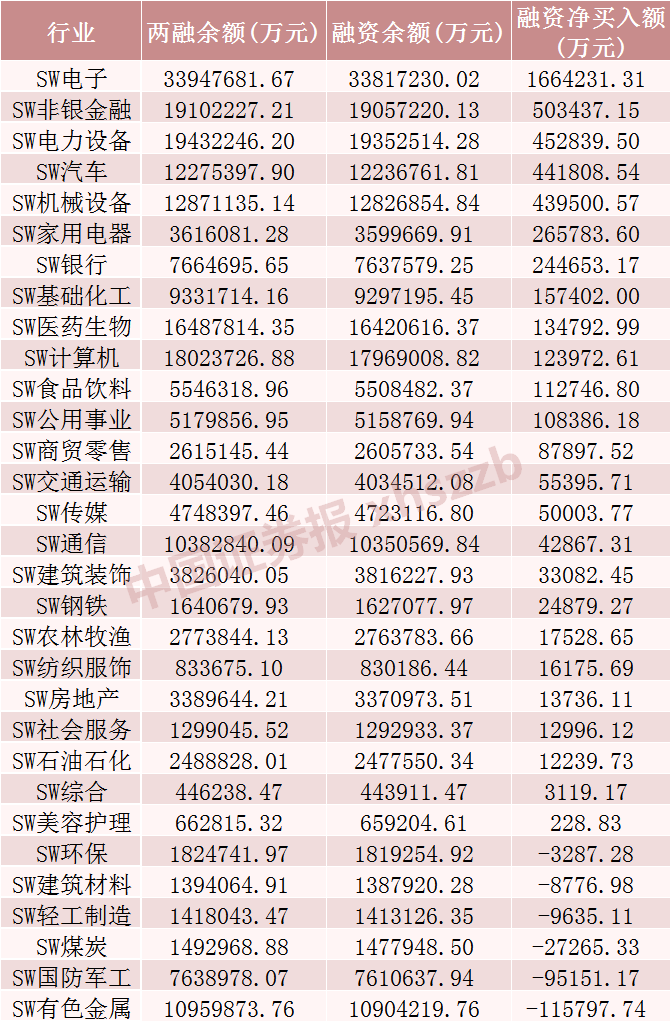
上周,A股震荡调整。Wind数据显示,截至9月19日,A股两融余额报23981.85亿元,其中融资余额报23816.10亿 元。上周A股市场融资余额增加466.46亿元。9月17日,A股两融余额和融资余额均创历史新高。 具体来看,上周的5个交易日中,9月15日A股融资余额增加183.37亿元,9月16日增加225.11亿元,9月17日增加 127.11亿元,9月18日减少27.62亿元,9月19日减少41.50亿元。 值得注意的是,8月13日—9月19日,A股连续28个交易日成交额与两融余额均超2万亿元。在A股历史上,仅有33个 交易日成交额与两融余额均超2万亿元。 从行业情况来看,上周申万一级31个行业中有25个行业融资余额增加,电子、非银金融、电力设备行业融资净买入 金额居前,分别为166.42亿元、50.34亿元、45.28亿元。在融资余额减少的行业中,有色金属、国防军工、煤炭行业 融资净卖出金额居前,分别为11.58亿元、9.52亿元、2.73亿元。 上周行业融资余额变动情况 | 行业 | | 两融余额(万元) 融资余额(万元) | 融资净买入额 | | --- | --- | --- | --- | ...

创金合信基金魏凤春:AI的尽头是能源
Xin Lang Ji Jin· 2025-09-22 03:14
Core Viewpoint - The article discusses the recent fluctuations in risk premiums, the impact of the Federal Reserve's interest rate cuts, and the adjustments in the A-share market amidst external shocks and domestic economic data indicating weakening internal momentum [1] Market Review - The coal sector has shown significant performance, attributed to both the effects of anti-involution and changes in global resource pricing logic due to geopolitical tensions [2] - The A-share market has seen a divergence in sentiment, with expectations of a shift from stocks to bonds, driven by the accelerated reduction of the national balance sheet and restored risk appetite [1][2] Macroeconomic Data - Consumer retail sales in August grew by 3.4% year-on-year, indicating ongoing adjustments in the consumption market, while real estate sales remain low, contributing to weak domestic demand [5] - Foreign direct investment (FDI) in China decreased by 12.7% from January to August, although high-tech sectors continue to attract significant interest, with notable increases in investment in e-commerce and aerospace [6] - Fiscal revenue for the first eight months of 2025 grew by 0.3%, with central government revenue declining by 1.7%, highlighting the need for fiscal expansion to support economic recovery [7] AI+ Investment Trends - The transition from theme-based investment in AI to a dominant industry investment is anticipated, with ongoing adjustments in the technology sector [8] - The investment logic post-adjustment for technology stocks emphasizes prioritizing global supply chains and innovative business models [8] Technical Indicators - Various sentiment indicators such as RSI, MACD, and KDJ show mixed signals, indicating market volatility and uncertainty regarding the end of the current adjustment phase [9][10][11] - The overall conclusion suggests that while there are signs of recovery in the A-share market, a clear upward trend has not yet been established [12] Energy Sector Insights - The article posits that the future of technology is closely tied to energy resources, emphasizing the importance of sustainable energy development to support high-tech advancements [14][15] - The shift in investor focus towards energy, particularly coal, is seen as a response to changing geopolitical dynamics and the need for tangible assets in a shifting market landscape [15][16]
港股开盘 | 恒指低开0.32% 科网股多数走弱
Zhi Tong Cai Jing· 2025-09-22 01:56
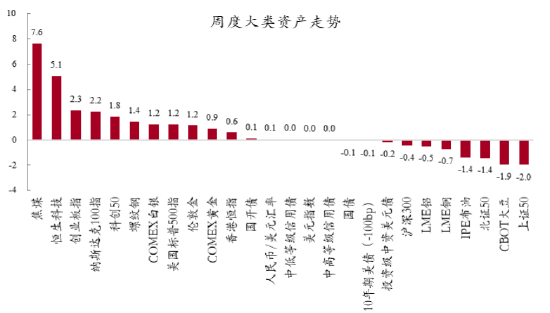
Group 1 - The Hang Seng Index opened down 0.32%, with the Hang Seng Tech Index falling 0.68%. Most tech stocks weakened, with Kuaishou down over 6%, Anta Sports down over 4%, and NetEase down over 1%. Zijin Mining rose over 2% [1] - The Hong Kong stock market has seen a net inflow of funds for 26 consecutive months, with a record monthly net inflow of 112.2 billion HKD in August 2025, indicating strong interest from mainland investors [3] - The average daily trading amount of southbound trading ETFs reached a new high of 3.8 billion HKD in the first half of 2025, with the number of eligible ETFs increasing from 5 to 17 [4] Group 2 - According to CITIC Securities, the Hong Kong stock market's performance stabilized in the first half of 2025, achieving positive growth in earnings, with revenue and profit growth rates of 1.9% and 4.6% respectively [5] - The technology, healthcare, and materials sectors showed high prosperity, supporting the performance of the Hong Kong stock market, while energy, utilities, and real estate sectors faced performance pressures [5] - AI remains a key theme in the Hong Kong stock market, with significant growth in AI cloud services and a shift towards self-developed chips among major AI companies [6]
开源证券:继续看好慢牛启航下非银金融板块战略性增配机会
Ge Long Hui· 2025-09-22 00:50
Core Viewpoint - The financial sector has experienced adjustments in the past month, with brokerage and insurance sectors showing some negative excess returns, yet market activity remains at a high level, indicating a continuation of the trend for institutional and retail funds entering the market in a low interest rate environment [1] Group 1: Market Conditions - The financial sector has seen adjustments recently, particularly in the brokerage and insurance segments [1] - Market activity is still high, suggesting ongoing interest from both institutional and retail investors [1] Group 2: Investment Opportunities - There is a strategic opportunity for increasing allocation in the non-bank financial sector as a slow bull market begins [1] - The brokerage sector is characterized by high profitability and attractive valuation, indicating a favorable risk-reward profile [1] - The undervalued insurance H-shares present a compelling investment value [1]
国庆前后市场怎么走?十大券商最新研判
Ge Long Hui A P P· 2025-09-21 23:58
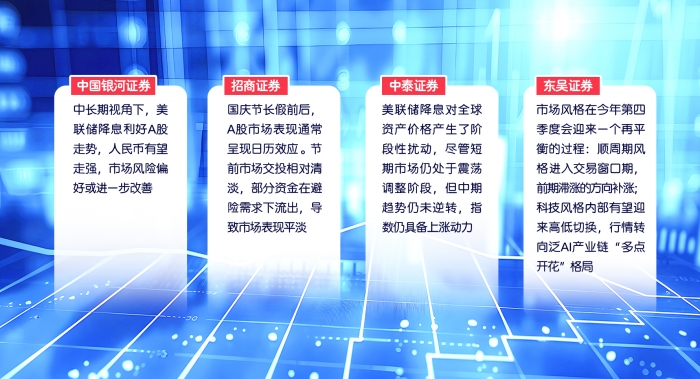
Market Overview - The market experienced fluctuations last week, with the Shanghai Composite Index falling by 1.30%, while sectors like power equipment, electronics, and communications continued to lead in gains, contrasting with the underperforming banking, non-banking, and food and beverage sectors [1] Broker Strategies - Guotai Junan Securities believes that the recent market adjustment presents an opportunity, asserting that the Chinese stock market will not stop here. They highlight the positive implications of the recent US-China talks and the potential for capital market reforms to accelerate, suggesting that the A/H share indices may reach new highs [2] - Guojin Securities indicates that a bull market is in the making, with a focus on cyclical opportunities in manufacturing and a shift from technology-driven growth to export-oriented growth as liquidity constraints ease [2] - Zheshang Securities anticipates continued consolidation in the Shanghai Composite Index, recommending a cautious approach and suggesting adjustments in sector allocations, particularly reducing exposure to technology and media while increasing positions in real estate and infrastructure [3] - Everbright Securities expects the A-share market to maintain a volatile pattern leading up to the National Day holiday, with a focus on structural balance amid potential profit-taking [4] - China Merchants Securities notes a historical pattern of financing trends around the National Day holiday, suggesting a potential rebound in market sentiment post-holiday, with a focus on sectors like solid-state batteries and AI [5] - Industrial Securities emphasizes a rotational investment strategy to navigate market volatility, advocating for a diversified approach across multiple sectors [6][7] - CITIC Securities highlights the clarity in market trading themes following the Fed's interest rate cut, with a focus on AI and domestic demand recovery as key drivers [8] - Huaxia Securities maintains a positive long-term outlook despite short-term fluctuations, emphasizing the importance of structural support from policies aimed at stabilizing the stock market [9] - Galaxy Securities recommends four main investment themes in the construction sector during the 14th Five-Year Plan period, focusing on urban renewal and digital transformation in construction [11]
A股短期或延续震荡立足景气逻辑挖掘主线机会
Shang Hai Zheng Quan Bao· 2025-09-21 18:07
Market Overview - A-shares experienced a mixed performance last week, with the Shanghai Composite Index declining by 1.30% to close at 3820.09 points, while the Shenzhen Component Index rose by 1.14% and the ChiNext Index increased by 2.34% [2] - The market showed overall volatility in the first half of the week, but retreated towards the end as investors reacted to the Federal Reserve's interest rate cut [2][3] Federal Reserve Impact - The Federal Reserve's decision to cut interest rates by 25 basis points was in line with market expectations, leading to a temporary cooling of investor sentiment and risk appetite [3][4] - Despite short-term fluctuations, the long-term outlook remains positive for A-shares, with expectations of a stronger RMB and improved market risk appetite [3][4] Calendar Effects - Historical data indicates that A-shares typically exhibit a calendar effect around the National Day holiday, with a tendency for the market to perform poorly before the holiday and rebound afterward [5][6] - Over the past decade, indices such as the Shanghai Composite and CSI 300 have shown over 60% probability of rising in the week following the National Day holiday [5] Sector Performance - Certain sectors, particularly technology-related industries such as computers, communications, and electronics, have a higher probability of rising in the five trading days following the holiday [6] - Financial sectors, including banks and non-bank financials, are also expected to perform well in the weeks following the holiday [6] Investment Strategy - The fourth quarter is anticipated to see a shift in investment styles, with a potential rotation from previously high-performing sectors to more defensive ones [7] - Investors are encouraged to focus on sectors driven by economic recovery and industry trends, such as AI, innovative pharmaceuticals, new energy, and consumer sectors [7]
非银金融行业周报:券商3季报增速或进一步扩张,调整带来布局机会-20250921
KAIYUAN SECURITIES· 2025-09-21 13:11
Investment Rating - The industry investment rating is "Overweight" (maintained) [1] Core Viewpoints - The non-bank financial sector is expected to benefit from a strategic allocation opportunity as the market remains active, with a trend of institutional and retail funds entering the market under a low interest rate environment [5] - The brokerage sector is experiencing high profitability and favorable valuation, indicating a high probability of success and returns [5] - The report highlights the potential for further expansion in the growth rate of brokerage firms' Q3 reports, driven by increased trading activity and margin financing [6] Summary by Sections Industry Overview - The non-bank financial sector has shown a positive trend, with the Shanghai and Shenzhen 300 index reflecting a steady increase [2] Brokerage Sector Insights - Daily average stock fund transaction volume reached 2.99 trillion, up 8% month-on-month, with a cumulative daily average of 1.90 trillion for 2025, representing a 108% year-on-year increase [6] - Margin financing balance increased to 2.39 trillion, a 30% growth since the beginning of the year, accounting for 2.54% of the A-share market capitalization [6] - The report anticipates further improvement in investment banking, derivatives, and public fund businesses, with leading brokerages' return on equity (ROE) expected to expand [6] Insurance Sector Insights - China Ping An has increased its stake in China Pacific Insurance H shares, indicating strong investment strategies in high-dividend assets [7] - The insurance sector is expected to see improvements in ROE due to stable long-term interest rates and reduced liability costs, enhancing the attractiveness of H shares [7] Recommended and Beneficiary Stocks - Recommended stocks include Huatai Securities, Guosen Securities, Oriental Securities H, GF Securities, and China Pacific Insurance [8] - Beneficiary stocks include Tonghuashun, Jiufang Zhitu Holdings, and Xinhua Insurance [8]





摩尔线程即将上会 直接或间接参股公司曝光
Zheng Quan Shi Bao Wang· 2025-09-21 12:17
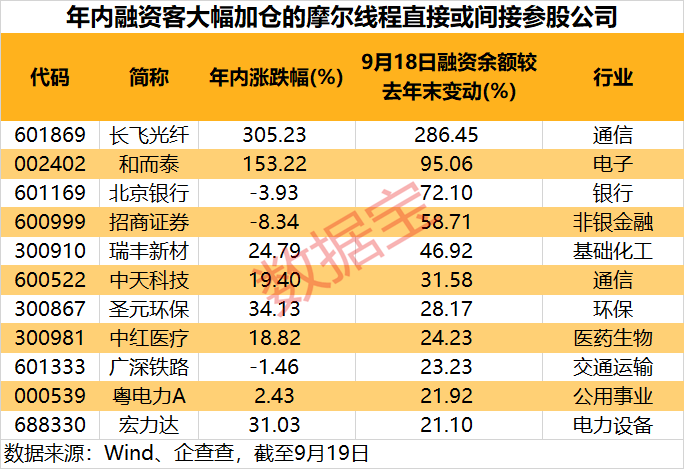
Core Viewpoint - The Shanghai Stock Exchange will review the initial public offering (IPO) of Moore Threads on September 26, aiming to raise 8 billion yuan [1] Group 1: Company Overview - Moore Threads plans to list on the Sci-Tech Innovation Board and seeks to raise 8 billion yuan through its IPO [1] - The company has direct and indirect stakes in various sectors, including electronics, computers, and communications [1] - Directly invested companies include Heertai (002402) and Yingqu Technology (002925), while indirectly invested companies include Honglida, Chuling Information (300250), and Changfei Fiber (601869) [1] Group 2: Market Performance - As of September 19, the average annual increase for the directly or indirectly invested companies is nearly 35%, with Changfei Fiber and Heertai exceeding 100% [1] - Financing data shows that as of September 18, these companies have seen an overall increase of nearly 30% in financing from investors this year [1] - Six companies, including Changfei Fiber, Heertai, and Ruifeng New Materials (300910), have received over 30% increase in financing from investors [1] Group 3: Investment Backers - In addition to A-share companies, notable investors in Moore Threads include Tencent, Lenovo, Sequoia Capital, and Houshu Capital [1]