债券

Search documents
国际化与本土化双向发力 债券指数“上新”提速
Zheng Quan Ri Bao· 2025-10-27 17:05
Core Viewpoint - FTSE Russell announced significant revisions to its flagship index, the FTSE China Renminbi Onshore Bond Index, effective from November, which will enhance the global representation of Chinese bonds [1] Group 1: Index Revisions and Market Impact - The minimum issuance balance for bonds has been reduced from 3 billion to 1.5 billion yuan, and the longest maturity limit for corporate bonds has been removed, allowing for the inclusion of callable/redeemable bonds and zero-coupon bonds [1] - An estimated 3,482 securities with a total market value of 11.21 trillion yuan will be included, representing 12.5% of the index weight, significantly increasing the global representation of Chinese bonds [1] - The acceleration of new bond indices since 2025 reflects a doubling in issuance, covering various sectors and forming a multi-layered bond index system [1] Group 2: Market Dynamics and Investor Engagement - The rapid increase in bond indices is a direct reflection of market expansion, enhancing market vitality, serving the real economy, and facilitating investor allocation [2] - The extension of index coverage to equity-linked and target maturity bonds is expected to attract new capital and improve liquidity in the bond market [2] - The emergence of thematic indices, such as green and technology innovation bonds, aligns with national strategies and directs social capital towards key sectors [2] Group 3: Internationalization and Domestic Growth - The dual development of the bond index market is evident in both internationalization and localization efforts, enhancing the quality of the domestic market [3] - Domestic index providers are collaborating with international index firms to align with global standards, improving the recognition and adaptability of Chinese bonds in the global market [3] - The recent revisions to the FTSE China Renminbi Onshore Bond Index will also be reflected in other indices, enhancing the overall index ecosystem [3] Group 4: Policy Support and Market Demand - The active performance of the bond index market is driven by policy guidance and sustained market demand [6] - Regulatory bodies have emphasized the importance of bond indices in directing capital flows and optimizing market structures, creating a favorable policy environment for new index launches [6] - Data shows that 271 of the new bond indices focus on technology innovation bonds, indicating a significant expansion in this area [6] Group 5: Future Directions - Future bond index releases should align more closely with deep market demands and policy directions, potentially implementing an "index registration system" to ensure quality [8] - Encouragement for standardized thematic index creation and optimization of mature parent indices is suggested to reduce fragmentation [8] - Establishing a "liquidity monitoring pool" is recommended to ensure the tradability of indices through specific thresholds for transaction volumes and market maker participation [8]
10月27日下午两点半,股债齐涨把握配置机会,加减仓提醒
Sou Hu Cai Jing· 2025-10-27 16:46
Core Viewpoint - The capital market experienced a rare phenomenon where both the stock market and bond market rose simultaneously, with the Shanghai Composite Index approaching the 4000-point mark while the 10-year government bond yield fell to 1.833% [1][35] Market Performance - The A-share indices all opened higher, with the ChiNext Index rising over 2% at one point [1] - The Shanghai Composite Index reached a high of 3998 points, just shy of the 4000-point threshold [9][35] - The trading volume in the stock market increased, with a total turnover exceeding 800 billion yuan, up 10% from the previous day [19] Bond Market Dynamics - The central bank conducted a 900 billion yuan MLF operation, resulting in a net injection of 200 billion yuan, marking the third consecutive week of large-scale liquidity provision [3] - The 10-year government bond yield fell by 1 basis point, while the futures market showed strong performance with the main contract rising by 0.08% [35] - The bond market displayed a mixed performance, with high-grade credit spreads narrowing while low-grade credit spreads remained elevated, indicating a cautious risk appetite [11][22] Investor Behavior - Insurance funds increased their allocation to government bonds, with one large insurance asset management company purchasing 10-year government bonds around 2.85% [7] - There was a notable divergence in institutional behavior, with broker proprietary accounts being net buyers while bank wealth management accounts were net sellers [5][20] - Foreign capital continued to flow into the A-share market, with net inflows exceeding 5 billion yuan for the fifth consecutive trading day, totaling over 20 billion yuan [13] Credit Market Insights - The primary market for credit bonds remained active, with three credit bonds issued today totaling 5 billion yuan, and one AAA-rated central enterprise bond issued at a rate 10 basis points lower than the secondary market [15] - The credit bond market showed significant differentiation, with high-grade credit bonds seeing increased demand while low-grade bonds faced selling pressure [31][26] Economic Outlook - Market analysts suggest that the current bond yield levels reflect many favorable factors, and further declines in yields may require new catalysts [13] - The upcoming economic data, including a potential rise in the manufacturing PMI to 49.5, may exert some pressure on the bond market, although current market performance appears to have absorbed this factor [29]

前9月境外机构在广东办理跨境债券交易近4000亿元
Zhong Guo Xin Wen Wang· 2025-10-27 12:17
Core Insights - In the first nine months of this year, foreign institutions conducted nearly 400 billion RMB in cross-border bond transactions in Guangdong, marking an 84% year-on-year increase [1][2] Group 1: Market Overview - The total size of China's bond market exceeds 190 trillion RMB, characterized by a diverse range of bond types and investor structures [1] - Foreign institutional investors can participate in the Chinese bond market through various channels, including direct market access, Bond Connect, QFII/RQFII, and swap connections [1] Group 2: Bond Issuance and Innovation - Guangdong's financial institutions and non-financial enterprises issued 873.2 billion RMB in bonds in the interbank market, ranking third nationwide [2] - Among these, technology enterprises and equity investment institutions issued a total of 48.4 billion RMB in technology innovation bonds, placing second in the country [1][2] Group 3: Market Development and Services - The People's Bank of China in Guangdong is focused on promoting the development of a multi-tiered bond market and enhancing the openness of the bond market [1] - The local financial institutions are actively providing services for foreign institutions to issue Panda bonds and participate in Chinese bond investment transactions [2] - The total trading volume of cash bonds in Guangdong's interbank market reached 141 trillion RMB, the highest in the country, while the total repurchase trading volume was 44.1 trillion RMB, ranking third [2]
美债突破38万亿美元,为什么不用还?还欠中国多少钱?
Sou Hu Cai Jing· 2025-10-27 10:04
Core Viewpoint - The total U.S. national debt has surpassed $38 trillion, raising questions about the sustainability of this debt and the implications for global investors, particularly China [2][9]. Group 1: U.S. National Debt Dynamics - The U.S. government continues to issue new debt to pay off old debt, leveraging the dollar's status as the world's primary reserve currency [3][7]. - Approximately 90% of global trade is settled in U.S. dollars, creating a strong demand for U.S. Treasury bonds among global investors [5][6]. - The U.S. Treasury does not need to deplete its reserves to repay the $38 trillion; it can simply roll over the debt as long as global confidence in the dollar remains intact [7][11]. Group 2: Risks and Challenges - The first significant risk is the "debt ceiling crisis," where political disagreements in Congress could lead to government shutdowns, potentially undermining confidence in U.S. debt [9]. - The second risk involves the rapid growth of debt outpacing economic growth, which could threaten the credibility of the dollar if interest payments become unsustainable [11]. Group 3: China's Position and Strategy - China has been reducing its holdings of U.S. debt while increasing its gold reserves, reflecting a strategy to diversify its foreign exchange reserves [11][13]. - The trend of "de-dollarization" is gaining momentum globally, with countries seeking to reduce reliance on the U.S. dollar [15][29]. Group 4: Alternatives to the Dollar - Potential alternatives to the dollar include the Chinese yuan, but its adoption as a global reserve currency could have negative implications for China's economy [17][20]. - Gold is considered a stable asset, but its limited supply makes it impractical as a global currency base [22][24]. - Encouraging direct currency settlements between countries is another approach, but it does not address fundamental trade imbalances [25][27]. Group 5: Future Implications - The ongoing exploration of alternatives to the dollar and the evolving role of central banks could lead to a more equitable and stable international monetary system [29].

央行单日净投放近1500亿元,债市收益率高开后下行
Xin Lang Cai Jing· 2025-10-27 09:31
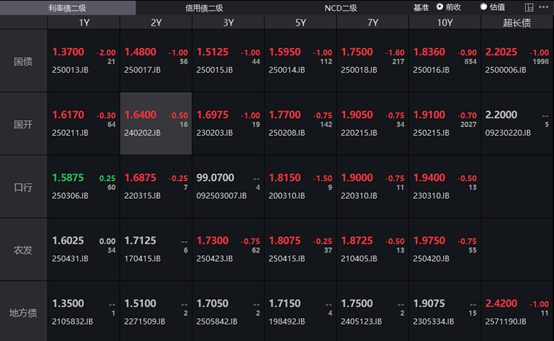
Market Overview - The bond market experienced a decline in yields after an initial rise, with 10-year and 30-year government bond yields both decreasing by nearly 1 basis point [1] - Government bond futures closed higher, with the 30-year main contract rising by 0.32%, the 10-year main contract by 0.15%, the 5-year by 0.12%, and the 2-year by 0.05% [1] Yield Changes - As of 16:30, the yield on the 10-year government bond (active bond 250011) fell by 0.45 basis points to 1.754%, while the 10-year policy bank bond (active bond 250215) decreased by 0.8 basis points to 1.931% [1] - The 30-year government bond (active bond 2500006) saw a yield drop of 2.5 basis points to 2.24% [1] Auction Results - In the primary market, the weighted average interest rates for various bonds were reported, with the 1-year government bond (250211X11) at 1.4748% and a bid-to-cover ratio of 2.86 [3] - The 3-year government bond (250214X31) had a weighted average interest rate of 1.7263% with a bid-to-cover ratio of 4.54 [3] Credit Bond Market Performance - The top five non-financial credit bonds by increase included H0宝龙04 and various 万科 bonds, with the highest increase being 3.72% for 22万科02 [4] - Conversely, the top five non-financial credit bonds by decrease included H0中骏02 and 25鄂交K1, with the largest drop being 4.83% for 25鄂交K1 [4] Monetary Policy Actions - The central bank conducted a reverse repurchase operation of 337.3 billion yuan at a fixed rate of 1.40%, resulting in a net injection of 148.3 billion yuan for the day [5] - Overnight SHIBOR rose to 1.4420%, while the 7-day SHIBOR increased to 1.5420% [5] Interbank Repo Rates - Interbank repo rates saw an overall increase, with FR001 rising by 15 basis points to 1.54% and FR007 increasing by 17 basis points to 1.65% [5][6]
债市日报:10月27日
Xin Hua Cai Jing· 2025-10-27 07:56
Core Viewpoint - The bond market is showing a strong consolidation trend, with long-term bonds performing particularly well, and the central bank may implement measures to release liquidity in the fourth quarter [1][6]. Market Performance - The closing prices for government bond futures showed an increase across all maturities, with the 30-year contract rising by 0.32% to 115.4, the 10-year contract up by 0.15% to 108.175, and the 5-year contract increasing by 0.12% to 105.745 [2]. - The interbank bond market also exhibited a strong performance, with the 10-year government bond yield for "25附息国债16" decreasing by 1.25 basis points to 1.833% [2]. Overseas Bond Market - In North America, U.S. Treasury yields varied, with the 10-year yield rising by 0.94 basis points to 4.010% [3]. - In Asia, Japanese bond yields generally increased, with the 10-year yield rising by 1.9 basis points to 1.674% [4]. Funding Conditions - The central bank conducted a reverse repurchase operation of 3,373 billion yuan at a fixed rate of 1.40%, resulting in a net injection of 1,483 billion yuan for the day [6]. - The Shibor rates for short-term instruments mostly increased, with the overnight rate rising by 12.2 basis points to 1.442% [6]. Economic Fundamentals - From January to September, the total profit of industrial enterprises above designated size reached 53,732 billion yuan, reflecting a year-on-year growth of 3.2% [7]. - In September alone, the profit of these enterprises increased by 21.6% year-on-year, driven by new economic growth points and low base effects [8]. Institutional Perspectives - Huatai Fixed Income suggests that the stock market's long-term upward trend remains intact, advising investors to maintain exposure while being cautious of year-end market disturbances [9]. - Guosheng Fixed Income anticipates continued fluctuations in the bond market, with a smoother decline in interest rates expected in the latter part of the fourth quarter [9].
许正宇:今年以来香港金融市场“质”与“量”均展现良好势头
智通财经网· 2025-10-27 07:45
Core Insights - Hong Kong's financial market has shown significant growth in both quality and quantity in 2023, with average daily trading volume reaching HKD 256.4 billion, a year-on-year increase of 126% [1] - The total fundraising amount in the IPO market reached HKD 182.9 billion, marking a substantial increase of 229% [1] - Hong Kong continues to rank third globally and first in the Asia-Pacific region in the Global Financial Centres Index, reflecting growing international confidence in the market [1] Group 1 - The approval of the first company relocation application signals a positive trend for businesses optimizing their structures and enhancing operational efficiency in Hong Kong [1] - The Hong Kong government aims to attract more mainland enterprises to use Hong Kong as an "outbound" platform, creating business opportunities and economic benefits [1][2] - The establishment of dedicated personnel in the company registry to streamline the registration process for state-owned enterprises is expected to enhance cross-border settlement and financing services [2] Group 2 - The Hong Kong Stock Exchange has issued consultation documents to optimize the listing rules for structured products, aiming to enhance market competitiveness and efficiency [2] - Hong Kong's bond issuance hub accounts for nearly 30% of the Asian market, with the Securities and Futures Commission and the Monetary Authority releasing a roadmap to attract issuers [2] - The People's Bank of China has announced measures to support foreign institutional investors in the mainland bond market, enhancing market connectivity and liquidity [3] Group 3 - The demand for gold as a safe-haven asset has surged, with global demand projected to rise by 45% year-on-year by Q2 2025, reaching USD 132 billion [3] - The Hong Kong government is working to establish an international gold trading market and improve storage facilities, reinforcing its position as a financial and trading hub [3] - Upcoming international financial events in Hong Kong aim to enhance the city's global influence and promote investment opportunities [3][4] Group 4 - The Financial Secretary's office will continue to implement measures from the Policy Address to maintain Hong Kong's leadership as an international financial center [4] - The focus will be on policy innovation and resource investment to explore emerging financial sectors and drive economic growth [4]
利率债周报:上周债市有所调整,长债收益率波动上行-20251027
Dong Fang Jin Cheng· 2025-10-27 06:19
Group 1: Report Industry Investment Rating - No information provided Group 2: Core Views - Last week, the bond market adjusted, and long - term bond yields fluctuated upwards. The expected improvement in Sino - US trade relations and the overall boost of the Fourth Plenary Session to the "15th Five - Year Plan" risk preference led to the stock - bond seesaw effect, making the bond market oscillate weakly. Short - term yields rose slightly more than long - term yields, and the yield curve flattened further [2]. - This week (the week of October 27), the bond market will continue the weakly oscillating market. The easing expectation of Sino - US trade relations and the high market risk preference, along with the concern about the bond - fund redemption and asset re - allocation pressure caused by the new regulations on public - fund sales fees, will continue to suppress the bond market. Without trend - driving factors, the bond market needs to digest these negative factors, and the 10 - year Treasury yield will run in the range of 1.70% - 1.80% [2]. Group 3: Summary of Each Section Section 1: Last Week's Market Review 1.1 Secondary Market - Last week, the bond market adjusted, and long - term bond yields rose significantly. The 10 - year Treasury futures main contract fell 0.24% cumulatively. On Friday, the 10 - year Treasury yield rose 2.40bp, and the 1 - year Treasury yield rose 2.82bp compared with the previous Friday, and the term spread continued to narrow [3]. - From October 20 to 24, the bond market showed different trends each day. For example, on October 20, the bond market weakened due to the stock - market rebound and progress in Sino - US talks; on October 21, the bond market oscillated strongly due to the expected interest - rate cut [3]. 1.2 Primary Market - Last week, 107 interest - rate bonds were issued, with an issuance volume of 10763 billion, a net financing of 847 billion. The issuance and net financing of Treasury bonds and local bonds increased, while those of policy - bank bonds decreased [9]. - The subscription demand for interest - rate bonds was generally acceptable. The average subscription multiples of Treasury bonds, policy - bank bonds, and local bonds were 2.61 times, 3.36 times, and 20.42 times respectively [10]. Section 2: Last Week's Important Events - In the third quarter of 2025, GDP growth slowed down to 4.8%. Although the export growth accelerated, domestic investment and consumption decelerated, and the pulling force of domestic demand on economic growth weakened. The slowdown of infrastructure investment, the impact on manufacturing investment confidence, and the decline of real - estate investment led to a significant decline in investment growth, which was the main reason for the GDP growth slowdown [11]. Section 3: Real - Economy Observation - Last week, most high - frequency data on the production side increased, such as the blast - furnace operating rate, semi - steel tire operating rate, and petroleum - asphalt plant operating rate, while the daily average pig - iron output decreased. On the demand side, the BDI index declined, and the CCFI index rose slightly. The sales area of commercial housing in 30 large and medium - sized cities decreased slightly. In terms of prices, pork prices continued to fall, while most commodity prices rose [12]. Section 4: Last Week's Liquidity Observation - Last week, the central bank's open - market net investment was 1981 billion yuan. R007 decreased, DR007 increased, the issuance rate of joint - stock bank certificates of deposit increased, the national - share direct - discount rates of all terms decreased, the volume of pledged - repo transactions fluctuated and decreased, and the inter - bank market leverage ratio continued to decline [23].
政府债周报:下周新增债披露发行1719亿-20251027
Changjiang Securities· 2025-10-27 05:13
Report Industry Investment Rating No relevant content provided. Core Viewpoints of the Report - 10月27日至11月2日地方债披露发行2706.82亿元,其中新增债1719.10亿元,再融资债987.72亿元 [1][5] - 10月20日至10月26日地方债共发行2472.28亿元,其中新增债1136.52亿元,再融资债1335.76亿元 [1][6] - 截至10月26日,第五轮第二批特殊再融资债共披露19934.09亿元,第六轮特殊再融资债共披露544.89亿元,下周新增披露245.84亿元;2025年特殊新增专项债共披露12379.89亿元,2023年以来共披露24258.52亿元 [7] Summary by Related Catalogs Local Bond Actual Issuance and Forecast Issuance - 10月20日至10月26日地方债净供给1658亿元,10月27日至11月2日地方债预告净供给1780亿元 [15] - 展示9月和10月地方债计划与实际发行情况,以及地方债近月发行计划与实际发行、净融资情况 [16][23] Local Bond Net Supply - 截至10月26日,新增一般债发行进度83.69%,新增专项债发行进度87.11% [28] - 截至10月26日,再融资债减地方债到期当年累计规模情况展示 [29] Special Bond Issuance Details - 截至10月26日,特殊再融资债统计情况展示,包括各轮发行额及各地区情况 [34] - 截至10月26日,特殊新增专项债统计情况展示,包括2023 - 2025年各地区情况 [37][38] Local Bond Investment and Trading - 展示地方债一二级利差及分区域二级利差情况 [41][42] - 展示新增专项债投向情况,最新月份统计只考虑已发行的新增债 [43]
债市公告精选 | 俊发集团子公司及债券担保人被纳入失信被执行人
Xin Lang Cai Jing· 2025-10-27 02:48
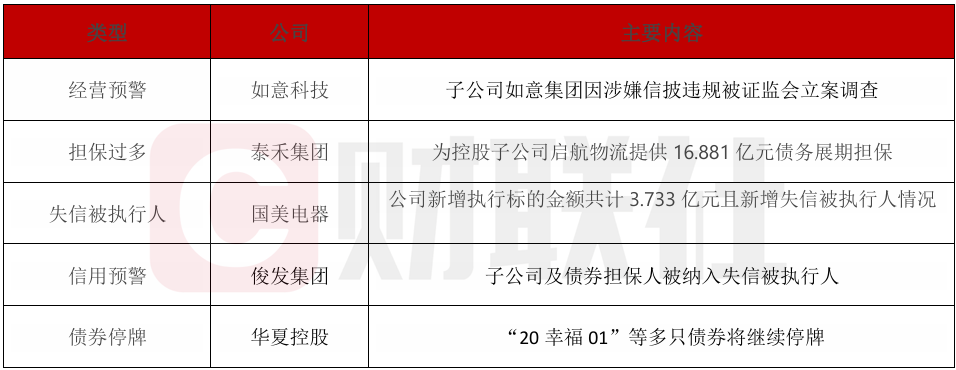
Group 1: Company Announcements - Shandong Ruyi Technology Group's subsidiary, Ruyi Group, is under investigation by the China Securities Regulatory Commission for suspected information disclosure violations, but the company's operations are reported to be normal and not significantly impacted [1] - Taihe Group announced it will provide a guarantee for its subsidiary, Qihang Logistics, for a debt extension of 1.6881 billion yuan, with the guarantee period extending until April 2027 [3] - Gome Electrical Appliances reported an increase in execution targets totaling 373.3 million yuan and has been listed as a dishonest executor due to failure to fulfill legal obligations [4] - Junfa Group's subsidiary and bond guarantor have been included in the list of dishonest executors, with overdue amounts reported [5] - Huaxia Happiness Holdings announced that several bonds, including "20 Happiness 01," will continue to be suspended as part of debt restructuring efforts, with total unpaid debts reaching 29.24 billion yuan [7] Group 2: Financial Status and Debt Issues - Ruyi Technology has offshore bonds with a total balance of 1.7318 billion USD, with a default amount of 300 million USD [2] - Taihe Group has a total of 1.4655 billion USD in offshore bonds, with the entire amount in default [4] - Gome Electrical Appliances has a total bond balance of 207 million yuan, with 123 million yuan already in default [5] - Junfa Group has a total bond scale of 4 billion yuan [6] - Huaxia Happiness has a total bond scale of 2.124 billion yuan, with a default amount of 551.4 million yuan [8]