
装备制造业

Search documents
制造业PMI连续两月回升释放积极信号
Zhong Guo Jing Ji Wang· 2025-07-03 01:32
Core Viewpoint - A new round of technological revolution and industrial transformation is deeply developing, leading to a restructuring of global industrial and supply chains, with international competition becoming more intense. The manufacturing industry in China is expected to strengthen and improve in market competition, achieving high-quality development [1][3]. Group 1: Manufacturing Industry Performance - In June, the Manufacturing Purchasing Managers' Index (PMI) was reported at 49.7%, an increase of 0.2 percentage points from the previous month, marking two consecutive months of growth [1]. - Among the 21 surveyed industries, 11 are in the expansion zone, an increase of 4 from the previous month, indicating an overall improvement in the manufacturing sector's prosperity [1]. - The recovery in manufacturing is attributed to improvements in both supply and demand sides, with the new orders index returning to the expansion zone at 50.2% after two months below 50% [1][2]. Group 2: Economic Context and Challenges - The manufacturing sector reflects macroeconomic trends, with both supply and demand gradually improving, particularly in equipment and high-tech manufacturing, which are showing rapid growth [2]. - Despite the positive trends, the PMI remains below the 50% threshold, indicating that the foundation for economic growth still needs to be solidified [2]. - External challenges such as global economic slowdown, weak external demand, and geopolitical risks pose significant threats to China's economic development [2]. Group 3: Strategic Recommendations - To enhance the competitiveness of the manufacturing sector, it is essential to strengthen innovation capabilities, focusing on upgrading traditional industries through technological advancements [2][3]. - Policy implementation is crucial, with initiatives such as pilot programs for the integration of human resources services and manufacturing in selected cities aimed at exploring new paths for industrial upgrading and employment promotion [3]. - Continuous policy support is needed to stabilize investment, foreign trade, and consumption, facilitating the transformation of the manufacturing industry towards high-end, intelligent, and green development [3].
湖南前5个月规模工业增加值同比增长8.1%
Zhong Guo Chan Ye Jing Ji Xin Xi Wang· 2025-07-02 00:40
Group 1: Industrial Growth in Hunan - Hunan's industrial added value increased by 8.1% year-on-year from January to May, 1.2 percentage points faster than the same period last year [1] - The equipment manufacturing sector showed strong support, with an added value growth of 12.9%, contributing 4.1 percentage points to industrial growth [1] - Specific sectors such as metal products grew by 23.6%, electronic information manufacturing by 16.2%, and electrical machinery and equipment manufacturing by 14.4% [1] - The raw materials sector maintained stable growth, with an added value increase of 8.4%, including a 14.2% growth in the non-ferrous sector and a 10.3% increase in non-metallic mineral products [1] - High-tech manufacturing also experienced rapid growth, with an added value increase of 13.9%, particularly in electronic and communication equipment manufacturing, which grew by 17.4% [1] - Production of high-tech products surged, with sensor output increasing by 28.1%, optoelectronic devices by 40.2%, and industrial control computers and systems by 77.7% [1] Group 2: Service Sector and Investment Trends - From January to April, the revenue of large-scale service enterprises in Hunan grew by 4.4%, with 29 out of 34 industries reporting revenue growth, expanding the growth coverage to 85.3% [2] - The technology service sector showed high growth rates, with research and experimental development revenue increasing by 14.6%, technology promotion and application services by 12.4%, and professional technical services by 12.1% [2] - Profitability in the service sector improved significantly, with total profits of large-scale service enterprises increasing by 21.1%, 27.1 percentage points higher than the previous year [2] - Fixed asset investment in Hunan grew by 3.8% year-on-year from January to May, 0.6 percentage points faster than the previous four months [2] - Industrial investment saw a notable increase of 14.2%, 1.9 percentage points faster than the previous four months, while high-tech industry investment grew by 9.5% [2] - Investment in equipment renewal and transformation was substantial, with equipment and tool purchases increasing by 28.2%, 20.3 percentage points faster than the previous year [2]
6月PMI数据点评:强在中游
Huachuang Securities· 2025-07-01 07:46
Group 1: PMI Data Overview - The manufacturing PMI for June is 49.7%, up from 49.5% in May[2] - The production index is at 51.0%, an increase of 0.3 percentage points from the previous value of 50.7%[2] - The new orders index stands at 50.2%, rising from 49.8%[2] Group 2: Sector Performance - The equipment manufacturing PMI is the highest at 51.4%, up 1.8 percentage points from April's 49.6%[4] - The construction industry business activity index is at 52.8%, an increase of 1.8 percentage points from the previous month[14] - The service industry business activity index is slightly down at 50.1%, a decrease of 0.1 percentage points[14] Group 3: Price and Inventory Trends - The PMI factory price index is at 46.2%, remaining below the neutral line for 13 consecutive months[4] - The inventory index has improved, with the purchasing index at 50.2%, up from 47.6%[3] - The comprehensive PMI output index is at 50.7%, reflecting a 0.3 percentage point increase from the previous month[15] Group 4: External Trade and Expectations - New export orders index is at 47.7%, a slight increase from 47.5%[3] - The manufacturing production expectation index is at 52.0%, down from 52.5%[14] - The construction industry business activity expectation index is at 53.9%, up from 52.4%[14]
6月PMI数据点评:需求重回扩张区间
Tai Ping Yang Zheng Quan· 2025-07-01 02:42
Group 1: Manufacturing PMI Insights - China's June official manufacturing PMI is 49.7, matching expectations and up from 49.5 in May, indicating a marginal improvement[4] - The production index rose to 51.0, up 0.3 percentage points from the previous month, signaling recovery in production activities[9] - New orders index increased to 50.2, up 0.4 percentage points, marking a return to the expansion zone after two months below the threshold[9] - The PMI for large enterprises is 51.2, up 0.5 percentage points, while medium-sized enterprises improved to 48.6, up 1.1 percentage points[13] Group 2: Non-Manufacturing Sector Performance - The non-manufacturing PMI for June is 50.5, up 0.2 percentage points, indicating continued expansion[19] - The construction activity index rose to 52.8, up 1.8 percentage points, driven by infrastructure investments[25] - The service sector index is at 50.1, slightly down by 0.1 percentage points, reflecting seasonal adjustments in travel-related services[22] Group 3: Price and Demand Dynamics - The raw material purchase price index is at 48.4, and the factory price index is at 46.2, both showing a 1.5 percentage point increase from the previous month[16] - New export orders index is at 47.7, up 0.2 percentage points, while the import index is at 47.8, up 0.7 percentage points, indicating a slight recovery in external demand[9]
6月份PMI数据出炉 我国经济景气水平总体保持扩张
Zheng Quan Ri Bao· 2025-06-30 16:12
6月30日,国家统计局服务业调查中心和中国物流与采购联合会发布了中国采购经理指数。数据显示,6 月份,制造业采购经理指数(PMI)、非制造业商务活动指数和综合PMI产出指数分别为49.7%、50.5% 和50.7%,比5月份上升0.2个百分点、0.2个百分点和0.3个百分点,三大指数均有所回升,我国经济景气 水平总体保持扩张。 与此同时,价格指数回升。主要原材料购进价格指数和出厂价格指数分别为48.4%和46.2%,均比5月上 升1.5个百分点,制造业市场价格总体水平有所改善。 "从两个价格指数的变化趋势来看,近期制造业上游原料端和下游产品端的价格走势协同性较好。5月 份、6月份,购进价格指数和出厂价格指数同向变化,变化幅度相当。"文韬说。 分行业看,三大重点行业继续扩张。装备制造业、高技术制造业和消费品行业PMI分别为51.4%、50.9% 和50.4%,均连续两个月位于扩张区间。其中,装备制造业生产指数和新订单指数均高于53.0%,相关 行业产需两端较为活跃。高耗能行业PMI为47.8%,比5月份上升0.8个百分点,景气水平有所改善。 文韬表示,下半年我国经济将重点推进"强内"和"稳外"工作。"强内"是继 ...
6月PMI数据点评:站在需求的十字路口
Changjiang Securities· 2025-06-30 14:15
Group 1: PMI Data Insights - The manufacturing PMI for June rose to 49.7%, exceeding the Bloomberg consensus expectation of 49.6%[3] - The increase in PMI was driven by improvements in both supply and demand, with the new orders index rising to 50.2% and the production index to 51%[11] - However, the sustainability of this improvement is questionable, as employment demand decreased month-on-month and production expectations slightly declined[3] Group 2: Demand and Supply Dynamics - Demand expansion is not uniform across industries, with small enterprises experiencing a contraction in orders, while high-tech manufacturing remains flat[11] - Among 15 sub-industries, only 7 showed improvement compared to May, indicating a lack of widespread demand expansion[11] - Price pressures persist, with the factory price index at 46.2% and major raw material purchase price index at 48.4%, reflecting ongoing downward pressure on prices[11] Group 3: Sectoral Performance - The non-manufacturing PMI increased to 50.5%, primarily due to a rise in the construction PMI to 52.8%, while the service sector PMI fell to 50.1%[11] - Infrastructure orders are shifting towards expansion, which may help offset export downturn pressures[11] - The real estate market shows weak economic expectations, as indicated by second-hand housing prices and futures prices, necessitating policy support for growth[11]
49.7%、50.5%、50.7%! 6月PMI三大指数均回升
Mei Ri Jing Ji Xin Wen· 2025-06-30 13:44
Group 1: Economic Indicators - In June, China's manufacturing PMI, non-manufacturing business activity index, and comprehensive PMI output index were 49.7%, 50.5%, and 50.7%, respectively, indicating a slight recovery with increases of 0.2, 0.2, and 0.3 percentage points from the previous month, suggesting overall economic expansion [1] - The production index, new orders index, and supplier delivery time index for manufacturing were 51.0%, 50.2%, and 50.2%, all above the critical point, with increases of 0.3, 0.4, and 0.2 percentage points from the previous month [3] - The non-manufacturing business activity index remained at 50.5%, reflecting continued expansion, while the service industry index was at 50.1%, down 0.1 percentage points from the previous month [5] Group 2: Sector Performance - The equipment manufacturing, high-tech manufacturing, and consumer goods industry PMIs were 51.4%, 50.9%, and 50.4%, respectively, all remaining in the expansion zone for two consecutive months [4] - The high-tech manufacturing PMI remained stable at 50.9%, indicating strong growth and resilience in the face of market demand and policy support [4] - The small enterprise PMI fell by 2 percentage points to 47.3%, indicating lower economic sentiment in this sector, which is crucial for employment [3] Group 3: Policy and Future Outlook - Economists suggest accelerating the issuance and use of local government special bonds and new policy financial tools to support domestic demand and stabilize foreign trade [2] - The macroeconomic policy is focusing on promoting service consumption as a key point to boost domestic demand, with various supportive measures being implemented [5] - Future projections indicate that the manufacturing PMI may remain around 49.7% in July, with potential downward risks due to cooling export momentum [6]

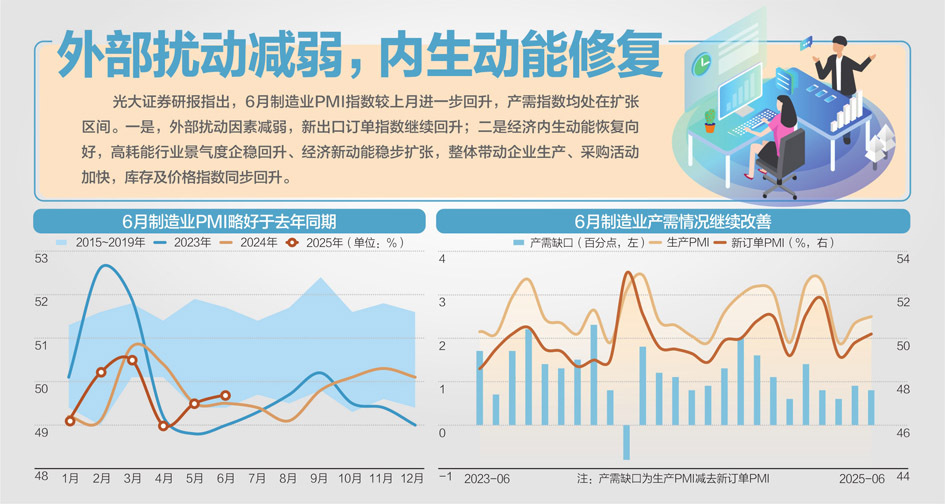
制造业PMI连续两月回升 上半年中国经济稳中向好态势凸显
Bei Jing Shang Bao· 2025-06-30 13:13
Core Viewpoint - The manufacturing sector in China shows signs of recovery with the Purchasing Managers' Index (PMI) rising to 49.7% in June, marking the highest level in three months and indicating a broadening of manufacturing activity [1][3]. Group 1: Manufacturing Activity - In June, 11 out of 21 surveyed industries are in the expansion zone, an increase of 4 from the previous month, reflecting strong internal economic momentum [1]. - The production index reached 51.0%, and the new orders index rose to 50.2%, indicating a significant acceleration in manufacturing activities and improved market demand [3]. - The procurement index surged to 50.2%, up 2.6 percentage points from the previous month, suggesting enhanced purchasing willingness among enterprises [3]. Group 2: Sector Performance - The equipment manufacturing, high-tech manufacturing, and consumer goods sectors all recorded PMIs above 50%, indicating continuous expansion for two consecutive months [4]. - The equipment manufacturing sector led with a PMI of 51.4%, while high-tech manufacturing and consumer goods sectors had PMIs of 50.9% and 50.4%, respectively, showcasing robust growth in production and new orders [4]. - The high-energy consumption sector's PMI improved to 47.8%, up 0.8 percentage points, reflecting ongoing structural adjustments and a shift towards greener practices [5]. Group 3: Enterprise Size Impact - Large enterprises reported a PMI of 51.2%, up 0.5 percentage points, indicating improved operational efficiency [6]. - Medium-sized enterprises saw a notable recovery with a PMI of 48.6%, increasing by 1.1 percentage points after two months of weak performance [6]. - The overall business activity index for the non-manufacturing sector was 50.5%, indicating a general acceleration in production and operational activities [6].

6月份制造业PMI继续回升,制造业景气水平有所改善
Xin Jing Bao· 2025-06-30 12:59
Group 1 - The manufacturing Purchasing Managers' Index (PMI) for June is reported at 49.7%, indicating a slight improvement from the previous month by 0.2 percentage points, although it remains below the expansion threshold of 50% [1][2] - The PMI has shown fluctuations throughout the year, peaking at 50.5% in March before dropping to 49% in April due to seasonal factors and increased trade tensions between China and the U.S. [2] - In May, the PMI rebounded to 49.5%, continuing its upward trend into June, with production and new orders indices at 51% and 50.2% respectively, suggesting an acceleration in manufacturing activities and improved market demand [2] Group 2 - The purchasing volume index for June reached 50.2%, up by 2.6 percentage points from the previous month, indicating increased procurement willingness among enterprises [3] - Rising procurement volumes have led to a rebound in raw material prices, with the main raw material purchase price index and factory price index at 48.4% and 46.2%, both increasing by 1.5 percentage points [3] - The equipment manufacturing sector is performing well, with both production and demand being active, as evidenced by the PMI for equipment manufacturing at 51.4% and high-tech manufacturing at 50.9%, both remaining in the expansion zone for two consecutive months [4] Group 3 - The equipment manufacturing PMI has shown a recovery from a significant drop in April, with values of 51.2% in May and 51.4% in June, alongside production and new orders indices exceeding 53% [4] - From January to May, profits in the railway, shipbuilding, aerospace, and other transportation equipment manufacturing sectors increased by 56% year-on-year [4] - The high-tech manufacturing PMI has maintained an expansion trend for five consecutive months, reflecting a positive development trajectory [4]
PMI点评:制造业PMI短期小幅改善,不确定性延迟但未消除
Huafu Securities· 2025-06-30 11:36
Manufacturing PMI Insights - June manufacturing PMI slightly improved by 0.2 percentage points to 49.7%, remaining below the expansion threshold[2] - New export orders index rose by 0.2 percentage points to 47.7%, indicating ongoing export challenges despite temporary easing in US-China trade tensions[3] - New orders index increased by 0.4 percentage points to 50.2%, with consumer goods PMI improving by 0.2 percentage points to 50.4%[3] Inventory and Production Trends - Finished goods inventory index surged by 1.6 percentage points to 48.1%, but annualized index fell by 0.1 percentage points to a low of 47.6%[4] - Production index rose by 0.3 percentage points to 51.0%, reflecting a temporary improvement in production driven by consumption and export demand[4] Economic Outlook and Risks - The rebound in manufacturing PMI is attributed to subsidies stimulating durable consumption and a second wave of export efforts[4] - Future uncertainties hinge on the domestic real estate market's recovery and the potential impact of the US tax reduction plan on local production and consumption[4] - There is a risk of additional interest rate cuts if the real estate market continues to struggle, with potential for increased subsidies for durable goods[4]