能源

Search documents
十月大宗商品价格指数公布 连续6个月环比上升
Yang Shi Xin Wen Ke Hu Duan· 2025-11-05 00:28
Core Insights - The China Logistics and Purchasing Federation reported that the commodity price index for October increased for the sixth consecutive month, indicating a recovery in the commodity market driven by government policies and improved international trade conditions [1][2] Price Index Overview - The October commodity price index reached 113.2 points, with a month-on-month increase of 1.2% [1] - Among 50 monitored commodities, 16 saw price increases, with electrolytic copper, corrugated paper, and coking coal leading the gains at 6.9%, 6%, and 6% respectively [1] Sector Analysis - The non-ferrous metals price index rose by 3.5% due to increased global demand for renewable energy, traditional production peaks, and incidents in Indonesian copper mines and Icelandic aluminum smelters [2] - The mineral price index rebounded by 0.7% thanks to a recovery in the construction industry [2] - The energy and chemical price indices fell by 1.3% and 3.1% respectively, influenced by declining international oil prices [2] Market Outlook - Experts noted rapid growth in high-tech manufacturing, equipment manufacturing, and consumer goods sectors, alongside positive signals from US-China negotiations and the Federal Reserve's second interest rate cut of the year [2] - Despite the overall positive trend, uncertainties in the global economy persist, and some commodity prices remain low, indicating ongoing supply-demand imbalances [2]
中金2026年展望 | 大宗商品:秩序新章的三重奏(要点版)
中金点睛· 2025-11-04 23:48
Core Viewpoint - The article discusses the reshaping of global trade patterns due to the 2025 U.S. tariff policy, leading to increased asset volatility and economic uncertainty, while also highlighting opportunities in the commodity market amidst geopolitical tensions and industry innovations [2]. Group 1: Geopolitical Risks and Supply Challenges - Geopolitical tensions and resource protectionism are expected to further challenge the already fragile supply elasticity in energy and metal markets [4]. - The decline in upstream investment in global energy and metals has persisted for nearly a decade, with capital expenditures decreasing compared to 2024 levels, which may suppress investment willingness among upstream companies [5]. - The copper market is experiencing supply constraints due to insufficient upstream investment, while the oil market is facing a potential turning point in non-OPEC production due to declining investment and rising costs [5][10]. Group 2: Strategic Security and Demand Dynamics - The focus on strategic security is increasing, with energy transition and reserve construction becoming essential trends, potentially providing resilience for strategic commodity resources [12]. - The demand for green transition metals and biofuels is expected to grow, driven by policies in countries like Indonesia, Malaysia, the U.S., and Brazil [13]. - Non-OECD countries are showing increased demand for oil reserves and gold purchases, reflecting a heightened concern for resource security amid rising geopolitical uncertainties [16]. Group 3: Emerging Demand and Industrialization - Emerging demand is gaining momentum, particularly from AI investments and the industrialization of emerging economies, which may drive the next supercycle in commodities [17]. - The ongoing restructuring of trade patterns and industrial divisions is expected to support the industrialization processes in emerging economies, with India and Belt and Road countries likely to be key drivers of future demand [19]. - The resilience in exports of intermediate goods, such as steel from China, indicates a marginal uplift in commodity demand [19]. Group 4: Commodity Market Outlook for 2026 - Despite high macroeconomic uncertainties, the supply disruptions and localized demand changes may lead to a marginal improvement in the oversupply situation in the commodity market by 2026 [24]. - Non-ferrous and precious metals are anticipated to continue their upward trend, with copper facing both long-term capital expenditure constraints and short-term supply disruptions [24]. - Oil and agricultural products are expected to rebound due to cost support and supply risks, while black metals may face continued pressure from domestic demand slowdowns [25].


涉欺诈银行和洗钱,印度富豪逾8亿美元企业资产遭查封
Xin Hua She· 2025-11-04 16:24
Core Points - The Enforcement Directorate of India has seized assets worth over 75 billion rupees (approximately 846 million USD) belonging to Anil Ambani and his associated companies as part of an investigation into allegations of bank fraud and money laundering [1] - Anil Ambani, born in 1959 in Mumbai, is the chairman of Reliance Group, one of India's largest private enterprises, which was founded by his father, Dhirubhai Ambani [1] - The seized assets include office spaces, residences, and over 53 hectares of land, with the Enforcement Directorate stating that multiple companies under Reliance Group have engaged in fraudulent transfers of public assets [1] Company Overview - Reliance Group was split in 2005 between Anil Ambani and his brother Mukesh Ambani, with Anil receiving sectors such as energy, telecommunications, and finance, while Mukesh took control of petrochemicals and currently serves as the chairman of Reliance Industries [1] - The Enforcement Directorate aims to recover the illicit funds for legitimate claimants [1]
2026年美股展望,最值得关注的板块以及一些建议
Sou Hu Cai Jing· 2025-11-04 14:36
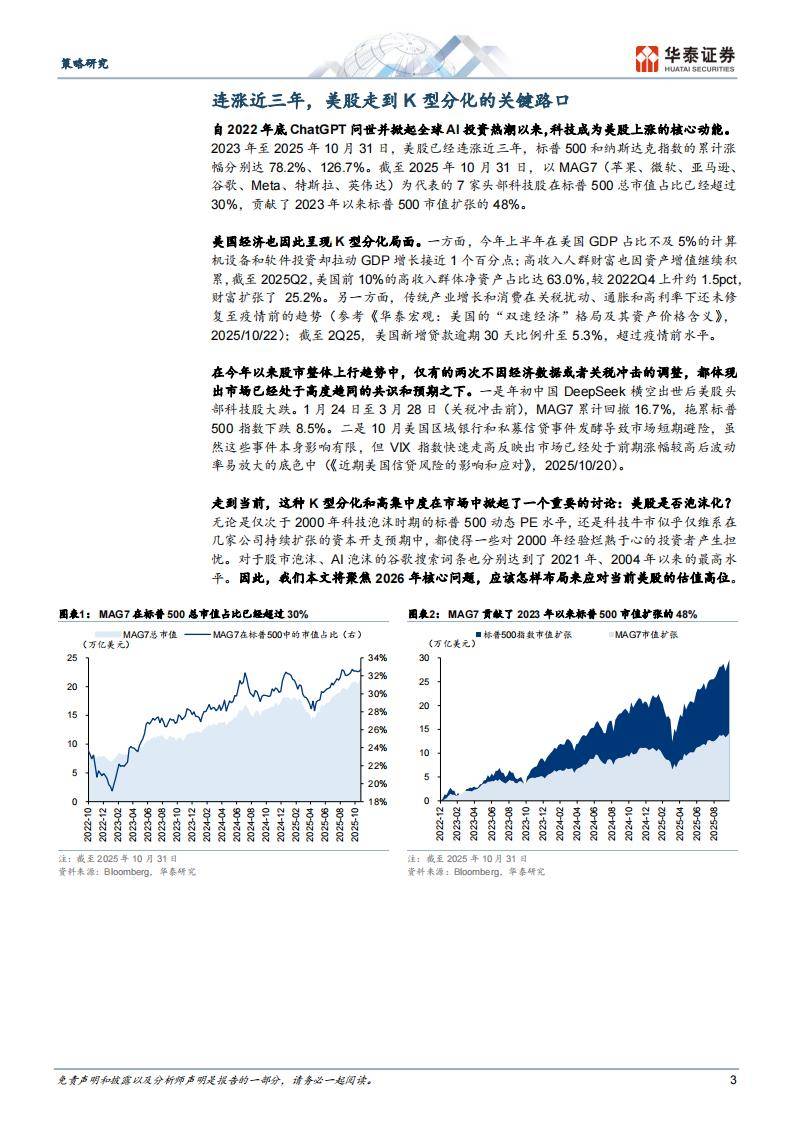
Group 1 - The U.S. stock market has experienced significant growth over the past three years, with the S&P 500 index rising by 78.2% and the Nasdaq index by 126.7% from 2023 to October 2025. The MAG7 companies (Apple, Microsoft, Amazon, Google, Meta, Tesla, Nvidia) account for over 30% of the S&P 500's total market capitalization and contributed 48% of the market expansion since 2023 [1][6][7]. - There are concerns about a potential tech bubble, as the current market concentration resembles the tech bubble of 2000. The price-to-earnings (PE) ratio is nearing its highest level since 1990, and the leverage ratio in the market has increased to 1.7%, surpassing the 1.5% level seen during the 2000 internet bubble [2][3][23]. - The K-shaped economic recovery is evident, with high-income households seeing a net worth share of 63.0% by Q2 2025, up 1.5 percentage points from Q4 2022. Meanwhile, traditional sectors have not fully recovered to pre-pandemic trends [7][8]. Group 2 - The Federal Reserve is expected to continue its accommodative monetary policy into the first half of 2026, with interest rates potentially dropping to the 3.00-3.25% range. However, the scope for further easing is limited, and historical trends suggest that the S&P 500 typically performs poorly in the months leading up to the end of a rate-cutting cycle [2][29]. - Capital expenditures (CAPEX) for MAG7 companies are projected to slow significantly, from a growth rate of 48.8% in 2025 to 18.8% in 2026, and further down to 6.0% in 2027. The future performance of tech stocks will depend on the successful deployment of AI applications and technological breakthroughs [3][34]. - The U.S. economy is expected to show resilience, with real GDP growth projected to rebound to 2.3% in 2026, supported by reduced trade policy uncertainty and accommodative fiscal and monetary policies [3][34]. Group 3 - Investment strategies for 2026 should balance liquidity, fundamentals, and sector structure, focusing on tech leadership in the first half and gradually increasing exposure to cyclical sectors in the latter half of the year [4][45]. - Global diversification is recommended, with high allocation value in developed markets like Germany and Switzerland, and emerging markets such as Saudi Arabia, South Korea, and India [5][47]. - Historical data indicates that after the end of a rate-cutting cycle, sectors like information technology, consumer discretionary, energy, and real estate tend to perform well, making them attractive for investment [5][48].





四川美丰:拟投资9000万元建设井口零散气回收利用项目
Zheng Quan Shi Bao Wang· 2025-11-04 11:40
Core Viewpoint - Sichuan Meifeng (000731) announced plans to invest approximately 90 million yuan in the "Wellhead Gas Recovery and Utilization Project" through its subsidiary Sichuan Shuangrui Energy Co., Ltd. [1] Company Summary - The total planned investment for the project is about 90 million yuan, which represents 2.15% of the company's most recent audited net assets [1] - The funding for the project will be sourced from the company's own funds [1]

科技新观察|院士眼中的创新关键词——“十五五”科技坐标解读之三
Ke Ji Ri Bao· 2025-11-04 07:40
Group 1: Core Views - The core focus of the article is on the importance of technological innovation in driving China's modernization and economic development, as emphasized in the 15th Five-Year Plan proposal [1][3][4]. Group 2: Technological Innovation and Research - The next five years are deemed critical for building a strong technological nation, with a focus on basic research and the integration of technological and industrial innovation [1][3]. - Basic research funding is projected to reach 249.7 billion yuan in 2024, reflecting a growth of over 70% since 2020 [4]. - The article highlights the need for stable funding and long-term support for basic research to enhance original innovation capabilities [4][6]. Group 3: Key Technological Breakthroughs - The article discusses significant advancements in key technologies, such as the development of high-speed oscilloscopes, which have reached international leading levels [7]. - China has achieved breakthroughs in nearly 700 key common technologies during the 14th Five-Year period, with a notable increase in high-value invention patents [7][8]. Group 4: Integration of Technology and Industry - The integration of technological innovation and industrial innovation is seen as essential for economic and social development, with a focus on meeting industry demands [11][12]. - The article notes that the transaction volume of technology contracts has maintained double-digit growth, reaching 6.8 trillion yuan in 2024 [12]. Group 5: Recommendations for Future Development - Suggestions include establishing a robust mid-term testing and transformation service system to accelerate the cultivation of new productive forces [13]. - The article advocates for collaborative research mechanisms between enterprises and research institutions to address technological challenges and foster talent [13].
从“五组数据”“四张网”看四川“十四五”基础设施发展“成绩单”
Zhong Guo Fa Zhan Wang· 2025-11-04 05:53
Core Insights - The Sichuan provincial government has made significant achievements in infrastructure development during the "14th Five-Year Plan" period, focusing on both traditional and new infrastructure projects [5][6] Infrastructure Achievements - The total length of the comprehensive transportation network in Sichuan has reached 443,000 kilometers, ranking first in the country, equivalent to the distance from Earth to the Moon [5] - The installed capacity of hydropower in Sichuan is about to exceed 100 million kilowatts, also ranking first nationally, with 30% of the country's hydropower coming from Sichuan [5] - Sichuan has established 10 major national scientific and technological infrastructure projects, ranking third in the country [5] - The province has built 248,000 5G base stations, ranking fifth nationally, achieving comprehensive coverage of gigabit networks in industrial parks [5][6] Investment and Economic Support - Infrastructure investment accounts for over 30% of fixed asset investment in Sichuan, providing strong support for stable economic operation and high-quality development [6] Four Networks of Infrastructure - **Three-dimensional Transportation Network**: Significant breakthroughs in strategic corridors, with the Sichuan-Tibet Railway under construction and the Chengdu to Huangshengguan section of the Chengqing Railway completed [7] - **Modern Water Conservancy Network**: The construction of a modern water network is accelerating, with urban water supply coverage achieved and rural self-supply rate increasing from 82% to 92% [8] - **Green Energy Network**: The completion of the Baihetan Hydropower Station contributes to Sichuan's position as a leader in clean energy, with wind and solar power installations expected to reach 32 million kilowatts by the end of the year [8] - **Smart Digital Network**: The development of computing power and internet infrastructure is advancing, with the Chengdu Supercomputing Center ranking among the top globally [9] Future Plans - Sichuan aims to build a modern infrastructure system that is advanced, applicable, systematic, efficient, safe, and green, supporting high-quality economic and social development in the "15th Five-Year Plan" [9]
锐财经|中国经济顶住压力稳中有进
Ren Min Ri Bao Hai Wai Ban· 2025-11-04 05:19
Core Insights - China's economy has shown resilience and progress in the first three quarters, with effective investment and strong social welfare measures laying a solid foundation for achieving annual economic and social development goals [1][6]. Economic Performance - The GDP grew by 5.2% year-on-year, maintaining a leading position among major global economies [2] - Retail sales of consumer goods increased by 4.5%, accelerating by 1.2 percentage points compared to the same period last year [2] - Industrial output rose by 6.2%, marking the highest growth for the same period since 2022 [2] Sectoral Growth - The equipment manufacturing and high-tech manufacturing sectors saw value-added growth of 9.7% and 9.6%, respectively, with their shares in industrial output increasing by 2.1 and 0.8 percentage points year-on-year [2] - The integrated circuit and smart device manufacturing sectors experienced significant growth, with increases of 22.4% and 12.2% in value-added [2] Quality and Efficiency - Improvements in product prices and corporate profits were noted, with industrial enterprise profits rising by 3.2% year-on-year, and a notable 21.6% increase in September alone [3][4] Resilience in Exports - Despite external challenges, exports maintained a growth rate of 7.1%, with high-tech and electromechanical products growing by 11.9% and 9.6%, respectively [2] - Exports to countries involved in the Belt and Road Initiative increased by 12.4% [2] Consumer and Industrial Trends - The service retail sector grew by 5.2%, driven by popular events such as sports and concerts [3] - Production of high-end and green technologies is on the rise, with civilian drones and industrial robots increasing by 43.2% and 29.8%, respectively [3] Social Welfare and Food Security - The government has effectively ensured food security and energy supply, with measures in place to stabilize grain markets and enhance agricultural production conditions [4][5] - The national coal stockpile reached 220 million tons, sufficient for over 35 days, ensuring energy supply during the winter [4][5] Investment Expansion - The government is actively promoting effective investment, with 500 billion yuan allocated to support local government financial capacity and investment projects [6] - Over 2,300 projects have been supported, with total investments around 7 trillion yuan, focusing on digital economy, AI, and infrastructure [6] Future Outlook - International economic organizations have raised their forecasts for China's economic growth, indicating confidence in achieving annual development goals [6][7]
【科技日报】院士眼中的创新关键词
Ke Ji Ri Bao· 2025-11-04 03:02
Group 1: Core Views - The core focus of the article is on the importance of technological innovation in driving China's modernization and economic development, as emphasized in the "15th Five-Year Plan" proposal [1][3][11] - The proposal highlights the need for a strong emphasis on basic research and original innovation to enhance China's technological self-reliance and productivity [3][4][11] Group 2: Basic Research - The "15th Five-Year Plan" aims to significantly enhance basic research and original innovation capabilities, with a strategic focus on increasing investment in foundational studies [3][4] - Basic research is identified as the primary source of original innovation, and neglecting it is equated to stifling future advancements [3][4] - China's investment in basic research has seen substantial growth, with funding reaching 249.7 billion yuan in 2024, a 70% increase from 2020 [4] Group 3: Key Technologies - The article discusses the advancements in key core technologies, particularly in the semiconductor industry, where domestic products are achieving international standards [6][7] - The "14th Five-Year Plan" has led to the establishment of 33 national manufacturing innovation centers and significant progress in critical common technologies [6][7] Group 4: Integration of Innovation and Industry - The proposal emphasizes the deep integration of technological innovation and industrial innovation as a pathway to enhance economic and social development [11][12] - The article notes that the integration of technology and industry has led to significant growth in technology contract transactions, projected to reach 6.8 trillion yuan in 2024 [11][12] Group 5: Recommendations for Future Development - Experts suggest establishing stable funding for long-term basic research and encouraging free exploration to enhance original innovation capabilities [4][5] - There is a call for a modern innovation system that prioritizes enterprise involvement and market orientation, fostering collaboration between academia and industry [8][12]
早盘直击|今日行情关注
申万宏源证券上海北京西路营业部· 2025-11-04 02:09
Group 1 - The core viewpoint of the article indicates that the profit growth rate of A-share listed companies is gradually turning from negative to positive, with expectations for low positive growth in the fourth quarter of this year due to easing base pressure in 2024 [1] - The non-financial and "three barrels of oil" A-share companies have experienced a continuous decline in net profit growth since Q1 2021, maintaining low single-digit growth in the first three quarters of this year [1] - The "14th Five-Year Plan" emphasizes industrial structure transformation and the implementation of "anti-involution" policies, which are expected to improve overall supply and demand conditions, leading to a recovery in gross margins and profitability for A-share companies [1] Group 2 - The stock market showed a rebound after a low opening, with the Shanghai Composite Index recovering to close higher, while the Shenzhen Component Index experienced a similar trend but closed with a weaker gain [2] - Market trading volume decreased to around 2.1 trillion yuan, indicating a reduction in transaction activity [2] - The market's focus was primarily on the media and energy sectors, with small and mid-cap stocks leading in gains, although technical resistance was observed at higher levels, suggesting a need for technical consolidation [2]