
商贸零售

Search documents
【12日资金路线图】两市主力资金净流出超210亿元 计算机等行业实现净流入
证券时报· 2026-01-12 12:37
1月12日,A股市场整体上涨。 截至收盘,上证指数收报4165.29点,上涨1.09%;深证成指收报14366.91点,上涨1.75%;创业板 指收报3388.34点,上涨1.82%。两市合计成交36013.76亿元,较上一交易日增加4786.81亿元。 1. 两市主力资金净流出超210亿元 今日沪深两市主力资金开盘净流出198.59亿元,尾盘净流出51.6亿元,全天净流出213.07亿元。 | | | 沪深两市最近五个交易日主力资金流向情况(亿元) | | | | --- | --- | --- | --- | --- | | 日期 | | 净流入金额 开盘净流入 | 尾盘净流入 | 超大单净买入 | | 2026-1-12 | -213.07 | -198.59 | -51. 60 | 53. 33 | | 2026-1-9 | -298.04 | -164. 63 | 1.02 | -16. 77 | | 2026-1-8 | -374. 35 | -163. 14 | -6. 58 | -144. 92 | | 2026-1-7 | -471.98 | -191.26 | 8. 31 | -213. ...


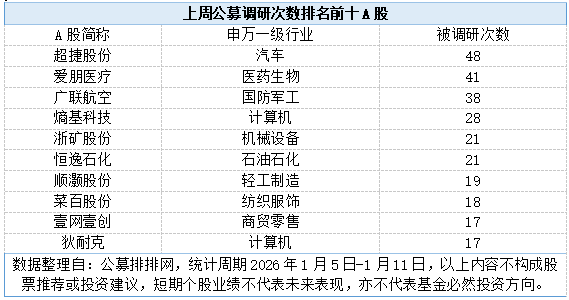
上周公募调研覆盖111家公司 生物医药行业居首
Zhong Guo Jin Rong Xin Xi Wang· 2026-01-12 08:04
Group 1 - Public fund institutions accelerated their research activities in early 2026, with 141 institutions participating in A-share research, covering 111 stocks across 24 industries, totaling 673 research instances, significantly higher than the usual weekly level [1][3] - Chaojie Co., Ltd. received the highest attention with 48 research instances from 43 public fund institutions, and 5 institutions conducted follow-up research. The company focuses on precision fasteners for the automotive industry and is also involved in aerospace and electronics [1][2] - Aipeng Medical was the second most researched stock with 41 instances, focusing on pain management and innovative fields like brain-machine interfaces, providing smart medical devices and solutions [1][2] Group 2 - The computer industry had two companies in the top ten for research instances: Entropy Technology with 28 instances and Dineike with 17 instances. Entropy focuses on smart spaces and digital identity authentication, while Dineike specializes in smart community and hospital solutions [2][3] - The pharmaceutical and biological sector had the highest research instances at 89, covering 8 stocks, while the machinery and electronics sectors had 17 stocks each, with research instances of 85 and 62 respectively [3][4] - Other notable companies in the top ten for research instances included Guanglian Aviation (38), Zhejiang Mining (21), Hengyi Petrochemical (21), Shunhao Co., Ltd. (19), Caizhi Co., Ltd. (18), and Yiwang Yichuang (17) [3][4]
商贸社服行业周报:国家发布假期优化文旅刺激政策,国务院开展外卖竞争调查-20260112
CMS· 2026-01-12 06:32
Investment Rating - The report maintains a "strongly recommend" rating for several companies in the e-commerce and tourism sectors, including Alibaba, Pinduoduo, JD Group, and Meituan, indicating a positive outlook for their future performance [17][20]. Core Insights - The restaurant and tourism sector index increased by 2.54%, underperforming compared to the Shanghai Composite Index (up 2.79%) and the ChiNext Index (up 3.89%). In contrast, the retail sector index rose by 4.43%, outperforming both indices [7][19]. - E-commerce companies are expected to see stable profit growth, with Alibaba's cloud business projected to grow significantly due to high demand in the AI cloud market [17][20]. - The local lifestyle sector, particularly Meituan, is viewed as having long-term competitive advantages despite short-term disruptions from competition [17]. - The travel sector is anticipated to maintain high growth, with recommendations for companies involved in leisure travel and outbound tourism, as well as related transportation and hotel services [17][20]. Summary by Sections Restaurant and Tourism Sector - The top five performing stocks in the restaurant and tourism sector this week included Guomai Culture (+11.23%), Qujiang Cultural Tourism (+4.72%), and Dalian Shengya (+4.39) [9][12]. - The report highlights the ongoing recovery in domestic travel demand since Q3 2025, with Ctrip's international business continuing to show strong growth [17][20]. E-commerce Sector - The report emphasizes the undervaluation of leading e-commerce companies, recommending Alibaba, Pinduoduo, JD Group, and Vipshop for their growth potential and market positioning [17][20]. - Pinduoduo's advertising revenue growth was slightly below expectations, but profits exceeded forecasts, indicating a positive long-term outlook [20]. Local Lifestyle and Travel - Meituan's competitive position remains strong despite recent challenges, with a focus on high-value users and operational efficiency [17]. - The report suggests that the travel industry will continue to thrive, with a focus on companies like Ctrip that are well-positioned for growth in international markets [17][20]. Retail Sector - The retail sector is seeing a shift towards quality retail, with companies like Yonghui Supermarket adapting their strategies to enhance consumer trust and service quality [17][20]. - The report recommends focusing on companies that are successfully navigating the changing retail landscape, such as Yonghui and others that emphasize quality and service [17].





零售概念走高,家家悦、三江购物涨停,茂业商业两连板
Zheng Quan Shi Bao Wang· 2026-01-12 03:45
Core Viewpoint - The retail sector is experiencing a significant boost, driven by government policies aimed at enhancing consumer spending and stimulating the economy, particularly in the lead-up to the traditional Chinese New Year [1] Group 1: Government Initiatives - The National Business Work Conference held on January 10-11 emphasized the need to accelerate the cultivation of new growth points in service consumption and to unleash the potential of service consumption [1] - Policies to optimize the implementation of trade-in programs for consumer goods are being promoted to expand and upgrade product consumption [1] - The government aims to create an international consumption environment and develop digital, green, and health-oriented consumption to invigorate spending in lower-tier markets [1] Group 2: Market Reactions - Retail stocks such as Juran Smart Home, Jiajiayue, and Sanjiang Shopping have seen significant gains, with some reaching their daily limit, indicating strong market sentiment [1] - The recent policy measures have led to a notable increase in market enthusiasm, as evidenced by the performance of retail and dining sectors, which are benefiting from various promotional activities [1] - The combination of top-level policy guidance and local promotional efforts is expected to enhance consumer willingness to spend during the upcoming festive season [1] Group 3: Economic Outlook - Analysts from Xiangcai Securities noted that since December 2025, there has been a marked increase in policy efforts to boost consumption, transitioning from isolated stimulus measures to a coordinated approach involving business and finance [1] - Local governments are actively launching various consumer promotion measures, such as issuing consumption vouchers and organizing cultural tourism events, to directly stimulate retail and large-scale consumption [1] - The convergence of favorable policies, improved fundamental expectations, and positive market sentiment is creating structural opportunities in the commercial retail sector [1]


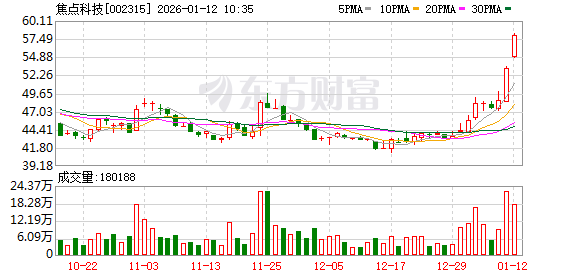
焦点科技盘中创历史新高
Zheng Quan Shi Bao Wang· 2026-01-12 02:35
Company Performance - The stock price of Focus Technology reached a historical high, increasing by 6.72% to 56.85 yuan, with a trading volume of 9.55 million shares and a transaction value of 534 million yuan, resulting in a turnover rate of 4.72% [2] - For the first three quarters, the company achieved a total operating revenue of 1.409 billion yuan, representing a year-on-year growth of 16.20%, and a net profit of 416 million yuan, also reflecting a year-on-year increase of 16.38% [2] - The basic earnings per share were reported at 1.3123 yuan, with a weighted average return on equity of 15.82% [2] Industry Overview - The retail trade industry, to which Focus Technology belongs, experienced an overall increase of 0.33%, with 54 stocks rising, including notable gainers such as Yiwang Yichuang, Maoye Commercial, and Sanjiang Shopping, which rose by 11.49%, 10.01%, and 7.21% respectively [2] - Conversely, 34 stocks in the industry saw declines, with the largest drops from Xinxunda, Jinheng Commercial Management, and Wushang Group, which fell by 5.47%, 2.79%, and 2.61% respectively [2]

2026“国补”首单已于近期陆续送达!关注可选消费板块机会
Mei Ri Jing Ji Xin Wen· 2026-01-12 00:59
Group 1 - The core viewpoint of the news is the launch of a new round of national subsidies for consumer goods, with a total of 62.5 billion yuan allocated to support the "trade-in" policy, aimed at boosting consumption during peak seasons like New Year's and Spring Festival [1] - The 2026 national subsidy program has optimized the range and standards of subsidies compared to 2025, adding smart glasses to the digital product category and focusing on "high-efficiency" appliances in the home appliance category [1] - The "trade-in" policy from 2024 to 2025 led to a significant increase in consumer goods sales, reaching 3.92 trillion yuan and benefiting 494 million consumers [1] Group 2 - The optional consumer ETF (562580.SH) is expected to benefit significantly from the continuation of the national subsidy policy, with a focus on sectors such as automobiles (46%) and home appliances (34%) [2] - The top ten weighted stocks in the optional consumer ETF include major companies like Midea Group, BYD, Gree Electric, and Haier Smart Home, indicating strong potential for growth in these sectors [2] - The index valuation PE-TTM stands at 23.47 times, which is in the 38.04% percentile over the past decade, suggesting a relatively attractive investment opportunity [2]
机构研究周报:中国市场长牛基础日益坚实
Wind万得· 2026-01-11 22:42
Group 1 - The current A-share market ecosystem is undergoing systematic restructuring, with a solid foundation for a "long bull, slow bull" market being established. The strategic position of the capital market has significantly improved, and the institutional framework is becoming more refined, providing a solid guarantee for stable market operations [5][14] - The "New Nine Articles" are promoting a transformation of the market from being financing-led to a balanced focus on both financing and investment, leading to continuous improvements in the quality of listed companies and investor protection [5] - The profitability of core assets is showing signs of a turning point, with both technology and traditional sectors presenting structural opportunities, and the matching of valuation and profitability is improving [5] Group 2 - The spring market is expected to gradually unfold, supported by factors that have driven previous market activity, including liquidity factors such as margin trading and insurance capital, which are anticipated to continue into January [6] - The macroeconomic environment, including the previous appreciation of the RMB, is creating a favorable atmosphere for liquidity and risk appetite, with potential catalysts such as policy adjustments and improvements in fundamental data expected in January [6] - After a two-month earnings window, listed companies will once again face fundamental verification as they enter the earnings forecast disclosure window in January [6] Group 3 - A-share market is expected to maintain an upward trend, with structural inflows of incremental funds anticipated in January, supported by the appreciation of the RMB and foreign capital positioning at the year-end [7] - Market sentiment appears slightly subdued, with industry preferences concentrated in sectors such as non-ferrous metals and defense, suggesting that investors should focus on large-cap styles and policy-related industry opportunities [7] Group 4 - The commercial aerospace industry is expected to enter a period of explosive growth, with the current phase being the initial stage of large-scale infrastructure development, accelerating towards commercial applications [13] - The "Space Power" goal is clearly defined, with national strategic support guiding the industry, and the low-orbit satellite internet constellation is set to begin high-density networking by 2025, marking a critical window for large-scale networking from 2025 to 2027 [13] Group 5 - A weak dollar cycle is expected to boost the performance of A/H shares, as it drives domestic exports and improves corporate profits, with global liquidity easing valuations and funds favoring high-growth emerging markets [14] - Structural improvements in sectors such as technology and domestic demand are anticipated to benefit from corporate profit recovery, leading to a rebound in these areas [14]

量化择时周报:情绪稳步修复,市场成交较上周显著放量-20260111
Shenwan Hongyuan Securities· 2026-01-11 13:45
Group 1 - Market sentiment is steadily recovering, with the sentiment indicator reaching 1.6 as of January 9, up from 1.35 the previous week, indicating a bullish outlook from a sentiment perspective [8][12] - The average daily trading volume for the entire A-share market increased significantly by 34.00% week-on-week, reaching an average of 28,519.51 billion yuan, with January 9 marking a recent high of 31,523.68 billion yuan [16][19] - The industry score trends show that sectors such as pharmaceuticals, coal, real estate, media, and environmental protection have seen upward trends in short-term scores, with defense and military industries scoring the highest at 100 [41][42] Group 2 - The correlation between industry congestion and weekly price fluctuations is high at 0.37, indicating that sectors with high congestion, such as defense and petrochemicals, have experienced significant gains, while sectors like retail and non-bank financials, despite high congestion, have shown lower price increases [44][47] - The current model indicates a preference for small-cap and value styles, with the 5-day RSI relative to the 20-day RSI continuing to rise, suggesting potential for enhanced signals in the future [52]
商社行业周报(2026.1.5-2026.1.11):CPI有所回升,CES智能眼镜热度延续-20260111
GUOTAI HAITONG SECURITIES· 2026-01-11 12:41
Investment Rating - The report assigns an "Accumulate" rating for the industry [1] Core Insights - The report recommends focusing on sectors such as the travel industry chain, gold and jewelry, and AI applications [3] - The investment highlights include the ongoing recovery in consumer spending, particularly in tourism and retail sectors, driven by favorable policies [4] Summary by Relevant Sections Investment Highlights - Key companies to watch include OTA platforms (Ctrip, Tongcheng), hotels (Atour, Huazhu, ShouLai, JinJiang, JunTing), and scenic spots (Emei Mountain, Three Gorges Tourism, Changbai Mountain) [4] - Significant improvement in competitive landscape noted for companies like Caibai Co. and Huatu Shanding [4] - AI application trends are gaining momentum with companies such as Kangnait Optical, Qingmu Technology, Tianli International Holdings, and Focus Technology [4] - Impressive sales data in the duty-free sector, particularly for China Duty Free Group [4] - Other undervalued companies highlighted include Laopu Gold, Sumida, Jiangsu Guotai, Action Education, and China Oriental Education [4] Market Performance - The retail sector saw a 4.43% increase last week, while the consumer services sector rose by 2.54%, ranking 13th and 21st among 30 industries respectively [4] - Notable stock performances included Focus Technology (+16.4%), Tianli International Holdings (+15.5%), and JunTing Hotel (+12.1%) [4] Industry Updates - The report provides updates on key industry metrics, including a 128.9% year-on-year increase in sales during the New Year holiday for Hainan's duty-free shopping [4] - The CPI data for December 2025 showed a year-on-year increase of 0.8% [4] - The CES 2026 event in Las Vegas featured over 50 Chinese brands showcasing smart glasses [4] - IKEA China announced the closure of seven large stores starting February 2, 2026, shifting focus to smaller stores and online channels [4]



春季行情主升时行业如何轮动?
Huajin Securities· 2026-01-10 11:19
Group 1: Market Trends - The spring market's main rising phase may see a rebound in growth sectors, particularly those with low valuation sentiment and significant future financing inflows[1] - Historical data shows that during the main rising phases, the Shanghai Composite Index has increased by approximately 4% to 22%, averaging around 19 trading days[10] - Key sectors that performed well during previous main rising phases include media, electronics, and non-ferrous metals, which experienced substantial financing inflows[1] Group 2: Sector Performance - In the current spring market, technology growth sectors such as media, computing, and pharmaceuticals are expected to rebound due to low valuations and sentiment[2] - Financing inflows since December 17, 2025, have been significant in sectors like electronics, non-ferrous metals, and defense, driven by ongoing industry trends[18] - The main rising phase typically sees theme indices outperforming primary industry indices, with notable gains in sectors like integrated circuits and digital marketing[42] Group 3: Economic Indicators - Short-term economic recovery remains weak, with CPI growth recorded at 0.8% and PPI at -1.9%, indicating a gradual improvement in industrial profitability[23] - The short-term liquidity environment is expected to loosen further, with potential interest rate cuts from the Federal Reserve and domestic central bank actions[31] - Risk appetite is likely to increase due to positive policy implementations and limited overseas risks, such as the anticipated Fed rate cut[38]