创新药

Search documents
万字复盘:今年VC心情好多了
投资界· 2025-12-06 07:56
Core Insights - The investment sentiment in the Chinese venture capital market is generally positive, with many industry leaders expressing optimism about the upcoming years, potentially marking the beginning of a "golden three years" for the sector [6][13][30] - The performance of the Hong Kong stock market, particularly in the biotech sector, has been strong, with some companies seeing stock price increases of 5 to 10 times, which contributes to the overall positive outlook [13][18] - There is a consensus that while opportunities exist in various sectors, including AI and healthcare, caution is warranted due to potential market bubbles, particularly in emerging technologies like robotics [20][25][29] Investment Climate - The overall investment climate is described as "good," with many firms reporting increased investment activity compared to the previous year, with some firms doubling their investment amounts [8][9][12] - Several firms have successfully exited investments through IPOs, indicating a healthy exit environment, with expectations for more IPOs in the near future [10][11][14] - The investment pace has accelerated, with many firms reporting a significant increase in the number of projects funded this year compared to last year [9][12][14] Market Opportunities - Key opportunities identified include advancements in AI, biotechnology, and the globalization of Chinese enterprises, which are seen as long-term growth drivers [17][20][25] - The robotics sector is highlighted as a rapidly growing area, although concerns about potential bubbles exist due to the influx of capital and competition [20][25] - The healthcare sector, particularly innovative pharmaceuticals, is also viewed as a significant opportunity, with many firms focusing on integrating into global supply chains [23][24][30] Challenges and Risks - The venture capital industry faces challenges related to fund duration and the need for extensions, which could impact the stability of the sector if not addressed [6][44] - There are concerns about the valuation discrepancies in the market, particularly in the Hong Kong stock market, where some companies are overvalued compared to their performance [18][19] - The regulatory environment, including IPO approval processes and tax policies, is seen as a barrier to optimizing the investment landscape, necessitating reforms to enhance market efficiency [42][43][44]


华创医药投资观点&研究专题周周谈·第153期:2025Q3海外心血管器械龙头收入拆分和管线进展-20251206
Huachuang Securities· 2025-12-06 07:24
Investment Rating - The report recommends a "Buy" rating for the innovative drug sector, highlighting the potential for significant growth in domestic and international markets [52]. Core Insights - The innovative drug industry is transitioning from quantity to quality, with a focus on differentiated products and international expansion. Companies like BeiGene, Innovent, and others are highlighted as key players [10]. - The medical device sector is experiencing a recovery in bidding volumes, particularly in imaging equipment, and is expected to benefit from government subsidies for home medical devices [10]. - The report emphasizes the growth potential in the orthopedic market due to aging demographics and the increasing penetration of domestic products [53]. - The blood products sector is expected to grow significantly due to relaxed regulations and increasing demand [12]. Market Overview - The report notes that the medical device index fell by 0.73%, underperforming the CSI 300 index by 2.00 percentage points, ranking 22nd among 30 sectors [6]. - The top-performing stocks in the medical sector included Haiwang Biological and Ruikang Pharmaceutical, while the worst performers included ST Jingfeng and Kangzhi Pharmaceutical [6]. Company-Specific Developments - Abbott's cardiovascular business reported revenues of $3.137 billion in Q3 2025, with significant growth in arrhythmia management and electrophysiology segments [17]. - Medtronic's cardiovascular revenue reached $3.436 billion in Q3 2025, driven by strong performance in cardiac rhythm and heart failure segments [24]. - Boston Scientific's cardiovascular revenue was $3.343 billion in Q3 2025, with notable growth in the Watchman and electrophysiology segments [31]. - Johnson & Johnson's cardiovascular revenue totaled $2.213 billion in Q3 2025, benefiting from acquisitions and strong growth in electrophysiology products [42]. - Edwards Lifesciences reported cardiovascular revenue of $1.55 billion in Q3 2025, with robust growth in transcatheter aortic valve replacement (TAVR) and mitral/tricuspid valve therapies [48]. Product Pipeline Progress - Abbott's AVEIR™ leadless pacemaker system has shown promising clinical results, while its Volt™ PFA system for atrial fibrillation has received CE certification [20]. - Medtronic's Evolut™ TAVR system has been approved for redo procedures, enhancing its market position [27]. - Boston Scientific's FARAPULSE™ PFA system has received expanded indications for treating persistent atrial fibrillation [36]. - Johnson & Johnson's VARIPULSE platform has been approved for atrial fibrillation treatment, further strengthening its product offerings [45].
长城基金投资札记:布局2026,关注市场结构性亮点
Xin Lang Cai Jing· 2025-12-05 20:06
Core Viewpoint - The market is entering a window period of upward resonance in policy, liquidity, and fundamentals as December approaches, with the upcoming Central Economic Work Conference expected to guide expectations for the macro economy in 2024 [1] Group 1: Market Outlook - A-shares are expected to have rebound potential, with a focus on the upcoming political bureau meeting and Central Economic Work Conference for macroeconomic guidance [1] - The market has released some valuation and sentiment risks after previous adjustments, leading to a more stable outlook [1] - The focus for investment opportunities should be on AI applications, overseas demand sectors due to the anticipated US interest rate cuts, resource stocks benefiting from a new round of dollar easing, and dividend stocks favored by domestic incremental capital [1] Group 2: Sector Focus - There is a need to identify new structural highlights as the market currently lacks a sustainable upward mainline, with funds rotating between different sectors [2] - The market may face short-term risks, but the Central Economic Work Conference and potential US interest rate cuts could create a window for preparing for next year's expectations [3] - Continued optimism for AI applications in the medical and consumer sectors, with a rational return of expectations after previous high anticipations [4] Group 3: Investment Themes - In the innovative drug sector, attention should be paid to the rhythm of clinical data releases and the globalization of business development (BD) for certain stocks [5] - Key events in December, such as the Central Economic Work Conference and the US Federal Reserve meeting, could influence domestic economic expectations and short-term liquidity in US markets, with price increases potentially becoming a trading focus [6] - Focus on domestic consumption, financial sectors, and capital goods, with expectations for improved competition and stability in certain industries [7][8] Group 4: Growth and Opportunities - A cautious optimism remains for the market, with some funds positioning for a potential "spring surge" in 2024, particularly in high-valuation growth and small-cap sectors [9] - AI continues to be viewed as a high-prospect area, with ongoing exploration of related opportunities and monitoring of energy storage developments [10] - Emphasis on sectors with independent logic in technology growth, new consumption, and exports, with a structural market trend expected to continue [11]
现金告急、管线存疑、估值承压:科望医药三闯港交所背后
Xin Lang Cai Jing· 2025-12-05 10:14
Core Viewpoint - The company, Kewang Pharmaceuticals, is facing significant financial challenges as it attempts to go public for the third time, with a history of over 2 billion yuan in losses and only enough cash to sustain operations for three months [1][6]. Financial Challenges - As of the end of 2024, Kewang Pharmaceuticals has only 32.82 million yuan in cash, a drastic decrease of 88% from 270 million yuan the previous year [2][7]. - The company's net debt stands at 2.738 billion yuan, largely due to convertible redeemable preferred shares that require repayment if the IPO is not completed by the deadline, adding substantial cash flow pressure [2][7]. - To alleviate financial strain, the company has implemented drastic measures such as selling production facilities, downsizing its team, and cutting R&D projects, but these efforts have not reversed the situation [2][7]. R&D Pipeline Concerns - Kewang's core product, ES102, is a six-valent OX40 agonist antibody, but its clinical data shows a low objective response rate of 11.1% and a disease control rate of 40.7%, which are not competitive compared to existing treatments [3][8]. - The company has not demonstrated strong in-house R&D capabilities, as its most advanced pipelines are licensed from other companies, and its proprietary technology platform has yet to yield significant clinical assets [3][8]. Market and Valuation Challenges - Kewang's valuation has seen a dramatic increase from 20 million USD in 2017 to 600 million USD in 2021, but it now appears significantly inflated compared to industry standards, with a market-to-research ratio of approximately 37 times, while the median for similar companies is only 15.65 times [4][9]. - The IPO environment has become more stringent, with new regulations requiring companies to demonstrate advanced clinical stages and sufficient commercial potential, posing additional challenges for Kewang [4][9]. Conclusion - Kewang Pharmaceuticals' journey to IPO reflects the broader struggles of Chinese biotech firms in balancing funding, R&D, and market trust, with the current situation presenting not just a developmental issue but a survival challenge [5][10].
中银国际:26年建议关注医疗服务板块的机会 看好医药板块创新、出海、消费三个方向
智通财经网· 2025-12-05 08:53
Core Viewpoint - The report from Zhongyin International indicates a significant divergence in the performance of various sub-sectors within the medical industry in 2025, with CXO and innovative drug-related sectors showing substantial growth. The firm remains optimistic about "product-driven" companies in 2026, as the industry trend continues to favor these companies, which are expected to gradually enter a profit cycle. Additionally, opportunities in the medical services sector are highlighted, despite its underwhelming performance in 2025, as the long-term logic of the sector remains intact and resilient [1][2]. Group 1: Sector Performance in 2025 - In 2025, the A-share market performed well, with all 31 Shenwan primary sectors recording positive returns by October 31, 2025. The pharmaceutical and biological sector ranked 10th with a growth rate of 34.95%. Among sub-sectors, CXO had the highest growth at 58.71%, followed by bioproducts at 57.59% and chemical preparations at 52.17%. In contrast, offline pharmacies and blood products had lower growth rates of 7.56% and 0.87%, respectively [1]. - As of October 31, 2025, the overall price-to-earnings (P/E) ratio for the pharmaceutical and biological sector was 30.82 times, indicating that the industry's valuation remains at a low level compared to 2020. The valuation increase in bioproducts and CXO is positively correlated with performance, while the valuation rise in vaccines and in vitro diagnostics is primarily due to profit declines [1]. Group 2: Outlook for Product-Driven Companies - The report emphasizes that "product-driven" companies are gradually overcoming the impacts of centralized procurement, with increased R&D investments leading to the launch of new products. Policy improvements, such as "anti-involution in centralized procurement" and "encouraging innovation," are guiding the pharmaceutical industry towards an innovation-driven transformation. This trend suggests that the industrial logic for "product-driven" companies will continue to be sustainable [2]. - The innovative drug sector is highlighted as a focal point, with the trend of innovative drug business development (BD) overseas gaining attention in 2025. This trend not only demonstrates the global competitiveness of Chinese innovative drugs but also serves as a crucial pathway for their international expansion. The performance of innovative drug companies and the clinical progress of key products are also noted as important areas to watch [2]. Group 3: Resilience of Medical Services - Despite a lackluster performance in 2025, the medical services sector is showing signs of gradual recovery, particularly in ophthalmology, where diagnostic and surgical volumes indicate a rebound. The long-term resilience of the medical services sector is supported by several factors: the increasing aging population leading to higher disease incidence, the exit of smaller companies due to centralized procurement and cost control, and the presence of unresolved issues in the industry, such as pathological myopia and glaucoma [3]. - The introduction of new technologies and products in the medical services sector presents significant growth opportunities. In 2026, the sector is expected to recover gradually, benefiting from the low base effect observed in 2025 [3].
创新药的逻辑,一篇给你讲明白
雪球· 2025-12-05 07:52
Core Viewpoint - The article emphasizes that investing in the innovative drug sector in Hong Kong is one of the most promising opportunities for 2025, with significant growth potential compared to other sectors, particularly in light of the recent performance of the Hang Seng Index and the healthcare indices [3][5]. Group 1: Market Performance - The Hang Seng Index has achieved a return of over 28% this year, ranking among the top global markets, but the innovative drug sector has outperformed with an 80% increase in indices related to innovative drugs [3][5]. - The innovative drug sector's performance is attributed to a combination of fundamental, emotional, valuation, and monetary factors, creating a synergistic effect that has driven growth [6]. Group 2: Financial Metrics - In the first half of 2025, the total revenue for 36 companies in the Hong Kong innovative drug sector is projected to be 28.5 billion RMB, reflecting a year-on-year growth of 15.8%, with a net profit of 1.8 billion RMB [6][7]. - Expanding the sample to 50 Hong Kong "18A companies," total revenue reached 44.9 billion RMB, with a year-on-year growth rate of 31.48% and a net profit of 2.727 billion RMB, showing a significant increase of 128.4% [7]. - For a broader sample of 149 Hong Kong pharmaceutical companies, total revenue was 896.12 billion RMB, with a modest growth of 1%, while net profit increased by 29.7% [7]. Group 3: Industry Trends - The innovative drug industry is seen as a natural fit for large countries like China, which can leverage its industrial chain advantages to reduce high R&D costs, making it more feasible to develop new drugs compared to markets like the U.S. [12]. - The article discusses the evolution of the innovative drug sector, highlighting the transition from generic drugs to innovative products, and the increasing clarity in the industry's development trajectory [10][12]. Group 4: Business Development Models - Business Development (BD) and NewCo models are crucial in the innovative drug sector, with BD involving licensing agreements that allow companies to recoup investments quickly while minimizing commercialization risks [14][15]. - The NewCo model allows companies to establish new entities for overseas operations, facilitating funding and development while retaining stakes in the original company [15][16]. - The BD model is not yet saturated, as many multinational corporations face patent cliffs and are actively seeking to replenish their pipelines through licensing agreements [16]. Group 5: Market Environment - The innovative drug sector is heavily influenced by monetary conditions, with low interest rates fostering a favorable financing environment, which is essential for companies that rely on external funding and M&A activities [17][18]. - The article notes that the healthcare sector in Hong Kong has raised a total of 61.5 billion HKD in funding as of August 31, 2025, indicating a robust fundraising environment that surpasses the total of the previous three years [18].

ETF日报 | “牛市旗手”卷土重来!反弹行情中的板块轮动怎么把握?
Sou Hu Cai Jing· 2025-12-05 07:47
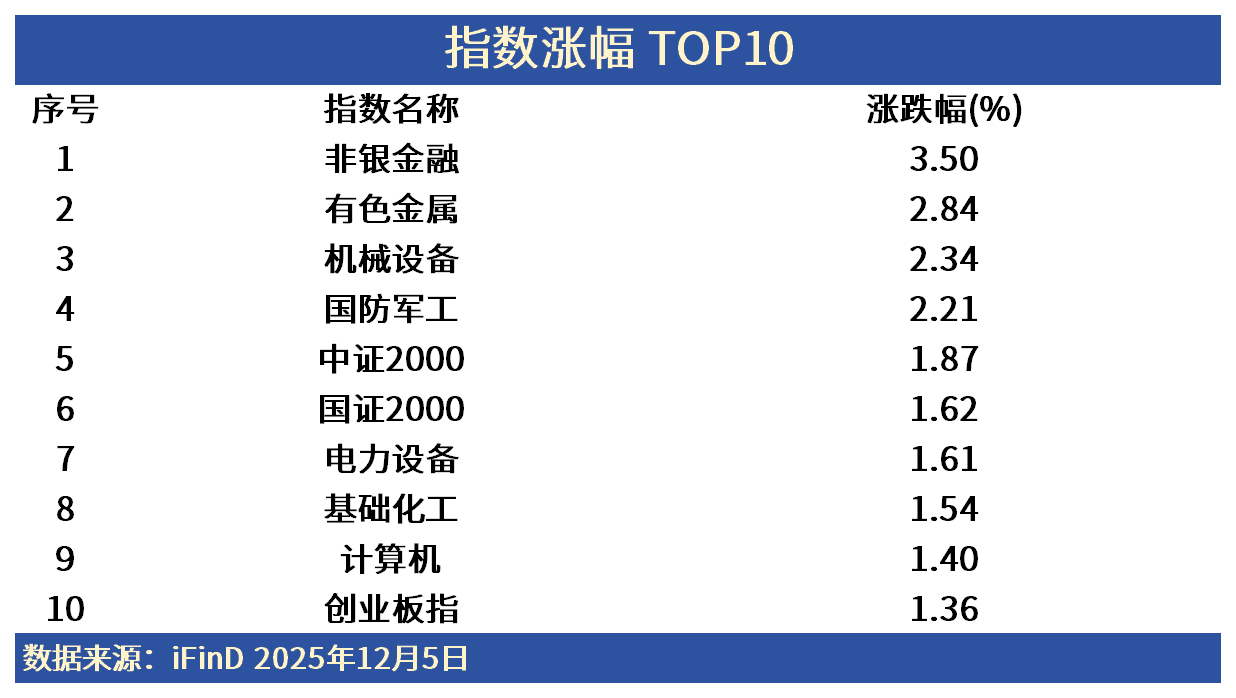
Non-Bank Financials - The Guangdong provincial government has issued a plan to support the integration and merger of industrial chains, allowing insurance funds to increase equity investment in M&A projects, which will enhance the role of non-bank financials as "patient capital" [2] - Morgan Stanley has included China Ping An in its focus list, expressing optimism about its long-term performance [2] - Donghai Securities is optimistic about the sector's configuration opportunities driven by year-end style switching and the "New Year Red" initiative, highlighting the importance of M&A restructuring, wealth management transformation, and ROE improvement [2] Nonferrous Metals - Three rare earth permanent magnet companies have obtained general export licenses, with the Chinese government facilitating compliant trade to maintain global supply chain stability [3] - Changjiang Futures believes that nonferrous metals like copper and aluminum will benefit from the optimization of traditional industries and the growth of emerging sectors during the 14th Five-Year Plan period [3] - The focus on rare metals such as rare earths and lithium is increasing, with the rare metal ETF (159608) gaining attention [3] Machinery Equipment - The "Machinery Industry Stable Growth Work Plan (2025-2026)" sets a revenue target of 10 trillion yuan by 2026, emphasizing innovation in key areas like industrial mother machines and smart equipment [4] - Excavator sales increased by 17% year-on-year from January to October, with engineering machinery exports reaching $48.57 billion, up 12% [4] - Bohai Securities notes a continued recovery in the engineering machinery sector, driven by domestic demand and significant infrastructure projects [4] Market Performance - As of December 5, 2025, the A-share market saw non-bank financials, nonferrous metals, and machinery equipment leading with gains of 3.50%, 2.84%, and 2.34% respectively [1][5] - The banking sector experienced a decline of 0.58%, with Chongqing Bank and Qilu Bank showing the largest drops [5][8] Pharmaceutical Sector - The upcoming release of the new basic medical insurance drug list and the first version of the commercial insurance innovative drug list is expected to create investment opportunities in related pharmaceutical companies [6] - The ongoing flu season is increasing interest in sectors such as in vitro diagnostics, vaccines, and pharmacies, presenting short-term investment opportunities [6] - The largest Hong Kong innovative drug ETF (513120) has seen continuous net inflows over the past six days, indicating strong investor interest [6]
科望医药ESMO Asia口头报告公布全球首创ES014单药疗法Ⅰ期亮眼数据
智通财经网· 2025-12-05 07:29
Core Insights - The article discusses the Phase I clinical trial results of ES014, a bispecific antibody developed by Kewang Pharmaceutical, presented at the ESMO Asia conference on December 5, 2025. [1] - ES014 is the world's first CD39/TGFβ bispecific antibody to enter clinical trials, showing promising anti-tumor activity in various cancer types with high unmet clinical needs. [1] Clinical Trial Results - In the treatment of desmoplastic tumors (DT), ES014 achieved an overall response rate (ORR) of 40% and a disease control rate (DCR) of 100%, indicating significant potential as an innovative treatment option. [1] - For non-small cell lung cancer (NSCLC), ES014 demonstrated preliminary efficacy in patients with high CD39 expression, laying the groundwork for precision medicine strategies. [1] - ES014 may provide a new treatment option for wild-type gastrointestinal stromal tumor (GIST) patients, who have very limited clinical treatment choices. [1] Strategic Implications - As ES014 and other core pipelines show initial clinical benefits, Kewang Pharmaceutical's value realization is expected to increase, particularly with its unique myeloid cell connector (MCE) platform. [1] - The company is focused on immunology and original research innovation, which may enhance its potential for international licensing and collaboration opportunities. [1] - From a long-term perspective in the innovative drug industry, once the clinical value of the innovative pipeline is recognized internationally, the sustainability of cash flow is likely to shift from being "financing-driven" to "transaction and collaboration-driven." [1]
科创100ETF基金(588220)涨近1%,一键布局“十五五”科技发展方向
Xin Lang Cai Jing· 2025-12-05 06:42
截至2025年12月5日 14:17,上证科创板100指数(000698)成分股铂力特(688333)上涨9.92%,埃夫特 (688165)上涨6.15%,财富趋势(688318)上涨6.04%,睿创微纳(688002)上涨5.21%,孚能科技(688567)上 涨4.55%。科创100ETF基金(588220)上涨0.78%,最新价报1.3元。 科创100ETF基金(588220),跟踪科创100指数[000698.SH],覆盖九大申万一级行业,一键布局科创板 市值中等且流动性较好的100 只证券。其中电子占比40.42%、生物医药占比17.36%、电力设备占比 14.54%。汇聚细分板块优秀标的与专精特新企业。其中专精特新成份股总计48家,累计权重占比 48.28%,未来发展潜力足。 数据显示,截至2025年11月28日,上证科创板100指数(000698)前十大权重股分别为华虹公司(688347)、 东芯股份(688110)、百济神州(688235)、源杰科技(688498)、国盾量子(688027)、睿创微纳(688002)、中 科飞测(688361)、安集科技(688019)、翱捷科技(68822 ...
早盘直击|今日行情关注
申万宏源证券上海北京西路营业部· 2025-12-05 02:37
Market Overview - A-shares continue to maintain a low-volume consolidation pattern after failing to break through the 3900-point mark, with trading volume shrinking to below 1.6 trillion [1] - As the year-end approaches, investor enthusiasm for trading has decreased, leading to a general trend of low-volume fluctuations in the market [1] - The market is expected to remain in this state for the next few weeks, with a focus on the 4000-point level as a potential preparation for upward movement [1] Future Outlook - The market is currently in a cautious atmosphere as year-end approaches, but the repeated fluctuations around the 4000-point mark may indicate preparation for a new upward phase [1] - The manufacturing sector is expected to see improved supply and demand conditions in the second half of 2026, which could lead to a significant rebound in the earnings growth of A-share listed companies [1] - Key focus areas for November include the impact of the 14th Five-Year Plan on industries, event-driven factors in the technology sector, and price increases driven by anti-involution trends, which may catalyze multiple sectors and support a continued upward trend in the market [1] Sector Highlights - In December, sectors benefiting from dividends and price increases are expected to outperform, with short-term attention on banks, public utilities, coal, and non-ferrous metals [2] - Technology remains the main focus for 2026, with particular attention on AI, lithium batteries, military industry, and robotics after a phase of adjustment [2] - The trend of AI hardware continues to solidify, with increasing token usage for major AI models indicating a peak in AI applications by 2026, presenting opportunities for high growth in AI hardware [2] - The domestic production of robots and their integration into daily life is a confirmed trend for 2026, with opportunities arising in sensors, controllers, and dexterous hands as robot products evolve [2] - The semiconductor industry is expected to continue its domestic production trend, with a focus on semiconductor equipment, wafer manufacturing, materials, and IC design [2] - The military industry is anticipated to see a recovery in orders by 2026, with many sub-sectors showing signs of bottoming out as third-quarter earnings declines continue to narrow [2] - The innovative drug sector is entering a harvest period after nearly four years of adjustment, with positive net profit growth expected to continue into 2026 [2]