传媒

Search documents
8点1氪丨爱奇艺回应充25年会员退费难;B站2025年度弹幕为“致敬”;官方明确明年继续“国补”
3 6 Ke· 2025-12-29 00:02
Group 1 - The movie "Zootopia 2" has become the first imported film in Chinese history to surpass 100 million viewers [5] - Bilibili announced that the annual bullet screen for 2025 is "Tribute," with over 22.82 million mentions and 4.59 million users participating [2] - The Chinese government plans to relax household registration restrictions outside of a few mega cities to promote urban integration [2] Group 2 - Xiaomi's co-founder Lin Bin plans to sell up to $2 billion worth of B-class ordinary shares starting December 2026, with proceeds aimed at establishing an investment fund [4] - The new national standard for electric vehicle energy consumption, considered the strictest globally, will be implemented starting January 1, 2026, limiting energy consumption for 2-ton vehicles to no more than 15.1 kWh per 100 km [6] - Guizhou Moutai aims to prevent price speculation and ensure reasonable pricing to stabilize market expectations [6] Group 3 - The precious metals market has seen significant price increases, with platinum futures surpassing $2,400 per ounce, marking a weekly increase of over 22% [5] - A lawsuit involving a subsidiary of XWANDA is seeking over 2.314 billion yuan due to alleged quality issues with delivered battery cells [6] - NASA's new director has stated that the U.S. will return to the moon during Trump's second term, emphasizing the importance of lunar exploration for economic and national security [8]




提升“四力” 达州为宣传队伍举办大讲堂
Xin Lang Cai Jing· 2025-12-28 20:28
Core Viewpoint - The training session organized by the Dazhou Municipal Propaganda Department aims to enhance the theoretical knowledge and media literacy of local propaganda and cultural officials, focusing on the integration of media in the current era [1] Group 1: Training Objectives and Content - The training session is part of the "Four Forces" lecture series, which includes over 200 participants from the local propaganda and cultural system [1] - The "Four Forces" refer to the comprehensive qualities of propaganda and cultural workers, namely physical strength, observational skills, intellectual capacity, and writing ability [1] - The session featured a lecture by award-winning journalist Li Yan, who discussed innovative paths for news planning and reporting in the context of integrated media [1] Group 2: Media Integration Challenges - The lecture addressed the core logic of media integration and analyzed the real challenges faced in the current media fusion process [1] - It emphasized the innovative directions and practical paths for news planning and reporting in terms of concepts, content, forms, and methods [1] Group 3: Previous Training Sessions - Dazhou has conducted three sessions of the "Four Forces" lecture series this year, focusing on themes such as the protection and inheritance of historical and cultural heritage, as well as the development and application of artificial intelligence [1] - These training sessions aim to continuously empower and enhance the high-quality development of local propaganda and cultural work [1]
总要相信点什么——财经记者的2025年度脱口秀
财联社· 2025-12-28 11:18
Group 1 - The article discusses the significant changes across various industries, highlighting the contrast between thriving emerging sectors and struggling traditional industries, particularly in the context of AI and robotics [3][4]. - The storage industry has experienced a "super cycle" due to the rising demand from AI, with prices for storage products increasing dramatically, leading to substantial gains for domestic storage companies [5]. - The humanoid robot market has seen a decline in rental prices, indicating a potential oversupply despite the hype surrounding the technology, with over 250 listed companies involved in related components [8]. Group 2 - The pharmaceutical industry is witnessing a surge in business development (BD) activities, with companies focusing on data-driven negotiations rather than speculative valuations, reflecting a shift in how multinational corporations engage with biotech firms [11]. - The gold market has experienced significant price increases, driven by geopolitical tensions and central bank purchases, but producers are concerned about rising costs and the sustainability of high performance in future years [20]. - The media industry is evolving with a focus on authenticity, as demonstrated by the success of a low-budget film that resonated with audiences, indicating that genuine storytelling can outperform traditional marketing strategies [25]. Group 3 - The emotional consumption trend is evident in the popularity of collectible toys, with stock prices reflecting consumer sentiment, showcasing the interplay between market performance and emotional engagement [29].


华金证券:一月春季行情延续 科技和周期占优
Xin Lang Cai Jing· 2025-12-28 06:45
Core Viewpoint - The A-share market is expected to experience a strong performance in January, driven by favorable policies, external events, and liquidity factors. Group 1: Historical Context and Influencing Factors - Historically, when the spring market starts early, the A-share market tends to perform strongly in January, influenced by policies, external events, and liquidity [1][7] - Key factors affecting January's A-share performance include: - Positive policies and external events can lead to an increase in the Shanghai Composite Index, as seen in 2019 with the easing of US-China trade tensions and in 2023 with the optimization of pandemic policies [1][7] - Conversely, external risk events or tightening policies may end the spring market, as evidenced by past events like the European debt crisis in early 2010 and the COVID-19 pandemic in early 2020 [1][7] - Liquidity plays a significant role; a loose liquidity environment may boost A-share performance, while tight liquidity could weaken it [1][7] - Economic fundamentals and profit outlooks have limited impact on January's A-share performance [1][7] Group 2: Outlook for January - The spring market is likely to continue into January, with expectations of a strong A-share performance [2][8] - Positive policy expectations are anticipated to rise in January, with potential announcements of provincial "14th Five-Year" plans and consumer stimulus policies [2][8] - External risks are expected to be limited, with global central banks likely to continue easing and stable US-China relations [2][8] - Liquidity conditions are projected to improve, with expectations of further interest rate cuts by the Federal Reserve and domestic central banks [2][8] - Economic recovery is expected to remain weak, but corporate profit growth may continue to rebound, with PPI growth likely to rise [2][8] Group 3: Sector Performance Expectations - In January, technology growth and certain cyclical industries are expected to outperform [3][9] - Historical data shows that technology growth sectors tend to perform well when the spring market starts early, driven by upward industry trends and increased fund allocations [3][9] - Current trends suggest that technology and cyclical sectors will continue to see upward momentum, particularly in AI and related industries [3][9] - Themes such as commercial aerospace and controlled nuclear fusion are expected to catalyze performance in January [3][9] Group 4: Investment Recommendations - A balanced allocation strategy is recommended for January, focusing on technology growth, cyclical sectors, and consumer industries [4][10] - Specific sectors to consider include: - Mechanical equipment (robots), military (commercial aerospace), new energy (nuclear fusion, energy storage), electronics (semiconductors, AI hardware), and pharmaceuticals (innovative drugs) [4][10] - Sectors that may see a rebound include brokerage firms and consumer goods (food, retail, and services) [4][10]
定期报告:一月春季行情延续,科技和周期占优
Huajin Securities· 2025-12-28 06:45
Investment Rating - The report suggests a positive outlook for the technology growth and certain cyclical industries in January, indicating a potential for strong performance in these sectors [2][3]. Core Insights - The report highlights that the spring market rally is likely to continue into January, driven by favorable policies, external events, and liquidity factors. Historical data shows that when the spring rally starts early, the A-share market tends to perform strongly in January [5][8]. - It emphasizes that the main drivers for January's performance will be proactive policies and external events, with liquidity playing a crucial role. The report notes that a loose liquidity environment can lead to market gains, while tightening can have the opposite effect [5][10]. - The report anticipates that January will see a continuation of weak economic recovery trends, with potential improvements in corporate earnings driven by rising prices in certain cyclical sectors and ongoing demand in technology [17][23]. Summary by Sections Section 1: January Spring Market Continuation - Historical analysis indicates that the A-share market has shown strong performance in January during years when the spring rally starts early, with 6 out of 8 instances since 2010 showing gains [5][7]. - Key factors influencing January's performance include proactive policies, external events, and liquidity conditions, with a focus on the impact of monetary policy and external risks [5][6]. Section 2: Industry Allocation for January - The report suggests that technology growth and certain cyclical industries are likely to outperform in January, supported by upward industry trends and thematic catalysts such as AI and commercial aerospace [8][23]. - Current sectors with low PEG ratios include electric power equipment and media, indicating potential for growth [23]. - A balanced allocation strategy is recommended, focusing on technology growth, cyclical sectors, and consumer industries, with specific mentions of robotics, military, new energy, electronics, and pharmaceuticals [23][24].
华金证券:明年1月春季行情可能延续 科技成长和部分周期行业占优
Zhi Tong Cai Jing· 2025-12-27 11:01
Core Viewpoint - The spring market rally is likely to continue in January, with A-shares expected to show a strong upward trend, driven by technology growth and certain cyclical industries [1][2]. Group 1: Market Trends and Influences - Historical data indicates that when the spring market rally starts early, A-shares tend to perform strongly in January, influenced by policies, external events, and liquidity [2]. - Key factors affecting A-share performance in January include positive policies and external events, which can lead to an increase in the Shanghai Composite Index, as seen in past instances like the easing of US-China trade tensions in 2019 and the optimization of pandemic policies in 2023 [2]. - Liquidity plays a crucial role in January's A-share performance; a loose liquidity environment may lead to an increase in A-shares, while tight liquidity could result in weaker performance [2]. Group 2: Economic and Policy Outlook - Positive policy expectations are anticipated to rise in January, with potential announcements of provincial "14th Five-Year" plans and consumer stimulus measures [3]. - Global central banks are expected to continue easing, and the relationship between China and the US is likely to remain stable, with limited external risks [3]. - Economic recovery is expected to continue, albeit weakly, with corporate profit growth likely to improve, particularly in technology and cyclical sectors [3]. Group 3: Sector Performance Expectations - Technology growth and certain cyclical industries are expected to outperform in January, driven by upward trends in the technology sector, particularly in artificial intelligence, and demand for non-ferrous metals and chemicals [4]. - Historical analysis shows that when the spring market rally begins early, technology growth sectors tend to perform relatively better in January [4]. - The upcoming themes in January, such as commercial aerospace and controllable nuclear fusion, are expected to catalyze market interest [4]. Group 4: Investment Recommendations - A balanced allocation strategy is recommended for January, focusing on technology growth, cyclical sectors, and consumer industries [5]. - Specific sectors suggested for investment include machinery (robots), military (commercial aerospace), new energy (nuclear fusion, energy storage), electronics (semiconductors, AI hardware), and media (AI applications, gaming) [5]. - There is potential for recovery in brokerage firms and consumer sectors (food, retail, and social services) that may see marginal improvements in fundamentals [5].

全球并购交易创历史次高 大型交易重塑行业格局
Huan Qiu Wang· 2025-12-27 01:13
Group 1 - The core viewpoint of the article indicates that global M&A activity is expected to reach $4.5 trillion in 2025, marking a nearly 50% increase from 2024 and the second-highest level on record since the 1970s, only behind the M&A boom of 2021 [1] - This year, there have been 68 large transactions, each valued at over $10 billion, significantly reshaping various industries from media to industrial sectors [3] - Key factors driving the current M&A wave include a favorable market environment, ample financing options, and a relatively relaxed regulatory landscape in the U.S., encouraging companies to pursue previously shelved M&A plans [3] Group 2 - The surge in transaction activity has directly contributed to an increase in investment banking revenues, which have risen to approximately $135 billion this year, a 9% year-on-year increase, with over half of the revenue coming from the U.S. market [4] - Despite the large-scale M&A activity, smaller transactions have seen a decline, with the total number of such deals dropping by 7% year-on-year to the lowest level since 2016 [4] - The private equity M&A market has also experienced a slow recovery, with total deal value increasing by about 25% to $889 billion, although challenges remain for acquisition groups in asset exits [4] Group 3 - Looking ahead, there is an expectation for further increases in M&A activity over the next couple of years, with financial sponsors beginning to gain momentum [5] - Despite stock markets reaching new highs, pricing imbalances persist in the market, with diverse financing sources supporting investment opportunities [5]
10%+!贵金属,史诗级暴涨!
证券时报· 2025-12-27 00:20
Core Viewpoint - Precious metals such as silver, platinum, and palladium experienced significant price increases, with silver futures rising by 11.15% and reaching historical highs, driven by geopolitical tensions, a weakening dollar, and low market liquidity [2][12]. Group 1: Precious Metals Performance - Silver futures increased by 11.15%, reaching $79.68 per ounce, with a weekly gain of 18.06% [7] - Spot silver rose by 10.24%, priced at $79.196 per ounce, with a weekly increase of 17.87% [7] - Platinum futures surged by 11.84%, now at $2,513.9 per ounce, with a weekly rise of 24.54% [9] - Palladium futures jumped by 14.04%, priced at $2,060.50 per ounce, with a weekly increase of 15.31% [10] - Gold futures also saw an increase of 1.31%, reaching $4,562 per ounce, with a weekly gain of 3.98% [6] Group 2: Mergers and Acquisitions - Global M&A activity reached $4.5 trillion in 2025, marking a nearly 50% increase from 2024 and the second-highest total in over 40 years [4] - The year saw 68 transactions exceeding $10 billion across various sectors, driven by favorable market conditions and a relatively lenient regulatory environment in the U.S. [4] - The largest transactions included a competitive bid for Warner Bros. Discovery and a major merger between Union Pacific and Norfolk Southern, creating a railroad giant valued at approximately $250 billion [4] - Despite the surge in large transactions, the overall number of smaller deals declined by 7%, reaching the lowest level since 2016 [4]

东方明珠(600637.SH):拟5000万元参与设立专项投资基金 重点投资核心数字文化技术产业及"AI+"、"文化+"融合领域
Xin Lang Cai Jing· 2025-12-26 15:55
Group 1 - The company plans to invest RMB 50 million to establish a special investment fund, acting as a limited partner, with an initial contribution of RMB 25 million [1] - The focus of the investment fund will be on core digital cultural technology industries centered around artificial intelligence (AI) and the integration of "AI+" and "culture+" [1] - The company has signed a partnership agreement with 12 other enterprises to jointly establish the Yangtze River Delta Smart Cultural Industry Private Investment Fund, with a total fund size of RMB 10 billion [1] Group 2 - The initial closed target subscription amount for the fund is RMB 3.003 billion, with the company committing RMB 50 million, including an initial investment of RMB 25 million [1]

全面复盘:史上5轮PPI回升的股债表现【国盛宏观熊园团队】
Xin Lang Cai Jing· 2025-12-26 14:58
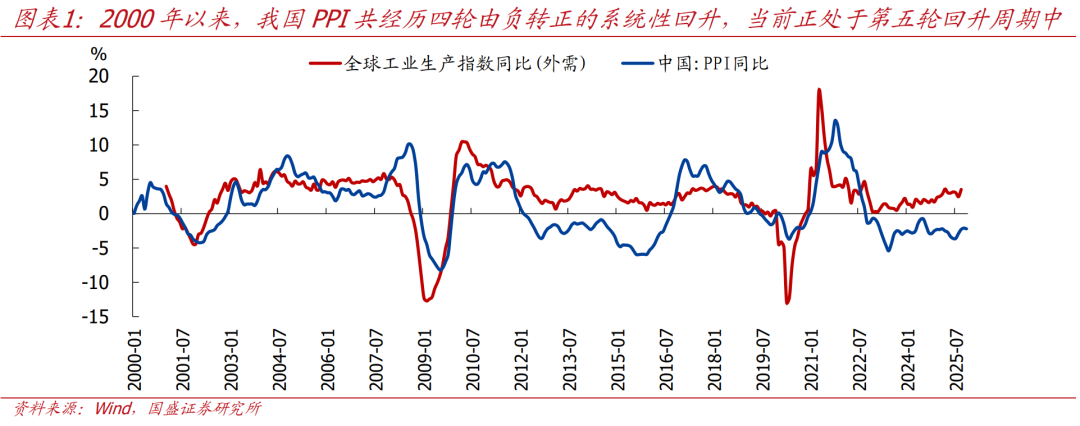
Core Viewpoint - The article discusses the recovery trend of China's Producer Price Index (PPI) since July 2025, predicting a narrowing year-on-year decline in PPI for 2026, with the next six months likely being the fastest recovery period. Historical analysis of past PPI recovery phases is used to identify potential investment opportunities in the stock and bond markets for 2026 [2][3]. Group 1: Historical PPI Recovery Phases - Since 2000, there have been five rounds of PPI recovery in China, with the current phase being the fifth. The PPI has transitioned from negative to positive during these periods, with significant economic events influencing these changes [15][22]. - The first round (2002-2004) saw PPI rise from -4.2% to 8.4%, driven by global economic recovery and domestic urbanization [4][16]. - The second round (2009-2010) experienced a rise from -8.2% to 7.1%, supported by the global financial crisis response and domestic stimulus measures [5][17]. - The third round (2015-2017) saw PPI increase from -5.9% to 7.8%, influenced by supply-side reforms and monetary policies [6][19]. - The fourth round (2020-2021) had PPI rise from -3.7% to 13.5%, primarily due to supply-side factors and global commodity price increases [7][20]. - The current phase (2025-present) has seen PPI recover from -3.6% to -2.2%, with expectations for further recovery in 2026 [8][21]. Group 2: Stock Market Performance During PPI Recovery - Historical analysis indicates that during the first phase of PPI recovery, A-shares typically show an upward trend, with small-cap growth stocks outperforming [3][6]. - In the second phase, as PPI rises from its bottom to positive territory, the stock market experiences a more balanced performance across growth, consumption, and cyclical sectors, with notable performances in electronics, communication, and consumer goods [3][8]. - The third phase, when PPI turns positive, often leads to high-level market fluctuations, with value stocks gaining an advantage over growth stocks [3][7]. Group 3: Bond Market Dynamics - The bond market's response to PPI recovery is influenced by various factors, including growth expectations and liquidity conditions, rather than solely by inflation [10][11]. - Historical data shows that during PPI recovery phases, the 10-year government bond yield may face upward pressure, but this is not always synchronized with PPI movements [10][11]. - A stable liquidity environment and lack of sustained demand improvement can prevent significant upward trends in bond yields, even during periods of PPI recovery [11][12]. Group 4: Outlook for 2026 - The PPI is expected to narrow its year-on-year decline in 2026, with the next six months likely being the fastest recovery period, driven by policies aimed at stabilizing coal and steel prices, as well as rising demand for lithium and copper [12][13]. - The stock market is anticipated to have upward potential, with growth, consumption, and cyclical sectors all presenting investment opportunities, particularly in undervalued sectors such as food and beverage, home appliances, and non-ferrous metals [12][13]. - The bond market is expected to remain in a state of fluctuation, with a continued focus on monetary easing, although significant adjustments in bond yields are not anticipated [13].