证券

Search documents
A股市场快照:宽基指数每日投资动态-20260211
Jianghai Securities· 2026-02-11 03:21
- The report primarily focuses on tracking and analyzing the performance of broad-based indices in the A-share market, including metrics such as daily returns, moving averages, turnover rates, risk premiums, PE-TTM, dividend yields, and net asset ratios[1][3][4] - The turnover rate of the indices is calculated as the weighted average of the turnover rates of constituent stocks, weighted by their free-float market capitalization[19] - The risk premium is measured relative to the 10-year government bond yield, serving as a reference for risk-free rates, to evaluate the relative investment value and deviation of indices[28][30] - The PE-TTM (Price-to-Earnings Trailing Twelve Months) is used as a valuation reference to assess the investment value of indices at the current point in time, with historical percentile ranks provided for comparison[40][43] - Dividend yield is analyzed as a measure of cash return, particularly relevant during market downturns or periods of declining interest rates, with historical trends and percentile ranks provided for each index[49][54] - The net asset ratio (or "破净率") is tracked to reflect the proportion of stocks trading below their book value, indicating market valuation attitudes and potential undervaluation[55][58]
央行四季度货币政策报告6大信号:存款“流失”的变与不变
GOLDEN SUN SECURITIES· 2026-02-11 03:16
Group 1: Monetary Policy Outlook - The central bank maintains an optimistic view on the domestic economy, expecting stable growth conditions for 2026, supported by solid foundations, new growth drivers, and strong policy support[2] - The monetary policy continues to emphasize "appropriate easing" and the importance of promoting stable economic growth as a key consideration[7] - The social financing cost outlook has shifted from "promoting cost reduction" to "promoting low-cost operation," indicating a more cautious approach to interest rate cuts[8] Group 2: Global Economic Concerns - The central bank has alleviated concerns about the global economy, citing short-term resilience in growth, but notes a divergence in performance among major economies[3] - Risks highlighted include persistent inflation, cooling labor markets, and increasing global trade uncertainties[3] - The central bank emphasizes the need for enhanced counter-cyclical and cross-cyclical adjustments to improve macroeconomic governance[4] Group 3: Inflation and Price Trends - Global inflation remains sticky, with ongoing monitoring of the de-inflation process, particularly in the U.S., U.K., and Japan[6] - Domestic inflation shows positive changes, with the CPI rising to its highest level since March 2023 by the end of 2025, supported by improved supply-demand matching[6] - The central bank prioritizes promoting reasonable price recovery as a key aspect of monetary policy[6] Group 4: Banking Sector Dynamics - The report discusses the "loss" of bank deposits, indicating that while asset reallocation affects bank liabilities, it does not significantly alter overall liquidity in the financial system[9] - The weighted average interest rate for new loans in December 2025 was 3.15%, down 0.09 percentage points from September, with corporate loans at 3.1% and personal housing loans stable at 3.06%[8]
来自华尔街的测算:“存款迁移”只有1万亿,而非10万亿,但对保险和A股仍然“意义重大”
Hua Er Jie Jian Wen· 2026-02-11 03:08
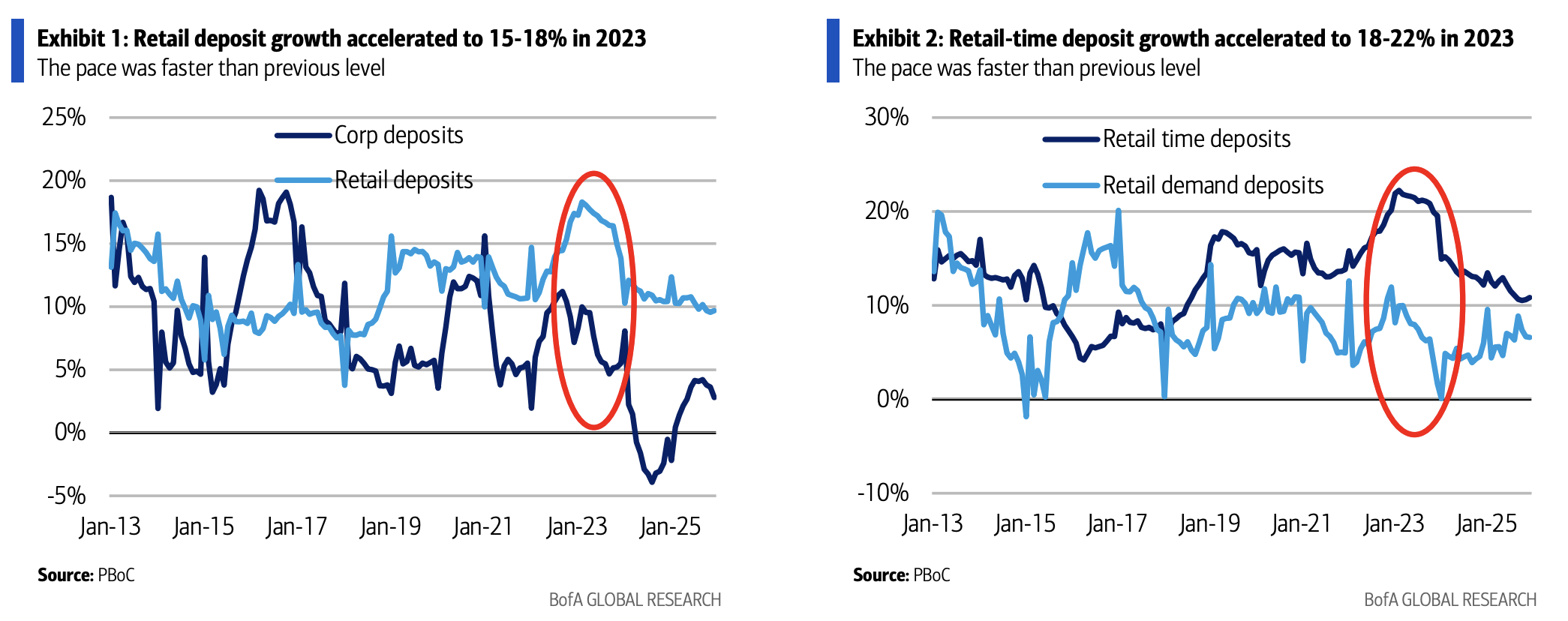
存款"搬家"从2025年中开始成了市场绕不开的话题:大额定存到期,会不会突然从银行体系流向股市、保险、甚至地产和消费?关于到期规模的传言从10万 亿一路飙到70万亿,背后期待的其实是"更快的资金再配置",足以改写不同资产的供需和定价。 据追风交易台,美国银行全球研究部分析师Michael Li在最新报告里把这个预期往回拉了一截,估计存款搬家规模约1万亿元,而不是10万亿元或更高。存款 外流确实在发生,但节奏和体量更像"渐进式",短期很难看到想象中的洪水。 美银表示,居民定存增速从过去常态的14%-16%抬升到18%-22%,累积出约4-5万亿元的"超额"定存,并将在未来逐步到期。问题在于,到期不等于迁徙。 70%-80%仍会留在银行体系(再定存、转活期、偿还按揭等),用于消费的比例不超过10%,真正流向"非存款资产"的规模大约1万亿元。 报告给了两个最直接的落点:一是保险,如果其中5000亿元流向保险,足以让寿险销售端出现"看得见的"弹性;二是A股,哪怕相对>100万亿元市值、日均 2.5-3.0万亿元成交看起来不大,但它是额外增量,还可能通过两融等杠杆放大对成交和情绪的影响。要检验这条链条是否真的在走,报告 ...

“抛售美国”谎言破灭?外国资金回流美债,获配比例飙升至近三年新高!
Jin Shi Shu Ju· 2026-02-11 03:07
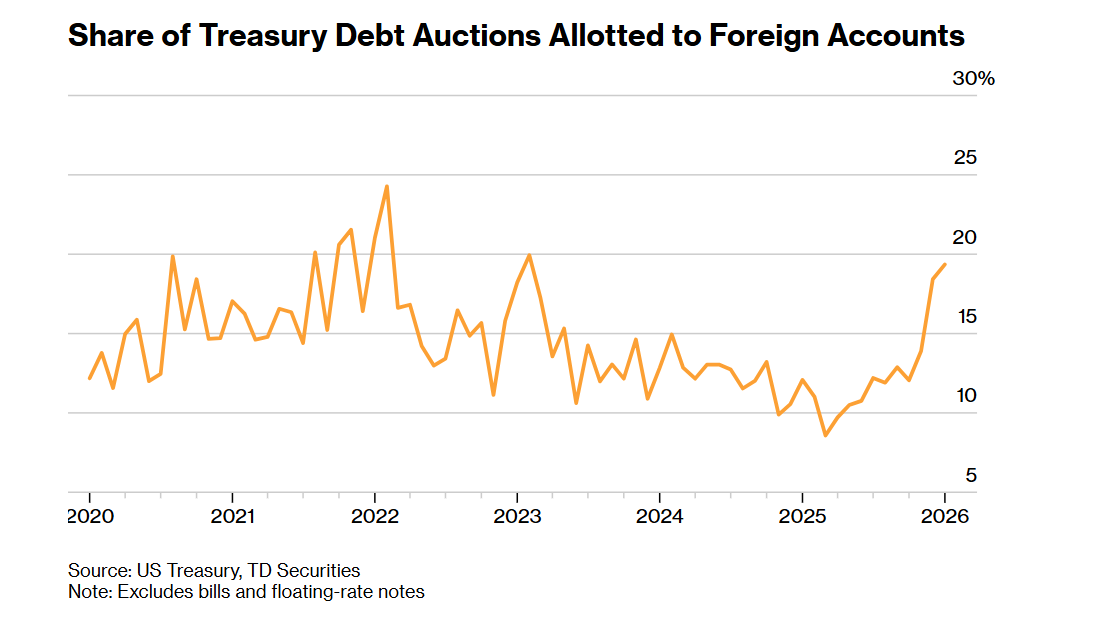
Group 1 - The core viewpoint of the article highlights that the allocation ratio of foreign buyers in U.S. Treasury auctions has been increasing, alleviating concerns about the loss of the safe-haven status of U.S. Treasuries and the impact of large fiscal deficits on foreign investments [1][4] - According to TD Securities' analysis, in January, the allocation ratio for foreign and international accounts in Treasury auctions reached approximately 19%, marking a three-year high. This ratio had previously peaked at nearly 25% in early 2022 but declined to below 10% by November 2024 [1][4] - The report indicates that the increase in foreign account allocations is broad-based, suggesting that the narrative of a "sell America" trend may be more of a market story than reality [4] Group 2 - Despite a significant sell-off of $53 billion in U.S. Treasuries by foreign investors following tariff announcements in April 2025, they subsequently increased their holdings by $354 billion by November of the same year [4] - The participation of foreign investors in Treasury auctions notably increased in November and December, driven by the expansion of the term premium, which is the additional yield of 10-year Treasuries over shorter-term bonds [4][6] - The upcoming auction of $58 billion in three-year Treasuries and the issuance of 10-year and 30-year bonds may further influence foreign investment behavior, as a lack of alternative assets could compel investors to continue holding U.S. dollar assets [7]
政策高频 | 中共中央政治局第二十四次集体学习召开(申万宏观·赵伟团队)
申万宏源宏观· 2026-02-11 02:53
Group 1 - The article emphasizes the importance of cultivating future industries to seize technological and industrial advantages, enhance modern industrial systems, and improve people's quality of life [2] - The focus is on the "14th Five-Year Plan" period, aligning with national strategic needs and technological maturity, while promoting collaboration between emerging and traditional industries [2] - The article highlights the need for innovation and policy support to foster leading technology enterprises and high-tech companies [2] Group 2 - The Central Document No. 1 outlines the goal of agricultural modernization and comprehensive rural revitalization, emphasizing the enhancement of agricultural production capacity and stability [4] - It sets a target of stabilizing grain production at around 1.4 trillion jin and strengthening farmland protection and agricultural technology innovation [4][5] - The document also emphasizes the importance of regular targeted assistance to prevent large-scale poverty and promote stable income growth for farmers [4][5] Group 3 - The "Happy New Year" initiative aims to stimulate consumption during the Spring Festival, focusing on six key areas including food, accommodation, travel, and shopping [6] - The plan includes various support measures such as prize invoices, subsidies for replacing old products, and financial consumption red envelopes to encourage consumer spending [6][7] Group 4 - The State Council's press conference interprets the Central Document No. 1, outlining four key tasks and two major support guarantees for rural revitalization [8] - Key tasks include improving agricultural production capacity, implementing regular assistance, promoting stable income for farmers, and advancing the construction of beautiful rural areas [8][9] - The support guarantees focus on strengthening institutional innovation and enhancing the Party's leadership over agricultural and rural work [8] Group 5 - The State Administration for Market Regulation outlines six key areas for improving market regulation to support high-quality economic development [10] - These areas include promoting a unified national market, optimizing the consumption environment, and enhancing platform economy governance [10][11] - The focus is on improving consumer protection, quality standards, and credit building in the market regulation sector [10][11] Group 6 - Shanghai has initiated a pilot program to acquire second-hand housing for affordable rental housing projects, targeting new citizens, young people, and graduates [12] - The program aims to meet the rental needs of talent and enhance the supply of affordable housing through innovative acquisition models [12][13] - Financial support from local banks is also highlighted to ensure the smooth progress of the project [12][13]

东吴证券晨会纪要2026-02-11-20260211
Soochow Securities· 2026-02-11 02:46
Macro Strategy - The core viewpoint indicates that recent liquidity shocks in overseas markets, driven by concerns over the AI software bubble and subsequent momentum selling, have led to significant volatility in equities, commodities, and cryptocurrencies. It suggests that some assets may have been "wrongly killed" due to these liquidity shocks, as the macroeconomic fundamentals and broad liquidity environment have not changed significantly [1][13] - The report anticipates that the upcoming U.S. non-farm employment and CPI data for January may present upward risks, potentially reversing the slight increase in expectations for Federal Reserve rate cuts observed this week [1][13] Financial Products - The report highlights that overseas market liquidity shows signs of stabilization, which may improve market sentiment. It predicts a positive outlook for the A-share market in February, with a historical probability of 78.57% for an increase following a macro timing model score of 0 [1][16] - Fund allocation recommendations suggest a balanced ETF configuration due to expected short-term market fluctuations, with a focus on sectors like chemicals and electric grid equipment, which continue to see increasing fund sizes [1][16] Commodity Market - The report discusses the impact of liquidity shocks on commodity prices, noting that certain commodities, which rely on supply-demand improvements, have been "wrongly hurt" but may return to fundamental pricing logic as market conditions stabilize [2][17] - It emphasizes that the recent volatility in silver and other precious metals indicates a potential end to the liquidity shock, with silver becoming a key indicator of market sentiment [2][17] Environmental Industry - The report stresses the importance of advancing the national carbon market and outlines investment recommendations in clean energy, energy conservation, and recycling sectors. It highlights specific companies such as Longjing Environmental and others involved in renewable energy and waste management [6][10] Non-Banking Financial Sector - The report notes a recovery in the IPO and refinancing market, with significant year-on-year growth in both areas. It indicates that the capital market reforms and increased market activity are expected to benefit brokerage firms' investment banking revenues [9] AI Industry and Bond Financing - The report focuses on the AI industry, highlighting the need for a diversified financing system to support technology companies, particularly private firms with high growth potential. It reviews case studies of leading tech companies' bond financing paths to assess the feasibility of similar strategies in China [4]

驫腾万里贺新春丨2026春节休市安排(内附假期闲钱理财攻略)
申万宏源证券上海北京西路营业部· 2026-02-11 02:35
t 申万宏源证券 secons weet seconn 专业服务 创造价值 i k = = Part P HAPPY NEW YEAR 國 I n The (0. 6 0 P 9 >> S ● 2026春节休市安排 星期六 星期一 星期五 星期日 阜期二 唐期一 2月13日 2月14日 2月15日 2月16日 2月17日 2月18日 A fficial 优市市 ffitit ffitit 开市 优标同 澳门 澳门 澳门 澳门 澳门 RS 开通 TEE 星期四 星期五 星期六 星期日 星期- 星期 2月19日 2月20日 2月21日 2月23日 2月24日 2月22日 film | fficial 优市 优市 优市 开市 lka 漫词 澳门 澳门 澳门 澳门 股 开通 TH 注:2026年春节期间,A股2月15日(星期日)至2月23日(星期一)休市,2月24日(星期二)起照常开 市;港股通2月15日(星期日)至2月23日(星期一)不提供港股通服务,2月24日(星期二)起照常开通 港股通服务。另外,2月14日(星期六)、2月28日(星期六)为周末休市。 拒绝特币过节 让闹钱动起来 国倩逆回购 …… 国债逆回购简介 ...

国海证券晨会纪要-20260211
Guohai Securities· 2026-02-11 02:29
Summary of Key Points Core Insights - The report highlights a significant narrowing of capital outflows in the market, with a balanced and slightly loose macro funding environment. The central bank conducted a net reverse repo of 756 billion and an additional 800 billion in three-month reverse repos, leading to a decline in short-term interest rates and a slight decrease in long-term rates [4][5]. - The automotive sector showed resilience, with the automotive index outperforming the Shanghai Composite Index during the reporting period. New models from major players like Li Auto and BYD are set to launch, indicating a competitive landscape in the electric vehicle market [10][11][12]. Group 1: Market Overview - The macro funding environment is balanced and slightly loose, with the central bank's actions leading to a net reverse repo of 756 billion and an additional 800 billion in three-month reverse repos [4]. - The stock market is experiencing pressure on the supply side, with a notable decline in equity fund issuance and a decrease in leveraged fund participation. The net outflow from stock ETFs has significantly narrowed, with a net outflow of 56.21 billion [5]. - The demand side of the stock market is facing increased pressure, with a slight rise in equity financing to 12.299 billion and a significant increase in the scale of restricted stock unlocks to 101.98 billion [5]. Group 2: Bond Market Insights - The sentiment in the bond market has shown signs of recovery, with the 10-year government bond yield breaking the 1.80% mark. The sentiment index for both buyers and sellers has improved, with a notable increase in bullish sentiment among sellers [7][8]. - A majority of bond market participants maintain a neutral stance, with 82% of sellers holding a neutral view and 14% adopting a bullish perspective, indicating a cautious optimism in the market [8][9]. Group 3: Automotive Industry Developments - The automotive sector has shown a positive trend, with the automotive index increasing by 0.3% compared to a decline in the Shanghai Composite Index [10]. - New models from Li Auto and AITO are set to launch, targeting both mainstream and high-end markets, which is expected to stimulate consumer interest [11]. - BYD has established a new sub-brand "Linghui" focused on the commercial vehicle market, indicating a strategic expansion into B2B services [12][13].
海外宏观周报:日本大选获胜提振风险资产情绪
China Post Securities· 2026-02-11 02:25
Group 1: Macro Economic Insights - Japan's recent election resulted in the ruling Liberal Democratic Party (LDP) winning over two-thirds of the seats, boosting the Nikkei 225 index to a historical high, indicating strong legislative support for fiscal stimulus measures[2] - The upcoming January CPI data in the U.S. is expected to show a rebound due to seasonal effects, with a potential increase in the month-on-month rate[2] - The U.S. job market shows signs of loosening, with initial jobless claims remaining low but rising layoffs and declining job vacancies indicating potential risks[3] Group 2: Market Trends and Recommendations - The U.S. software sector has underperformed since the beginning of 2026, but signs suggest that the sell-off may have peaked, with increased trading volume and volatility indicating a potential stabilization[3] - Caution is advised in selecting stocks within the software sector, focusing on companies with strong fundamentals and rapid transformation progress[3] - The market is pricing in two additional rate cuts by the Federal Reserve within the year, reflecting expectations of a more accommodative monetary policy[24] Group 3: Risks and Considerations - Potential risks include increased tariffs leading to higher goods inflation, insufficient cooling of service inflation, and geopolitical tensions driving up energy prices, which could limit the Fed's ability to ease monetary policy[4][25] - The Federal Reserve's stance remains cautious, with officials emphasizing the need for clear evidence of inflation decline before making further policy adjustments[21][23]
三大交易所发布优化再融资一揽子措施,相较此前有何重点变化?
Sou Hu Cai Jing· 2026-02-11 01:59
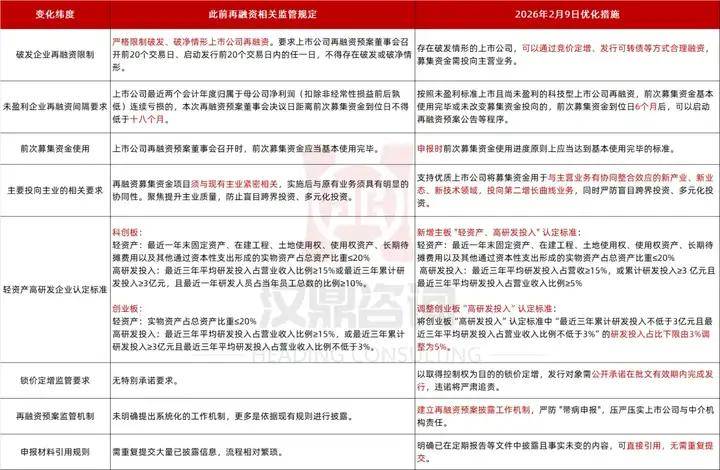
Core Viewpoint - The Shanghai and Shenzhen Stock Exchanges have introduced a package of measures to optimize refinancing, aimed at improving efficiency, supporting technological innovation, and ensuring regulatory compliance while preventing risks. Group 1: Key Measures - Strong support for quality listed companies in refinancing, optimizing review processes to enhance efficiency, and allowing funds to be directed towards new industries and technologies that align with core business operations [1][3] - Support for unprofitable technology companies to implement refinancing based on demand, with specific conditions allowing for new rounds of financing after previous funds are nearly fully utilized [1][3] - Clear requirements for listed companies to disclose previous fundraising usage and future plans when announcing refinancing proposals, simplifying the process by allowing the use of previously disclosed information [2][6] Group 2: Regulatory Enhancements - Strengthened responsibilities for information disclosure by listed companies and intermediaries, with a focus on ensuring compliance and transparency in refinancing proposals [2][6] - Introduction of a mechanism for the disclosure of refinancing proposals, emphasizing the need for commitments from companies regarding the use of funds and strict penalties for violations [2][6] - Enhanced scrutiny of refinancing practices to prevent blind diversification and ensure funds are used effectively, maintaining a focus on core business operations [3][5] Group 3: Differences from Previous Regulations - Allowing companies experiencing stock price declines to raise funds through competitive placements and convertible bonds, with strict requirements for fund allocation to core business areas [5][7] - Shortening the refinancing interval for unprofitable technology companies from 18 months to 6 months, addressing their funding needs for research and development [5][7] - Establishing new recognition standards for "light asset, high R&D investment" companies on the main board, expanding the scope of beneficiaries under the new policies [6][7]