
消费电子

Search documents
泉果基金刚登峰—— A股港股仍处宝贵布局时期 投资主战场聚焦三大领域
Zheng Quan Shi Bao Wang· 2026-01-18 23:06
Core Viewpoint - The current equity market, particularly in A-shares and Hong Kong stocks, presents a favorable investment period despite a lack of clear investor sentiment, as the market is in a unique phase of adjustment [1] Economic Recovery and Structural Changes - The concerns that have weighed on the market in recent years are gradually subsiding, particularly in the real estate sector, where the negative impact on consumer wealth and spending is diminishing [2] - China's export structure has diversified, reducing reliance on single markets, with high-value products like electric vehicles, lithium batteries, and solar cells gaining prominence [2] - The manufacturing sector is experiencing a recovery as previous over-expansion leads to clearer supply constraints, improving the supply-demand relationship [2] - The capital market is undergoing changes, with a more restrained financing pace and increased emphasis on dividends and share buybacks, indicating a focus on investor returns [2] Industry Trends: Technology, New Energy, and Cycles - The investment framework emphasizes that technology, new energy, and cyclical industries are interconnected, reflecting different stages of industrial logic [3] - In technology, the focus is on certainty and the ability to deliver results rather than short-term gains, with particular attention on sectors benefiting from the AI wave, such as internet and consumer electronics [3] - New energy sectors are characterized by supply-demand structural changes, with capital expenditure contracting while downstream demand continues to grow, indicating investment opportunities [3] - The cyclical sector is assessed based on clear supply constraints and stable competitive landscapes, where supply-side changes can lead to profit improvements even with limited demand growth [3] Investment Strategy and Company Quality - The core of the investment strategy is to seek value across different industrial cycles rather than betting on a single direction, with technology, new energy, and cyclical sectors resonating in terms of industrial logic and valuation [4][5] - Company quality is prioritized, with a focus on firms that possess clear competitive advantages and sustainable growth potential, as limited growth can restrict shareholder returns [6] - The approach to left-side positioning is more cautious, emphasizing participation during clearer industrial trends and balancing return potential with risk control over a 3 to 12-month horizon [6] - Research collaboration is crucial, with the value of research lying in its ability to support real investment decisions, enhancing the efficiency of investment research conversion [6]
创新创造催生新质生产力
Ren Min Wang· 2026-01-18 22:43
Group 1 - China occupies six positions in the top ten of the "Nature Index - Research Cities," indicating a strong presence in global scientific research [1] - The 2025 "Highly Cited Researchers" list by Clarivate shows that one-fifth of the researchers are from mainland China, with the Chinese Academy of Sciences leading globally with 258 entries [1][2] - China's R&D investment is projected to exceed 3.6 trillion yuan in 2024, a 48% increase from 2020, with R&D intensity reaching 2.68% [2][3] Group 2 - The Jiangmen neutrino experiment, led by China, has set a world record in measuring neutrino oscillation parameters, showcasing China's growing influence in scientific research [2] - In 2024, China's basic research funding is expected to reach 249.7 billion yuan, a more than 70% increase since 2020, contributing to significant advancements in various scientific fields [3] - High-quality research outputs and teams are synchronously improving, with China's share of global hotspot papers projected to reach 53.2% by August 2025 [3] Group 3 - China's innovation ecosystem is characterized by a mature research organization, long-term investment mechanisms, and a tiered talent structure, providing resilience and sustainable development potential [4] - The successful implementation of a heterogeneous integrated Fourier transform system by Peking University marks a significant advancement in practical applications of foundational research [5] - The commercial space sector in China is evolving, with private enterprises increasingly participating alongside state-owned entities, reflecting a shift in innovation dynamics [6] Group 4 - China's innovation activities have been recognized for their outstanding performance, with the World Intellectual Property Organization noting the government's significant role in supporting the innovation system [5][6] - By 2025, China is expected to maintain its position as the top country with the most innovation clusters globally, with cities like Shenzhen, Beijing, and Shanghai leading the rankings [6] Group 5 - Chinese technologies are increasingly being adopted globally, with examples including high-yield rice varieties developed for Africa and open-source projects in Sri Lanka [8] - Didi's autonomous driving technology is expanding into the Middle East, indicating China's commitment to international collaboration in technology [9] - Chinese companies are showcasing innovative products at international events, highlighting their global market presence and technological advancements [10]
A股港股仍处宝贵布局时期 投资主战场聚焦三大领域
Xin Lang Cai Jing· 2026-01-18 19:30
Group 1 - The core viewpoint is that despite the current market adjustments, both A-shares and Hong Kong stocks represent a favorable investment period in the long term, as the core factors suppressing the equity market are gradually entering a phase of adjustment [1][2] - Economic recovery is supported by the diminishing impact of the real estate sector, a diversified export structure, and the gradual recovery of manufacturing supply-demand relationships [2] - The capital market is experiencing changes in its institutional environment, with a more restrained financing pace and increased emphasis on dividends and buybacks by listed companies, indicating a focus on investor returns [2] Group 2 - The investment framework emphasizes the interrelation of technology, new energy, and cyclical sectors, focusing on the position of industries within their respective cycles [3][4] - In technology investments, the focus is on certainty and the ability to deliver results, particularly in sectors benefiting from the AI wave, such as internet and consumer electronics [3] - New energy investments are driven by supply-demand structural changes, with a focus on sectors nearing critical points in their cycles, rather than being influenced by market sentiment [3] Group 3 - The core of the investment strategy is to seek value across different industrial cycles rather than betting on a single direction, allowing for better adaptability in structural market conditions [4] - The quality of companies is prioritized, with a focus on those with clear competitive advantages and sustainable growth potential, which can endure through cycles [5] - The approach to left-side positioning is more cautious, emphasizing participation during clearer industrial trends and balancing return elasticity with risk control [6] Group 4 - The importance of research collaboration is highlighted, with the value of research lying in its ability to support real investment decisions, ensuring patience and restraint in structural markets [6]


泉果基金刚登峰——A股港股仍处宝贵布局时期 投资主战场聚焦三大领域
Zheng Quan Shi Bao· 2026-01-18 18:21
Core Viewpoint - The current equity market, particularly in A-shares and Hong Kong stocks, presents a favorable investment period despite a disconnect between market performance and investor sentiment [1] Economic Recovery and Structural Changes - The core variables that have caused market concerns in recent years, such as real estate, foreign trade structure, and manufacturing supply-demand relationships, are undergoing significant adjustments [2] - The real estate sector has experienced substantial adjustments since 2021, leading to a gradual reduction in its negative impact on consumer wealth and spending [2] - China's reliance on a single export market has decreased, with a more diversified export structure and an increase in high-value-added products, reducing overall external risk exposure [2] - The manufacturing sector is seeing a recovery as capital expenditures have declined, leading to clearer supply constraints and a correction of previous over-expansion impacts [2] - The capital market is also evolving, with a more restrained financing pace and increased emphasis on dividends and share buybacks, indicating a focus on investor returns [2] Industry Trends: Technology, New Energy, and Cycles - The investment framework emphasizes that technology, new energy, and cyclical industries are interconnected and reflect different stages of industrial logic [3] - In technology, the focus is on certainty and the ability to deliver results rather than short-term gains, with particular attention on sectors benefiting from the AI wave, such as internet and consumer electronics [3] - New energy investments are driven by supply-demand structural changes, with some sectors experiencing reduced capital expenditures while downstream demand continues to grow [3] - The cyclical sector is assessed based on structural judgments, focusing on industries with clear supply constraints and stable competitive landscapes, where supply-side changes can enhance profitability even with limited demand growth [3] Portfolio Structure - The core of the portfolio structure is not to bet on a single direction but to find value across different industrial cycles [4] - The current stage allows for a resonance among technology, new energy, and cyclical sectors in terms of industrial logic, valuation levels, and verifiability, enhancing the portfolio's adaptability in structural markets [4] Company Quality Focus - The emphasis is placed on company quality, with a preference for long-term holdings that possess clear competitive advantages and sustainable growth potential [5][6] - Companies must demonstrate the ability to navigate through cycles and consistently deliver performance, with dividends and buybacks seen as indicators of mature corporate governance [6] - A more cautious approach to left-side positioning is adopted, with a focus on participating during clearer industrial trends and balancing return potential with risk control over a 3 to 12-month horizon [6] - The importance of research collaboration is highlighted, with the goal of supporting real investment decisions and maintaining patience and discipline to achieve returns in structural markets [6]
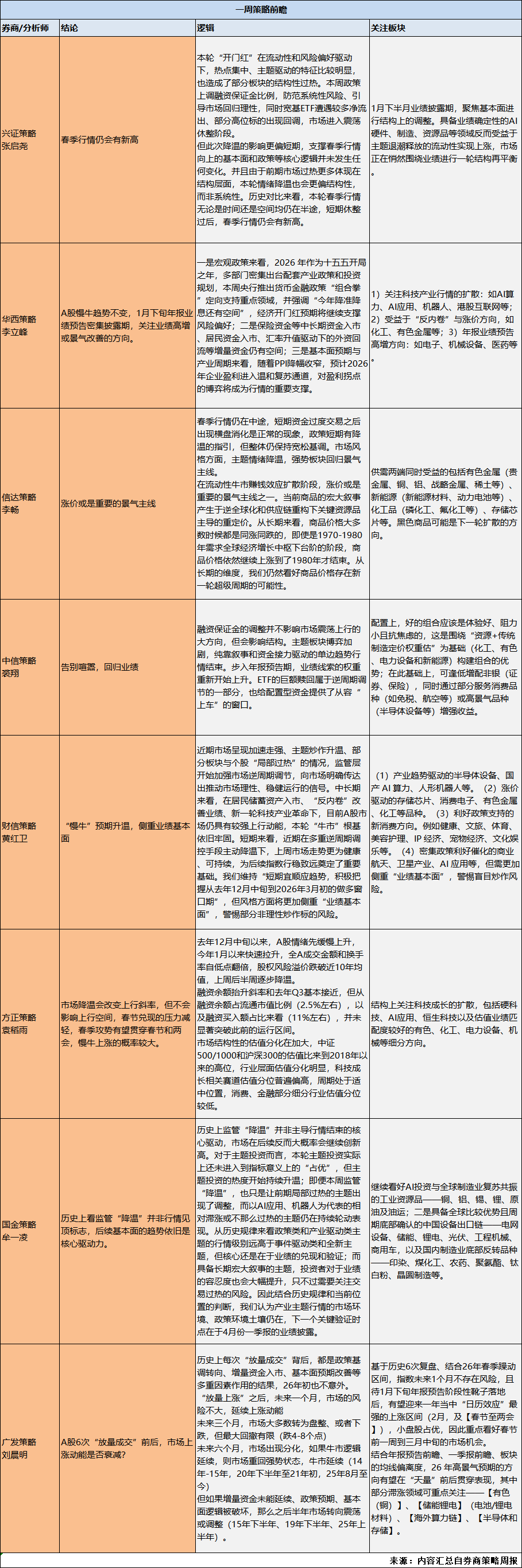
A股分析师前瞻:后市指数行情依旧值得期待,结构上更关注业绩线
Xuan Gu Bao· 2026-01-18 14:42
Core Viewpoint - The current market sentiment is driven by liquidity and risk appetite, leading to a concentration of hot sectors and thematic investments, which has resulted in structural overheating in some areas [1][2] Group 1: Market Trends - The recent "opening red" market rally is characterized by significant liquidity and heightened risk preferences, with a clear focus on thematic investments [1][2] - The adjustment of financing margin ratios aims to prevent systemic risks and guide the market back to rationality, while broad-based ETFs have experienced significant net outflows, indicating a market entering a phase of consolidation [1][2] - Historical comparisons suggest that the current spring market rally is still in its early stages, with potential for new highs following a short-term correction [1][2] Group 2: Sector Focus - Analysts emphasize that the upcoming earnings reporting period will shift focus back to performance indicators, particularly in sectors expected to show high growth or improved conditions, such as electronics, machinery, and pharmaceuticals [1][2] - The adjustment in financing margins is not expected to impact the overall upward trend of the market but will affect sector dynamics, with increased competition among thematic sectors [2][3] - The focus on sectors benefiting from the "anti-involution" trend and price increases includes chemicals and non-ferrous metals, with a particular emphasis on high-growth areas in the upcoming earnings forecasts [2][3] Group 3: Investment Strategies - The market is expected to maintain a "slow bull" trend, with a focus on performance fundamentals as the primary driver of investment decisions, while cautioning against irrational speculative activities [2][3] - The anticipated earnings reports in late January are expected to catalyze significant market movements, particularly in sectors with strong performance indicators [2][3] - The overall market sentiment remains positive, with expectations of continued upward momentum despite short-term fluctuations, driven by fundamental improvements and policy support [2][3]
广货大航海:珠三角稳坐出海品牌“发动机” 电子品类占比近半
2 1 Shi Ji Jing Ji Bao Dao· 2026-01-18 14:29
Core Insights - The report "2025 MeetBrands China Outbound New Consumer Brands List" indicates that 62% of the top 50 brands are from the Pearl River Delta region, highlighting the acceleration of Chinese goods entering the global market [1] - The Pearl River Delta serves as a core engine for Chinese brands going global, with a complete smart hardware supply chain established [2] - The report emphasizes that "hard technology" remains the most certain path for outbound expansion, while categories like fashion and beauty are facing growth bottlenecks due to high advertising costs [2] Industry Trends - The proportion of "powered" categories such as consumer electronics, home appliances, and personal care devices in outbound brands has approached 50%, indicating a shift towards technology-driven growth [2] - Companies are diversifying market layouts and building regional supply chains to reduce reliance on single markets, enhancing their resilience against risks [3] - Brands like Shein and Ugreen are adapting their strategies by investing in local production and launching new products across multiple regions to mitigate regional fluctuations [3] Localization Strategies - Despite increasing recognition of Chinese brands internationally, challenges remain in product quality, after-sales service, and cultural acceptance, making deep localization crucial for long-term success [3] - TESSAN, a 3C accessories brand, exemplifies successful localization by integrating products with travel scenarios and adjusting communication strategies based on regional cultural traits [3] - Companies must closely monitor consumer demand changes in different markets and understand local usage scenarios to avoid potential risks and challenges [4]

全球视野看家电:从三星电子看家电龙头产业升级之路
Changjiang Securities· 2026-01-18 14:25
Investment Rating - The report maintains a "Positive" investment rating for the home appliance industry [13] Core Insights - The report analyzes Samsung Electronics' successful transition from home appliances to semiconductor storage, display panels, and mobile phones, providing a reference for China's leading home appliance companies in their industrial upgrades [4] - Samsung Electronics has achieved an average annual compound growth rate of 19% in net profit from 1993 to 2024, making it the largest and fastest-growing home appliance company globally [7][34] - The report emphasizes the importance of proactive engagement with industry changes and policy opportunities during the growth phase of home appliances, highlighting Samsung's strategic investments and efficiency improvements [8][9] Summary by Sections Background and Timing - Samsung Electronics entered the semiconductor storage industry in 1983 when the penetration rate of home appliances in South Korea was rapidly increasing, supported by a strong GDP growth rate of over 10% [8][46] - The company capitalized on government support and market opportunities to navigate early losses and establish a profitable cycle in the semiconductor industry [8][46] Challenges and Strategies - Samsung leveraged its latecomer advantage and implemented a counter-cyclical investment strategy to quickly capture market share, achieving a 39% market share in the storage sector by 2024 [9] - The company focused on efficiency and cost advantages across various dimensions, including organizational structure and production strategies [9] Effects and Outcomes - By 2017, Samsung surpassed Intel to become the world's largest semiconductor manufacturer, with R&D investment increasing from 2% in 1980 to 12% in 2024 [10] - The company successfully expanded into display panels and mobile phones, creating a synergistic industrial system that enhanced its brand image and market position [10] Comparison with Midea Group - Midea Group is positioned to achieve significant industrial upgrades, with a projected 22% revenue contribution from non-home appliance sectors by 2024 and a growth rate of 15%-20% in recent years [11] - The report highlights Midea's advantages in cash flow stability and efficiency, suggesting a strong potential for industrial upgrades [11]

策马逐牛5:中国优势资产春水长流
CAITONG SECURITIES· 2026-01-18 13:51
Core Insights - The report emphasizes long-term opportunities with the strategy "蓄力新高" suggesting that the Shanghai Composite Index briefly broke 4000, while the 2026 strategy "奔马资产, 策马逐牛" focuses on embracing "奔马资产" (globally competitive leaders) leading to a revaluation of value [3][10] - The mid-term analysis indicates a potential for market fluctuations towards the end of the year, with a strong market rally observed in the first week of January, confirming previous predictions [3][10] Industry and Sector Analysis - Leading sectors such as telecommunications, electronics, and non-ferrous metals remain core themes, with internal shifts observed, such as a transition from rare earths and precious metals to industrial metals and lithium-cobalt-nickel within non-ferrous metals, and from consumer electronics to storage and semiconductor equipment in electronics [4][14] - The report identifies three key investment directions: 1. Core growth assets, particularly in the Hang Seng Internet sector, benefiting from platform economy support and potential AI catalysts, alongside improvements in US-China relations and passive foreign capital inflow due to RMB appreciation [5][13] 2. Globally competitive assets (奔马 50), which are expected to benefit from global economic recovery, strong policy support, and institutional capital inflow, with a high cost-performance ratio due to trends in AI, high-end manufacturing, and resource supply-side adjustments [5][13] 3. Emerging growth sectors, particularly those related to the "Musk chain," focusing on AI applications and underground transportation, with a bottom-up investment approach in areas like computing power and humanoid robots [5][13] Market Dynamics - The report notes that despite recent volatility, the fundamentals of a long-term bull market remain intact, with market sentiment high and financing balances nearing a ten-year high, indicating a healthy market environment [7][11] - Historical patterns suggest that after a major rally, the market may enter a consolidation phase, but the underlying growth logic remains strong, particularly in technology and cyclical sectors [12][14]
财信证券宏观策略周报(1.19-1.23):“慢牛”预期升温,侧重业绩基本面-20260118
Caixin Securities· 2026-01-18 13:18
Group 1 - The market is showing signs of strengthening, with increased thematic speculation and some sectors and stocks becoming "locally overheated," prompting regulatory measures to enhance counter-cyclical adjustments [4][7] - The A-share market has strong upward momentum due to factors such as increased household savings entering the market, improved performance from "anti-involution" efforts, and a new wave of technological industrial revolution [4][7] - The report maintains a "short-term trend-following" strategy, emphasizing the importance of focusing on performance fundamentals while being cautious of irrational speculation risks [4][7] Group 2 - Investment opportunities are identified in sectors driven by industrial trends such as semiconductor equipment, domestic AI computing, and humanoid robots [4][7] - Price-driven sectors such as storage chips, consumer electronics, non-ferrous metals, and chemicals are highlighted as potential areas for investment [4][7] - New consumption directions supported by favorable policies, including health, cultural tourism, sports, beauty care, IP economy, pet economy, and cultural entertainment, are recommended for attention [4][7] Group 3 - The report notes that the China Securities Regulatory Commission emphasizes timely counter-cyclical adjustments and strict enforcement against excessive speculation to promote stable market operations [4][7] - The People's Bank of China has introduced eight policy measures to support economic structural transformation, including lowering interest rates on various structural monetary policy tools [8][9] - December's social financing data exceeded expectations, with new social financing of 22,075 billion yuan, although the structure still requires optimization [10] Group 4 - December's import and export data showed positive performance, with exports increasing by 6.6% year-on-year, driven by seasonal demand and global AI investment trends [11] - The report indicates that there is a potential "rush to export" in the first quarter of 2026 due to adjustments in export tax rebate policies, although this may partially preempt demand in the second quarter [11] Group 5 - The report highlights the importance of monitoring employment performance and the independence of the Federal Reserve as key factors influencing the Fed's interest rate path [12][13] - The report concludes that recent counter-cyclical measures have laid a solid foundation for stable market performance moving forward, with a focus on sectors such as non-ferrous metals and technology growth [4][7]
广货大航海:珠三角稳坐出海品牌“发动机”,电子品类占比近半
2 1 Shi Ji Jing Ji Bao Dao· 2026-01-18 12:57
Core Insights - The report "2025 MeetBrands China Outbound New Consumer Brands List" indicates that 62% of the top 50 brands are from the Pearl River Delta region, highlighting the acceleration of Chinese brands entering the global market [1] - The Pearl River Delta serves as a core engine for Chinese brands going global, supported by a complete smart hardware supply chain [1] - Shenzhen, known as the "Silicon Valley of Hardware," has a rapid production iteration cycle of 24-48 hours for electronic hardware, aligning with the structural changes in outbound product categories [1] Industry Trends - "Hard technology" remains the most certain path for outbound expansion, while categories like outdoor sports and niche home goods are gaining traction [2] - Traditional categories such as fashion and beauty are facing growth bottlenecks due to high advertising costs and reliance on aesthetic appeal [2] - Brands are diversifying market strategies and building regional supply chains to mitigate risks associated with single-market dependency [2] Company Strategies - Companies like Shein and Ugreen are adopting localized production and multi-regional product launches to counteract market fluctuations [2] - Shein's network of "small batch quick response" factories supports rapid product iteration and local production investments in Brazil [2] - TESSAN, a 3C accessories brand, integrates products with travel scenarios and tailors communication strategies based on regional cultural traits, achieving top sales in the Amazon 3C accessories category for seven consecutive years [3] Localization Challenges - Despite increasing brand recognition, Chinese companies face challenges in product quality, after-sales service, and cultural acceptance in international markets [2] - Deep localization is crucial for long-term brand development, requiring an understanding of local consumer needs and market conditions [3] - Variations in infrastructure and regulations in emerging markets necessitate a focused approach to localization [3]