电商

Search documents
微醺悦己成跨年消费热门趋势 美团闪购新奇酒水销量翻倍
Xin Jing Bao· 2025-12-31 05:46
Group 1 - The core trend for New Year's consumption is the pursuit of self-indulgence and ritual among young consumers, with various products catering to these desires becoming popular [1] - Sales of alcoholic beverages surged, with craft beer and white wine seeing over 100% year-on-year growth, while brandy sales increased by over 230% and fruit-flavored beer by over 70% [1] - Innovative alcoholic products, such as low-alcohol options, gained traction, exemplified by the launch of a 29-degree Five Grains Liquor, which quickly became a hot item [1] Group 2 - Young consumers are the main force in New Year's spending, prompting multiple platforms to offer consumer incentives [2] - Meituan Flash Purchase plans to distribute a maximum of 2026 yuan in New Year's flash purchase vouchers from December 31, 2025, to January 1, 2026, enhancing the shopping experience [2]

微醺悦己成跨年消费热门趋势,美团闪购新奇酒水销量翻倍
Bei Ke Cai Jing· 2025-12-31 05:41
Group 1 - The core trend in New Year's consumption is the pursuit of self-indulgence and ritual among young consumers, with various products catering to this demand [1] - On December 31, data from Meituan Flash Purchase indicated that various alcoholic beverages, including craft beer and white wine, saw significant sales increases, with white brandy sales up over 230% and fruit-flavored beer sales up over 70% year-on-year [1] - New and trendy fruit and flower products are also popular among young consumers for creating a New Year's atmosphere, with certain items like yogurt apples seeing a search volume increase of 13 times compared to the previous week [1] Group 2 - Young consumers are the main force in New Year's spending, prompting multiple platforms to offer consumption incentives, including Meituan Flash Purchase, which plans to distribute up to 2026 yuan in New Year's vouchers [2]
2026国补新政落地,无需抽签摇号,单人累计最高省11000元
Guan Cha Zhe Wang· 2025-12-31 05:35
Core Viewpoint - The new policy for 2026 aims to enhance consumer spending through a large-scale equipment update and trade-in program, incorporating subsidies for emerging smart devices like AI glasses, and streamlining the application process for consumers [1][4][6]. Group 1: Policy Adjustments - The 2026 national subsidy policy expands its scope to include both digital and smart products, with AI glasses being newly eligible for subsidies alongside smartphones, tablets, and smartwatches [4]. - The policy introduces a unified national subsidy standard, optimizing the calculation method and ensuring that all eligible consumers can apply without restrictive measures like lotteries [5][6]. - The subsidy for household appliances is focused on six core categories: refrigerators, washing machines, televisions, air conditioners, computers, and water heaters, with a cap of 1500 yuan per item [4][5]. Group 2: Subsidy Standards and Implementation - The subsidy for digital and smart products is set at 15% of the sales price, with a maximum of 500 yuan per item, applicable to mainstream consumer products [5]. - For automobiles, the subsidy structure includes 12% for scrapping old vehicles when purchasing new energy cars (up to 20,000 yuan) and 10% for fuel vehicles (up to 15,000 yuan) [5]. - The application process has been simplified to allow for immediate subsidy access, with online platforms like JD.com facilitating direct claims without additional paperwork [6]. Group 3: Consumer and Market Impact - The policy aims to stimulate rural consumption by providing substantial subsidies and support for logistics and service networks, ensuring that rural consumers can benefit from the national subsidy [1][7]. - The government has allocated 625 billion yuan in special long-term bonds to ensure the availability of subsidy funds, preventing issues related to funding shortages [6]. - The overall adjustments in the subsidy policy are expected to enhance consumer experience, promote green consumption, and drive economic growth through increased spending and industry upgrades [7].



护航、酣战、变局、狂飙分别指向哪些大事件?
Sou Hu Cai Jing· 2025-12-31 03:59
Group 1 - The core viewpoint of the article highlights the significant economic events of 2025, including the US-China summit, the release of the 15th Five-Year Plan, and the implementation of the Private Economy Promotion Law, which collectively shape the economic landscape and future expectations for 2026 [1][3][20]. Group 2 - The US-China summit in Busan on October 30, 2025, marked a crucial meeting between the leaders of both nations, aiming to stabilize relations and enhance cooperation in trade and energy, providing a positive signal amid global uncertainties [8][20]. - The 15th Five-Year Plan suggestions were approved during the 20th Central Committee's fourth plenary session, emphasizing the construction of a modern industrial system and solidifying the foundation of the real economy as a strategic priority [9][21]. - The Private Economy Promotion Law, effective from May 20, 2025, is the first foundational law dedicated to the development of the private economy in China, establishing its legal status and promoting sustainable, high-quality growth [10][21]. - The Shanghai Composite Index surpassed the 4000-point mark on October 28, 2025, indicating a significant shift in market confidence and reflecting the effectiveness of policy reforms [11][21]. - The film "Nezha 2" achieved record-breaking box office success in China and abroad, showcasing the strength of Chinese cultural exports and the potential for domestic IP to resonate globally [12][21]. - The competition in instant retail among major players like Alibaba, Meituan, and JD.com intensified in 2025, with the market expected to reach 971.4 billion yuan, marking a pivotal year for the sector [13][21]. - The Hainan Free Trade Port officially commenced full island closure operations on December 18, 2025, representing a significant step in China's commitment to high-level opening-up and innovative policy frameworks [15][21]. - The AI competition has led to a surge in demand for supply chain and energy resources, with significant implications for global financial markets and the technology sector [16][21]. - The US dollar experienced a decline due to consecutive interest rate cuts by the Federal Reserve, while the Chinese yuan appreciated, reflecting shifts in global currency dynamics [17][21]. - Precious metals like gold and silver reached historic highs, driven by investor demand for safe-haven assets amid economic uncertainties and industrial needs [18][21].

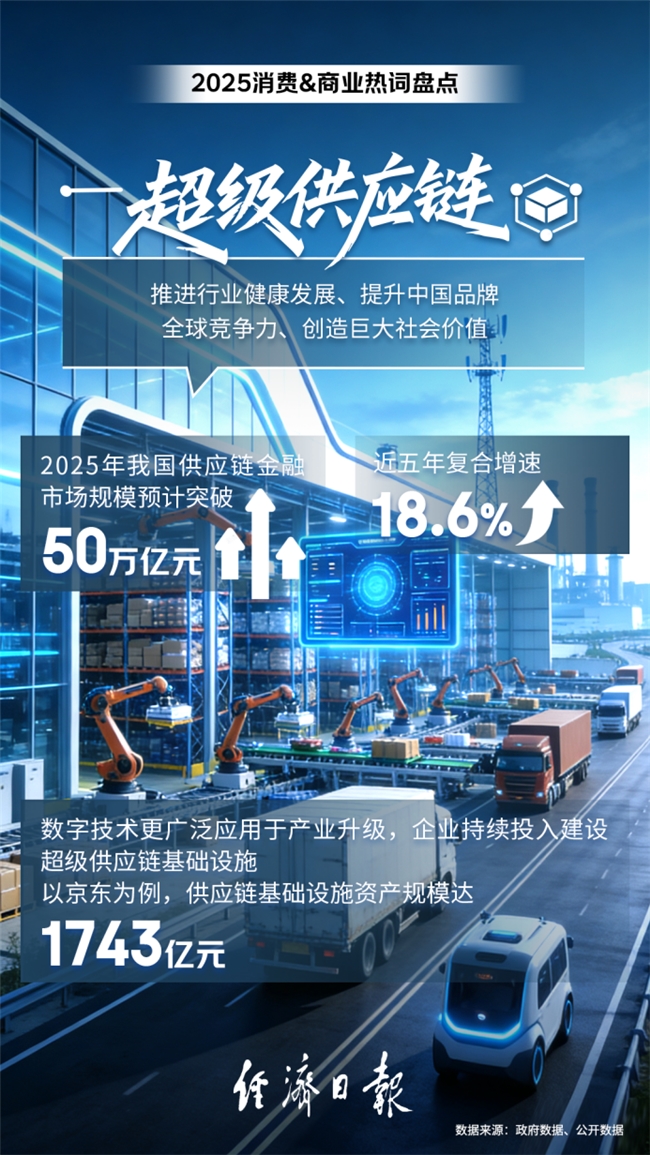
2025年度消费&商业热词出炉:“超级供应链”入选十大热词
Sou Hu Wang· 2025-12-31 03:55
Core Insights - The article outlines ten key consumption and business trends for 2025, including "AI," "robotics," "food delivery wars," "super supply chains," "cultural tourism integration," "weight management," "event economy," "emotional health," "silver economy," and "cross-industry collaboration" [1][5]. Super Supply Chain - The strategic value of supply chains is increasingly recognized, with a reported 5.1% year-on-year growth in national freight turnover in the first half of 2025, indicating improved operational efficiency [3]. - The supply chain finance market in China has surpassed 50 trillion yuan, with a compound annual growth rate of 18.6% from 2019 to 2025, stabilizing the funding chains of over 30 million small and micro enterprises [3]. - Companies like JD.com are investing heavily in supply chain infrastructure, with assets reaching 174.3 billion yuan, showcasing the effectiveness of super supply chains in enhancing efficiency and service optimization [3][4]. AI - AI technology is deeply integrated into industrial upgrades and consumer quality improvements, with a significant increase in AI-related product searches on JD.com, growing over 100 times year-on-year [8][9]. - The government aims for over 70% application rate of new-generation intelligent agents by 2027, driving AI's role in everyday consumer products [8]. Robotics - The robotics industry in China saw a revenue growth of 27.8% in the first half of 2025, maintaining its position as the largest industrial robot application market globally [12]. - The search volume for robotics-related products on JD.com exceeded 80 million, indicating a shift from novelty to practical tools in daily life [12]. Food Delivery Wars - The food delivery market has evolved into a competitive landscape dominated by Meituan, Taobao Flash Purchase, and JD Delivery, with high brand recognition rates [15][16]. - Consumer focus has shifted from price to service quality, delivery speed, and overall experience, prompting platforms to enhance their service capabilities [16]. Cultural Tourism Integration - Cultural tourism is evolving towards immersive experiences, with the market expected to grow from 431.4 billion yuan in 2024 to 697.2 billion yuan by 2027, reflecting a compound annual growth rate of 18.9% [18]. - Consumers are increasingly seeking experiences that connect them with local culture, as evidenced by significant growth in sales of products featuring local cultural elements [18]. Event Economy - The event economy is driving consumption across various sectors, with key events in 2025 generating over 16 billion yuan in consumer spending [21][22]. - The popularity of sports events is fostering a culture of regular participation in physical activities, contributing to a shift towards sustained consumer engagement [22]. Weight Management - Weight management is transitioning from a focus on weight loss to holistic health, with a significant increase in related product searches and sales on JD.com [24]. - The launch of specialized online services for weight management reflects a growing consumer interest in health-oriented solutions [24]. Emotional Health - Emotional health is becoming a mainstream concern, with a surge in demand for psychological services and products, as indicated by a dramatic increase in related searches on JD.com [26][27]. - The government's initiatives to enhance mental health services are contributing to the normalization of emotional health discussions in public discourse [26]. Silver Economy - The silver economy is expanding rapidly, with a reported 76% increase in silver-related products on JD.com from 2020, highlighting the growing market for elder care and lifestyle products [29][30]. - The government is actively promoting initiatives to enhance the quality of life for the elderly, further driving growth in this sector [29]. Cross-Industry Collaboration - Cross-industry collaboration is emerging as a key strategy for innovation, with various IPs collaborating to create new consumer experiences and expand market reach [31][34]. - The integration of cultural heritage and modern consumer demands is fostering new business models that enhance consumer engagement and satisfaction [34].
2026年“国补”即将开启 京东以全链路能力护航政策精准落地
Sou Hu Cai Jing· 2025-12-31 03:45
Core Viewpoint - The new "National Subsidy" policy for 2026 emphasizes the optimization of fund allocation and the prevention of fraudulent claims, with a focus on enhancing the technical capabilities of implementing entities [1][2][3] Group 1: Policy Implementation - The 2026 policy aims to expand the coverage and scale of the "old-for-new" subsidy program, with a shift towards more refined execution to prevent fraud and ensure effective fund distribution [1] - The policy includes strict measures against fraudulent claims, such as "pre-increase then subsidize" practices, highlighting the importance of technical capability and collaborative execution among stakeholders [1] Group 2: Company Involvement - JD.com has actively participated in the "old-for-new" program by innovating subsidy models and enhancing user experience through online and offline collaboration [1][2] - The company has invested nearly 30 billion yuan to support the "National Subsidy" initiative in rural areas, focusing on product subsidies, technology development, and logistics [2] Group 3: Technology and Risk Management - JD.com utilizes AI image detection, data verification, and location services to ensure accurate fulfillment and verification of subsidy claims, reducing risks of false claims and enhancing policy accessibility [2] - The company has implemented a fully digital management system for subsidy funds, ensuring traceability and security, while adapting risk control strategies to local policy requirements [2][3] Group 4: Expected Outcomes - The effectiveness of the new policy will be measured by its ability to prevent fraud and enhance the efficiency of fiscal fund usage, with JD.com positioned to support these goals through its systematic capabilities [3] - By leveraging its supply chain and technology, JD.com aims to ensure that the benefits of the "old-for-new" program reach consumers fairly and efficiently, maximizing social benefits [3]
关注港股科技ETF(513020)投资机会,出海是驱动增长的核心因素
Mei Ri Jing Ji Xin Wen· 2025-12-31 03:17
Group 1 - The core viewpoint emphasizes that the growth of the Hong Kong technology sector ETF (513020) is primarily driven by overseas expansion opportunities [1] - The Hang Seng Technology Index has historically shown weak performance in Q4, with a typical recovery in Q1/Q2 of the following year [1] - Key focus areas for 2026 include the overseas business progress of internet giants, with opportunities for domestic cloud and gaming companies due to AI development trends [1] Group 2 - The Hong Kong Technology ETF (513020) tracks the Hong Kong Stock Connect Technology Index (931573), which includes technology-related companies listed in Hong Kong [1] - The index is concentrated in sectors such as electronics, media, internet, and semiconductor chips, reflecting high-tech innovation characteristics [1] - The index focuses on technology leaders with a high concentration of weight, which can represent the overall performance of the technology industry [1]
2025 中国互联网纪事
Tai Mei Ti A P P· 2025-12-31 02:14
Group 1 - Alibaba Group announced the sale of its entire stake in Gao Xin Retail for approximately HKD 13.138 billion, marking a significant divestment from its "new retail" strategy initiated by Jack Ma in 2016 [3] - ByteDance was ordered to pay CNY 82.668 million for code plagiarism involving eight products, including Douyin and Jianying, after a three-year legal battle [7] - Baidu officially acquired YY Live for approximately USD 2.1 billion, after initially announcing the acquisition in 2020 and later terminating it due to legal disputes [7] Group 2 - Honor officially announced the departure of its former CEO Zhao Ming after multiple denials, coinciding with the company's completion of a share reform and initiation of an A-share IPO process [4] - Xiaomi's first SUV model, YU7, launched with over 200,000 pre-orders within three minutes, indicating strong market demand [19] - The Chinese stock market index, Shanghai Composite, broke the 4,000-point mark for the first time in ten years, with total trading volume exceeding CNY 4.0782 trillion for the year [34] Group 3 - The founder of Baidu, Robin Li, stated that the company would spare no effort to win the competition in the food delivery market amid a subsidy war with Meituan [16] - Xiaomi's automotive division faced backlash over a carbon fiber hood controversy, leading to an apology and compensation offers for affected customers [16] - The Chinese government announced a child-rearing subsidy of CNY 3,600 per year for families, effective from January 1, 2025, to encourage population growth [22]



智通港股早知道 | 隔夜COMEX白银期货涨7.88% 两部门:2026年继续实施消费品以旧换新 支持汽车置换更新
智通财经网· 2025-12-31 01:40
Group 1: Consumer Subsidy Policy - The National Development and Reform Commission and the Ministry of Finance announced a subsidy policy for consumer electronics and appliances, effective from 2026, providing a 15% subsidy on the sales price for specific products [1][4] - Consumers can receive a subsidy of up to 1,500 yuan for each qualifying appliance, and up to 500 yuan for each qualifying digital product, with a limit of one subsidy per product category per consumer [1][4] - The policy also supports the replacement of vehicles, offering subsidies for consumers who trade in their cars for new energy vehicles or low-displacement fuel vehicles [4] Group 2: Market Performance - COMEX silver futures rose by 7.88%, while the Dow Jones Industrial Average fell by 0.2%, closing at 48,367.06 points [2] - The S&P 500 index decreased by 0.14%, and the Nasdaq Composite index dropped by 0.24% [2] - Major tech stocks showed mixed performance, with Intel and Meta both gaining over 1% [2] Group 3: Corporate Announcements - China Aircraft Leasing announced the purchase of 30 Airbus A320neo aircraft, with deliveries expected to occur in phases until 2033 [9] - China Aluminum International plans to acquire a 51% stake in Yunnan Yun Aluminum Logistics for approximately 264 million yuan [15] - Zijin Mining Group expects a net profit of approximately 51-52 billion yuan for 2025, representing a year-on-year increase of about 59%-62% [18]

从“铺渠道”到“锚行业”:2026营销人的思维升维
Sou Hu Wang· 2025-12-31 01:25
Core Insights - The digital marketing industry in China is experiencing significant growth, with the market size expected to reach approximately 1.2 trillion RMB by 2025 and 4.8 trillion RMB by 2030, despite challenges faced by brands due to intense competition for traffic [3][4] - The rise of the HarmonyOS ecosystem, which has captured an 18% market share in the smartphone operating system market, presents a new opportunity for brands to escape the cycle of traffic competition and regain growth [4][9] - The gaming industry is facing increasing user acquisition costs, with a reported 86.6% year-on-year increase in spending on user acquisition for the top 100 mobile games in the first half of 2025, while user retention and conversion rates have not kept pace [6][14] Industry Challenges - Brands are struggling with resource misallocation and declining conversion efficiency due to a focus on traffic competition, leading to a paradox where market growth does not translate to individual brand growth [3][4] - The e-commerce sector is experiencing a disconnect between traffic costs and profits, with high public traffic costs eroding already thin margins, while private traffic engagement is hindered by platform barriers and user attention fragmentation [6][14] - Various industries, including finance, tourism, and lifestyle services, are in need of innovative solutions to address unique user value challenges and break free from traditional traffic-driven models [6][14] Solutions and Strategies - The "Whale Harmony Dynamics" initiative aims to provide tailored solutions for five key industries: gaming, e-commerce, finance, tourism, and lifestyle services, enhancing commercial growth logic within the HarmonyOS ecosystem [8][17] - The transition from a "traffic mindset" to a "value mindset" is emphasized, with a focus on understanding user intent and leveraging data science to create a comprehensive digital life map for brands [10][11] - The implementation of AI-driven insights and decision-making processes is set to transform marketing strategies, allowing for real-time data feedback and a shift from traditional advertising to contextually relevant service delivery [11][12] Growth Methodology - A replicable growth methodology is proposed, focusing on deep user insights, precise scene engagement, and long-term asset management, aiming for continuous user interaction throughout their lifecycle [14][15] - Case studies demonstrate the effectiveness of this methodology, such as the gaming industry example where targeted strategies led to a 48% increase in conversion rates and significant user engagement [14][15] - The Whale Harmony Dynamics initiative is positioned as a bridge between developers, users, and the commercial value ecosystem, leveraging AI and data science to build sustainable competitive advantages for partners [16][17]