
化工

Search documents
冰火两重天!化工、有色强者恒强,科技股延续低迷,资金去向何方?
Xin Lang Ji Jin· 2026-02-08 12:14
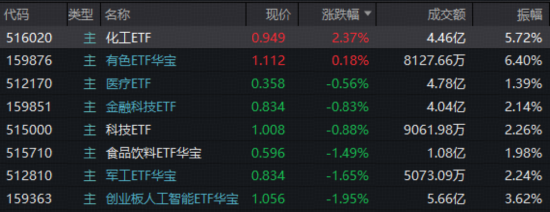
Market Overview - A-shares experienced volatility on February 6, with the Shanghai Composite Index closing down 0.25% at 4065.58 points, and the ChiNext Index down 0.73% [1] - The overall market turnover decreased to 2.16 trillion yuan, marking a continuous six-day decline in trading volume [1] Sector Performance - The chemical and new energy sectors led the market, while the pharmaceutical sector showed relative resilience. Consumer goods experienced a pullback, and technology continued to be sluggish [1] - The chemical ETF (516020) saw a significant inflow of 199 billion yuan, with a daily gain of 2.37% after reaching a peak increase of 3.45% during the day [2][5][6][8] Chemical Sector Insights - The chemical sector is experiencing a strong upward cycle, driven by increased demand for lithium batteries and key chemical materials [9][10] - Major stocks in the chemical sector, such as Enjie Co., Ltd. and Zhejiang Longsheng, saw significant gains, with some stocks rising over 6% [6][9] Non-Ferrous Metals Sector - The non-ferrous metals sector demonstrated resilience, with the non-ferrous ETF (159876) reversing early losses to close slightly up by 0.18% despite fluctuations in international gold prices [3][11] - Over 100 billion yuan of main funds flowed into the non-ferrous metals sector, indicating strong investor interest [11] Hong Kong Market Dynamics - The Hong Kong market experienced a downward trend, with the Hang Seng Index and Hang Seng Tech Index both closing down over 1% [3] - Despite the overall decline, there was significant buying activity from southbound funds, with purchases reaching 133.7 billion HKD, 249.8 billion HKD, and 148.6 billion HKD over three days [4] Pharmaceutical Sector Developments - The Hong Kong pharmaceutical sector showed signs of recovery, with the innovative drug ETF (520880) rising by 2% during the day, driven by strong earnings forecasts from key companies [15][16] - Notable performers included Innovent Biologics, which projected a revenue increase of approximately 134% by 2025, and several other companies expecting significant profit growth [16][18] Investment Opportunities - Analysts suggest that the chemical sector remains a promising investment opportunity, particularly in leading companies and price recovery products [10][22] - For investors looking to capitalize on the pharmaceutical sector, the innovative drug ETF (520880) and the medical ETF (159137) are recommended for their strong growth potential and coverage of key industry players [21][22]

2月8日周末公告汇总 | 晶合集成拟20亿取得晶奕集成100%股权;沪硅产业拟签订逾30亿电子级多晶硅框架合同
Xuan Gu Bao· 2026-02-08 12:01
Group 1: Resumption and Suspension of Trading - Longyun Co., Ltd. plans to acquire 58% equity of Yuheng Film Industry through share issuance, leading to stock resumption [1] - Ruili Kemi intends to issue shares to purchase 16% equity of Wuhan Kedes, resulting in stock suspension [2] - Yongtai Technology aims to acquire 25% equity of Yongtai High-tech, with Ningde Times becoming a shareholder, leading to stock suspension [3] Group 2: Mergers and Acquisitions - Jinghe Integration plans to acquire 100% equity of Jingyi Integration for 2 billion yuan; Jingyi is the construction entity for Jinghe's Phase IV project [4] - Shahe Co., Ltd. intends to purchase 70% equity of Jinghua Electronics for 274 million yuan; the target company focuses on IoT smart display controllers and LCD devices [4] - Yiwan Yichuang plans to issue shares and pay cash to acquire 100% equity of Lianshi Legend; the target company specializes in AI algorithm-based intelligent marketing services [4] - Shanshan Co., Ltd. has signed a restructuring investment agreement with its controlling shareholder and subsidiaries; if successful, the actual controller will change to the Anhui State-owned Assets Supervision and Administration Commission [4] Group 3: Equity Transfers and Increases - Dongwang Times' controlling shareholder plans to publicly solicit the transfer of 6% equity [5] - Kangtai Biological's shareholder Yuan Liping intends to transfer 2% equity to Huabao Wanying Private Fund [6] - Linyang Energy's controlling shareholder Huahong Electronics plans to increase holdings by 50 million to 100 million yuan [7] Group 4: External Investments and Daily Operations - Hu Silicon Industry plans to sign a framework contract for the procurement of 3.045 billion yuan of electronic-grade polysilicon [8] - Dongtian Micro plans to invest 400 million yuan to establish a global R&D center and manufacturing headquarters in South China, focusing on precision optical components for optical communication [8] - Zhenyu Technology intends to invest in Thailand to establish a production base with an annual output of 15 million precision transmission components [9] - Lvtong Technology's investment fund plans to invest 10 million yuan in Shenghao Optoelectronics, which specializes in optical communication chip testing equipment [10] - Xinwangda's subsidiary has reached a settlement with Weir Electric, expected to impact the net profit attributable to the parent company by 500 million to 800 million yuan in 2025 [11] - Heng Rui Pharmaceutical's HRS-4642 injection has been included in the list of breakthrough therapeutic varieties, with no similar drugs approved for sale domestically or internationally [12] - Zhixin Co., Ltd. plans to invest 1.1 billion yuan to establish an automotive welding parts project [13] - Aisheng Co., Ltd. has received patent authorization for Maxeon BC batteries and components, with total licensing fees amounting to 1.65 billion yuan [14] - Sanfu Co., Ltd. is investing in a new project with an annual output of 200 tons (Phase I: 40 tons) of SOD and supporting solvents, with a total investment of 154 million yuan, including 125 million yuan for Phase I [14] - Gongxiao Daji is participating in the auction for 60% equity of Guotou Agricultural Products Supply Chain (Beijing), with a transfer base price of 99.7776 million yuan [15]

中盘蓝筹系列:避险情绪助推消费,化工农业仍是重点
Orient Securities· 2026-02-08 11:42
Group 1 - The report highlights that the recent volatility in the commodity market has significantly impacted market sentiment, with a notable focus on the consumer and financial sectors, which have shown resilience despite overall market weakness [4][7][13] - The analysis suggests that the recent adjustments in commodity prices are primarily driven by deleveraging rather than a fundamental shift in market trends, indicating that the market does not expect significant changes from the newly appointed hawkish Federal Reserve chairman [9][14] - The report identifies that the consumer and financial sectors have become preferred options for expressing risk aversion, as traditional safe-haven assets like gold have been affected by high leverage risks [13][14] Group 2 - The report anticipates that as the deleveraging issues in the commodity market stabilize, cyclical sectors, particularly chemicals and agriculture, are likely to regain prominence as key investment themes [4][14] - It is noted that the recent performance of the financial sector, particularly banks over brokerages, reflects a lower risk appetite in the market, further supporting the notion of risk aversion [13][14] - The report emphasizes that the current market dynamics, including the inverse relationship between long-term interest rates and consumer stocks, suggest a unique market environment where traditional correlations are disrupted [14][15]
量化周报:三维择时框架进入谨慎状态-20260208
Guolian Minsheng Securities· 2026-02-08 11:29
Timing Perspective - The three-dimensional timing framework has entered a cautious state, indicating a judgment of oscillating decline due to a downward trend in liquidity and an upward trend in divergence[5] - The Shanghai Composite Index has repeatedly tested the demand line without breaking through, suggesting that while the upward trend remains, market volume is significantly shrinking[5] Sector Rotation - The communication equipment index saw a substantial inflow of 208% over the past week, while the oil and gas industry had a 630% inflow over the past month[27] - The ETF hot trend strategy has achieved a return of 54.82% since 2025, outperforming the Shanghai Composite Index by 33.27%[28] All-Weather Allocation - The high-volatility version of the all-weather strategy has an annualized return of 11.8% with a maximum drawdown of 3.6% and a Sharpe ratio of 2.3[59] - Since 2026, the high-volatility and low-volatility versions have returns of 2.3% and 0.9%, respectively[59] Factor Tracking - The market is currently characterized by a "high value, high leverage, high volatility" style, with the value factor achieving a positive return of 1.48% this week[61] - The liquidity shock factor has shown strong performance with a multi-head excess return of 1.56% over the past week[66] Risk Warning - Quantitative conclusions are based on historical statistics, and future market environment changes may lead to potential invalidation of these conclusions[69]
中信建投:春节后春季行情有望延续 建议持股过节
智通财经网· 2026-02-08 11:20
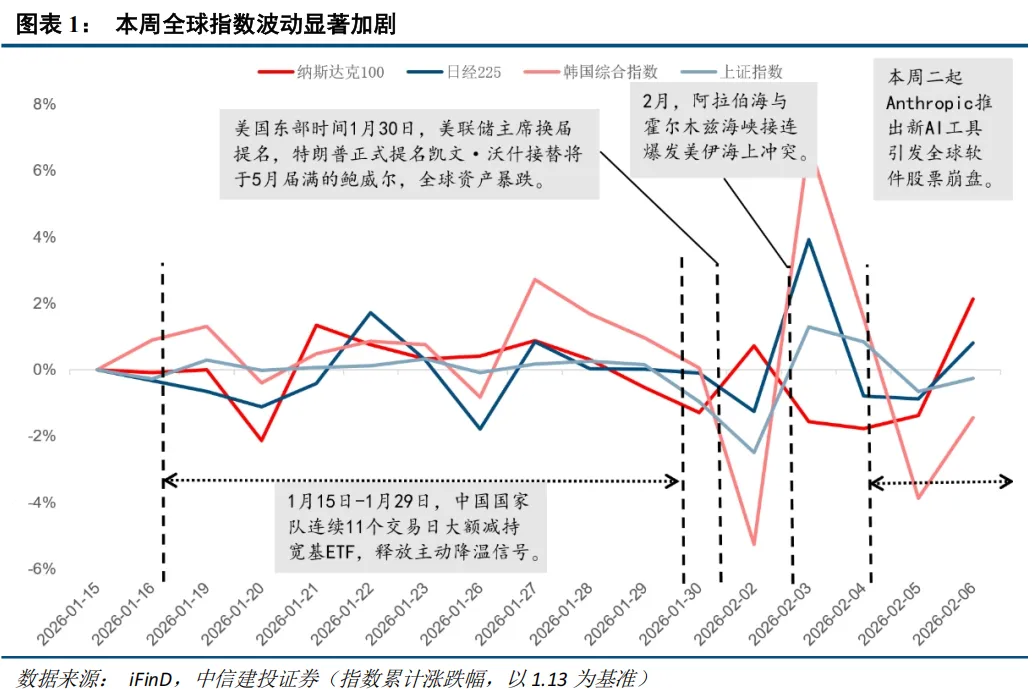
Core Viewpoint - The recent adjustment in the A-share market is primarily driven by internal factors, such as proactive cooling measures and a sell-off in broad-based ETFs, while external factors include political actions by Trump, the change in the Federal Reserve chair, geopolitical tensions in Iran, and a decline in global AI stock preferences. Despite these disturbances, the fundamental industry outlook in China remains intact, and the market sentiment has sufficiently released, suggesting a potential continuation of the spring rally after the Spring Festival [1][2][9]. Internal Factors - The proactive cooling measures by regulators have led to a sell-off in broad-based ETFs, resulting in a temporary decline in market risk appetite. Some thematic sectors have experienced speculative bubbles, prompting the China Securities Regulatory Commission to implement "counter-cyclical adjustments" [9][11]. - The adjustment is viewed as phase-specific, with the proactive cooling measures nearing completion and seasonal factors related to the Spring Festival and the Two Sessions expected to support market recovery [2][11]. External Factors - External disturbances, including Trump's political actions, the new Federal Reserve chair's policy expectations, and geopolitical tensions in Iran, have amplified the adjustment pressure. However, these factors are not expected to have a long-term impact on the A-share market due to its weak correlation with global markets [9][11][13]. - The current external disturbances do not possess the necessary conditions to transmit long-term impacts to the A-share market, as they primarily pertain to financial and political short-term disruptions rather than fundamental changes in supply chains or demand [13][15]. Market Sentiment and Liquidity - Market sentiment has sufficiently cooled, with a significant reduction in trading volume and a drop in the Shanghai Composite Index below its 20-day moving average. This indicates that the previously overheated market sentiment has been effectively resolved [18][20]. - The sell-off in broad-based ETFs has shown signs of easing since January 30, which is expected to improve the independent funding environment of the A-share market [15][18]. Industry Focus and Investment Opportunities - Key sectors to focus on include AI computing power, chemicals, electric equipment, and energy storage, with potential investment opportunities arising from upcoming policy signals from local Two Sessions and the national Two Sessions [20][28]. - The AI computing power sector is expected to see significant capital expenditure increases, with major companies like Meta, Google, Amazon, and Microsoft planning substantial investments in AI infrastructure [20][21]. - The chemical sector is experiencing a valuation recovery driven by price increases in various sub-sectors, with leading companies in PET, polyurethane, and other chemical products becoming focal points for investment [24][25]. - The energy storage industry is benefiting from both domestic and international demand, particularly from AI-driven data center projects in North America, highlighting its critical role in power solutions [28][29].

中信建投:外部冲击影响有限,围绕景气布局
Xin Lang Cai Jing· 2026-02-08 11:09
Core Viewpoint - The recent adjustment in the A-share spring market is primarily driven by internal factors, with external factors acting as catalysts. Internal factors include proactive cooling measures and a sell-off in broad-based ETFs, while external factors encompass political actions by Trump, the change in the Federal Reserve chair, geopolitical tensions in Iran, and the release of new tools by Anthropic that triggered a decline in global tech stocks. Despite these disturbances, the fundamental industrial landscape in China remains intact, and the market sentiment has sufficiently released, suggesting a potential continuation of the spring market after the Spring Festival [3][4][36]. Internal Factors - The adjustment is mainly due to the emergence of speculative bubbles in certain thematic sectors, prompting regulatory bodies to implement "counter-cyclical adjustments" [4][12][47]. - A sell-off in broad-based ETFs has led to a temporary decline in market risk appetite [4][12][47]. External Factors - External disturbances include political actions by Trump that increase policy uncertainty, the change in the Federal Reserve chair affecting global funding pricing, rising geopolitical tensions in Iran, and concerns over AI technologies replacing traditional tools, which have collectively amplified adjustment pressures [4][12][47]. - The correlation between A-shares and global markets has weakened, indicating that external shocks may not have a long-term impact on A-shares [15][50]. Market Sentiment and Performance - Market sentiment has cooled significantly, as evidenced by a decrease in trading volume and a drop in the Shanghai Composite Index below its 20-day moving average, indicating that previous over-exuberance has been adequately addressed [20][55]. - The overall liquidity environment remains stable despite fluctuations in major asset classes, with no significant cross-asset capital flow observed [41]. Industry Configuration - Future industry allocation should focus on sectors with strong growth potential, particularly AI computing power, chemicals, and energy storage, which are expected to benefit from both domestic and international demand [5][39][59]. - The AI computing power sector is supported by significant capital expenditure increases from global tech giants, with Meta planning to raise its capital expenditure to $135 billion, a potential increase of 87% [24][60]. - The chemical sector is experiencing a valuation recovery driven by price increases in various sub-sectors, with major companies like BASF announcing price hikes for TDI products, boosting market sentiment [24][61]. Thematic Investment Opportunities - The upcoming national two sessions are expected to provide policy signals that could benefit sectors such as commercial aerospace and traditional Chinese medicine, which should be monitored for potential investment opportunities [30][65]. - The energy storage industry is poised for growth due to domestic pricing mechanisms and increasing overseas demand driven by AI computing needs, with many storage companies securing orders from North American data centers [28][63].


量化择时周报:缩量信号近在咫尺,重回科技与周期-20260208
ZHONGTAI SECURITIES· 2026-02-08 10:43
Quantitative Models and Construction Methods Model Name: Industry Trend Allocation Model - **Model Construction Idea**: This model aims to identify industry trends and allocate investments accordingly[5][8][10] - **Model Construction Process**: - The model uses various indicators to assess industry trends, including market performance, valuation levels, and risk appetite. - It incorporates signals from different sub-models such as the Mid-term Distress Reversal Expectation Model, TWO BETA Model, and Performance Trend Model. - The Mid-term Distress Reversal Expectation Model waits for reversal signals in industries like liquor and real estate. - The TWO BETA Model recommends the technology sector and monitors opportunities in commercial aerospace. - The Performance Trend Model focuses on the computing power industry chain and oversold sectors like non-ferrous metals and chemicals. - **Model Evaluation**: The model is effective in identifying industry trends and making allocation recommendations based on various market signals[5][8][10] Model Name: Timing System - **Model Construction Idea**: This model aims to distinguish the overall market environment and provide timing signals for investment decisions[5][8][9] - **Model Construction Process**: - The model uses the distance between the long-term moving average (120 days) and the short-term moving average (20 days) of the WIND All A Index. - The latest data shows the 20-day moving average at 6787 and the 120-day moving average at 6338, with a difference of 7.08%. - The model also considers the market trend line, which is currently around 6780 points, and the profitability effect, which is -1.44%. - The model suggests that the market is in a shock pattern and monitors short-term risk appetite changes. - **Model Evaluation**: The model provides clear signals for market timing based on moving averages and other indicators[5][8][9] Model Backtesting Results - **Industry Trend Allocation Model**: - **PE Valuation Level**: 90th percentile, indicating a high level[8][10] - **PB Valuation Level**: 50th percentile, indicating a medium level[8][10] - **Position Recommendation**: 70% for absolute return products with WIND All A as the stock allocation subject[8][10] - **Timing System**: - **Moving Average Distance**: 7.08%, greater than the absolute value of 3%[5][8][9] - **Market Trend Line**: Around 6780 points[5][8][9] - **Profitability Effect**: -1.44%, indicating a temporary end to the upward trend[5][8][9] Quantitative Factors and Construction Methods Factor Name: Mid-term Distress Reversal Expectation Model - **Factor Construction Idea**: This factor aims to identify potential reversal signals in distressed industries[5][8][10] - **Factor Construction Process**: - The model monitors industries like liquor and real estate for reversal signals. - It uses various market indicators to assess the likelihood of a reversal. - **Factor Evaluation**: The factor is useful for identifying potential investment opportunities in distressed industries[5][8][10] Factor Name: TWO BETA Model - **Factor Construction Idea**: This factor aims to recommend sectors with high growth potential, such as technology[5][8][10] - **Factor Construction Process**: - The model focuses on the technology sector and monitors opportunities in commercial aerospace. - It uses market performance and other indicators to make recommendations. - **Factor Evaluation**: The factor is effective in identifying high-growth sectors and making investment recommendations[5][8][10] Factor Name: Performance Trend Model - **Factor Construction Idea**: This factor aims to identify sectors with strong performance trends[5][8][10] - **Factor Construction Process**: - The model focuses on the computing power industry chain and oversold sectors like non-ferrous metals and chemicals. - It uses performance indicators to make recommendations. - **Factor Evaluation**: The factor is useful for identifying sectors with strong performance trends and making investment recommendations[5][8][10] Factor Backtesting Results - **Mid-term Distress Reversal Expectation Model**: - **PE Valuation Level**: 90th percentile, indicating a high level[8][10] - **PB Valuation Level**: 50th percentile, indicating a medium level[8][10] - **TWO BETA Model**: - **PE Valuation Level**: 90th percentile, indicating a high level[8][10] - **PB Valuation Level**: 50th percentile, indicating a medium level[8][10] - **Performance Trend Model**: - **PE Valuation Level**: 90th percentile, indicating a high level[8][10] - **PB Valuation Level**: 50th percentile, indicating a medium level[8][10]
兴证策略:前期调整释放一定风险 持股过节兼具胜率与赔率
Xin Lang Cai Jing· 2026-02-08 10:18
由此来看,近期海外一系列不确定性因素对风险资产的冲击更多是在叙事与情绪层面,而并非基本面或 政策路径出现实质性变化,尤其是支撑春季行情的国内核心逻辑——向好的基本面、政策"开门红" 与 充裕的流动性均未发生任何改变,这也是我们看好春季行情尚未结束的核心原因。 往后看,随着前期调整释放一定风险,近期全球叙事变化对市场情绪冲击最大的时刻或正在逐步过去。 一方面,从资产表现来看,周五(2月6日)比特币、美股、中概股、贵金属等一系列风险资产企稳反 弹,表明全球风险偏好已在逐步修复;另一方面,从我们跟踪的一系列情绪指标来看,当前A股与港股 已调整出一定的性价比,尤其是我们构建的港股情绪指数已经回落至去年12月19日底部的水平,并跌穿 滚动一年均值-1.5倍标准差,显示港股已到值得重点关注的区间。 从事件催化和日历效应的角度来看,后续也将逐步进入一个有利于权益资产演绎的良好环境。事件催化 角度,下周即将进入中美宏观数据的披露窗口,国内物价、社融等数据对于基本面改善的验证值得期 待,美国非农和CPI数据也有望对货币政策预期形成校准。此外,国内外AI应用等产业层面的密集催化 也有望在春节前后集中演绎。经历近期轮动加快、主线降 ...
宏观周报(2月2日-2月8日):假日需求稳中有升,海外制造业景气回暖-20260208
Yin He Zheng Quan· 2026-02-08 09:42
Domestic Demand - Domestic travel demand is steadily increasing, with subway passenger volume up 8.8% compared to the same period in 2024, and domestic flight numbers averaging 14,500, a 1.6% increase year-on-year[2] - Movie ticket revenue has decreased by 37.2% year-on-year, averaging 62.245 million yuan per day[2] - Passenger car sales in January were 679,000 units, down 31.7% from the previous year[2] External Demand - The Baltic Dry Index (BDI) averaged 1993.2, showing a marginal decline but significantly higher than the previous year[2] - The China Export Container Freight Index averaged 1122.2, down 4.5% week-on-week and 16.4% year-on-year[2] - Port cargo throughput reached 281.597 million tons, a 25.5% increase compared to the same period in 2024[2] Production Sector - The operating rate of blast furnaces increased by 0.53 percentage points to 79.55%[2] - The operating rate for automotive semi-steel tires decreased by 2.08 percentage points to 72.76%[2] - PTA production increased by 35,500 tons to 1.4639 million tons, with an operating rate of 76.29%[2] Price Trends - Consumer Price Index (CPI) remains low, with pork prices down 1.12% week-on-week and vegetable prices down 1.46%[3][4] - Producer Price Index (PPI) shows significant increases in coking coal and coke prices, while non-ferrous metals have adjusted downwards due to a stronger dollar and seasonal demand decline[4] Monetary Policy - The central bank's reverse repurchase operations netted 756 billion yuan this week, with SHIBOR rates showing a seasonal decline[5] - The yield curve for government bonds has flattened, with the 30-year yield at 2.2510% and the 10-year yield at 1.8102%[5] International Context - U.S. consumer confidence index rose to 57.3, with one-year inflation expectations dropping to 3.5%, the lowest in 13 months[5] - The ISM Manufacturing PMI rebounded to 52.6%, indicating a return to expansion, with new orders and production indices showing significant growth[7]