
银行业

Search documents
隔夜shibor报1.2700%,下跌0.70个基点
Jin Rong Jie· 2026-02-09 03:17
隔夜shibor报1.2700%,下跌0.70个基点;7天shibor报1.5050%,上涨7.00个基点;14天shibor报 1.5840%,上涨8.00个基点;1月shibor报1.5500%,与前一交易日持平。3月shibor报1.5800%,与前一交 易日持平。 本文源自:金融界AI电报 ...
资金面整体宽松,债市延续暖意
Dong Fang Jin Cheng· 2026-02-09 02:54
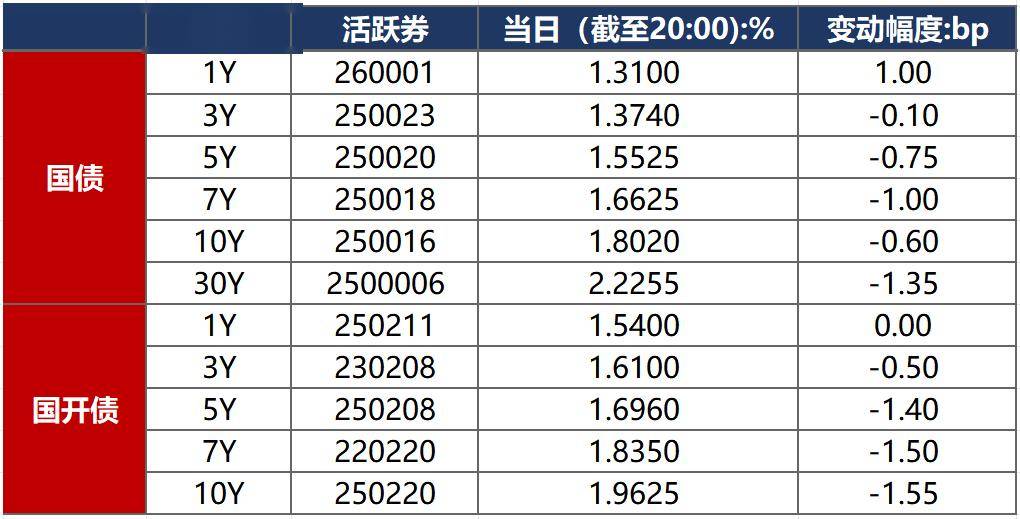
Report Industry Investment Rating - Not provided in the content Core Viewpoints - On February 6, the overall capital situation was loose, with major repurchase rates declining; the bond market continued its positive trend; the main indices of the convertible bond market closed higher, and most convertible bond issues rose; yields on U.S. Treasuries of various maturities generally increased, and the yields on 10-year government bonds of major European economies showed divergent trends [2] Summary by Directory I. Bond Market News (1) Domestic News - Premier Li Qiang chaired the tenth plenary meeting of the State Council, emphasizing promoting effective investment, using various funds and tools, and promoting major projects in key areas [4] - As of the end of January 2026, China's foreign exchange reserves increased for the 6th consecutive month to $3399.1 billion, and gold reserves increased for 15 consecutive months to 74.19 million ounces. The increase in foreign exchange reserves was due to factors such as exchange rate conversion and asset price changes [5] - Eight departments jointly re - emphasized the ban on virtual currency in China and put forward policy requirements for related businesses [5] - The China Securities Regulatory Commission issued a regulatory guideline for the overseas issuance of asset - backed security tokens of domestic assets to prevent speculation risks [6][7] - The first meeting of the China - UK Financial Working Group was held in Beijing, reaching many practical cooperation results [7] (2) International News - In February 2026, the preliminary reading of the U.S. consumer confidence index was 57.3, higher than the January final value. The short - term inflation expectation dropped to 3.5%, while the long - term inflation expectation rose slightly to 3.4% [8] - The U.S. and India reached a temporary trade framework. The U.S. will impose a 18% tariff on Indian goods, and India will purchase $500 billion of U.S. products in five years [9] - On February 6, international crude oil futures prices rose, with WTI March crude oil futures up 0.41% and Brent April crude oil futures up 0.74%. COMEX gold futures rose 1.96%. The NYMEX natural gas price fell 3.16% [10] II. Capital Situation (1) Open Market Operations - On February 6, the central bank conducted 7 - day reverse repurchase operations of 31.5 billion yuan at an interest rate of 1.40% and 14 - day reverse repurchase operations of 300 billion yuan. With 477.5 billion yuan of reverse repurchases maturing, the net capital withdrawal was 146 billion yuan [12] (2) Capital Interest Rates - On February 6, the capital situation was loose, and major repurchase rates declined. DR001 dropped 4.41bp to 1.275%, and DR007 dropped 2.08bp to 1.461% [13] III. Bond Market Dynamics (1) Interest - rate Bonds - Spot Bond Yield Trends: On February 6, the bond market continued its positive trend. As of 20:00, the yield of the 10 - year Treasury bond active issue 250016 dropped 0.60bp to 1.8020%, and the yield of the 10 - year CDB bond active issue 250220 dropped 1.55bp to 1.9625% [15] - Bond Tendering Situation: The 3 - year 25Jinchujin13 (Increment 10), 1 - year 26Fuxiguozhai01 (Re - issue), and 30 - year 26Fuxiguozhai02 (Re - issue) were issued, with their respective issuance scales, winning bid yields, full - field multiples, and marginal multiples provided [16] (2) Credit Bonds - Secondary Market Transaction Anomalies: On February 6, the trading price of one industrial bond, "23Chanrong11", deviated by more than 10%, falling more than 17% [16] - Credit Bond Events: Multiple companies announced events such as debt repayment issues, mergers and reorganizations, and bond issuance cancellations [19] (3) Convertible Bonds - Equity and Convertible Bond Indices: On February 6, the three major A - share indices fell, with the Shanghai Composite Index, Shenzhen Component Index, and ChiNext Index down 0.25%, 0.33%, and 0.73% respectively. The convertible bond market rose, with the CSI Convertible Bond Index, Shanghai Convertible Bond Index, and Shenzhen Convertible Bond Index up 0.75%, 0.56%, and 1.02% respectively [18][20] - Convertible Bond Tracking: On February 7, Shenergy Co., Ltd.'s convertible bond issuance was approved by the exchange. On February 6, some convertible bonds announced adjustments to conversion prices, early redemptions, or approaching redemption conditions [24] (4) Overseas Bond Markets - U.S. Bond Market: On February 6, yields on U.S. Treasuries of various maturities generally increased. The 2 - year yield rose 3bp to 3.50%, and the 10 - year yield rose 1bp to 4.22%. The 2/10 - year and 5/30 - year yield spreads narrowed by 2bp. The 10 - year inflation - protected Treasury (TIPS) break - even inflation rate rose 2bp to 2.34% [23][25][26] - European Bond Market: On February 6, the yields on 10 - year government bonds of major European economies showed divergent trends. The German, French, and Italian yields rose 1bp, the Spanish yield remained unchanged, and the British yield dropped 5bp [27] - Daily Price Changes of Chinese - funded U.S. Dollar Bonds: As of the close on February 6, the prices of some Chinese - funded U.S. dollar bonds rose or fell, with details on the daily and monthly changes, credit subjects, bond balances, and yields provided [29]
中金:不是选择,是必然——政治经济学眼中的美国政策
Xin Lang Cai Jing· 2026-02-09 02:49
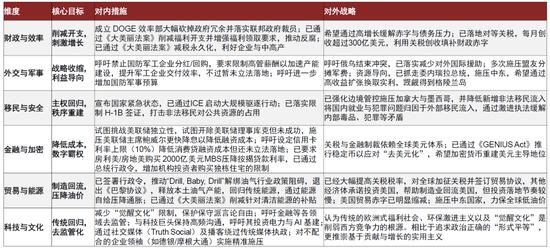
Core Viewpoint - Trump's unconventional policies are a response to escalating domestic social contradictions in the U.S., rooted in long-term distribution imbalances caused by neoliberalism since the 1980s [2][3][4]. Group 1: Domestic Policies - Trump has initiated measures to cut government spending and stimulate growth, including the establishment of the DOGE Efficiency Department to reduce government redundancy and accelerate federal layoffs [6]. - He has challenged the independence of the Federal Reserve and proposed a cap on credit card interest rates at 10% to lower consumer loan financing costs [6][4]. - The administration has implemented policies to limit executive compensation and has pressured allies to share military expenses [6][4]. Group 2: International Strategies - Trump's foreign policy includes imposing tariffs on a wide range of imports and advocating for the end of the Russia-Ukraine conflict while reducing international aid [6][4]. - The administration aims to strengthen control over overseas resources and energy to lower domestic living costs [3][4]. Group 3: Economic Implications - The ongoing internal contradictions in the U.S. are contributing to a relative decline in its international standing, with Trump's policies likely to expand in scope as he seeks to win midterm elections and achieve the goal of "Making America Great Again" [4]. - The proposed monetary policy changes, such as the nomination of Warsh as Fed Chair, aim to shift from a large fiscal framework to a model involving interest rate cuts and balance sheet reductions, which could lead to significant market volatility [4][6]. Group 4: Structural Issues - The article highlights the widening gap in income distribution in the U.S., with labor's share of income remaining stable while corporate profits have increased [9][10]. - The disparity between actual household income and the "qualified" income needed for affordable housing has widened significantly, indicating a growing financial burden on American families [9][11]. Group 5: Theoretical Framework - The return of neoclassical economics is identified as a key factor in the exacerbation of social contradictions in the U.S., with Keynesian policies being normalized in response to crises without addressing structural reforms [39][66]. - The article suggests that the challenges faced by the U.S. in implementing structural reforms are compounded by political and economic factors, including the weakening of labor unions and regional inequalities [58][66].

债市早报:资金面整体宽松,债市延续暖意
Sou Hu Cai Jing· 2026-02-09 02:41
Group 1: Domestic News - The State Council, led by Premier Li Qiang, emphasized the importance of promoting effective investment to stabilize economic growth and enhance development momentum during the 10th plenary meeting on February 6 [2] - The meeting discussed innovative policy measures to optimize the use of central budget investments, ultra-long special bonds, and local government special bonds, focusing on key areas such as infrastructure and emerging industries [2] Group 2: Foreign Exchange and Monetary Policy - As of January 2026, China's foreign exchange reserves increased to $339.91 billion, up by $41.2 billion from December 2025, while gold reserves rose to 74.19 million ounces, an increase of 40,000 ounces [3] - The People's Bank of China conducted a 7-day reverse repo operation of 31.5 billion yuan at a rate of 1.40% and a 14-day reverse repo operation of 300 billion yuan, resulting in a net withdrawal of 146 billion yuan on February 6 [8][9] Group 3: Bond Market Dynamics - The bond market showed positive sentiment with a decline in yields; the 10-year government bond yield fell by 0.60 basis points to 1.8020% and the 10-year policy bank bond yield decreased by 1.55 basis points to 1.9625% [10][11] - The secondary market for credit bonds experienced significant price deviations, with one industrial bond, "23产融11," dropping over 17% [12] Group 4: Equity and Convertible Bond Market - The convertible bond market saw major indices rise, with the China Convertible Bond Index increasing by 0.75% and trading volume reaching 88.755 billion yuan, up by 14.689 billion yuan from the previous trading day [20][21] - Notable individual convertible bonds included 泰瑞转债, which rose over 10%, while 新致转债 fell over 9% [21] Group 5: International Trade Developments - The U.S. and India reached a temporary trade framework, reducing tariffs on Indian goods to 18% and committing to a $500 billion purchase of U.S. products over five years [6] - The U.S. consumer confidence index slightly increased to 57.3 in February 2026, while long-term inflation expectations rose marginally to 3.4% [5]
英镑汇率承压回调 央行政策分化成核心影响因素
Jin Tou Wang· 2026-02-09 02:24
Core Viewpoint - The British pound has been experiencing a downward trend against the US dollar, primarily driven by the divergence in monetary policy between the Bank of England and the Federal Reserve, alongside persistent inflation and global market sentiment fluctuations [1][2]. Group 1: Monetary Policy and Economic Indicators - The Bank of England decided to maintain the benchmark interest rate at 3.75%, reflecting a close vote of 5:4 among its Monetary Policy Committee members, indicating increasing internal divisions regarding inflation and economic growth balance [1][2]. - The Consumer Price Index (CPI) in the UK for December 2025 rose to 3.4%, up from 3.2% in November, highlighting persistent inflationary pressures [1]. - Analysts suggest that the Bank of England is in a "dilemma," facing weak consumer spending and employment while inflation is not declining as expected, complicating the potential for interest rate cuts [2]. Group 2: Comparison with the Federal Reserve - The Federal Reserve's hawkish stance continues to support the US dollar, with officials indicating no support for further rate cuts until inflation shows significant decline [2][3]. - The market's perception of the potential nomination of Kevin Warsh as the next Fed Chair is providing additional support for the dollar, as he is expected to maintain a cautious approach towards interest rate cuts [2]. Group 3: Economic Outlook and Risks - The National Institute of Economic and Social Research (NIESR) projects the UK's GDP growth for 2026 at 1.4%, slightly above the long-term trend, but this growth is heavily reliant on government fiscal support [3]. - The UK faces risks from a cooling job market, geopolitical tensions, and rising uncertainty in global trade, which could suppress investment willingness and impact the pound's performance [4]. - The UK's public debt is nearing 100% of GDP, limiting the effectiveness of fiscal policy and increasing pressure on monetary policy to stabilize the economy [4].
央行开展1130亿元7天期逆回购操作
Xin Lang Cai Jing· 2026-02-09 01:43
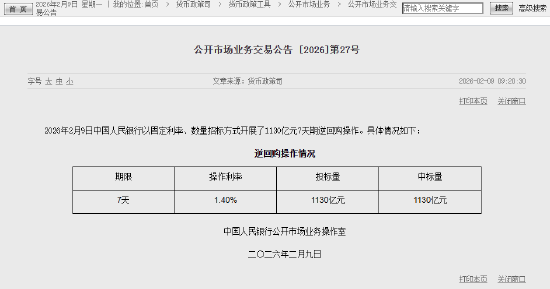
Group 1 - The People's Bank of China conducted a 7-day reverse repurchase operation amounting to 113 billion yuan on February 9, 2026 [1] - The operation was carried out using a fixed interest rate and quantity tendering method [1] - This action is part of the central bank's monetary policy tools to manage liquidity in the financial system [1]
“固收+”爆发:33万亿理财市场新主角
Xin Jing Bao· 2026-02-09 01:38
Core Viewpoint - The increasing popularity of "fixed income +" (固收+) investment products reflects a shift in investor sentiment towards seeking stable returns amid market volatility and low interest rates, with a notable growth in demand for these products in 2025 [1][4][11]. Group 1: Market Trends - The "fixed income +" investment strategy combines stable income from fixed income assets with potential performance bonuses from equities and other assets, appealing to investors' desire for both security and growth [4][6]. - As of the end of 2025, the total size of the bank wealth management market reached 33.29 trillion yuan, marking an 11.15% increase from the beginning of the year, with "fixed income +" products contributing significantly to this growth [5][7]. - The "fixed income +" product market saw a year-on-year growth of 16%, reaching a total size of 10.8 trillion yuan, outpacing the overall growth of fixed income products [7][8]. Group 2: Investor Behavior - Investors are increasingly turning to "fixed income +" products as a response to the challenges posed by low interest rates and market volatility, indicating a shift towards more proactive wealth management strategies [6][11]. - The average annualized return of "fixed income +" products was close to 4% from January 2018 to September 2025, outperforming pure bond funds while maintaining lower volatility [8][10]. - The growth of "fixed income +" products is seen as a reflection of the evolving investment mindset among domestic residents, moving from passive to active management of their financial assets [11][12]. Group 3: Institutional Developments - Financial institutions are actively launching new "fixed income +" products, with a focus on low-risk strategies that incorporate a mix of fixed income and equity assets to enhance returns [9][10]. - Internet banks like WeBank and MyBank are expanding their "fixed income +" offerings, making these investment options more accessible to a broader audience [10][11]. - The competitive landscape for "fixed income +" products is intensifying, with various institutions vying for market share by offering innovative and diversified investment strategies [9][10].

理财趋势观察|“固收+”爆发:33万亿理财市场新主角
Bei Ke Cai Jing· 2026-02-09 01:37
Group 1 - The capital market is experiencing increased volatility, leading to a common concern among investors about where to allocate their funds [1][17] - The topic of "fixed income +" is gaining popularity on social media, with many investors recognizing its defensive strategy during market fluctuations [2][10] - Financial institutions are actively promoting "fixed income +" products, with significant growth in demand observed in early 2025 [3][12] Group 2 - "Fixed income +" is characterized as a combination of stable income from fixed assets and performance bonuses from equities and other assets, appealing to investors seeking both stability and growth [8][10] - The "fixed income +" strategy aligns with the trend of wealth management focusing on stability while still aiming for additional returns [11][13] - The market for "fixed income +" products has seen a substantial increase, with a reported growth of 16% year-on-year, reaching a total of 10.8 trillion yuan by the end of 2025 [12][18] Group 3 - The average annualized return for "fixed income +" products is approximately 4%, outperforming pure bond funds while maintaining lower volatility [20] - Financial institutions are expected to diversify their strategies to include more equity exposure through "fixed income +" and multi-asset approaches, potentially bringing in an additional 150 to 250 billion yuan in annual funds [21][22] - The rise of "fixed income +" reflects a shift in investor behavior towards more proactive and diversified asset allocation strategies [33]

白银 开盘大涨!美联储 降息大消息!美国财长重磅发声
Qi Huo Ri Bao· 2026-02-09 01:23
Group 1: Precious Metals Market - Silver prices rose over 2.4% to $79.7 per ounce, indicating a potential short-term consolidation phase for metals like gold, silver, and copper, as per Morgan Stanley's report [2] - Analysts suggest that the current adjustment in metal prices is a necessary pause in a long-term upward trend, with copper expected to rebound earlier than gold due to stronger fundamentals supported by the global manufacturing cycle [2] Group 2: U.S. Federal Reserve Actions - U.S. Treasury Secretary Yellen anticipates that the Federal Reserve will not quickly act to reduce its balance sheet, even under the leadership of nominated Chair Powell, suggesting a decision timeline of up to a year [3] - San Francisco Fed President Daly indicated that the Fed may need to implement one or two more rate cuts to address the weak labor market, emphasizing the need for an open approach to interest rate decisions [5][6] - Current inflation remains above the Fed's 2% target, but some officials expect a decline in commodity inflation by mid-year, which could lead to a stabilization of overall inflation [6] Group 3: Industrial Silicon Market - Industrial silicon futures prices have hit a recent low, closing at 8,500 yuan per ton, down 3.95% for the week, primarily due to weak macro sentiment and a general decline in the non-ferrous sector [8] - The number of operational furnaces for industrial silicon has significantly decreased, with a total of 178 furnaces operating at a rate of 22.36%, a reduction of 32 from the previous week, influenced by planned production cuts from major manufacturers [9] - Demand for industrial silicon remains weak, with expectations of a drop in production to around 80,000 tons in February due to reduced operational rates and upcoming maintenance schedules [10]
沃什力挺,影响深远!时隔75年,美联储又要和美国财政部达成协议了?
Hua Er Jie Jian Wen· 2026-02-09 01:20
Core Viewpoint - The nomination of Waller as the next Federal Reserve Chair has sparked significant interest on Wall Street regarding his proposal for a new agreement between the Federal Reserve and the U.S. Treasury, aimed at reshaping their relationship, potentially impacting the $30 trillion U.S. Treasury market and fundamentally altering the Fed's balance sheet management [1][2]. Group 1: Proposed Agreement - Waller has called for a new version of the "1951 Agreement" to reform the relationship between the Federal Reserve and the Treasury, which historically limited the Fed's footprint in the bond market and established its autonomy in monetary policy [2]. - The proposed agreement would clearly define the size of the Fed's balance sheet and align it with the Treasury's debt issuance plans, addressing concerns raised during the financial crisis and the COVID-19 pandemic regarding the Fed's extensive asset purchases [2][3]. Group 2: Treasury's Position - Treasury Secretary Yellen shares Waller's skepticism towards prolonged quantitative easing (QE), advocating for its use only in genuine emergencies and with coordination among government departments [3]. - A streamlined new agreement may stipulate that the Fed can only conduct large-scale Treasury purchases with Treasury approval, aiming to halt QE as market conditions allow [3]. Group 3: Asset Composition Shift - There is an expectation that a more substantive agreement could lead to a significant shift in the Fed's asset holdings, moving from medium- and long-term securities to Treasury bills with maturities of 12 months or less [4]. - This shift would enable the Treasury to reduce the issuance of notes and bonds or at least avoid significant increases in issuance [4][5]. Group 4: Market Risks and Concerns - While enhanced coordination may aim to lower borrowing costs for U.S. borrowers, any fundamental changes carry risks, including concerns about the Fed's independence and its potential alignment with fiscal policy [6]. - Analysts warn that a public agreement linking the Fed's balance sheet to Treasury financing could undermine the Fed's inflation-fighting mandate, leading to increased volatility and diminished attractiveness of U.S. assets [6]. Group 5: Skepticism on Formal Agreement - Some experts express skepticism about the likelihood of a formal agreement, suggesting that while cooperation may increase, it could also reduce the chances of a formalized arrangement [7]. - There are proposals for the Fed to exchange its $2 trillion mortgage-backed securities portfolio for Treasury bills, aimed at lowering mortgage rates, but this faces significant obstacles [7].