
生猪养殖

Search documents
生猪 维持区间操作
Qi Huo Ri Bao· 2025-09-03 00:56
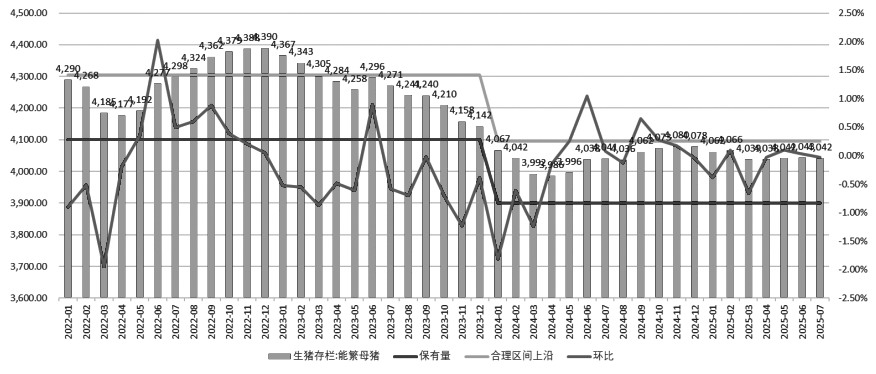
Core Viewpoint - The recent fluctuations in national pork reserves and declining pig prices indicate a critical phase for the pork industry, with the pig-to-grain ratio falling below the warning line, prompting government intervention to stabilize prices and encourage quality production [1] Group 1: Market Dynamics - The National Development and Reform Commission auctioned 10,000 tons of domestic frozen pork at prices between 19.90 to 20.00 yuan per kilogram, translating to a live pig price of approximately 13.6 to 13.8 yuan per kilogram, marking a temporary bottom for current pork prices [1] - The agricultural sector is actively working to optimize production capacity by eliminating inefficient sows and controlling weights, although the overall impact on capacity reduction remains limited [2][3] Group 2: Production and Capacity - In July, the number of sows eliminated increased by 2.1% month-on-month, while the total breeding sow inventory decreased by 10,000 heads to 40.42 million heads [2] - Major companies are reducing costs and improving efficiency, with leading firms achieving production costs around 12 yuan per kilogram, while others hover around 13 yuan per kilogram [3] Group 3: Price Trends and Forecasts - As of mid-2025, live pig inventory reached 42.447 million heads, with a year-on-year increase of 2.2%, but prices have dropped to a five-year low of 14,677 yuan per ton due to weak demand and high slaughter losses [5] - The market is expected to face increased supply pressure in the second half of the year, with a predicted rise in commodity pig supply from September to November, limiting significant price fluctuations [5][6] Group 4: Future Considerations - The uncertainty in the market largely hinges on whether producers will continue to follow policy guidance to reduce weights, with average weights for pigs being monitored closely [6] - Short-term price increases may occur due to seasonal factors, but a return to a demand lull post-holidays is anticipated, which could suppress prices [6]

开源证券晨会纪要-20250903
KAIYUAN SECURITIES· 2025-09-02 23:32
Summary of Key Points Overall Market Trends - The overall market shows a rebound in institutional attention, particularly in the mechanical, pharmaceutical, and automotive sectors [5][6][7] - The Shanghai and Shenzhen 300 indices have shown varied performance across different sectors, with banking and utilities leading in gains [1][2] Industry Insights - The pharmaceutical sector is witnessing significant advancements in the small molecule GLP-1RA space, with Orforglipron leading globally and domestic pipelines gaining value [28][30][31] - The mechanical industry is focusing on unmanned intelligent equipment, highlighted by the upcoming military parade showcasing new technologies [35][36][38] Company-Specific Updates - **Old Phoenix (老凤祥)**: The company reported a 10.5% year-on-year increase in Q2 revenue, with a focus on brand rejuvenation and product upgrades [42][44] - **Federation Pharmaceutical (联邦制药)**: The company achieved a 4.61% increase in revenue for H1 2025, with significant growth in its formulation segment [46][48] - **Giant Star Agriculture (巨星农牧)**: The company experienced a 66.49% increase in revenue for H1 2025, driven by a substantial rise in pig sales [51][52] - **China Shenhua (中国神华)**: The company reported a decline in revenue but maintained strong integrated operations, with a focus on asset injection and sustainable dividends [56][58] Investment Recommendations - The small molecule GLP-1RA market is expected to provide new growth opportunities, with several domestic companies positioned to benefit from international expansion [33] - Companies involved in the mechanical sector, particularly those developing robotic technologies, are recommended for investment due to their innovative potential [39][40]




罗牛山:公司管理层对主业发展充满信心
Zheng Quan Ri Bao Wang· 2025-09-02 11:13
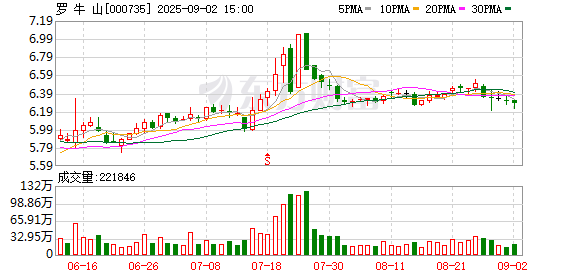
证券日报网讯罗牛山(000735)9月2日在互动平台回答投资者提问时表示,公司生猪养殖板块在2024年 已实现盈利,2025年上半年因部分项目计提预计负债等非经营性因素影响,短期内未实现盈利。公司与 行业头部企业仍存在一定差距,对此公司高度重视,将持续通过优化种群结构、加强成本管控、提升生 物安全水平等措施,不断提高养殖效率与盈利能力。公司管理层对主业发展充满信心,将继续稳步经 营,努力提升业绩,回报广大投资者的支持与信任。 ...

农业行业周报:建议关注饲料的回升周期和养殖的边际改善-20250902
Shanxi Securities· 2025-09-02 10:52
Investment Rating - The report maintains an investment rating of "Buy-A" for Hai Da Group and "Buy-B" for Sheng Nong Development, with several other companies rated as "Increase-A" or "Increase-B" [3][4][5]. Core Insights - The agricultural sector has shown a market performance with the CSI 300 index increasing by 2.71% and the agricultural sector rising by 2.02% during the week of August 25 to August 31 [2][20]. - The report highlights a recovery cycle in the feed industry and marginal improvements in livestock farming, suggesting potential growth opportunities [4][5]. - The report indicates that the current market sentiment may be overly pessimistic regarding the impact of rising pig production capacity on profitability, while it overlooks the positive effects of declining raw material costs and potential macro demand recovery in 2025 [5][6]. Summary by Sections Swine Farming - As of August 29, the average prices for external three yuan pigs in Sichuan, Guangdong, and Henan were 13.25, 14.84, and 13.73 yuan/kg, reflecting a week-on-week change of -2.21%, -3.57%, and 0.00% respectively [3][28]. - The average pork price was 19.94 yuan/kg, down 0.80% from the previous week, while the average wholesale price for piglets remained stable at 26.00 yuan/kg [3][28]. - The self-breeding profit was 32.24 yuan/head, while the profit from purchasing piglets was -148.41 yuan/head [3][28]. Poultry Farming - As of August 29, the weekly price for white feather broilers was 7.33 yuan/kg, remaining unchanged from the previous week, while the price for broiler chicks increased by 0.84% to 3.61 yuan/chick [3][43]. - The profit from broiler farming was reported at 1.37 yuan/chick, and the egg price was 7.24 yuan/kg, down 0.82% [3][43]. Feed Processing - In July 2025, the total industrial feed production in China was 28.31 million tons, reflecting a month-on-month increase of 2.3% and a year-on-year increase of 5.5% [50]. - The report notes a significant decline in the factory prices of feed products, with the proportion of corn in compound feed at 33.1% and soybean meal at 14.1% [50]. Aquaculture - As of August 29, the prices for sea cucumbers, shrimp, and bass were stable at 90.00 yuan/kg, 320.00 yuan/kg, and 50.00 yuan/kg respectively [57]. - For freshwater products, the price of grass carp was 16.73 yuan/kg, up 0.54%, while the prices for crucian carp and carp showed slight fluctuations [57]. Crop and Grain Processing - As of August 29, the spot price for soybeans was 4005.79 yuan/ton, with corn and wheat prices at 2364.71 yuan/ton and 2428.89 yuan/ton respectively, showing slight declines [65]. - The report indicates that the prices for various mushroom products remained stable during the same period [65].



罗牛山:旗下海南职业技术学院目前以全日制专科层次学历教育为核心
Zheng Quan Ri Bao· 2025-09-02 10:40
Group 1 - The core business of the company remains focused on pig farming and its industrial chain, as well as cold chain logistics [2] - The company is closely monitoring the policy developments related to the Hainan Free Trade Port, particularly opportunities in the education sector [2] - The company operates Hainan Vocational Technical College, which currently focuses on full-time associate degree education and is stable in its operations [2] Group 2 - Future development of the education sector will be evaluated and planned carefully, considering the overall strategy, resource endowment, and market opportunities [2] - The company will adhere to information disclosure regulations for any significant matters related to cooperation [2]
天康生物:郑东生辞去公司副总经理职务
Mei Ri Jing Ji Xin Wen· 2025-09-02 10:11
Company Overview - TianKang Biological announced the resignation of Deputy General Manager Zheng Dongsheng due to personal work adjustments, effective immediately upon submission to the board [1] - After his resignation, Zheng Dongsheng will no longer hold any positions within the company or its subsidiaries [1] Financial Performance - For the first half of 2025, TianKang Biological's revenue composition is as follows: pig farming accounted for 32.2%, feed accounted for 27.51%, agricultural product processing accounted for 16.37%, corn storage accounted for 14.75%, and veterinary medicine accounted for 5.44% [1] - As of the report date, TianKang Biological has a market capitalization of 9.2 billion yuan [1]

新 希 望(000876) - 2025年09月01日投资者关系活动记录表
2025-09-02 08:48
Financial Performance - The company's revenue for the first half of 2025 reached 51.6 billion CNY, a year-on-year increase of 4% [2] - The net profit attributable to shareholders was 5.7 billion CNY, showing a turnaround with a growth of 19.7% compared to the previous year [2] - The feed business generated a net profit of 6 billion CNY, with a total sales volume of 1.3 million tons, reflecting a year-on-year growth of 13% [2][3] Feed Business Strategy - The company aims to expand its scale by targeting key customers and optimizing product offerings, with customized feed sales to major clients increasing by over 20% [4] - To mitigate trade war impacts, the company is enhancing external procurement and optimizing raw material sourcing, achieving a 96% usage rate of its online sourcing system in the first half of 2025 [4] - The overseas feed capacity has exceeded 7 million tons, with plans to add 3-4 million tons in the next 3-5 years, and overseas sales grew by 18% in the first half of 2025 [5] Swine Business Highlights - The company reported a 60% reduction in ASF incidence in the first half of 2025, with significant improvements in production metrics [6] - Average piglets per litter increased to 11.2, and the average PSY (pigs weaned per sow) improved to 25.4, both showing enhancements from 2024 [6][8] - The average cost of production dropped to 13.1 CNY/kg, with some regions achieving costs below 12 CNY/kg [8] Stock Issuance and Regulatory Compliance - The non-public stock issuance project is progressing well, with major issues resolved, and the company plans to submit updated materials to the exchange soon [9] - The company is actively participating in national capacity regulation discussions, believing these policies will support long-term industry health [10] Future Outlook and Cost Management - The company aims to maintain a stable breeding stock of 760,000 sows and plans to keep annual slaughter volumes between 16-17 million heads [11] - Cost reduction strategies include enhancing disease control, optimizing breeding management, and improving production efficiency, with expectations for further cost reductions by year-end [14] - The company anticipates stable pork prices in the medium to long term, with limited downward pressure [15] International Operations and Profitability - The average profit per ton of overseas feed is over 180 CNY, significantly higher than domestic profits [18] - The company is focusing on expanding in regions with stable political and economic environments, prioritizing markets with high potential for growth [18]

产业经济周报:中报看结构性企稳复苏、AI应用加速落地-20250902
Tebon Securities· 2025-09-02 08:30
Core Insights - The report indicates that while the A-share market is in a phase of profit bottoming, structural opportunities have emerged, particularly in technology and high-end manufacturing, policy dividends, and low valuation directions [4][11] - The report highlights that the revenue of the entire A-share market showed initial signs of stabilization, but the recovery of non-financial enterprises remains lagging, necessitating effective policies to boost domestic demand and counteract excessive competition [4][11] Industry Economic Insights - The overall revenue of the A-share market in Q2 2025 totaled 18.08 trillion yuan, with a year-on-year growth of 0.35%, while the net profit attributable to shareholders was 1.49 trillion yuan, reflecting a year-on-year growth of 2.44% [8][12] - The profit growth rate is slowing, indicating increased pressure on profitability, with the profit-revenue gap narrowing significantly, especially for non-financial enterprises [9][11] High-End Manufacturing Insights - The report notes that generative AI is rapidly transitioning from conceptual exploration to practical application, driven by both policy guidance and market demand, which is expected to reshape the industry landscape and release long-term growth momentum [4][10] - The capital expenditure in the semiconductor sector remains high, particularly in mainland China, with major overseas semiconductor equipment companies reporting that around 30% of their revenue comes from this market [10][11] Hard Technology Insights - The demand for artificial intelligence is sustaining high capital expenditure in the semiconductor industry, with mainland China's performance being particularly notable [10][11] - The report mentions that domestic wafer foundries are maintaining high capacity utilization rates, which supports ongoing expansion and capital expenditure [10][11] Consumer Sector Insights - The new consumption concept has gained traction in the A-share market, leading to valuation increases and sustained stock price growth in related sectors [4][11] - The report suggests that while the recovery in consumer demand is slow, leading companies possess strong pricing power, and potential policy catalysts could significantly enhance recovery elasticity [11][12]


透视豫股“中考成绩单”丨经探号
Sou Hu Cai Jing· 2025-09-02 05:40
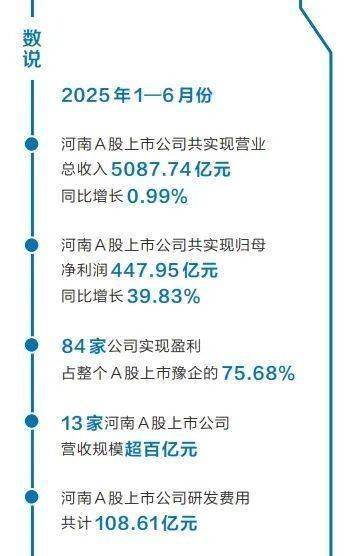
Core Insights - The performance of A-share listed companies in Henan for the first half of 2025 shows resilience and growth, with nearly 80% achieving profitability and overall revenue and net profit reaching new highs [1][8] - Traditional industries are enhancing quality and efficiency, exemplified by Muyuan Foods, which reported a revenue of 764.63 billion yuan, a 34.46% increase year-on-year, and a net profit of 105.30 billion yuan, up 1169.77% [2][3] - The green economy is gaining momentum, with significant growth in sales revenue for ecological protection and environmental governance industries, increasing by 16.1% and 21.9% respectively [8][9] Traditional Industries - Muyuan Foods has transformed the pig farming industry through technology, achieving record revenue and profit levels [2][3] - Yutong Bus has expanded its international presence, with a revenue of 161.29 billion yuan and a net profit of 19.36 billion yuan, marking a 15.64% increase [3][5] - Luoyang Molybdenum's net profit reached 86.71 billion yuan, a 60.07% increase, driven by the completion of major projects [5] Green Industries - Jin Dan Technology is focusing on the circular economy, reporting a revenue of 7.77 billion yuan, a 5.43% increase, and a net profit of 0.96 billion yuan, up 56.31% [7] - The sales revenue of the green industry in Henan has shown robust growth, with wind power and biomass energy sales increasing by 16.5% and 19.1% respectively [8][9] New Quality Industries - Zhongchuang Zhiling reported a revenue of 199.82 billion yuan, a 5.42% increase, and a net profit of 25.15 billion yuan, up 16.36% [10] - The company is investing in AI chip technology to enhance its industrial capabilities [10][12] - R&D expenditures among Henan A-share companies totaled 108.61 billion yuan, with Muyuan Foods leading at 9.21 billion yuan [12] Mergers and Acquisitions - The Henan government has introduced policies to support mergers and acquisitions, aiming to enhance the competitiveness of traditional industries and foster new sectors [13][16] - The Henan Securities Regulatory Bureau has been actively engaging with companies to address operational challenges and promote high-quality development [15][16]

生猪期货与期权2025年9月报告-20250902
Fang Zheng Zhong Qi Qi Huo· 2025-09-02 03:47
Report Industry Investment Rating - Not provided in the content Core Viewpoints - In August 2025, the weight reduction in the pig industry led to an increase in slaughter volume, causing both futures and spot prices to reach new lows for the year [1][6]. - The overall atmosphere of "anti - involution" drives up the prices of risk assets, and domestic inflation expectations are likely to rise. Policy signals to support the pig market are released, but the short - term supply pressure is high due to weight reduction. For the second half of 2025, if the macro - expectations continue to strengthen, there are conditions for the valuation of low - priced pig futures to be revised upwards [3][4]. - The industry's production efficiency has improved, but the overall expansion is slow. The supply in the second half of 2025 may not be worse than in 2023, and it is recommended to go long on pig futures at low prices or buy call options near the cost [3][4]. Summary by Directory 2025 August Pig Futures and Spot Price Review - In August, the futures and spot prices of pigs fluctuated and declined, with the 2509 contract hitting a new low for the year. The decline was affected by factors such as the increase in slaughter volume due to weight reduction and the weak terminal consumption [6][25]. - Historically, the pig price in August usually shows an upward trend, but in 2025, it went against the season and weakened [41]. Pig Production Capacity and Slaughter Situation - The current inventory of breeding sows is in the green reasonable range, with a cumulative increase of about 3% compared to March 2024 [44][45]. - Group enterprises' capital expenditure has significantly decreased year - on - year, the price of reserve sows has been stable, and market speculation has declined [46][49]. - The production efficiency of single sows has improved, and the gap between leading enterprises is gradually narrowing. In 2025, pig slaughter volume has increased due to the recovery of breeding sow capacity and improved production efficiency, but the growth rate may not be large [51][54][55]. Listed Pig Enterprises - In 2025, the overall profitability of leading listed pig companies has expanded, but the monthly sales volume of piglets has decreased [60][63]. - The asset - liability ratio of listed companies is at a historically high level [66]. Near - term Supply and Demand Fundamentals - From July to August, the industry's weight reduction led to an increase in slaughter volume, and the current weight is still at a high level compared to the same period in history. In August, the slaughter volume rebounded significantly and was higher than that in 2023 [70][72]. - The import volume of pork and offal has declined from a high level, and the frozen product inventory rebounded slightly at a low level in August 2025 [75][78]. - The current monthly average profit level is at the historical median. In July, the profit of purchasing piglets for fattening was near the break - even point, and in August, it started to make losses [81]. August Futures Price Review - The pig futures index rebounded from a historical low, and the trading volume and open interest increased significantly month - on - month and year - on - year [83]. - The near - month contract made up for the decline compared to the spot price, and the premium of the far - month contract in the peak season expanded under the support of policies [86][89]. - The basis is stronger than in previous years, and attention should be paid to the way of the regression of spot and futures prices in the third quarter [95]. - In August, the spread trading showed a reverse spread trend, and the volatility of the 2601 contract declined [98][104]. Conclusion - The industry is currently in the process of weight reduction and capacity reduction. Attention should be paid to whether the supply pressure can be alleviated in the fourth quarter. In trading, it is recommended to go long on the 2511 contract at low prices or conduct spread trading between 2601 and 2605, and sell wide - straddle option spreads when the volatility is high [106].